
Every day, businesses publish millions of social media posts, yet only a small percentage consistently turn followers into paying customers.
If your content is getting likes but not generating leads or sales, the missing piece is likely a well-designed social media funnel. A strategic funnel guides people from discovering your brand to becoming loyal customers, ensuring every post has a purpose instead of simply filling your content calendar.
By the end of this guide, you'll have a practical framework for building a social media funnel that drives measurable business results instead of just growing your follower count.
What Is a Social Media Funnel?
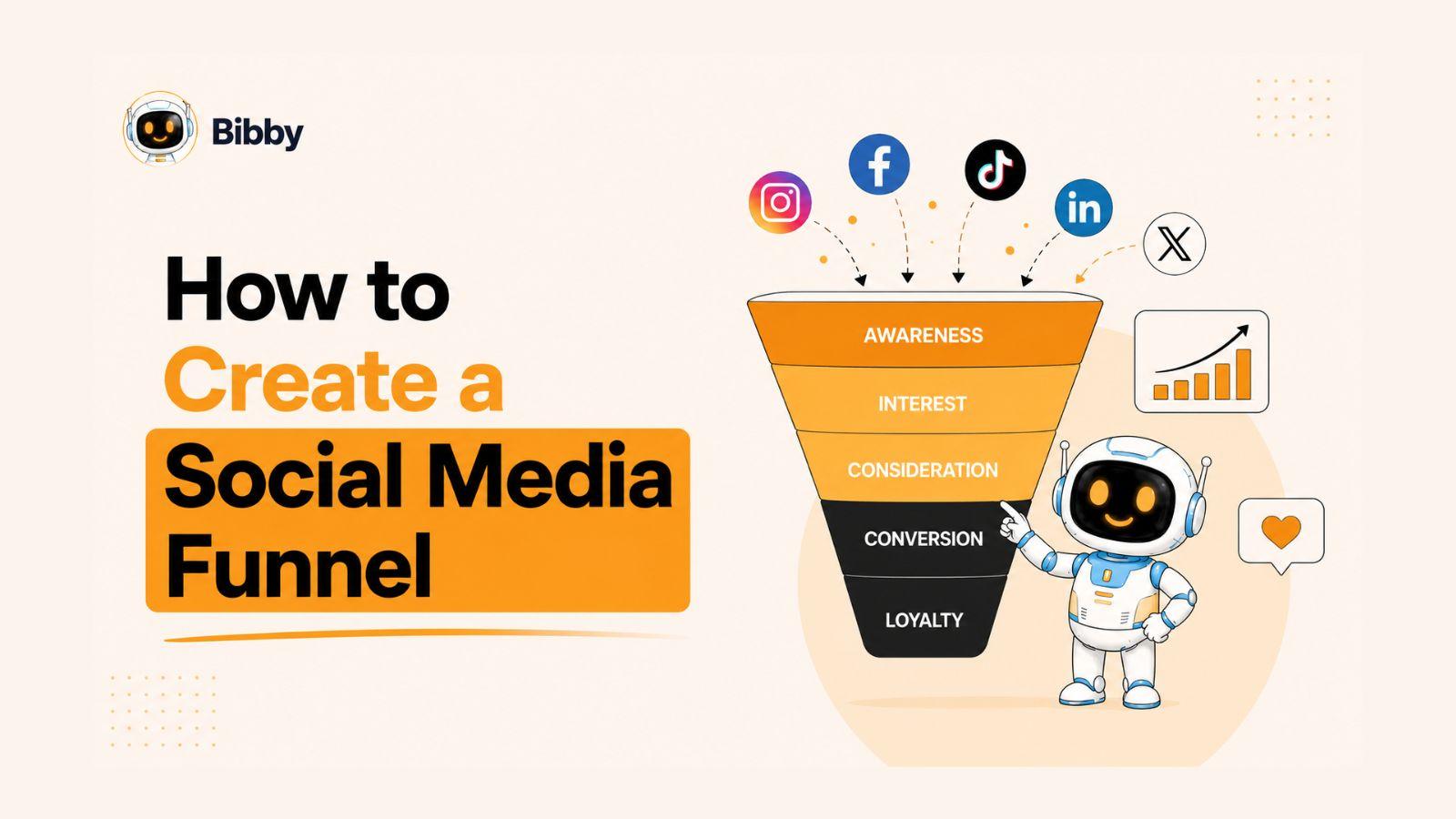
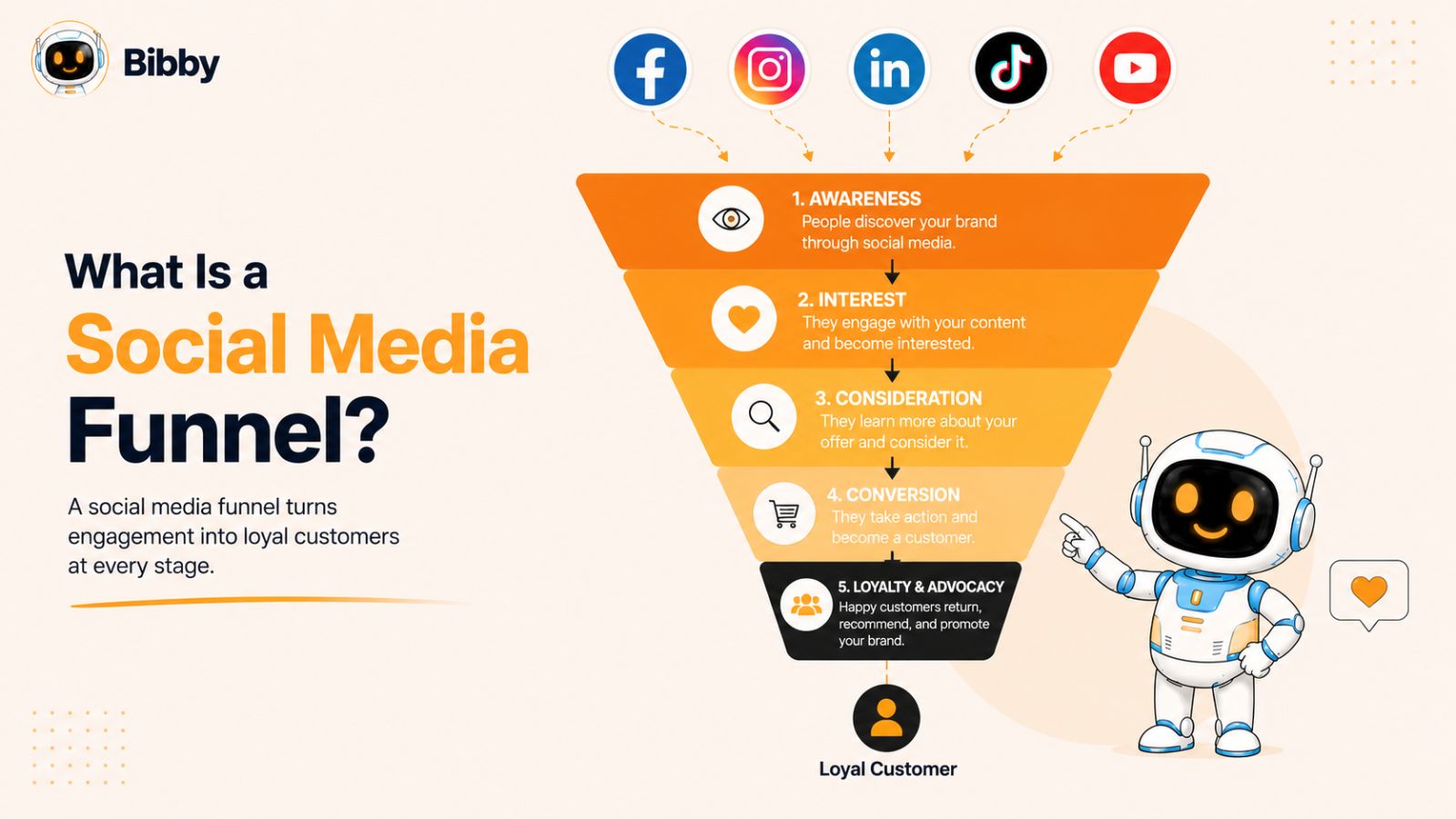
A social media funnel is a strategic framework that moves potential customers through a series of stages—from discovering your brand to becoming loyal advocates. Instead of posting content randomly, every piece of content is designed to guide people one step closer to taking meaningful action, whether that's subscribing to your email list, requesting a demo, or making a purchase.
Think of your social media channels as the top of your marketing funnel. They attract attention and build relationships, but the real goal is to convert that attention into measurable business results. A successful social media funnel ensures that every post has a purpose and supports your overall marketing objectives.
Why Social Media Alone Doesn't Generate Sales
Many businesses believe that posting consistently is enough to drive revenue. While consistency is important, it doesn't automatically lead to conversions.
Without a clear funnel, your audience may enjoy your content but never know what to do next. They might like a post, watch a video, or leave a comment, but if there's no clear path toward becoming a customer, those interactions rarely translate into sales.
A well-designed social media funnel removes this friction by guiding users through a logical customer journey with the right message at the right time.
Random Posting vs. Strategic Funnel Marketing
Random posting focuses on publishing content whenever inspiration strikes. One day it's a product promotion, the next it's a motivational quote, followed by a behind-the-scenes photo. While this approach may keep your profile active, it often lacks direction and produces inconsistent results.
A strategic social media funnel takes a completely different approach. Every post serves a specific purpose based on where your audience is in the buying journey. Educational content introduces your brand, engaging content builds trust, lead magnets capture contact information, and conversion-focused content encourages prospects to become customers.
This structured approach creates a predictable system for attracting, nurturing, and converting your audience over time.
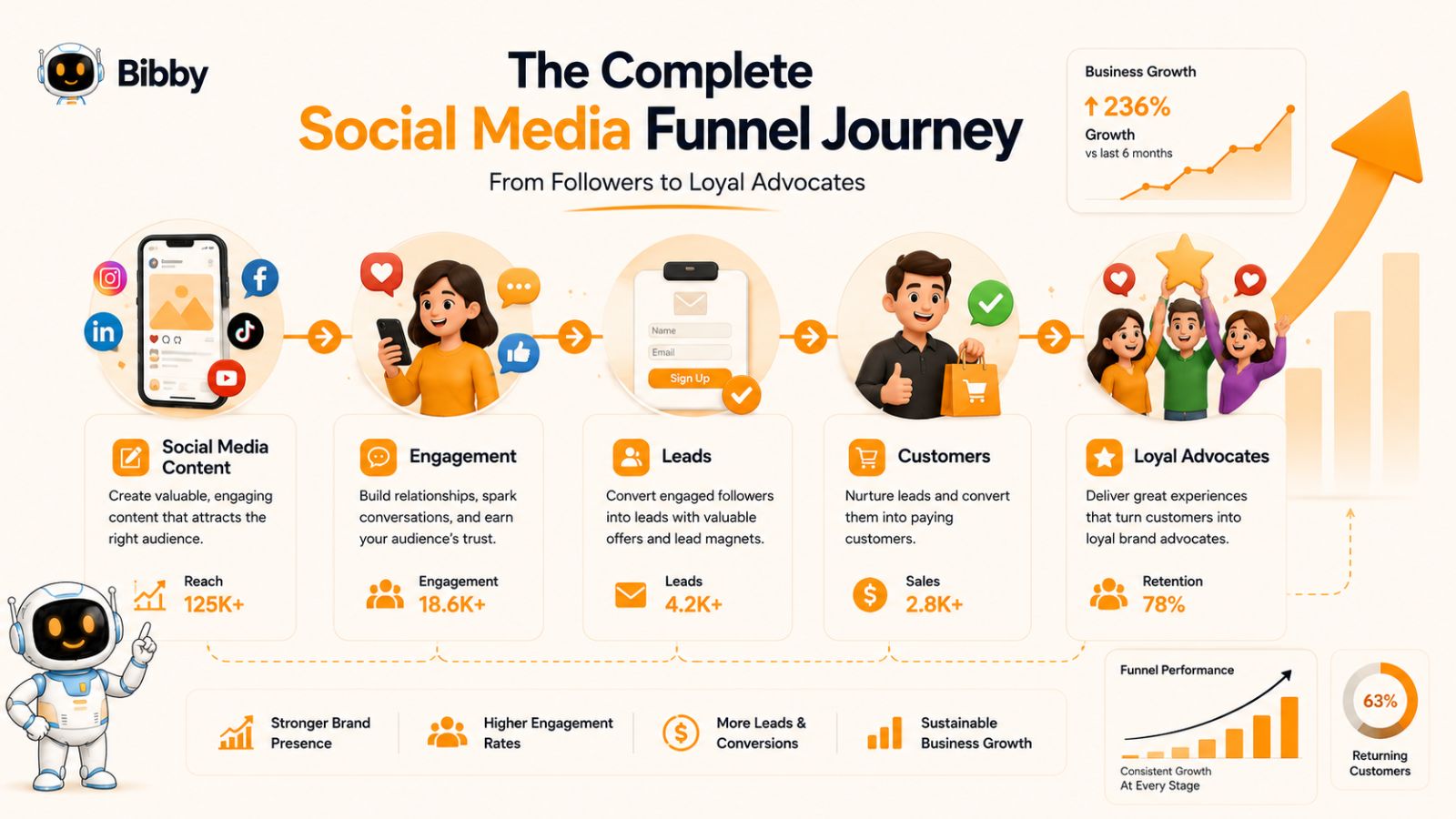
The Five Stages of a Social Media Funnel
A high-converting social media funnel typically includes five key stages:
- Awareness: Introduce your brand and attract new audiences with valuable, entertaining, or educational content.
- Interest: Build credibility and encourage people to engage with your content through comments, shares, polls, stories, and conversations.
- Consideration: Provide deeper value with resources, case studies, webinars, or product demonstrations that help prospects evaluate your solution.
- Conversion: Encourage prospects to take action by purchasing your product, booking a consultation, requesting a demo, or signing up for your service.
- Loyalty and Advocacy: Continue delivering value after the sale so customers return, recommend your brand, and become long-term advocates.
When these stages work together, your social media efforts become a repeatable system for generating leads, increasing conversions, and building lasting customer relationships instead of simply accumulating followers.
Also read: Social Media Automation for Franchises and Multi-Location Businesses: The Complete Guide (2026) →
Why Most Social Media Funnels Fail
Many businesses invest significant time creating content for social media but still struggle to generate leads or sales. The problem usually isn't the platform or the algorithm—it's the lack of a structured funnel. Without a clear strategy, even high-quality content can fail to move people toward becoming customers.
Below are the most common reasons social media funnels fail and how to avoid them.
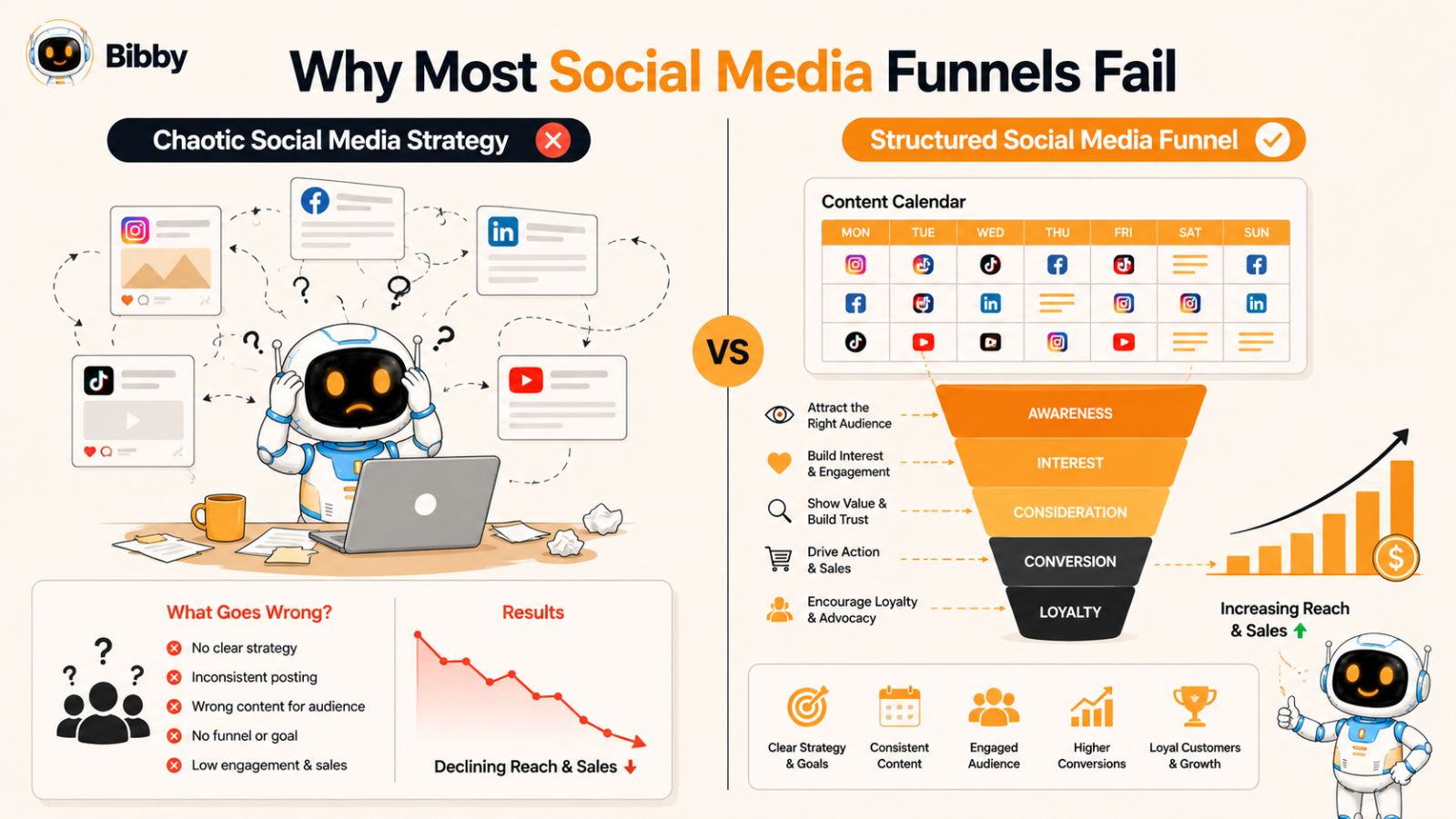
Posting Without a Clear Strategy
One of the biggest mistakes is publishing content without a defined goal. If every post is created independently, your audience receives mixed messages and has no clear path to follow.
Before publishing any piece of content, ask yourself:
- What stage of the funnel is this content targeting?
- What action do I want the audience to take next?
- How does this post support my overall marketing goals?
Every post should move people one step closer to becoming customers.
Focusing on Followers Instead of Customers
A large follower count may look impressive, but it doesn't guarantee business growth. Thousands of followers who never engage or purchase are far less valuable than a smaller audience that actively trusts your brand.
Instead of chasing vanity metrics, focus on metrics that directly impact revenue, such as:
- Qualified leads
- Website traffic
- Email subscribers
- Demo requests
- Sales conversions
- Customer retention
A successful funnel prioritizes business outcomes over social validation.
Selling Too Early
Many brands start promoting their products before earning their audience's trust. When every post is a sales pitch, people are more likely to scroll past or unfollow your account.
Social media users want value before they make a buying decision. Educational content, helpful tips, industry insights, and authentic storytelling build credibility and position your brand as a trusted resource. Once trust is established, promotional content becomes far more effective.
Inconsistent Posting
An inconsistent posting schedule makes it difficult to stay visible and maintain audience engagement. Long gaps between posts can reduce momentum and make your brand easy to forget.
Creating a content calendar and scheduling posts in advance helps maintain a consistent presence across all your social media platforms. Consistency builds familiarity, and familiarity builds trust.
Weak or Missing Calls to Action
Even engaging content can fail if it doesn't tell people what to do next.
Every post should include a relevant call to action that aligns with its purpose. Depending on the stage of the funnel, your CTA might encourage readers to:
- Read a blog post
- Download a free guide
- Subscribe to a newsletter
- Watch a video
- Leave a comment
- Visit a landing page
- Book a consultation
- Make a purchase
Small, clear actions help move people naturally through the funnel.
Ignoring Analytics
Many marketers continue publishing the same type of content without reviewing performance data. This often leads to repeating ineffective strategies while overlooking opportunities for improvement.
Regularly tracking metrics such as reach, engagement, click-through rates, conversions, and audience demographics allows you to identify what's working and refine your content strategy over time.
Data-driven decisions consistently outperform guesswork.
Managing Everything Manually
As your business grows, manually creating captions, uploading content to multiple platforms, choosing posting times, and monitoring performance becomes increasingly time-consuming.
Automation helps eliminate repetitive tasks while maintaining consistency. By streamlining content creation, scheduling, publishing, and performance tracking, you can spend more time engaging with your audience and optimizing your funnel instead of managing daily posting tasks.
No Plan for Customer Retention
Many businesses focus all their effort on acquiring new customers and forget about the people who have already purchased.
The most profitable social media funnels continue delivering value after the first sale through educational content, exclusive updates, community engagement, referral programs, and customer success stories. Loyal customers are more likely to buy again and recommend your business to others, making retention an essential part of long-term growth.
Avoiding these common mistakes creates a much stronger foundation for your social media funnel. The next step is understanding exactly what content belongs in each stage of the funnel and how to guide your audience from first impression to loyal customer.
Also read: The Complete Guide to Cross-Posting on Social Media (2026 Guide) →
The Five Stages of a High-Converting Social Media Funnel
A successful social media funnel doesn't try to sell to everyone immediately. Instead, it delivers the right content at the right time, helping potential customers move naturally from discovering your brand to becoming loyal advocates.
Each stage has a different objective, audience mindset, and content strategy. Understanding these differences allows you to create content that consistently moves people closer to conversion.
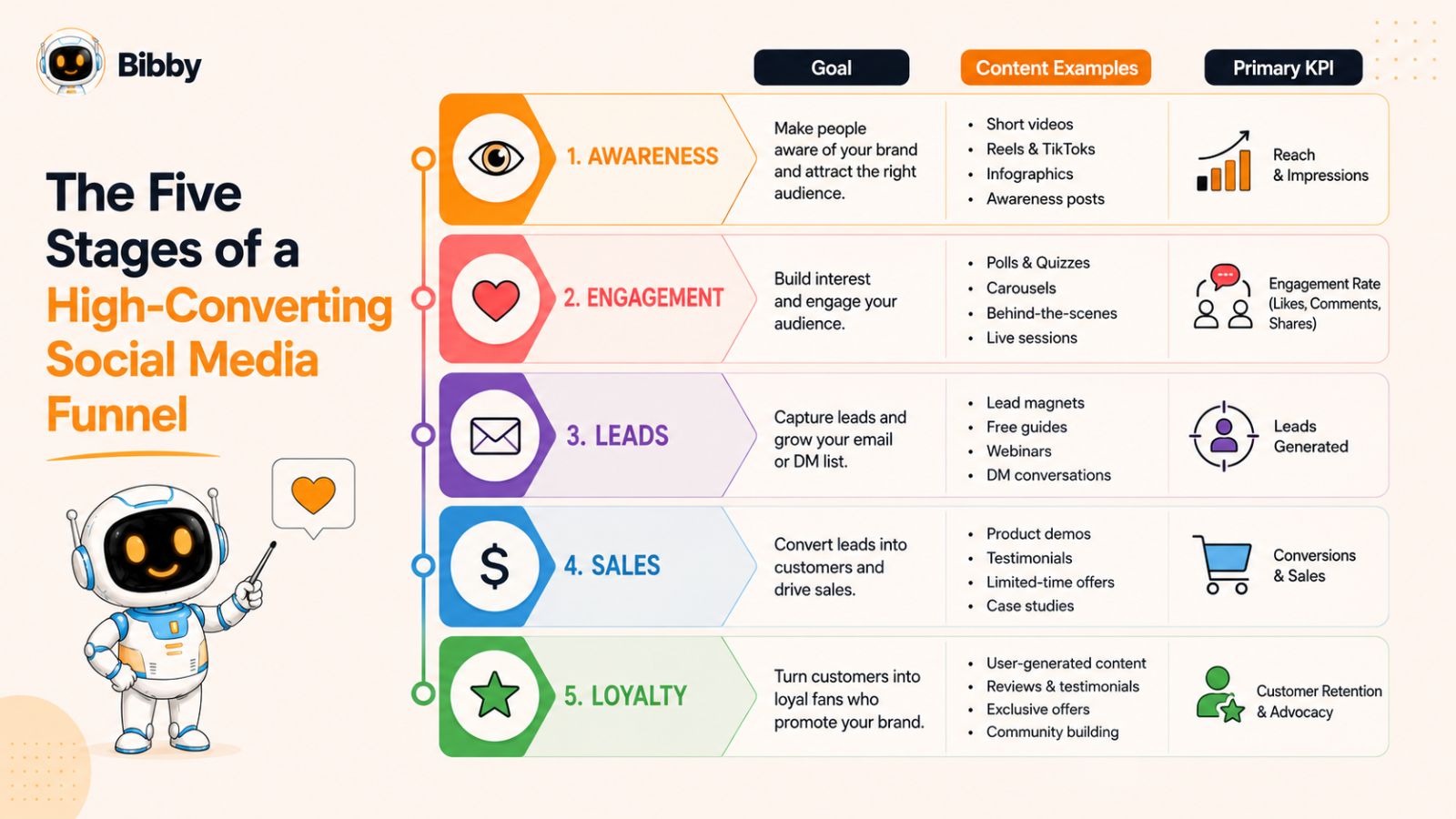
Stage 1: Awareness
The awareness stage is where potential customers first discover your brand. At this point, they may not know who you are or even realize they have a problem that your product or service can solve.
Your goal isn't to sell—it's to capture attention and provide value.
Focus on creating content that is educational, entertaining, or inspirational enough to encourage people to stop scrolling and engage with your brand.
Best Content Types
- Short-form videos
- Reels
- YouTube Shorts
- Infographics
- Educational carousels
- Trending content
- Memes (when appropriate)
- Industry tips
- Behind-the-scenes content
Primary Goal
Increase your brand's visibility and attract new audiences.
Key Metrics
- Reach
- Impressions
- Video views
- Profile visits
- Shares
Stage 2: Interest and Engagement
Once people know your brand exists, the next objective is building trust and encouraging interaction.
This is where relationships begin. Instead of broadcasting messages, focus on creating conversations that encourage your audience to participate.
People are more likely to buy from brands they know, like, and trust.
Best Content Types
- Polls
- Question posts
- Interactive Stories
- Live videos
- Q&A sessions
- Tutorials
- User-generated content
- Industry discussions
- Comment-driven posts
Primary Goal
Increase engagement while demonstrating expertise and authenticity.
Key Metrics
- Comments
- Saves
- Shares
- Direct messages
- Engagement rate
Stage 3: Consideration and Lead Generation
At this stage, your audience understands the problem and is actively looking for solutions. They are interested in learning more but may not be ready to purchase just yet.
Your goal is to collect contact information and continue nurturing the relationship outside of social media.
Offering valuable resources in exchange for an email address is one of the most effective ways to move prospects deeper into your funnel.
Effective Lead Magnets
- Free eBooks
- Checklists
- Templates
- Webinars
- Free trials
- Mini courses
- Industry reports
- Exclusive newsletters
Best Calls to Action
- Download now
- Get your free guide
- Start your free trial
- Join our newsletter
- Register for the webinar
Primary Goal
Convert social media followers into qualified leads.
Key Metrics
- Landing page visits
- Email sign-ups
- Resource downloads
- Lead conversion rate
- Cost per lead
Also read: Social Media Automation for B2B Companies: The Complete Guide (2026) →
Stage 4: Conversion
By this point, your prospects are familiar with your brand and have shown genuine interest. They simply need enough confidence to make a purchase or commit to your service.
Your content should remove uncertainty, answer objections, and reinforce why your solution is the best choice.
Trust-building becomes the priority.
Best Conversion Content
- Customer testimonials
- Case studies
- Product demonstrations
- Before-and-after examples
- Frequently asked questions
- Success stories
- Comparison posts
- Limited-time offers
- Product walkthrough videos
Strong Calls to Action
- Book a demo
- Start today
- Buy now
- Schedule a consultation
- Request a quote
Primary Goal
Turn qualified leads into paying customers.
Key Metrics
- Conversion rate
- Sales
- Revenue
- Cost per acquisition
- Return on investment (ROI)
Stage 5: Loyalty and Advocacy
The customer journey doesn't end after the first purchase. In fact, retaining existing customers is often more cost-effective than acquiring new ones.
Happy customers become repeat buyers, leave positive reviews, and recommend your brand to friends and colleagues.
This stage focuses on strengthening long-term relationships.
Best Content Types
- Customer success stories
- Exclusive updates
- Loyalty rewards
- Referral campaigns
- Community groups
- Product tutorials
- Feature announcements
- Appreciation posts
- Customer spotlights
Primary Goal
Increase customer retention and encourage referrals.
Key Metrics
- Repeat purchases
- Customer lifetime value (CLV)
- Referral rate
- Customer satisfaction
- Brand mentions
- Review volume
How the Funnel Works Together
The five stages work as a continuous system rather than isolated activities. Awareness content attracts new audiences, engagement builds trust, lead generation captures interested prospects, conversion content drives sales, and loyalty initiatives turn customers into enthusiastic brand advocates.
Businesses that intentionally create content for each stage are far more likely to generate predictable leads and sustainable revenue than those relying on random posts or one-off promotional campaigns. The key is maintaining a balanced content strategy that supports the entire customer journey from the first impression to long-term loyalty.
Also read: How to Manage Multiple Brands on Social Media Efficiently (Complete 2026 Guide) →
The Best Types of Content for Every Stage of Your Social Media Funnel
Creating great content is only half the battle. To maximize conversions, you need to match your content to your audience's stage in the customer journey. Someone discovering your brand for the first time has very different needs than someone who is ready to make a purchase.
When each piece of content has a clear purpose, your social media strategy becomes more effective, helping you attract the right audience, build trust, generate leads, and convert customers consistently.
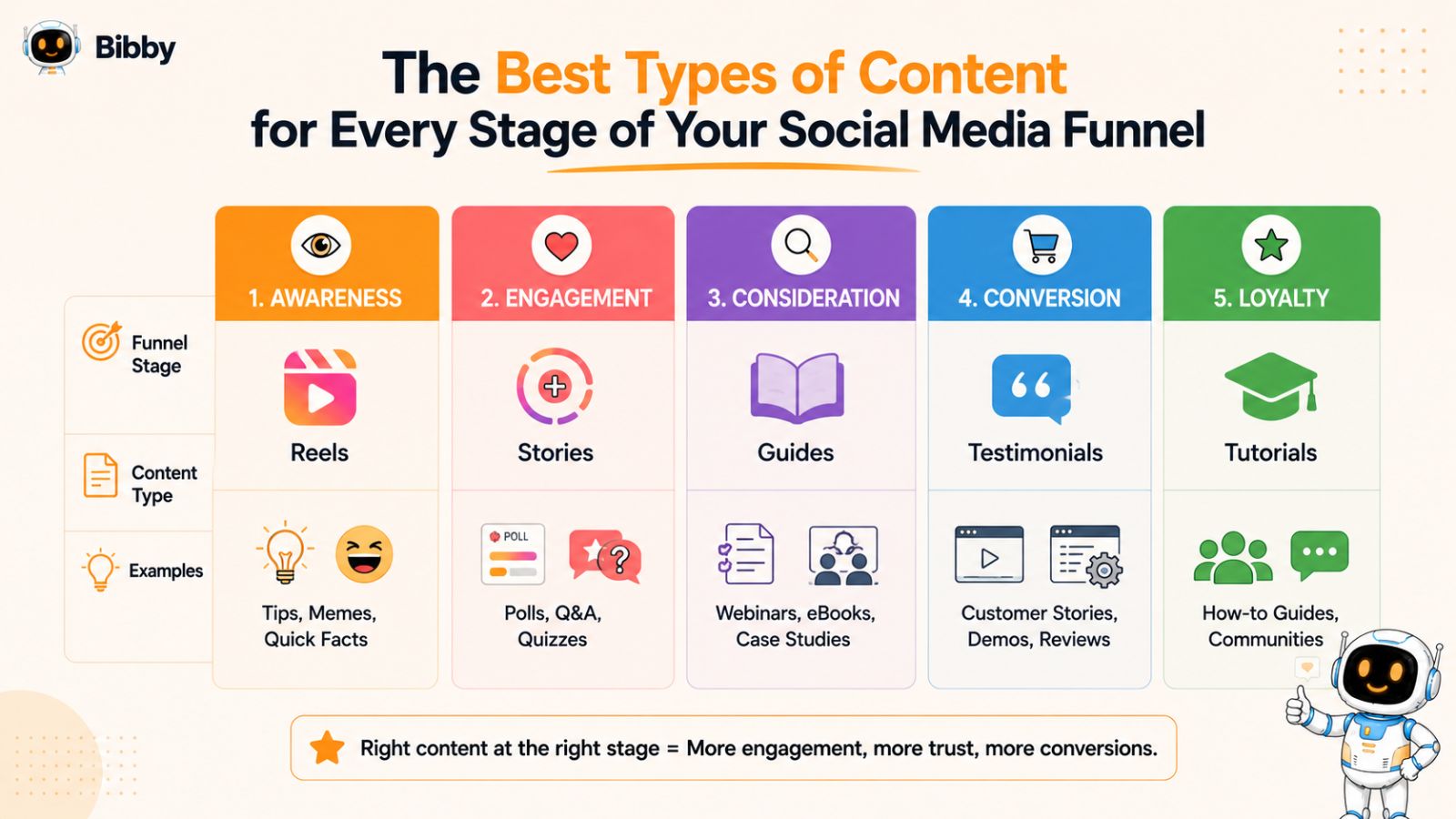
Awareness Stage Content
At the top of the funnel, your priority is visibility. Your content should educate, entertain, or inspire while encouraging people to engage and share it with others.
Best Content Formats
- Short-form videos
- Instagram Reels
- YouTube Shorts
- TikTok videos
- Educational carousels
- Infographics
- Industry statistics
- Trending topics
- Memes relevant to your niche
- Behind-the-scenes content
Content Ideas
- "5 Common Mistakes Beginners Make"
- Quick how-to videos
- Myth vs. fact posts
- Industry trends
- Tips and hacks
- Inspirational stories
Interest and Engagement Stage Content
Once you've captured attention, it's time to build relationships. The goal is to encourage conversations and demonstrate your expertise.
People who regularly engage with your content are much more likely to trust your recommendations later in the funnel.
Best Content Formats
- Polls
- Question posts
- Interactive Stories
- Live streams
- Ask Me Anything (AMA) sessions
- Tutorials
- Community discussions
- User-generated content
- Behind-the-scenes videos
- Ask your audience for their opinions
- Share personal experiences
- Host live Q&A sessions
- Feature customer stories
- Respond to common questions
- Create educational mini-series
Consideration Stage Content
Your audience now recognizes your brand and is evaluating possible solutions. This is your opportunity to provide deeper value and encourage them to take the next step.
Content at this stage should educate while demonstrating why your product or service is the right choice.
Best Content Formats
- Free guides
- eBooks
- Webinars
- Case studies
- Product comparison posts
- In-depth tutorials
- Downloadable templates
- Email courses
Content Ideas
- Ultimate buying guides
- Step-by-step tutorials
- Industry reports
- Customer success stories
- Product walkthroughs
- Expert interviews
Also read: Content Repurposing Strategy: Turn Blogs Into Viral Social Posts →
Conversion Stage Content
At the bottom of the funnel, your audience needs confidence, not more awareness. Your content should address objections, provide proof, and make taking action as easy as possible.
Best Content Formats
- Customer testimonials
- Product demonstrations
- Before-and-after examples
- Case studies
- FAQs
- Free consultations
- Limited-time offers
- Product videos
Content Ideas
- Customer transformation stories
- Live product demonstrations
- Success metrics
- Detailed feature explanations
- Time-sensitive promotions
- Frequently asked questions
Loyalty and Advocacy Stage Content
Your relationship with customers shouldn't end after they make a purchase. Continuing to deliver value increases customer retention and encourages referrals.
Loyal customers often become your best marketers by recommending your brand to others.
Best Content Formats
- Customer spotlights
- Loyalty program announcements
- Exclusive tips
- Community updates
- Product tutorials
- Referral campaigns
- User-generated content
- Feature updates
Content Ideas
- Thank-you posts
- Customer success interviews
- Advanced tutorials
- Product update videos
- Community challenges
- Referral rewards
Content Distribution Across the Funnel
A common mistake is creating too much promotional content and not enough educational or relationship-building content. An effective social media funnel includes a healthy mix of content across every stage.
A balanced strategy might look like this:
| Funnel Stage | Primary Goal | Recommended Content |
|---|---|---|
| Awareness | Attract new audiences | Reels, Shorts, viral videos, educational posts |
| Interest | Build trust | Stories, polls, live sessions, tutorials |
| Consideration | Generate leads | eBooks, webinars, guides, case studies |
| Conversion | Drive sales | Testimonials, demos, offers, FAQs |
| Loyalty | Retain customers | Communities, referrals, tutorials, updates |
Keep Your Content Consistent Across Every Platform
Creating different content for every social media platform can quickly become overwhelming. That's why many businesses struggle to stay consistent.
Instead of manually writing captions, scheduling posts one by one, and switching between multiple platforms, using an AI-powered social media management tool can significantly simplify the process.
For example, Bibby streamlines your entire publishing workflow. You can upload your own images or generate new visuals with AI, choose a posting style that matches your brand, and let Bibby automatically create engaging captions. From there, it schedules your content at AI-optimized times and publishes across multiple platforms—including Facebook, Instagram, LinkedIn, YouTube, and TikTok—from one dashboard.
Beyond scheduling, Bibby also supports videos, stories, and other media formats while providing built-in analytics to help you understand what's performing best. This allows you to focus on creating valuable content for every stage of your funnel while Bibby handles the repetitive tasks behind the scenes.
The most successful social media funnels aren't built by posting more—they're built by publishing the right content consistently, measuring performance, and continually optimizing based on results.
Also read: AI Caption Generator vs Manual Writing: Which Performs Better? →
Why Manual Social Media Management Is Holding Your Funnel Back
Building a high-converting social media funnel requires consistency, timing, and continuous optimization. While creating quality content is important, manually managing every aspect of your social media workflow can quickly become a major obstacle as your business grows.
From writing captions and designing visuals to scheduling posts and tracking performance, repetitive tasks consume valuable time that could be spent improving your marketing strategy or engaging with your audience.
Here's why manual social media management often prevents businesses from reaching their full potential.
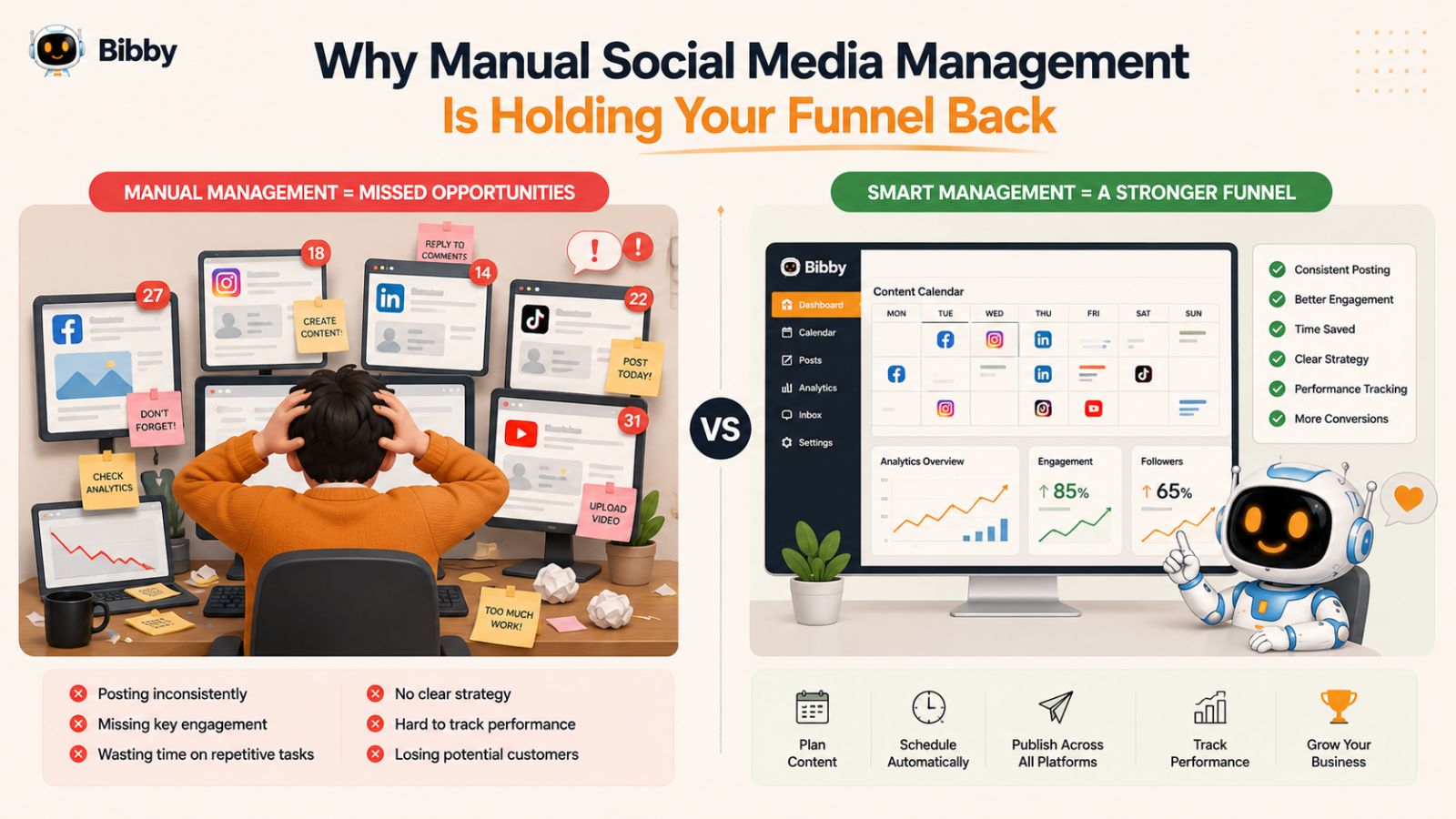
Inconsistent Posting Hurts Your Reach
Consistency is one of the most important factors in social media marketing. When you post sporadically, your audience may lose interest, and social media algorithms are less likely to prioritize your content.
Maintaining a regular publishing schedule manually becomes increasingly difficult when you're managing multiple campaigns, platforms, and content formats.
Planning and scheduling content in advance helps ensure your audience hears from you consistently without the stress of daily posting.
Managing Multiple Platforms Is Time-Consuming
Every platform has its own publishing workflow, media requirements, and best practices. Logging into Facebook, Instagram, LinkedIn, TikTok, and YouTube separately to upload content is not only repetitive but also increases the risk of missed posts and inconsistent messaging.
As your business expands, this process becomes difficult to scale.
A centralized publishing workflow saves time while ensuring your brand maintains a consistent presence across every channel.
Writing Captions for Every Post Becomes a Bottleneck
Creating engaging captions is often more challenging than designing the content itself. Every post needs to match your brand voice, encourage engagement, and include an effective call to action.
Writing fresh captions for dozens of weekly posts can slow down your entire content production process.
Using AI-assisted caption generation helps maintain quality while significantly reducing the time spent creating social media copy.
Choosing the Best Time to Post Isn't Always Obvious
Audience behavior varies across platforms, industries, and time zones. Posting when your audience isn't active can reduce reach and engagement, even if your content is excellent.
Many businesses rely on guesswork when selecting publishing times, leading to inconsistent results.
Scheduling content based on data-driven, AI-optimized publishing times increases the likelihood that your audience will see and interact with your posts.
Tracking Performance Across Platforms Is Difficult
Understanding which content drives engagement and conversions is essential for improving your social media funnel.
When analytics are spread across multiple platforms, comparing performance and identifying trends becomes time-consuming.
Having all your key metrics in one place makes it easier to answer questions like:
- Which content generates the most engagement?
- Which platform drives the most traffic?
- What posting times perform best?
- Which campaigns produce the highest conversions?
- What content should you create more often?
Data-driven decisions consistently outperform assumptions.
Also read: AI Content Planner: Plan an Entire Month of Content in Minutes →
How Bibby Simplifies Your Entire Social Media Workflow
As your social media strategy grows, automation becomes essential—not to replace creativity, but to eliminate repetitive work and maintain consistency.
Bibby is designed to simplify every step of the content publishing process, making it easier to execute a successful social media funnel from a single platform.
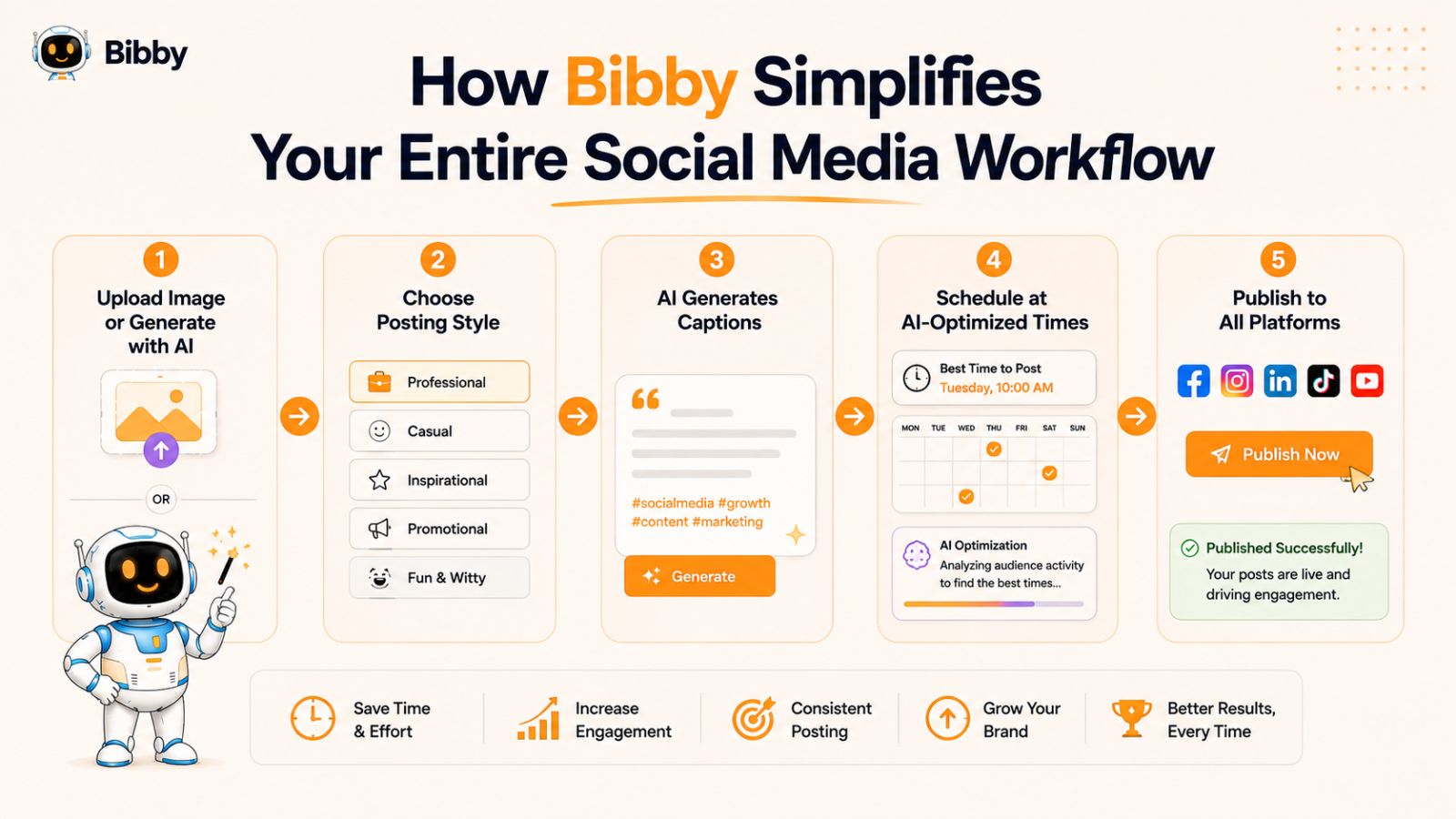
Create or Upload Content in Minutes
Whether you're working with your own visuals or starting from scratch, Bibby gives you flexibility.
You can:
- Upload your own images
- Generate AI-powered images
- Prepare content for multiple campaigns
- Organize media in one place
This reduces the time spent switching between different design and publishing tools.
Generate Captions Automatically
Instead of writing every caption manually, simply choose the posting style that best matches your brand.
Whether your content is educational, professional, conversational, or promotional, Bibby automatically generates captions that align with your selected tone, helping you publish faster while maintaining a consistent voice.
Schedule Smarter with AI
Timing can have a significant impact on content performance.
Rather than manually selecting publishing dates and times, Bibby automatically schedules your posts across future dates using AI-optimized publishing times that are designed to maximize visibility and engagement.
This allows your content to work around the clock—even when you're focused on other parts of your business.
Publish Everywhere from One Dashboard
Managing multiple social media accounts doesn't have to mean using multiple tools.
Bibby lets you publish content across major platforms from a single, streamlined dashboard, including:
- TikTok
- YouTube
You can also schedule and publish different content formats, including:
- Images
- Videos
- Stories
- Reels
- Shorts
This unified workflow saves time while ensuring your messaging remains consistent across every platform.
Also read: How to Create a Consistent Brand Experience Across Social Channels →
Measure What Matters
Publishing content is only one part of the equation. Improving your funnel requires understanding what's working.
Bibby's built-in analytics help you monitor key performance indicators such as:
- Reach
- Engagement
- Audience growth
- Clicks
- Top-performing posts
- Platform performance over time
These insights help you refine your content strategy, improve future campaigns, and maximize your return on investment.
Spend Less Time Managing and More Time Growing
The purpose of automation isn't simply to post faster—it's to free up time for higher-value activities like building relationships, creating better content, responding to customers, and optimizing your marketing strategy.
By combining AI-powered image generation, automatic caption writing, intelligent scheduling, multi-platform publishing, and centralized analytics, Bibby removes many of the repetitive tasks that slow businesses down. Instead of juggling multiple tools and daily posting routines, you can focus on guiding your audience through every stage of your social media funnel—from awareness to loyalty—with greater consistency and efficiency.
How to Measure the Success of Your Social Media Funnel
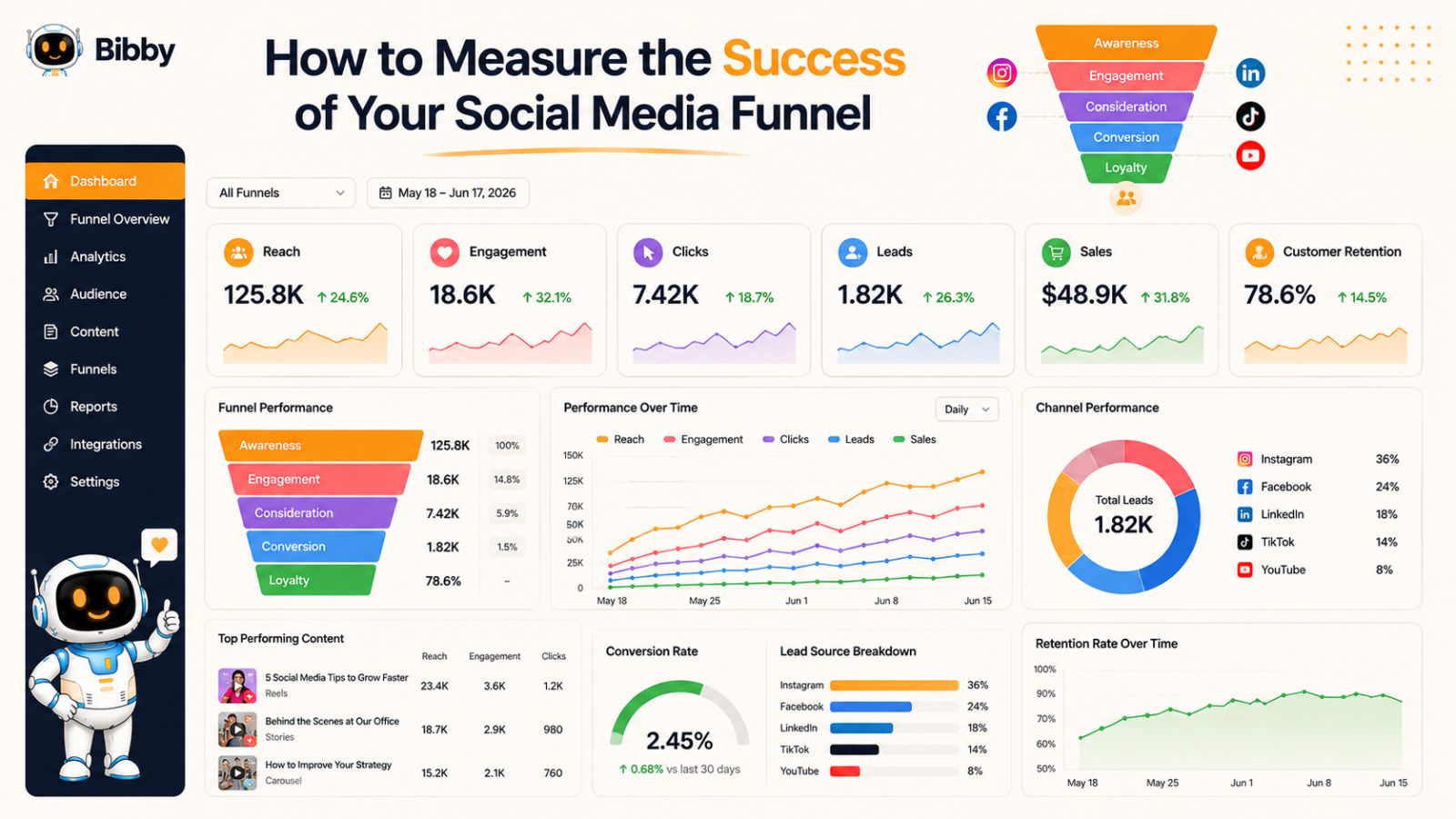
Building a social media funnel is only the first step. To improve its performance over time, you need to measure the right metrics at every stage of the customer journey. Tracking meaningful data helps you identify what's working, uncover opportunities for improvement, and make informed decisions that increase leads, conversions, and revenue.
Rather than focusing solely on vanity metrics like follower count, evaluate how effectively your content moves people from one stage of the funnel to the next.
Awareness Metrics
The goal of the awareness stage is to maximize your brand's visibility and introduce your business to new audiences.
Key metrics to monitor include:
- Reach
- Impressions
- Video views
- Profile visits
- Brand mentions
- Share rate
- New followers
Strong awareness metrics indicate that your content is successfully attracting attention and expanding your audience.
Engagement Metrics
Engagement shows how well your content resonates with your audience. High engagement often signals that people find your content valuable, relevant, and worth interacting with.
Track metrics such as:
- Likes
- Comments
- Shares
- Saves
- Direct messages
- Story interactions
- Engagement rate
If engagement is low despite good reach, your content may need stronger messaging, better visuals, or more compelling calls to action.
Lead Generation Metrics
At the consideration stage, your objective is to convert interested followers into qualified leads.
Important metrics include:
- Link clicks
- Landing page visits
- Email subscribers
- Lead magnet downloads
- Webinar registrations
- Form submissions
- Cost per lead (for paid campaigns)
These metrics reveal how effectively your social media content encourages users to take the next step.
Conversion Metrics
Ultimately, your social media funnel should contribute to measurable business growth.
Monitor conversion-focused metrics such as:
- Sales
- Conversion rate
- Revenue generated
- Average order value
- Customer acquisition cost (CAC)
- Return on ad spend (ROAS)
- Return on investment (ROI)
Analyzing these figures helps you understand whether your funnel is generating profitable results.
Customer Retention Metrics
A successful funnel continues creating value after the first purchase. Loyal customers often become repeat buyers and brand advocates, making retention just as important as acquisition.
Track metrics including:
- Repeat purchase rate
- Customer lifetime value (CLV)
- Referral rate
- Customer satisfaction
- Review volume
- Subscription renewals
- Customer retention rate
Improving these metrics can significantly increase long-term profitability without constantly acquiring new customers.
Build a Dashboard That Tells the Full Story
Looking at isolated metrics rarely provides an accurate picture of your funnel's performance. Instead, create a dashboard that tracks key performance indicators across every stage of the customer journey.
Your dashboard should answer questions like:
- Which platform generates the most qualified leads?
- Which content formats produce the highest engagement?
- Where are potential customers dropping out of the funnel?
- Which campaigns generate the most revenue?
- How does each platform contribute to overall business goals?
When you regularly review this data, you can make small improvements that compound into significant results over time.
Use Analytics to Continuously Improve Your Funnel
The highest-converting social media funnels aren't built overnight—they're refined through continuous testing and optimization.
Experiment with different:
- Content formats
- Headlines
- Calls to action
- Posting frequencies
- Publishing times
- Creative styles
- Audience segments
Measure the results, keep what works, and refine what doesn't.
Using a platform like Bibby makes this process much easier. Because your content is scheduled, published, and analyzed from one dashboard, you can quickly identify top-performing posts, understand audience behavior across platforms, and adjust your strategy based on real performance data instead of guesswork. This continuous optimization helps your social media funnel become more effective over time, delivering stronger engagement, higher-quality leads, and increased conversions.
Also read: 15 Social Media Scheduling Hacks Every Small Business Owner Should Know →
Common Social Media Funnel Mistakes to Avoid
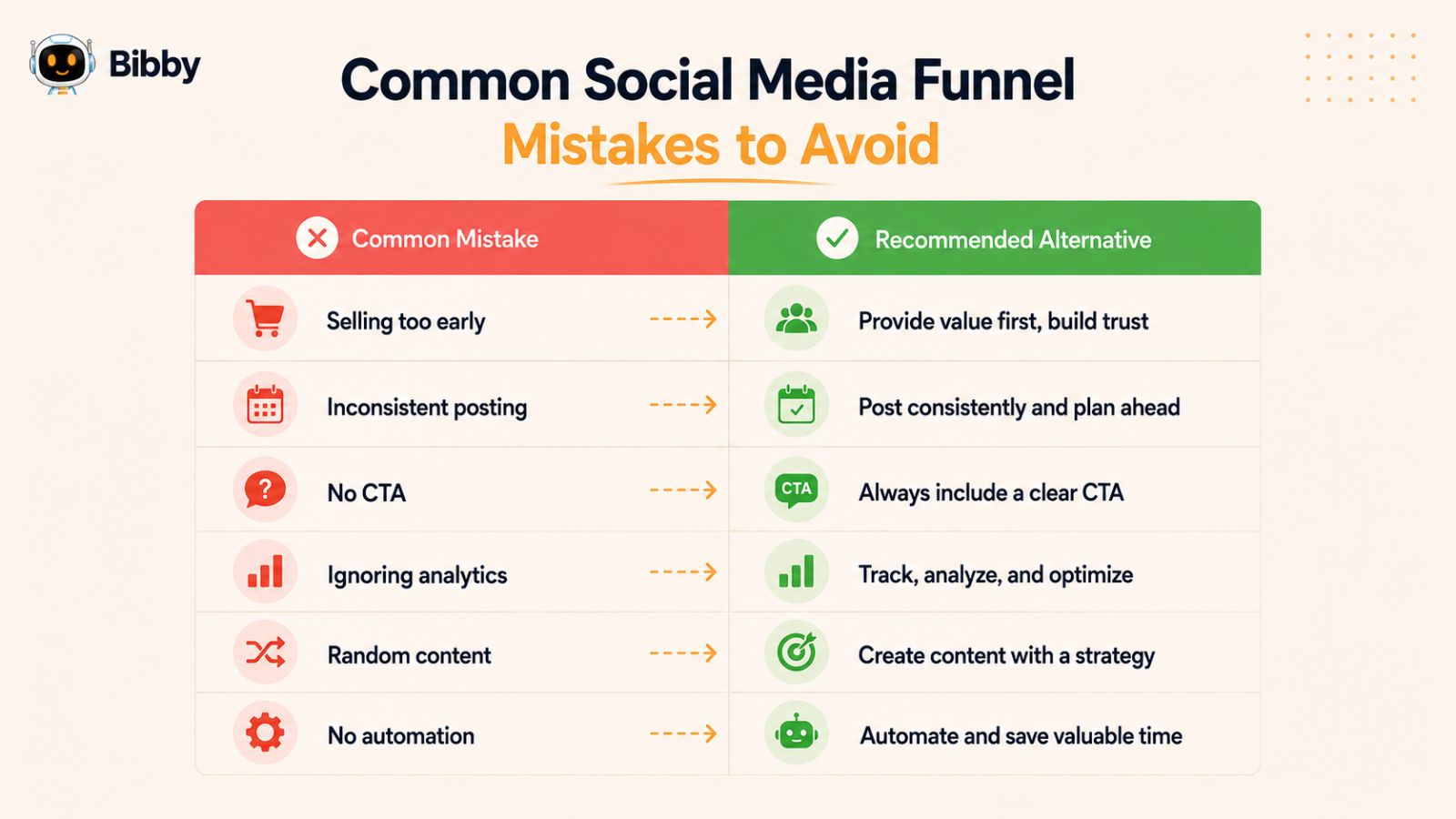
Even with a well-planned strategy, small mistakes can prevent your social media funnel from generating consistent leads and sales. The good news is that most of these issues are easy to fix once you recognize them.
Avoiding the following mistakes will help you build a more effective funnel that attracts the right audience, nurtures relationships, and converts followers into loyal customers.
Trying to Sell in Every Post
One of the fastest ways to lose your audience is by constantly promoting your products or services.
People use social media to learn, connect, and be entertained—not to see endless sales pitches. If every post asks your audience to buy something, engagement will likely decline over time.
Instead, follow a value-first approach. Share educational content, answer common questions, provide helpful tips, and inspire your audience. When you do promote your products, your followers will be much more receptive because you've already earned their trust.
Ignoring the Customer Journey
Not everyone who discovers your brand is ready to make a purchase immediately.
Some people are just learning about the problem, while others are actively comparing solutions. Treating every follower as if they're ready to buy often leads to poor conversion rates.
Create content for every stage of the funnel so your audience always has a logical next step, whether it's watching another video, downloading a resource, joining your email list, or scheduling a consultation.
Posting Inconsistently
Consistency builds familiarity, and familiarity builds trust.
Publishing several posts one week and then disappearing for the next two weeks makes it difficult to maintain momentum. Inconsistent posting can also reduce your visibility as social media platforms prioritize active creators.
Develop a content calendar and schedule your posts in advance to maintain a consistent publishing rhythm throughout the month.
Neglecting Video Content
Short-form video continues to dominate engagement across nearly every major social media platform.
If your strategy relies exclusively on static images or text posts, you're likely missing valuable opportunities to increase reach and attract new audiences.
Incorporate a variety of formats, including:
- Reels
- TikTok videos
- YouTube Shorts
- Stories
- Live streams
- Product demonstrations
- Customer testimonials
Diversifying your content helps you connect with different audience preferences.
Forgetting Strong Calls to Action
Great content alone doesn't move people through your funnel. Every post should encourage your audience to take a specific next step.
Depending on the stage of your funnel, your call to action might encourage users to:
- Read a blog post
- Download a free guide
- Subscribe to your newsletter
- Watch a product demo
- Book a consultation
- Start a free trial
- Purchase a product
Clear and relevant calls to action improve conversions by reducing uncertainty about what to do next.
Overlooking Analytics
Many businesses continue creating the same content without analyzing its performance.
Regularly reviewing your analytics helps you understand:
- Which topics resonate most with your audience
- Which platforms generate the highest engagement
- What content drives the most leads
- Which campaigns produce the highest return on investment
The more you learn from your data, the more effective your future campaigns become.
Managing Everything Manually
As your content library grows, manually uploading posts, writing captions, selecting publishing times, and switching between multiple platforms becomes increasingly inefficient.
Automation allows you to maintain consistency without increasing your workload.
For example, Bibby simplifies the entire publishing process by allowing you to upload your own images or generate AI-powered visuals, automatically create captions based on your preferred posting style, and schedule content across Facebook, Instagram, LinkedIn, TikTok, and YouTube at AI-optimized times. You can also publish videos, stories, and other media formats while tracking performance through a centralized analytics dashboard.
By reducing repetitive tasks, you can dedicate more time to creating valuable content, engaging with your audience, and optimizing your funnel for better results.
Treating Social Media as a Standalone Channel
Your social media funnel should work alongside your broader marketing strategy—not in isolation.
Connect your social media efforts with:
- Your website
- Landing pages
- Email marketing
- CRM
- Blog content
- Lead magnets
- Customer support
An integrated marketing ecosystem creates a smoother customer journey and increases the likelihood of converting prospects into long-term customers.
Failing to Test and Optimize
No social media funnel is perfect from day one.
The highest-performing brands continually test different headlines, visuals, captions, posting schedules, content formats, and calls to action. Small improvements made consistently can significantly increase your results over time.
View your funnel as an evolving system rather than a one-time project. Monitor performance, learn from your audience, and refine your strategy regularly to maximize engagement, leads, and conversions.
Frequently Asked Questions
What is a social media funnel?
A social media funnel is a structured marketing strategy that guides people through the customer journey—from discovering your brand to becoming loyal customers. Instead of posting random content, each post is designed to move your audience closer to a specific goal, such as subscribing to your email list, requesting a demo, or making a purchase.
Why is a social media funnel important?
Without a funnel, your social media efforts may generate likes and followers but fail to produce meaningful business results. A well-designed funnel helps you attract qualified prospects, build trust, generate leads, increase conversions, and retain customers over the long term.
What are the stages of a social media funnel?
A typical social media funnel consists of five stages:
- Awareness
- Interest and Engagement
- Consideration and Lead Generation
- Conversion
- Loyalty and Advocacy
Each stage requires different types of content and calls to action to guide potential customers toward making a purchase and becoming repeat buyers.
Which social media platform is best for building a funnel?
There isn't a single "best" platform because it depends on where your target audience spends their time.
For example:
- Facebook works well for community building and advertising.
- Instagram excels at visual storytelling and brand awareness.
- LinkedIn is ideal for B2B marketing and professional services.
- TikTok can generate rapid organic reach through short-form videos.
- YouTube is highly effective for educational content, tutorials, and long-term search visibility.
Many businesses achieve the best results by using multiple platforms together as part of an integrated social media strategy.
How often should I post on social media?
Consistency is more important than frequency.
A realistic publishing schedule might include three to five high-quality posts per week for each platform, supplemented by Stories, short-form videos, or community interactions. The ideal frequency depends on your audience, industry, and available resources.
Planning content in advance helps maintain a consistent presence without the stress of daily posting.
Should I automate social media posting?
Yes. Automating repetitive tasks allows you to focus on creating valuable content and engaging with your audience rather than manually publishing every post.
Automation is especially beneficial for businesses managing multiple platforms, campaigns, and content formats.
Can AI improve my social media marketing?
AI can significantly improve productivity by assisting with content creation, caption writing, scheduling, analytics, and optimization.
Rather than replacing creativity, AI helps eliminate repetitive work so marketers can spend more time developing strategy, building relationships, and producing high-quality content.
What is the best way to manage multiple social media platforms?
Using a centralized social media management platform is the most efficient approach.
Instead of switching between multiple apps, tools like Bibby allow you to manage your entire workflow from one dashboard. You can upload your own images or generate visuals with AI, select your preferred posting style, automatically generate captions, and schedule posts across Facebook, Instagram, LinkedIn, TikTok, and YouTube using AI-optimized publishing times. Bibby also supports videos, Stories, and other media formats while providing built-in analytics to measure performance and improve your social media funnel over time.
How long does it take for a social media funnel to generate results?
The timeline depends on factors such as your industry, competition, content quality, posting consistency, and marketing strategy.
Many businesses begin seeing improvements in engagement within a few weeks, while consistent lead generation and sales typically develop over several months. The key is to remain consistent, monitor your analytics, and continuously optimize your funnel based on performance data.
Can small businesses benefit from a social media funnel?
Absolutely.
A social media funnel helps businesses of all sizes attract qualified prospects, build trust, and convert followers into customers. For small businesses with limited marketing resources, combining a well-planned funnel with AI-powered automation can significantly increase efficiency while reducing the time spent managing day-to-day social media activities.
Conclusion
Building a social media funnel that actually converts isn't about posting more content—it's about guiding your audience through a purposeful journey. By creating content for every stage of the funnel, delivering consistent value, and measuring the right metrics, you can turn casual followers into loyal customers and long-term advocates.
The three biggest takeaways are simple: first, every post should have a clear purpose within your funnel; second, consistency and data-driven optimization are essential for long-term success; and third, automation allows you to scale your efforts without sacrificing quality or spending hours on repetitive tasks.
If you're managing multiple social media platforms, tools like Bibby can simplify your workflow from end to end. Instead of manually creating captions, scheduling posts, and switching between platforms, you can upload your own images or generate AI-powered visuals, choose your preferred posting style, let Bibby generate engaging captions automatically, and schedule content across Facebook, Instagram, LinkedIn, YouTube, and TikTok at AI-optimized publishing times. You can also publish videos, Stories, Reels, and Shorts while tracking performance through a centralized analytics dashboard—all from one place.
Remember that a high-converting social media funnel isn't something you build once and forget. Continue testing new content formats, refining your messaging, analyzing performance, and improving each stage of the customer journey. Small, consistent improvements can lead to significant growth over time.
Now that you know how to build a social media funnel that converts, the natural next step is learning how to create a strategic content calendar that consistently feeds every stage of your funnel. With a well-planned content strategy and the right automation tools, you'll be able to attract more qualified prospects, nurture stronger relationships, and generate predictable business growth through social media.