
Writing compelling social media captions consistently has become one of the biggest challenges for businesses, creators, and marketers.
If you've ever wondered whether an AI caption generator can truly outperform human-written captions, you're not alone. While AI tools can create captions in seconds, manual writing still offers creativity and authenticity that technology hasn't fully replicated. The real question isn't just which is better—it's which approach delivers the best results for your goals.
In this article, you will learn:
- How AI-generated captions compare to manual writing in real-world scenarios.
- The strengths and limitations of both approaches for social media success.
- How tools like Bibby combine AI captions with automated scheduling to streamline your entire social media workflow.
Let's explore how AI and human creativity compare—and discover which strategy can help you save time while maximizing engagement.
Why Great Captions Matter More Than Ever
A great social media post is more than just an eye-catching image or video—it's the caption that provides context, sparks conversation, and encourages action. Whether you're promoting a product, sharing industry insights, or telling your brand's story, a well-crafted caption can significantly influence how your audience responds.
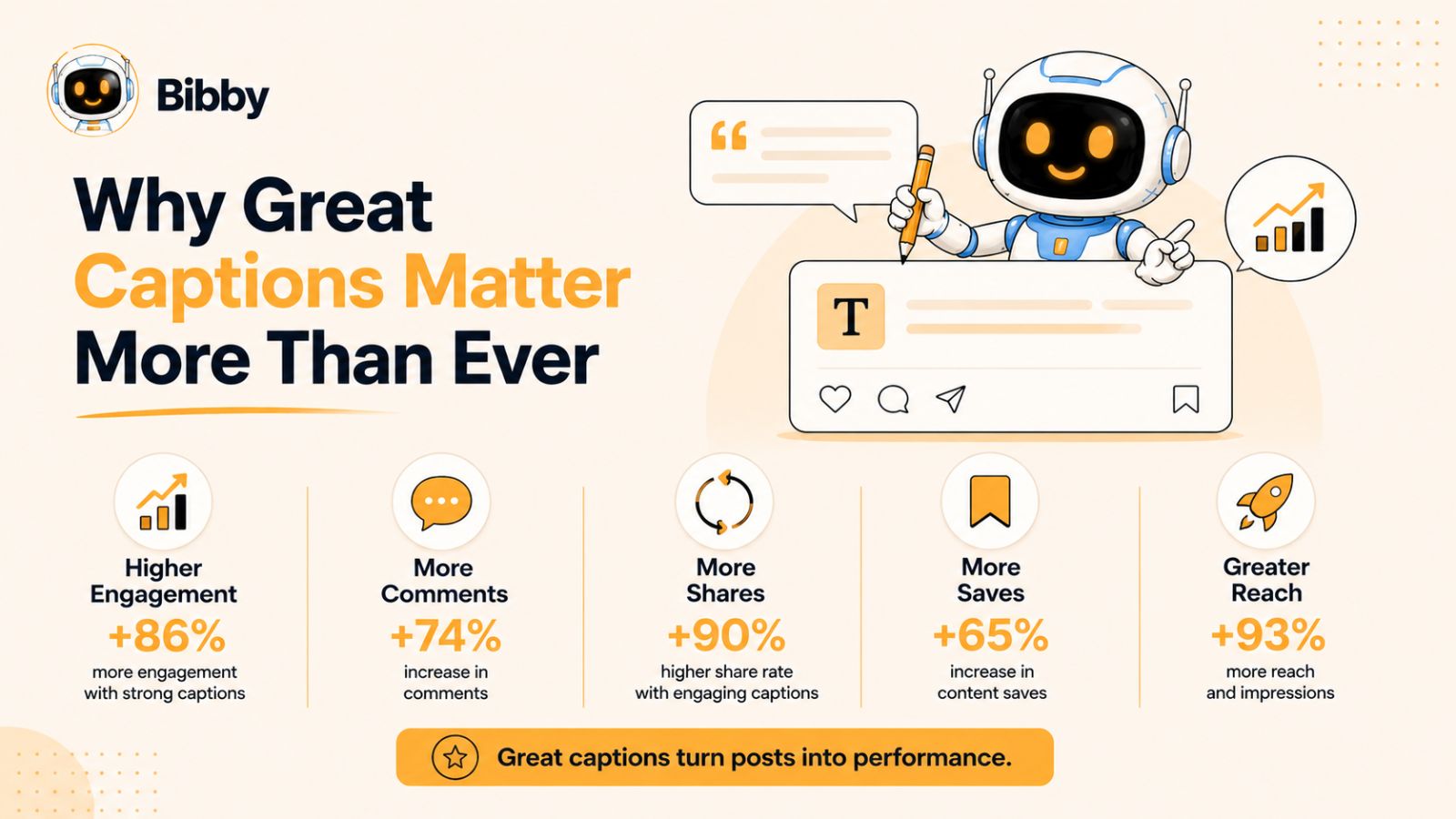
Today's Social Media Platforms prioritize meaningful engagement. Likes, comments, shares, saves, and watch time all play a role in determining how widely your content is distributed. Strong captions encourage these interactions by asking questions, telling relatable stories, providing valuable information, or including a clear call to action.
Captions also help establish your brand voice. A consistent tone across your social media channels builds trust and makes your content instantly recognizable. Whether your brand is professional, educational, humorous, or conversational, every caption contributes to how your audience perceives your business.
Beyond engagement, captions improve discoverability. Using relevant keywords, hashtags, and natural language helps your content appear in platform searches and recommendations. As social media platforms increasingly function like search engines, optimizing your captions has become an important part of your overall content strategy.
However, creating high-quality captions consistently can be time-consuming. Businesses that publish across multiple platforms often spend hours brainstorming ideas, writing platform-specific copy, and maintaining a consistent posting schedule. This challenge has fueled the rise of AI caption generators, which promise to produce engaging captions in seconds while reducing the workload for marketers and creators.
Understanding why captions matter is the first step toward deciding whether an AI caption generator or manual writing is the better choice for your social media strategy.
What Is an AI Caption Generator?
An AI caption generator is a tool that uses artificial intelligence to create social media captions based on your content, prompt, or marketing goals. Instead of spending time brainstorming ideas from scratch, you can provide a few details—such as your topic, audience, or desired tone—and the AI generates one or more caption options within seconds.
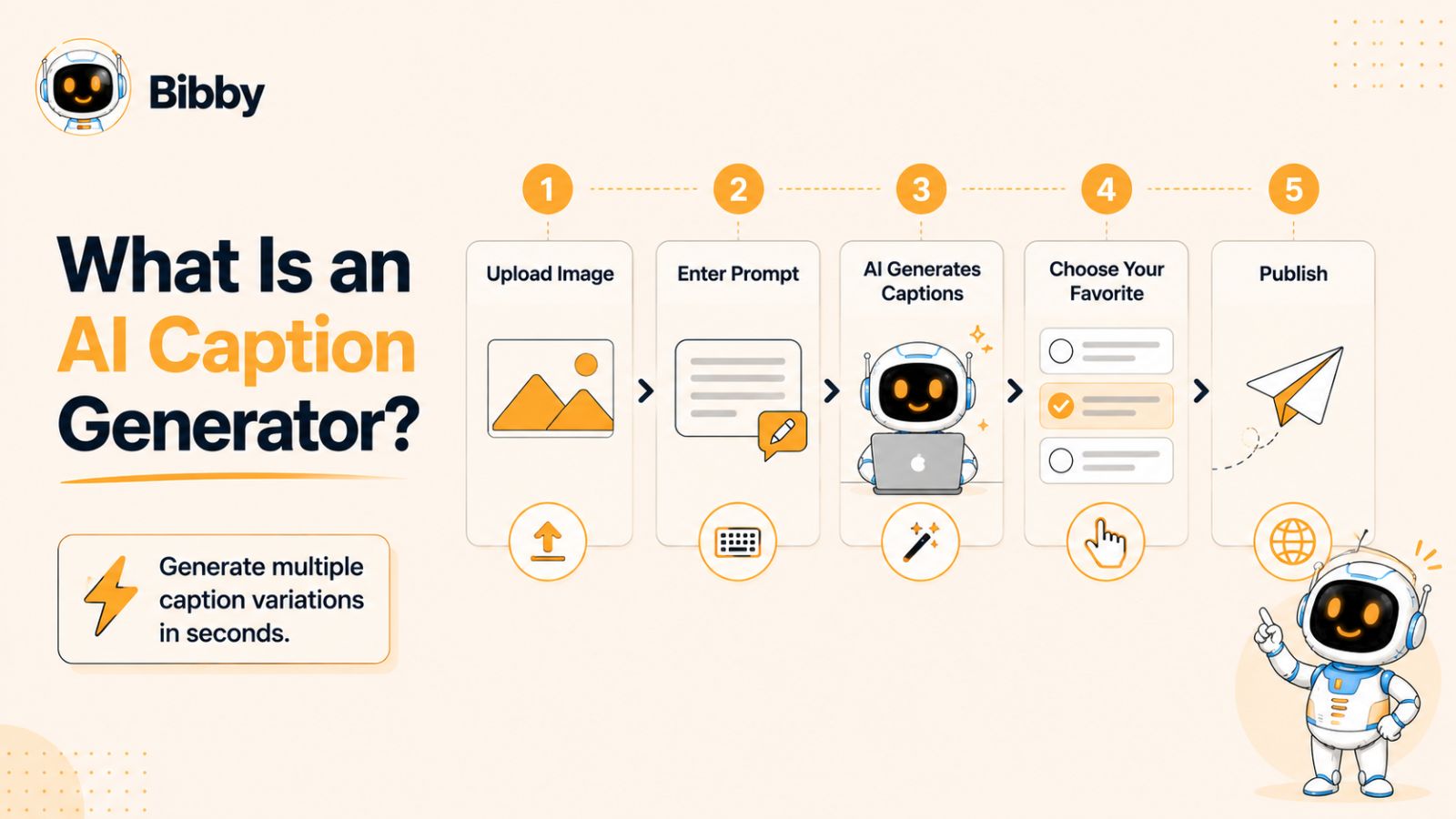
Modern AI caption generators are powered by advanced language models trained on vast amounts of text. They can understand context, adapt to different writing styles, and produce captions tailored for platforms like Instagram, Facebook, LinkedIn, TikTok, YouTube, and X. Many tools also suggest relevant hashtags, emojis, and calls to action, helping users create more engaging posts with minimal effort.
One of the biggest advantages of AI is speed. Whether you're managing a single business account or multiple client profiles, an AI caption generator can dramatically reduce the time spent writing repetitive content. It can also overcome writer's block by providing fresh ideas and multiple variations that you can refine to match your brand voice.
Many AI-powered social media platforms go beyond caption generation by combining content creation with automation. For example, Bibby allows you to upload your own images or generate visuals using AI, then automatically creates captions based on your preferred posting style. From there, you can schedule posts across platforms like Facebook, Instagram, LinkedIn, YouTube, and TikTok using AI-optimized posting times. Bibby also supports videos and stories, automatically resizes content for different social media platforms, and provides built-in analytics to help you track performance—all from a single, streamlined dashboard.
Despite these advantages, AI isn't designed to replace human creativity entirely. While it excels at generating fast, consistent, and scalable content, the most effective captions often benefit from a human review to ensure they reflect your brand's personality, accuracy, and unique perspective.
What Is Manual Caption Writing?
Manual caption writing is the traditional process of creating social media captions without relying on AI. It involves brainstorming ideas, understanding your audience, crafting a message, and refining it until it aligns with your brand's voice and marketing goals. While this approach requires more time and effort, it gives writers complete creative control over every word.
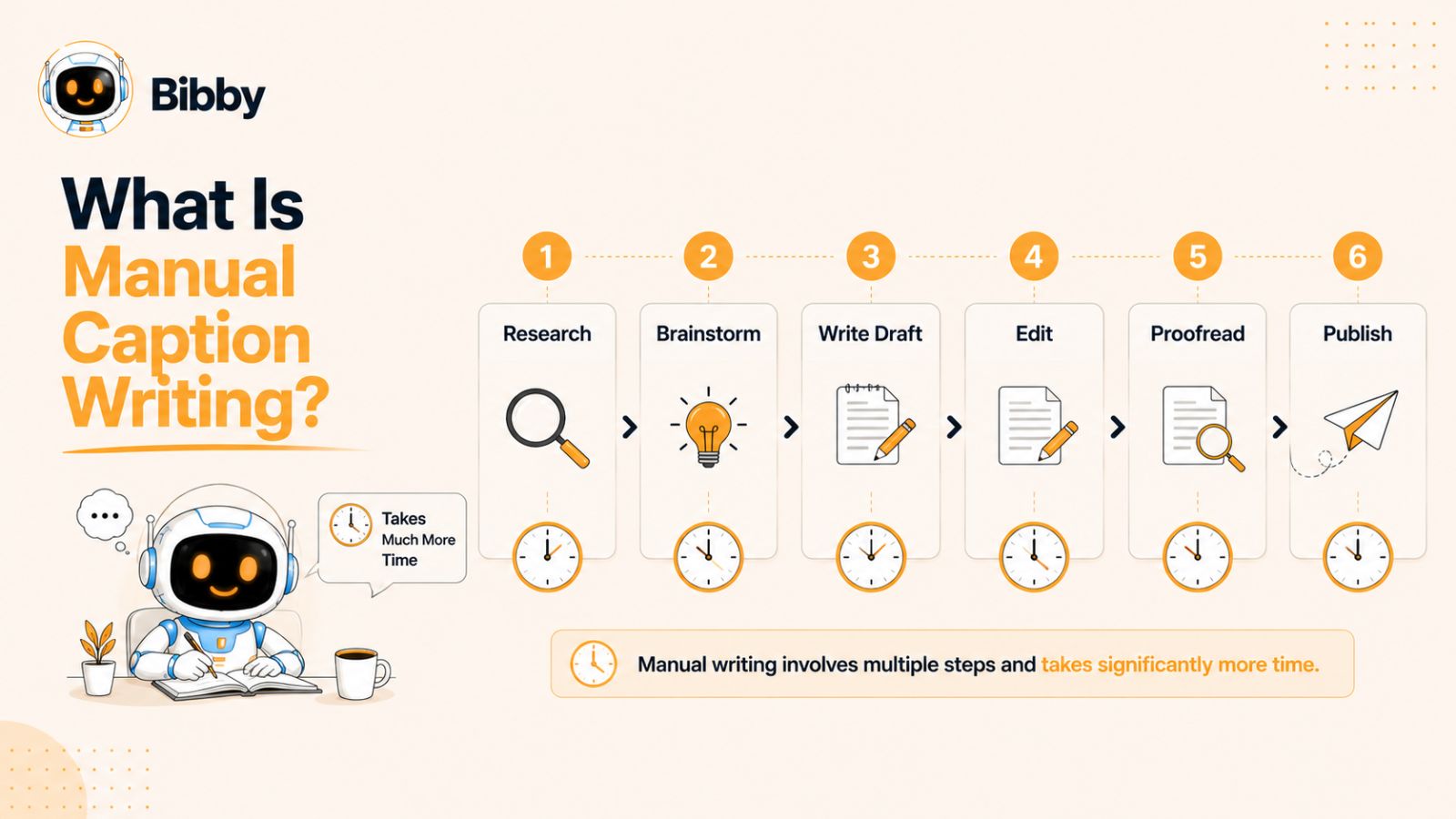
Unlike AI-generated captions, manual writing allows you to incorporate personal experiences, storytelling, humor, and cultural context that resonate with your audience. Skilled copywriters can adapt their messaging to current trends, customer emotions, and brand-specific nuances, making captions feel more authentic and relatable.
Another advantage of manual writing is precision. Businesses in industries such as healthcare, finance, or law often need carefully reviewed content to ensure accuracy and compliance. Human writers are better equipped to verify facts, interpret complex topics, and avoid wording that could be misleading or inappropriate.
However, manual caption writing can become a bottleneck for businesses that publish frequently or manage multiple social media accounts. Creating fresh, engaging captions for every post takes time, and maintaining consistency across platforms can be challenging without a well-defined content strategy.
This is why many marketers now use a hybrid approach. Instead of choosing between AI and manual writing, they use AI to generate initial caption ideas and then refine them with human creativity and brand expertise. This combination offers the efficiency of automation while preserving the authenticity and personality that audiences value.
Ultimately, manual caption writing remains an essential skill, especially for high-impact campaigns, emotional storytelling, and brand-building. The key is understanding when a human touch makes the greatest difference and when AI can handle repetitive tasks more efficiently.
Also read: 12 Most Effective Ways to Integrate Social Media Into Your Sales Strategy →
AI Caption Generator vs Manual Writing: Head-to-Head Comparison
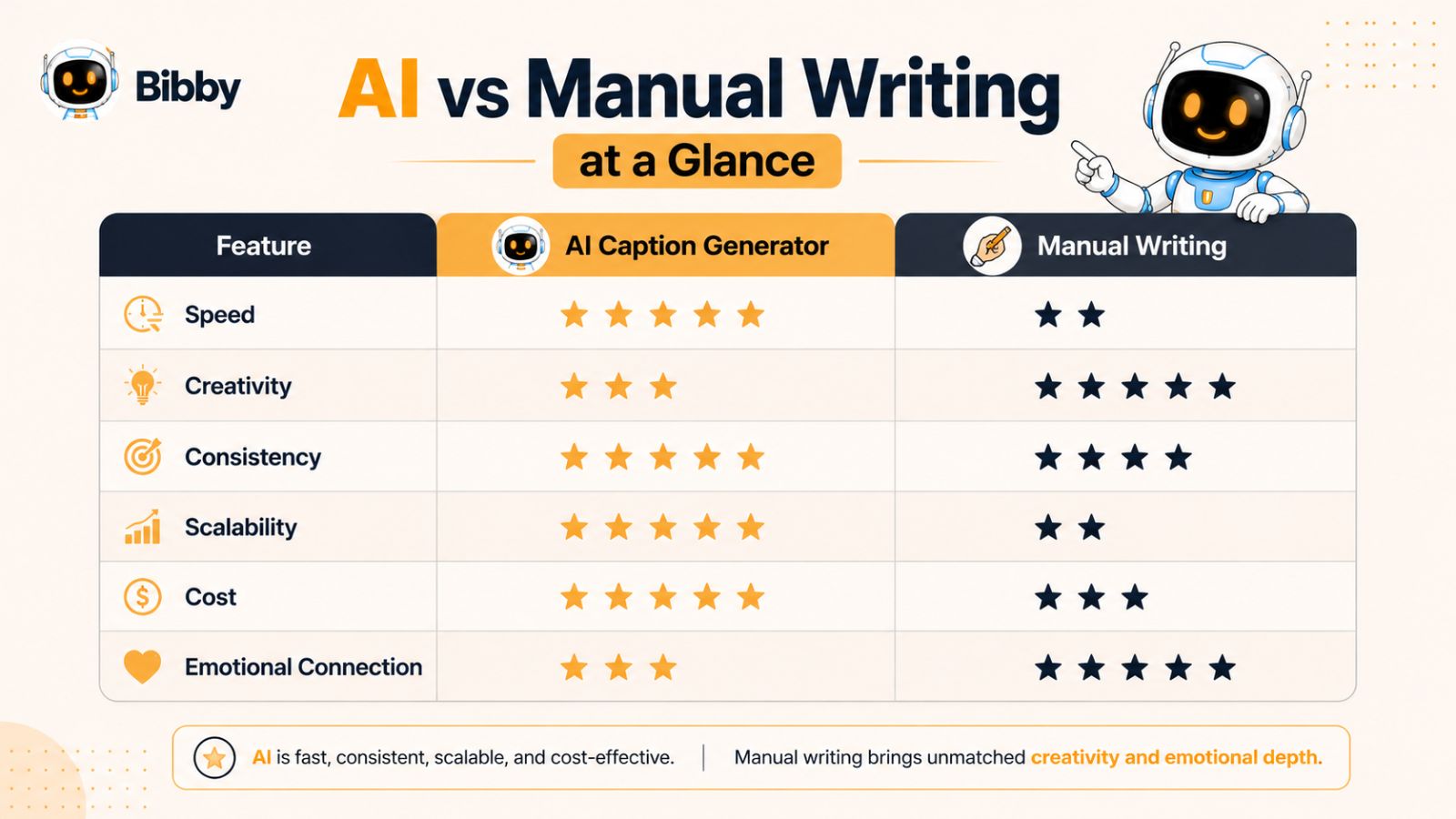
Choosing between an AI caption generator and manual writing depends on your goals, workflow, and the type of content you create. While AI excels at speed and scalability, manual writing offers creativity and emotional depth that machines can't fully replicate. Here's how they compare across the factors that matter most.
1. Speed
When it comes to speed, AI caption generators are the clear winner. They can produce multiple caption variations in seconds, making them ideal for businesses, agencies, and creators who publish content regularly.
Manual writing, on the other hand, requires brainstorming, drafting, editing, and proofreading. A single high-quality caption may take anywhere from a few minutes to half an hour, depending on its complexity.
Winner: AI Caption Generator
2. Creativity
Human writers bring originality, storytelling, humor, and personal experiences that make captions memorable. They understand subtle emotions, cultural references, and audience expectations in ways AI still struggles to match.
AI is excellent at generating ideas and overcoming writer's block, but its content can sometimes feel generic if used without editing.
Winner: Manual Writing
3. Consistency
Maintaining a consistent brand voice across dozens or even hundreds of posts can be difficult when writing manually, especially with multiple team members involved.
AI tools can generate captions based on predefined tones and styles, helping businesses maintain consistency across different platforms and campaigns.
Winner: AI Caption Generator
4. Scalability
If you're managing multiple brands, clients, or social media accounts, manually writing every caption quickly becomes time-consuming.
AI makes it possible to create content at scale by generating captions for numerous posts in a fraction of the time. Platforms like Bibby take this a step further by generating captions, automatically resizing media for different social platforms, scheduling posts at AI-optimized times, and publishing them across Facebook, Instagram, LinkedIn, YouTube, TikTok, and more—all from a single dashboard.
Winner: AI Caption Generator
5. Cost
Hiring experienced copywriters or dedicating internal resources to caption writing can be expensive, particularly for businesses with frequent posting schedules.
AI caption generators offer a cost-effective alternative by reducing the amount of manual writing required. While human review is still valuable, AI significantly lowers the time and effort needed to produce high-quality content.
Winner: AI Caption Generator
6. SEO and Discoverability
Social media platforms increasingly function as search engines, making optimized captions more important than ever.
AI tools can quickly incorporate relevant keywords, hashtags, and calls to action into captions. However, human writers are often better at weaving keywords naturally into engaging content that avoids sounding repetitive or overly optimized.
For the best results, use AI to create an SEO-friendly first draft and refine it manually to ensure it feels authentic and valuable to your audience.
Winner: Tie
7. Engagement Potential
Engagement depends on more than just well-written captions—it also relies on relevance, timing, visuals, and audience understanding.
AI can generate engaging captions efficiently, but human writers are generally better at creating emotionally compelling stories, responding to current events, and tailoring messages to specific communities. Combining AI-generated drafts with human editing often produces the strongest results.
Winner: Manual Writing
Comparison at a Glance
| Feature | AI Caption Generator | Manual Writing |
|---|---|---|
| Speed | ⭐⭐⭐⭐⭐ | ⭐⭐☆☆☆ |
| Creativity | ⭐⭐⭐☆☆ | ⭐⭐⭐⭐⭐ |
| Consistency | ⭐⭐⭐⭐⭐ | ⭐⭐⭐⭐☆ |
| Scalability | ⭐⭐⭐⭐⭐ | ⭐⭐☆☆☆ |
| Cost Efficiency | ⭐⭐⭐⭐⭐ | ⭐⭐⭐☆☆ |
| SEO Support | ⭐⭐⭐⭐☆ | ⭐⭐⭐⭐☆ |
| Emotional Connection | ⭐⭐⭐☆☆ | ⭐⭐⭐⭐⭐ |
Final Verdict
There isn't a universal winner. If your priority is saving time, publishing consistently, and managing content at scale, an AI caption generator is the better choice. If your focus is storytelling, emotional connection, and highly personalized messaging, manual writing remains invaluable.
For most businesses, the most effective strategy is combining both approaches. Use AI to generate ideas and first drafts, then apply human creativity to refine the message, strengthen your brand voice, and ensure every caption feels authentic. When paired with an all-in-one platform like Bibby—which combines AI-generated captions, automated scheduling, media resizing, analytics, and multi-platform publishing—you can streamline your entire social media workflow without sacrificing quality.
Pros of Using an AI Caption Generator
AI caption generators have transformed the way businesses, creators, and marketers manage their social media content. Instead of spending hours brainstorming and writing captions, you can generate engaging copy in seconds, freeing up more time to focus on strategy, customer engagement, and content creation.
Here are some of the biggest advantages of using an AI caption generator.
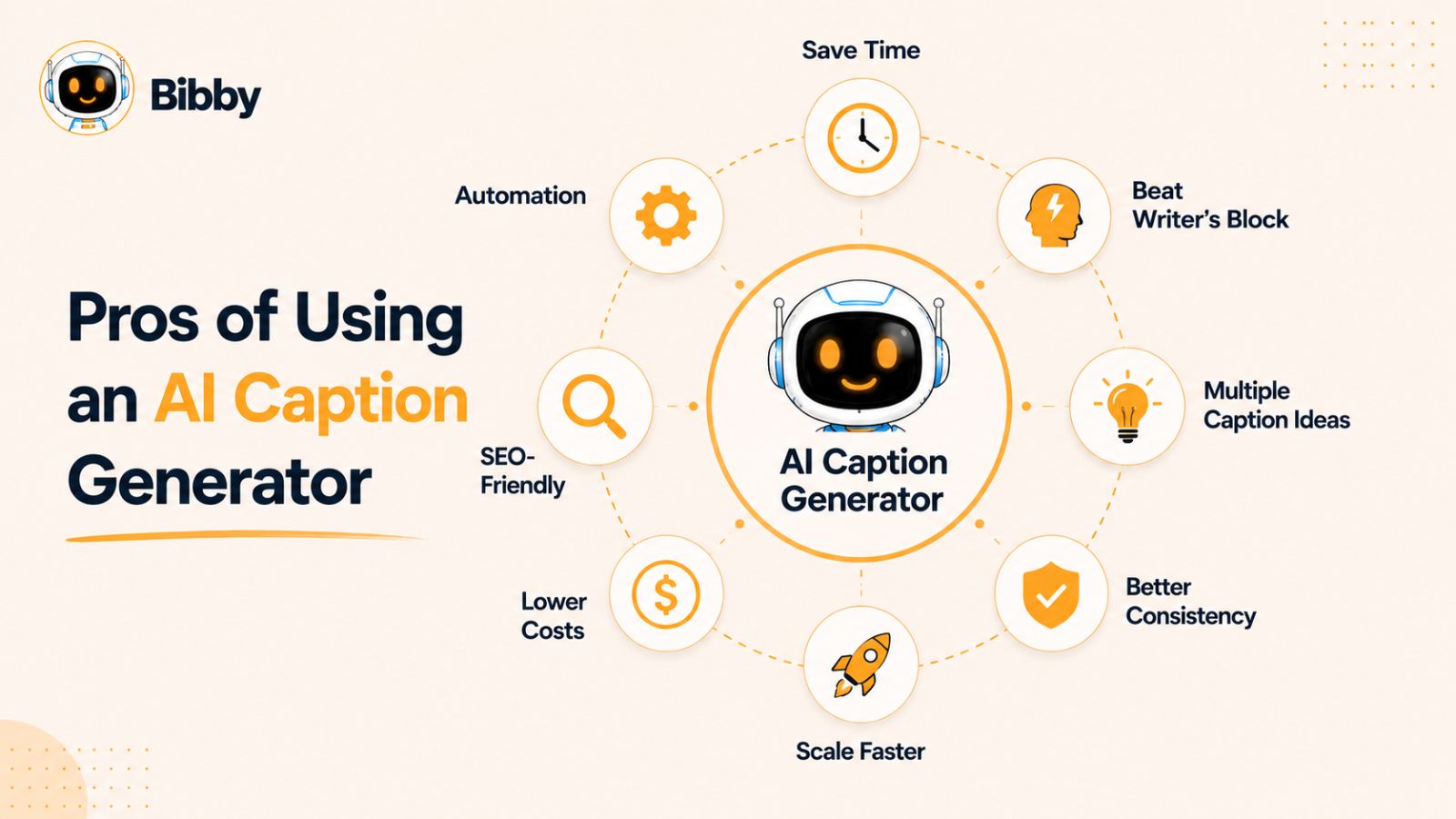
1. Saves Significant Time
One of the greatest benefits of AI is speed. Whether you're creating one post or planning an entire month's content calendar, AI can generate multiple caption options almost instantly.
This allows social media managers and business owners to spend less time writing and more time growing their brands.
2. Eliminates Writer's Block
Even experienced marketers occasionally struggle to come up with fresh ideas. AI provides instant inspiration by generating different caption styles, tones, and formats, making it easier to overcome creative blocks and maintain a consistent publishing schedule.
3. Creates Multiple Caption Variations
Every audience responds differently to messaging. AI tools can generate several versions of the same caption, allowing you to test different calls to action, writing styles, or levels of formality.
This flexibility is especially valuable for A/B testing and optimizing engagement over time.
4. Maintains Consistency Across Platforms
Maintaining a consistent brand voice becomes increasingly difficult as your social media presence grows.
AI helps ensure your messaging remains aligned with your preferred tone while adapting captions for different platforms, making your brand more recognizable and professional.
5. Supports Large-Scale Content Creation
Businesses that manage multiple brands, products, or client accounts often need to produce dozens of social media posts every week.
AI makes scaling content production far more efficient without requiring a proportional increase in writing resources.
6. Improves Productivity with Automation
Many modern AI tools extend beyond caption generation by combining content creation with workflow automation.
For example, Bibby allows you to upload your own images or generate visuals using AI, automatically resize them for different social media platforms, generate captions based on your selected posting style, and schedule posts at AI-optimized times. You can publish content across Facebook, Instagram, LinkedIn, YouTube, TikTok, and other platforms from a single dashboard. Bibby also supports videos and stories while providing built-in analytics to help you measure performance and refine your content strategy.
By combining AI-generated captions with automated scheduling and performance tracking, businesses can manage their entire social media workflow more efficiently.
7. Encourages Consistent Posting
Consistency is one of the most important factors in social media growth, but maintaining a regular posting schedule can be challenging.
AI simplifies content planning by reducing the time required to create captions. When paired with scheduling tools, it becomes much easier to publish content consistently without scrambling for ideas at the last minute.
8. Cost-Effective for Growing Businesses
Hiring dedicated copywriters or outsourcing every social media caption can quickly become expensive.
AI caption generators provide an affordable way for startups, small businesses, and creators to produce high-quality content while keeping marketing costs under control.
The Bottom Line
AI caption generators excel at saving time, increasing productivity, and making content creation more scalable. While they may not replace human creativity entirely, they provide an excellent foundation for producing consistent, engaging social media content. For the best results, many businesses use AI to generate the first draft and then refine it to reflect their unique brand voice and audience.
Also read: The Perfect Post Length for Instagram, Facebook, LinkedIn, and X in 2026 →
Pros of Manual Writing
While AI has made content creation faster and more efficient, manual caption writing continues to play an important role in successful social media marketing. Human creativity, emotional intelligence, and real-world experience often produce captions that feel more authentic and memorable, helping brands build stronger relationships with their audiences.
Here are some of the key advantages of writing captions manually.
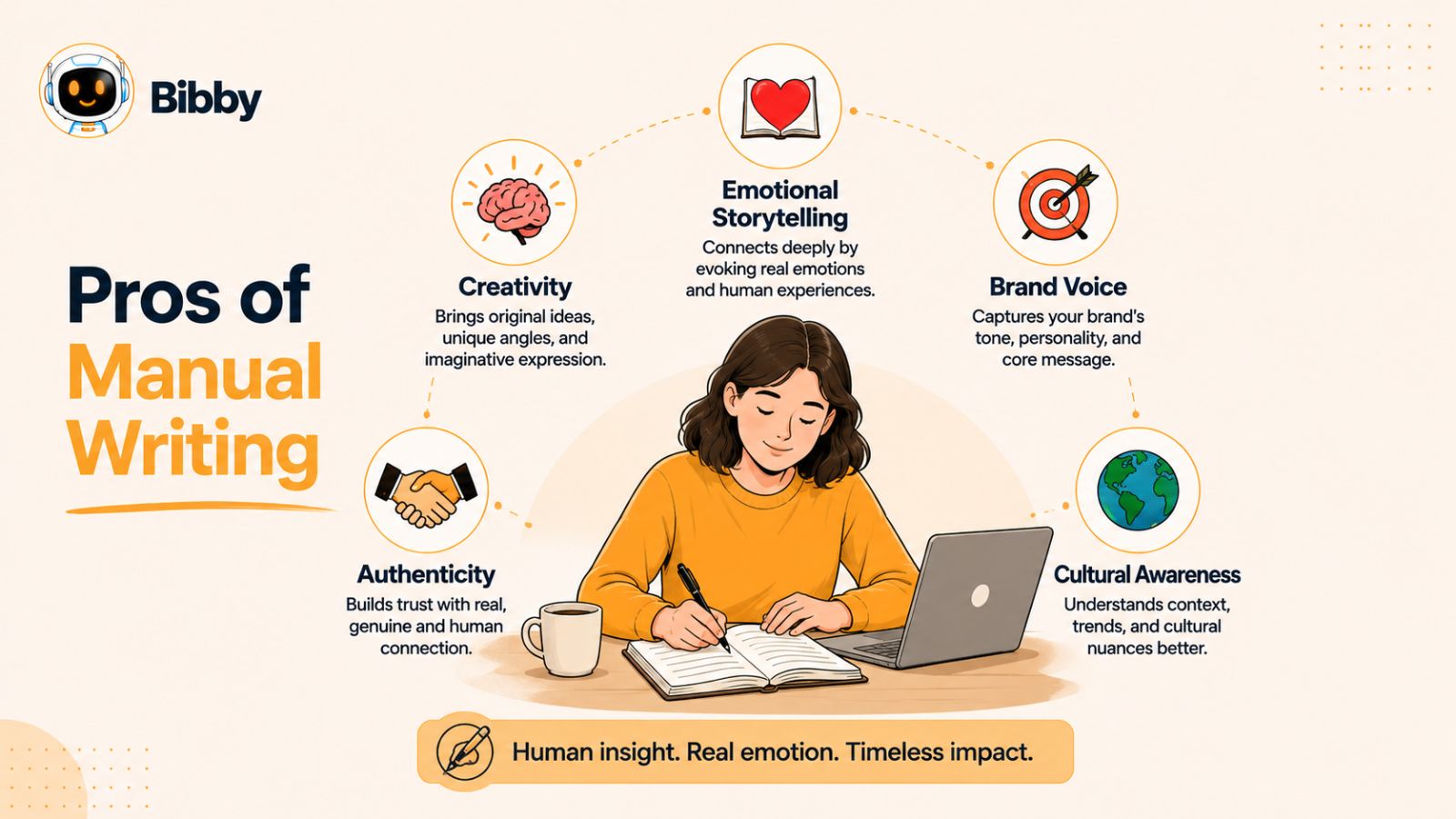
1. Builds Genuine Emotional Connections
People connect with stories, experiences, and emotions—not just well-structured sentences. Human writers can create captions that inspire, entertain, or empathize with readers, making them more likely to engage, comment, and share.
Whether you're celebrating a milestone, responding to customer feedback, or sharing your brand's journey, manually written captions often feel more personal and relatable.
2. Reflects a Unique Brand Voice
Every brand has its own personality. Some are playful and humorous, while others are professional and educational. Manual writing gives you complete control over tone, style, and messaging, ensuring every caption aligns with your brand identity.
This level of customization helps create a consistent experience that audiences recognize and trust over time.
3. Adapts to Trends and Cultural Context
Social media trends evolve rapidly. A phrase, meme, or cultural reference that resonates today may be outdated tomorrow.
Human writers can quickly understand these shifts and create captions that feel timely, relevant, and appropriate for their audience. They are also better equipped to avoid language that could be misunderstood or insensitive.
4. Supports Complex Storytelling
Some posts require more than a catchy one-liner. Product launches, customer success stories, behind-the-scenes updates, and thought leadership content often benefit from detailed storytelling.
Manual writing allows you to structure narratives, highlight key moments, and guide readers toward a clear message in a way that feels natural and engaging.
5. Provides Greater Accuracy and Control
In industries where precision matters—such as healthcare, finance, legal services, or technology—manual review is essential. Human writers can verify facts, ensure compliance, and adjust messaging to reduce the risk of errors or misleading information.
Even when using AI to generate a draft, reviewing and refining the final caption helps maintain credibility and protect your brand's reputation.
6. Creates More Authentic Conversations
Audiences appreciate brands that sound human rather than robotic. Manual writing makes it easier to respond to current events, acknowledge customer feedback, and participate in conversations with empathy and authenticity.
These genuine interactions can strengthen customer relationships and foster long-term loyalty.
When Manual Writing Works Best
Manual caption writing is especially valuable when you're:
- Launching a new product or service.
- Sharing customer stories or testimonials.
- Building a personal brand.
- Communicating sensitive or complex information.
- Running high-impact marketing campaigns.
- Creating thought leadership content.
The Bottom Line
Manual writing remains the gold standard for originality, storytelling, and authentic communication. While it requires more time than using an AI caption generator, it offers creative flexibility and emotional depth that technology cannot fully replicate. For many businesses, the ideal approach is to use AI for speed and efficiency while relying on human expertise to add personality, context, and authenticity before publishing.
Where AI Still Falls Short
Artificial intelligence has come a long way, but it's not perfect. While AI caption generators can create high-quality content quickly, there are situations where human judgment, creativity, and experience remain essential. Understanding these limitations helps you use AI more effectively instead of relying on it blindly.
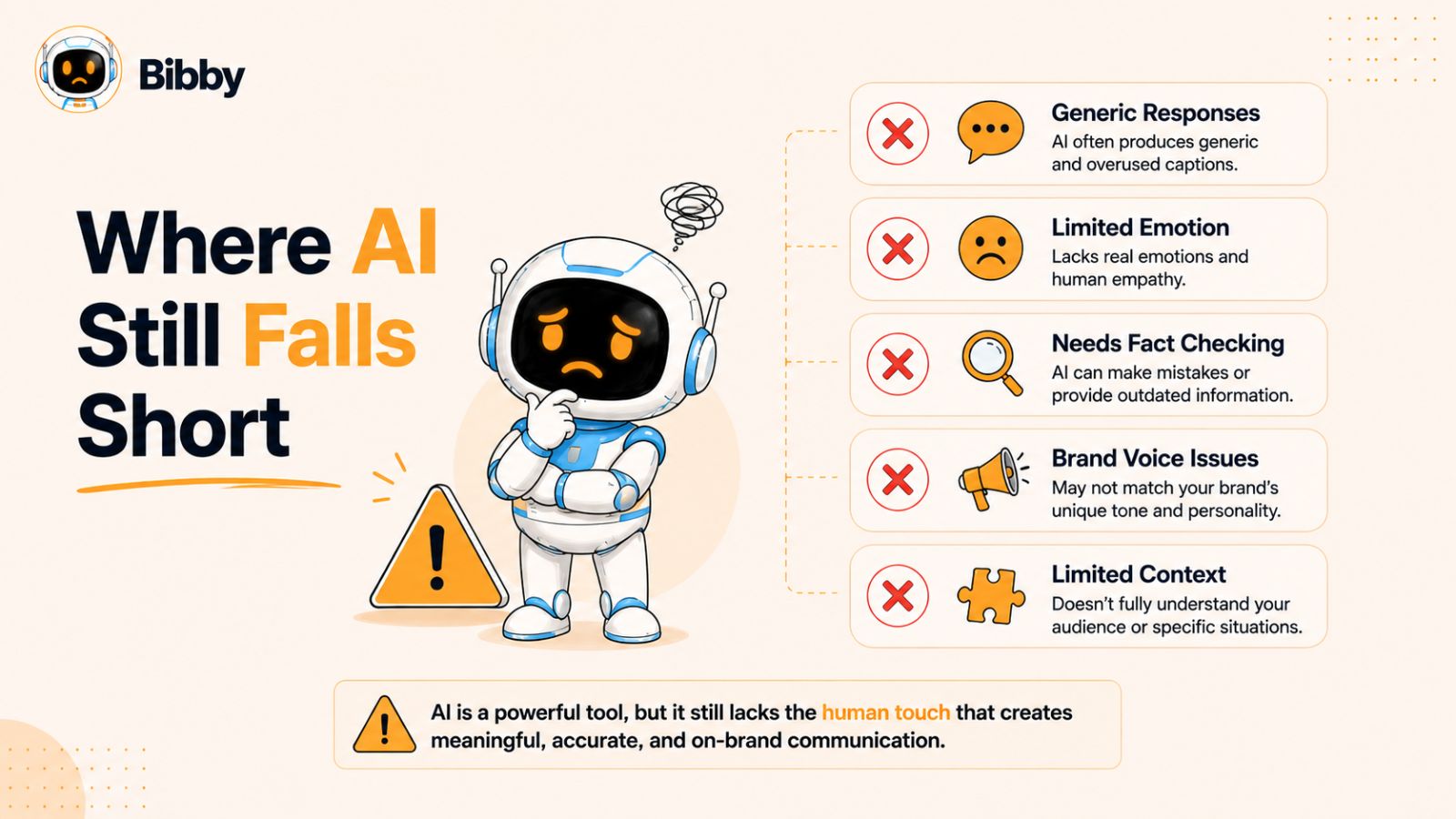
1. Limited Emotional Intelligence
AI can recognize emotional language, but it doesn't genuinely understand human emotions or personal experiences. As a result, AI-generated captions may sometimes sound polished yet lack the authenticity needed to build deeper connections with your audience.
For emotionally driven campaigns, customer appreciation posts, or personal stories, human writers are better equipped to create content that feels sincere and relatable.
2. Difficulty Understanding Brand Nuances
Every brand has its own personality, values, and communication style. While many AI tools can be trained to follow a specific tone, they may occasionally produce captions that don't fully align with your brand voice.
A quick human review helps ensure every caption reflects your company's identity and messaging.
3. Limited Context Awareness
AI generates captions based on the information you provide. If your prompt lacks important details, the output may include generic statements or miss the context entirely.
Human writers naturally consider factors such as recent events, customer feedback, campaign objectives, and industry trends when crafting captions, making their content more relevant and impactful.
4. Risk of Generic Content
Because AI models learn from large datasets, they can sometimes produce captions that feel familiar or repetitive, especially when given broad prompts.
Adding your own insights, experiences, and brand-specific messaging transforms an AI-generated draft into content that stands out from the competition.
5. Accuracy Still Requires Verification
Although AI is highly capable, it can occasionally generate incorrect or outdated information. This is particularly important for industries where accuracy is critical, such as healthcare, finance, education, or legal services.
Always review AI-generated captions before publishing to ensure that facts, statistics, product details, and claims are accurate.
6. Cultural and Regional Differences
Language, humor, slang, and cultural references vary across countries and communities. A caption that works well for one audience may not resonate—or could even be misunderstood—by another.
Human writers are better positioned to adapt messaging for local audiences and ensure content is culturally appropriate.
7. Creativity Has Limits
AI is excellent at remixing patterns and generating ideas, but truly original concepts often come from human imagination. Creative campaigns, unique storytelling angles, and memorable brand narratives still benefit from human brainstorming and strategic thinking.
That's why many marketing teams use AI as a creative assistant rather than a replacement for skilled writers.
How to Get the Best Results from AI
The most effective approach is to treat AI as your first draft—not your final draft.
Generate caption ideas with AI, then refine them by:
- Adding your brand's unique voice and personality.
- Including real customer experiences or success stories.
- Verifying facts and product information.
- Personalizing calls to action.
- Adjusting the tone for your target audience.
If you're using an all-in-one platform like Bibby, you can generate captions quickly, edit them before publishing if needed, and then schedule your posts across multiple social media platforms from one dashboard. This workflow combines AI's speed with human creativity, helping you save time without sacrificing quality.
The Bottom Line
AI is an incredibly powerful tool for creating social media captions, but it's most effective when paired with human expertise. By understanding its limitations and reviewing content before publishing, you can enjoy the efficiency of automation while maintaining the authenticity, creativity, and trust that your audience expects.
The Best Strategy: Combine AI With Human Creativity
The debate between AI caption generators and manual writing often assumes you have to choose one over the other. In reality, the most successful marketers, businesses, and content creators use a hybrid approach that combines the speed of AI with the creativity and judgment of human writers.
AI is excellent at handling repetitive tasks, generating fresh ideas, and producing first drafts in seconds. Human creativity adds the personality, emotional depth, and strategic thinking that make content truly resonate with an audience. Together, they create a workflow that is both efficient and authentic.
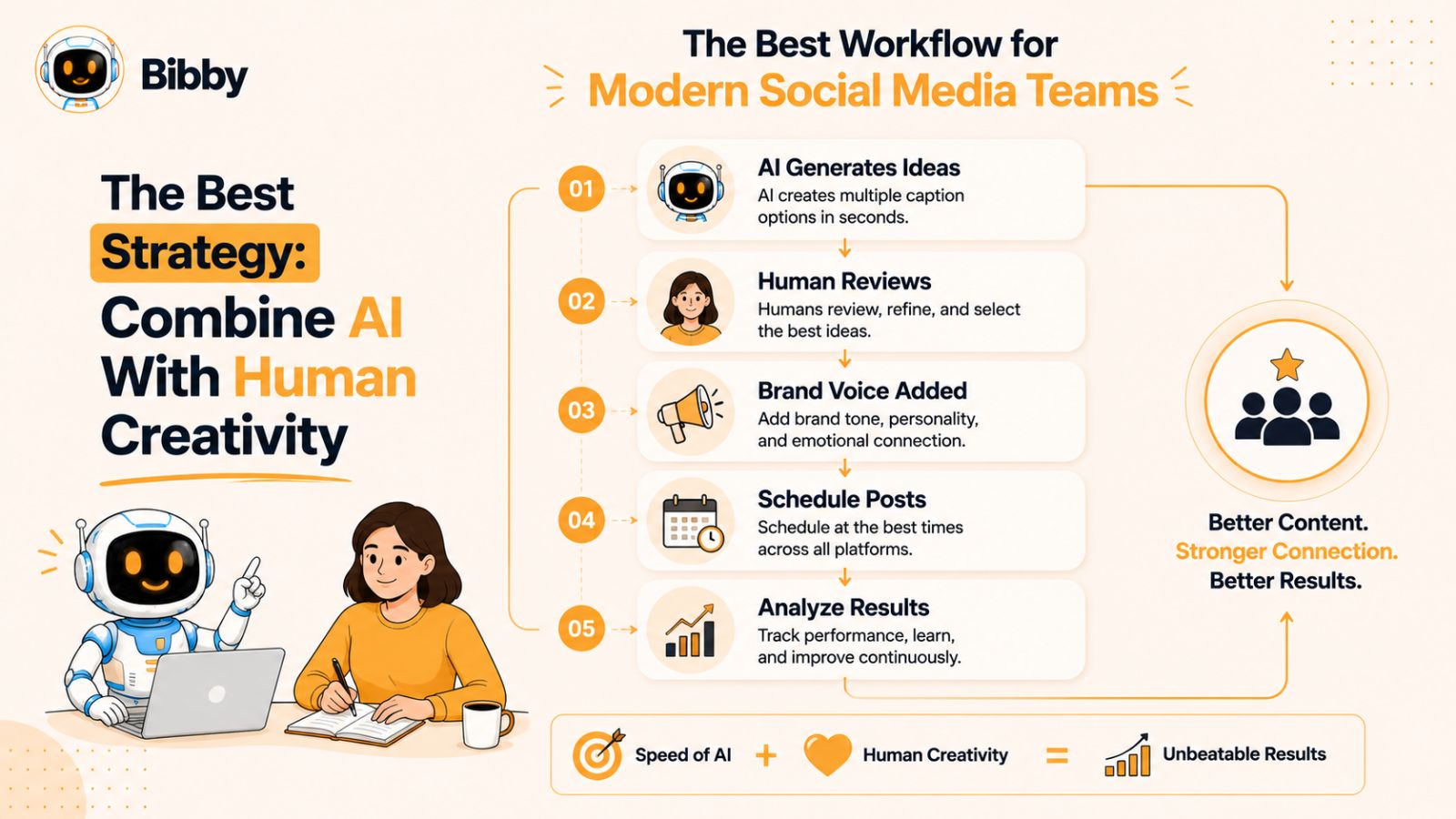
Start with AI for Speed
Rather than staring at a blank screen, use an AI caption generator to create several caption ideas based on your image, video, or campaign objective.
This helps you:
- Generate ideas faster.
- Overcome writer's block.
- Create multiple caption variations.
- Maintain a consistent posting schedule.
- Save valuable time on repetitive tasks.
Instead of spending 20–30 minutes writing a caption from scratch, you can start with a solid draft in just a few seconds.
Add the Human Touch
Once AI has generated a draft, review it carefully before publishing.
Consider making improvements by:
- Adding your brand's personality.
- Sharing personal experiences or customer stories.
- Including industry-specific insights.
- Refining the call to action.
- Adjusting the tone for your audience.
- Removing generic or repetitive wording.
These edits ensure your captions feel authentic rather than automated.
Automate the Rest of Your Workflow
Writing captions is only one part of managing social media. You still need to prepare visuals, optimize content for different platforms, schedule posts, monitor performance, and stay consistent.
This is where platforms like Bibby can significantly simplify your workflow.
With Bibby, you can:
- Upload your own image or generate one with AI.
- Automatically resize visuals for different social media platforms.
- Choose your preferred posting style and brand voice.
- Generate AI-powered captions for every post.
- Schedule posts across Facebook, Instagram, LinkedIn, YouTube, TikTok, and other supported platforms.
- Publish videos, stories, and standard posts from one dashboard.
- Let AI recommend optimized publishing times.
- Track performance using built-in analytics to understand what works best.
By bringing content creation, caption generation, scheduling, and analytics into one platform, Bibby helps reduce manual work and keeps your social media strategy organized.
Build a Sustainable Content Strategy
Consistency is one of the biggest drivers of long-term social media growth. However, maintaining a steady publishing schedule can become overwhelming if every caption and post is created manually.
A hybrid workflow makes consistency much easier:
- Create or upload your visual content.
- Use AI to generate several caption options.
- Edit the best version to match your brand voice.
- Schedule content in advance across multiple platforms.
- Review analytics and refine future content based on performance.
This process saves time without sacrificing quality, allowing you to focus on engaging with your audience and growing your business.
Final Thoughts
AI isn't here to replace human creativity—it's here to enhance it. By combining AI-generated captions with thoughtful editing and smart automation, you can create content that's engaging, authentic, and efficient to produce.
Instead of asking whether AI or manual writing is better, the more valuable question is: How can you use both together to create better content in less time? For most businesses, that's the strategy that delivers the best long-term results.
Also read: 15 Social Media Scheduling Hacks Every Small Business Owner Should Know →
Who Should Use AI Caption Generators?
AI caption generators aren't just for large marketing teams. Whether you're a solo creator, a growing business, or a global brand, these tools can help you save time, maintain consistency, and scale your content strategy. The key is understanding how they fit into your specific workflow.
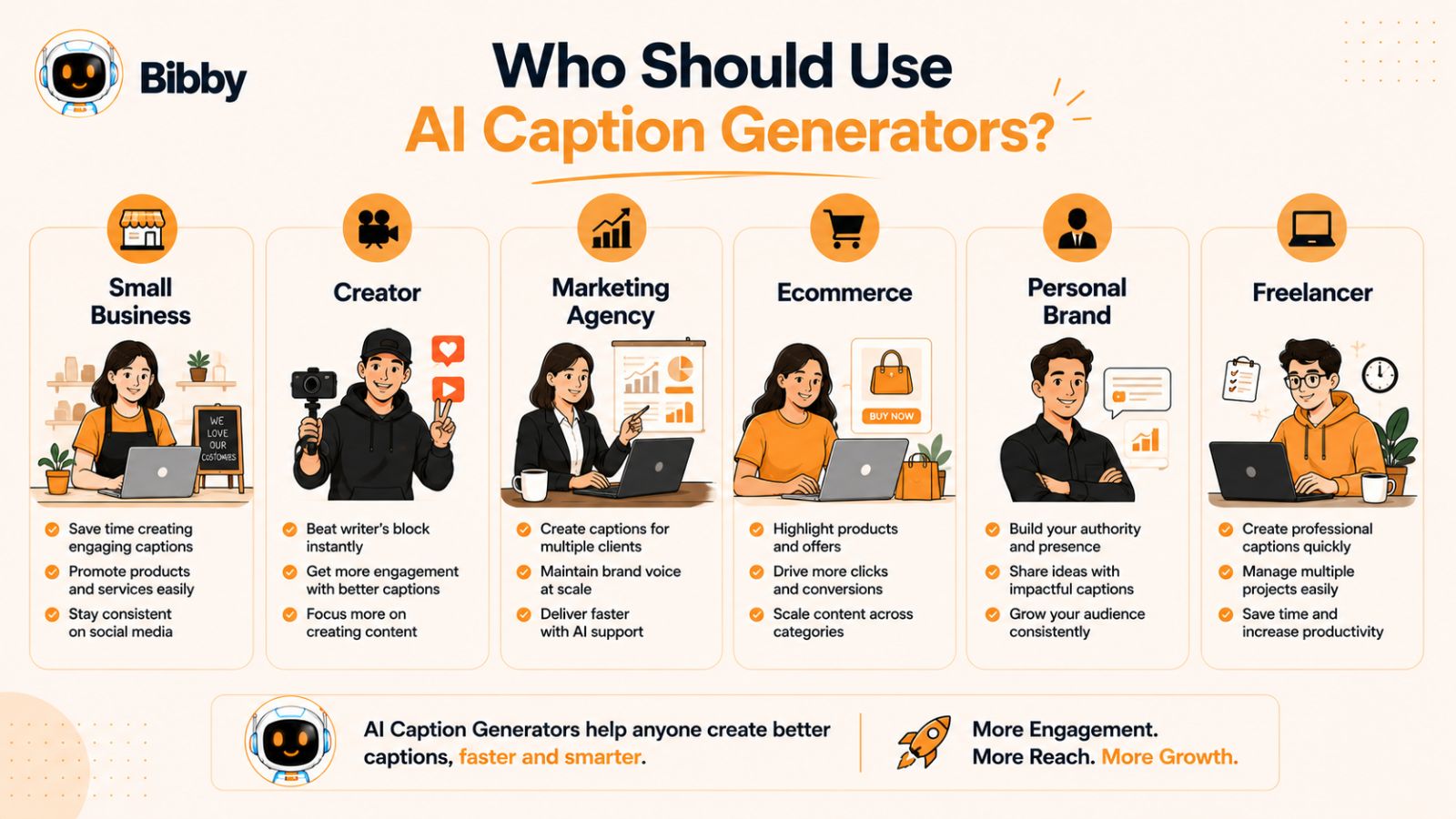
Small Businesses
Small business owners often wear multiple hats, managing everything from customer service to marketing. Finding time to write engaging social media captions every day can be difficult.
An AI caption generator helps streamline content creation by producing caption ideas in seconds, allowing business owners to focus on serving customers and growing their business rather than spending hours writing social media posts.
Content Creators and Influencers
Creators need to publish consistently to keep their audience engaged. Whether you're sharing lifestyle content, travel experiences, educational videos, or product reviews, AI can help generate fresh caption ideas while you focus on creating high-quality content.
You can use AI as a starting point, then personalize each caption to reflect your unique voice and strengthen your connection with your audience.
Marketing Agencies
Agencies often manage multiple clients across different industries, each with its own brand voice and posting schedule. Writing every caption manually can become time-consuming as client portfolios grow.
AI caption generators improve efficiency by producing first drafts quickly, while human editors refine the content before publication. This enables agencies to scale their services without compromising quality.
E-commerce Brands
Online stores rely heavily on social media to showcase products, announce promotions, and drive traffic to their websites.
AI can generate captions for product launches, seasonal campaigns, customer testimonials, and promotional offers, helping e-commerce businesses maintain an active online presence with less manual effort.
Personal Brands and Thought Leaders
Entrepreneurs, coaches, consultants, and industry experts often build their reputation through valuable social media content.
AI can help organize ideas and draft captions, while the creator adds personal insights, experiences, and opinions that establish credibility and authenticity.
Freelancers and Solopreneurs
Freelancers frequently handle every aspect of their business, including marketing. AI caption generators reduce the time spent on repetitive writing tasks, making it easier to stay visible on social media without sacrificing billable hours.
Teams Managing Multiple Social Media Platforms
Publishing the same content across several platforms requires more than simply copying and pasting captions. Each platform has its own audience, formatting preferences, and content style.
Using an all-in-one platform like Bibby makes this process much more efficient. After uploading your content or generating visuals with AI, you can automatically create captions, resize media for different platforms, choose your preferred posting style, schedule posts at AI-optimized times, publish videos and stories, and monitor analytics from one centralized dashboard.
Is an AI Caption Generator Right for You?
If you regularly post on social media and want to save time while maintaining a consistent presence, an AI caption generator is a valuable addition to your workflow. While it won't replace creativity or strategic thinking, it can significantly reduce the effort required to produce high-quality content.
The most successful users treat AI as a productivity tool rather than a replacement for human expertise. By combining AI-generated captions with thoughtful editing and a platform that simplifies scheduling and analytics, you can create a more efficient and scalable social media strategy.
Also read: 25 Social Media Management Mistakes Costing You Followers (And How to Fix Them) →
Common Mistakes to Avoid When Using an AI Caption Generator
An AI caption generator can dramatically improve your social media workflow, but getting the best results requires more than simply copying and pasting AI-generated text. Avoiding these common mistakes will help you create captions that are engaging, authentic, and aligned with your brand.
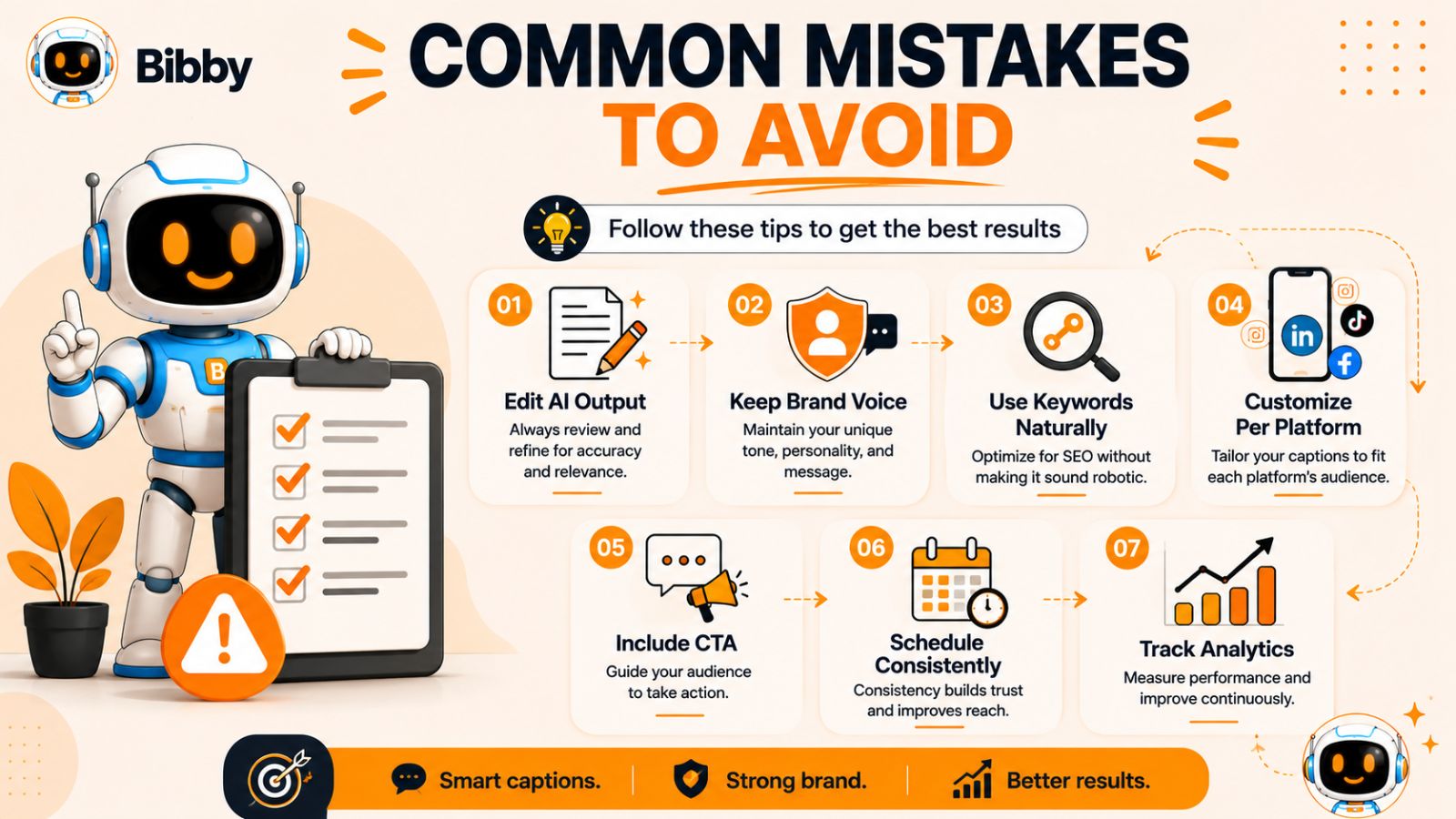
1. Publishing AI-Generated Captions Without Editing
One of the biggest mistakes is treating AI output as the final version. While AI can produce well-written captions, they may not fully capture your brand's personality or accurately reflect your message.
Before publishing, review every caption to:
- Match your brand voice.
- Improve clarity and flow.
- Remove repetitive phrases.
- Add a personal touch.
- Verify facts and product details.
A few minutes of editing can make a significant difference in the quality of your content.
2. Ignoring Your Brand Voice
Your audience follows you because of your unique style and perspective. If every caption sounds generic or inconsistent, your brand identity can become diluted.
Use AI as a starting point, but customize the wording so it reflects your company's tone, values, and communication style.
3. Overusing Keywords and Hashtags
Including relevant keywords helps improve discoverability, but stuffing captions with keywords or excessive hashtags can make them difficult to read.
Instead:
- Use keywords naturally within your message.
- Choose a handful of relevant hashtags.
- Focus on readability before optimization.
Well-written captions perform better than captions overloaded with SEO elements.
4. Forgetting to Include a Call to Action
Even the best caption can miss its purpose if it doesn't guide readers toward the next step.
Depending on your goal, encourage your audience to:
- Leave a comment.
- Share the post.
- Visit your website.
- Watch a video.
- Save the post.
- Send you a message.
A clear call to action increases engagement and gives readers a reason to interact with your content.
5. Using the Same Caption Everywhere
Every social media platform has different audiences and content formats. A caption that performs well on LinkedIn may not be as effective on Instagram or TikTok.
Adjust your captions to match each platform's style while maintaining a consistent brand voice.
Tools like Bibby simplify this process by automatically resizing content for different social media platforms, generating AI-powered captions, and scheduling posts across Facebook, Instagram, LinkedIn, YouTube, TikTok, and more from one place. This makes it easier to adapt your content while managing multiple channels efficiently.
6. Posting Inconsistently
Creating great captions won't deliver results if you post only occasionally. Consistency is one of the most important factors in building an engaged audience and growing your reach.
Planning content in advance and scheduling posts helps maintain a reliable publishing schedule, even during busy periods.
7. Ignoring Performance Analytics
Many marketers focus on publishing content but rarely analyze the results.
Regularly review metrics such as:
- Reach
- Engagement rate
- Click-through rate
- Saves
- Shares
- Comments
- Follower growth
These insights reveal what resonates with your audience and help you refine your future caption strategy. Platforms like Bibby include built-in analytics, making it easier to measure performance and make data-driven improvements over time.
The Bottom Line
An AI caption generator is most effective when used as part of a thoughtful content strategy. By reviewing AI-generated captions, preserving your brand voice, optimizing for each platform, posting consistently, and tracking performance, you can maximize the value of AI while creating content that genuinely connects with your audience.
Also have a look at: Best AI Social Media Content Scheduling Tools
Frequently Asked Questions
Is an AI caption generator better than manual writing?
Neither approach is universally better. AI caption generators excel at creating captions quickly, maintaining consistency, and scaling content production. Manual writing, however, offers greater creativity, emotional depth, and personalization. For most businesses, combining AI-generated drafts with human editing delivers the best results.
Can AI generate captions for all social media platforms?
Yes. Most modern AI caption generators can create captions for platforms such as Facebook, Instagram, LinkedIn, TikTok, YouTube, and X. Many tools also tailor the tone and length of captions to suit each platform's audience and content style.
Will AI-generated captions improve engagement?
AI can help improve engagement by generating well-structured captions, relevant hashtags, and strong calls to action. However, engagement also depends on factors such as content quality, visuals, posting time, audience relevance, and consistency. Editing AI-generated captions to reflect your brand voice often leads to better results.
Are AI-generated captions good for SEO?
Yes. AI caption generators can naturally incorporate relevant keywords, hashtags, and phrases that improve discoverability on social media platforms. As social platforms continue to expand their search capabilities, writing keyword-rich yet natural captions has become increasingly important.
Can AI replace human copywriters?
AI is best viewed as a productivity tool rather than a replacement for professional copywriters. While it can generate ideas, draft captions, and speed up content creation, human writers remain essential for storytelling, strategic messaging, emotional communication, and maintaining a unique brand voice.
How do AI caption generators save time?
Instead of writing every caption from scratch, AI can produce multiple caption options within seconds. This reduces brainstorming time, eliminates writer's block, and enables marketers to focus on higher-value activities such as campaign planning, audience engagement, and performance analysis.
What features should I look for in an AI caption generator?
When choosing an AI caption generator, consider features such as:
- High-quality AI-generated captions.
- Customizable brand voice and writing style.
- Support for multiple social media platforms.
- Built-in hashtag and call-to-action suggestions.
- Content scheduling and publishing tools.
- Analytics and performance tracking.
- Collaboration features for teams.
An all-in-one platform like Bibby combines many of these capabilities by allowing you to generate AI-powered captions, upload or create visuals with AI, automatically resize media for different platforms, schedule posts at AI-optimized times, publish videos and stories, and monitor analytics—all from a single dashboard.
Should I edit AI-generated captions before publishing?
Yes. Reviewing and editing AI-generated captions helps ensure they align with your brand voice, accurately reflect your message, and include any important context or personal insights. Even minor edits can make your content feel more authentic and engaging.
Is an AI caption generator suitable for small businesses?
Absolutely. AI caption generators are particularly valuable for small businesses with limited marketing resources. They reduce the time spent creating social media content while helping businesses maintain a consistent online presence without hiring a dedicated copywriting team.
Conclusion
Choosing between an AI caption generator and manual writing doesn't have to be an either-or decision. AI excels at saving time, improving consistency, and scaling content creation, while manual writing adds the creativity, emotional connection, and authenticity that help brands stand out. The most effective social media strategy combines both—using AI to generate ideas and first drafts, then refining them with your unique voice and expertise.
If you're looking to streamline your entire workflow, platforms like Bibby go beyond caption generation by helping you create or upload visuals, automatically resize content for different social media platforms, generate AI-powered captions, schedule posts at AI-optimized times, publish across Facebook, Instagram, LinkedIn, YouTube, TikTok, and more, and track performance with built-in analytics. This allows you to spend less time managing social media and more time creating meaningful content and growing your business.
Now that you understand how AI and manual writing complement each other, a great next step is learning how to build a complete AI-powered social media content strategy—from content planning and creation to automation, analytics, and long-term audience growth.