
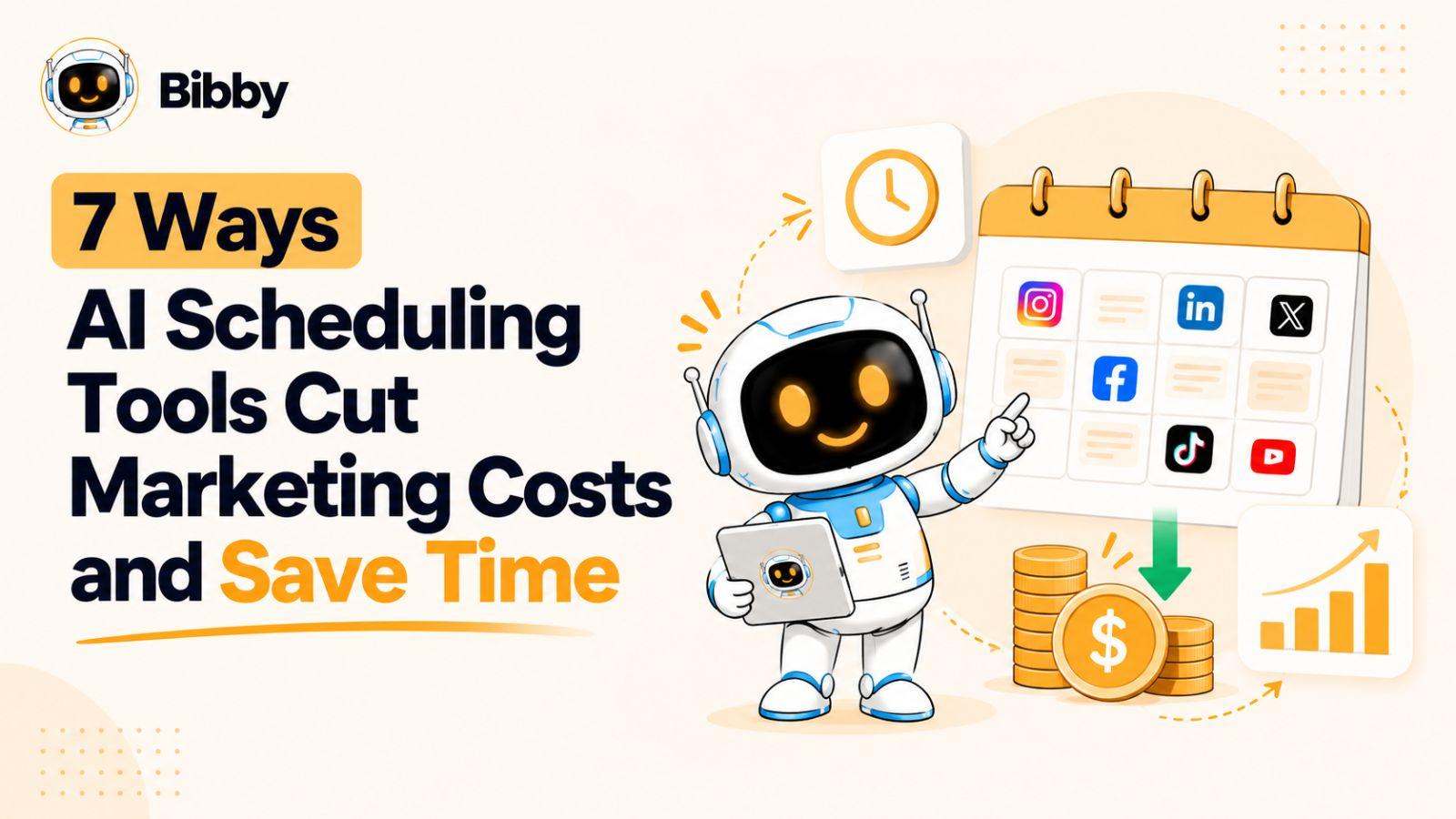
Managing social media across multiple platforms can quickly become one of the most time-consuming parts of digital marketing. AI scheduling tools are changing that by automating repetitive tasks such as Caption creation, content scheduling, and multi-platform publishing.
For marketers, the real value goes beyond posting content automatically: the right AI scheduling tool can reduce manual work, consolidate marketing workflows, and help teams get more from the time and resources they already have. Tools such as Bibby combine AI-powered content creation, automated captions, optimized scheduling, and multi-platform publishing into a single workflow.
Let’s look at exactly where these savings come from and how AI scheduling fits into a modern social media workflow.
What Are AI Scheduling Tools?
AI scheduling tools are software platforms that use artificial intelligence to automate and optimize when, where, and how marketing content is published. In social media marketing, these tools can go beyond simply placing posts on a calendar by helping create captions, adapt content, identify suitable publishing times, and distribute posts across multiple platforms.
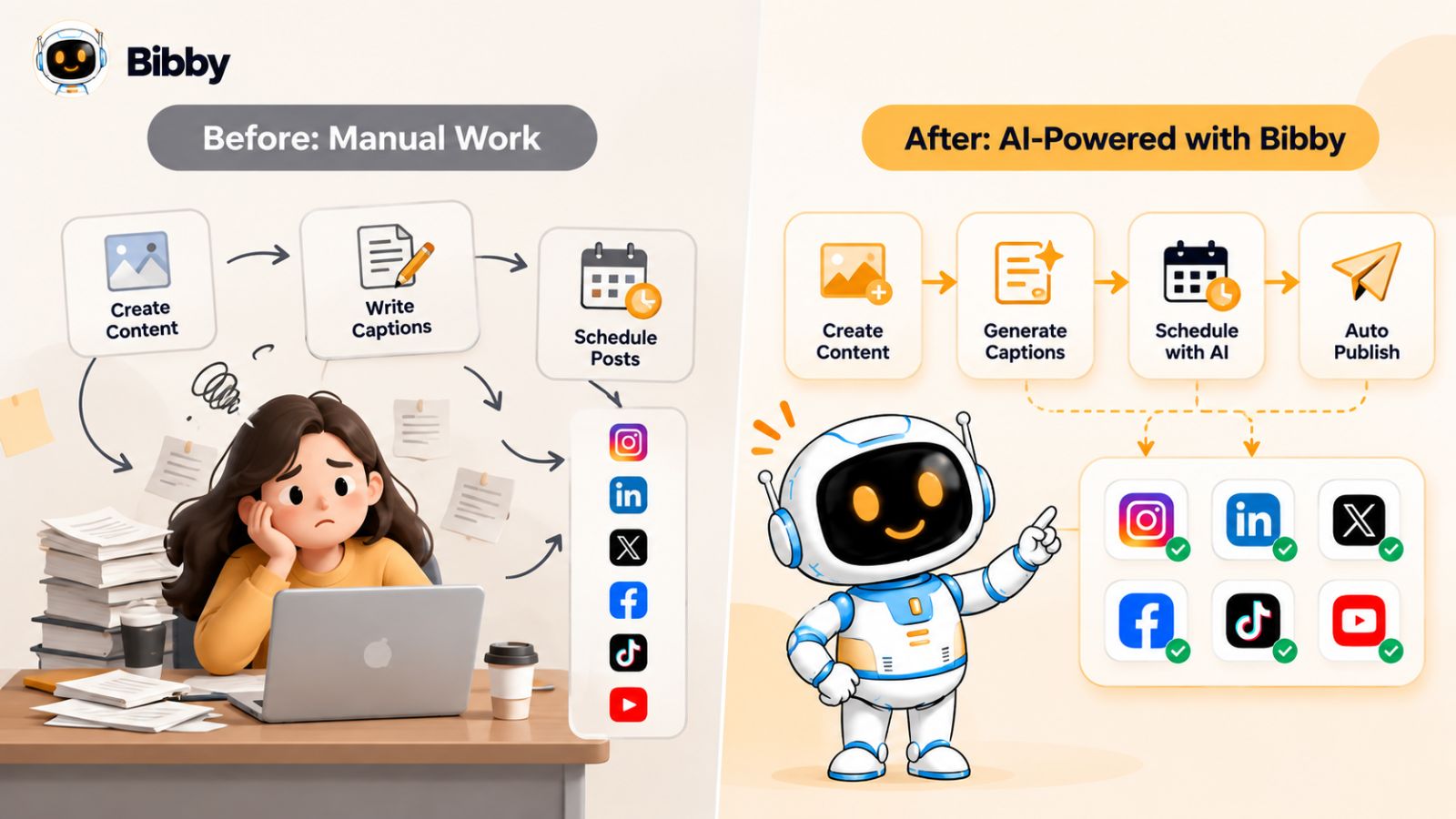
Traditional social media scheduling usually follows a simple process: create a post, choose a platform, select a date and time, and schedule it. That workflow removes some manual publishing work, but the marketer still has to handle most of the decisions and repetitive tasks.
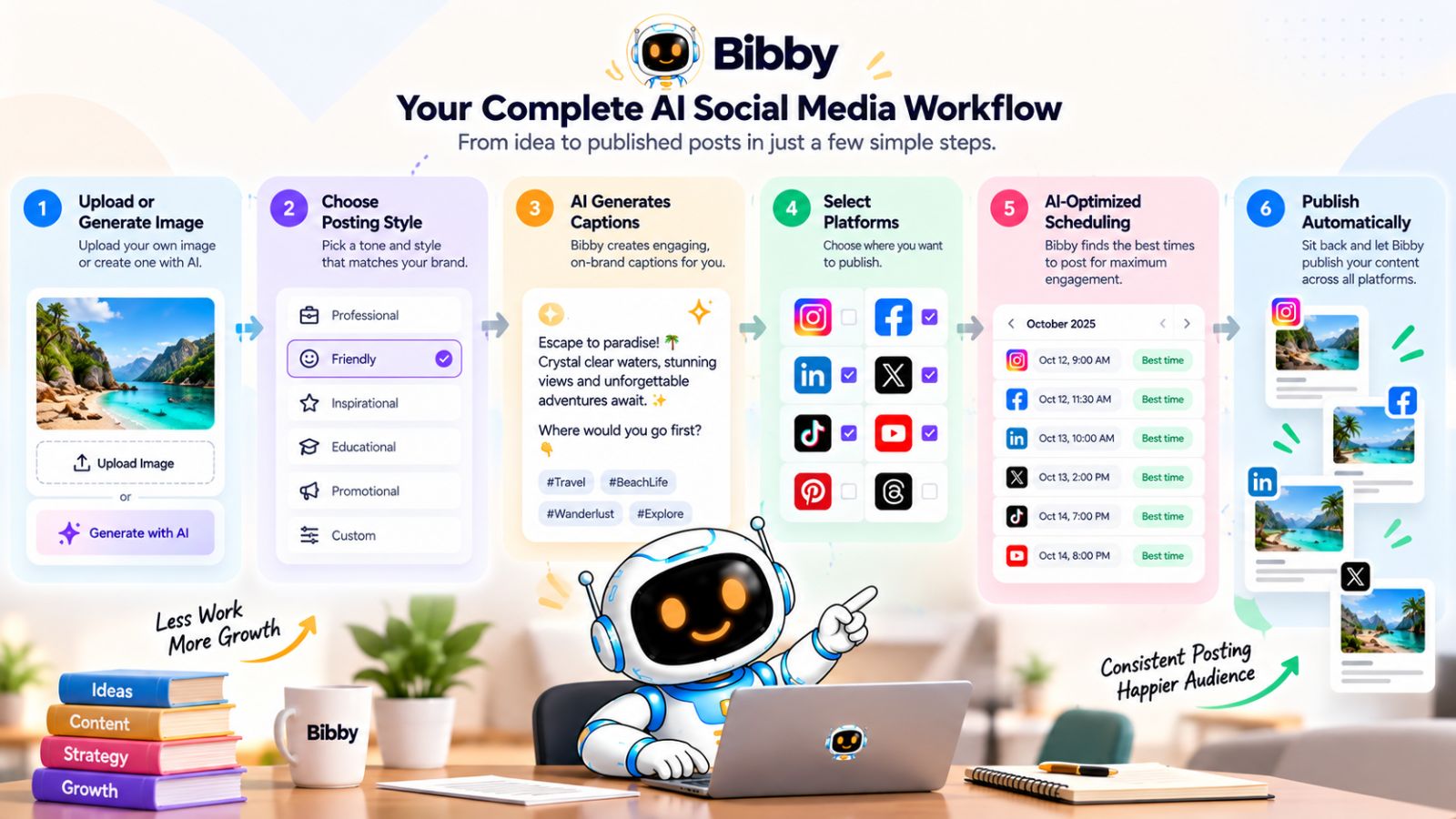
AI scheduling tools can connect more of those steps into one workflow. A marketer might upload an image, use AI to create the visual, choose a preferred posting style, generate a caption, select social platforms, and let the software determine appropriate publishing times. The goal is to reduce the number of manual decisions and actions required to maintain a consistent social media presence.
This distinction matters because the biggest cost savings don't necessarily come from scheduling a post—they come from automating the work surrounding the schedule.
For example, a social media manager responsible for Facebook, Instagram, LinkedIn, YouTube, and TikTok may otherwise have to repeatedly prepare content, write or adapt captions, choose publishing times, upload media, and organize posts for each channel. An AI-powered workflow can bring many of these tasks together, allowing the marketer to spend less time executing routine tasks and more time on strategy, creative direction, audience engagement, and performance analysis.
Modern platforms such as Bibby take this approach further by combining content creation, AI-generated captions, scheduling, multi-platform publishing, and conversational social media management. Instead of treating scheduling as an isolated task, the tool can become part of a broader system for managing the social media workflow.
That shift—from automating individual posts to automating the entire publishing workflow—is where AI scheduling tools can have a meaningful impact on marketing costs and productivity.
Also read the guide on: Best AI Social Media Content Scheduling Tools
How AI Scheduling Tools Reduce Marketing Costs
Marketing costs are not limited to advertising budgets and software subscriptions. A significant portion of the cost of social media marketing comes from the time people spend creating, adapting, organizing, scheduling, and publishing content.
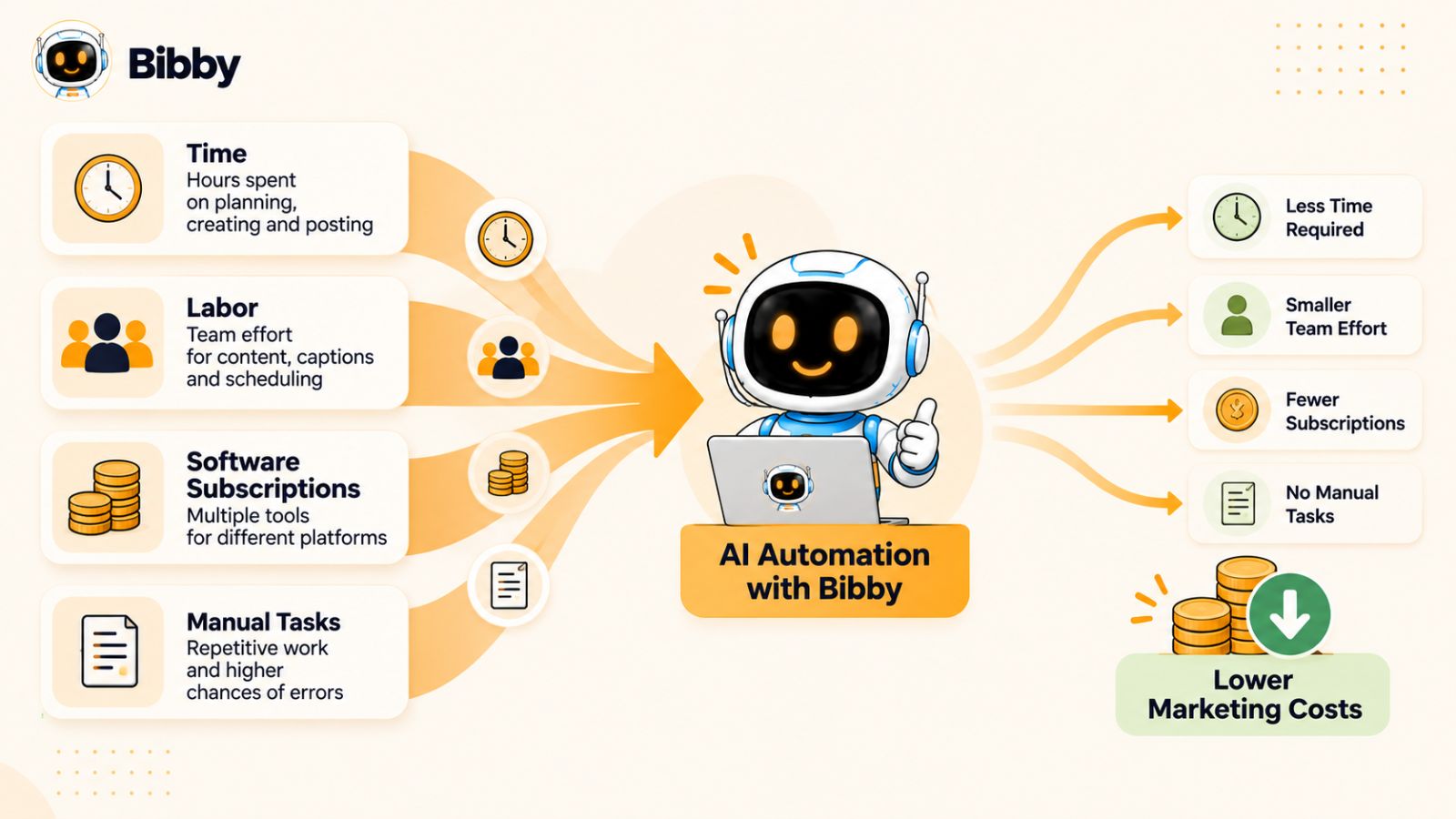
Consider everything that can happen before a single post goes live: finding or creating an image, writing a caption, adapting the message for different platforms, choosing a publishing time, uploading the media, checking formatting, and repeating the process across multiple channels. When these tasks are performed manually every day, the hours add up quickly.
AI scheduling tools can reduce this operational workload by automating parts of the process. Instead of paying a marketer to repeatedly perform the same mechanical tasks, a team can use software to handle much of the execution while people remain responsible for the decisions that require human judgment.
There are several ways this affects the economics of social media marketing.
First, automation reduces labor spent on repetitive tasks. If a social media manager can prepare and schedule a batch of content in substantially less time, those saved hours can be redirected toward higher-value activities such as developing campaigns, analyzing performance, responding to customers, and improving creative strategy.
Second, automation can reduce tool fragmentation. Teams sometimes use one application for graphic creation, another for caption writing, another for scheduling, and separate native platforms for publishing. An AI-powered social media workflow that combines several of these functions can reduce the amount of software switching and manual coordination required.
Third, automation makes content production more scalable. Publishing on five social networks does not necessarily have to require five separate publishing workflows. A centralized system can help marketers manage multiple channels from one place, increasing output without requiring the same proportional increase in manual effort.
Fourth, AI can assist with decisions that previously required additional manual work. For example, instead of manually determining when every post should be published, an AI scheduling platform can use its scheduling logic to identify appropriate publishing times based on the workflow and available data.
Bibby illustrates this broader approach to automation. A marketer can upload an image or generate one with AI, select a posting style, have captions generated automatically, and schedule the resulting content across selected platforms. The platform can also handle formats such as images, carousels, videos, and stories, reducing the number of separate steps involved in maintaining a social media calendar.
The important point is that AI scheduling does not necessarily make marketing cheaper simply because it schedules posts. The potential savings come from reducing the total amount of manual work required to consistently plan, create, prepare, and publish social media content.
That becomes clearer when we break down the specific tasks AI scheduling tools can automate.
1. They Eliminate Repetitive Manual Posting
Publishing a social media post is simple. Publishing dozens of posts across several platforms every week is not.
Without automation, marketers often have to repeat the same basic process for every piece of content: open a platform, upload the media, paste or write the caption, select the date and time, configure the post, publish or schedule it, and then repeat the process for another channel.
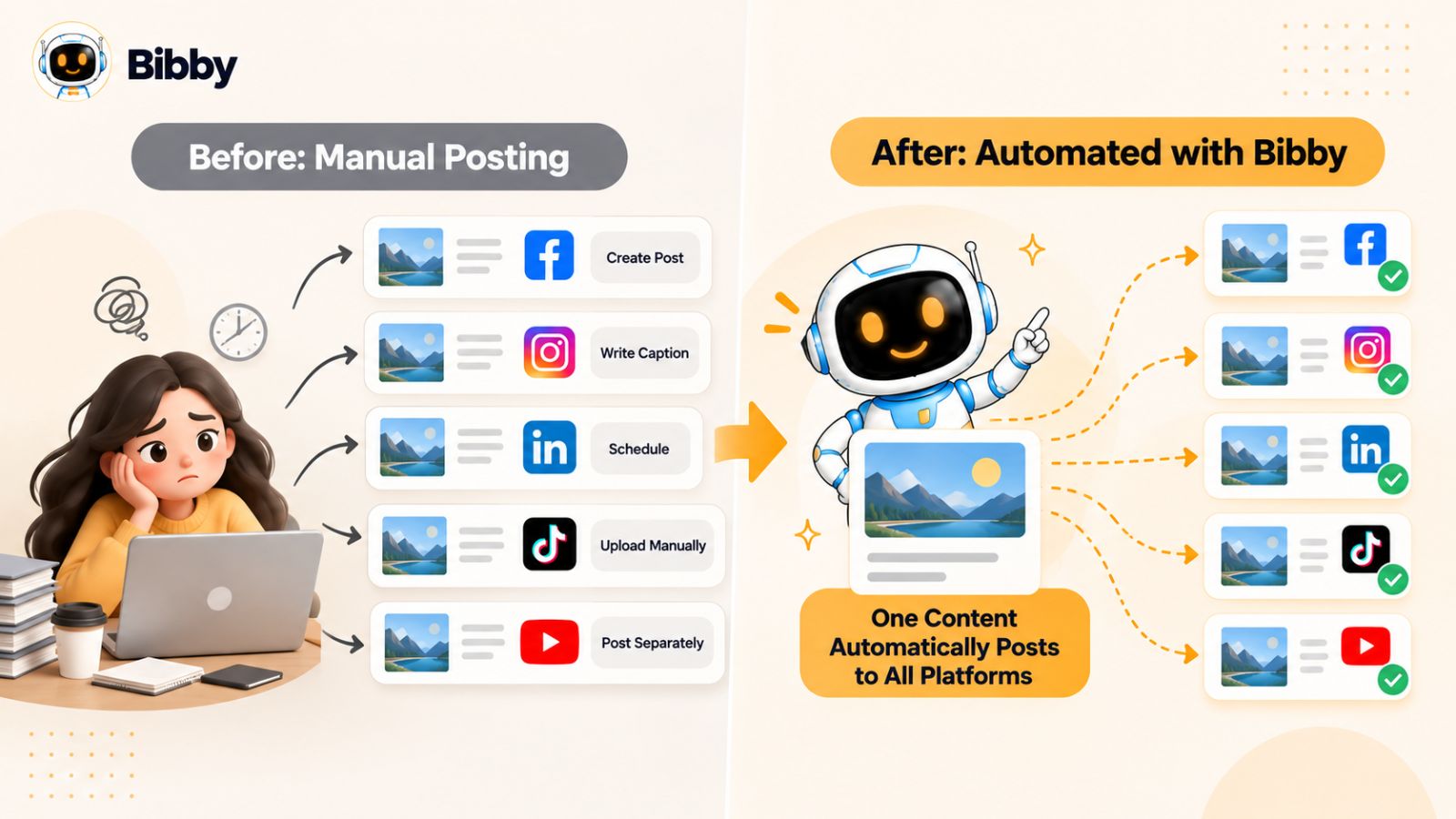
Multiply that workflow across Facebook, Instagram, LinkedIn, YouTube, and TikTok, and a task that initially takes only a few minutes can become hours of repetitive administrative work every week.
AI scheduling tools reduce this repetition by allowing marketers to manage multiple publishing destinations from a centralized workflow. Instead of manually coordinating every post on every platform, marketers can prepare their content once and let the scheduling system handle much of the distribution.
This is particularly useful for businesses that maintain a consistent publishing schedule. A marketing team might prepare a week or month of content in advance, then use an AI scheduling tool to organize when each piece should be published rather than returning to each platform every day.
Bibby is designed around this type of workflow. After uploading an image or generating one with AI, users can select the platforms they want to publish to and schedule their content rather than manually uploading the same media to each network. The platform supports formats including images, carousels, videos, and stories, allowing more of the publishing process to happen from one place.
The time savings become more significant as the number of platforms and posts increases.
For example, imagine a business publishes five pieces of content per week across four social networks. Even if manually preparing and scheduling each platform-specific post takes only a few minutes, the repeated actions can consume several hours over the course of a month. Automation doesn't eliminate the need to create a content strategy or review the final posts, but it can remove much of the repetitive execution.
That distinction is important.
AI scheduling tools aren't replacing the marketer's role; they're reducing the amount of manual publishing work the marketer has to perform.
The hours saved can then be redirected toward activities that are harder to automate and more valuable to the business, such as developing campaign ideas, studying audience behavior, responding to customers, and analyzing content performance.
And manual publishing is only one part of the workload. Writing captions for every post can consume just as much time.
2. They Reduce the Time Spent Writing Social Media Captions
Creating social media content isn't just about producing a visual. Every post usually needs supporting copy, and writing that copy repeatedly can become a surprisingly large part of a marketer's workload.
A single campaign might require dozens of captions. If the same content needs to appear on Instagram, Facebook, LinkedIn, TikTok, or other channels, marketers may also need to adjust the wording, length, tone, hashtags, and call to action for each platform.
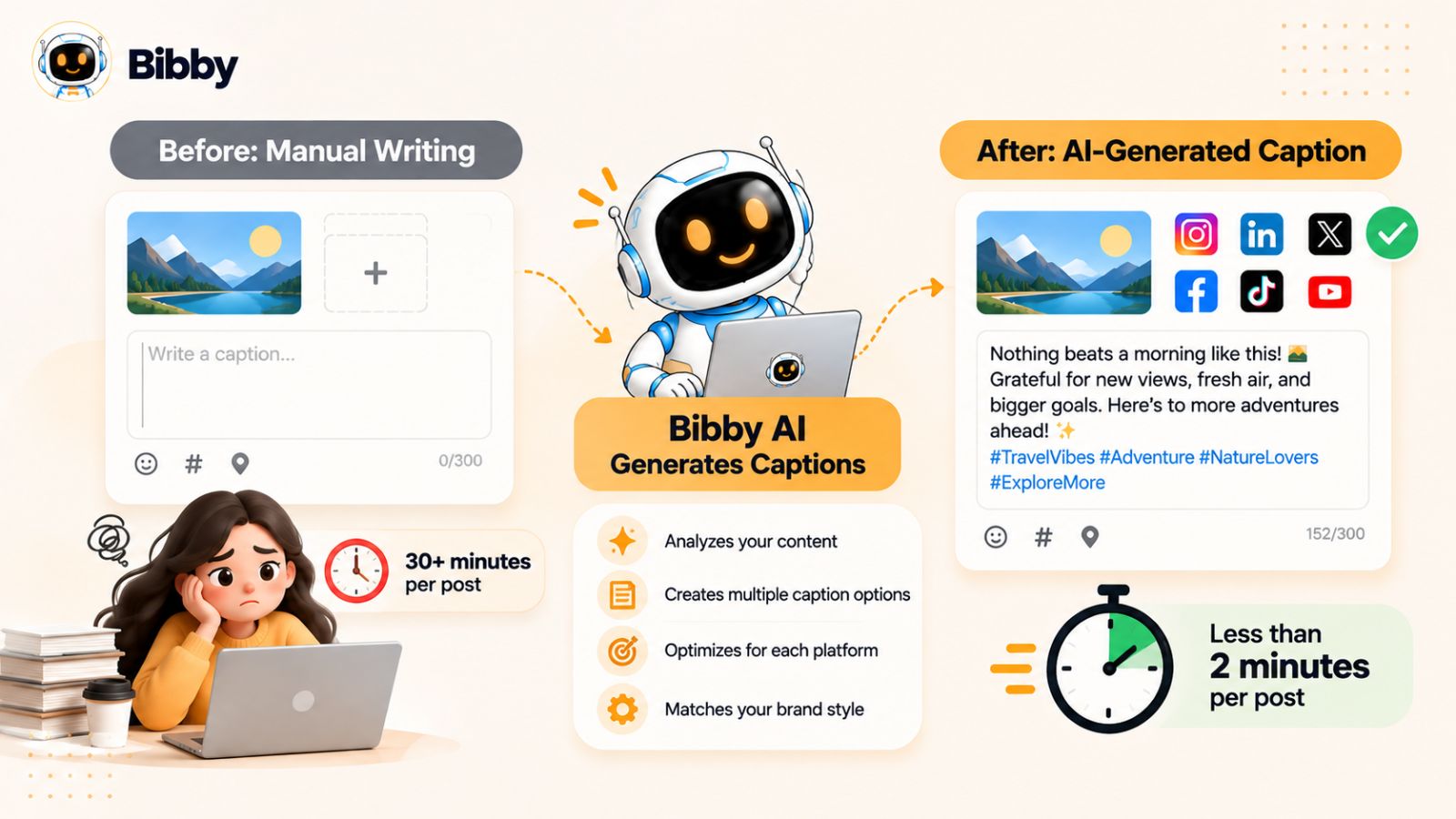
AI scheduling tools can reduce this workload by generating captions as part of the publishing workflow.
Instead of starting with a blank text box every time, a marketer can provide the content and desired style, then use AI to create a caption that can be reviewed and edited before publication. This can turn caption writing from a time-consuming creative bottleneck into a faster review-and-refine process.
For example, Bibby allows users to choose a posting style and automatically generate captions for their social media content. Rather than separately writing copy for every scheduled post, marketers can use AI to create the initial version and then make any edits needed to match their brand voice.
This becomes particularly useful when creating content in batches. A marketer could prepare several visuals or videos, upload them, generate captions, and organize the resulting posts within the same scheduling workflow. Instead of repeatedly switching between a content-generation tool and a scheduling platform, more of the process happens in one place.
However, automation shouldn't mean publishing every AI-generated caption without review.
Brand voice, factual accuracy, context, and audience expectations still matter. A strong workflow treats AI-generated copy as a starting point that speeds up production while leaving the final editorial decision with the marketer.
The real cost saving comes from reducing the amount of time required to get from idea to publishable caption.
If a marketer previously spent several minutes brainstorming, drafting, editing, and formatting every caption, even a modest reduction in that time can create substantial savings when multiplied across dozens or hundreds of monthly posts.
And captions aren't the only scheduling decision AI can help with. Marketers also spend considerable time deciding when each post should go live.
3. They Help Teams Publish at Better Times Automatically
Choosing when to publish social media content sounds simple until you're managing dozens of posts across several platforms.
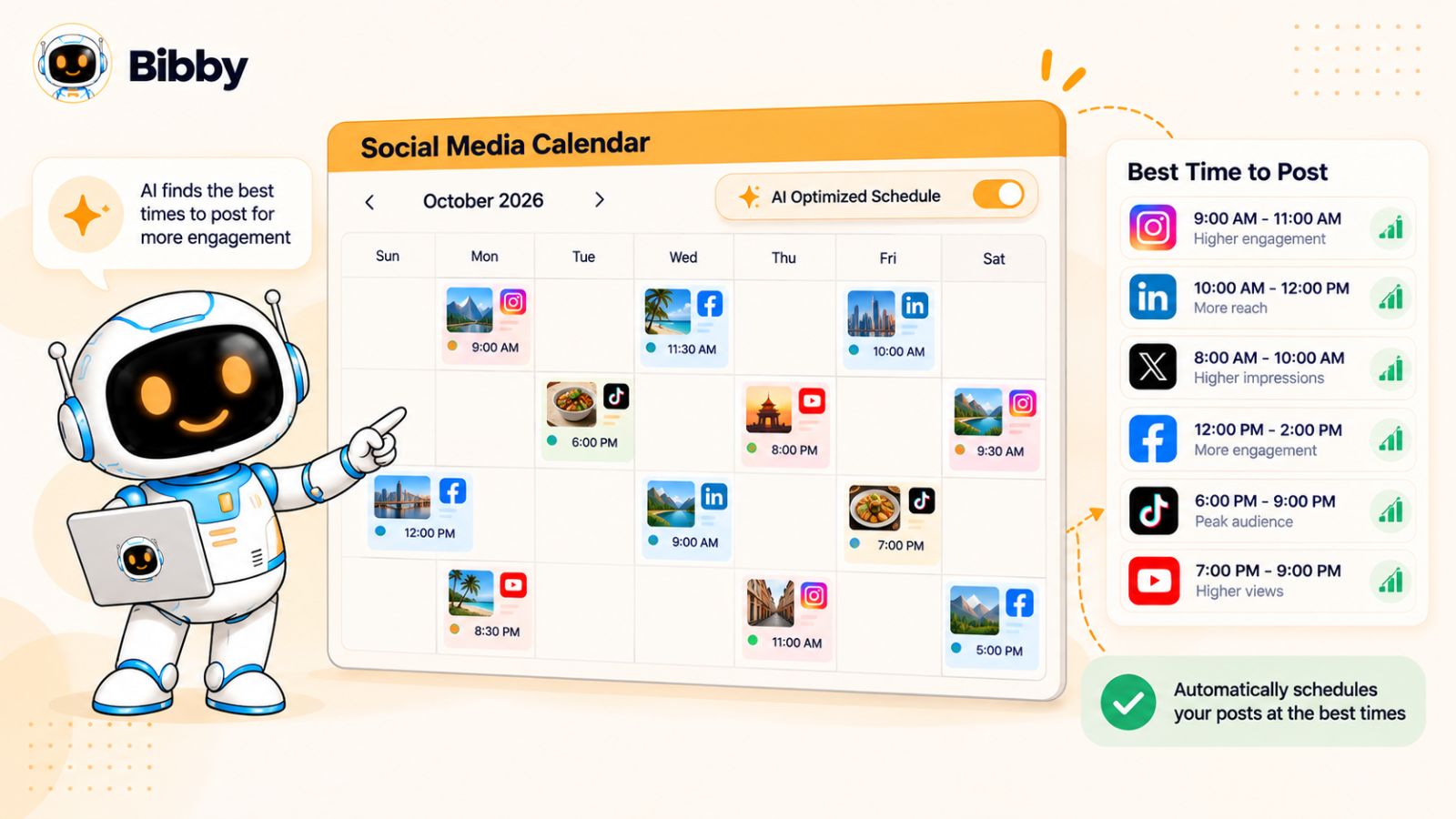
Marketers have to consider audience activity, time zones, platform differences, campaign schedules, and the timing of other content. When this is handled manually, every post creates another small scheduling decision.
AI scheduling tools can automate much of that decision-making by using scheduling logic and available audience or platform data to identify suitable publishing times. Instead of requiring marketers to manually choose a date and time for every post, the software can help determine when content should enter the publishing queue.
This matters because the time spent choosing publishing slots can become another form of hidden marketing labor.
Imagine a social media manager preparing 30 posts for the month. If each post needs to be manually assigned a date and time across multiple platforms, the scheduling process itself becomes a recurring administrative task. An automated system can reduce that workload by organizing the content according to its scheduling rules.
Bibby incorporates AI-optimized scheduling into its workflow. Once content is prepared, users can schedule their media across selected social platforms while allowing the system to determine appropriate publishing times. This means the marketer doesn't have to manually decide the exact posting time for every individual piece of content.
The benefit isn't simply convenience. Automated scheduling creates a more repeatable publishing process.
Instead of asking every day, “What should we post today, and when should it go live?”, a marketing team can prepare content in batches and allow the scheduling system to manage the calendar.
There is also an important distinction between optimization and prediction. No AI system can guarantee that a particular publishing time will produce a specific result. Audience behavior changes, platform algorithms change, and the quality of the content still matters. AI-optimized timing should therefore be viewed as a way to reduce manual decision-making and improve the consistency of the workflow—not as a guarantee of higher engagement.
For marketers, the practical advantage is that scheduling becomes something they set up and review, rather than something they have to repeatedly manage throughout the week.
And when an AI scheduling platform can also create content, generate captions, and publish across multiple networks, the potential savings extend beyond scheduling itself.
That leads to another major source of wasted marketing spend: using too many disconnected tools to accomplish what could be handled in one workflow.
4. They Reduce the Need for Multiple Social Media Tools
A social media workflow can become complicated surprisingly quickly. One tool might be used to create graphics, another to generate captions, another to schedule posts, and the native dashboards of each social network may still be needed for publishing or management.
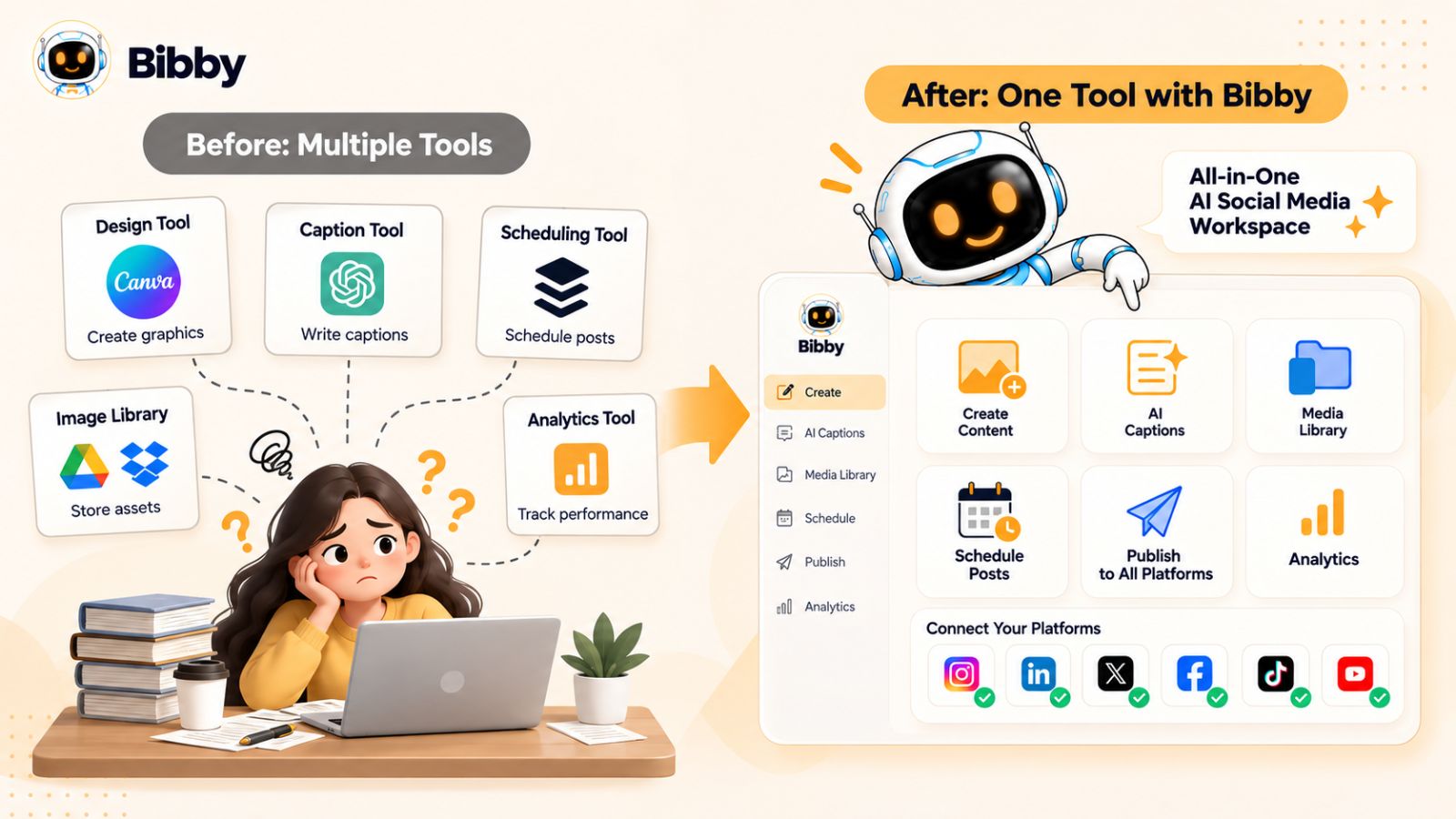
Each tool may be useful individually. The problem is the workflow between them.
Marketers have to move files from one platform to another, copy captions, check formatting, switch accounts, coordinate publishing schedules, and keep track of which content has already been prepared. The more disconnected tools involved, the more opportunities there are for duplicated work and missed steps.
AI scheduling platforms can reduce this fragmentation by bringing more of the workflow into one environment.
Instead of creating a visual in one application, generating a caption somewhere else, manually transferring the content to a scheduling platform, and then managing individual networks separately, marketers can use an integrated workflow to handle several of these tasks together.
Bibby is an example of this broader approach. A user can upload an existing image or generate an image with AI, choose a posting style, generate captions automatically, select social platforms, and schedule the content from the same workflow. It also supports different formats, including images, carousels, videos, and stories.
This can reduce more than software costs. It can reduce workflow costs.
Suppose a marketing team uses several separate applications. Every transition between those applications introduces another action: downloading a file, uploading it again, copying text, checking the correct account, or remembering which version of an asset is current. None of these tasks is particularly difficult, but collectively they consume time that could otherwise be spent on marketing strategy.
Consolidation can also make social media management easier for smaller teams. A business that doesn't have a dedicated specialist for every part of the content process may benefit from having creation, caption generation, scheduling, and publishing closer together.
However, using fewer tools isn't automatically better. A specialized tool may still provide functionality that an all-in-one platform doesn't. The important question is whether the combined workflow eliminates enough repetitive work to justify consolidating the process.
For many businesses, the most valuable outcome isn't simply paying for one fewer subscription. It's having fewer places to manage the same piece of content.
And once content can be created and distributed through a centralized workflow, another opportunity emerges: getting more content out of the work you've already done.
That's where content repurposing becomes particularly valuable.
5. They Make Repurposing Content Faster
Creating original content for every social media post can become one of the biggest demands on a marketing team's time. But not every post needs to start from scratch.
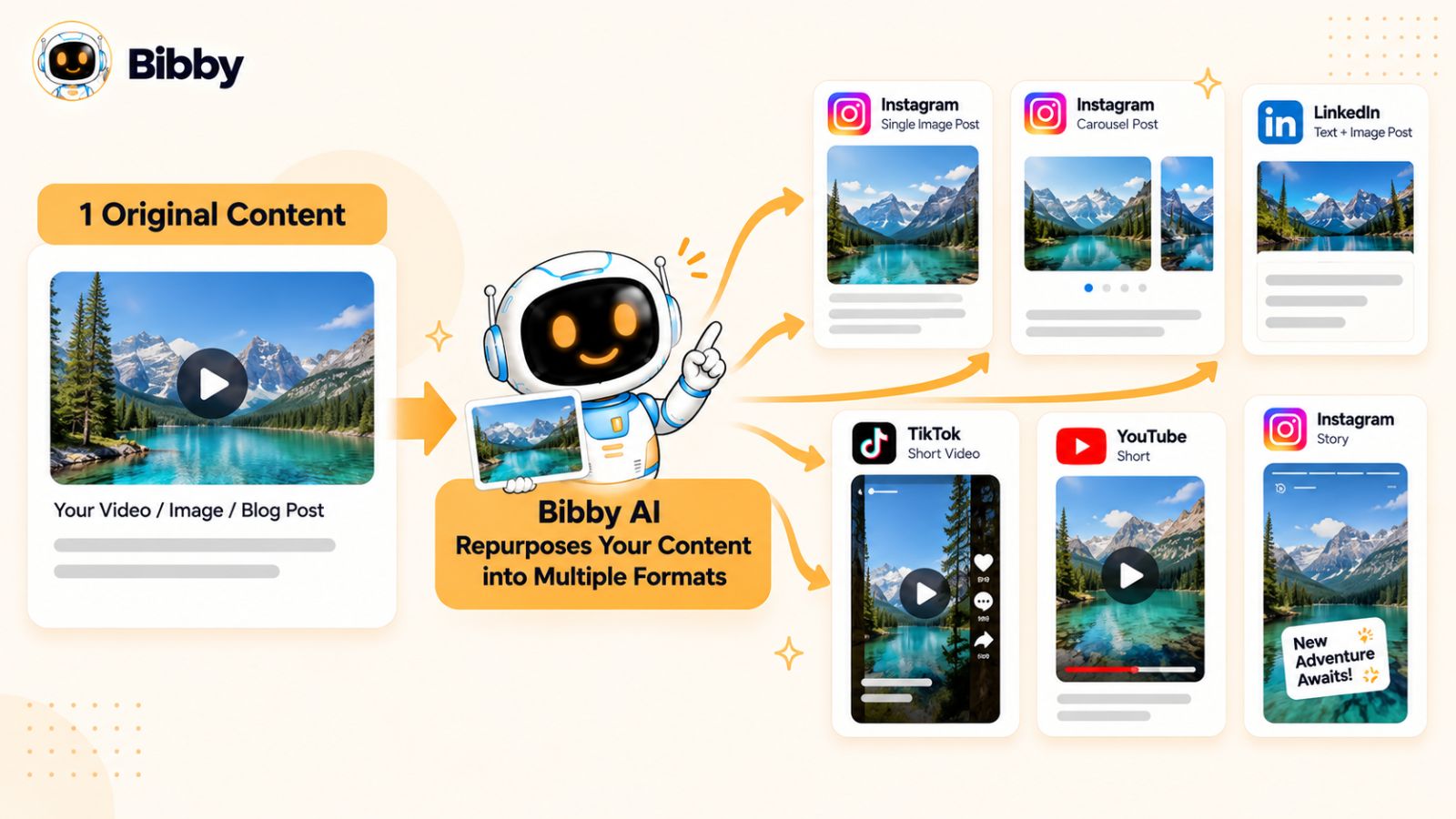
A single campaign asset can often be used in several different ways. An image can become an Instagram post, a Facebook update, or part of a carousel. A video can be adapted for short-form platforms. A campaign idea can generate multiple posts with different angles, formats, and calls to action.
The challenge is turning that existing material into usable social content without creating another large production workload.
AI-powered social media tools can make this process faster by helping marketers organize, adapt, and schedule content across different formats and platforms. Instead of treating every post as an entirely separate project, teams can build a larger content system around the assets they already have.
This has a direct effect on marketing efficiency.
If a business spends significant time producing a campaign visual, maximizing the value of that asset means finding multiple appropriate ways to use it. The goal isn't to publish the exact same post everywhere indefinitely. It's to extract more useful content from the original creative work while adapting it to the context of each platform.
Bibby supports this workflow by allowing marketers to work with different types of social media content, including images, carousels, videos, and stories. Combined with AI-generated visuals, captions, and automated scheduling, this makes it possible to build a broader publishing calendar from a relatively small set of initial creative inputs.
For example, a marketer could start with a single campaign concept and create several related social assets from it. Those assets can then be distributed over different dates rather than publishing everything at once. The result is a more structured content pipeline without requiring the team to develop an entirely new concept for every publishing slot.
This is particularly useful for small marketing teams.
A larger company may have dedicated designers, copywriters, social media managers, and video specialists. A small business may have one person responsible for most of those functions. Repurposing allows that person to increase content output without increasing production effort at the same rate.
The key is to distinguish repurposing from repetition.
Simply copying the same content onto every platform may save time, but it doesn't necessarily create the best experience for the audience. Effective repurposing means preserving the central idea while adjusting the format, presentation, or message to suit the channel.
When AI handles more of the repetitive transformation and scheduling work, marketers can focus on deciding which ideas are worth expanding and how those ideas should be presented.
That leads to one of the biggest advantages of automation: allowing a small marketing team to operate with the publishing capacity of a much larger workflow.
6. They Let Small Teams Operate Like Larger Marketing Teams
A large social media operation can divide marketing work among strategists, designers, copywriters, content creators, and social media managers. Smaller businesses rarely have that luxury.
Often, one person is expected to plan campaigns, create content, write captions, schedule posts, monitor multiple platforms, and analyze results. The challenge isn't necessarily a lack of ideas. It's the amount of execution required to turn those ideas into a consistent publishing schedule.
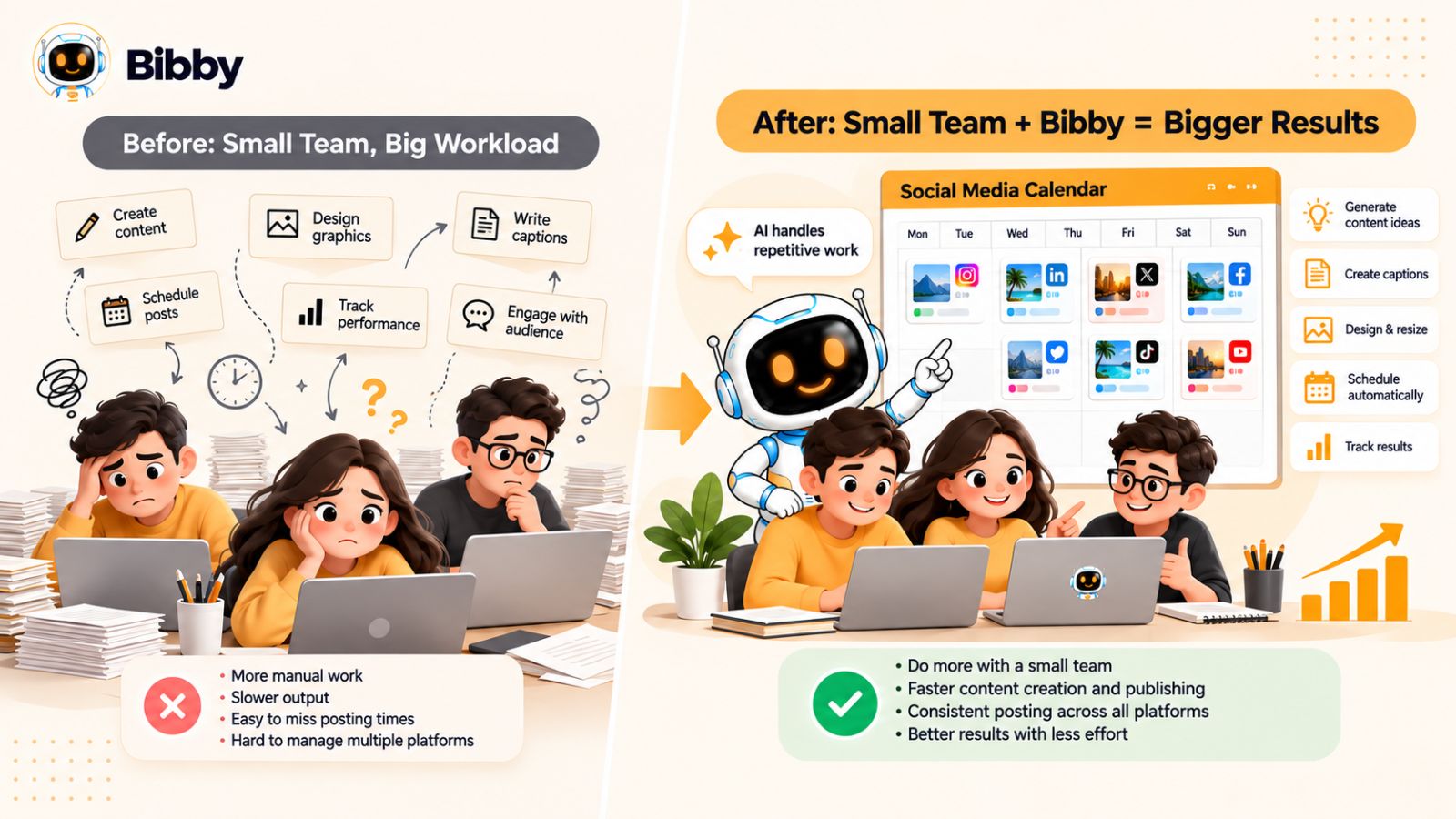
AI scheduling tools can reduce that execution burden.
By automating repetitive parts of the workflow, a small team can spend less time performing administrative social media tasks and more time making decisions that require human judgment. The team still controls the strategy, messaging, creative direction, and final approval, while software handles more of the repetitive execution.
This changes what a small marketing team can accomplish with the same number of people.
For example, a business might previously have struggled to maintain a consistent presence across Facebook, Instagram, LinkedIn, YouTube, and TikTok because manually managing every channel consumed too much time. With an automated workflow, the team can prepare content in batches and schedule it across multiple platforms without individually managing every publishing action.
Bibby's workflow is designed around this kind of consolidation. A marketer can create or upload visual content, generate captions, choose a posting style, schedule content across selected platforms, and manage different formats from one system. Its chat interface adds another layer by allowing users to interact with the social media workflow conversationally.
For example, instead of navigating through multiple menus for every task, a marketer can use the chat interface to work on activities such as creating a brand kit, building a campaign, creating posts, or regenerating captions.
The benefit is not that AI becomes the marketing team.
The benefit is that the marketing team spends less of its time behaving like a publishing operations department.
That distinction matters. Strategy still requires people who understand the company's customers, positioning, products, brand voice, and business objectives. AI can accelerate the execution of that strategy, but it doesn't automatically know which audience to target, which message matters most, or what the business should stand for.
When repetitive execution is automated, however, marketers have more time to work on those higher-value decisions.
This can also reduce the need to scale headcount purely because the number of social channels or publishing requirements has increased. A business can potentially increase its content operations without increasing manual workload at the same rate.
And the more capable AI scheduling platforms become, the more they can automate beyond individual posts.
Instead of simply asking software to publish content, marketers can increasingly use AI to manage larger parts of the social media workflow itself.
7. They Automate More Than Publishing
The biggest misconception about AI scheduling tools is that their primary purpose is simply to post content at a predetermined time.
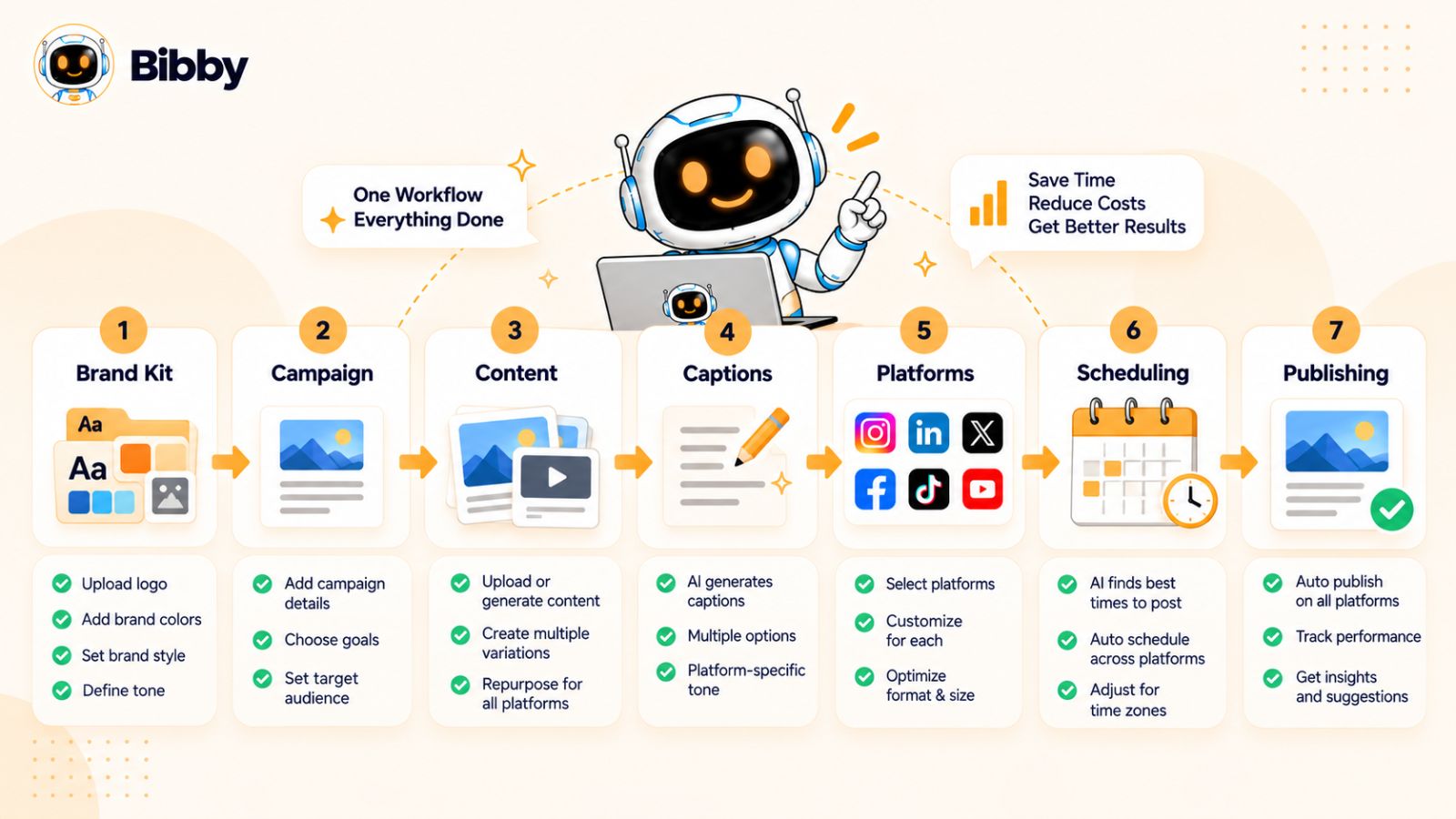
Scheduling is useful, but it is only one part of social media management. Modern AI-powered platforms can connect content creation, caption writing, campaign planning, brand management, scheduling, and publishing into a more unified workflow.
This changes the role of automation.
Instead of using AI only after a marketer has already completed all the creative and strategic work, marketers can use it throughout the content workflow. The marketer provides the direction, context, and brand requirements, while AI helps turn those inputs into executable social media tasks.
Bibby's chat interface is an example of this approach. Rather than requiring users to manage every task through separate scheduling screens, users can interact with the platform conversationally to manage parts of their social media workflow.
Within the chat experience, users can work on tasks such as:
- Creating a brand kit
- Creating a campaign
- Creating social media posts
- Regenerating captions
- Managing content workflows
This conversational approach can reduce the friction involved in moving from one task to another.
For example, instead of separately creating a campaign, preparing individual posts, writing captions, and then organizing everything inside a scheduling calendar, a marketer can use a conversational workflow to move between these activities.
The same principle applies to content creation. A user can upload an existing image or use AI to generate one, select a preferred posting style, generate a caption, and schedule the content across selected social platforms. The workflow can then handle different content formats, including images, carousels, videos, and stories.
This is an important distinction when evaluating AI scheduling tools.
A traditional scheduler primarily answers:
“When should this post be published?”
A broader AI social media platform can help answer:
“What should I create, how should I present it, where should it go, and when should it be published?”
That doesn't mean AI should make every marketing decision independently. Human oversight remains important for brand positioning, campaign strategy, factual accuracy, creative quality, and audience relationships.
Instead, the value comes from reducing the number of low-value operational decisions that marketers have to make manually.
When those individual tasks are connected, the cumulative time savings can become much larger than the benefit of scheduling alone.
And that brings us to the central idea behind AI-powered social media automation: the greatest efficiency gains come from automating the workflow around publishing, not merely the publishing action itself.
Also read: How AI Automation Helps New Brands Go From 0 to Viral →
Traditional Social Media Scheduling vs. AI Scheduling
The difference between traditional social media scheduling and AI scheduling isn't simply that one uses artificial intelligence and the other doesn't. The bigger difference is how much of the social media workflow the tool can help automate.
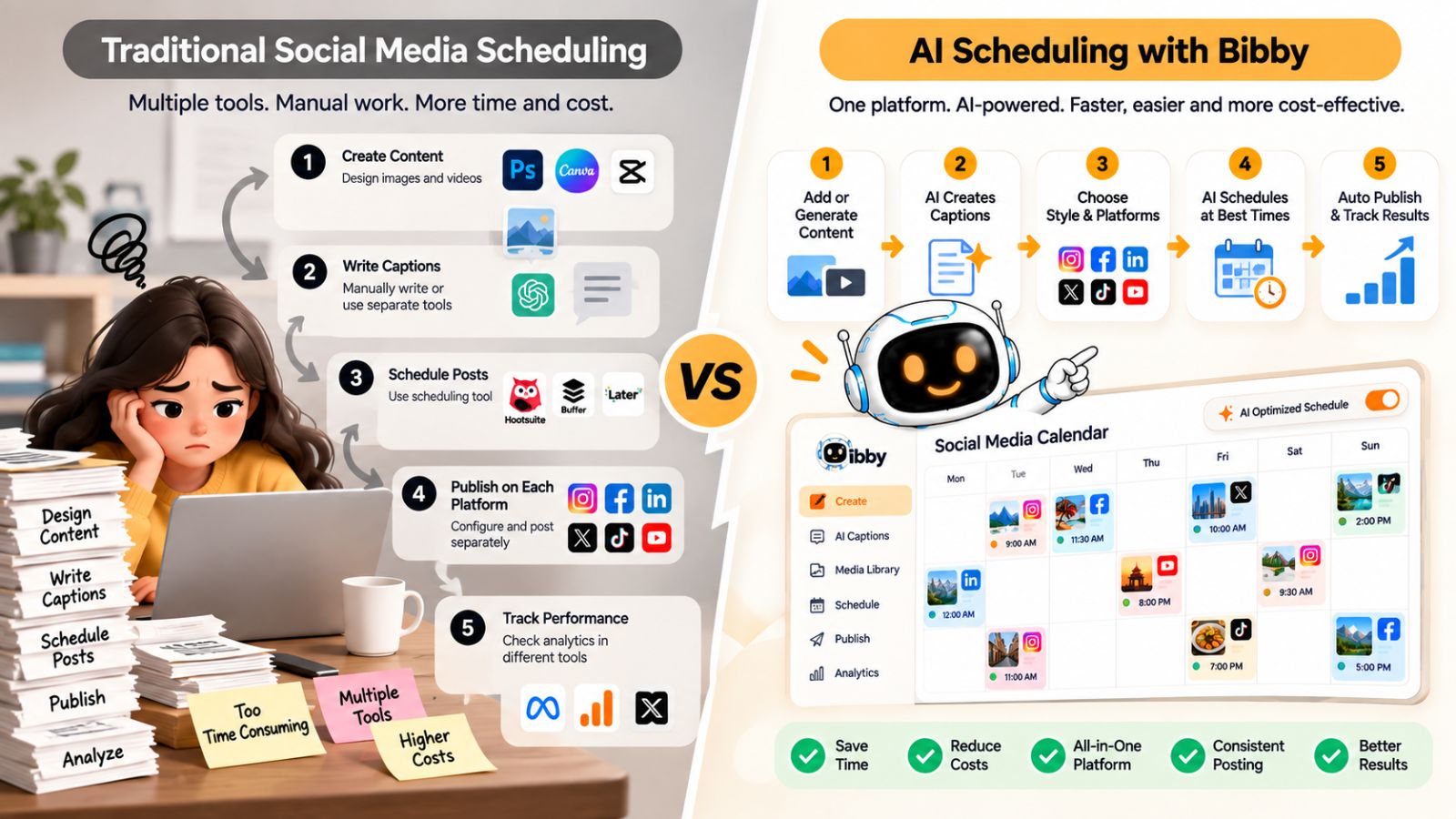
Traditional scheduling platforms are primarily designed to solve a publishing problem. A marketer creates the content, writes the caption, decides when it should be published, and then uses the scheduler to place that content on a calendar.
AI-powered platforms can extend the workflow further by assisting with content creation, captions, publishing-time decisions, campaign organization, and multi-platform distribution.
Here's how the two approaches typically compare:
| Workflow | Traditional Scheduling | AI Scheduling |
|---|---|---|
| Content creation | Usually handled separately | Can be AI-assisted |
| Caption writing | Mostly manual | AI-generated or assisted |
| Publishing time | Manually selected | Can be AI-optimized |
| Multi-platform posting | Scheduled manually | Automated from a centralized workflow |
| Content variations | Often created manually | Can be AI-assisted |
| Campaign workflow | Often separate from scheduling | Can be integrated |
| Brand management | Usually separate | Can be incorporated into the workflow |
| Social management | Primarily calendar-based | Calendar + AI-assisted workflows |
The distinction becomes especially important when managing several social networks.
With a traditional scheduler, a marketer may still need to create the visual in one application, write the caption separately, decide the publishing time, and then move everything into the scheduling platform.
With an AI-powered workflow, more of those activities can happen within the same system.
Bibby demonstrates this broader model by combining AI-assisted visual creation, caption generation, posting-style selection, multi-platform scheduling, and support for different content formats. Its chat interface also allows users to manage tasks such as campaigns, brand kits, posts, and caption regeneration conversationally.
However, AI scheduling shouldn't be viewed as a replacement for traditional marketing judgment.
A human still needs to decide what the brand should communicate, which campaigns matter, how the company should position itself, and whether the final content accurately represents the business. AI is most useful when it reduces the operational workload surrounding those decisions.
This is why the most useful question isn't necessarily “Which scheduler has the most AI features?”
A better question is:
“How much of my current social media workflow can this tool remove, simplify, or automate?”
The answer to that question determines whether an AI scheduling tool is merely another calendar or a meaningful part of a more efficient marketing operation.
How Much Time Can AI Scheduling Actually Save?
The amount of time an AI scheduling tool saves depends on how much content a business publishes, how many platforms it manages, how complex its workflow is, and how much of that work was previously performed manually.
There is no universal number of hours that applies to every marketing team. A business publishing five posts per month has a very different workload from a brand publishing multiple pieces of content every day across several platforms.
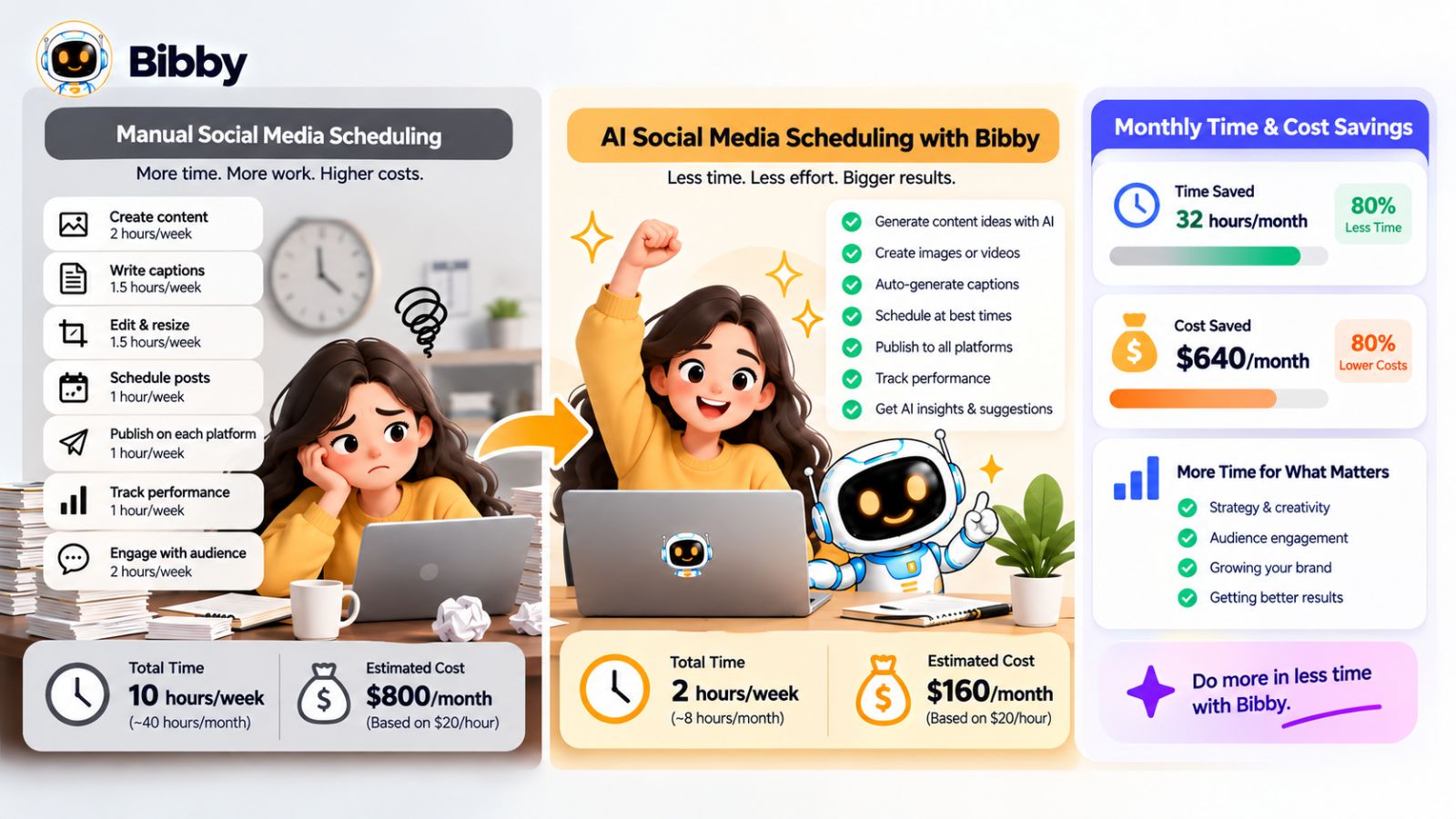
A better way to measure the potential value is to calculate how much time your existing workflow consumes.
Start by listing the recurring tasks involved in your social media process:
- Creating or sourcing visual assets
- Writing captions
- Adapting content for different platforms
- Uploading media
- Choosing publishing dates and times
- Scheduling posts
- Managing multiple content formats
- Organizing campaigns
- Repeating these tasks across multiple social networks
Then estimate how much time your team spends on each activity every month.
For example, imagine a marketer spends an average of 10 minutes preparing and scheduling each social media post. If the business publishes 100 posts per month, that represents approximately 16.7 hours of manual scheduling and preparation time before accounting for broader content-production work.
If automation reduces the manual portion of that workflow, the business can calculate the value of the time recovered.
A simple calculation is:
Monthly labor savings = hours saved × hourly labor cost
For example, if a business saves 10 hours per month and values the marketer's working time at $30 per hour, the recovered labor capacity represents $300 per month in potential operational value.
The calculation can become more useful when software consolidation is included:
Potential monthly savings = labor time recovered + avoided software costs + value of additional productive capacity
The third component is important. Time doesn't necessarily have to translate directly into a lower payroll expense to create value. A marketer who spends fewer hours scheduling posts can use that time for campaign planning, audience research, creative development, customer engagement, or performance analysis.
AI scheduling tools such as Bibby can potentially reduce time across several parts of this calculation because the workflow extends beyond basic calendar scheduling. Content can be uploaded or generated with AI, captions can be created automatically, publishing times can be optimized, and content can be scheduled across selected platforms.
The best way to evaluate the impact is therefore to measure your before-and-after workflow, rather than relying on a generic claim about how many hours AI will save.
Track how long it takes to turn an idea into a published social media post today. Then compare that process after introducing automation.
That gives you a much clearer picture of whether an AI scheduling tool is actually reducing your marketing costs.
What to Look for in an AI Social Media Scheduling Tool
Not every social media scheduler provides the same level of automation. Some primarily manage publishing calendars, while others combine scheduling with AI-powered content creation, caption generation, campaign management, and multi-platform workflows.
If the goal is to reduce marketing costs and save time, it's worth evaluating a tool based on the entire workflow it can automate, not simply whether it has an AI label.
Here are the capabilities to consider.
Multi-Platform Publishing
A useful AI scheduling tool should make it possible to manage multiple social networks without repeatedly uploading and scheduling the same content. Support for platforms such as Facebook, Instagram, LinkedIn, YouTube, and TikTok can be particularly valuable for teams managing several channels.
AI Caption Generation
Caption creation can consume a significant amount of time when producing content at scale. AI-assisted caption generation can shorten the process from blank page to publishable copy while still allowing marketers to review and edit the result.
AI-Assisted Visual Creation
If the platform can generate visuals as well as schedule them, marketers may be able to reduce the number of separate steps involved in preparing social media content.
AI-Optimized Scheduling
Look for scheduling functionality that can help determine appropriate publishing times rather than simply requiring users to manually select every date and time.
Multiple Content Formats
Social media isn't limited to static images. A useful workflow should accommodate formats such as images, carousels, videos, and stories where supported by the relevant platforms.
Campaign Management
Scheduling individual posts is different from managing a campaign. Campaign-oriented functionality can help marketers organize related content around a specific promotion, launch, event, or marketing objective.
Brand Management
AI-generated content still needs to sound and look like the business that publishes it. Features such as brand kits can help centralize brand information and create greater consistency across generated content.
Conversational Controls
Chat-based interfaces can make complex workflows easier to manage. Instead of navigating through multiple screens for every task, users can interact with the system conversationally to create campaigns, generate posts, modify captions, or manage other social media activities.
Bibby brings many of these capabilities into one workflow. Users can upload an image or generate one with AI, choose a posting style, generate captions, schedule content across selected social platforms, and work with formats such as images, carousels, videos, and stories. Its chat interface also provides a conversational way to work on brand kits, campaigns, posts, and caption regeneration.
Ultimately, the best tool depends on the workflow a business actually needs.
A company that only wants to schedule a handful of posts each month may not need extensive AI capabilities. A business managing multiple platforms and publishing frequently may benefit much more from a system that combines creation, optimization, scheduling, and management.
The key is to evaluate the number of manual steps the tool removes—not the number of features listed on its pricing page.
How Bibby Fits Into an AI-Powered Social Media Workflow
AI scheduling becomes more useful when it is part of a complete social media workflow rather than a standalone calendar. Instead of creating content in one place, writing captions somewhere else, and scheduling everything in another application, marketers can bring more of the process together.
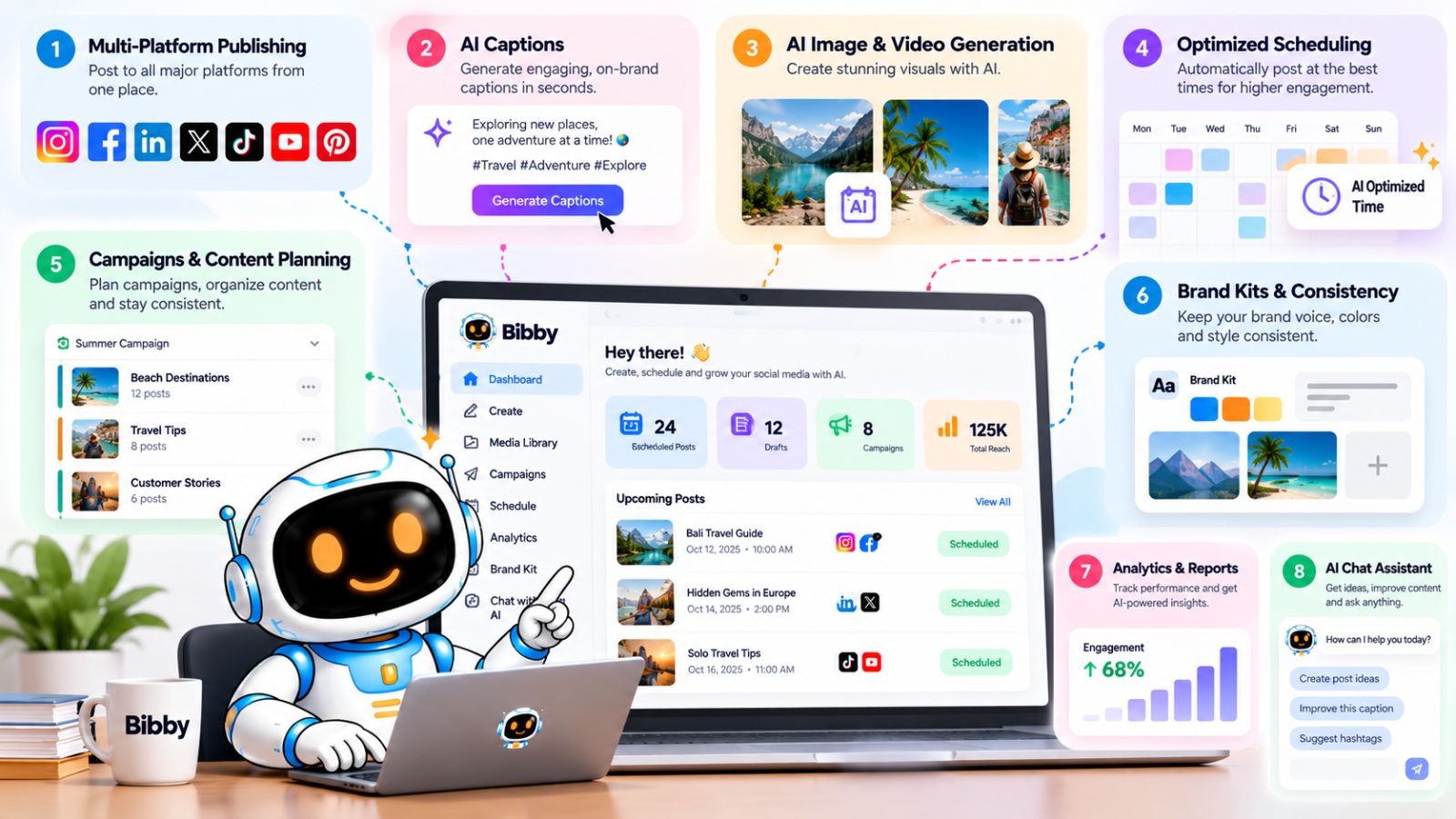
Bibby is built around this approach, combining AI-assisted content creation, caption generation, scheduling, and multi-platform social media management.
The workflow can start with the creative itself. Users can upload an existing image or generate an image with AI, then select a preferred posting style. Bibby can automatically generate captions based on that content and workflow, reducing the need to start each post's copy from a blank page.
From there, marketers can select the social platforms they want to use and schedule their content. Bibby supports platforms such as Facebook, Instagram, LinkedIn, YouTube, and TikTok, allowing users to manage content for multiple channels rather than manually coordinating each platform.
The scheduling process is also designed to use AI-optimized publishing times. Instead of requiring marketers to manually determine when every piece of content should be published, the platform can organize content around its scheduling system.
The workflow isn't limited to static posts, either. Marketers can work with different social media formats, including:
- Images
- Carousels
- Videos
- Stories
This matters because modern social media strategies typically involve multiple formats rather than a single type of post. Having those formats within the same workflow can reduce the need to coordinate separate publishing processes.
Managing Social Media Through Chat
Bibby also extends the workflow through its chat interface.
Instead of treating social media management as a series of isolated dashboard actions, users can interact with the platform conversationally. Within the chat experience, marketers can work on tasks such as creating a brand kit, building a campaign, creating posts, and regenerating captions.
This can make the workflow more flexible because the marketer can move between planning and execution without necessarily navigating through separate tools for each task.
For example, a marketer could work on a campaign, create related social posts, refine the captions, and then organize the resulting content for publishing. The AI handles more of the repetitive execution while the marketer remains responsible for the overall direction and final decisions.
The broader value of Bibby's workflow is therefore not simply that it can schedule posts.
It's that content creation, caption generation, publishing, scheduling, and social media management can be connected into one process.
For a marketer evaluating AI scheduling tools, this is an important distinction. The more disconnected steps a platform can eliminate without sacrificing quality or control, the greater its potential to reduce the operational cost of maintaining an active social media presence.
Also read: Social Media Growth With AI: The New Rules Every Brand Must Know
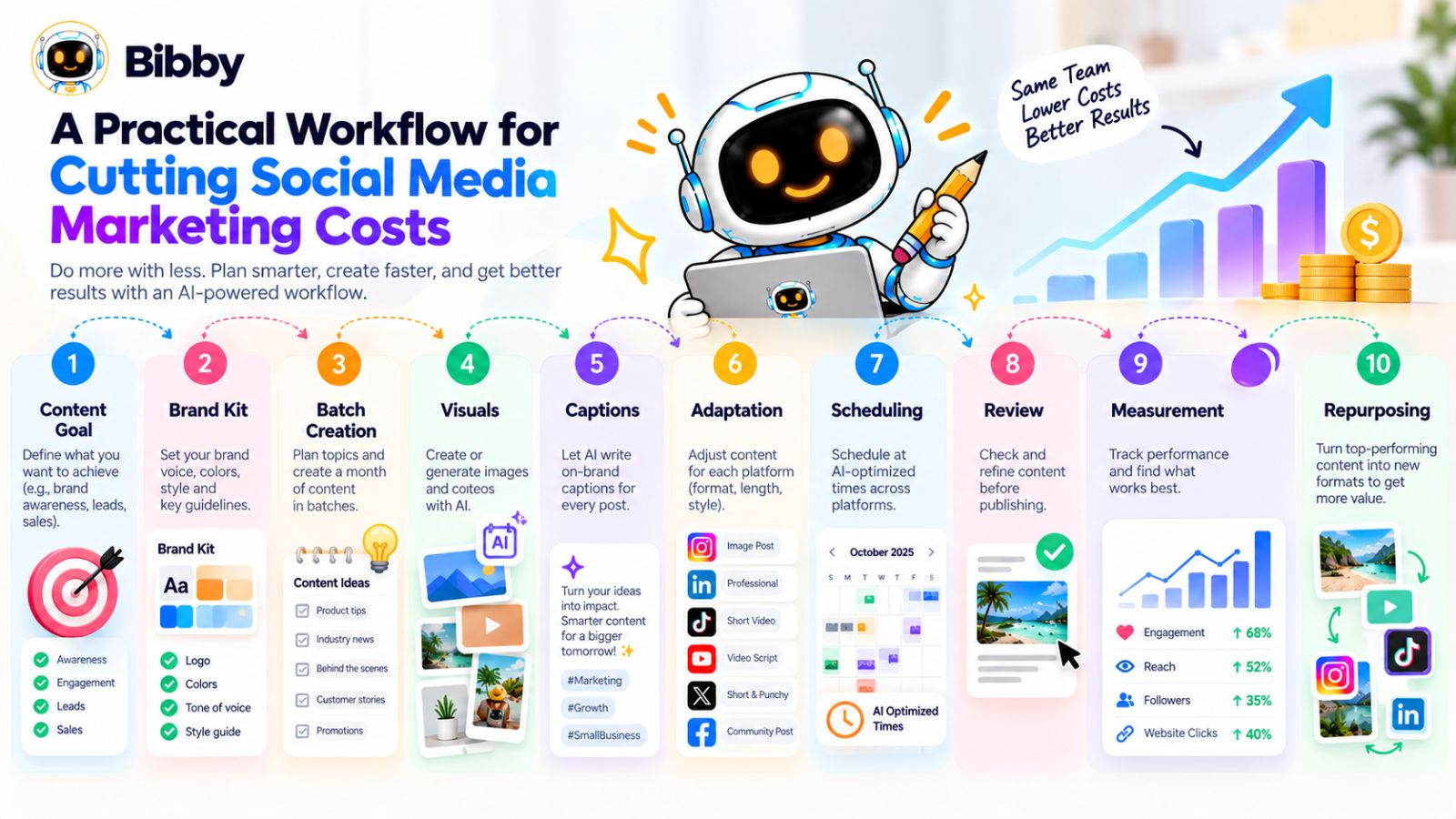
A Practical Workflow for Cutting Social Media Marketing Costs
AI scheduling tools create the most value when they are integrated into a repeatable content workflow. Simply connecting a social account to an AI scheduler won't automatically reduce marketing costs. The biggest savings come from identifying repetitive tasks and systematically moving them into an automated process.
A practical workflow can look like this.
1. Set a Monthly Content Goal
Start by deciding how much content you realistically want to publish across each platform. This gives the AI scheduling system a defined workload and prevents the team from creating content without a clear publishing plan.
2. Build a Reusable Brand Kit
Centralize the information that should remain consistent across your social content, including brand elements, visual direction, tone, and other relevant guidelines.
Tools such as Bibby can help marketers create a brand kit within the platform, giving AI-generated content a more consistent foundation.
3. Create Content in Batches
Instead of creating one post every time something needs to be published, prepare multiple pieces of content during dedicated production sessions.
Batching reduces context switching and makes it easier to maintain a consistent publishing calendar.
4. Generate or Upload Visuals
Use existing creative assets when they're available, and use AI-assisted image creation when new visuals are needed.
The goal is to remove unnecessary production bottlenecks while keeping human review involved in the final creative decisions.
5. Generate Captions With AI
Provide the relevant content and desired posting style, then use AI to generate initial captions.
Review the output for brand voice, accuracy, clarity, and the intended call to action before scheduling.
6. Adapt Content for Multiple Platforms
Don't assume every social network requires identical content. Preserve the core campaign idea while adjusting the presentation, format, or messaging where necessary.
This creates more useful repurposing rather than simple duplication.
7. Schedule the Content Automatically
Once the content is ready, schedule it across the selected social platforms. AI-optimized scheduling can reduce the need to manually assign a publishing time to every post.
With Bibby, marketers can schedule content for platforms such as Facebook, Instagram, LinkedIn, YouTube, and TikTok within the same workflow.
8. Review the Calendar Before Publishing
Automation should not mean abandoning oversight.
Review upcoming posts to check that the messaging makes sense, the creative is correct, campaigns are properly spaced, and the overall content mix reflects the marketing strategy.
9. Measure Performance
Track the metrics that actually matter to the business, such as engagement, traffic, leads, conversions, or other campaign-specific outcomes.
The objective isn't simply to publish more content. It's to determine whether the automated workflow is helping the marketing team use its resources more effectively.
10. Repurpose What Works
When certain topics, formats, or creative approaches perform well, consider developing additional content around those ideas.
This creates a feedback loop:
Create → Schedule → Publish → Measure → Learn → Repurpose
Over time, that process can make social media management more systematic and less dependent on constant manual intervention.
The result is not “set it and forget it” marketing. It's a workflow where AI handles more of the repetitive execution while marketers retain control over strategy, quality, and brand direction.
Common Mistakes When Using AI Scheduling Tools
AI scheduling tools can reduce repetitive work, but automation alone doesn't guarantee effective social media marketing. If the underlying strategy is weak, automating it simply allows weak content to be published faster.
Avoiding a few common mistakes can help businesses get more value from their AI scheduling workflow.
Automating Low-Quality Content
The first mistake is assuming that more automation automatically means better content.
AI can help generate visuals, captions, and content ideas, but marketers still need to evaluate whether the result is useful to their audience. A high-volume publishing schedule filled with generic posts can consume resources without creating meaningful business value.
Publishing Identical Content Everywhere
Multi-platform scheduling is valuable, but every social network has its own audience expectations and content formats.
Publishing the exact same message everywhere may be efficient, but it doesn't always make the best use of each platform. Repurpose the underlying idea while adapting the presentation when necessary.
Ignoring Brand Voice
AI-generated captions can save time, but they should still sound like the business.
A brand that normally communicates in a professional, conversational tone shouldn't suddenly publish generic AI copy simply because it was generated quickly. Brand guidelines and human review remain important.
Scheduling Too Far Ahead Without Reviewing the Calendar
Automation makes batch scheduling possible, but circumstances can change.
Campaigns may change direction, promotions may expire, and current events can make previously scheduled content inappropriate. A scheduled calendar should therefore be reviewed regularly rather than left completely unattended.
Treating AI-Generated Captions as Final
AI-generated copy should be reviewed for accuracy, context, tone, and relevance.
A few seconds of human editing can often make the difference between content that feels generic and content that feels specific to the brand.
Optimizing for Posting Frequency Instead of Business Outcomes
Publishing more frequently isn't automatically the same as marketing more effectively.
The purpose of automation is to make the workflow more efficient so marketers can spend more time on activities that contribute to business goals. Those goals might include awareness, Engagement, website traffic, leads, sales, or customer retention.
Assuming AI Can Replace Marketing Strategy
AI can help execute a strategy, but it doesn't eliminate the need for one.
Marketers still need to understand their audience, define campaign objectives, choose the right messages, establish positioning, and decide what the brand should communicate.
Tools such as Bibby can automate and simplify many of the operational tasks involved in creating and scheduling social content, but the strongest workflow still combines AI execution with human direction.
The goal isn't to remove people from social media marketing.
It's to remove unnecessary manual work so people can spend more of their time on the parts of marketing where judgment, creativity, and context matter most.
The ROI of AI Social Media Scheduling
The return on investment from an AI scheduling tool isn't determined by how many features the platform has. It comes from whether the tool reduces enough manual work, software overhead, or production friction to create measurable value for the business.
The simplest way to think about the ROI is to compare the cost of the tool with the value of the resources it helps recover.
1. Time Savings
Start with the number of hours your team currently spends on repetitive social media tasks.
Track activities such as caption writing, content uploading, scheduling, platform switching, campaign organization, and manual publishing. Then compare those numbers after implementing an AI-powered workflow.
If a marketer spends fewer hours on these tasks, that recovered capacity has economic value.
2. Reduced Tool Costs
If your current workflow requires separate tools for image creation, caption generation, scheduling, and social media management, an integrated platform may reduce the number of subscriptions you need.
The relevant calculation is:
Software savings = previous tool costs − new workflow costs
However, cost consolidation should never be the only consideration. A cheaper workflow that produces worse content or lacks important functionality may not create meaningful business value.
3. Greater Content Capacity
Automation can allow the same team to manage a larger publishing operation.
This doesn't mean businesses should automatically publish more. Instead, it means marketers can potentially produce and manage a broader content program without increasing manual workload at the same rate.
For example, a small team using Bibby can combine AI-assisted visual creation, caption generation, scheduling, and multi-platform publishing within a connected workflow. That can make it easier to maintain a consistent presence across several social networks without manually coordinating every post.
4. Higher-Value Use of Marketing Time
Perhaps the most overlooked component of ROI is what marketers do with the time they recover.
If automation saves several hours per month, those hours can be redirected toward:
- Campaign strategy
- Audience research
- Creative development
- Community engagement
- Performance analysis
- Conversion optimization
- Customer research
The value of those activities may be considerably greater than the value of simply publishing posts faster.
A Simple ROI Formula
Businesses can start with a basic calculation:
AI scheduling ROI = (financial value created − tool cost) ÷ tool cost × 100
The difficult part is determining the “financial value created.” That's why measuring the workflow before and after automation is important.
Track your current monthly hours, software costs, content volume, and relevant marketing outcomes. Then compare those numbers after introducing the AI scheduling workflow.
Over a 30-, 60-, or 90-day period, you should have enough operational data to determine whether the tool is genuinely reducing workload and improving resource efficiency.
Ultimately, AI scheduling should not be judged by how much content it can publish.
It should be judged by how much unnecessary work it removes while helping the marketing team maintain or improve the quality of its social media operation.
Final words
AI scheduling tools can do much more than place social media posts on a calendar. They can reduce repetitive publishing work, accelerate caption and content creation, consolidate disconnected marketing tools, and help small teams manage multiple social platforms without adding the same amount of manual effort.
The three biggest takeaways are simple:
- Automation reduces repetitive labor: AI can handle many routine tasks involved in creating, preparing, and publishing social content.
- Integrated workflows reduce marketing costs: Bringing creation, captions, scheduling, and publishing closer together can reduce tool switching and operational overhead.
- Human strategy still matters: AI works best when it handles execution while marketers remain responsible for strategy, brand voice, quality, and business goals.
Platforms such as Bibby demonstrate how AI social media management is evolving beyond traditional scheduling. With AI-assisted visual creation, automatic captions, optimized scheduling, multi-platform publishing, multiple content formats, and a conversational interface for managing campaigns and posts, the workflow can extend from content creation through publication.
The next step is to evaluate which AI social media scheduling tool fits your workflow, budget, platforms, and content volume. Once you understand where your current process consumes the most time, you can choose automation based on the work you actually need to eliminate—not simply the number of AI features a tool offers.