

Most brands don't have a social media goal problem. They have a goal-setting problem.
It's easy to say you want more followers, higher engagement, better reach, or more website traffic. But none of those numbers matter much if they aren't connected to what the business is actually trying to achieve. A brand can add thousands of followers and still generate little revenue. It can get millions of impressions and attract almost no potential customers.
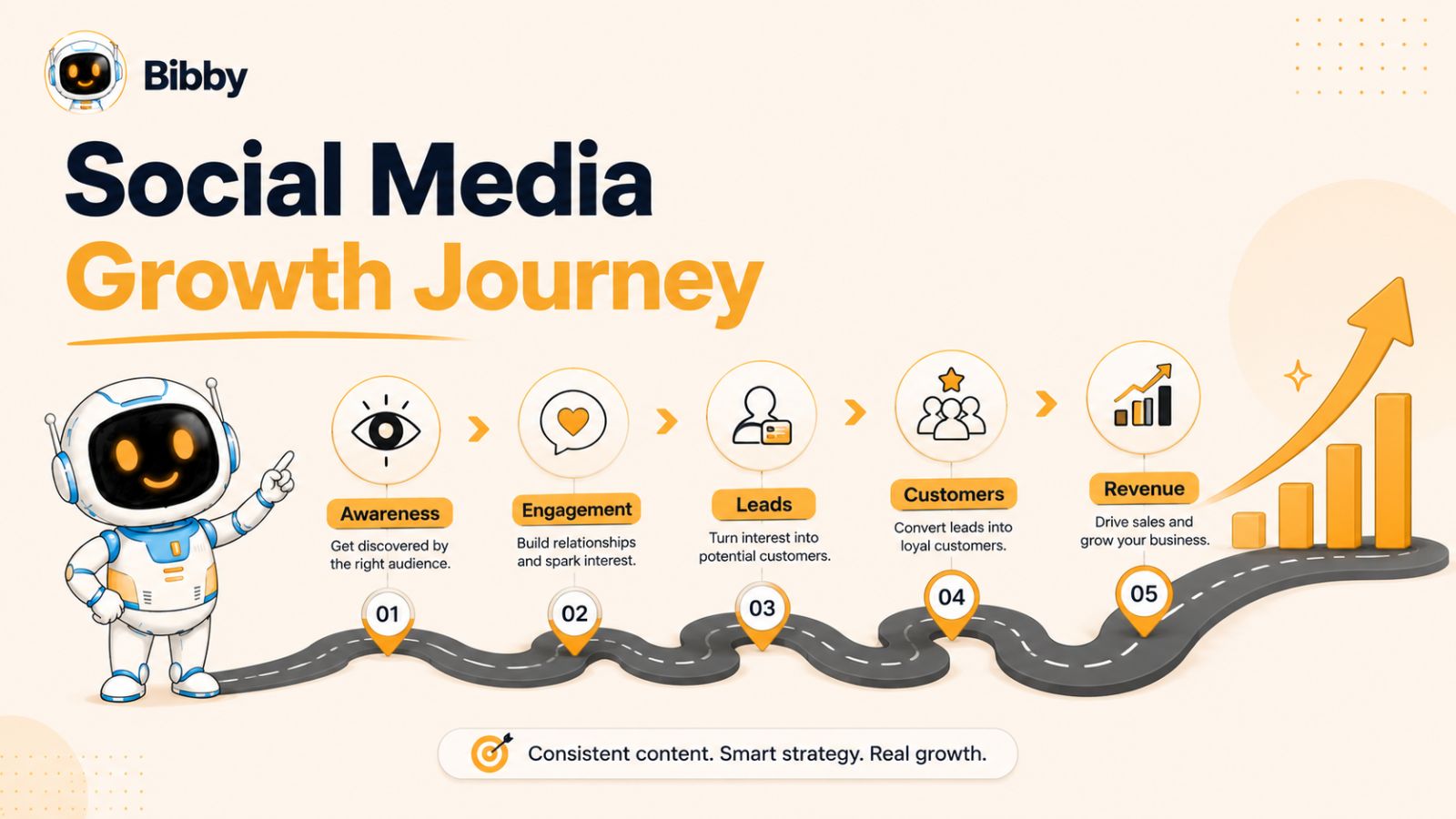
The right approach is to work backward from the business outcome. If the business needs more qualified leads, social media should have a role in generating demand. If the priority is entering a new market, awareness and reach among the right audience may matter more. If existing customers are disengaged, building a stronger community may be the better objective.
That means a useful social media goal isn't simply “increase engagement by 20%.” It looks more like “increase qualified website traffic from LinkedIn by 25% over the next 90 days,” with a clear reason why that traffic matters to the business.
In this guide, we'll show you how to choose the right social media goals, turn them into measurable targets, select the KPIs that actually matter, and build your content strategy around them. You'll also find practical examples, platform-specific goals, a 90-day framework, and a template you can use to set your own goals.
The framework is simple:
Business objective → Social media goal → KPI → Target → Strategy → Measurement
Get that chain right, and social media stops being a stream of posts and starts becoming a measurable part of your growth strategy.
What Are Social Media Goals?
Social media goals are specific outcomes you want your social media activity to achieve within a defined period. They give your team a reason behind every post, campaign, and platform decision, and they provide a way to determine whether your social media efforts are contributing to the business.
The important distinction is that a social media goal is not the same thing as a metric.
Getting 10,000 impressions is a metric. Increasing qualified brand awareness among your target audience is a goal.
Getting 500 clicks is a metric. Increasing qualified traffic to a product page is a goal.
Gaining 1,000 followers is a metric. Building an audience of potential customers who regularly engage with your brand is a goal.
That distinction matters because social platforms can produce impressive numbers that have little business value. A post can go viral without generating a single meaningful lead. A smaller campaign can generate fewer impressions but attract the exact people your business wants to reach.
Social Media Goals vs. Objectives vs. KPIs vs. Metrics
These terms are often used interchangeably, but keeping them separate makes goal-setting much easier.
| Term | What it means | Example |
|---|---|---|
| Business goal | The broader result the company wants | Generate more qualified pipeline |
| Social media objective | The role social media can play in reaching that result | Generate demand among B2B buyers |
| Social media goal | The specific outcome you want from your social activity | Generate 100 qualified leads from LinkedIn in 90 days |
| KPI | The primary measure used to evaluate progress | Qualified leads |
| Metric | A measurable data point that provides context | Clicks, impressions, CTR |
| Target | The specific level you want to reach | 100 qualified leads |
| Tactic | The action you take to achieve the goal | Publish three expert posts per week |
Think of the relationship as a chain:
Business goal → Social objective → Goal → KPI → Target → Tactics
For example, a SaaS company might have a business goal of increasing its sales pipeline. Its social media objective could be to create demand among marketing leaders. The social media goal might be to generate 100 qualified leads from LinkedIn over the next quarter. Qualified leads become the primary KPI, while impressions, engagement rate, clicks, and conversion rate help explain what is happening along the way.
This approach also prevents one of the most common social media mistakes: choosing a metric first and then trying to justify why it matters.
Start with what the business needs. Then decide what social media should accomplish, how you'll measure it, and what target would represent meaningful progress.
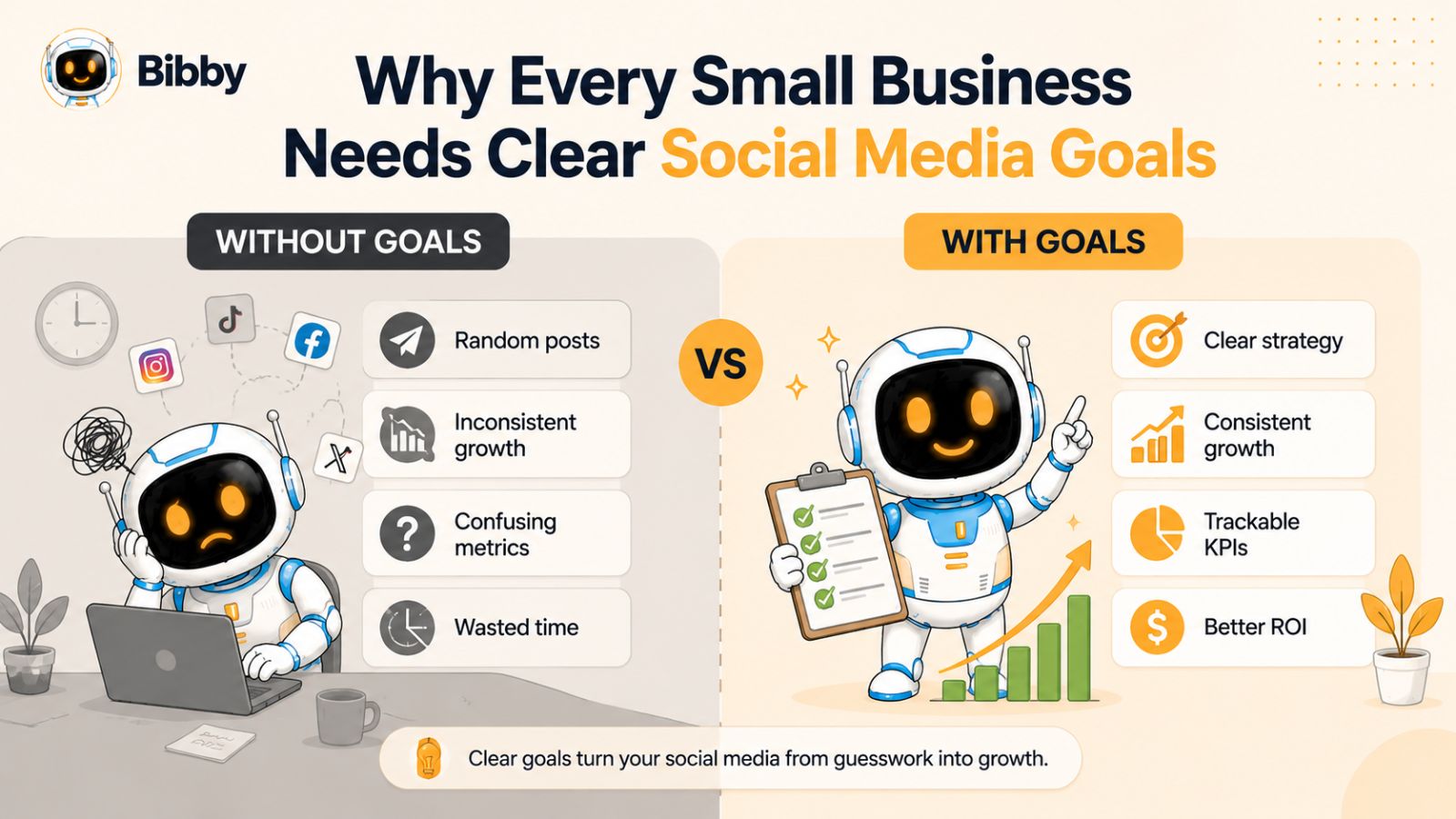
Start With the Business Result, Not the Social Platform
The easiest way to set the wrong social media goal is to start by asking, “What should we post on Instagram?”
Start somewhere else:
“What does the business need to achieve?”
Your social media strategy should support the answer. If the company needs more qualified leads, your social strategy should help create demand and move the right people toward a conversion. If the company is launching a new product, awareness and product education may matter more. If customer retention is the priority, building an active community and maintaining relationships may be more valuable than chasing reach.
This shift sounds small, but it changes how you evaluate almost every social media decision.
The 5 Questions to Ask Before Setting a Social Media Goal
Before choosing a KPI or setting a target, answer these five questions:
1. What does the business need right now?
Look beyond social media. Is the priority revenue, pipeline, customer retention, brand awareness, market expansion, or something else?
2. Who are we trying to reach?
A social media goal is only useful if it attracts or influences the right audience. Reaching 100,000 people who will never buy from you isn't necessarily better than reaching 10,000 potential customers.
3. What action do we want that audience to take?
Depending on the business, that action could be following the brand, engaging with content, visiting the website, signing up for a product, requesting a demo, making a purchase, or becoming an advocate.
4. Can social media realistically influence that outcome?
Not every business problem is a social media problem. Social can contribute to demand generation, awareness, traffic, community, retention, and sales, but it cannot compensate for a weak product, poor positioning, or a broken conversion funnel.
5. How will we know whether social media is making a difference?
Choose the measurement before launching the strategy. If you cannot explain what success looks like in numbers, the goal probably needs to be more specific.
Map Business Goals to Social Media Goals
Once you know the business priority, translate it into an outcome that social media can influence.
| Business priority | Possible social media goal |
|---|---|
| Increase brand awareness | Increase qualified reach among the target audience |
| Generate more pipeline | Generate qualified leads from social channels |
| Increase website demand | Increase engaged referral traffic |
| Launch a new product | Build awareness and product consideration within the target market |
| Increase online sales | Generate more social-assisted conversions and revenue |
| Improve customer retention | Increase meaningful customer engagement and advocacy |
| Build industry authority | Increase relevant mentions, shares, and engagement from industry audiences |
The important word here is “possible.” There is no universal list of social media goals that every business should pursue.
A B2B SaaS company may prioritize qualified leads from LinkedIn. An e-commerce brand may care more about product discovery and purchases from Instagram. A local business may prioritize awareness and customer visits. A creator may prioritize audience growth and community engagement.
The right goal depends on the business model, audience, growth stage, and current constraint.
Don't Let the Platform Choose Your Goal
Each social platform has its own strengths, formats, and audience behavior. That doesn't mean the platform should determine your objective.
Instead of saying:
“We're on Instagram, so our goal should be followers.”
Start with:
“We need to reach more potential customers, and Instagram is one of the channels that can help us do that.”
That distinction keeps your strategy anchored to the business rather than the platform's dashboard.
Your social media goals should ultimately answer one question:
What meaningful business outcome should social media help us move forward?
Once you have that answer, choosing the right social media goal, KPI, target, and content strategy becomes much easier.
Also read: How to Build a Successful Social Media Strategy from Scratch
The 7 Types of Social Media Goals
Once you know what the business needs, the next step is choosing the type of outcome social media should help create.
There is no single “best” social media goal. The right one depends on your business model, growth stage, audience, and current bottleneck. A startup entering a crowded market may need awareness, while an established SaaS company may care far more about qualified pipeline.
Most social media goals fall into seven broad categories:
- Brand awareness
- Engagement and community
- Website traffic
- Lead generation
- Sales and revenue
- Customer retention and advocacy
- Authority and thought leadership
The key is not to pursue all seven at once. Choose the goal that solves the most important business problem, then use the others as supporting objectives when necessary.
1. Brand Awareness
Brand awareness is the right goal when your biggest challenge is getting the right people to recognize, remember, and understand your brand.
This is particularly useful for new businesses, new products, companies entering new markets, and brands competing in categories where customers have many options.
Primary KPIs:
- Qualified reach
- Impressions
- Brand mentions
- Share of voice
- Branded search growth
Example goal:
Increase monthly reach among our target audience by 30% over the next six months.
Don't confuse awareness with simply accumulating impressions. Reaching more people only matters when a meaningful portion of those people could potentially become customers.
2. Engagement and Community
Engagement goals focus on creating meaningful interactions between your brand and its audience.
Likes can be useful, but they shouldn't automatically define success. Comments, shares, saves, direct messages, user-generated content, and repeat participation can tell you much more about whether people actually care about what you're publishing.
Primary KPIs:
- Engagement rate
- Comments
- Shares
- Saves
- Direct messages
- User-generated content
- Community participation
Example goal:
Increase meaningful engagement on LinkedIn by 25% over the next 90 days while maintaining engagement from our target audience.
The goal should be quality of engagement, not engagement at any cost.
3. Website Traffic
If your social strategy is designed to move people from social platforms to your website, traffic can be an important goal.
But raw clicks don't tell the whole story. Ten thousand visitors who immediately leave can be less valuable than 1,000 visitors who read your content, explore your product, or convert.
Primary KPIs:
- Engaged sessions from social
- Referral traffic
- Click-through rate
- Landing-page engagement
- Social-assisted conversions
Example goal:
Increase qualified, engaged traffic from LinkedIn to our product pages by 25% in the next quarter.
This makes the goal much more useful than simply saying “get more clicks.”
4. Lead Generation
Lead generation becomes important when social media is expected to contribute directly to your sales pipeline.
The goal isn't necessarily to generate the largest possible number of leads. For many businesses, particularly B2B companies, qualified leads are considerably more valuable than raw lead volume.
A typical journey might look like:
Impression → Engagement → Click → Landing page → Lead → Qualified lead → Sales opportunity
Your social media strategy can influence several stages of this journey.
Primary KPIs:
- Qualified leads
- Conversion rate
- Cost per lead
- Cost per qualified lead
- Sales opportunities generated
Example goal:
Generate 100 qualified leads from social media during the next 90 days while maintaining a cost per qualified lead below our target.
5. Sales and Revenue
For e-commerce and other businesses where social media can directly or indirectly influence purchases, sales and revenue can become the primary objective.
Useful measures include:
- Revenue attributed to social
- Social-assisted conversions
- Conversion rate
- Customer acquisition cost
- Return on ad spend
- Revenue per visitor
Example goal:
Increase social-assisted revenue by 20% over the next quarter while maintaining our target customer acquisition cost.
Revenue attribution can be imperfect, particularly when customers interact with several channels before purchasing. Treat social analytics as part of the broader customer journey rather than assuming every conversion came from a single social interaction.
6. Customer Retention and Advocacy
Social media isn't only a customer acquisition channel.
For established brands, it can also help maintain relationships with existing customers, encourage advocacy, answer questions, showcase customer experiences, and create a stronger sense of community.
Primary KPIs:
- Customer engagement
- Repeat interactions
- User-generated content
- Customer mentions
- Reviews
- Referral activity
- Response and resolution metrics
Example goal:
Increase meaningful engagement from existing customers by 20% over the next six months and generate 50 new pieces of customer-created content.
This goal is particularly valuable when your existing customers can become a source of repeat purchases, referrals, reviews, or social proof.
7. Authority and Thought Leadership
Some businesses use social media primarily to become more recognizable and credible within their industry.
This is especially relevant for founders, consultants, professional services firms, B2B brands, and companies selling products that require significant consideration before purchase.
Useful signals include:
- Relevant industry mentions
- Shares from recognized experts
- Engagement from decision-makers
- Invitations to podcasts, events, or publications
- Branded search growth
- High-quality backlinks or referral opportunities generated through content
Example goal:
Increase engagement from relevant industry decision-makers by 30% over the next six months through original research and expert-led content.
Authority is harder to measure than clicks or conversions, so avoid pretending that one metric can perfectly capture it. Look for a collection of signals that indicate your brand is becoming more visible and credible among the people who matter.
The Goal Isn't to Win Every Category
A common mistake is turning this list into a checklist and deciding that your brand needs to improve all seven.
It doesn't.
If your biggest problem is an empty sales pipeline, increasing follower count probably shouldn't be your primary objective. If nobody knows your new product exists, optimizing conversion rates before building awareness may be premature.
Your job is to identify the outcome that matters most right now, then select the social media goal that can make a meaningful contribution to it.
That leads to the next question: How do you know which social media goal is the right one for your business?
How to Choose the Right Social Media Goal
Knowing the different types of social media goals is useful. Knowing which one to choose is what actually makes the strategy work.
The right goal depends on where your business is today. A brand with almost no awareness has a different problem from a brand with strong awareness but weak conversions. Choosing a goal that doesn't address the current bottleneck can produce impressive social metrics while leaving the underlying business problem untouched.
A simple way to choose is to work backward from the point where your customer journey is breaking down.
If Nobody Knows Your Brand
If your target audience has little awareness of your company or product, focus on brand awareness.
Your priority is to get in front of the right people repeatedly enough for them to recognize your brand and understand what you offer.
Focus on:
- Qualified reach
- Relevant impressions
- Brand mentions
- Branded search
- Audience growth within your target market
Don't make raw follower growth the objective. A smaller audience that closely matches your ideal customers can be considerably more valuable.
Example goal:
Increase qualified reach among our target audience by 30% over the next six months.
If People Know You but Don't Engage
If people recognize your brand but rarely interact with it, your problem may be engagement or community.
Look beyond likes. Stronger signals include comments, shares, saves, direct conversations, user-generated content, and repeat participation.
Focus on:
- Engagement rate
- Shares
- Saves
- Comments
- DMs
- Community participation
Example goal:
Increase meaningful engagement from our target audience by 25% over the next 90 days.
The objective is not to manufacture interaction. It's to create content and conversations that give the right audience a reason to participate.
If People Engage but Don't Visit Your Website
You may have an attention problem solved but a distribution or conversion-path problem.
People are interacting with your content, but they aren't taking the next step.
Focus on:
- Link clicks
- Click-through rate
- Engaged sessions
- Landing-page visits
- Social referral traffic
Example goal:
Increase qualified traffic from LinkedIn to our highest-value website pages by 25% over the next quarter.
Before publishing more content, also examine your calls to action. If every post asks people to “like and follow,” don't be surprised when they don't click through to your website.
If Traffic Is High but Leads Are Low
This is where many brands make the wrong move.
They respond by trying to generate even more traffic.
But if 10,000 visitors aren't converting, another 10,000 visitors may not solve the problem.
Your focus should shift toward lead generation and conversion quality.
Examine:
- Landing-page conversion rate
- Lead quality
- Call-to-action performance
- Content-to-landing-page relevance
- Cost per qualified lead
- Conversion by traffic source
Example goal:
Increase the qualified lead conversion rate from social traffic by 20% within 90 days.
Social media may still be doing its job. The problem could be happening after the click.
If Leads Are Coming In but Sales Aren't
At this stage, the problem may no longer be social media awareness or traffic.
You need to examine lead quality and the journey from lead to customer.
Look at:
- Qualified lead rate
- Sales opportunity rate
- Customer conversion rate
- Revenue from social-assisted leads
- Customer acquisition cost
Example goal:
Increase the percentage of social-generated leads that become qualified sales opportunities by 15% over the next quarter.
This often means changing the audience you're targeting and the type of content you're creating, rather than simply increasing publishing volume.
If Existing Customers Aren't Engaging
If acquisition is healthy but existing customers are becoming inactive, consider retention and advocacy.
Use social media to deepen the relationship rather than constantly trying to acquire new audiences.
Focus on:
- Customer participation
- User-generated content
- Reviews
- Customer mentions
- Repeat engagement
- Referral activity
Example goal:
Generate 50 pieces of customer-created content and increase repeat customer engagement by 20% over the next six months.
If Your Brand Wants to Become an Industry Authority
For founders, consultants, experts, professional services firms, and B2B brands, the objective may be authority and thought leadership.
In this case, follower growth alone is a poor proxy for success.
Look for evidence that the right people are paying attention:
- Industry mentions
- Shares from experts
- Engagement from decision-makers
- Invitations to industry events
- Media opportunities
- Relevant backlinks
- Branded search growth
Example goal:
Increase engagement from senior decision-makers in our target industry by 30% over the next six months.
A Simple Decision Framework
If you're unsure where to start, use this sequence:
Nobody knows us
→ Build awareness
People know us but don't interact
→ Build engagement and community
People interact but don't visit
→ Improve traffic and calls to action
People visit but don't convert
→ Improve lead generation and conversion
People become leads but don't become customers
→ Improve lead quality and sales alignment
Customers aren't engaging or advocating
→ Focus on retention and community
We need greater credibility in our market
→ Build authority and thought leadership
This framework keeps your goal connected to the problem you're actually trying to solve.
And in most cases, you don't need seven goals. One primary goal and one or two supporting goals are enough.
Goal #1: Increase Brand Awareness
For many small businesses, increasing brand awareness is the most important social media goal—and for good reason. Before people can buy from you, they need to know you exist. Social media provides a cost-effective way to introduce your brand to new audiences, build recognition, and establish trust over time.
Whether you're launching a new business, entering a new market, or competing against larger brands, growing awareness creates the foundation for every other marketing objective. More visibility often leads to more engagement, more website traffic, more leads, and ultimately more sales.
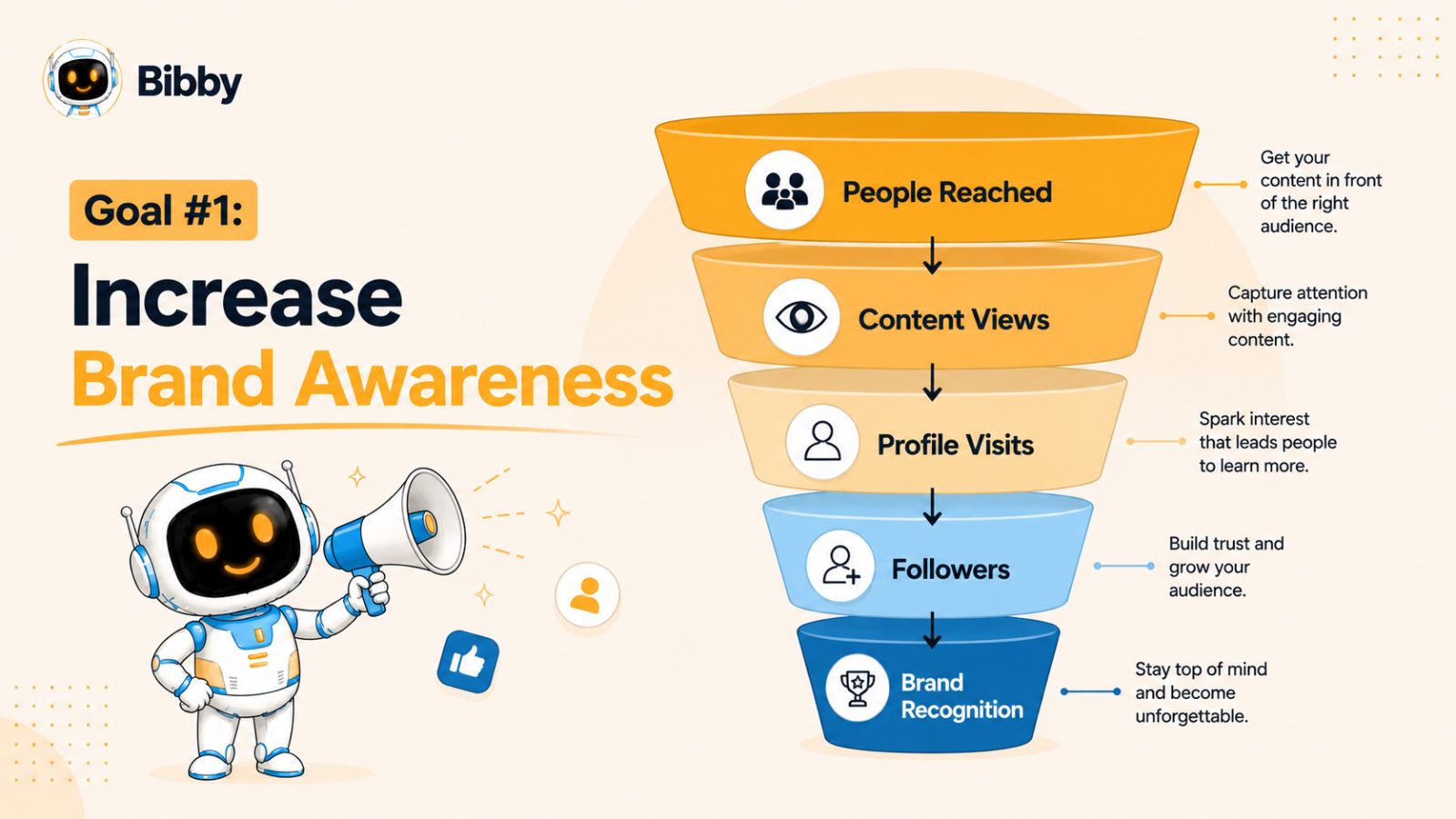
Why Brand Awareness Matters
Consumers are more likely to purchase from brands they recognize and trust. The more often potential customers see your business providing value through social media, the more familiar and credible your brand becomes.
Strong brand awareness can help your business:
- Reach new audiences consistently
- Build trust before the buying decision
- Stay top-of-mind with potential customers
- Differentiate yourself from competitors
- Create long-term growth opportunities
Even if someone isn't ready to buy today, increased visibility improves the chances they'll remember your business when the need arises.
Key Metrics to Track
To measure brand awareness effectively, focus on metrics that indicate how many people are discovering and seeing your content.
Reach
Reach measures the number of unique users who see your content. Growing reach indicates that your content is being exposed to new audiences.
Impressions
Impressions track how many times your content is displayed. A high number of impressions often suggests strong visibility and repeated exposure.
Follower Growth
While follower count isn't everything, steady growth can indicate increasing brand recognition and interest.
Brand Mentions
Mentions, tags, and shares show that people are actively talking about your business and spreading awareness to others.
Effective Strategies to Increase Brand Awareness
Create Consistent Content
Consistency is one of the biggest drivers of brand recognition. Posting regularly helps keep your business visible and familiar to your audience.
Focus on Short-Form Video
Platforms like Instagram Reels, TikTok, YouTube Shorts, and Facebook Reels often provide significantly greater organic reach than static content. Short videos are highly shareable and favored by platform algorithms.
Share Educational Content
Helpful content positions your business as a trusted resource while increasing the likelihood that users will share your posts with others.
Examples include:
- How-to guides
- Industry tips
- Common mistakes to avoid
- Frequently asked questions
- Quick tutorials
Encourage User-Generated Content
Customer photos, testimonials, and reviews help expand your reach while building social proof.
Repurpose Content Across Platforms
Creating unique content for every platform can be time-consuming. Repurposing content allows businesses to maintain a strong presence without dramatically increasing workload.
How Automation Helps Build Brand Awareness Faster
One of the biggest challenges for small businesses is maintaining consistent posting across multiple platforms. Missing posting days or publishing irregularly can slow audience growth and reduce visibility.
This is where automation platforms like Bibby can be particularly valuable.
With Bibby, businesses can upload an image or generate one using AI, select a preferred posting style, and automatically receive optimized captions. Bibby then schedules content across Facebook, Instagram, LinkedIn, YouTube, TikTok, and other selected platforms at AI-optimized posting times designed to maximize visibility and engagement.
Because content is scheduled automatically, businesses can maintain a consistent publishing schedule without spending hours each week managing social media manually. This consistency helps increase reach, improve recognition, and accelerate brand awareness growth over time.
The Bottom Line
Brand awareness is the foundation of successful social media marketing. The more people who discover and recognize your business, the larger your potential customer base becomes. By focusing on visibility, consistency, and valuable content, small businesses can steadily build an audience that supports future engagement, lead generation, and sales goals.
Also read: How to Scale a YouTube Channel With Automation
Goal #2: Generate High-Quality Leads
While brand awareness helps people discover your business, lead generation moves potential customers one step closer to making a purchase. For many small businesses, generating qualified leads is one of the most valuable social media goals because it creates a predictable pipeline of future customers.
A lead is any person who has shown interest in your business by taking a specific action, such as filling out a contact form, downloading a resource, signing up for a newsletter, requesting a quote, or booking a consultation. Social media provides a powerful way to attract these prospects and guide them through the buying journey.
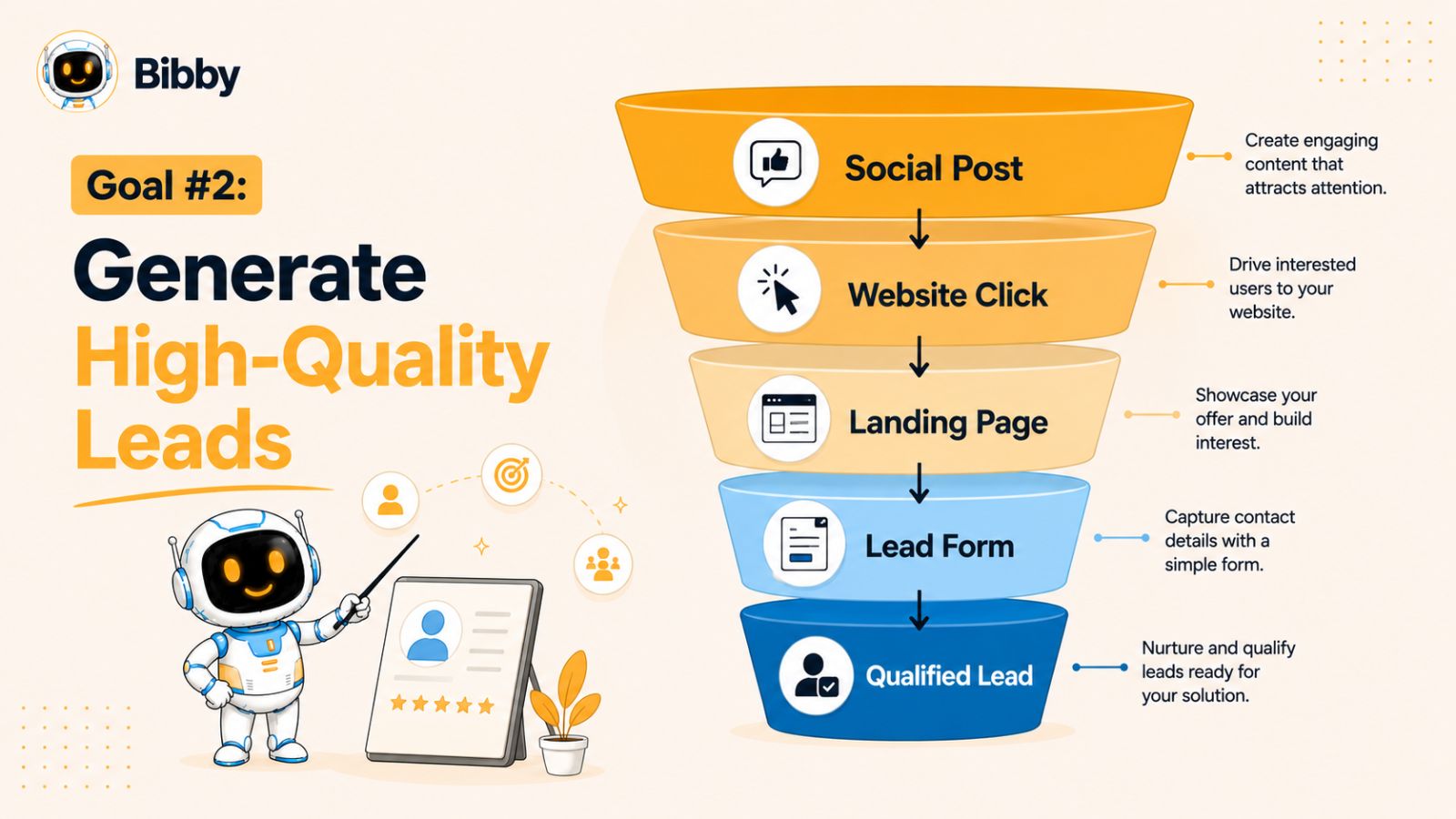
Why Lead Generation Matters
Not every social media user is ready to buy immediately. In fact, most people need multiple interactions with a brand before making a purchasing decision. Lead generation allows businesses to capture contact information and continue nurturing potential customers until they are ready to convert.
Benefits of lead generation include:
- Building a pipeline of future customers
- Reducing dependence on immediate sales
- Improving conversion opportunities
- Creating predictable business growth
- Increasing marketing ROI
Instead of hoping followers eventually become customers, lead generation creates a structured path toward conversion.
Key Metrics to Track
To evaluate lead generation success, focus on metrics that directly indicate customer interest and intent.
Lead Form Submissions
Track how many people complete contact forms, quote requests, demo requests, or consultation bookings.
Website Clicks
Website traffic from social media often serves as the first step in the lead generation process.
Landing Page Conversion Rate
Measure the percentage of visitors who complete your desired action after clicking through from social media.
Cost Per Lead (CPL)
If you're running paid campaigns, cost per lead helps determine how efficiently you're acquiring prospects.
Email Sign-Ups
Growing your email list through social media can create valuable long-term marketing opportunities.
Effective Lead Generation Strategies
Offer Valuable Lead Magnets
People are more likely to share their contact information when they receive something valuable in return.
Popular lead magnets include:
- Free guides
- Checklists
- Templates
- Industry reports
- Webinars
- Free trials
Create Strong Calls-to-Action
Every lead-focused post should clearly tell users what action to take next.
Examples include:
- Download the guide
- Book a free consultation
- Request a demo
- Get a free quote
- Join our newsletter
Use Educational Content to Build Trust
Helpful content attracts prospects who are actively researching solutions. Once trust is established, users are more likely to provide their contact information.
Leverage Video Content
Video often generates stronger engagement and can explain products or services more effectively than text alone. Demonstrations, tutorials, and customer success stories can all support lead generation efforts.
Common Lead Generation Mistakes
Many businesses fail to generate leads because they make one of these common mistakes:
- Asking for too much information upfront
- Using weak or unclear calls-to-action
- Sending users to poorly optimized landing pages
- Promoting products before building trust
- Failing to follow up with leads quickly
Successful lead generation focuses on reducing friction and making the next step as easy as possible.
Also read the complete guide for Multi Platform Social Media Management
How Bibby Can Support Lead Generation
Creating enough content to consistently attract leads can be challenging, especially for small businesses managing multiple platforms.
Bibby helps simplify this process by automating content creation and scheduling. Businesses can upload images or generate visuals with AI, choose a posting style, and let Bibby automatically create captions optimized for engagement. Content can then be scheduled across Facebook, Instagram, LinkedIn, YouTube, TikTok, and other platforms at AI-optimized posting times.
This consistent content flow helps keep lead-generation campaigns active without requiring daily manual effort. Businesses can focus on responding to prospects and closing sales while Bibby handles much of the publishing process behind the scenes.
The Bottom Line
Generating high-quality leads is one of the most direct ways social media can contribute to business growth. By creating valuable content, offering compelling lead magnets, and guiding users toward clear next steps, small businesses can turn social media audiences into a steady stream of qualified prospects.
Goal #3: Drive More Website Traffic
Social media platforms are excellent for building relationships and engaging with your audience, but your website is where most important business actions happen. Whether you're generating leads, selling products, booking appointments, or educating potential customers, your website serves as the central hub of your online presence.
That's why driving website traffic is one of the most valuable social media goals for small businesses. The more qualified visitors you bring to your website, the more opportunities you create for conversions and revenue.
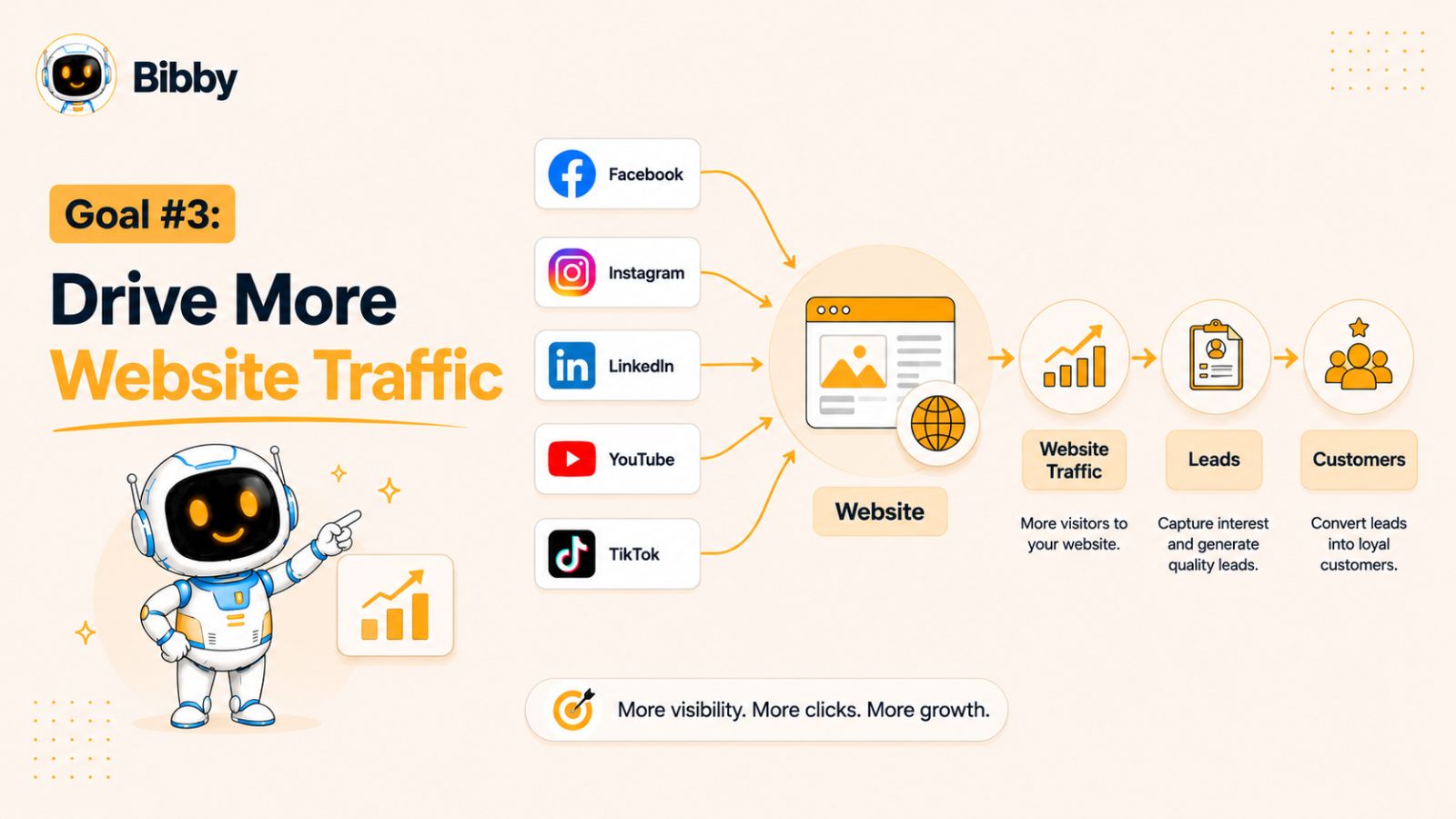
Why Website Traffic Matters
Unlike social media platforms, your website is an asset you fully control. Algorithms may change, platforms may evolve, and audience reach may fluctuate, but your website remains your digital home base.
Increasing website traffic can help you:
- Generate more leads
- Increase product sales
- Grow your email list
- Improve brand authority
- Support long-term SEO growth
- Gather valuable customer insights
When social media and your website work together, they create a powerful marketing ecosystem that drives sustainable business growth.
Key Metrics to Track
To determine whether your social media efforts are successfully driving traffic, monitor these important metrics.
Click-Through Rate (CTR)
CTR measures the percentage of people who click on your links after seeing your content. A higher CTR often indicates that your messaging and calls-to-action are effective.
Referral Traffic
Referral traffic shows how many website visitors come directly from social media platforms.
Bounce Rate
Bounce rate measures the percentage of visitors who leave your website without taking further action. Lower bounce rates often indicate stronger content relevance.
Average Session Duration
This metric helps you understand how engaged visitors are once they arrive on your website.
Conversion Rate
Traffic alone isn't enough. Measuring conversions helps determine whether visitors are taking meaningful actions after arriving on your site.
Also read: How to Automate Social Media for Small Business (Without Hiring Anyone)
Effective Strategies to Drive More Website Traffic
Promote Valuable Blog Content
Educational blog posts are one of the best ways to drive consistent traffic from social media. Helpful articles encourage clicks, shares, and repeat visits.
Examples include:
- How-to guides
- Industry trends
- Case studies
- Expert tips
- Step-by-step tutorials
Use Strong Calls-to-Action
Every post designed to generate traffic should clearly tell users what action to take.
Examples include:
- Read the full article
- Learn more on our website
- Download the complete guide
- View the case study
- Get started today
Share Video Teasers
Instead of providing all information within the social media post, use short videos to create curiosity and direct users to your website for the complete content.
Repurpose High-Performing Content
Analyze which posts generate the most clicks and create additional content around similar topics.
Optimize Your Profile Links
Ensure your social media profiles make it easy for visitors to access your website, landing pages, and lead generation offers.
Website Traffic and SEO: A Powerful Combination
Driving traffic from social media can indirectly support your SEO efforts. Increased exposure often leads to more content shares, brand searches, backlinks, and audience engagement, all of which can contribute to stronger online visibility.
While social media is not a direct ranking factor, it can amplify content and help attract the audience that ultimately supports SEO growth.
How Bibby Helps Increase Website Traffic
One challenge many small businesses face is maintaining a consistent content schedule across multiple social media platforms. Without regular publishing, opportunities to drive website visitors are often missed.
Bibby simplifies this process by automating much of the content workflow. Businesses can upload images or generate visuals with AI, select a posting style, and allow Bibby to automatically create captions designed to encourage engagement and clicks.
Once content is prepared, Bibby schedules posts across Facebook, Instagram, LinkedIn, YouTube, TikTok, and other selected platforms at AI-optimized posting times. This helps maximize visibility while ensuring your website-promoting content continues working even when you're focused on other areas of your business.
In addition, Bibby's analytics tools make it easier to identify which content generates the most traffic, allowing businesses to refine their strategy and improve results over time.
The Bottom Line
Website traffic bridges the gap between social media engagement and meaningful business outcomes. By consistently directing users to valuable content, landing pages, and offers on your website, small businesses can transform social media from a branding channel into a reliable source of leads, sales, and long-term growth.
Also read: What to Post on Instagram When You Have No Ideas
Goal #4: Increase Customer Engagement
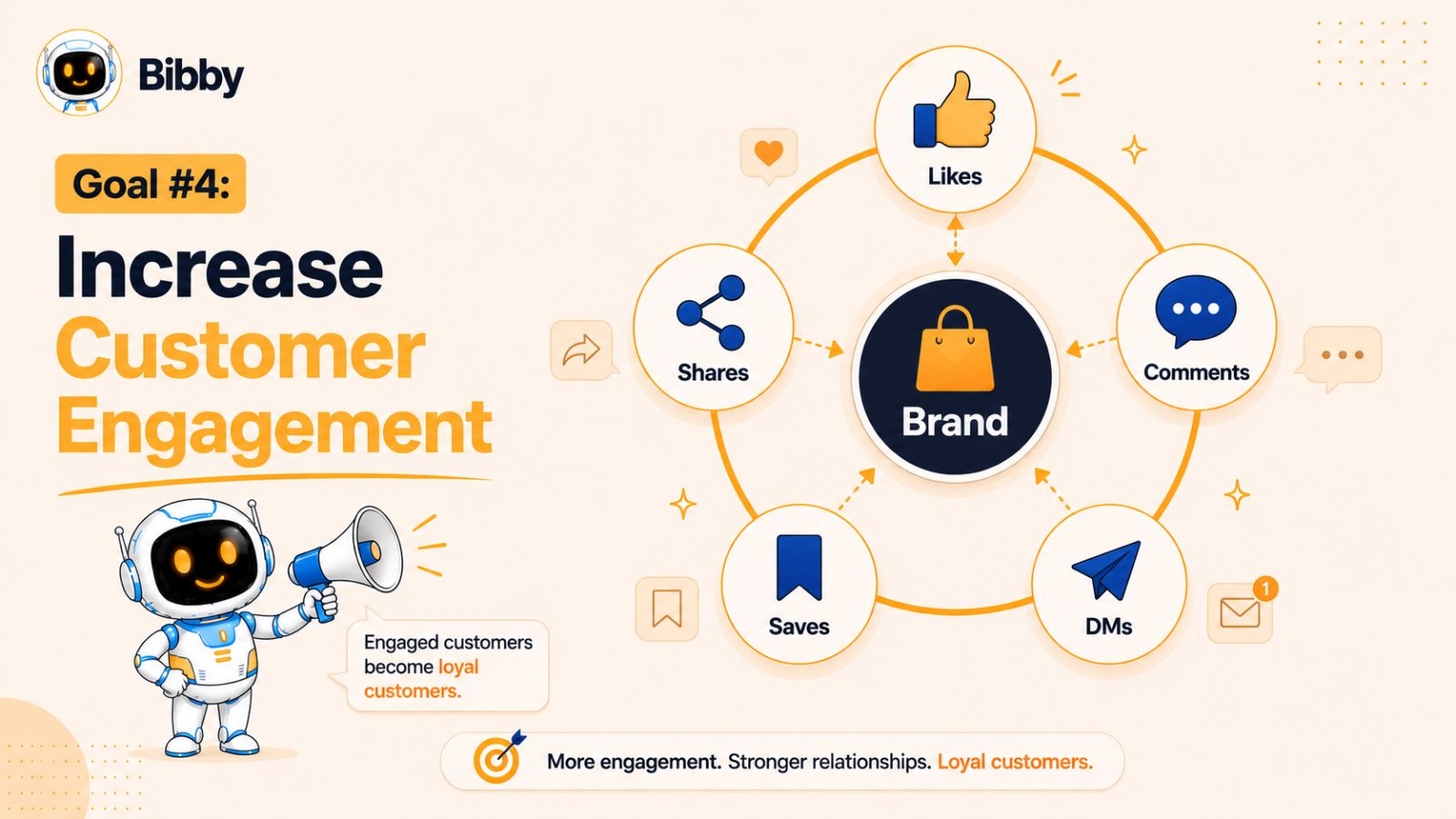
Having thousands of followers means very little if your audience rarely interacts with your content. Engagement is one of the strongest indicators that your social media strategy is resonating with the people you want to reach. When users actively like, comment, share, save, or respond to your content, they're signaling interest in your brand.
For small businesses, increasing customer engagement is often the key to building stronger relationships, improving visibility, and creating a loyal community that supports long-term growth.
Why Customer Engagement Matters
Social media platforms are designed to reward content that generates interaction. The more engagement your posts receive, the more likely they are to be shown to additional users.
Beyond algorithm benefits, engagement helps businesses:
- Build trust with potential customers
- Strengthen relationships with existing customers
- Gather valuable feedback and insights
- Increase brand loyalty
- Improve organic reach
- Create more opportunities for conversions
When people engage with your content regularly, your business remains top-of-mind whenever they need the products or services you offer.
Key Metrics to Track
Tracking engagement helps determine whether your content is truly connecting with your audience.
Likes and Reactions
While likes are considered a basic engagement metric, they still provide insight into audience interest and content relevance.
Comments
Comments often indicate deeper engagement because users are investing time to participate in the conversation.
Shares
Shares can significantly expand your reach by introducing your content to new audiences.
Saves
A saved post suggests that users found the content valuable enough to revisit later.
Direct Messages
Direct messages often indicate strong interest and can become valuable sales or customer service opportunities.
Engagement Rate
Engagement rate measures interactions relative to audience size and is often one of the most useful indicators of content performance.
Effective Strategies to Increase Engagement
Ask Questions
Simple questions encourage followers to participate and share their opinions.
Examples include:
- What's your biggest challenge with social media marketing?
- Which feature would help your business the most?
- Have you tried this strategy before?
Create Interactive Stories
Polls, quizzes, sliders, and question stickers make it easy for users to engage with your content in seconds.
Share Behind-the-Scenes Content
People connect with people. Showing your team, processes, and company culture helps humanize your brand and build stronger relationships.
Respond to Comments Quickly
Engagement is a two-way conversation. Businesses that actively respond to comments often experience higher overall interaction levels.
Highlight Customer Success Stories
Featuring customer experiences, testimonials, and user-generated content encourages participation while building credibility.
Content Types That Generate High Engagement
Certain formats naturally encourage more interaction than others.
Examples include:
- Short-form videos
- Polls and surveys
- Industry hot takes
- Educational carousels
- Before-and-after transformations
- Customer spotlights
- Contests and giveaways
- Trending topics with unique perspectives
The key is creating content that provides value while encouraging a response.
How Bibby Helps Improve Engagement
One reason engagement declines is inconsistent posting. When businesses disappear for days or weeks at a time, audiences become less active and less connected to the brand.
Bibby helps maintain consistency by automating much of the social media workflow. Users can upload an image or generate one with AI, choose a posting style, and allow Bibby to automatically create captions designed to drive interaction.
Bibby then schedules content across Facebook, Instagram, LinkedIn, YouTube, TikTok, and other selected platforms at AI-optimized times when audiences are most likely to engage. This consistent publishing strategy helps businesses stay visible and maintain regular interaction with followers.
In addition, Bibby's analytics tools allow businesses to identify their highest-performing content, making it easier to create more posts that generate meaningful engagement.
The Bottom Line
Customer engagement is more than just likes and comments—it's a measure of how connected your audience feels to your brand. By creating valuable, interactive content and maintaining a consistent publishing schedule, small businesses can build stronger relationships that lead to increased trust, loyalty, and future sales.
Also read: How Local Shops Can Attract More Customers Through Social Media
Goal #5: Improve Customer Loyalty and Retention
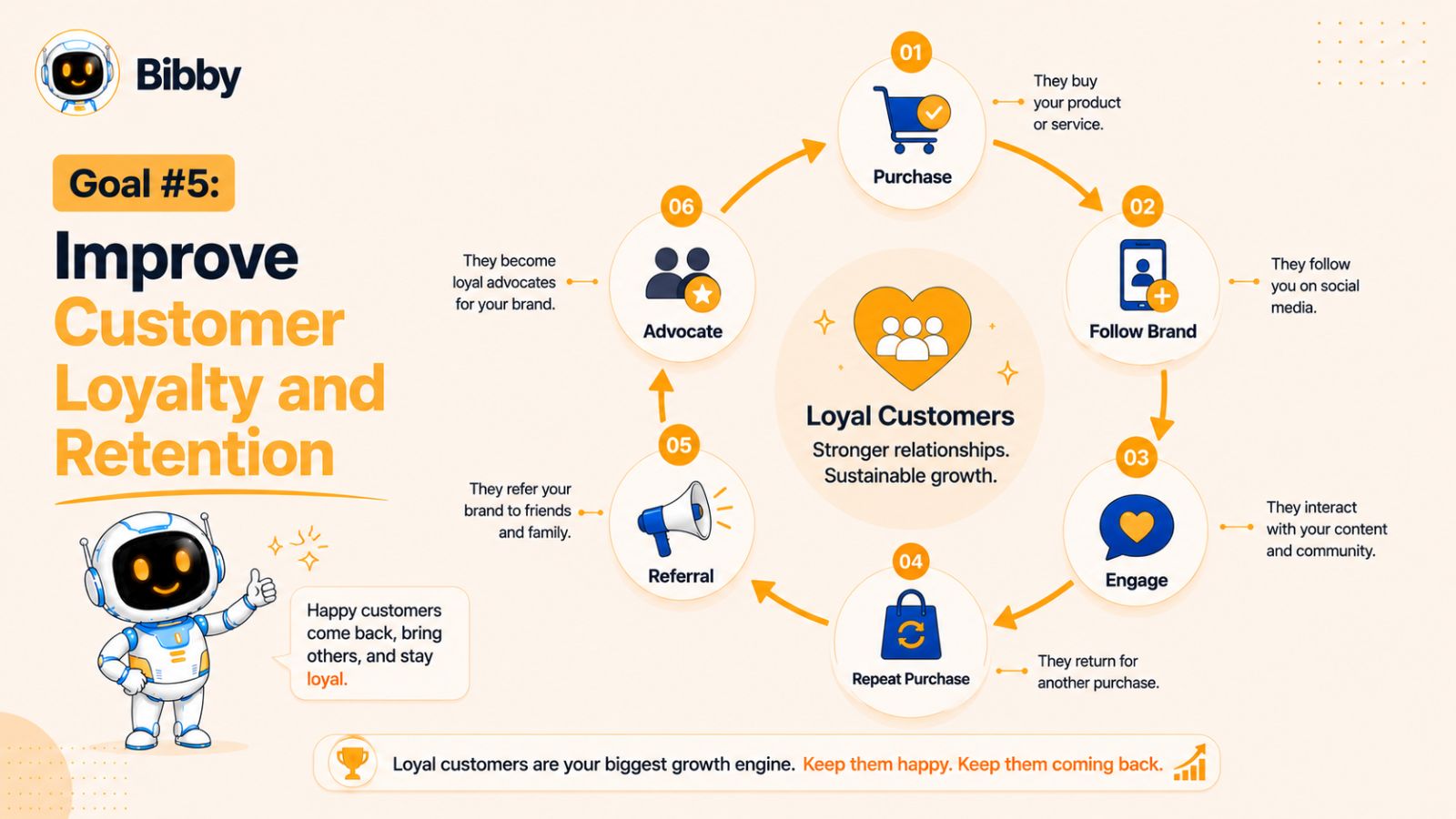
Many businesses focus heavily on attracting new customers, but long-term success often depends on keeping existing customers engaged and satisfied. Acquiring a new customer typically costs far more than retaining an existing one, making customer loyalty and retention one of the most profitable social media marketing goals for small businesses.
Social media provides a unique opportunity to stay connected with customers long after the initial purchase. Through consistent communication, valuable content, and community-building efforts, businesses can strengthen relationships and encourage repeat business.
Why Customer Loyalty Matters
Loyal customers do more than make repeat purchases. They often become brand advocates who recommend your products or services to friends, family, and colleagues.
Benefits of strong customer loyalty include:
- Increased customer lifetime value
- Higher repeat purchase rates
- More referrals and word-of-mouth marketing
- Lower customer acquisition costs
- Greater resistance to competitor offers
- More predictable revenue
When customers feel connected to your brand, they're more likely to continue choosing your business over alternatives.
Key Metrics to Track
To measure customer loyalty and retention, focus on indicators that reflect long-term customer relationships.
Repeat Customer Rate
This metric shows how many customers return to make additional purchases after their first transaction.
Customer Lifetime Value (CLV)
CLV estimates the total revenue a customer generates throughout their relationship with your business.
Customer Sentiment
Monitor comments, reviews, messages, and mentions to understand how customers feel about your brand.
Community Participation
Engagement from existing customers often indicates a healthy and active community.
Referral Activity
Referrals are a strong signal that customers trust your business enough to recommend it to others.
Effective Strategies to Build Customer Loyalty
Provide Ongoing Value
Don't limit communication to promotional content. Continue educating, entertaining, and supporting customers after the sale.
Examples include:
- Helpful tips
- Product tutorials
- Industry insights
- Frequently asked questions
- Best practices
Showcase Your Customers
Featuring customer stories, reviews, and success experiences helps customers feel appreciated while strengthening community engagement.
Create Exclusive Content
Reward loyal followers with content, offers, or insights that aren't available elsewhere.
Examples include:
- Early access to products
- Exclusive discounts
- VIP communities
- Member-only resources
Build a Brand Community
People enjoy being part of groups with shared interests. Creating opportunities for discussion and participation can strengthen customer relationships over time.
Respond to Customer Feedback
Acknowledging customer questions, suggestions, and concerns demonstrates that your business values its audience.
Also read the guide on: Scheduled Posts vs Manual Posting
Common Retention Mistakes
Many businesses unintentionally weaken customer loyalty by:
- Focusing only on acquiring new customers
- Posting only promotional content
- Ignoring customer comments and messages
- Failing to recognize loyal customers
- Providing inconsistent customer experiences
Retention improves when businesses continue nurturing relationships after the sale rather than treating social media solely as a sales channel.
How Bibby Supports Customer Retention
Maintaining customer relationships requires consistent communication, but many small business owners struggle to find the time to create and publish content regularly.
Bibby simplifies this process by helping businesses stay active across multiple platforms without adding significant workload. Users can upload images or generate visuals with AI, choose a preferred posting style, and let Bibby automatically create captions tailored to their audience.
Content can then be scheduled across Facebook, Instagram, LinkedIn, YouTube, TikTok, and other platforms at AI-optimized times. This helps businesses consistently deliver valuable content that keeps customers engaged and connected to the brand.
Bibby's analytics also provide insights into which content resonates most with audiences, helping businesses continuously improve their retention strategy and strengthen customer relationships.
The Bottom Line
Customer loyalty and retention are among the most valuable drivers of long-term business growth. By using social media to consistently provide value, recognize customers, and foster meaningful relationships, small businesses can create a loyal community that generates repeat purchases, referrals, and sustainable revenue for years to come.
Also read guide on Multi Platform Social Media Management
Goal #6: Establish Industry Authority
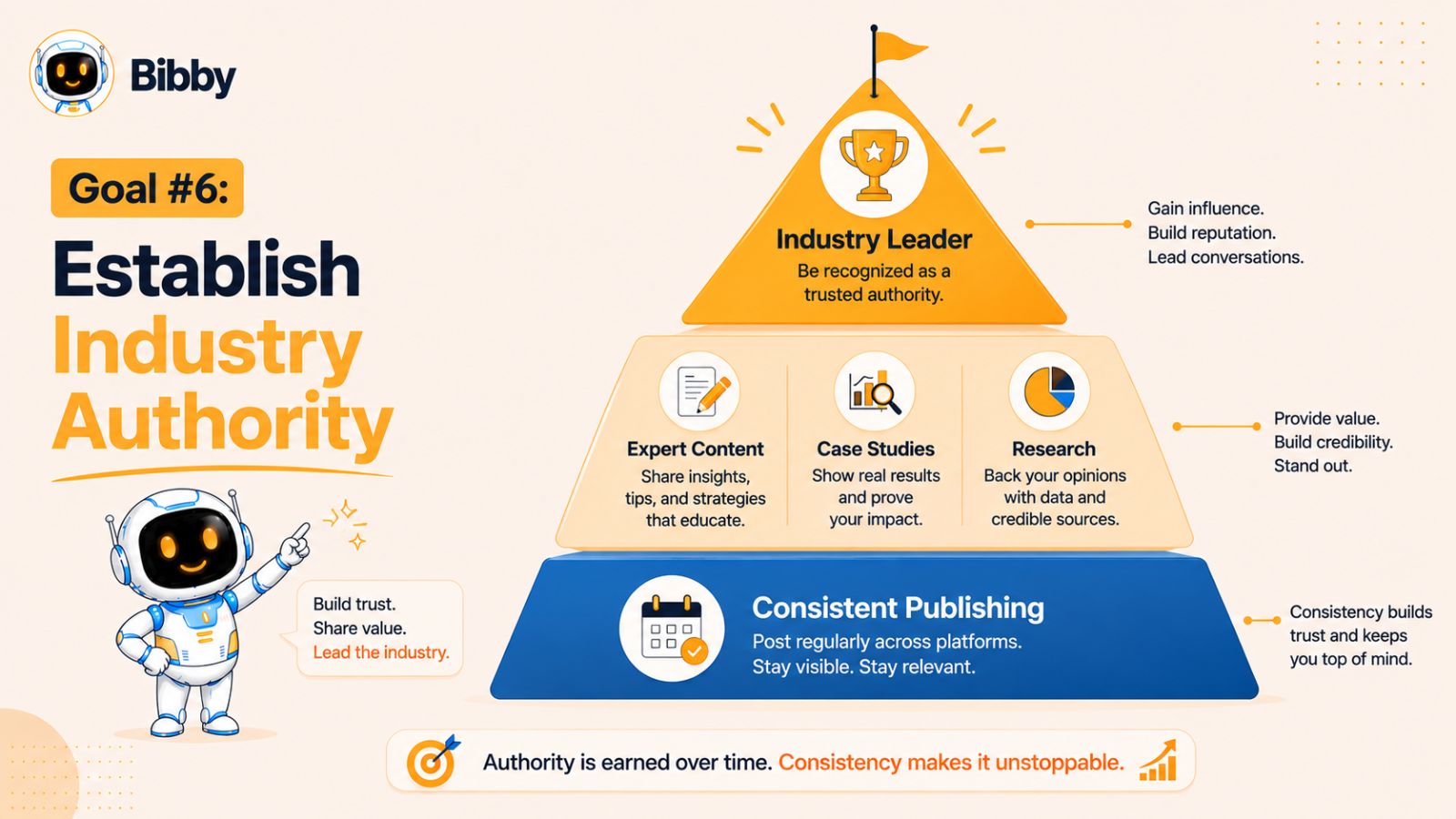
In today's crowded digital marketplace, customers have more choices than ever before. When multiple businesses offer similar products or services, trust often becomes the deciding factor. One of the most effective ways to build trust is by establishing your business as an authority in your industry.
Social media gives small businesses a platform to showcase expertise, share valuable insights, and demonstrate thought leadership. Over time, this positions your brand as a trusted resource rather than just another company trying to sell something.
Why Industry Authority Matters
People naturally prefer doing business with brands they perceive as knowledgeable and credible. When your audience consistently learns something useful from your content, they begin to view your business as an expert source of information.
Building authority can help your business:
- Increase customer trust
- Differentiate from competitors
- Attract higher-quality leads
- Improve conversion rates
- Generate more referrals
- Create partnership opportunities
- Strengthen brand reputation
Authority often compounds over time. The more valuable content you publish, the more trust and visibility your brand gains.
Key Metrics to Track
While authority can feel difficult to measure, several indicators can help track your progress.
Content Shares
People share content they find useful, insightful, or educational. Increased sharing often indicates growing authority.
Brand Mentions
Mentions across social media, blogs, podcasts, and industry discussions can signal rising influence.
Website Backlinks
Authoritative content often attracts backlinks from other websites, helping expand reach and support SEO efforts.
Speaking and Collaboration Opportunities
Invitations to participate in webinars, podcasts, interviews, or industry events often indicate that others recognize your expertise.
Audience Growth Among Target Customers
Growing a relevant audience is often more important than simply increasing follower numbers.
Effective Strategies to Build Authority
Publish Educational Content Consistently
Educational content is one of the fastest ways to demonstrate expertise.
Examples include:
- How-to guides
- Industry trends
- Best practices
- Case studies
- Frequently asked questions
- Common mistakes to avoid
The goal is to help your audience solve problems and make better decisions.
Share Original Insights
Instead of repeating what everyone else is saying, offer unique perspectives based on your experience and observations.
Businesses that contribute fresh ideas are often viewed as leaders rather than followers.
Use Data and Real Examples
Supporting your recommendations with results, examples, or data increases credibility and trust.
Showcase Customer Success Stories
Case studies and testimonials demonstrate that your expertise produces real-world outcomes.
Participate in Industry Conversations
Engaging with discussions, trends, and relevant topics helps increase visibility while positioning your business as an active contributor to the industry.
Common Authority-Building Mistakes
Businesses often struggle to establish authority because they:
- Focus only on promotional content
- Post inconsistently
- Follow trends without adding unique insights
- Avoid sharing expertise for fear of giving away too much information
- Prioritize selling over educating
Authority grows when businesses consistently provide value before asking for a sale.
How Bibby Helps Build Industry Authority
Establishing authority requires publishing high-quality content consistently across multiple channels. However, maintaining that level of consistency can be difficult for small business owners who already manage numerous responsibilities.
Bibby helps streamline the entire content workflow. Businesses can upload images or generate visuals with AI, select a preferred posting style, and automatically generate captions designed to align with their brand voice and audience.
Content can then be scheduled across Facebook, Instagram, LinkedIn, YouTube, TikTok, and other platforms at AI-optimized posting times. This allows businesses to maintain a consistent presence and regularly share educational content without spending hours every week on manual publishing.
Additionally, Bibby's analytics help identify which content performs best, making it easier to refine authority-building strategies and create more of the content that audiences value most.
The Bottom Line
Industry authority isn't built overnight, but consistent education, valuable insights, and authentic expertise can gradually position your business as a trusted leader in your field. As authority grows, so do opportunities for engagement, lead generation, customer trust, and long-term business success.
You may also like reading: Best Platforms to Share Video Content and Grow Your Audience
Goal #7: Increase Sales and Revenue
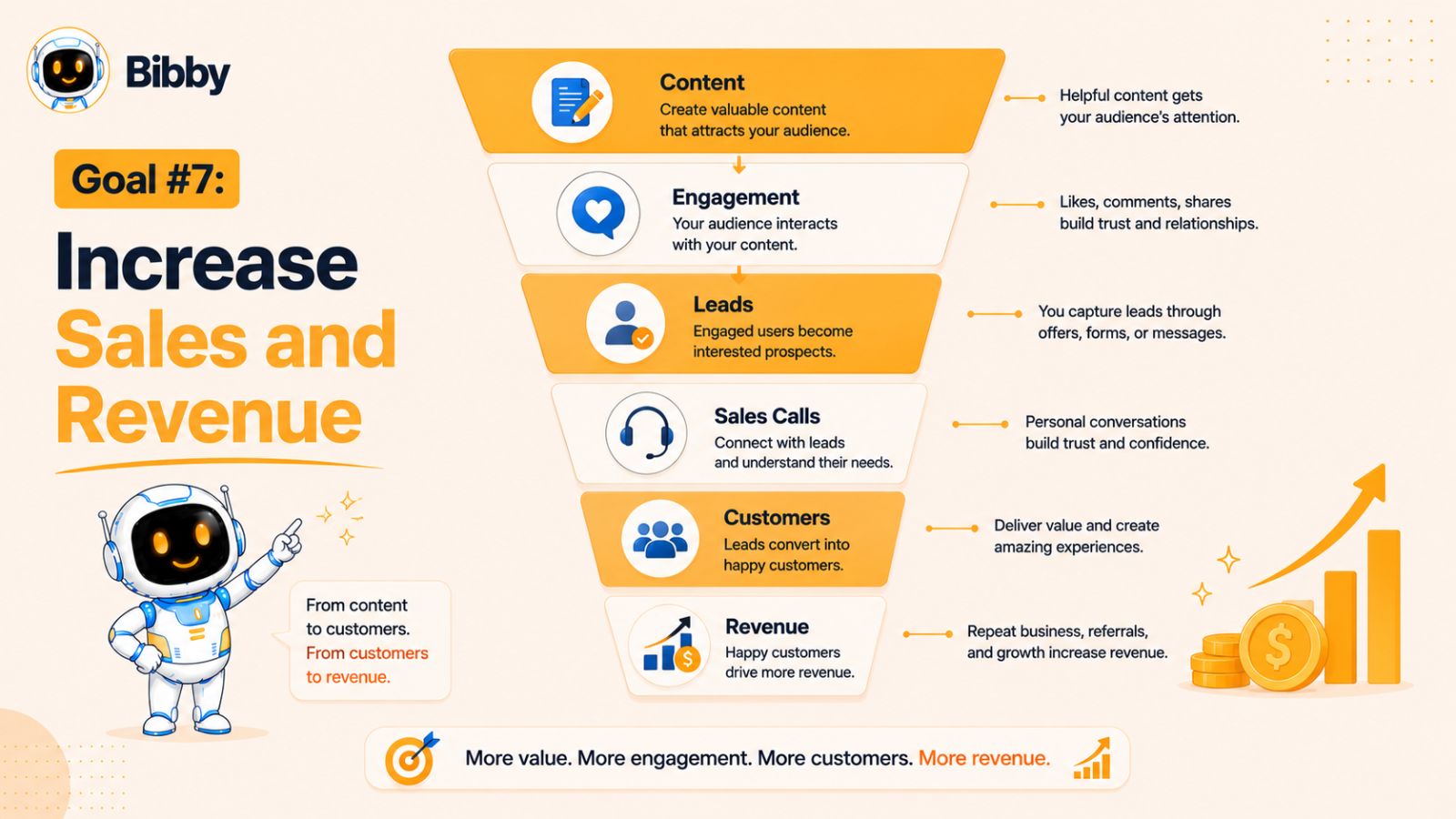
While social media can help build awareness, engagement, loyalty, and authority, most small businesses ultimately want to achieve one outcome: increased revenue. Sales are the lifeblood of any business, and social media can be a powerful tool for attracting prospects, nurturing relationships, and converting followers into paying customers.
The key is understanding that successful social media selling isn't about constantly promoting products. Instead, it's about guiding potential customers through a journey that builds trust and demonstrates value before asking for the sale.
Why Revenue-Focused Goals Matter
Every business invests time, money, and resources into marketing. Measuring social media's impact on revenue helps determine whether those investments are producing meaningful business results.
Revenue-focused social media strategies can help businesses:
- Increase product or service sales
- Generate higher-quality leads
- Improve conversion rates
- Shorten sales cycles
- Increase customer lifetime value
- Maximize marketing ROI
When social media activities are tied directly to revenue goals, it becomes easier to justify investments and scale successful campaigns.
Key Metrics to Track
To understand how social media contributes to revenue, monitor metrics that directly impact sales performance.
Conversion Rate
Conversion rate measures the percentage of visitors who complete a desired action, such as making a purchase, booking a consultation, or requesting a quote.
Revenue From Social Media
Tracking revenue generated from social media campaigns provides a clear picture of financial performance.
Cost Per Acquisition (CPA)
CPA helps determine how much it costs to acquire a new customer through social media marketing efforts.
Return on Investment (ROI)
ROI compares revenue generated against marketing costs, helping businesses evaluate overall effectiveness.
Average Order Value (AOV)
Increasing average order value can significantly improve profitability without requiring additional customers.
Effective Strategies to Increase Sales Through Social Media
Educate Before You Sell
Customers rarely make purchasing decisions based solely on promotional content. Educational content helps build trust and demonstrates expertise before introducing products or services.
Examples include:
- Product tutorials
- Industry tips
- Problem-solving guides
- Customer success stories
- Frequently asked questions
Use Social Proof
People trust other customers more than marketing messages. Testimonials, reviews, and case studies can significantly increase conversion rates.
Showcase Product Benefits, Not Just Features
Rather than focusing only on product specifications, explain how your offering solves customer problems or improves outcomes.
Create Strong Calls-to-Action
Every sales-focused campaign should clearly guide users toward the next step.
Examples include:
- Start your free trial
- Book a consultation
- Request a quote
- Shop now
- Get started today
Leverage Video Content
Videos often outperform other content formats when it comes to demonstrating products, answering objections, and building confidence in purchasing decisions.
Common Sales Mistakes on Social Media
Many businesses struggle to generate revenue because they:
- Focus exclusively on promotional content
- Post inconsistently
- Fail to build trust before selling
- Ignore customer questions and objections
- Use weak calls-to-action
- Target the wrong audience
The most successful social media sales strategies combine value, trust, consistency, and strategic promotion.
How Bibby Helps Businesses Increase Revenue
Generating sales through social media requires a steady stream of high-quality content that keeps your audience engaged throughout the buying journey.
Bibby simplifies this process by automating content creation and scheduling. Businesses can upload an image or generate one using AI, select a preferred posting style, and allow Bibby to automatically create captions that align with their content goals.
Bibby then schedules content across Facebook, Instagram, LinkedIn, YouTube, TikTok, and other selected platforms at AI-optimized posting times designed to maximize visibility and engagement. This ensures businesses maintain a consistent presence without spending hours managing social media manually.
In addition, Bibby's analytics provide valuable insights into content performance, helping businesses identify which posts generate the most engagement, traffic, leads, and sales. By understanding what works, businesses can continuously refine their strategy and improve revenue outcomes over time.
The Bottom Line
Increasing sales and revenue is often the ultimate objective of social media marketing. However, successful social selling requires more than simply promoting products. By focusing on education, trust-building, customer relationships, and consistent content delivery, small businesses can transform social media into a reliable channel for generating long-term revenue growth.
Now that we've covered the seven most important social media goals, the next step is learning how to choose the right goals for your specific business stage, industry, and growth objectives.
How Many Social Media Goals Should You Have?
More goals do not mean a better social media strategy.
In fact, trying to improve everything at once usually makes it harder to improve anything. If your team is simultaneously trying to increase followers, engagement, reach, website traffic, leads, sales, and customer retention, every metric becomes a priority and none of them truly is.
For most businesses, a better starting point is:
One primary goal + one or two supporting goals.
Your primary goal should represent the business outcome social media is expected to influence. Supporting goals should help you achieve that outcome.
Example: A B2B SaaS Company
Primary goal: Generate qualified leads
Supporting goals:
- Increase reach among marketing decision-makers
- Increase qualified traffic to high-intent product pages
The company doesn't need separate goals for followers, likes, impressions, comments, clicks, leads, and sales. Those can be tracked as metrics or supporting indicators without turning each one into a strategic objective.
Example: An E-commerce Brand
Primary goal: Increase social-assisted revenue
Supporting goals:
- Increase product discovery
- Increase qualified traffic to product pages
Here, reach and engagement still matter, but they're not necessarily the destination. They're signals that help explain whether the strategy is moving toward revenue.
Example: A New Brand
Primary goal: Build awareness within its target market
Supporting goals:
- Increase qualified reach
- Increase meaningful engagement
The goals can change as the business develops. Once awareness reaches a healthy level, the brand may shift its primary objective toward traffic, leads, sales, or retention.
Why Fewer Goals Work Better
A focused goal structure gives your team clearer answers to three important questions:
What are we trying to achieve?
Your primary goal answers this.
How will we know we're making progress?
Your KPI and target answer this.
What should we prioritize when resources are limited?
Your primary goal answers this too.
Without that hierarchy, social media teams often fall into activity-based planning: publishing more often, chasing trends, increasing posting volume, or trying every new format simply because the platform makes it available.
A focused goal gives those activities a job to do.
Your Goals Should Change With the Business
Your primary social media goal doesn't have to remain the same forever.
A typical progression might look like:
Early stage
Awareness → Engagement
Growing audience
Engagement → Traffic
Established demand
Traffic → Leads
Strong acquisition engine
Leads → Sales
Mature customer base
Sales → Retention and advocacy
This isn't a fixed lifecycle. A business can move backward or skip stages depending on its circumstances.
The important point is that your social media goals should reflect your current business priority, not last year's strategy.
Before setting your next target, ask:
If we could improve only one social media outcome over the next 90 days, which improvement would have the greatest impact on the business?
That answer should usually become your primary goal.
How to Set SMART Social Media Goals
Once you've chosen the right social media goal, turn it into a target your team can actually work toward.
This is where the SMART framework can help. SMART stands for Specific, Measurable, Achievable, Relevant, and Time-bound.
The framework is useful, but it is often applied too mechanically. Adding a number and a deadline to a vague objective doesn't automatically make it a good goal.
A strong SMART social media goal should connect three things:
A meaningful business outcome + a measurable target + a realistic timeframe.
Specific
A goal should make it obvious what you're trying to change.
Weak:
Increase social media performance.
Better:
Increase qualified traffic from LinkedIn to our website.
The second goal identifies the platform, audience outcome, and desired direction of change.
Measurable
You need a metric that allows you to determine whether you're making progress.
Weak:
Improve our LinkedIn presence.
Better:
Increase qualified LinkedIn referral sessions by 25%.
The metric should be closely related to the outcome you're trying to achieve. Don't choose a number simply because the platform makes it easy to measure.
Achievable
A target should stretch the team without becoming disconnected from reality.
If your account has historically grown by 5% per quarter, suddenly targeting 500% growth without a major change in strategy, budget, audience, or distribution is unlikely to be useful.
An achievable goal should consider:
- Historical performance
- Available resources
- Audience size
- Content capacity
- Paid media budget
- Market conditions
- Previous experiments
“Achievable” doesn't mean setting an easy target. It means having a credible reason to believe the target is possible.
Relevant
Your goal needs to matter to the business.
For example, increasing Instagram followers by 50% might sound impressive. But if your business sells a high-value B2B product and your sales pipeline comes primarily from LinkedIn, that follower target may have little strategic value.
A relevant goal might instead be:
Generate 100 qualified leads from LinkedIn in the next quarter.
The best social media goals aren't necessarily the most impressive numbers. They're the numbers connected to outcomes the business actually cares about.
Time-Bound
Every meaningful goal needs a timeframe.
Compare:
Increase qualified leads from social media.
with:
Increase qualified leads from social media by 20% within the next 90 days.
The second gives your team a defined period in which to execute, measure, and evaluate the strategy.
Weak vs. Strong Social Media Goals
Here's what the progression looks like in practice:
Weak:
Get more followers.
Better:
Increase Instagram followers by 20%.
Stronger:
Increase relevant Instagram followers by 20% over the next 90 days.
Strongest:
Increase relevant Instagram followers by 20% over the next 90 days while maintaining an engagement rate above our current baseline.
The final version gives you a target, timeframe, audience-quality consideration, and a guardrail against pursuing growth at the expense of engagement.
A Simple SMART Goal Formula
Use this structure when writing your own goal:
Increase [specific outcome] from [baseline] to [target] among [audience] on [platform] by [deadline].
For example:
Increase qualified LinkedIn leads from 60 to 100 per quarter among marketing decision-makers by the end of Q4.
That is much more actionable than:
Improve our LinkedIn lead generation.
One final rule: don't force every social media activity into a SMART goal. Not every metric needs its own target. Choose the few outcomes that matter most, measure the supporting signals, and keep your strategic focus narrow.
How to Set a Realistic Social Media Target
Choosing the right goal is only half the job. You also need to decide how much improvement is realistic.
This is where many social media strategies become arbitrary. Someone picks a target such as “increase engagement by 50%” because it sounds ambitious, or “double our followers this year” because a competitor did it.
A better approach is to build your target from evidence.
Your target should answer:
Where are we now, where do we want to go, and why is that level of improvement achievable?
1. Start With Your Baseline
You can't set a meaningful target without knowing your starting point.
Before choosing a number, record your current performance for the KPI that matters.
For example:
- Current qualified leads: 60/month
- Current social referral traffic: 8,000/month
- Current engagement rate: 3.2%
- Current conversion rate: 2.5%
- Current qualified reach: 120,000/month
Then define the desired outcome.
Increase qualified leads from 60 to 90 per month.
Now you have something measurable to work toward.
2. Look at Historical Performance
Your previous performance gives you a useful reference point.
Look at the last three to six months, or longer if you have enough reliable data.
Ask:
- What has grown consistently?
- Which metrics have remained flat?
- What changed when performance improved?
- Which content or campaigns produced the strongest results?
- Have previous targets been achieved?
If qualified leads have increased by roughly 8% per quarter without major changes, a 10–15% improvement might be a defensible target.
A 300% target might require a completely different strategy, budget, audience, or distribution model.
3. Account for Seasonality
Social media performance rarely moves in a perfectly straight line.
Some businesses see major differences around:
- Holidays
- Product launches
- Sales periods
- Industry events
- Seasonal buying cycles
- Back-to-school periods
- End-of-quarter or end-of-year purchasing
Compare performance against the appropriate historical period whenever possible.
A 20% drop in traffic during a normal seasonal slowdown isn't necessarily a strategic failure. Likewise, a 40% increase during an unusually strong sales period doesn't automatically establish a new baseline.
4. Consider the Resources Behind the Goal
A target should reflect what you can realistically put behind it.
Consider:
- Content production capacity
- Number of people on the social team
- Paid media budget
- Creative resources
- Publishing frequency
- Available distribution channels
- Website conversion capacity
- Sales capacity
If you want twice as many qualified leads but aren't increasing distribution, improving the offer, or changing the content strategy, the target may simply be wishful thinking.
5. Separate Targets From Aspirations
It is perfectly reasonable to have an ambitious vision.
But your operating target should be grounded in evidence.
For example:
Business aspiration:
Double social-generated pipeline this year.
90-day operating target:
Increase qualified social-generated opportunities by 20%.
The aspiration gives the team direction. The operating target gives the team something measurable and realistic to execute against.
6. Use a Target Range When Precision Is Artificial
Not every outcome can be predicted precisely.
Instead of pretending that you know you'll generate exactly 1,250 qualified visitors, you may be better served by defining a range:
Increase qualified social traffic by 20–30% over the next quarter.
This is particularly useful when your sample size is small, attribution is imperfect, or external factors can significantly affect performance.
A Simple Target-Setting Framework
Use this sequence:
Baseline → Historical trend → Business ambition → Available resources → Target
For example:
Baseline: 60 qualified leads/month
↓
Historical trend: Growing approximately 8% per quarter
↓
Business ambition: Build a larger sales pipeline
↓
Resources: New content program + increased distribution
↓
Target: 90 qualified leads/month within 90 days
Now the target has a rationale behind it.
That's the difference between a number that simply looks ambitious and a number your team can actually build a strategy around.
Social Media Goals by Platform
Your social media goals should be consistent with your business objectives, but they don't have to be identical across every platform.
Different platforms attract different audiences, support different content formats, and create different opportunities for discovery, engagement, traffic, and conversion. Treating every channel as if it has the same job often leads to unfocused content and meaningless performance comparisons.
The better approach is to give each platform a specific role within your overall social media strategy.
Instagram Goals
Instagram is often strongest when visual discovery, brand identity, community, and product consideration are important.
Depending on your business, useful Instagram goals can include:
- Increase qualified reach
- Improve engagement with target customers
- Increase product discovery
- Generate website or product-page traffic
- Increase user-generated content
- Drive social-assisted purchases
Example goal:
Increase qualified Instagram reach among our target customer segment by 30% over the next 90 days while maintaining our current engagement rate.
Don't judge Instagram solely by follower count. A smaller audience that actively engages with your products can be more valuable than a much larger passive audience.
Facebook Goals
Facebook can support several objectives, particularly for businesses that rely on communities, local audiences, existing customers, or paid distribution.
Potential goals include:
- Increase local or regional awareness
- Grow an active community
- Increase website traffic
- Generate leads
- Retain and engage existing customers
- Drive conversions through paid campaigns
Example goal:
Increase qualified website traffic from Facebook by 20% over the next quarter.
The right objective depends heavily on how your audience uses the platform and where Facebook fits into your customer journey.
LinkedIn Goals
For B2B companies, LinkedIn can play a particularly important role in awareness, thought leadership, demand generation, and pipeline creation.
Useful goals include:
- Increase visibility among decision-makers
- Build executive or founder authority
- Generate qualified leads
- Increase qualified website traffic
- Improve engagement from industry professionals
- Create sales opportunities
Example goal:
Generate 100 qualified leads from LinkedIn among marketing decision-makers over the next 90 days.
For B2B brands, raw impressions or follower growth can be useful supporting metrics, but the quality of the audience often matters considerably more.
TikTok Goals
TikTok can be particularly useful for discovery and reaching audiences that may not already know your brand.
Potential goals include:
- Increase qualified reach
- Grow awareness among a new audience
- Increase video completion and engagement
- Drive product discovery
- Generate traffic from high-performing content
Example goal:
Reach 500,000 relevant users within our target demographic over the next quarter while maintaining a video completion rate above our baseline.
Virality can be valuable, but it shouldn't automatically become the objective. A viral video that reaches the wrong audience may produce very little business value.
YouTube Goals
YouTube can support both social and search-driven discovery, making it useful for education, authority building, product consideration, and long-form content.
Potential goals include:
- Increase relevant video views
- Grow watch time
- Increase subscribers within the target audience
- Generate qualified website traffic
- Build topical authority
- Generate leads or sales
Example goal:
Increase qualified organic traffic from YouTube by 25% over the next six months through educational videos targeting high-intent search topics.
YouTube also gives you an opportunity to evaluate deeper engagement signals such as watch time and audience retention rather than relying only on views.
Don't Force Every Platform to Do Everything
One of the most common social media strategy mistakes is expecting every platform to generate the same result.
You might use:
Instagram → Discovery and community
LinkedIn → B2B demand generation
TikTok → New audience discovery
YouTube → Education and authority
Facebook → Community, distribution, and conversions
The exact mix will depend on your audience and business model.
The goal is not to be everywhere. It's to understand where your audience is, what each platform is good at, and what job you want each channel to perform.
Create a Platform Role Before Setting Platform Goals
For each social network, define three things:
Platform role: Why are we using this channel?
Primary goal: What outcome should it produce?
Primary KPI: How will we know whether it's working?
For example:
| Platform | Role | Primary goal | Primary KPI |
|---|---|---|---|
| Product discovery | Increase qualified reach | Qualified reach | |
| Demand generation | Generate qualified leads | Qualified leads | |
| TikTok | Audience discovery | Build awareness | Relevant reach |
| YouTube | Education | Increase qualified traffic | Engaged referral traffic |
| Community | Increase customer engagement | Meaningful interactions |
This prevents your social strategy from becoming a collection of disconnected platform tactics.
Your business should have one overarching social media strategy, but each platform should have a clear job within it.
Match Each Social Media Goal With the Right KPI
A social media goal tells you what you want to achieve. A KPI tells you how you'll determine whether you're achieving it.
The mistake is choosing KPIs simply because they're easy to find in a social media dashboard.
Followers, impressions, likes, and clicks can all be useful. But they're not automatically meaningful just because a platform reports them. The right KPI should tell you something important about progress toward your actual goal.
A useful measurement hierarchy is:
Primary KPI → Supporting KPIs → Diagnostic metrics
Your primary KPI measures the outcome you're trying to improve. Supporting KPIs help explain progress, while diagnostic metrics help you understand why performance changed.
Social Media Goals and Their Primary KPIs
| Social media goal | Primary KPI | Supporting KPIs | Metrics to interpret carefully |
|---|---|---|---|
| Brand awareness | Qualified reach | Impressions, mentions, branded search | Raw follower growth |
| Engagement | Engagement rate | Shares, saves, comments, DMs | Likes alone |
| Website traffic | Engaged sessions | CTR, clicks, landing-page engagement | Click volume alone |
| Lead generation | Qualified leads | Conversion rate, CPL, opportunities | Raw form submissions |
| Sales | Revenue | Conversion rate, CAC, ROAS | Impressions and clicks |
| Retention | Repeat engagement | ugc, mentions, referrals | Follower growth |
| Authority | Relevant mentions | Expert engagement, shares, branded search | Total impressions |
The table is a starting point, not a universal rule. The right KPI depends on your business model, attribution system, and customer journey.
Brand Awareness: Measure the Right Audience
If awareness is your goal, reach and impressions matter, but who you reach matters just as much as how many people you reach.
For example, reaching 500,000 people outside your target market may be less valuable than reaching 50,000 people who fit your ideal customer profile.
Useful supporting signals include:
- Relevant audience reach
- Impressions
- Brand mentions
- Share of voice
- Branded search trends
Engagement: Look Beyond Likes
Likes are easy to generate and easy to report.
They also tell you relatively little on their own.
Shares, saves, comments, DMs, and meaningful conversations can provide stronger evidence that your content is resonating.
For example, if your goal is to build an expert community, 100 thoughtful comments from relevant professionals may be more valuable than 10,000 likes from a broad audience.
Traffic: Measure What Happens After the Click
Clicks are only the beginning.
If your goal is to generate valuable website traffic, look at:
- Engaged sessions
- Time spent on important pages
- Pages viewed
- Landing-page conversion
- Return visits
- Assisted conversions
A social post that produces 5,000 clicks but almost no meaningful website engagement may not be performing as well as one that produces 800 highly relevant visitors.
Lead Generation: Measure Lead Quality
Lead volume can become a vanity metric surprisingly quickly.
If 1,000 people submit a form but only 10 are potential customers, the campaign isn't necessarily successful.
For lead-generation goals, consider:
- Qualified leads
- Marketing-qualified leads
- Sales-qualified leads
- Lead-to-opportunity rate
- Cost per qualified lead
- Opportunities generated
Your CRM and social analytics should ideally work together so you can evaluate what happens after the initial conversion.
Sales: Connect Social Activity to Revenue
If sales are the objective, eventually you need to connect social activity with commercial outcomes.
Useful measures include:
- Revenue
- Conversion rate
- Customer acquisition cost
- Return on ad spend
- Revenue per visitor
- Assisted conversions
Attribution will rarely be perfect. A customer might see your social post, search for your brand later, read an article, return through email, and then purchase.
That doesn't make social irrelevant. It means you should avoid treating a single attribution model as an absolute representation of the customer journey.
Retention: Measure Relationships
Retention goals require different signals.
Look at whether existing customers are:
- Engaging repeatedly
- Sharing your content
- Creating content about your brand
- Mentioning your company
- Participating in your community
- Referring other customers
The goal isn't simply to make existing customers “more active” on social media. It's to strengthen the relationship in ways that can contribute to loyalty and advocacy.
Authority: Use a Collection of Signals
Authority is one of the hardest social media outcomes to measure with a single number.
Instead, look for a pattern:
Relevant people see your content → engage with it → share it → mention your brand → seek your expertise → eventually take a commercial action.
Useful indicators can include:
- Mentions from relevant experts
- Shares by industry professionals
- Engagement from decision-makers
- Invitations to events or podcasts
- Media opportunities
- Branded search growth
- Relevant referral traffic
Don't Turn Every Metric Into a KPI
This is one of the most important rules in social media measurement.
If everything is a KPI, nothing is.
For each campaign or goal, choose one primary KPI that represents success. Then select a handful of supporting metrics that help explain what is driving that result.
For example:
Goal: Generate qualified B2B leads
Primary KPI: Qualified leads
Supporting KPIs: Conversion rate, cost per qualified lead, sales opportunities
Diagnostic metrics: Reach, impressions, engagement, clicks, CTR
This hierarchy keeps reporting focused on outcomes instead of producing a monthly spreadsheet full of numbers nobody knows how to act on.
The best social media reporting doesn't answer “How many things happened?”
It answers:
“Did social media produce the outcome we were trying to create, and what should we change next?”
25 Social Media Goal Examples You Can Actually Use
Knowing the theory is useful, but most teams eventually reach the same point:
“Okay, but what should our actual goal look like?”
A useful social media goal should identify the outcome, the audience or channel when relevant, the target, and the timeframe. Avoid vague goals such as “improve engagement” or “grow our presence.”
Below are practical examples you can adapt to your own baseline and business objectives.
Brand Awareness Goals
1. Increase qualified reach
Increase monthly reach among our target audience by 30% within the next 90 days.
2. Increase brand visibility
Increase relevant brand mentions by 20% over the next six months.
3. Expand into a new market
Reach 100,000 potential customers in our new target market within the first three months of launch.
4. Increase branded search interest
Increase branded search volume by 15% over the next six months alongside our social awareness campaign.
Engagement and Community Goals
5. Improve engagement rate
Increase our average engagement rate from 3% to 4% within the next quarter.
6. Increase meaningful conversations
Increase comments and direct conversations from our target audience by 25% over the next 90 days.
7. Increase content sharing
Increase average content shares by 30% within the next three months.
8. Generate user-generated content
Generate 50 pieces of customer-created content over the next six months.
Website Traffic Goals
9. Increase qualified referral traffic
Increase engaged website sessions from social media by 25% within the next quarter.
10. Improve social CTR
Increase the average click-through rate on promotional social posts from 1.8% to 2.5% within 90 days.
11. Drive traffic to a new product
Generate 10,000 qualified visits to the new product page from social media during the first 60 days after launch.
12. Increase content discovery
Increase engaged traffic from social media to our highest-value educational content by 30% over the next six months.
Lead Generation Goals
13. Generate qualified leads
Generate 100 qualified leads from social media over the next 90 days.
14. Improve lead conversion
Increase the conversion rate from social referral traffic to qualified leads by 20% within the next quarter.
15. Reduce cost per qualified lead
Reduce cost per qualified lead from social campaigns by 15% over the next three months.
16. Generate sales opportunities
Generate 30 qualified sales opportunities from social-generated leads during the next quarter.
Sales and Revenue Goals
17. Increase social-assisted revenue
Increase revenue influenced by social media by 20% over the next six months.
18. Increase social conversion rate
Increase the conversion rate of qualified social traffic by 15% within the next quarter.
19. Improve customer acquisition efficiency
Reduce customer acquisition cost from paid social campaigns by 10% over the next 90 days.
20. Increase product purchases
Increase purchases originating from social campaigns by 25% during the next quarter.
Retention and Advocacy Goals
21. Increase customer engagement
Increase meaningful social interactions from existing customers by 20% over the next six months.
22. Increase customer advocacy
Generate 75 customer testimonials, reviews, or user-generated posts through social channels over the next six months.
23. Increase referrals
Generate 50 qualified customer referrals from social advocacy campaigns within the next quarter.
Authority and Thought Leadership Goals
24. Increase expert engagement
Increase engagement from relevant industry professionals and decision-makers by 30% over the next six months.
25. Increase industry visibility
Earn 20 mentions or shares from relevant industry experts and publications within the next six months.
How to Adapt These Goals to Your Business
Don't copy these targets blindly.
A 30% increase might be reasonable for one business and completely unrealistic for another. Your starting point, audience size, industry, resources, content quality, distribution, and historical performance all affect what a sensible target looks like.
Instead, use the structure behind each example:
Outcome + audience/channel + baseline + target + timeframe
For example:
Increase qualified LinkedIn leads from 60 to 100 per quarter among marketing decision-makers by the end of Q4.
That's more useful than:
Get more leads from LinkedIn.
And if you don't have enough historical data to establish a baseline yet, your first goal may simply be to establish a reliable baseline.
The goal isn't to choose the biggest number you can imagine. It's to choose a number that represents meaningful progress toward an outcome the business actually cares about.
Social Media Goals for Different Types of Businesses
There is no universal social media goal that works for every business.
A B2B SaaS company selling a $20,000 annual contract should not measure social media the same way as an e-commerce brand selling $40 products. A local restaurant has different priorities from a consultant building a personal brand.
Your business model changes what social media is expected to accomplish, which means it should also change the goals you set.
SaaS and B2B Software
For SaaS companies, social media can support awareness, demand generation, education, thought leadership, and pipeline creation.
A typical goal structure might be:
Primary goal: Generate qualified leads or sales opportunities
Supporting goals:
- Increase visibility among decision-makers
- Increase qualified website traffic
- Build authority around important industry topics
Primary KPIs:
- Qualified leads
- Sales opportunities
- Pipeline influenced by social
- Conversion rate
Example:
Generate 100 qualified leads from LinkedIn among our target accounts within the next quarter.
For high-consideration B2B products, don't judge success primarily by impressions or follower growth. A smaller audience of relevant decision-makers can be considerably more valuable.
E-commerce Brands
E-commerce brands often have a shorter path between social discovery and purchase, making product discovery, conversion, and revenue especially important.
A typical goal structure might be:
Primary goal: Increase social-assisted revenue
Supporting goals:
- Increase product discovery
- Increase qualified product-page traffic
- Increase repeat customer engagement
Primary KPIs:
- Revenue
- Conversion rate
- Customer acquisition cost
- Return on ad spend
- Average order value
Example:
Increase purchases originating from social campaigns by 25% over the next quarter while maintaining our target customer acquisition cost.
Social content can also play an important role before the purchase itself by building familiarity, demonstrating products, and generating customer-created content.
Local Businesses
Restaurants, salons, gyms, clinics, retailers, and other local businesses often have a much more immediate geographic constraint.
Reaching 500,000 people across an entire country may be less useful than reaching 20,000 people within the area you actually serve.
A typical goal structure might be:
Primary goal: Increase local customer demand
Supporting goals:
- Increase local awareness
- Increase inquiries or bookings
- Increase reviews and customer advocacy
Primary KPIs:
- Local reach
- Calls or inquiries
- Bookings
- Website actions
- Reviews
- Directions or location-related actions
Example:
Increase qualified local inquiries generated through social media by 20% over the next 90 days.
Professional Services
Consultants, agencies, accountants, lawyers, coaches, and other professional service businesses often need to build trust before a prospect is ready to buy.
That makes authority and expertise particularly important.
A typical goal structure might be:
Primary goal: Generate qualified opportunities
Supporting goals:
- Increase visibility among decision-makers
- Establish subject-matter authority
- Drive qualified traffic to high-intent content
Primary KPIs:
- Qualified inquiries
- Discovery calls
- Relevant engagement
- Referral traffic
- Mentions from industry professionals
Example:
Generate 30 qualified consultation requests from social media within the next quarter.
For these businesses, publishing useful expertise can be more valuable than constantly promoting a service.
Startups
Startups often need to balance several competing priorities: building awareness, finding product-market fit, generating early demand, and learning what resonates with the market.
That makes experimentation particularly important.
A typical goal structure might be:
Primary goal: Build qualified awareness and demand
Supporting goals:
- Test positioning
- Identify high-performing content themes
- Generate early customer conversations
Primary KPIs:
- Qualified reach
- Relevant engagement
- Website visits
- Signups
- Qualified conversations
Example:
Generate 200 qualified product signups from social channels over the next 90 days while testing three positioning themes.
The goal isn't simply to maximize growth. It's to learn which audiences, messages, and content approaches create meaningful demand.
Creators and Personal Brands
Creators, founders, and personal brands often have different commercial models from traditional companies.
Their goals might focus on audience growth, authority, community, sponsorships, or direct monetization.
A typical goal structure might be:
Primary goal: Build a relevant audience
Supporting goals:
- Increase meaningful engagement
- Grow email subscribers
- Generate brand or partnership opportunities
Primary KPIs:
- Relevant audience growth
- Engagement rate
- Email subscribers
- Inbound opportunities
- Revenue
Example:
Increase relevant LinkedIn followers by 25% over the next six months while generating at least 10 qualified inbound opportunities.
The important word is relevant. Audience size is only useful when the audience has a reason to care about what you offer.
Choose Goals Based on Your Business Model, Not Someone Else's Dashboard
It's tempting to look at a competitor's social presence and copy their targets.
That's usually a mistake.
A competitor may have a larger audience, a different customer base, a different budget, a different product, or a completely different role for social media.
Instead, ask:
What does our business need social media to accomplish?
Then choose the goal, KPI, and target that fit that answer.
Your business model determines the destination. Your social platforms are simply the roads you use to get there.
How to Turn a Social Media Goal Into a Content Strategy
Setting a social media goal is only useful if it changes what you do next.
If your goal is to generate qualified leads but your content strategy is built entirely around entertaining memes, you have a strategy problem. If your goal is brand awareness but every post is a product promotion, your content may struggle to reach people who don't know you yet.
Your goal should influence who you create content for, what you say, which formats you use, and what action you want people to take.
A simple framework is:
Goal → Audience → Message → Content → Format → CTA → Measurement
1. Start With the Goal
Be clear about the outcome you're trying to create.
For example:
Generate 100 qualified leads from LinkedIn within 90 days.
That immediately gives your content strategy a different direction than a goal such as:
Increase brand awareness among marketing leaders.
The goal determines what the content needs to accomplish.
2. Define the Audience
Next, identify the people who can help you achieve the goal.
Don't settle for “our target audience.”
Get specific about:
- Job role
- Industry
- Company size
- Experience level
- Problems they face
- Buying stage
- Questions they are asking
- Content they already consume
For a B2B SaaS company, for example, the audience might be marketing leaders at 50–500 employee companies who are struggling to scale content production.
The more specific the audience, the easier it becomes to create content that feels relevant rather than generic.
3. Decide What You Need the Audience to Believe
This is the bridge between the goal and the content.
Ask:
What does our audience need to understand, believe, or discover before they take the action we want?
If you're trying to generate leads, they may need to believe that:
- Their current problem is costing them something
- There is a better way to solve it
- Your approach is credible
- Your product or service can actually help
That gives your content a job beyond simply filling a publishing calendar.
4. Build Content Around the Goal
Different goals require different content.
| Goal | Content focus | Typical CTA |
|---|---|---|
| Awareness | Education, trends, entertainment, discovery | Follow, share |
| Engagement | Opinions, questions, community discussions | Comment |
| Traffic | Guides, research, articles, resources | Read more |
| Leads | Case studies, problem-solving content, lead magnets | Sign up, book |
| Sales | Product proof, comparisons, testimonials | Buy, start |
| Retention | Customer education, support, community | Reply, participate |
| Authority | Original insights, research, expertise | Follow, discuss |
The table isn't a rigid formula. A single piece of content can serve multiple purposes. But having a primary goal helps prevent your feed from becoming a random collection of posts.
5. Choose the Right Format
The format should support the message and platform.
For example:
Awareness goal: Short-form video, visual explainers, educational posts
Engagement goal: Questions, polls, opinions, debates, community posts
Traffic goal: Research, articles, reports, guides
Lead goal: Case studies, webinars, product education, high-intent resources
Authority goal: Original research, expert analysis, frameworks, strong opinions
Don't choose formats simply because they're trending. Choose them because they give your message the best chance of achieving the intended outcome.
6. Give the Audience a Clear Next Step
Your CTA should match the goal.
If you're building awareness, asking someone to immediately book a demo may be too large a leap.
If someone has already consumed several high-intent pieces of content, asking them to learn more or start a trial may make sense.
Think of the CTA as the next logical step in the customer journey.
Awareness: Follow → Learn more
Engagement: Comment → Join the conversation
Traffic: Read → Explore
Lead generation: Download → Sign up → Book
Sales: Evaluate → Start → Purchase
7. Measure Content Against the Goal
Once you start publishing, evaluate content based on what it was designed to accomplish.
A lead-generation post shouldn't be considered a failure simply because it received fewer likes than an entertaining post.
Likewise, a brand-awareness video shouldn't automatically be judged by how many people clicked a link.
Ask:
Did this piece of content produce the behavior or outcome it was designed to create?
That question keeps content evaluation connected to strategy.
Build a Social Media Goal-to-Content Matrix
Before creating your next month's content, map your goals to the content you need.
| Goal | Audience need | Content | Format | CTA | Primary KPI |
|---|---|---|---|---|---|
| Awareness | Understand the problem | Educational insight | Short video | Follow | Qualified reach |
| Engagement | Express an opinion | Discussion post | Text/carousel | Comment | Engagement rate |
| Traffic | Learn more | Detailed guide | Article/post | Read | Engaged sessions |
| Leads | Solve a business problem | Case study | Carousel/video | Book demo | Qualified leads |
| Sales | Reduce purchase risk | Product proof | Case study/testimonial | Buy/start | Revenue |
| Authority | Gain expert perspective | Original research | Report/carousel | Share | Relevant mentions |
This matrix turns your social media strategy into something operational.
Instead of asking your team:
“What should we post today?”
you can ask:
“Which business outcome are we trying to move, and what content gives us the best chance of moving it?”
That's the difference between having a social media calendar and having a social media strategy.
How to Measure Social Media Goals
Setting a goal gives your social media strategy direction. Measurement tells you whether that direction is actually producing results.
But measurement shouldn't mean opening every platform dashboard at the end of the month and copying every available number into a report.
A useful measurement system answers three questions:
- Are we moving toward the goal?
- Why is performance changing?
- What should we do next?
The simplest way to build that system is to separate measurement into three levels:
Weekly → Monthly → Quarterly
Each level serves a different purpose.
Weekly: Monitor Signals, Don't Overreact
Weekly measurement is primarily about spotting changes early.
Look at the metrics that can help you understand whether your strategy is moving in the right direction:
- Reach
- Engagement
- Click-through rate
- Website traffic
- Leads
- Content performance
- Audience growth
You don't need to make a strategic change every week.
Social media performance naturally fluctuates because of content mix, publishing schedules, audience behavior, platform distribution, seasonality, and other factors.
Use weekly reporting to identify signals, not to declare victory or failure.
For example:
“Our LinkedIn posts about original research are consistently generating more qualified clicks than our promotional posts.”
That's a useful observation.
“This week's impressions dropped 12%, so our entire strategy isn't working.”
That's probably premature.
Monthly: Evaluate Patterns
Monthly reporting gives you enough data to identify meaningful patterns.
Compare your performance against:
- Your previous month
- Your baseline
- Your target
- Previous campaigns
- Different content types
- Different platforms
- Relevant audience segments
Ask:
What improved?
What declined?
Which content consistently performed well?
Which audiences responded?
Are we getting closer to the primary goal?
For example, if your primary goal is qualified lead generation, you might discover:
- Leads increased 18%
- Qualified leads increased 27%
- Website traffic increased 12%
- Engagement decreased 5%
That could still be a strong month.
If you were optimizing for engagement alone, you might conclude that performance declined. If you're measuring against the actual business objective, the picture is different.
Quarterly: Make Strategic Decisions
Quarterly reviews should be less about reporting numbers and more about deciding what happens next.
Ask:
- Did we achieve the goal?
- Which tactics contributed most?
- Which content should we scale?
- Which activities should we stop?
- Did our target remain realistic?
- Has the business priority changed?
- Should we keep, change, or replace the goal?
This is where social media measurement becomes strategic.
If your goal was to generate 300 qualified leads and you generated 340, don't simply celebrate the number and move on.
Find out why you achieved it.
Was it:
- A particular content series?
- A new platform?
- Better targeting?
- A stronger CTA?
- A product launch?
- Paid distribution?
- Improved landing pages?
The answer tells you what to do next.
Use a North-Star KPI and Supporting Metrics
A common reporting problem is having too many “important” metrics.
Instead, create a simple hierarchy.
North-Star KPI
The primary measure of whether the goal is being achieved.
Example:
Goal: Generate qualified leads
North-Star KPI: Qualified leads
Supporting KPIs
Metrics that help explain progress.
- Conversion rate
- Cost per qualified lead
- Sales opportunities
- Qualified traffic
Diagnostic Metrics
Lower-level metrics that help identify what's happening.
- Impressions
- Reach
- Engagement
- Clicks
- CTR
- Video views
This creates a useful chain:
Business outcome → Primary KPI → Supporting KPIs → Diagnostic metrics
If your qualified leads decline, diagnostic metrics can help you investigate whether reach, engagement, traffic, or conversion is responsible.
But don't let the diagnostic metrics replace the actual goal.
Don't Compare Every Metric in Isolation
Context matters.
Suppose your reach falls by 15% but qualified leads increase by 25%.
That's not necessarily a problem.
Or your engagement rate falls while revenue increases.
Again, the right interpretation depends on what you're trying to achieve.
The purpose of measurement isn't to make every number go up.
The purpose is to determine whether the numbers that matter are moving in the right direction.
Build a Simple Social Media Goal Dashboard
A useful dashboard doesn't need dozens of charts.
At minimum, track:
| Goal | Target | Current | Status | Key insight |
|---|---|---|---|---|
| Qualified leads | 100/month | 82 | Behind | LinkedIn case studies outperform |
| Qualified traffic | 10,000/month | 11,400 | On track | Research posts driving traffic |
| Conversion rate | 3% | 2.7% | Watch | Product pages need optimization |
This gives your team something much more valuable than a collection of vanity metrics.
It tells you where you stand, what's working, and what deserves attention next.
And when a goal isn't being achieved, don't immediately conclude that social media isn't working. The next step is to diagnose where the journey is breaking down.
What to Do When Your Social Media Goal Isn't Working
Not every social media goal will be achieved on the first attempt.
That isn't necessarily a sign that the strategy failed. Sometimes the target was too ambitious. Sometimes the audience was wrong. Sometimes the content worked, but the conversion path didn't. And sometimes the metric you chose wasn't actually a good measure of the business outcome.
The important thing is to diagnose the problem before changing everything.
Start by looking at the journey:
Reach → Engagement → Click → Website action → Lead → Qualified lead → Opportunity → Customer
Find the stage where performance starts to weaken.
Reach Is Increasing but Engagement Is Falling
If more people are seeing your content but fewer are interacting with it, the problem may be relevance.
Look at:
- Audience quality
- Content topics
- Creative formats
- Opening hooks
- Publishing frequency
- Platform fit
Ask:
Are we reaching more of the right people, or simply more people?
If reach is growing because your content is being distributed to a broad audience that has little interest in your product, increasing reach further won't necessarily solve the problem.
Engagement Is High but Traffic Is Low
This usually means people enjoy the content but don't have a strong reason to take the next step.
Check:
- Calls to action
- Link placement
- Content-to-page relevance
- Offer strength
- Audience intent
A post can generate thousands of likes and comments while creating very little commercial value.
If traffic matters, make the path from content to the next action obvious.
Traffic Is High but Leads Are Low
This is often a conversion problem rather than a traffic problem.
Check:
- Landing-page experience
- Message match
- Offer
- Call to action
- Form length
- Page speed
- Audience intent
For example, educational content may generate a lot of traffic from people researching a problem, while a sales page expects them to be ready to buy.
The solution may be creating content and landing pages for different stages of the buying journey.
Leads Are High but Sales Are Low
A high lead count can hide a serious quality problem.
If your social campaigns generate 500 leads but only five become sales opportunities, generating even more leads may make the problem worse.
Look at:
- Lead quality
- Audience targeting
- Offer
- Qualification criteria
- Sales follow-up
- Lead-to-opportunity rate
You may need fewer, better leads rather than more leads.
Followers Are Increasing but Business Results Are Flat
This is one of the clearest signs of a vanity-metric problem.
If followers are growing but:
- Qualified traffic isn't increasing
- Leads aren't increasing
- Sales aren't increasing
- Brand searches aren't increasing
- Meaningful engagement isn't increasing
then follower growth may not be the right primary goal.
Don't automatically conclude that the audience has no value. First determine whether the new followers match your target audience.
If they don't, change the strategy that is attracting them.
Engagement Is Down but Revenue Is Up
This is an important counterexample.
A decrease in likes or comments isn't automatically a problem if the business outcome you're optimizing for is improving.
For example:
Engagement: −10%
Qualified leads: +24%
Sales opportunities: +18%
In this situation, reducing your strategy to “engagement is down” would lead you toward the wrong decision.
Your primary goal determines how you interpret the supporting metrics.
Nothing Is Moving
If reach, engagement, traffic, leads, and revenue are all flat, investigate the fundamentals before simply publishing more.
Ask:
- Are we targeting the right audience?
- Is our positioning clear?
- Is the content differentiated?
- Are we using the right platform?
- Is the offer compelling?
- Are we publishing enough to learn?
- Is the conversion path working?
- Do we have enough data to judge the strategy?
Sometimes the problem isn't execution.
It may be that the strategy itself is pointed at the wrong problem.
Use the funnel to Find the Problem
A simple diagnostic framework can help:
| What you're seeing | Likely issue to investigate |
|---|---|
| Reach ↓ | Distribution, audience, content, platform |
| Reach ↑, engagement ↓ | Relevance or content quality |
| Engagement ↑, traffic ↓ | CTA or intent |
| Traffic ↑, leads ↓ | Landing page or offer |
| Leads ↑, sales ↓ | Lead quality or sales process |
| Followers ↑, everything else flat | Audience quality or vanity metric |
| Engagement ↓, revenue ↑ | Possibly no problem |
This prevents the most common reaction to disappointing results:
“Let's post more.”
More content is not a strategy.
If the problem is audience quality, publishing more won't fix it. If the problem is conversion, more traffic won't necessarily fix it. If the problem is positioning, another hundred posts won't magically make the message clearer.
Diagnose first. Then change the part of the system that is actually underperforming.
You may also like reading: Best Platforms to Share Video Content and Grow Your Audience
How to Choose the Right Social Media Goals for Your Business
One of the biggest mistakes small businesses make is trying to achieve every social media goal at the same time. While increasing brand awareness, generating leads, driving traffic, improving engagement, building loyalty, establishing authority, and increasing sales are all valuable objectives, not every goal should be a priority right now.
The most successful businesses focus on the goals that align with their current stage of growth and overall business objectives. By concentrating resources on the right priorities, you can achieve faster results and create a stronger foundation for future growth.
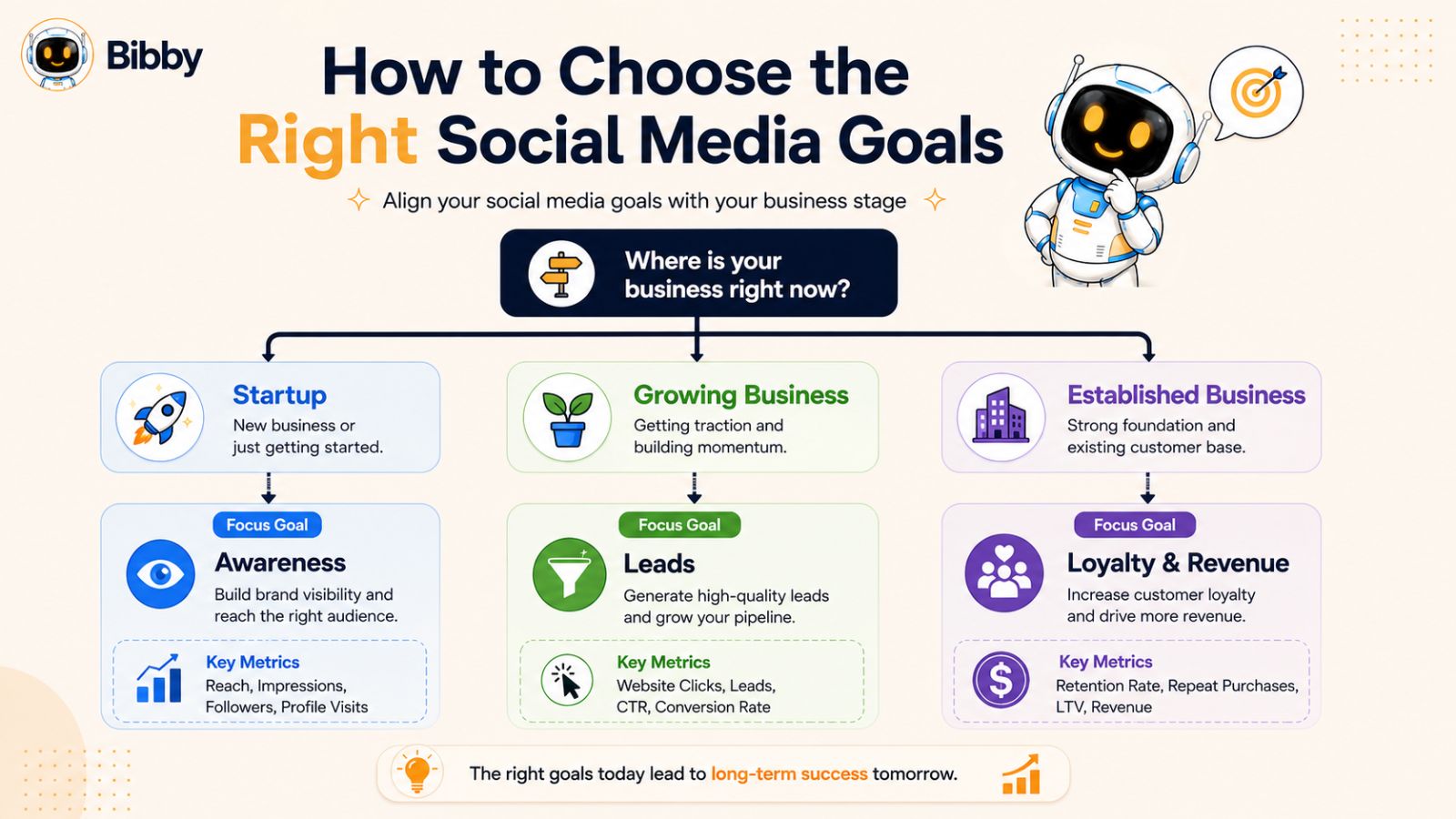
Start by Assessing Your Current Business Stage
Your business stage often determines which social media goals should receive the most attention.
Startup or New Business
If your business is new, very few people know who you are. In this stage, brand awareness should typically be your primary focus.
Recommended priorities:
- Increase Brand Awareness
- Increase Customer Engagement
- Drive Website Traffic
The goal is to get your business in front of as many relevant people as possible while building initial trust and visibility.
Growing Business
Once you've established some visibility, the next step is turning attention into opportunities.
Recommended priorities:
- Generate High-Quality Leads
- Drive Website Traffic
- Establish Industry Authority
At this stage, your content should focus on attracting prospects and moving them through the buying process.
Established Business
Businesses with a steady customer base often benefit most from focusing on retention and revenue growth.
Recommended priorities:
- Improve Customer Loyalty and Retention
- Increase Sales and Revenue
- Strengthen Industry Authority
These goals help maximize customer lifetime value while reinforcing your position within the market.
Align Social Media Goals With Business Objectives
Your social media strategy should support broader business priorities.
For example:
| Business Objective | Recommended Social Media Goal |
|---|---|
| Increase visibility | Brand Awareness |
| Generate prospects | Lead Generation |
| Grow website visitors | Website Traffic |
| Build community | Customer Engagement |
| Increase repeat business | Customer Loyalty |
| Become a trusted expert | Industry Authority |
| Increase revenue | Sales and Revenue |
When your social media goals directly support business objectives, measuring success becomes much easier.
Use the SMART Goal Framework
Setting vague goals such as "get more followers" or "increase engagement" makes progress difficult to measure. Instead, use the SMART framework.
Specific
Clearly define what you want to achieve.
Example:
Increase Instagram followers by 20%.
Measurable
Choose metrics that allow you to track progress.
Example:
Generate 50 qualified leads per month from social media.
Achievable
Set realistic goals based on your resources and current performance.
Relevant
Ensure the goal supports your overall business strategy.
Time-Bound
Establish a deadline.
Example:
Increase website traffic from social media by 30% within the next six months.
Focus on One Primary Goal at a Time
Many businesses see better results when they choose one primary goal and one secondary goal rather than pursuing everything simultaneously.
For example:
Primary Goal: Lead Generation
Secondary Goal: Website Traffic
This approach creates clarity and makes content planning significantly easier.
Review and Adjust Goals Regularly
Social media isn't static. Customer behavior, platform algorithms, and business priorities can change over time.
Review your goals regularly by asking:
- Are we achieving our target metrics?
- Which content performs best?
- Are our goals still aligned with business objectives?
- Should we shift focus to a different growth stage?
Businesses that regularly analyze and adjust their strategy often achieve stronger long-term results.
How Bibby Makes Goal Execution Easier
Regardless of which social media goals you choose, consistency is critical for success. Unfortunately, many small business owners struggle to maintain a regular posting schedule while managing daily operations.
Bibby helps simplify execution by providing an all-in-one social media scheduling and automation solution. Users can upload images or generate visuals with AI, select a posting style, and automatically generate captions tailored to their audience.
Bibby then schedules content across Facebook, Instagram, LinkedIn, YouTube, TikTok, and other selected platforms at AI-optimized posting times. This ensures your content continues supporting your business goals even when you're busy focusing on other aspects of growth.
With analytics, performance tracking, video publishing, story scheduling, and automated content workflows all in one platform, Bibby helps businesses stay consistent while working toward their most important social media objectives.
The Bottom Line
The best social media goals are the ones that align with your current business needs. Rather than trying to accomplish everything at once, focus on the objectives that will have the greatest impact on your growth stage. By setting SMART goals, tracking meaningful metrics, and maintaining consistency, you'll create a social media strategy that produces measurable business results.
Also read: How to Increase Instagram Followers: What Actually Works
How Social Media Automation Helps Achieve Goals Faster
Setting the right social media goals is important, but achieving those goals consistently is where many small businesses struggle. Creating content, writing captions, scheduling posts, managing multiple platforms, responding to engagement, and analyzing performance can quickly become overwhelming.
For business owners already juggling sales, operations, customer service, and other responsibilities, social media often becomes inconsistent. Posts get delayed, opportunities are missed, and growth slows down.
This is why social media automation has become an essential part of modern marketing strategies. Automation allows businesses to maintain a strong and consistent presence while significantly reducing the time required to manage social media activities.
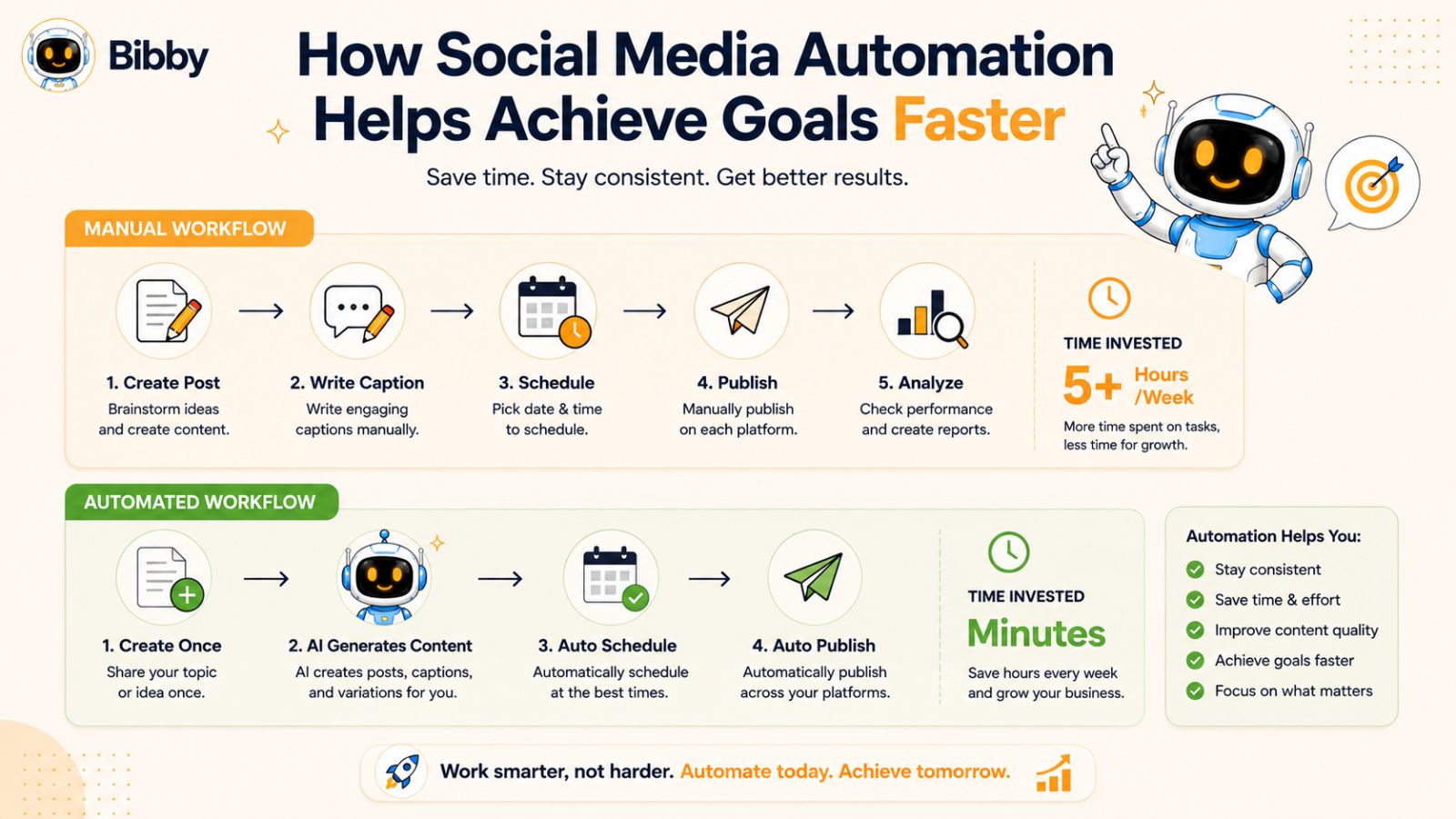
The Challenge of Managing Multiple Platforms
Today's customers are spread across multiple social networks. A potential customer may discover your business on Instagram, research your company on LinkedIn, watch your videos on YouTube, and interact with your content on Facebook or TikTok.
Managing all these platforms manually creates several challenges:
- Creating enough content consistently
- Writing unique captions for every platform
- Remembering optimal posting times
- Tracking performance across channels
- Scheduling content weeks in advance
- Maintaining a consistent brand voice
As the number of platforms increases, so does the complexity of social media management.
Why Automation Matters
Automation helps businesses streamline repetitive tasks while improving consistency and efficiency.
Some of the biggest benefits include:
More Consistent Posting
Consistency is one of the most important factors in social media success. Businesses that publish regularly tend to see better engagement, stronger audience growth, and improved visibility.
Automation ensures content continues to be published even when you're focused on other priorities.
Time Savings
Instead of manually posting content every day, businesses can plan and schedule weeks or even months of content in advance.
This allows teams to spend more time on strategy, customer relationships, and business growth.
Improved Content Planning
Automation tools make it easier to organize campaigns, maintain publishing schedules, and ensure content aligns with business goals.
Better Performance Tracking
Many automation platforms provide analytics that help identify top-performing content, audience behavior, and opportunities for improvement.
Reduced Marketing Stress
Knowing your content is already scheduled and ready to publish provides peace of mind and eliminates much of the daily pressure associated with social media management.
How Automation Supports Every Social Media Goal
Automation doesn't just save time—it actively supports the goals discussed throughout this guide.
| Social Media Goal | How Automation Helps |
|---|---|
| Brand Awareness | Maintains consistent visibility |
| Lead Generation | Keeps lead-focused content active |
| Website Traffic | Continuously promotes website content |
| Customer Engagement | Ensures regular audience interaction |
| Customer Loyalty | Delivers ongoing value to customers |
| Industry Authority | Supports consistent educational publishing |
| Sales and Revenue | Keeps promotional and conversion-focused content running |
The more consistent your content strategy becomes, the easier it is to achieve measurable results.
Common Automation Mistakes to Avoid
While automation can be incredibly effective, businesses should avoid treating it as a complete replacement for human interaction.
Some common mistakes include:
- Automating every customer interaction
- Publishing content without reviewing it
- Ignoring comments and messages
- Failing to monitor analytics
- Using the same content repeatedly without optimization
The best approach combines automation with authentic audience engagement.
Why Modern Businesses Are Adopting AI-Powered Automation
Artificial intelligence has significantly improved the effectiveness of social media automation.
AI can now help businesses:
- Generate content ideas
- Write captions
- Optimize posting schedules
- Analyze performance data
- Identify engagement trends
- Recommend improvements
These capabilities allow small businesses to compete more effectively without hiring large marketing teams.
The Bottom Line
Social media success isn't just about creating great content—it's about publishing consistently, reaching the right audience at the right time, and continuously optimizing your strategy. Automation makes this process significantly easier, allowing businesses to achieve their goals faster while reducing the workload required to manage multiple platforms.
For businesses looking to maximize efficiency, the next step is choosing a platform that combines AI-powered content creation, intelligent scheduling, analytics, and multi-platform publishing into a single streamlined workflow.
Bibby: The All-in-One Social Media Scheduling and Automation Platform
Managing social media effectively requires consistency, creativity, and time. Unfortunately, most small business owners don't have hours each day to create content, write captions, schedule posts, and monitor performance across multiple platforms.
This is where Bibby simplifies the entire process.
Bibby is an AI-powered social media scheduling and automation platform designed to help businesses create, schedule, publish, and analyze content from a single dashboard. Instead of spending hours every week managing social media manually, businesses can automate much of the workflow and focus on growing their business.
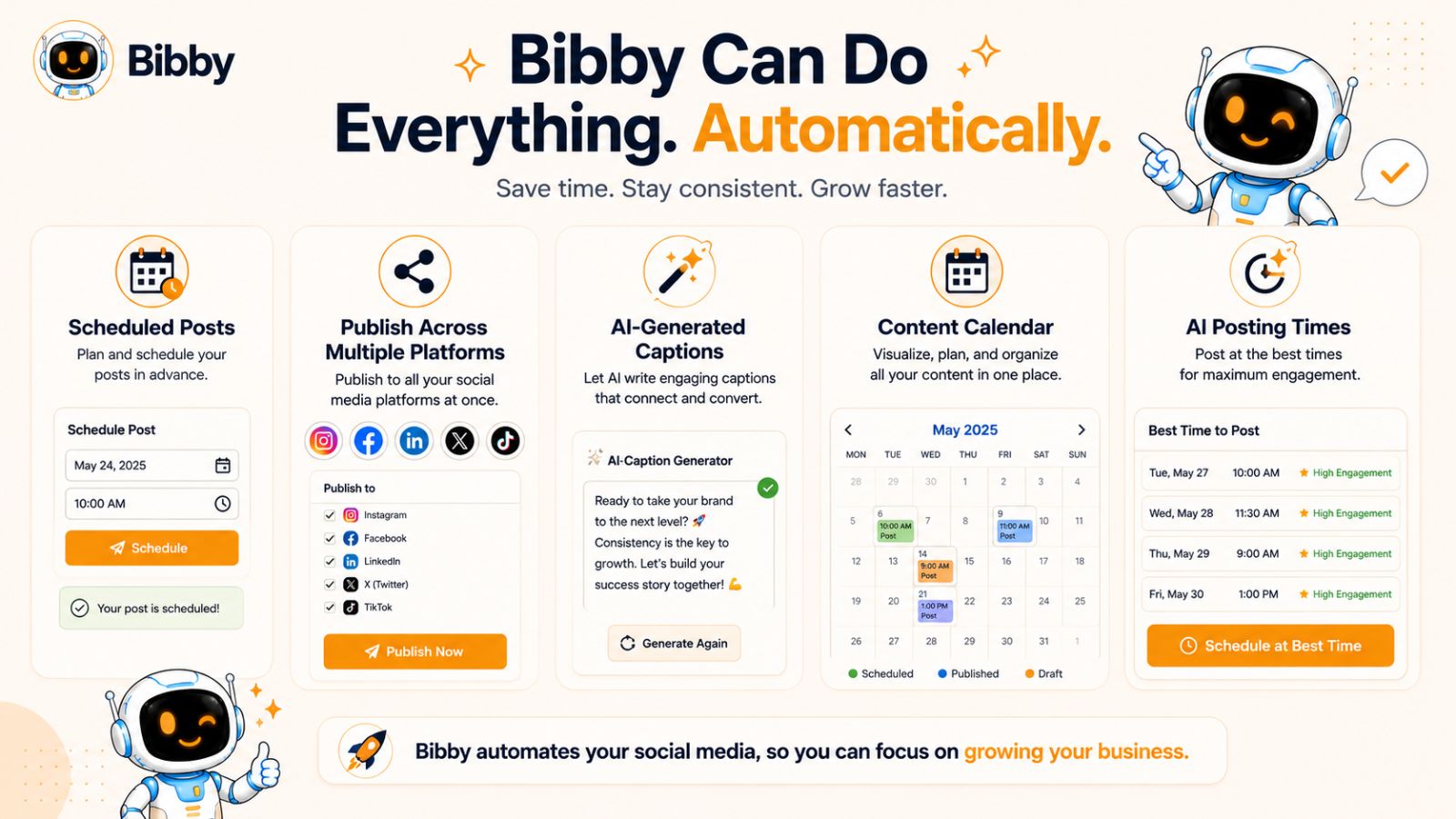
What Makes Bibby Different?
Many social media tools focus only on scheduling posts. Bibby goes much further by helping businesses create content, generate captions, optimize publishing schedules, and manage multiple platforms through one simple workflow.
The goal is simple: spend less time managing social media while achieving better results.
The Simple Bibby Workflow
One of Bibby's biggest advantages is its ease of use.
Step 1: Upload an Image or Generate One with AI
Start by uploading your own image or creating a new visual using Bibby's AI image generation capabilities.
This allows businesses to quickly create content without relying on complicated design tools.
Step 2: Choose Your Posting Style
Select the style that best matches your brand and goals.
For example:
- Professional
- Educational
- Promotional
- Inspirational
- Entertaining
- Thought Leadership
This helps ensure content remains consistent with your brand voice.
Step 3: Let Bibby Generate Captions Automatically
Once your image and style are selected, Bibby's AI creates captions for you automatically.
Instead of spending time brainstorming and writing social media copy, businesses can quickly generate content designed to engage audiences and support marketing objectives.
Step 4: Schedule Across Multiple Platforms
After generating content, Bibby automatically schedules posts across your selected social media channels.
Supported platforms include:
- YouTube
- TikTok
This eliminates the need to manually publish content on each platform separately.
Step 5: Publish at AI-Optimized Times
Timing matters on social media.
Bibby uses AI to identify optimal posting times based on audience behavior and engagement opportunities, helping businesses maximize visibility and reach.
The result is a smarter publishing schedule without requiring constant manual analysis.
Manage All Your Content From One Dashboard
Modern businesses often create multiple content formats to reach different audiences.
Bibby supports:
- Image posts
- Video posts
- Stories
- Promotional content
- Educational content
- Brand awareness campaigns
- Lead generation campaigns
This makes it easier to execute a complete social media strategy from a single platform.
Analytics That Help You Improve
Publishing content is only part of the equation. Understanding what works is equally important.
Bibby's analytics dashboard helps businesses monitor:
- Reach
- Engagement
- Follower growth
- Website traffic
- Content performance
- Campaign effectiveness
These insights allow businesses to make data-driven decisions and continuously improve their social media strategy.
How Bibby Supports Every Social Media Goal
Regardless of your primary objective, Bibby helps simplify execution.
Brand Awareness
Maintain consistent visibility across multiple platforms with automated publishing.
Lead Generation
Keep lead-focused content active without daily manual management.
Website Traffic
Promote blogs, landing pages, and offers consistently to drive visitors.
Customer Engagement
Publish content at optimal times to encourage more interactions.
Customer Loyalty
Stay connected with customers through regular and valuable content.
Industry Authority
Maintain a steady flow of educational and thought leadership content.
Sales and Revenue
Support conversion-focused campaigns with consistent promotional content.
Why Small Businesses Love Bibby
Small businesses often operate with limited time, budget, and resources. Hiring a full social media team isn't always realistic.
Bibby helps bridge that gap by providing:
- AI-powered content creation
- Automated caption generation
- Multi-platform publishing
- AI-optimized scheduling
- Analytics and reporting
- Video and story publishing
- Simplified workflow management
Instead of managing multiple tools and repetitive tasks, businesses can handle everything from one centralized platform.
Spend Less Time Posting and More Time Growing
The ultimate benefit of Bibby is freedom.
Rather than worrying about what to post, when to post, or how to manage multiple social networks, businesses can automate much of the process and focus on serving customers, generating sales, and growing their brand.
For small businesses looking to achieve their social media goals faster, Bibby provides a streamlined solution that combines AI, automation, scheduling, publishing, and analytics into one powerful platform.
Common Social Media Goal-Setting Mistakes to Avoid
Setting social media goals is an important first step, but many small businesses still struggle to achieve meaningful results because they make common strategic mistakes. Even the best content and most advanced tools can't compensate for poorly defined objectives or ineffective execution.
By understanding these mistakes, you can avoid wasted time, improve performance, and create a social media strategy that consistently supports business growth.
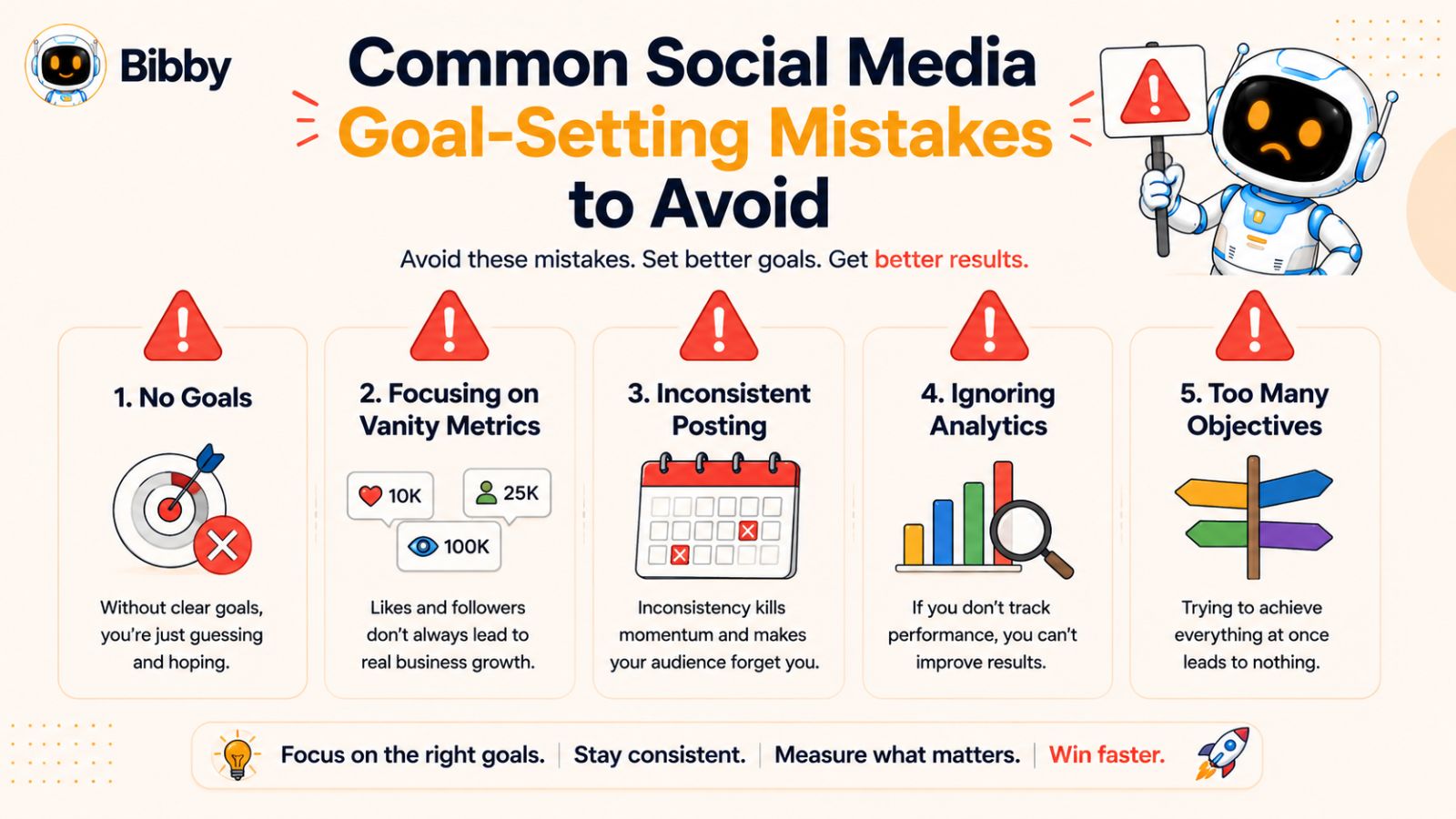
Mistake #1: Trying to Achieve Every Goal at Once
One of the most common mistakes is attempting to focus on brand awareness, engagement, lead generation, website traffic, authority building, customer retention, and sales simultaneously.
While all of these goals are valuable, trying to prioritize everything often leads to diluted efforts and unclear results.
Instead, choose:
- One primary goal
- One supporting secondary goal
For example:
Primary Goal: Lead Generation
Secondary Goal: Website Traffic
This creates clarity and makes content planning significantly more effective.
Mistake #2: Focusing on Vanity Metrics
Many businesses celebrate growing follower counts or increasing likes without understanding whether those metrics contribute to real business outcomes.
Vanity metrics can create the illusion of success while generating little actual value.
Instead of focusing only on:
- Followers
- Likes
- Views
Also track:
- Leads
- Website traffic
- Conversions
- Customer acquisition
- Revenue
The most important metrics are the ones that support your business goals.
Mistake #3: Not Defining Success Clearly
Goals such as:
- "Get more followers"
- "Increase engagement"
- "Grow social media"
are too vague to be useful.
Successful goals should be specific and measurable.
For example:
- Increase Instagram engagement by 25% within six months.
- Generate 50 qualified leads per month from LinkedIn.
- Increase website traffic from social media by 30% this quarter.
Clear goals make it easier to evaluate progress and make informed decisions.
Mistake #4: Ignoring Analytics
Many businesses spend significant time creating content but rarely analyze performance data.
Without analytics, it's impossible to know:
- Which content performs best
- Which platforms generate results
- What posting times work best
- Which campaigns drive conversions
Regular analysis helps identify opportunities and eliminate ineffective tactics.
Mistake #5: Posting Inconsistently
Consistency is one of the strongest predictors of social media success.
Many businesses begin with enthusiasm but eventually post less frequently as other responsibilities take priority.
Inconsistent posting can lead to:
- Reduced visibility
- Lower engagement
- Slower audience growth
- Missed opportunities
Maintaining a consistent publishing schedule helps build momentum and trust over time.
Mistake #6: Choosing the Wrong Platforms
Not every social media platform is right for every business.
Trying to maintain a presence everywhere can spread resources too thin and reduce overall effectiveness.
Instead, focus on the platforms where your target audience is most active.
For example:
- LinkedIn often performs well for B2B businesses.
- Instagram is highly effective for visual brands.
- TikTok can help businesses reach younger audiences.
- Facebook remains valuable for local businesses and community engagement.
- YouTube excels for educational and long-form video content.
A focused strategy typically outperforms a scattered approach.
Mistake #7: Treating Social Media as a One-Way Broadcast
Social media is designed for conversation.
Businesses that only publish promotional content often struggle to build engagement and loyalty.
Successful brands actively:
- Respond to comments
- Answer questions
- Participate in discussions
- Encourage audience interaction
- Build community relationships
The more connected your audience feels to your brand, the stronger your long-term results are likely to be.
Mistake #8: Failing to Adapt and Improve
Social media platforms, audience preferences, and industry trends constantly evolve.
Strategies that worked a year ago may not perform as well today.
Businesses should regularly review:
- Performance metrics
- Content trends
- Audience behavior
- Platform updates
- Competitive insights
Continuous improvement helps maintain growth and relevance.
How Bibby Helps Businesses Avoid These Mistakes
Many of these challenges stem from limited time, inconsistent execution, and a lack of visibility into performance.
Bibby helps address these issues by simplifying social media management through automation and analytics.
With Bibby, businesses can:
- Maintain consistent posting schedules
- Generate content faster with AI
- Publish across multiple platforms
- Schedule content at AI-optimized times
- Track performance through analytics
- Identify high-performing content
- Improve strategy based on data
By reducing manual workload and providing actionable insights, Bibby helps businesses stay focused on the goals that matter most.
The Bottom Line
Achieving social media success isn't just about setting goals—it's about avoiding the mistakes that prevent those goals from becoming reality. By focusing on meaningful objectives, tracking the right metrics, maintaining consistency, and continuously improving your strategy, your business can build a stronger social media presence that delivers measurable results.
You may also like reading: How to Schedule Instagram Reels Automatically?
Measuring Social Media Success
Setting goals is only half of the equation. To understand whether your social media strategy is working, you need a reliable system for measuring performance. Without tracking the right metrics, it's impossible to know what's driving results, what needs improvement, and whether your efforts are contributing to business growth.
Successful businesses don't rely on assumptions. They use data to make smarter decisions, optimize campaigns, and maximize return on investment.
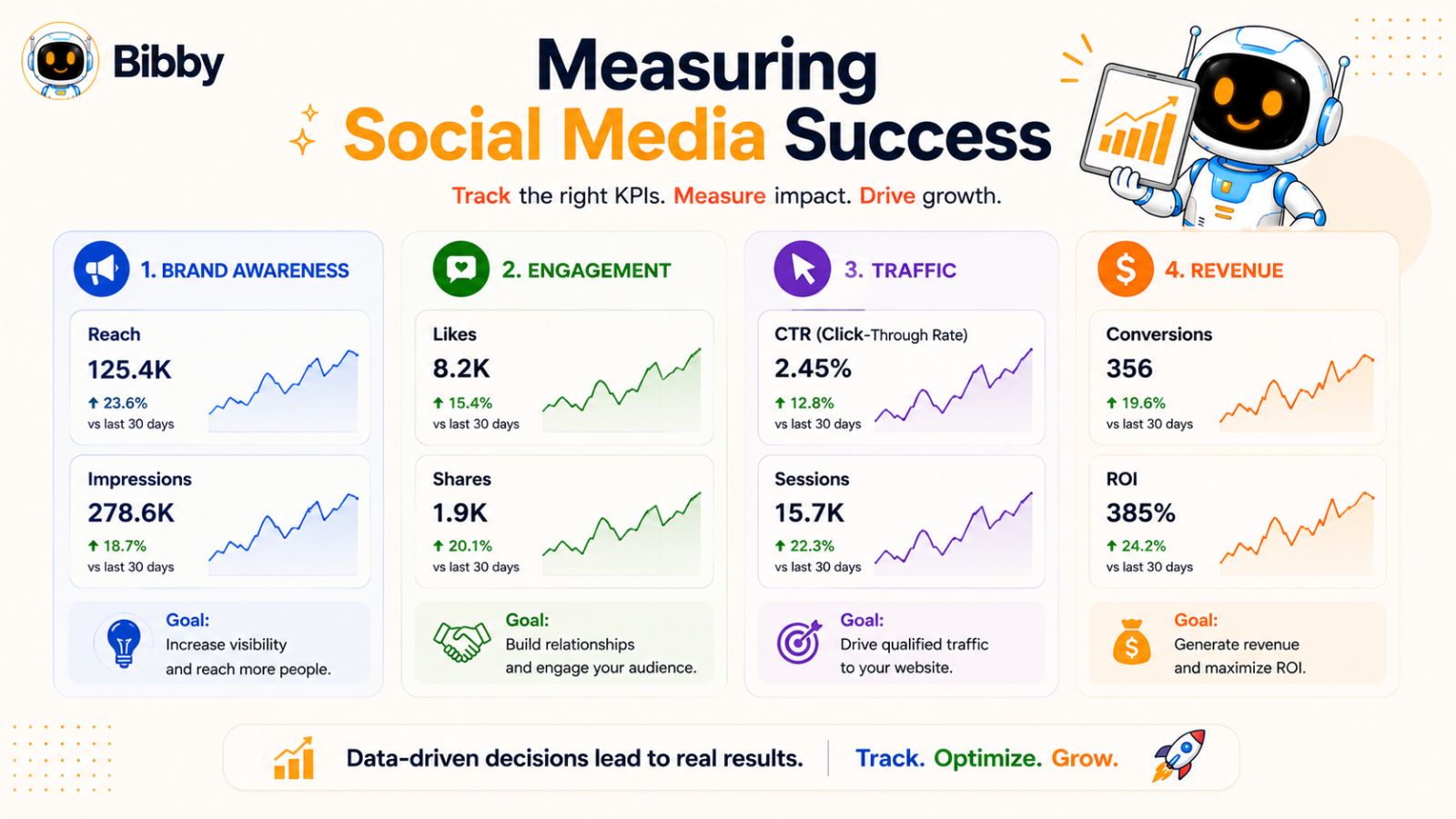
Why Measuring Success Matters
Regular performance tracking helps businesses:
- Understand what's working
- Identify underperforming content
- Allocate resources more effectively
- Improve marketing ROI
- Support data-driven decision-making
- Align social media activities with business objectives
The more accurately you measure results, the easier it becomes to improve them.
Match Metrics to Your Goals
Not every metric is equally important. The key is tracking the KPIs that align with your specific objectives.
If Your Goal Is Brand Awareness
Focus on:
- Reach
- Impressions
- Follower growth
- Brand mentions
- Share rate
These metrics help determine how many people are discovering and recognizing your brand.
If Your Goal Is Lead Generation
Focus on:
- Lead form submissions
- Website clicks
- Landing page conversions
- Email sign-ups
- Cost per lead
These indicators show how effectively social media is generating potential customers.
If Your Goal Is Website Traffic
Focus on:
- Referral traffic
- Click-through rate (CTR)
- Session duration
- Bounce rate
- Pages per session
These metrics help evaluate how social media contributes to website performance.
If Your Goal Is Customer Engagement
Focus on:
- Likes
- Comments
- Shares
- Saves
- Direct messages
- Engagement rate
These KPIs reveal how actively your audience interacts with your content.
If Your Goal Is Customer Loyalty
Focus on:
- Repeat customer rate
- Customer lifetime value
- Community participation
- Referral activity
- Customer sentiment
These metrics help assess long-term relationship strength.
If Your Goal Is Industry Authority
Focus on:
- Content shares
- Brand mentions
- Backlinks
- Media mentions
- Collaboration opportunities
These indicators reflect growing credibility and influence.
If Your Goal Is Sales and Revenue
Focus on:
- Conversion rate
- Revenue generated
- Cost per acquisition
- Return on investment
- Average order value
These are the most direct indicators of business impact.
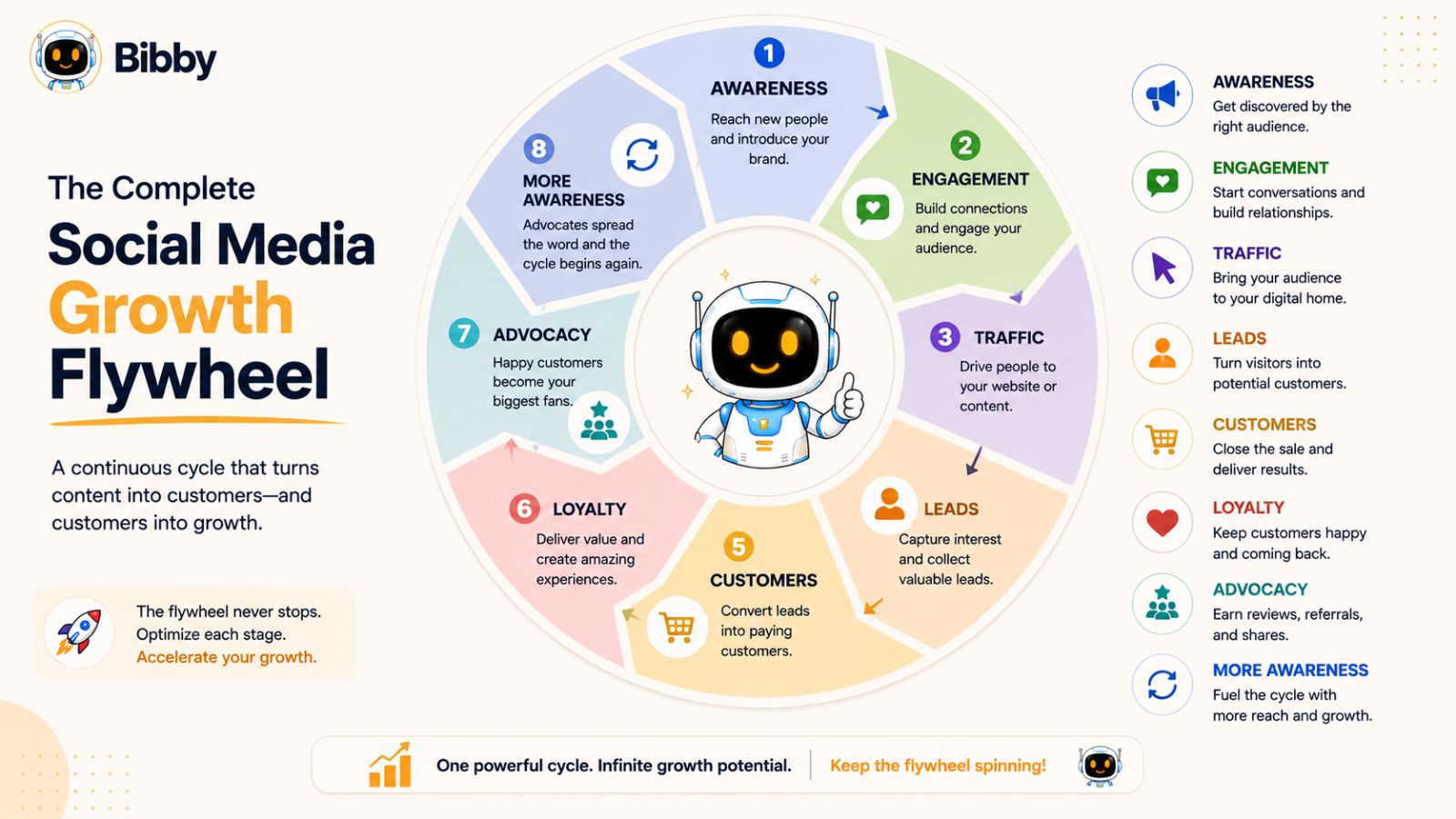
Build a Simple Social Media Dashboard
A dashboard helps consolidate important metrics into one place so you can monitor progress efficiently.
Your dashboard might include:
| Category | Key Metrics |
|---|---|
| Awareness | Reach, Impressions, Followers |
| Engagement | Likes, Comments, Shares, Saves |
| Traffic | Website Clicks, CTR, Sessions |
| Leads | Form Submissions, Email Sign-Ups |
| Revenue | Conversions, Sales, ROI |
Reviewing these metrics regularly provides a clear picture of overall performance.
Conduct Monthly Performance Reviews
Many businesses either analyze data too frequently or not often enough.
A monthly review process typically provides the right balance.
During your review, ask:
- Which content performed best?
- Which platforms generated the strongest results?
- Are we achieving our target KPIs?
- What trends are emerging?
- Which strategies should be expanded?
- Which tactics should be improved or removed?
Consistent reviews help ensure your strategy evolves alongside audience behavior and business goals.
Look Beyond Individual Posts
It's easy to become overly focused on the performance of individual posts. However, social media success is usually the result of long-term consistency rather than a single viral moment.
Instead of judging success based on one post, evaluate:
- Overall audience growth
- Lead generation trends
- Traffic improvements
- Revenue contributions
- Long-term engagement patterns
This broader perspective provides a more accurate picture of performance.
How Bibby Simplifies Performance Tracking
Tracking metrics across multiple social media platforms can quickly become complicated.
Bibby helps simplify reporting by providing centralized analytics that allow businesses to monitor performance from one dashboard.
With Bibby, businesses can track:
- Engagement metrics
- Audience growth
- Content performance
- Traffic-driving posts
- Campaign effectiveness
- Publishing consistency
These insights help identify what's working while making it easier to optimize future content.
Because Bibby combines scheduling, publishing, automation, and analytics in one platform, businesses spend less time gathering data and more time acting on it.
The Bottom Line
The most successful social media strategies are built on measurement and continuous improvement. By tracking the KPIs that align with your goals, reviewing performance regularly, and making data-driven adjustments, you can turn social media from a guessing game into a predictable growth channel.
Whether your objective is awareness, leads, engagement, loyalty, authority, or revenue, the ability to measure progress accurately is what ultimately transforms goals into results.
Conclusion
The best goals for small business social media marketing are the ones that align directly with your current stage of growth and overall business objectives. Whether your focus is increasing brand awareness, generating qualified leads, driving website traffic, improving customer engagement, building loyalty, establishing authority, or increasing sales, success starts with choosing the right priorities and measuring the right metrics.
The three most important takeaways are simple: focus on goals that support your business objectives, track meaningful KPIs instead of vanity metrics, and maintain consistency through a structured content strategy. Businesses that combine clear goals with data-driven decision-making are far more likely to achieve sustainable growth through social media.
Managing that consistency manually can be challenging, which is why many businesses turn to platforms like Bibby. With AI-powered content creation, automatic caption generation, intelligent scheduling, multi-platform publishing, and analytics, Bibby helps simplify the entire social media workflow so businesses can spend less time posting and more time growing.
Now that you understand which social media goals matter most, the next step is learning how to create a social media content calendar that turns those goals into a repeatable system for generating engagement, leads, and sales throughout the year.