
The TikTok algorithm can determine whether your next video reaches a handful of viewers or thousands of potential followers.
If you want more views in 2026, understanding how TikTok evaluates content is only half the battle—you also need a consistent system for creating, optimizing, and publishing content. In this guide, you’ll learn what signals matter, how to build content the algorithm is more likely to recommend, and how Bibby can automate the repetitive work across TikTok and your other social platforms.
In this blog:
- How the TikTok algorithm determines which videos get more reach
- How to create content that encourages stronger viewer signals
- How Bibby automates your social media publishing workflow
Once you understand what drives distribution, you can turn TikTok growth from guesswork into a repeatable system.
What Is the TikTok Algorithm in 2026?
The TikTok algorithm is the recommendation system that decides which videos appear in a user's For You feed. Rather than showing everyone the same collection of popular videos, TikTok uses signals from each viewer's behavior and the content itself to personalize what appears on their screen.
This is why two people can open TikTok at the same moment and see completely different videos.
The important takeaway for creators is that getting more views isn't simply about having a large following. TikTok can put your content in front of people who don't follow you when the platform determines that your video is relevant and interesting to them.
How the TikTok algorithm actually works
Think of TikTok distribution as a continuous testing process.
When you publish a video, TikTok can show it to an initial group of viewers. The platform then observes how those people respond. Do they keep watching? Do they finish the video? Do they rewatch it, share it, comment, save it, or visit your profile?
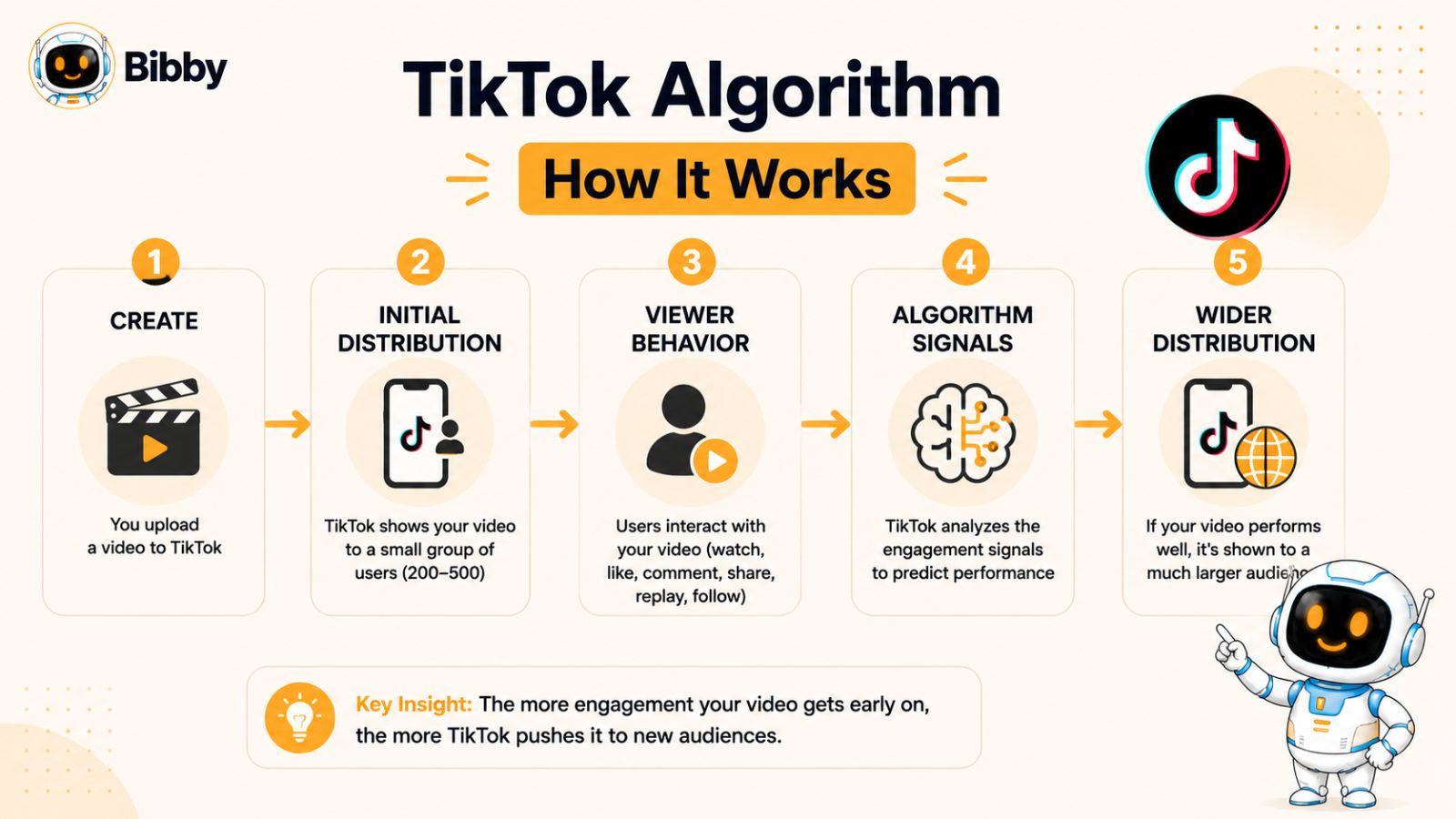
When the signals suggest that viewers find the content valuable or entertaining, the video can be shown to additional audiences. If those audiences respond positively as well, distribution can continue expanding.
This means your goal shouldn't be to find one secret trick that makes every video go viral. Instead, you should consistently create content that gives the right viewers a reason to keep watching and interacting.
Why there isn't one universal TikTok algorithm
There isn't a single fixed formula that determines how many views every video receives.
TikTok personalizes recommendations based on individual users and the content they're likely to enjoy. A viewer who frequently watches business advice will naturally receive different recommendations from someone who primarily watches cooking, fitness, gaming, or comedy content.
For creators, this makes relevance extremely important.
The clearer TikTok can understand what your video is about and which viewers are likely to appreciate it, the easier it becomes for the platform to match your content with an appropriate audience.
What TikTok is looking for from your content
While creators shouldn't obsess over individual ranking factors, several types of signals are particularly important to understand:
- Watch behavior: Do people continue watching instead of immediately scrolling away?
- Completion: Do viewers stay until the end?
- Rewatches: Is the video compelling enough to watch again?
- Engagement: Do people like, comment, share, or save it?
- Relevance: Does the content match the interests of the people seeing it?
- Content context: Can TikTok understand the topic through elements such as spoken words, captions, and on-screen text?
- Audience response: Do viewers take additional actions, such as visiting your profile or following you?
No single signal guarantees reach. What matters is whether your content consistently creates positive experiences for the people TikTok shows it to.
Stop chasing TikTok “hacks”
One of the biggest mistakes creators make is treating the algorithm like a puzzle with a secret combination.
They constantly search for the perfect hashtag, the perfect posting time, or the perfect number of videos to publish each day. These things can be useful parts of a strategy, but they can't compensate for content that people don't want to watch.
A better approach is to build a repeatable content system.
Create useful or entertaining content. Make the topic immediately clear. Give viewers a strong reason to continue watching. Publish consistently. Study what performs well. Then create more content based on what you learn.
The challenge is that doing all of this manually across TikTok, Instagram, Facebook, LinkedIn, and YouTube can quickly become a full-time job.
That's where social media automation can make a difference. With Bibby, you can upload your media or generate an image with AI, choose your posting style, have captions generated automatically, and schedule your content across your selected platforms at AI-optimized times.
Instead of spending your time repeatedly uploading, writing captions, and scheduling individual posts, you can spend more of it creating content that your audience actually wants to watch.
Also read: Social Media Growth With AI: The New Rules Every Brand Must Know →
The Most Important TikTok Ranking Signals
Once you understand the basic idea behind TikTok's recommendation system, the next question is simple: what makes the platform continue showing one video while another stops getting views?
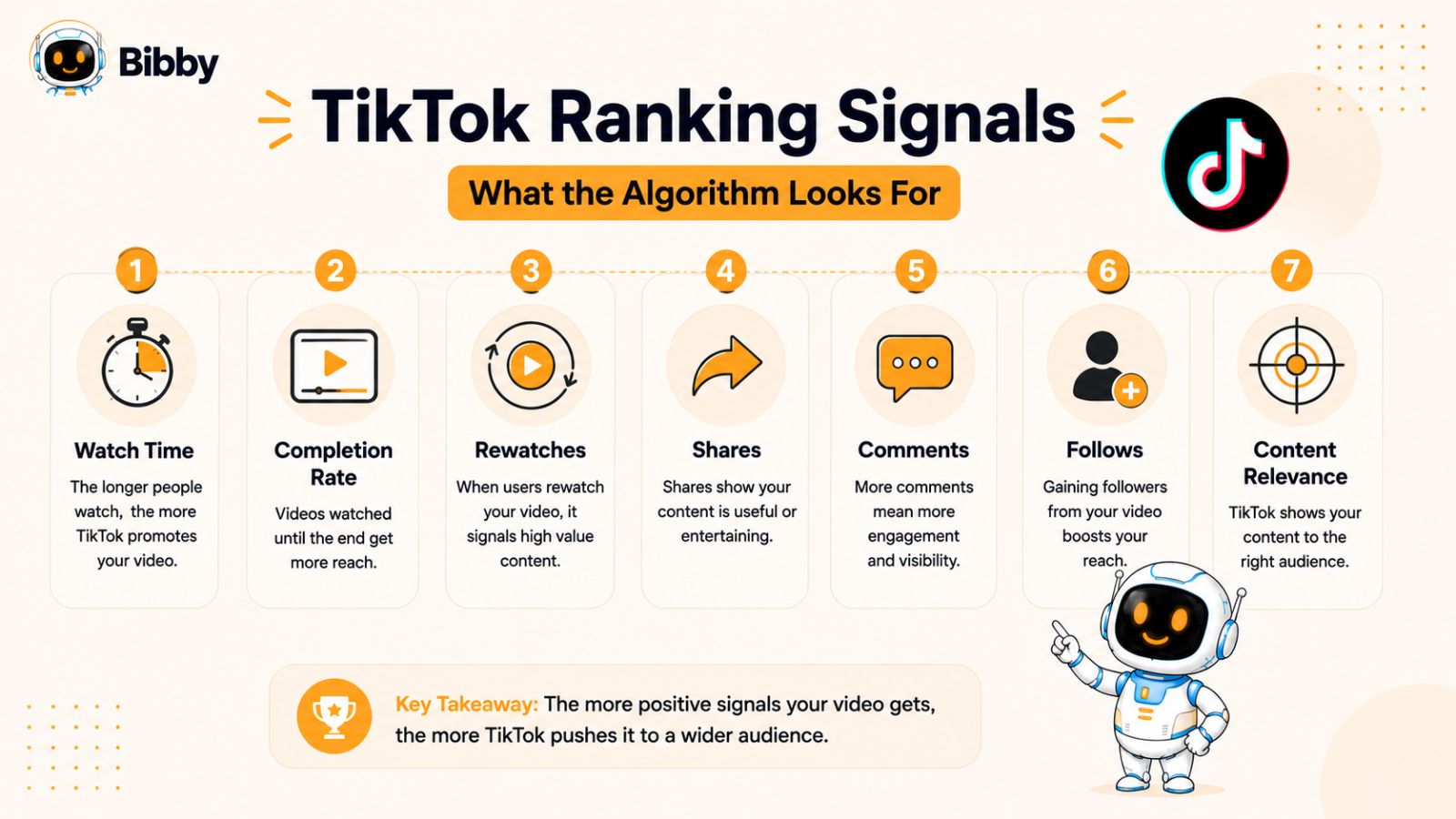
There isn't one magic metric. TikTok evaluates a combination of viewer behavior, content relevance, and other signals to determine whether a video is worth recommending to more people. Understanding these signals helps you focus your effort on things you can actually improve.
Watch time
Watch time is one of the most useful metrics for understanding whether your content holds attention.
If viewers immediately swipe away, your video has little opportunity to generate additional engagement. But when people continue watching, you're giving TikTok a stronger indication that the content is relevant or interesting to them.
This doesn't mean every video should be as long as possible. A 15-second video that people watch completely can be more effective than a two-minute video that loses viewers after the first few seconds.
The goal is simple: make every second earn the next second of attention.
Completion rate
Completion rate measures how often viewers make it to the end of your video.
A strong completion rate often starts with good structure. Instead of revealing everything immediately, create a clear reason for viewers to stay until the payoff.
For example, an educational video might begin with:
"Three mistakes are costing you TikTok views. The third one is probably the most common."
The viewer now has a reason to continue watching.
The key is to make sure the promised payoff actually arrives. Clickbait may generate an initial view, but disappointing viewers isn't a sustainable content strategy.
Rewatches
A rewatch is another useful indication that your content has captured someone's attention.
People may replay a video because it is entertaining, contains information they want to remember, moves quickly, or has a detail they didn't catch the first time.
You don't need to artificially force rewatches. Instead, create content that naturally rewards another viewing.
Tutorials, fast demonstrations, visually detailed videos, surprising reveals, and concise educational content can all give viewers a reason to watch again.
Likes, comments, shares, and saves
Engagement can provide additional context about how viewers respond to your content.
A like may indicate that someone enjoyed the video. A comment can show that the topic generated a reaction or conversation. A share can indicate that someone believes another person would benefit from seeing it. A save can suggest that the content is useful enough to return to later.
This is why simply chasing likes isn't the best way to evaluate your strategy.
Ask a better question:
"What did this video make viewers want to do?"
If your content consistently makes people share useful information, save tutorials, discuss an opinion, or send a video to a friend, you're creating stronger reasons for people to interact with it.
Content relevance
A great video shown to the wrong audience can still perform poorly.
Imagine creating an excellent video about social media automation and showing it primarily to people who have no interest in marketing or content creation. Their lack of interest doesn't necessarily mean the video is bad. It may simply be a poor audience match.
That's why your topic, language, visuals, spoken words, captions, and overall context should make the subject of your video clear.
The more consistently you create content around recognizable topics, the easier it becomes to build an audience that understands what your account is about.
What viewers do after watching
The viewer journey doesn't necessarily end when the video ends.
Someone might watch your video, visit your profile, watch another video, follow you, or interact with additional content. These actions can help indicate that your content successfully attracted someone who genuinely cares about your subject.
This is especially important for businesses and creators.
Your goal isn't simply to accumulate random views. You want to turn attention into an audience that is interested in what you consistently publish.
The bigger picture
The most important lesson is that you shouldn't build your TikTok strategy around a single algorithm signal.
Instead, focus on creating content that:
- Captures attention quickly
- Keeps viewers watching
- Delivers on its promise
- Provides genuine value or entertainment
- Encourages natural interaction
- Reaches a clearly defined audience
Once you've built that foundation, consistency becomes your next challenge.
And consistency is where automation can become particularly useful. Rather than manually preparing every caption, uploading every asset, and scheduling every post, you can use Bibby to turn your content strategy into a repeatable publishing workflow across TikTok and your other social platforms.
Also read: Step-by-Step Guide to Creating an AI Social Media Workflow for Small Businesses
How to Make TikTok Videos the Algorithm Wants to Recommend
Understanding ranking signals is useful, but knowing what to do with that information is even more important. You don't need to create videos specifically "for the algorithm." You need to create videos that people genuinely want to watch, and then make it easy for TikTok to understand who those videos are for.
The strongest TikTok strategies combine a compelling hook, clear content, useful or entertaining information, and a satisfying payoff.
Start with a strong hook
The first few seconds can determine whether someone keeps watching or scrolls to the next video.
Your opening should quickly answer the viewer's silent question: "Why should I care about this?"
Instead of starting with a long introduction, get directly into the value.
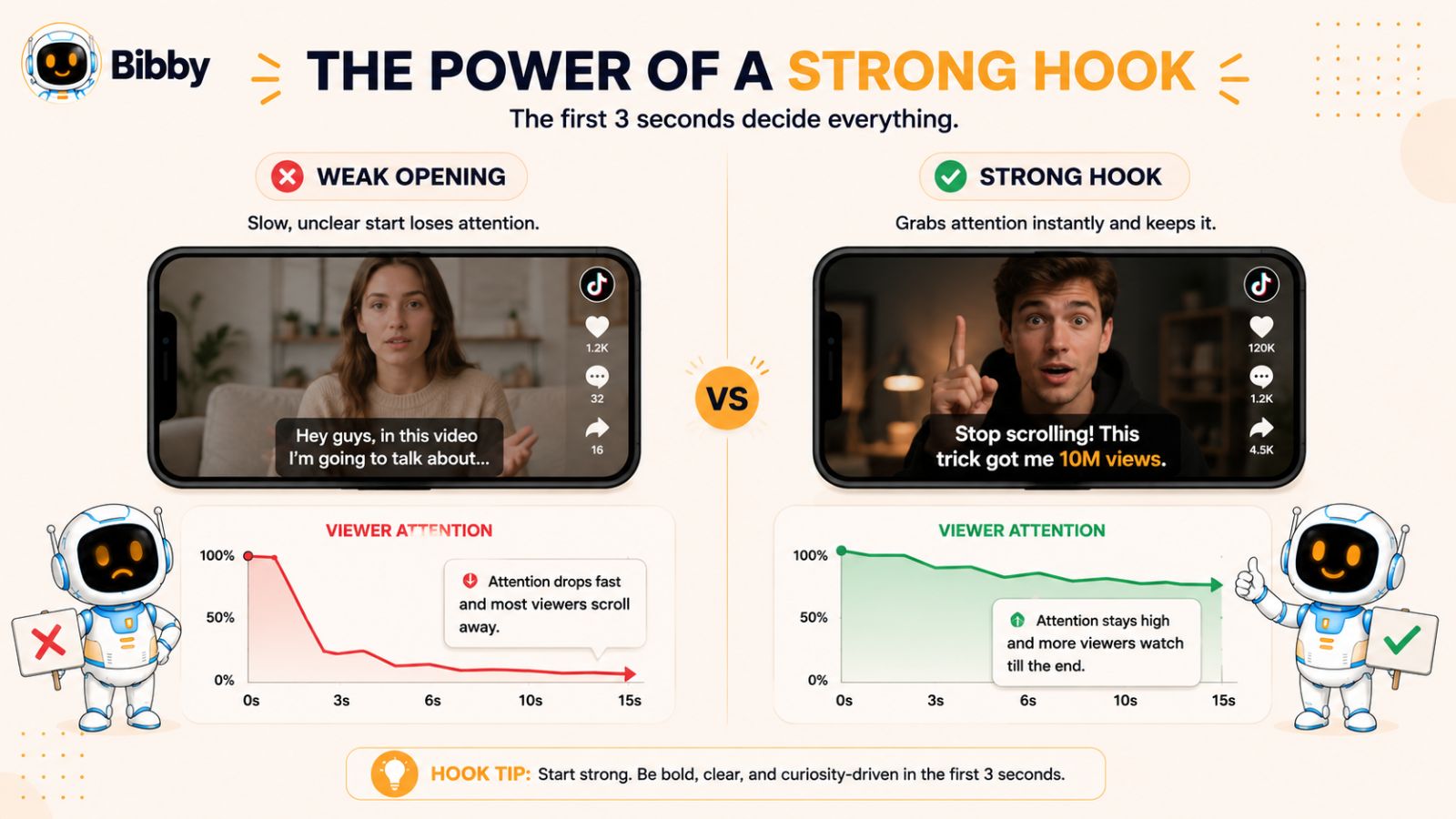
For example:
- "Here's why your TikTok videos aren't getting views."
- "Three things I would change on your TikTok today."
- "I tested this content strategy for 30 days. Here's what happened."
- "If you're still posting manually to every platform, watch this."
- "This is the simplest way to build a week of social content."
A strong hook doesn't need to be sensational. It needs to create enough curiosity or relevance to earn the viewer's attention.
Give viewers one clear idea
Trying to explain five different ideas in a single TikTok can make the video difficult to follow.
Instead, give each video one central purpose.
If you're teaching social media marketing, you could create separate videos about:
- Writing better TikTok hooks
- Choosing content pillars
- Improving video retention
- Creating captions with AI
- Building a social media calendar
This approach also makes content production easier because one broad topic can become dozens of focused videos.
Build curiosity into the structure
Curiosity gives viewers a reason to continue watching.
You can create it through:
Open loops: Introduce an unanswered question and resolve it later.
Step-by-step processes: Tell viewers you're going to show them how something works, then reveal each step.
Before-and-after examples: Show the outcome first and explain how you achieved it.
Unexpected information: Challenge a common assumption and explain what actually works.
Progressive reveals: Give viewers information in stages rather than explaining everything in the opening sentence.
The important part is to make the payoff worth waiting for.
Make your videos easy to understand
People scroll quickly, often while distracted or watching without sound.
Make your main idea obvious through clear visuals, concise on-screen text, and straightforward narration.
Avoid unnecessary introductions, complicated explanations, and visual clutter.
If a viewer can understand what your video is about within seconds, you've already removed one major barrier to engagement.
Give viewers a reason to share
Shares can be particularly valuable because they put your content in front of people who weren't originally watching your account.
Think about what makes someone send a video to another person.
It might be:
- "You need to see this."
- "This explains exactly what we've been struggling with."
- "Try this strategy."
- "This is hilarious."
- "I wish I'd known this earlier."
Useful information, relatable experiences, surprising insights, and practical frameworks naturally create shareable moments.
Don't confuse optimization with manipulation
There is an important distinction between understanding the algorithm and trying to trick it.
A strategy built around misleading hooks, irrelevant trends, engagement bait, or artificial tactics may produce short-term activity without building a valuable audience.
Instead, optimize the viewer experience.
If your hook accurately represents the content, your video delivers on its promise, and the information is genuinely useful or entertaining, the signals you're trying to improve become a natural consequence of better content.
Turn good content into a consistent system
Creating one great TikTok is very different from building a successful social media presence.
You need a system that allows you to repeatedly:
- Choose relevant topics.
- Create useful content.
- Develop strong hooks.
- Write captions.
- Prepare visual assets.
- Schedule content.
- Publish consistently.
- Review performance.
- Improve the next batch.
Doing every step manually can quickly become exhausting, particularly when you're publishing on multiple platforms.
Bibby helps simplify that workflow. You can upload your image or video, generate an image with AI when you need one, choose your posting style, and have Bibby automatically generate captions. You can then schedule your content across TikTok, Instagram, Facebook, LinkedIn, YouTube, and other selected platforms at AI-optimized times.
That means the algorithm strategy remains focused on what matters most—creating content people want to consume—while Bibby handles much of the repetitive work required to consistently distribute it.
TikTok seo: Help TikTok Understand Your Content
Getting people to watch your TikTok is important, but there is another piece of the puzzle: helping TikTok understand what your content is about.
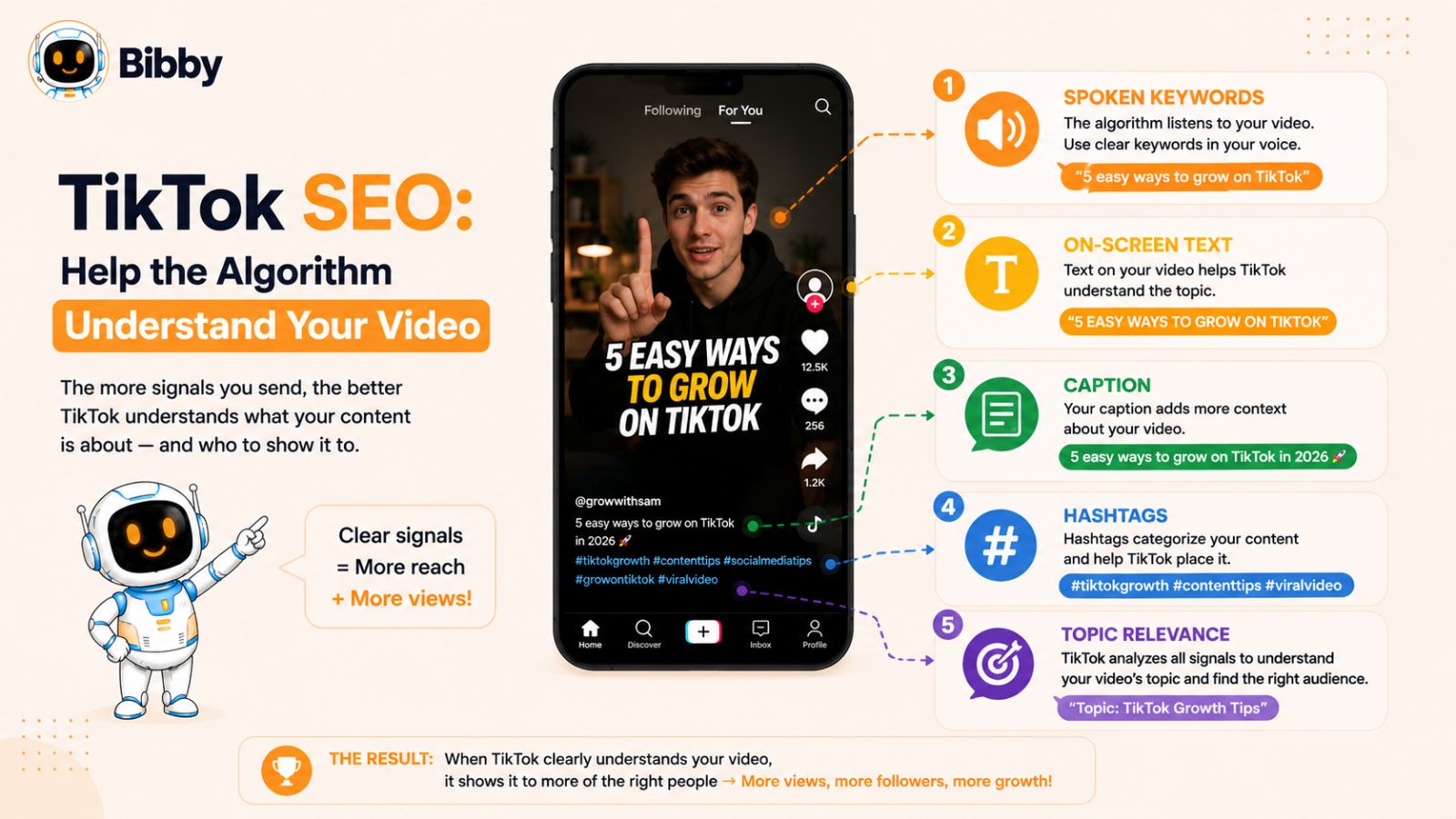
TikTok is increasingly used as a discovery and search platform. People don't only open the app to scroll through recommendations; they also search for answers, tutorials, products, ideas, and specific topics.
That creates an opportunity for creators and businesses. When you clearly communicate your video's topic, you increase the chances of your content being matched with people interested in that subject.
Use topics your audience is actually searching for
Start by understanding what your audience wants to know.
Instead of creating content around vague topics like "social media tips," get more specific:
- "How to schedule Instagram posts"
- "How to get more TikTok views"
- "Best social media automation tools"
- "How to create a content calendar"
- "How to write better social media captions"
Specific questions often make better content because they give you a clear problem to solve.
You can also turn frequently asked questions from customers, followers, comments, sales conversations, and communities into a steady source of TikTok topics.
Say your target topic in the video
If your video is about the TikTok algorithm, don't make the audience guess what you're discussing.
Mention the topic naturally in your opening or narration.
For example:
"Here's how the TikTok algorithm decides which videos get more views."
Now both the viewer and the platform have immediate context.
The goal isn't to awkwardly repeat keywords. It's to communicate the subject naturally and clearly.
Use on-screen text strategically
On-screen text gives viewers another way to understand your content and reinforces the video's central topic.
If you're creating a video about TikTok SEO, your opening text could say:
"5 TikTok SEO mistakes you're probably making."
Keep the text concise and easy to read. Your on-screen copy should support the video rather than competing with it.
Write captions that add context
Your caption is another opportunity to explain what your content is about.
A good caption doesn't need to be stuffed with keywords. Instead, use natural language that reinforces the video's subject and gives viewers additional context.
For example, if your video demonstrates how to automate social media publishing, your caption could explain the problem you're solving and summarize the workflow.
This creates a consistent connection between your video, caption, and audience intent.
Use relevant hashtags
Hashtags can help categorize your content, but they shouldn't become the foundation of your TikTok SEO strategy.
Choose hashtags that genuinely relate to the topic you're discussing.
For a video about social media automation, relevant examples might include:
- #SocialMediaAutomation
- #SocialMediaMarketing
- #ContentMarketing
- #TikTokMarketing
- #SocialMediaTips
Avoid adding unrelated popular hashtags simply because they have a large number of views. Relevance is more useful than trying to attach your video to every trending topic.
Think about search intent
The most effective TikTok SEO strategy starts with the same question you should ask when creating any content:
What does this viewer actually want?
Someone searching for "how to schedule TikTok posts" wants a practical explanation. Someone searching for "best social media automation tool" may be comparing solutions. Someone searching for "TikTok algorithm 2026" wants an updated explanation of how distribution works.
Match the content to that intent.
If you answer the question clearly and efficiently, you're not just optimizing for a platform—you are creating a better experience for the person searching.
Turn one SEO topic into a content series
You don't have to answer every related question in one video.
One topic can become an entire content series.
For example, the broad topic "TikTok algorithm" could become:
- How the TikTok algorithm works
- How watch time affects TikTok views
- How to improve your TikTok hook
- How often you should post on TikTok
- Does posting time matter?
- How TikTok SEO works
- Why your TikToks aren't getting views
This approach creates a repeatable content pipeline while helping you build topical authority around a subject your audience cares about.
And once you've identified the topics worth creating, the next challenge is publishing them consistently—which is where an automation system like Bibby can save significant time.
Also read: The Complete Checklist for Managing Social Media with AI (2026 Guide)
How Often Should You Post on TikTok in 2026?
One of the most common questions creators ask is how often they should post on TikTok. The temptation is to look for one perfect number—three posts a day, five posts a week, or even more.
But there is no universal posting frequency that guarantees more views.
A better strategy is to find a publishing rhythm you can maintain while producing content that is genuinely worth watching. Consistency gives you more opportunities to learn what your audience responds to, but publishing more content doesn't automatically make every piece of content better.
Consistency matters more than arbitrary posting targets
Imagine two creators.
The first publishes seven rushed videos in one week, then disappears for three weeks.
The second publishes three useful videos every week for several months.
The second creator has created a much more sustainable system.
Consistency helps you build a predictable production process, develop audience expectations, and generate enough content data to understand which topics and formats work.
Instead of asking, "How many times should I post?", ask:
"How much high-quality content can I consistently create and distribute?"
Your answer should determine your posting frequency.
Start with a realistic publishing schedule
Your ideal frequency depends on your resources.
A solo creator might comfortably produce three quality videos per week. A marketing team with dedicated writers, designers, and video editors might be able to produce several pieces of content every day.
Both approaches can work.
Start with a schedule that doesn't force you to sacrifice quality. Then increase your publishing volume when your content production system becomes more efficient.
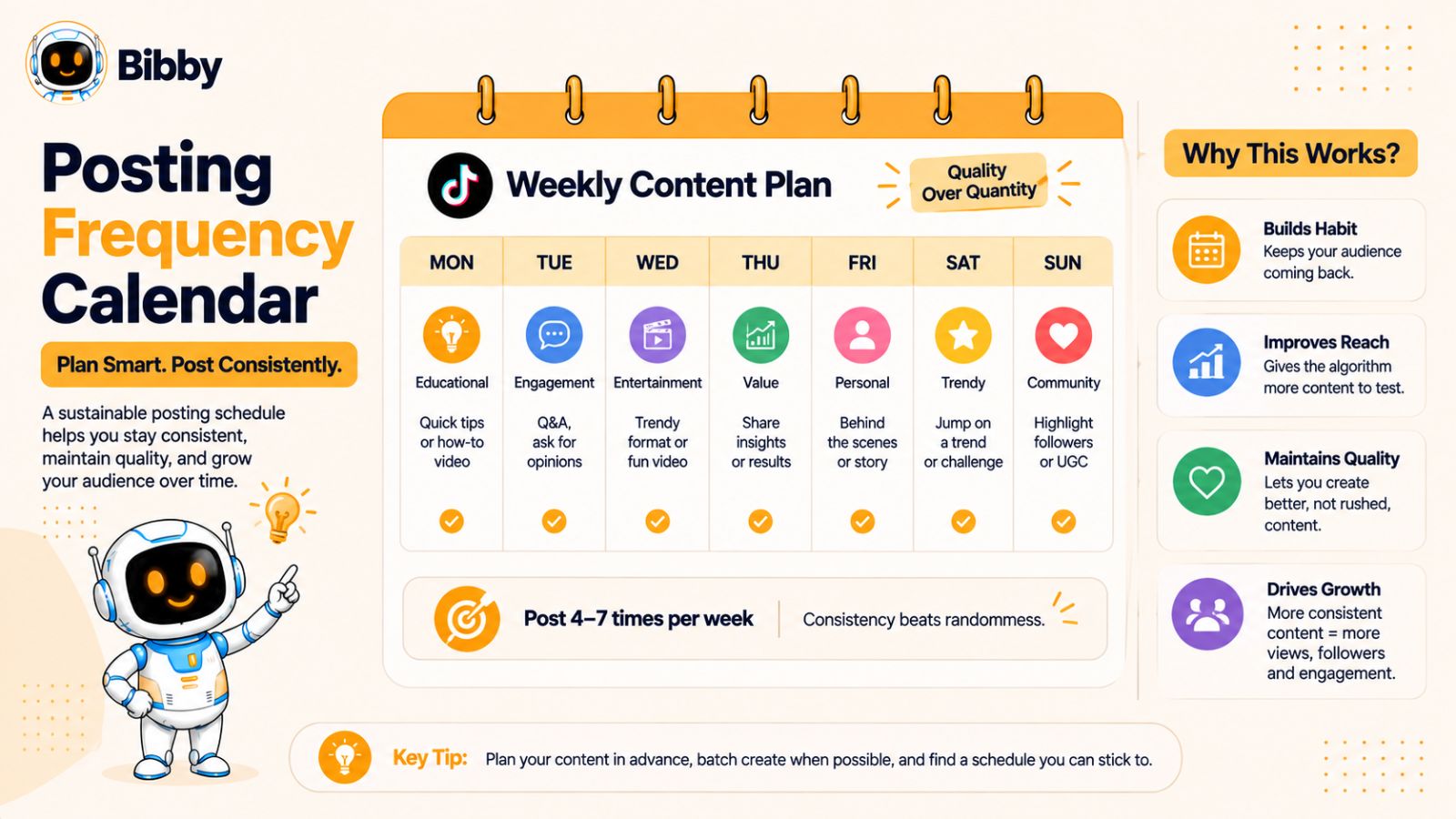
A simple starting point could be:
- 2–3 TikToks per week: Good for creators with limited production time.
- 4–7 TikToks per week: A strong rhythm for creators building a serious content engine.
- Multiple posts per day: Appropriate when you have enough content capacity and a clear reason to increase testing volume.
These aren't rules. They're starting points you can adjust based on your audience, resources, and results.
Batch your content instead of creating every day
One of the easiest ways to become more consistent is to separate content creation from content publishing.
Instead of waking up every morning and asking, "What should I post today?", create several pieces of content in batches.
For example, you could spend one session:
- Researching topics.
- Writing hooks.
- Recording several videos.
- Creating supporting visuals.
- Preparing captions.
- Organizing the publishing schedule.
You can then distribute that content throughout the following days or weeks.
This approach reduces the mental overhead of constantly switching between strategy, creation, editing, and publishing.
Build a content calendar
A content calendar turns your publishing schedule into a system.
Your calendar can include:
- Content topic
- Content pillar
- Platform
- Format
- Caption
- Publishing date
- Publishing time
- Campaign
- Status
It also makes it easier to see whether you're balancing different types of content.
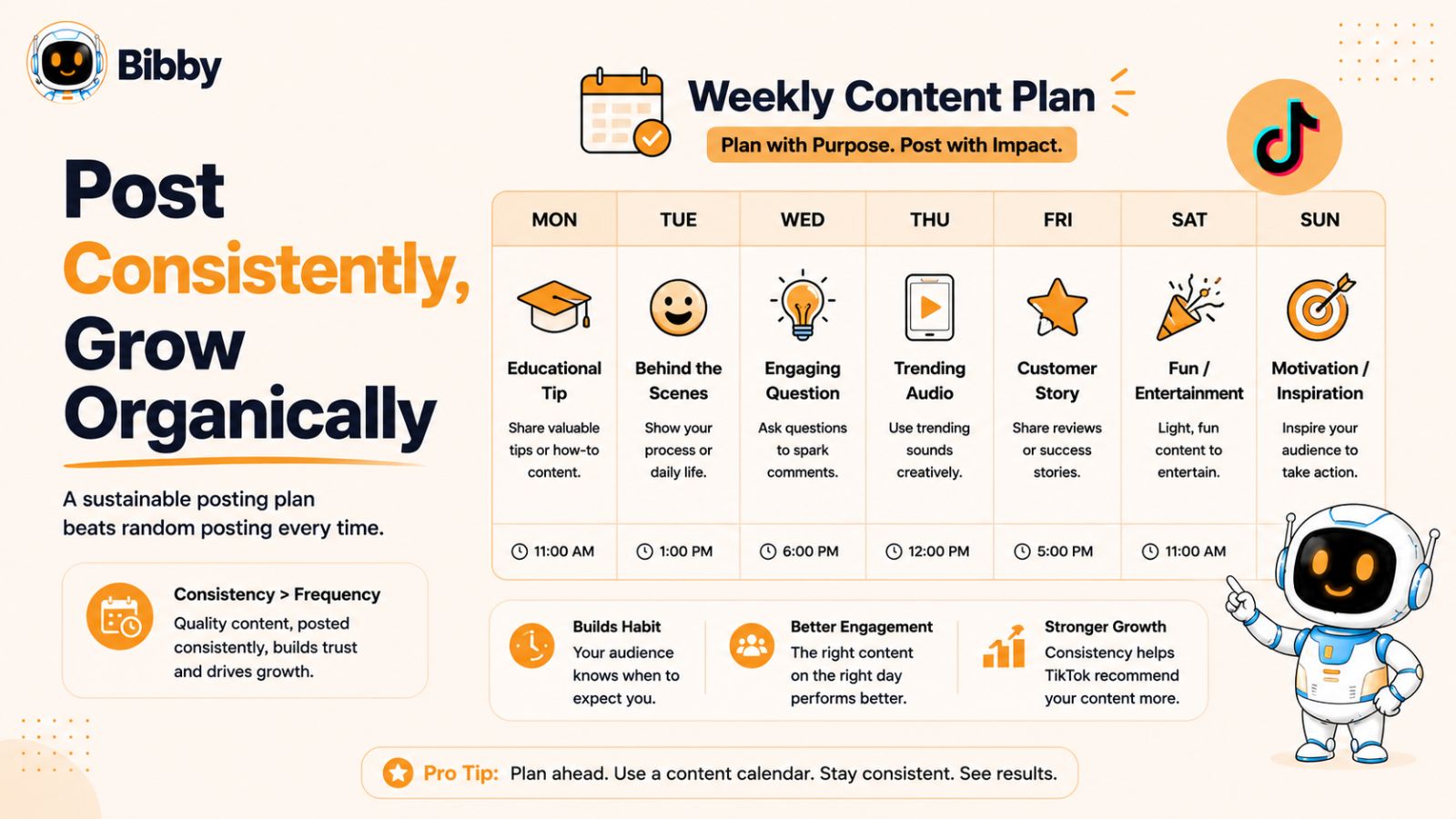
For example, a weekly TikTok strategy might include educational videos on Monday, a relatable video on Wednesday, and a product-focused video on Friday.
Once you have the system, you can repurpose appropriate content for other platforms instead of creating everything from scratch.
Use automation to maintain consistency
The hardest part of consistent publishing isn't always creating content. It's everything that happens afterward.
You may need to upload the media, write a caption, choose the platform, decide on a date, select a time, repeat the process for other platforms, and keep track of what has already been published.
This is exactly the kind of repetitive work that Bibby is designed to simplify.
With Bibby, you can upload an image or video—or generate an image with AI—choose your preferred posting style, and let the platform generate captions automatically. You can then schedule your media across selected platforms, including TikTok, Instagram, Facebook, LinkedIn, and YouTube, at AI-optimized times.
Bibby also supports different formats such as images, carousels, videos, and stories, allowing you to manage more of your social media workflow from one place.
The goal isn't to post more. It's to create a better system.
Posting frequency is only one part of your TikTok strategy.
If increasing your posting frequency means publishing lower-quality content, you're solving the wrong problem.
Instead, build a system that makes quality and consistency easier to maintain.
Create content in batches. Repurpose strong ideas. Schedule your posts ahead of time. Review your results. Then use those insights to improve your next content cycle.
The less time you spend on repetitive publishing tasks, the more time you have to focus on the part of social media that actually drives long-term growth: creating content your audience wants to see.
How Posting Time Affects TikTok Views
Once you've built a consistent publishing schedule, the next question is when you should publish your content.
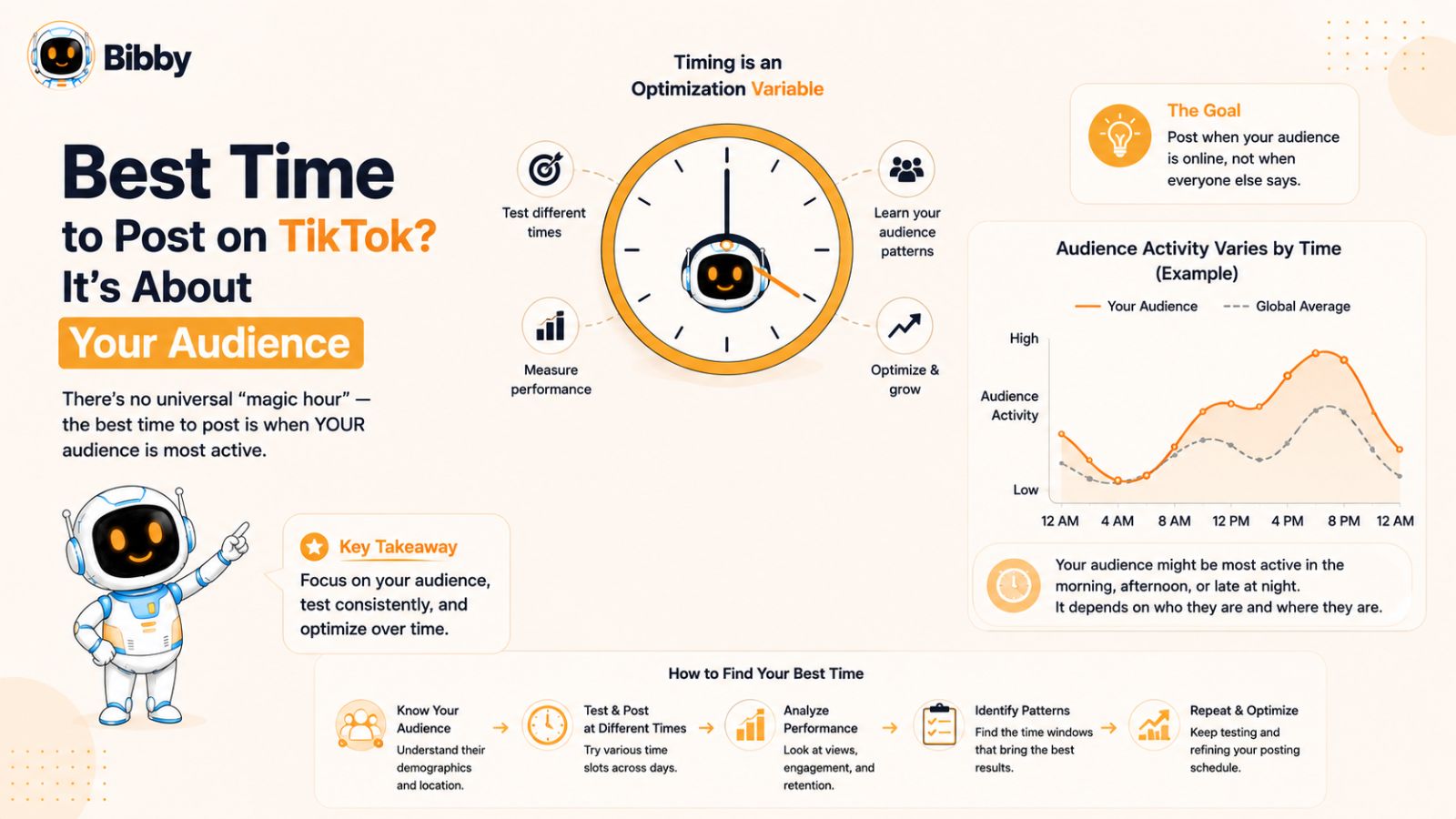
Posting time can matter, but it shouldn't become an obsession. There is no single "best time" that guarantees every TikTok will perform well. The right publishing window depends on your audience, location, habits, and the type of content you're publishing.
More importantly, posting at the perfect time cannot rescue content that people don't want to watch.
Does posting time really matter?
Timing can influence how quickly your content starts receiving attention, particularly when your audience is active on the platform.
If your followers and potential viewers are active when you publish, your content has an opportunity to receive early engagement from people who are already interested in your subject.
But don't confuse correlation with a guaranteed algorithm advantage.
A great video can continue gaining views after its initial publication window if people respond positively to it. Likewise, publishing at a supposedly "perfect" time won't automatically make a weak video successful.
Think of timing as an optimization layer—not the foundation of your strategy.
Find when your audience is active
Your audience may behave differently from another creator's audience.
For example, a B2B creator might find that their audience is more active during working hours, while a lifestyle creator could see stronger activity in the evening. An audience consisting primarily of students may have completely different viewing patterns.
Look at your own analytics and identify patterns in when your audience is most engaged.
Then test different publishing windows rather than assuming someone else's schedule will work for you.
Test different publishing windows
Instead of changing your posting time every day based on guesses, run simple experiments.
Choose several publishing windows and use them consistently for a period of time. Compare the results across similar types of content.
For example, you might test:
- Morning publishing
- Midday publishing
- Afternoon publishing
- Evening publishing
Track how different content performs within those windows, while remembering that the topic, hook, format, and audience can all influence the outcome.
Over time, you should have enough information to make better scheduling decisions based on your own audience rather than generic advice.
Why AI-optimized scheduling can simplify timing
The problem with manual scheduling is that you're constantly making small decisions.
Which day should this post go out?
What time should I choose?
Should this video go before or after another campaign?
What if I'm publishing across several platforms?
And what happens when you have dozens of pieces of content waiting to be published?
Bibby helps reduce that decision-making workload by providing AI-optimized scheduling. Instead of manually assigning every piece of content to a date and time, you can prepare your media and let Bibby organize your publishing schedule.
You can upload your content, choose your posting style, have captions generated automatically, and schedule your media across your selected platforms.
That can include TikTok, Instagram, Facebook, LinkedIn, and YouTube.
Think beyond TikTok
If TikTok is part of your broader social media strategy, there's another advantage to centralizing your publishing workflow.
The same content idea may have value on several platforms.
A TikTok video could become an Instagram post, a Facebook video, a LinkedIn adaptation, or part of a YouTube content strategy. You may also have images, carousels, and stories that need to be published alongside your videos.
Managing each platform separately creates unnecessary work.
With Bibby, you can manage your content distribution from one workflow rather than repeatedly logging into different platforms and rebuilding the same publishing process.
Don't let timing distract you from content quality
If you remember one thing from this section, remember this:
The best posting time is useful, but the best content still matters more.
Use analytics to understand your audience. Test different publishing windows. Take advantage of automation when it makes scheduling easier.
But don't spend hours trying to find a magical posting time while neglecting your hooks, topics, retention, and overall content quality.
Once your timing and publishing process are under control, the next step is building a content strategy that gives you enough valuable ideas to publish consistently.
The TikTok Content Strategy That Creates Sustainable Growth
Getting more TikTok views isn't about creating one lucky viral video. Sustainable growth comes from building a repeatable content system that consistently gives your audience reasons to watch, engage, follow, and return.
The strongest strategy combines clear content pillars, repeatable formats, audience-focused topics, and a distribution system that makes consistency easier.
Build content pillars
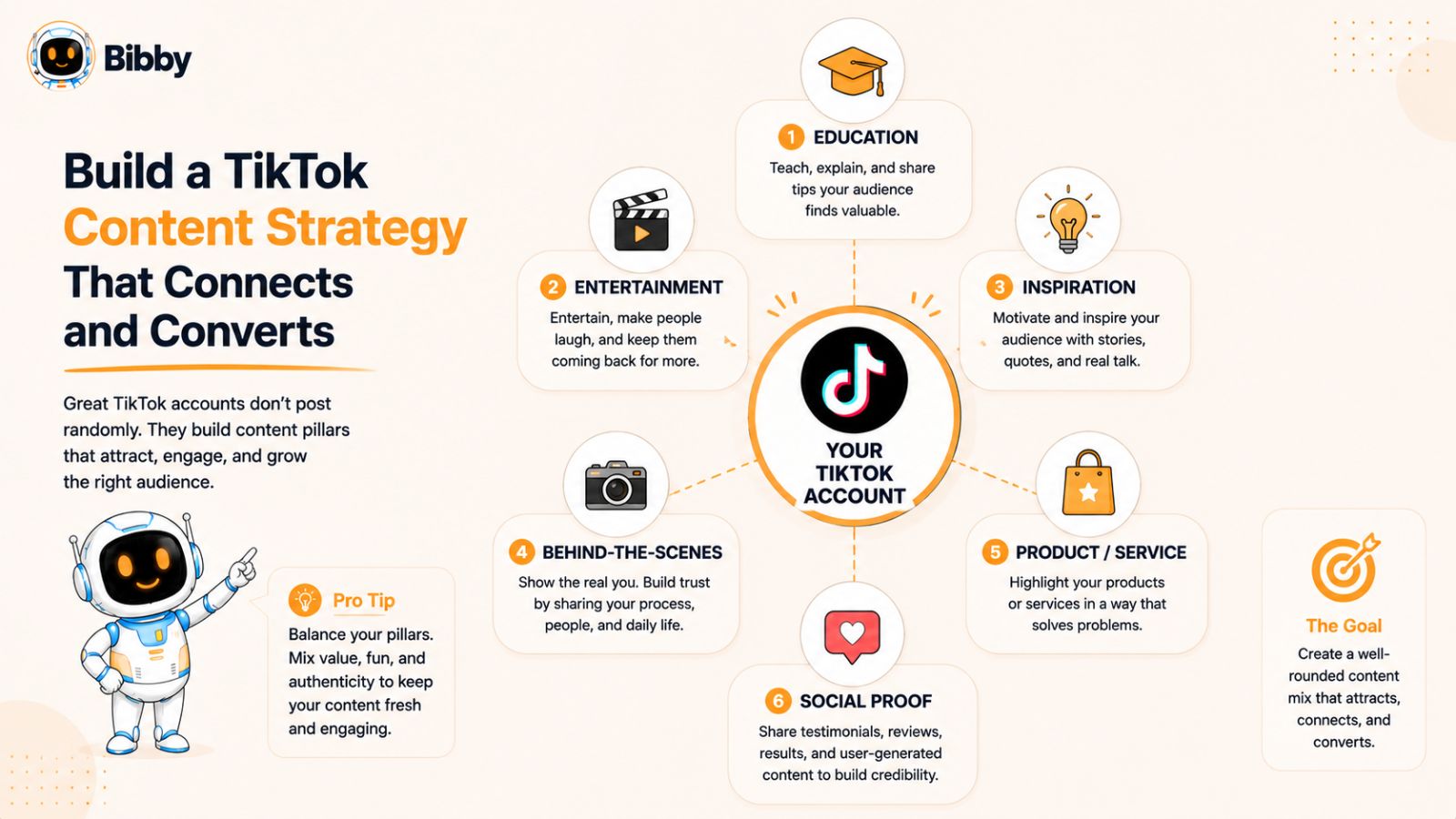
Content pillars are the recurring themes you want your account to be known for.
Instead of creating completely unrelated videos every day, choose several areas that connect to your expertise, audience, or business.
For example, a social media automation brand like Bibby could build content around:
- Education: TikTok strategy, social media tips, content marketing
- Automation: Ways to reduce repetitive social media work
- AI: How AI can help with content creation and management
- Productivity: Systems for creating and publishing content faster
- Behind the scenes: How campaigns and content are created
- Product content: Demonstrations, workflows, and use cases
- Customer stories: Examples of how businesses use automation
Content pillars make it easier to decide what to publish because you're no longer starting from a blank page every time.
Create repeatable content formats
Once you have your pillars, turn them into formats you can repeatedly produce.
Some formats work particularly well for educational and business-focused TikTok content:
Tutorials: Show viewers how to accomplish a specific task.
Mistakes to avoid: Explain common problems and how to fix them.
List videos: Give viewers several useful ideas in a short format.
Before-and-after: Demonstrate what changes when someone applies a strategy.
Case studies: Show what happened when a particular approach was used.
FAQs: Answer questions your audience repeatedly asks.
Myth versus reality: Challenge common misconceptions.
Storytelling: Explain an experience, lesson, failure, or success.
The advantage of repeatable formats is that you don't need to reinvent your creative process every time you publish.
Turn one idea into multiple pieces of content
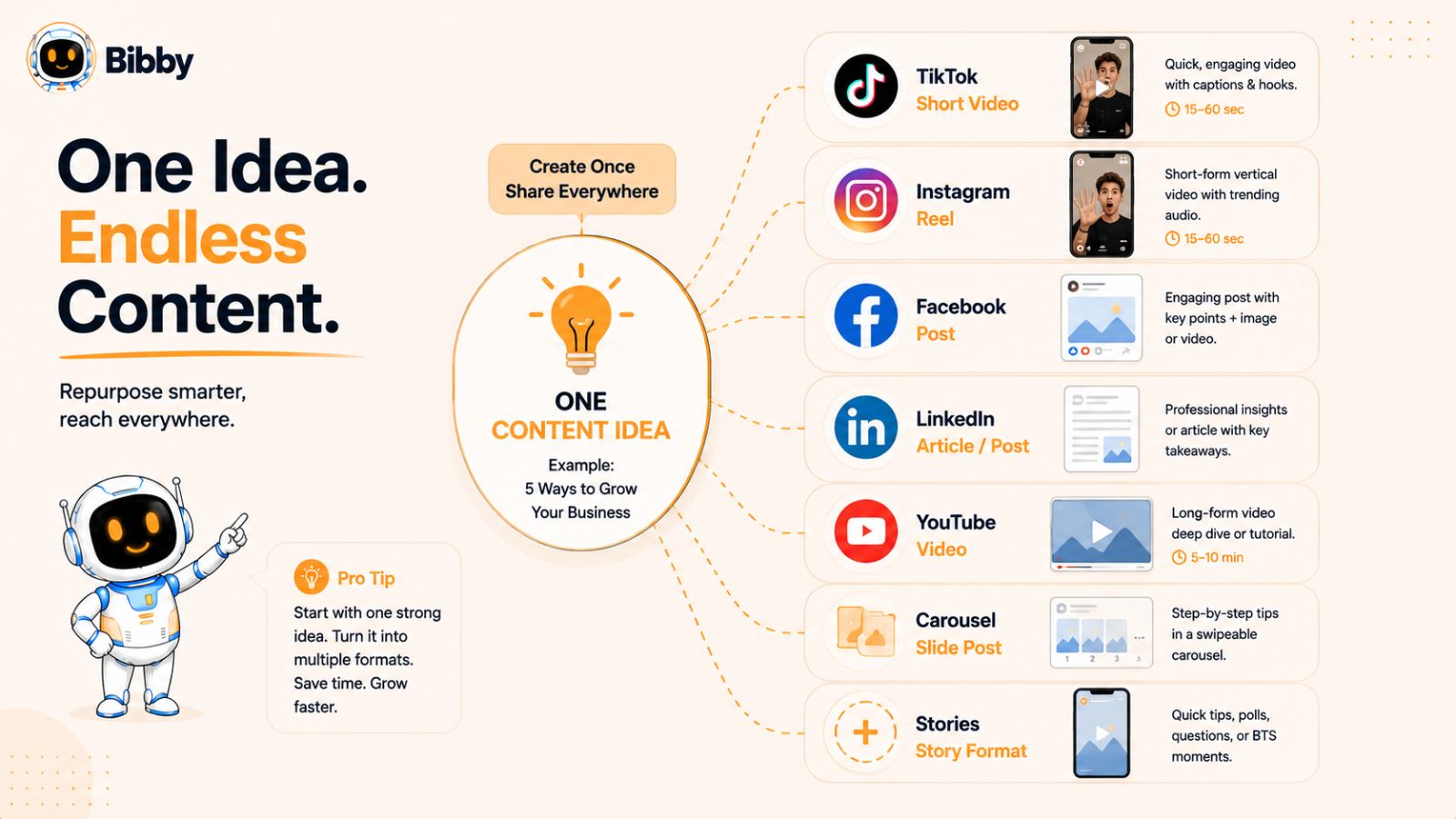
A single strong idea can become an entire content cluster.
Suppose your core idea is:
"Social media scheduling saves hours of repetitive work."
That could become:
- A TikTok explaining the problem
- A TikTok showing a manual scheduling workflow
- A tutorial demonstrating an automated workflow
- An Instagram Reel
- A LinkedIn post about social media productivity
- A Facebook video
- An Instagram carousel showing the steps
- A YouTube video explaining the broader strategy
- Stories highlighting individual features
- A customer-focused post explaining the business benefit
This approach gives you more content without requiring you to invent a completely new concept for every platform.
The key is adaptation. Don't simply copy and paste identical content everywhere. Adjust the presentation, caption, format, and context to suit the platform and audience.
Create once, distribute strategically
One of the biggest opportunities in modern social media is separating content creation from content distribution.
You can create a valuable piece of content once and then determine where else it makes sense to publish it.
The problem is that distributing content across multiple platforms manually can take almost as much effort as creating the original content.
You may have to upload the asset repeatedly, write different captions, select dates, choose times, and track everything across multiple scheduling interfaces.
Bibby brings those tasks into a single workflow.
Upload your image or video, or generate an image with AI. Choose your posting style, and Bibby can automatically generate the caption. You can then schedule your content across selected platforms—including TikTok, Instagram, Facebook, LinkedIn, and YouTube—at AI-optimized times.
You can also work with multiple formats, including images, carousels, videos, and stories.
Build a content library
A strong content strategy becomes much easier when you maintain a library of ideas and assets.
Your library might contain:
- Video ideas
- Hooks
- Content pillars
- Evergreen posts
- Product content
- Customer questions
- Campaign concepts
- Images
- Videos
- Carousel ideas
- Previously successful posts
This prevents you from repeatedly starting from scratch.
It also makes it easier to turn successful topics into additional content. If one TikTok performs exceptionally well, don't treat it as a one-time event. Ask why it worked and explore related angles.
Use performance to guide your next ideas
Your content strategy should evolve based on what you learn.
If educational videos consistently outperform promotional videos, create more educational content.
If short tutorials receive more saves and shares than opinion videos, increase the number of tutorials.
If one topic repeatedly attracts the right audience, explore it from different angles.
This creates a feedback loop:
Create → Publish → Measure → Learn → Improve → Create again.
Automation can make the publishing part of that loop easier, but the strategic thinking still comes from you.
Use Bibby to turn your content strategy into a system
This is where social media automation becomes more than a simple scheduling feature.
With Bibby, you can manage the workflow from creating assets through distribution. You can upload media, generate images with AI, select a posting style, generate captions, and schedule content across multiple platforms.
And Bibby's chat interface takes the workflow a step further.
Instead of navigating through different menus for every task, you can interact with Bibby conversationally. You can use the chat interface to create a brand kit, create a campaign, create posts, regenerate captions, and manage other parts of your social media workflow.
That means your content strategy can become something you direct, rather than something you spend hours manually operating.
The objective isn't to automate creativity away. It's to remove repetitive tasks so you can spend more time deciding what your audience should see next.
How to Use AI Without Creating Generic TikTok Content
AI can dramatically speed up social media content creation, but faster content doesn't automatically mean better content.
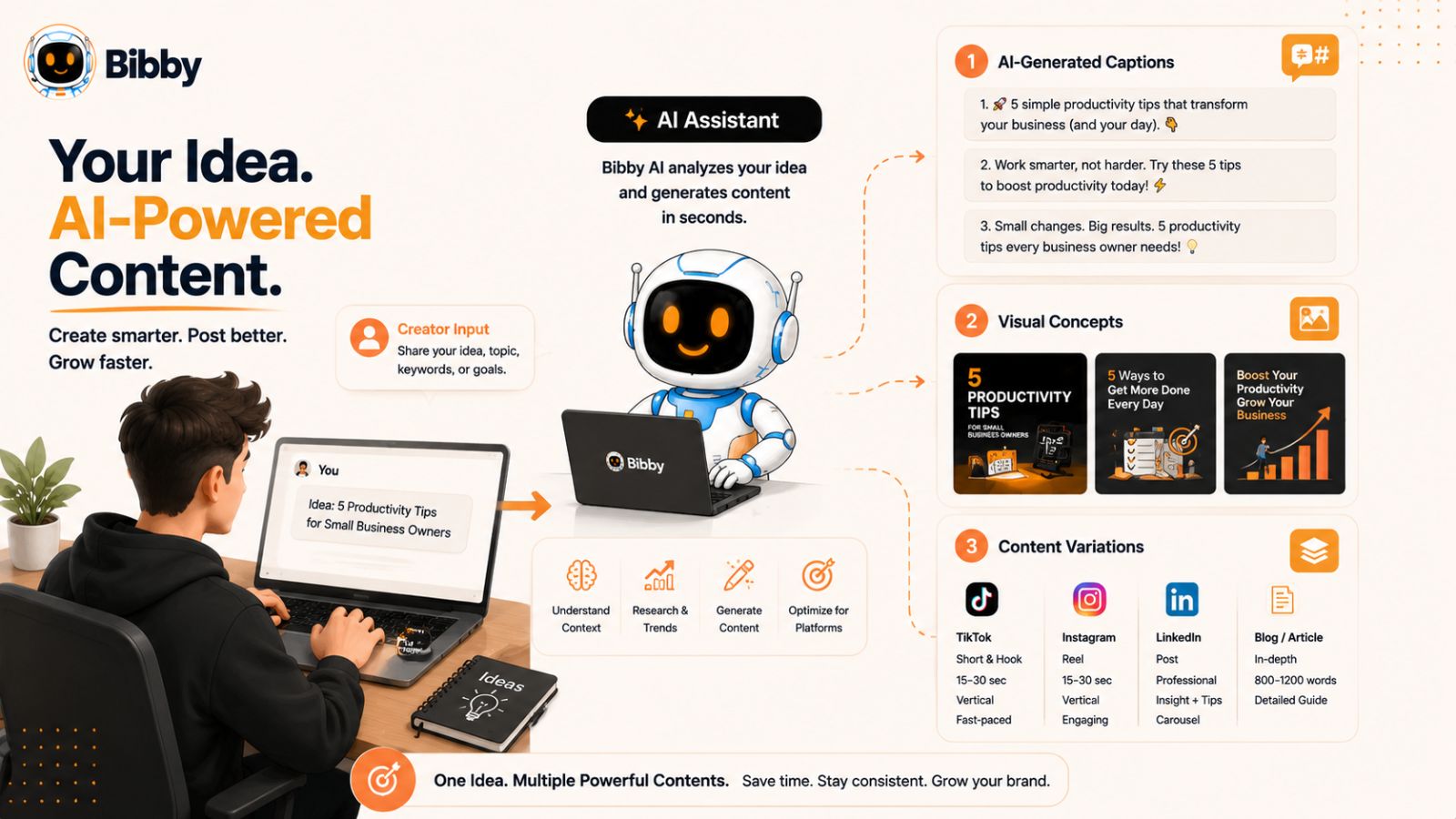
One of the biggest risks of using AI for social media is producing content that feels interchangeable: generic hooks, predictable captions, stock-looking visuals, and posts that sound like they were written for everyone.
The best approach is to use AI as a creative assistant while keeping your expertise, personality, and brand at the center of the content.
AI should accelerate creativity, not replace it
Think of AI as a tool that helps you move from idea to finished content faster.
It can help you:
- Brainstorm content ideas
- Generate visual concepts
- Create images
- Write initial captions
- Adapt content for different platforms
- Generate alternative hooks
- Rewrite content in different tones
- Organize campaigns
- Repurpose existing ideas
But you should still decide what your audience needs to hear and why.
For example, instead of asking AI to "write a TikTok about social media," give it a specific objective:
"Create a short TikTok explaining why manually scheduling posts across five platforms wastes time, and show a simpler workflow."
The more specific your direction, the more useful the output is likely to be.
Generate visual assets faster
Creating enough visual content for multiple social platforms can become a major bottleneck.
You may need images for posts, graphics for campaigns, thumbnails, carousel slides, or supporting visuals for your videos.
AI image generation can reduce some of that production time.
With Bibby, you can generate an image with AI when you don't already have a suitable visual. You can then incorporate that asset into your broader social media publishing workflow rather than moving between separate tools for creation and scheduling.
This is especially useful when you're building content in batches.
Instead of stopping your workflow because you don't have an image ready, you can generate the visual, prepare the post, and continue toward scheduling.
Automatically generate captions
Writing captions for every social media post can become surprisingly repetitive.
Even if the underlying content is already finished, you may still need to write a caption, adapt the tone, add context, and create platform-appropriate variations.
Bibby can automatically generate captions based on your content and chosen posting style.
If the first caption isn't what you want, you don't have to start from scratch. You can regenerate it and continue refining the result.
This is particularly useful when you're managing a large content calendar and don't want caption writing to become the bottleneck.
Keep your brand voice consistent
AI-generated content becomes much more useful when it understands your brand.
Your audience should be able to recognize your communication style whether they're seeing a TikTok, Instagram post, LinkedIn update, or Facebook post.
That means consistency in areas such as:
- Tone
- Vocabulary
- Messaging
- Visual identity
- Audience
- Positioning
- Content themes
Bibby's chat interface can also be used to create a brand kit, giving you a centralized way to establish important brand guidelines as part of your social media workflow.
Instead of repeatedly explaining your brand from scratch, you can build the foundation once and use it to support future content creation.
Use AI to create variations, not clones
One of the most practical ways to use AI is to generate multiple versions of an idea.
For example, a single topic could have:
- An educational version
- A conversational version
- A bold opinion
- A short-form version
- A story-driven version
- A product-focused version
This allows you to test different approaches without having to completely recreate the content yourself.
If one approach performs better, you can use that information to guide future content.
Let AI handle the repetitive work
The real advantage of AI isn't simply that it can write a caption faster.
It's that AI can help connect multiple parts of your social media workflow.
With Bibby, you can move from creating or uploading an asset to selecting a posting style, generating a caption, scheduling the content, and distributing it across your selected platforms.
And because Bibby now includes a chat interface, you can manage many of these tasks conversationally. You can ask it to create a campaign, create posts, build a brand kit, regenerate captions, and handle other social media tasks without manually navigating every step.
That changes the role of AI from a simple content-generation feature into something closer to an always-available social media assistant.
The human still makes the content valuable
The best AI-assisted TikTok strategy isn't:
AI creates everything → you publish everything.
It's:
Your expertise → AI accelerates production → you review and refine → automation handles distribution.
Your ideas, experiences, opinions, customer knowledge, and understanding of your audience are what make content distinctive.
AI and automation simply help you turn those ideas into more content, more efficiently.
Once that foundation is in place, the next step is to see exactly how Bibby can bring the entire process together—from creating your media to generating captions and scheduling your content across your social channels.
Bibby: Turn Your TikTok Strategy Into an Automated Social Media Workflow
Understanding the TikTok algorithm is useful. Creating great content is essential. But even the best strategy can become difficult to maintain when you're manually managing every post, caption, platform, date, and publishing time.
That's where Bibby comes in.
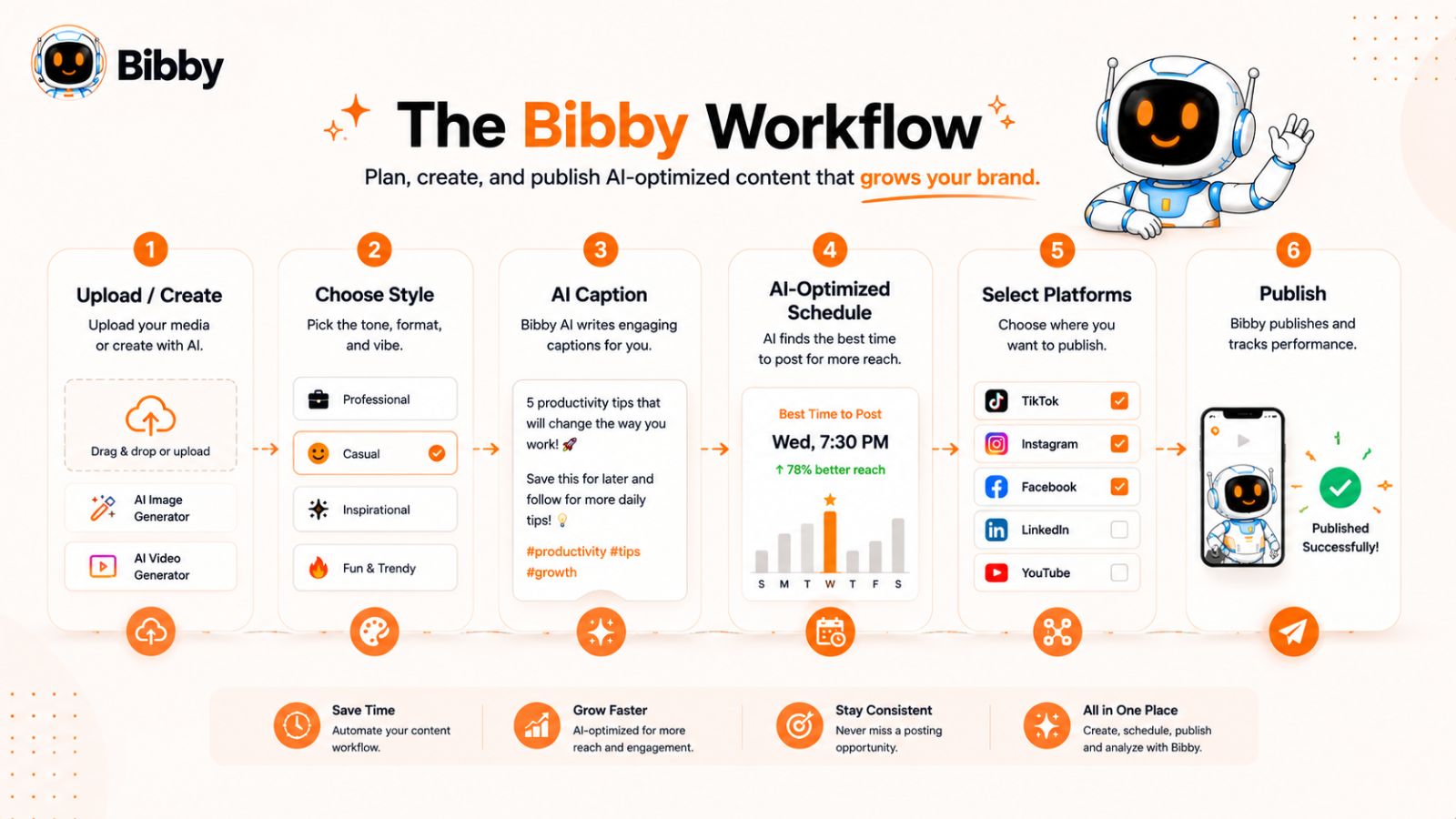
Bibby is designed to turn social media management into a simple workflow: create or upload your media, choose how you want to present it, let AI help with the copy, and schedule your content across the platforms you want to reach.
Instead of spending hours operating multiple social media tools, you can focus on the strategy and let Bibby handle much of the repetitive execution.
Start with your media
The workflow begins with the content itself.
You can upload an image or video you've already created, or generate an image with AI when you need a new visual.
This gives you flexibility whether you're working with professionally produced content, user-generated content, product images, educational graphics, or AI-assisted visuals.
You don't have to build every asset from scratch just to use the automation workflow.
Choose your posting style
Once your media is ready, you can choose the posting style you want.
This helps Bibby understand how you want the content presented and gives the AI direction when generating your accompanying copy.
Instead of staring at a blank caption box every time you create a post, you can use your preferred style as part of a repeatable workflow.
Let Bibby generate your captions
Writing a caption for one post isn't difficult.
Writing captions for dozens or hundreds of posts across multiple platforms is another story.
Bibby can automatically generate captions for your content, reducing one of the most repetitive parts of social media management.
If you don't like the first version, you can regenerate the caption rather than starting over manually.
You remain in control of the final content while Bibby handles the repetitive first draft and revision work.
Schedule your content across multiple dates
Consistency is easier when your content isn't sitting in a folder waiting for someone to remember to publish it.
Bibby lets you schedule your media across different dates and use AI-optimized posting times as part of the scheduling workflow.
That means you can prepare content in advance and create a publishing calendar instead of manually deciding what to publish every day.
This is particularly valuable when you're trying to maintain consistent TikTok publishing while also managing several other channels.
Publish across your selected platforms
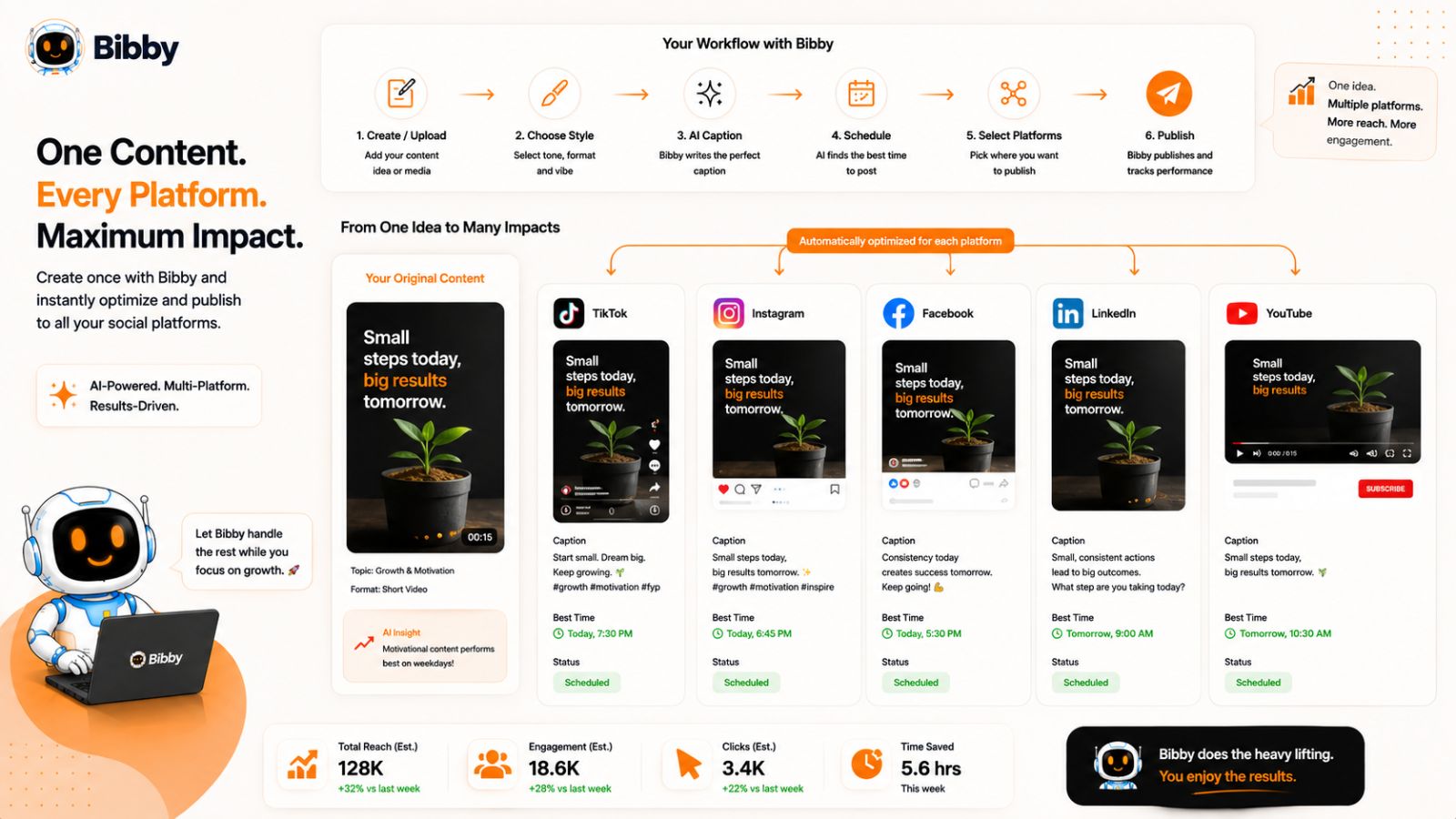
TikTok may be the focus of this article, but most creators and businesses don't operate on only one platform.
Your audience might be spread across:
- TikTok
- YouTube
Bibby brings these channels into a centralized social media workflow.
You can select the platforms you want to use and manage your content distribution without repeatedly rebuilding the same process on each individual platform.
This makes it easier to turn one content strategy into a broader multi-platform publishing system.
Manage more than just videos
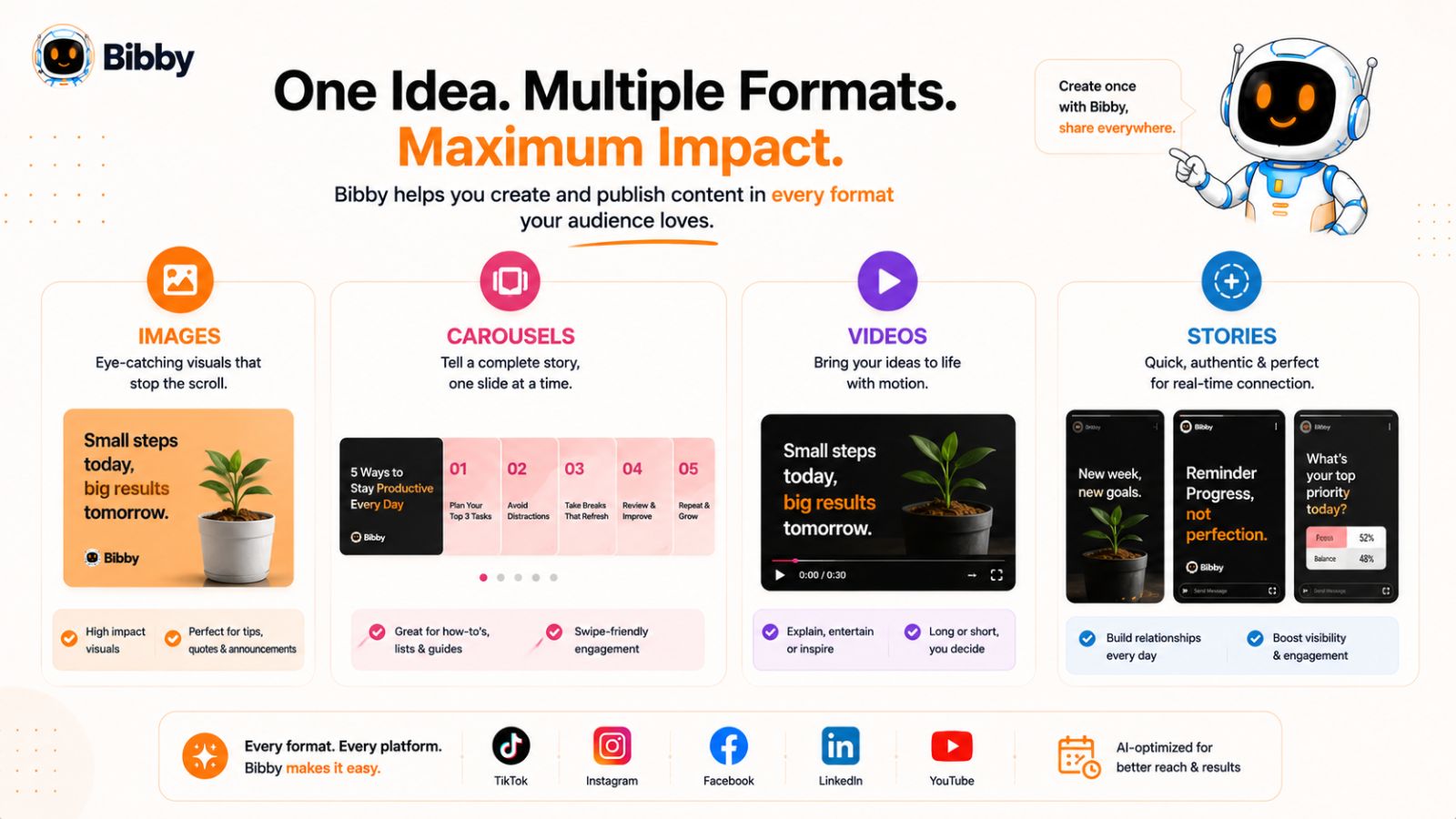
A modern social media strategy isn't limited to short-form video.
Depending on the platform and campaign, you may also need:
- Images
- Carousels
- Videos
- Stories
Bibby supports these different types of social content, allowing you to manage more of your publishing workflow from the same system.
This is important because a strong social media presence often depends on a mixture of formats rather than endlessly producing one type of post.
The simple Bibby workflow
The entire process can be thought of as a straightforward sequence:
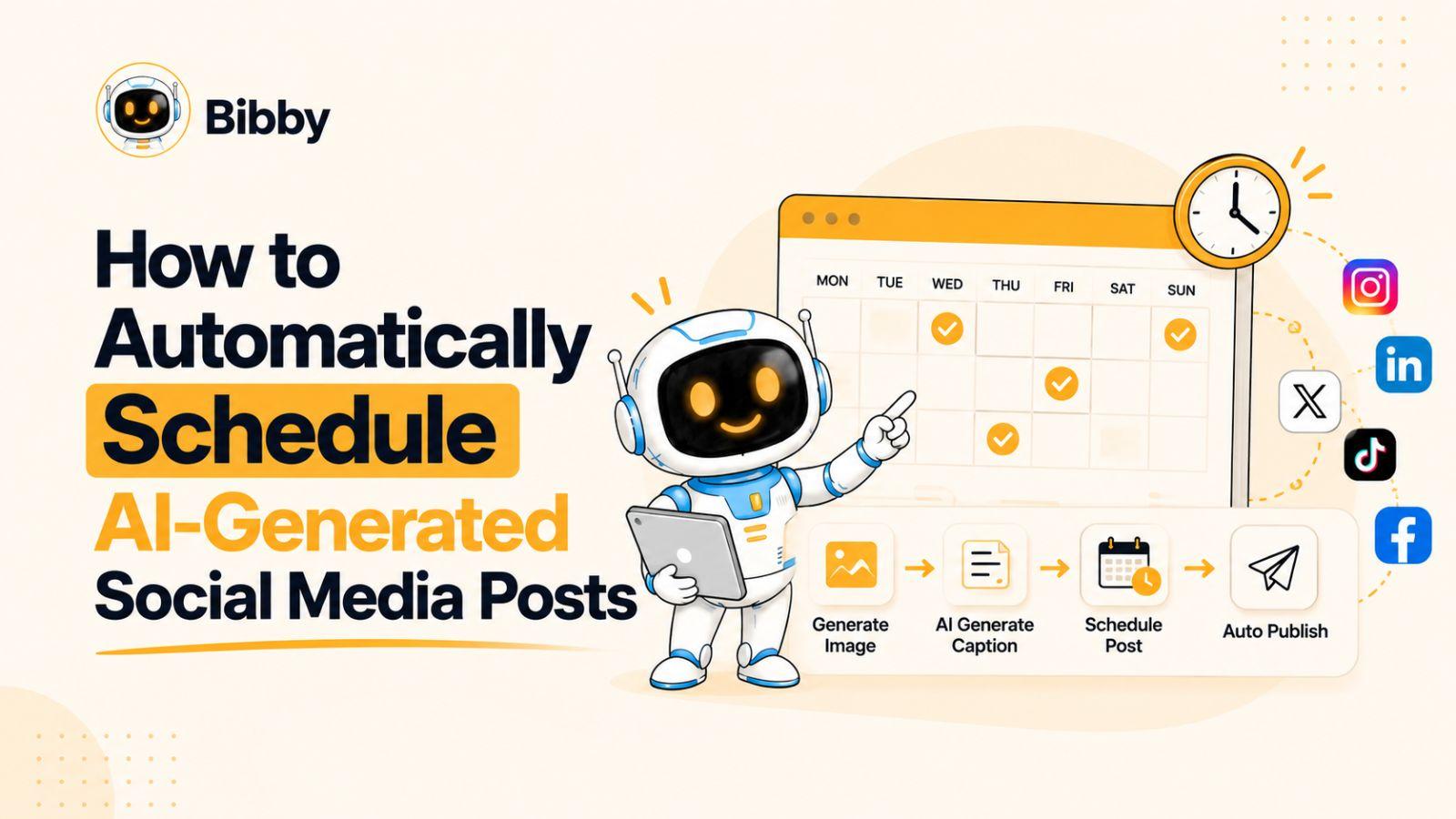
Upload or generate → Choose your style → Generate captions → Schedule → Publish.
That simplicity is the real advantage.
You don't need to manually repeat the same administrative tasks for every piece of content. Instead, you can build a batch of content, organize it, and let Bibby handle the publishing workflow.
From TikTok strategy to complete social media automation
The TikTok algorithm rewards creators who consistently produce content that people want to watch.
But consistency becomes much easier when the operational side of social media doesn't consume all your time.
Bibby helps bridge that gap.
You can focus on finding better topics, creating stronger hooks, and producing content that provides genuine value. Bibby can then help with the repetitive work of generating captions, organizing your publishing schedule, and distributing content across your selected social platforms.
And this is only part of the workflow.
With Bibby's AI-powered chat interface, you can now go beyond scheduling and manage your social media by simply telling Bibby what you want to accomplish.
Meet Bibby's AI Chat Interface: Manage Social Media by Talking to It
Scheduling posts is useful, but social media management involves far more than publishing content at the right time.
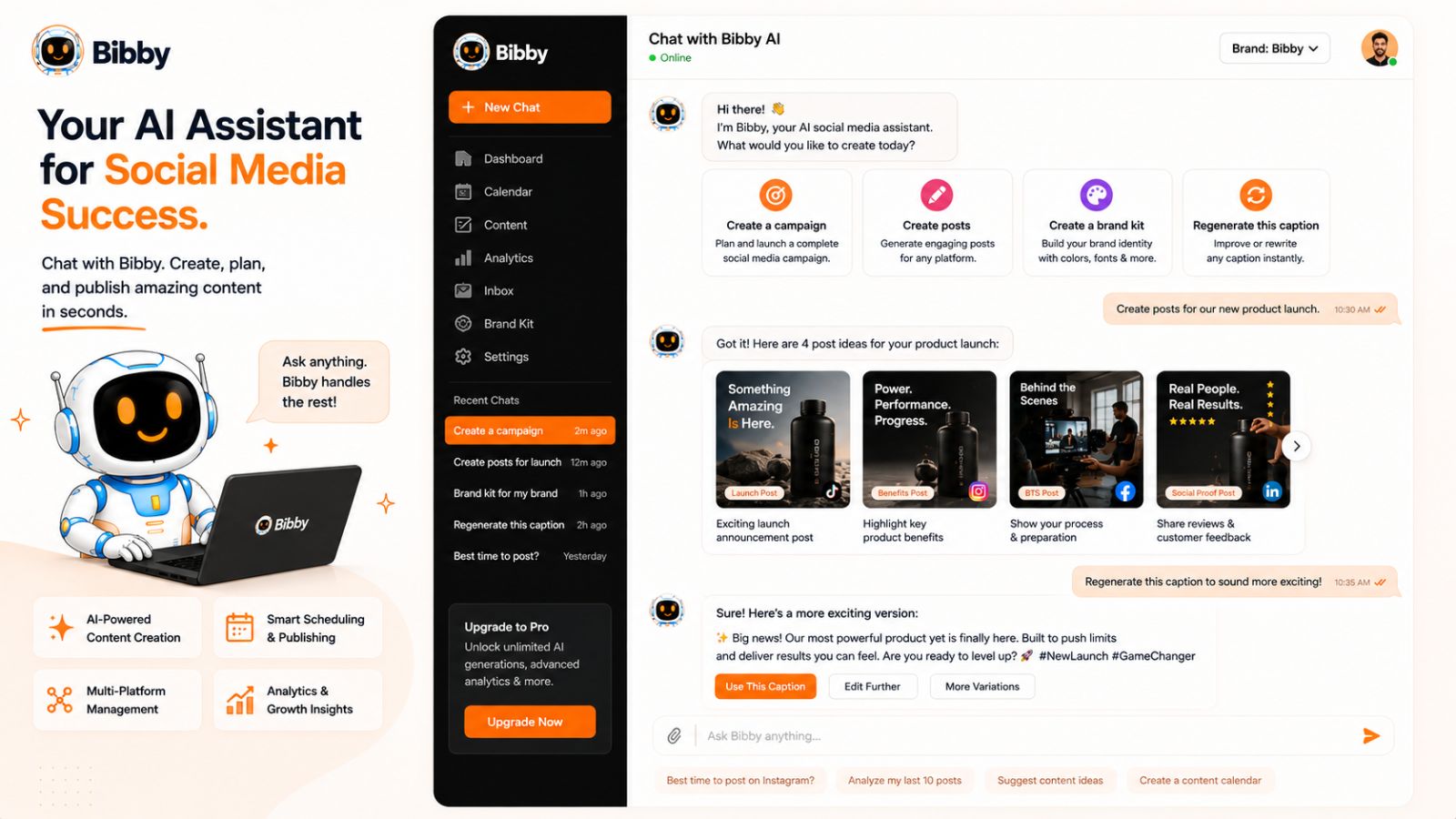
You need to build campaigns, maintain your brand identity, create posts, rewrite captions, organize content, and make changes as your strategy evolves.
Bibby's AI chat interface is designed to make those tasks more conversational.
Instead of treating social media management as a collection of menus, buttons, and repetitive workflows, you can simply tell Bibby what you want to accomplish and use the conversation to manage your social presence.
Your social media manager in a chat interface
Imagine opening your social media tool and saying:
"Create a campaign for our new product launch and prepare posts for TikTok, Instagram, Facebook, LinkedIn, and YouTube."
Rather than manually creating every component from scratch, you can use Bibby's chat interface to guide the process.
You can also refine what it creates through the conversation.
For example:
- "Make the captions more conversational."
- "Create three more variations."
- "Make this campaign more educational."
- "Regenerate the captions."
- "Create a carousel version."
- "Prepare posts for next week."
The idea is simple: communicate your intent instead of manually operating every step.
Create a brand kit through chat
A consistent brand is easier to maintain when your brand guidelines are organized in one place.
With Bibby's chat interface, you can create a brand kit conversationally.
You can establish important elements such as your brand's identity, voice, visual direction, and communication style.
This gives future content a stronger foundation and reduces the need to repeatedly explain how your brand should sound and look.
For businesses publishing across multiple platforms, that consistency can be particularly valuable.
Create campaigns through chat
Campaigns often require multiple pieces of content rather than one isolated post.
You might need:
- Launch announcements
- Educational posts
- Promotional content
- Videos
- Carousels
- Stories
- Follow-up posts
Instead of building each component separately, you can describe the campaign you want to create and use Bibby to help organize the content workflow.
This makes it easier to turn a marketing objective into an actual publishing plan.
Create posts through chat
You can also use the chat interface to create individual social posts.
For example, you could ask Bibby to create a TikTok post about a specific topic, request a particular tone, or turn an existing idea into a different format.
This is particularly useful when you have the idea but don't want to spend time translating that idea into every individual social media component.
The conversation becomes the interface between your strategy and the content.
Regenerate captions and refine content
The first version of a caption isn't always the right one.
Maybe it's too formal.
Maybe it doesn't sound like your brand.
Maybe you want something shorter.
Maybe you want a stronger hook.
Instead of manually rewriting everything, you can simply ask Bibby to regenerate or modify the content.
For example:
"Make this caption shorter and more conversational."
Or:
"Give me three stronger versions with a curiosity-driven opening."
That iterative workflow can make AI-assisted content creation feel much more natural.
Manage your social media workflow conversationally
The bigger idea behind Bibby's chat interface is that social media management doesn't have to feel like operating complicated software.
You can use conversation to direct tasks such as:
- Creating a brand kit
- Creating campaigns
- Creating posts
- Regenerating captions
- Developing content
- Organizing your publishing workflow
- Managing other social media tasks
This gives you a different way to work.
Instead of thinking, "Which button do I need to click?", you can think, "What do I want my social media manager to do?"
From social media operator to social media director
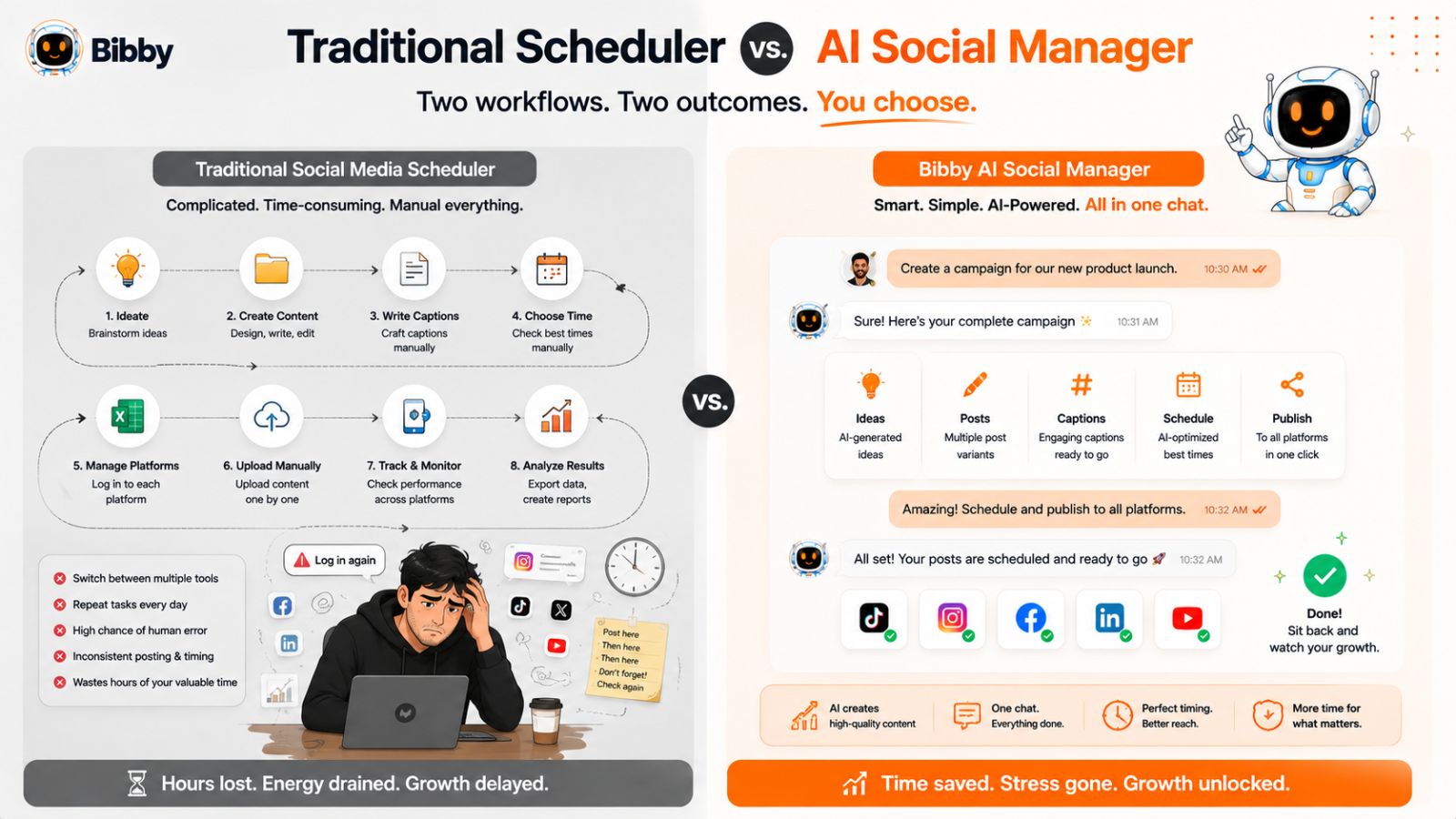
This is where AI automation becomes particularly powerful.
Without automation, you may spend your time doing administrative work:
Upload this.
Write that caption.
Schedule this post.
Change the date.
Create another version.
Publish it to another platform.
With a conversational system like Bibby, you can spend more of your time directing the strategy and less time performing repetitive operations.
You still decide what your brand should say, who it should reach, and what your goals are.
Bibby simply helps turn those decisions into an organized social media workflow.
And when that workflow is combined with a clear TikTok content strategy, consistent publishing becomes much easier to maintain.
A Practical 2026 TikTok Growth Workflow
Understanding the algorithm is one thing. Putting everything together into a repeatable workflow is what turns that knowledge into action.
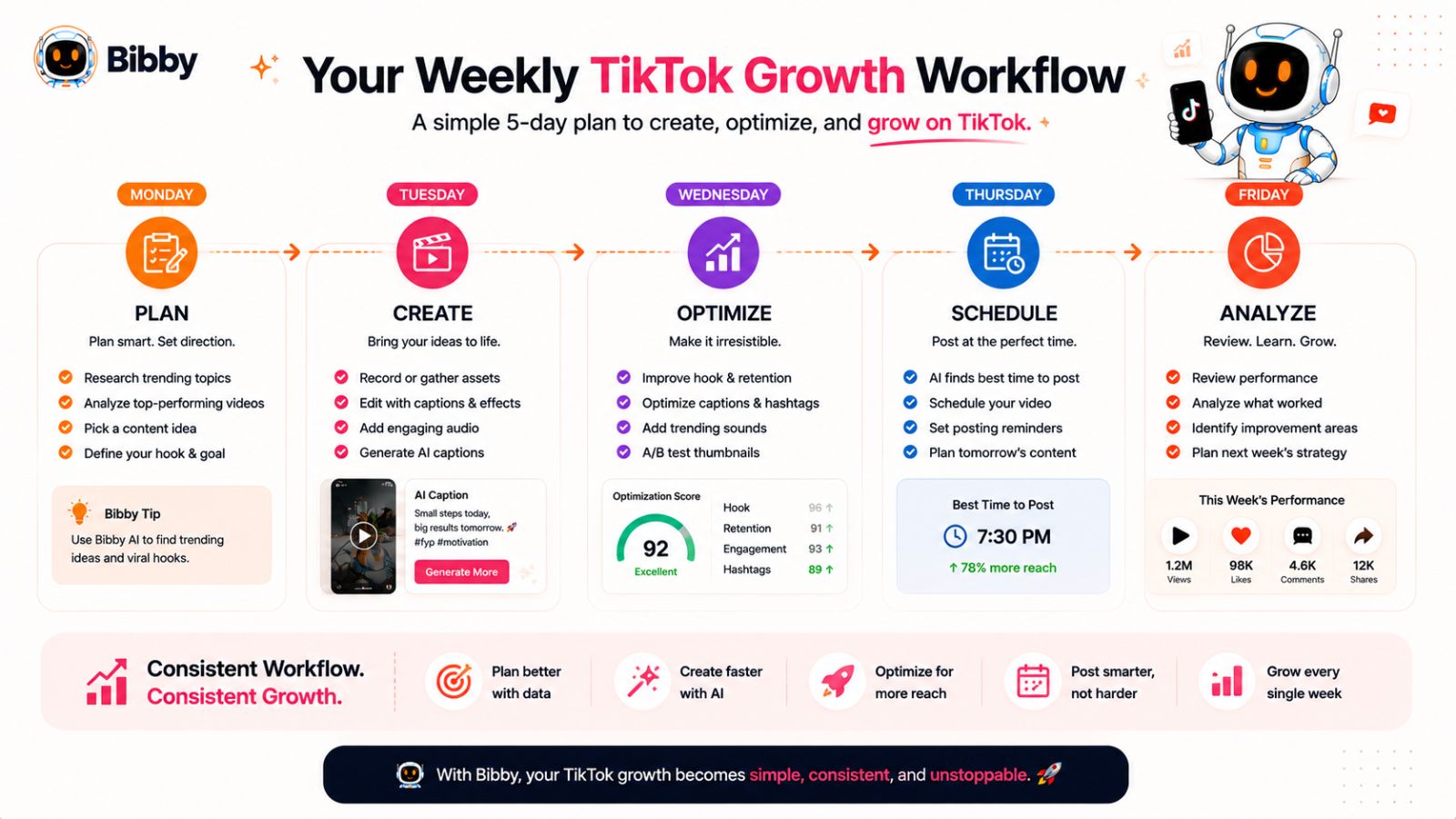
A practical TikTok growth system doesn't require you to spend every day thinking about what to post, writing captions, and manually publishing content. Instead, you can separate strategy, creation, optimization, scheduling, and analysis into a simple cycle.
Here's a workflow you can repeat every week.
Monday: Plan your content
Start the week by deciding what you want to publish.
Review your content pillars and identify topics that are relevant to your audience. Look at questions people are asking, previous posts that performed well, current conversations in your niche, and gaps where you can provide useful information.
Then turn those ideas into specific video concepts.
For each concept, define:
- The target audience
- The main topic
- The hook
- The key takeaway
- The desired action
- The content format
Don't try to make every post promotional.
A healthy content mix can include educational content, entertaining posts, relatable ideas, behind-the-scenes content, product demonstrations, and occasional promotional content.
Tuesday: Create your content
Once your ideas are selected, batch your production.
If you're recording videos, record several in the same session. If you're creating visual content, prepare multiple assets at once.
You can also use AI to speed up parts of the creative process.
For example, Bibby allows you to generate images with AI when you need additional visual assets. You can combine those visuals with your existing images, videos, carousels, and other content.
The objective is to create enough material to support your publishing schedule without having to start from zero every morning.
Wednesday: Optimize your content
Before scheduling, review each piece of content.
Ask:
Is the topic immediately clear?
Does the opening give viewers a reason to continue?
Does the video deliver on its promise?
Is the information genuinely useful or entertaining?
Does the content sound like our brand?
Would someone want to share or save it?
You can also prepare the accompanying captions and make sure the content is appropriate for each platform.
This is where AI can help accelerate the process without replacing your judgment.
Bibby can generate captions based on your content and chosen posting style, and you can regenerate them when you want a different approach.
Thursday: Schedule your content
Now turn your finished content into a publishing calendar.
Upload your media to Bibby, or generate the visual assets you need with AI. Choose your posting style and let Bibby generate the captions.
Then select the platforms you want to publish to and schedule the content across different dates.
Bibby's AI-optimized scheduling can help determine suitable publishing times, reducing the need to manually decide when every post should go live.
Instead of spending the rest of the week thinking about individual publishing tasks, you can have your content prepared in advance.
Friday: Review and learn
A content strategy shouldn't end when you press publish.
Review how your content performed.
Look for patterns in:
- Views
- Watch time
- Completion
- Shares
- Saves
- Comments
- Follows
- Profile activity
Don't judge your entire strategy based on one post.
Look for patterns across multiple pieces of content.
Maybe tutorial videos consistently receive more saves. Perhaps videos with direct hooks generate better retention. Maybe a particular topic repeatedly attracts new followers.
Those insights should influence what you create next.
Repeat what works—and improve what doesn't
The next week shouldn't be a completely new experiment.
Take your strongest ideas and explore them from different angles.
If a video about TikTok SEO performs well, create additional videos answering related questions.
If a specific hook generates strong retention, experiment with similar structures.
If a particular format consistently performs poorly, either improve it or allocate more of your content budget to formats that produce stronger results.
This creates a continuous improvement loop:
Plan → Create → Optimize → Schedule → Publish → Analyze → Improve.
Let Bibby handle the repetitive parts
The biggest benefit of this workflow is that not every step needs to consume your time.
Bibby can help with several of the repetitive operational tasks involved in the cycle.
You can upload your media, generate images with AI, choose your posting style, generate captions, schedule content across different dates, and publish across platforms such as TikTok, Instagram, Facebook, LinkedIn, and YouTube.
You can also use images, carousels, videos, and stories as part of your broader content strategy.
And when you don't want to navigate through individual tools and settings, Bibby's chat interface gives you another way to manage the workflow.
You can ask Bibby to create a brand kit, create a campaign, create posts, regenerate captions, and handle other social media tasks through conversation.
Your role becomes more strategic
The goal of automation isn't to remove you from the process.
It's to remove the repetitive work that prevents you from focusing on the parts only you can do well.
You should still decide:
- What your brand stands for
- Who you're trying to reach
- What problems you want to solve
- What stories you want to tell
- What makes your content different
Bibby can then help turn those decisions into a consistent publishing system.
That's the difference between simply posting on TikTok and building a scalable social media engine.
Common TikTok Algorithm Mistakes That Kill Reach
Knowing how the TikTok algorithm works doesn't automatically mean your content will perform well. Many creators understand the basic principles but still make mistakes that limit their reach, consistency, or ability to learn from their results.
The good news is that most of these problems are fixable.
Creating content for everyone
One of the fastest ways to make your content less relevant is trying to appeal to everyone.
If your videos are aimed at "anyone interested in business," your messaging may become too broad to strongly connect with a specific audience.
Instead, define who you're creating for.
A fitness creator might focus on busy professionals trying to exercise at home. A SaaS company might create content specifically for small business owners managing their own marketing.
The more clearly you understand your audience, the easier it becomes to choose topics, hooks, examples, and language that resonate.
Starting with a weak hook
If your opening takes too long to reach the point, viewers have little reason to keep watching.
Avoid unnecessary introductions such as:
"Hey guys, welcome back to another video..."
Get to the value quickly.
Instead, open with the problem, promise, question, result, or curiosity gap that matters to your audience.
For example:
"If you're manually scheduling every social media post, you're wasting hours every week."
The viewer immediately knows what the video is about and why it might matter to them.
Making videos longer without adding value
Longer isn't automatically better.
A video should be as long as necessary to deliver its idea effectively—not as long as possible.
If a point can be explained in 30 seconds, don't stretch it to two minutes simply because you think longer videos will perform better.
At the same time, don't cut valuable information just to make a video shorter.
Focus on information density and viewer value.
Ignoring retention
Views tell you how many people watched. Retention helps you understand what happened after they started watching.
If viewers consistently leave during the first few seconds, your opening may need improvement.
If they leave halfway through, perhaps the pacing slows down or the payoff isn't strong enough.
Use retention patterns as feedback.
Instead of saying, "The algorithm didn't like my video," ask:
"Where did viewers lose interest, and what can I change in the next version?"
Posting inconsistently
You don't need to publish dozens of videos every day.
But disappearing for long periods makes it harder to build a reliable content engine.
Choose a publishing schedule you can actually maintain.
Then make consistency easier through batching and scheduling.
This is one area where automation can have a significant practical impact. When your content is prepared in advance, you don't have to rely on remembering to publish something every day.
Overusing irrelevant hashtags
Adding dozens of popular hashtags doesn't guarantee more reach.
Irrelevant hashtags can make your content less clearly categorized and don't solve the underlying problem if the video itself isn't relevant to the audience you're trying to reach.
Use hashtags selectively and make sure they genuinely describe the subject of your content.
Your primary focus should remain the content itself, the audience, and the value you're delivering.
Copying trends without adding anything original
Trends can create opportunities, but simply copying what everyone else is doing doesn't necessarily give viewers a reason to follow you.
Ask how a trend can connect to your expertise or perspective.
A marketing company could use a popular format to explain a marketing lesson. A software company could turn a trending concept into a product demonstration. A creator could use a popular format to tell a story from their own experience.
The trend gets attention.
Your unique perspective gives people a reason to remember you.
Focusing only on likes
Likes are easy to understand, but they're only one part of the picture.
A video with fewer likes could still be extremely valuable if it generates saves, shares, comments, profile visits, or qualified followers.
Look at multiple signals before deciding whether a piece of content worked.
More importantly, connect content performance to your actual objective.
If you're a business, the goal may not be maximum views. It may be attracting the right audience and turning attention into leads, customers, or brand awareness.
Publishing manually across every platform
Creating content is already time-consuming.
Uploading the same asset separately to TikTok, Instagram, Facebook, LinkedIn, and YouTube can add another layer of repetitive work.
Then you have to write captions, choose dates, select publishing times, and remember what has already been scheduled.
This is exactly where a centralized automation platform like Bibby can help.
You can upload or generate your media, choose your posting style, generate captions with AI, and schedule your content across selected platforms from one workflow.
Bibby also supports multiple formats, including images, carousels, videos, and stories, so your social media system doesn't have to revolve around a single content type.
Treating automation as a substitute for good content
Automation can make publishing easier.
It cannot make an irrelevant idea valuable.
This is perhaps the most important mistake to avoid.
Use automation to eliminate repetitive work—not to eliminate strategic thinking.
You still need to understand your audience, create useful content, develop strong hooks, study performance, and improve your ideas.
The ideal workflow is:
Better strategy → Better content → Smarter automation → More consistent execution.
When those pieces work together, you're no longer relying on occasional viral moments. You're building a repeatable system for creating and distributing content that has a reason to exist.
Also read: How to Manage Multiple Brands on Social Media Efficiently (Complete 2026 Guide)
How to Measure Whether Your TikTok Strategy Is Working
Getting more views feels good, but views alone don't tell you whether your TikTok strategy is actually working.
A video can generate thousands of views without attracting the right audience. Another video might receive fewer views but generate significantly more saves, shares, followers, or business opportunities.
The goal is to understand which content creates meaningful results and use that information to improve your next publishing cycle.
Views
Views are the most obvious metric to watch because they tell you how much exposure your content received.
But don't treat views as the final measure of success.
A sudden spike in views can be useful, especially if you're trying to increase awareness, but you also need to understand what happened after people started watching.
Ask:
- Did they keep watching?
- Did they finish the video?
- Did they interact with it?
- Did they visit your profile?
- Did they follow you?
A high view count is an opportunity to investigate what worked—not proof that everything about the video was successful.
Average watch time
Average watch time helps you understand whether your content is holding attention.
If viewers consistently leave early, examine the opening.
Maybe the hook isn't clear enough. Perhaps the introduction is too long. Maybe the video takes too long to deliver its value.
On the other hand, strong watch time can reveal formats, topics, or storytelling approaches worth repeating.
Compare watch time across similar videos rather than assuming one number applies to every type of content.
Completion rate
Completion rate tells you how many viewers watched through to the end.
This can be especially useful for short-form content because it gives you insight into whether the structure successfully carried viewers from the opening to the final payoff.
If your completion rate is weak, consider whether:
- The video is unnecessarily long
- The hook promises something the video doesn't deliver
- The pacing becomes slow
- The main point appears too late
- The content isn't relevant enough to the intended audience
Improving these elements can make your videos more compelling without relying on artificial engagement tactics.
Shares and saves
Shares and saves can reveal something that a simple like doesn't always capture: value.
People may like a video because they enjoyed it for a moment.
They may save it because they expect to use the information later.
They may share it because they believe another person should see it.
For educational, professional, and business content, these actions can be particularly valuable.
If a certain topic consistently generates saves or shares, consider creating more content around that subject.
Comments
Comments can tell you whether your content is generating conversation.
Pay attention not only to the number of comments but also to what people are saying.
Are they asking follow-up questions?
Are they sharing their experiences?
Are they disagreeing with your opinion?
Are they asking you to explain something in more detail?
These conversations can become your next content ideas.
A single useful question in your comments could turn into an entire TikTok series.
Follower growth
Views are temporary attention. Followers can become an ongoing audience.
Look at which videos generate new followers and identify common characteristics.
Perhaps educational tutorials bring the most followers. Maybe behind-the-scenes videos build stronger connections. Or perhaps product demonstrations attract the people most interested in your business.
This helps you distinguish between content that generates reach and content that generates audience growth.
You need both, but they don't always come from the same videos.
Profile and website actions
If you're using TikTok to support a business, don't stop measuring platform metrics.
Consider what happens after someone discovers your content.
Do they visit your profile?
Do they click through to your website?
Do they sign up?
Do they request information?
Do they eventually become a customer?
Your social media strategy should ultimately connect to your broader business objective.
A video with 20,000 views and no meaningful action may be less valuable to your business than a video with 5,000 views that attracts highly relevant prospects.
Look for patterns, not isolated wins
One viral video can be exciting, but it shouldn't automatically become your entire strategy.
Instead, analyze groups of posts.
Look for patterns such as:
- Which topics consistently perform well?
- Which hooks generate stronger retention?
- Which formats receive more shares?
- Which content produces followers?
- Which posting windows perform well for similar content?
- Which subjects attract the right audience?
This turns analytics into a feedback system.
Your process becomes:
Publish → Measure → Identify patterns → Improve → Publish again.
Use your insights to improve the next content cycle
The best analytics strategy isn't spending hours staring at dashboards.
It's taking one useful insight and applying it to your next batch of content.
If tutorials are generating more saves, create more tutorials.
If shorter videos have stronger completion rates, test more concise formats.
If a particular topic attracts new followers, build a content series around it.
If a certain hook consistently loses viewers, stop using it.
Small improvements repeated over dozens of posts can create a much stronger content system over time.
Let automation handle distribution while you focus on learning
Analytics are most useful when you can quickly turn insights into action.
Once you've identified what works, you need a reliable way to create and distribute more of it.
That's where Bibby fits into the process.
You can prepare your next batch of content, upload your media or generate images with AI, choose your posting style, automatically generate captions, and schedule the content across your selected platforms.
You can also use Bibby's chat interface to help manage your social media workflow—creating campaigns, creating posts, building a brand kit, regenerating captions, and handling other tasks conversationally.
The result is a continuous system:
Create → Schedule → Publish → Measure → Learn → Create better content.
That is ultimately what sustainable TikTok growth looks like: not trying to beat the algorithm once, but continuously improving your ability to create content that your audience wants to watch.
Final Words
Getting more TikTok views in 2026 isn't about discovering a secret algorithm hack. It's about understanding what makes people stop scrolling, keep watching, engage with your content, and come back for more—and then building a consistent system around those principles.
The three biggest takeaways are simple:
- Create for viewers first: Strong hooks, relevance, retention, and genuine value matter more than chasing shortcuts.
- Build a repeatable content system: Consistent topics, formats, testing, and analysis give you more opportunities to improve.
- Automate the repetitive work: Tools like Bibby can handle captions, scheduling, AI-generated visuals, and multi-platform publishing so you can focus on strategy and creativity.
If you're ready to put this strategy into practice, the natural next step is to build your own automated social media workflow. With Bibby, you can create or upload content, generate captions, schedule posts at AI-optimized times, publish across TikTok and other major platforms, and even manage your social media through an AI chat interface.
The goal isn't to work harder to keep up with the algorithm. It's to build a system that makes consistently creating and distributing valuable content easier.