Social media management has evolved dramatically, making the choice between scheduled posts and manual posting more important than ever.
Businesses, creators, and marketers are expected to maintain a consistent presence across Facebook, Instagram, LinkedIn, TikTok, and YouTube while keeping up with trends and audience engagement. As AI-powered marketing tools continue to advance, many are wondering whether automated scheduling has finally surpassed manual posting—or if there is still value in publishing content in real time.
In this article, you will learn:
- When scheduled posts outperform manual posting
- Where manual posting still delivers unique advantages
- How AI tools like Bibby simplify social media management
The reality is that the most successful social media strategies in 2026 aren't choosing one approach over the other—they're finding the right balance between automation, consistency, and authentic engagement.
The Evolution of Social Media Management in 2026
Social media management looks very different in 2026 than it did just a few years ago. What was once a simple process of creating a post and publishing it manually has evolved into a complex marketing discipline that requires consistency, speed, creativity, and data-driven decision-making.
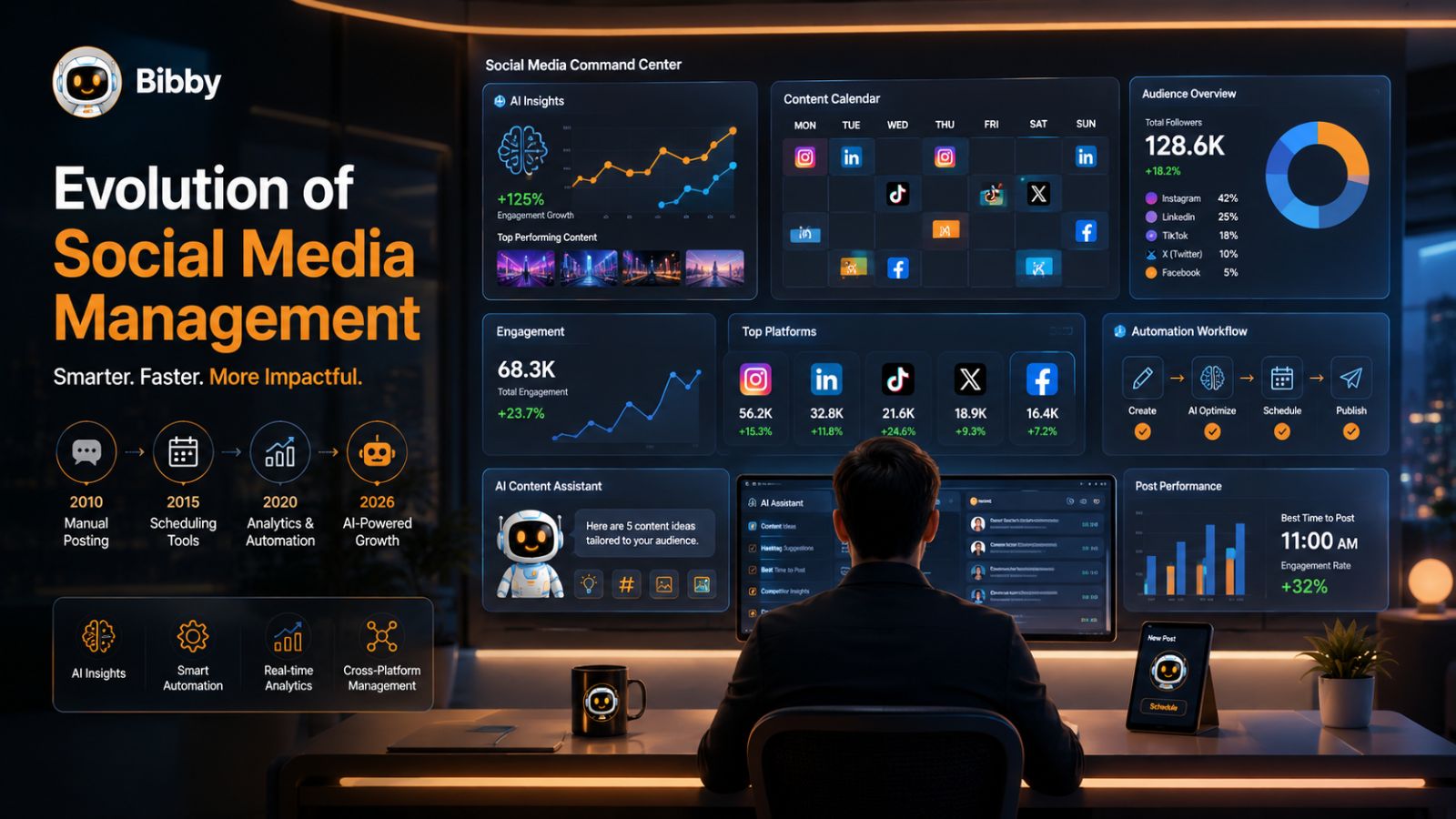
Today's brands are expected to maintain active profiles across multiple platforms, including Facebook, Instagram, LinkedIn, TikTok, and YouTube. At the same time, audiences consume content in various formats such as posts, stories, reels, shorts, carousels, and long-form videos. Managing all of these channels manually can quickly become overwhelming, especially for small businesses and creators with limited resources.
Adding to the challenge, social media algorithms now prioritize consistent activity and audience engagement. Brands that post irregularly often struggle to maintain visibility, while those that publish consistently are more likely to stay in front of their audience. This shift has made strategic content planning more important than ever.
Artificial intelligence has also transformed how businesses approach social media. Modern AI tools can help generate content ideas, write captions, identify the best publishing times, analyze performance data, and automate repetitive tasks. Instead of spending hours every day managing social media accounts, marketers can now focus more on strategy, creativity, and audience relationships.
As a result, the debate between scheduled posts and manual posting has become increasingly relevant. While automation offers efficiency and scalability, real-time posting still provides opportunities for authentic engagement and timely communication. Understanding the strengths and weaknesses of each approach is essential for building an effective social media strategy in 2026.
What Are Scheduled Posts?
Scheduled posts are social media posts that are created in advance and automatically published at a specific date and time. Instead of logging into each platform every day to post content manually, marketers can plan weeks or even months of content ahead of time and let scheduling software handle the publishing process.
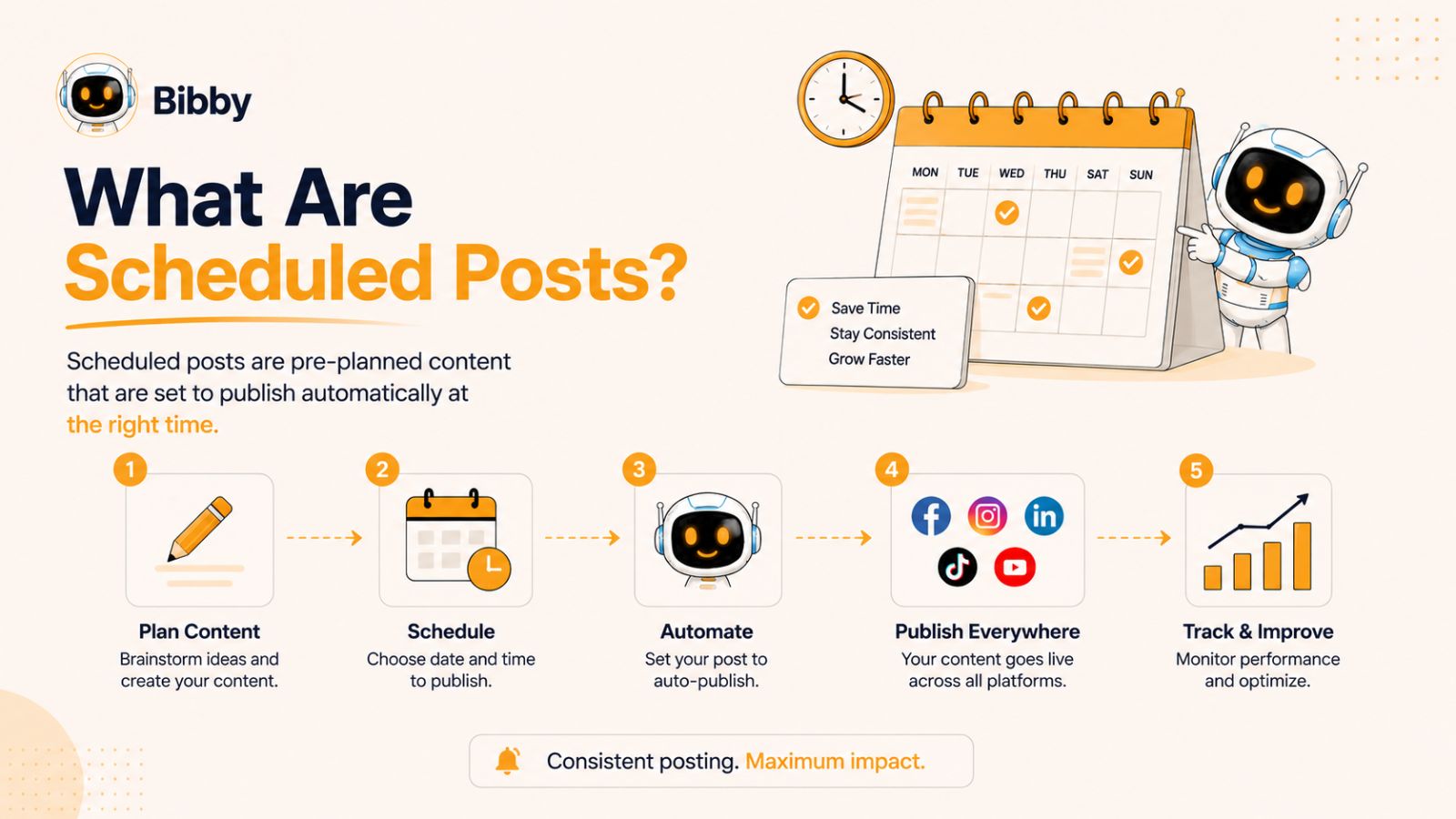
Over the years, social media scheduling has evolved from a simple convenience feature into a critical component of modern marketing strategies. In 2026, businesses of all sizes use scheduling tools to maintain consistency, improve efficiency, and maximize engagement across multiple platforms.
Benefits of Scheduled Posting
Consistent Publishing
One of the biggest advantages of scheduled posts is consistency. Social media algorithms generally reward accounts that publish content regularly, making it easier to maintain visibility and audience engagement.
By scheduling content in advance, businesses can ensure that their profiles remain active even during weekends, holidays, vacations, or busy work periods. This helps create a reliable posting rhythm that audiences and algorithms both appreciate.
Significant Time Savings
Creating content in batches can dramatically reduce the time spent managing social media. Rather than interrupting the workday to publish individual posts, marketers can dedicate a few hours each week or month to planning and scheduling their content.
This approach allows businesses to focus more on growth, customer relationships, and content quality instead of repetitive publishing tasks.
Better Team Collaboration
For organizations with multiple stakeholders, scheduled posting simplifies content approval and collaboration. Marketing teams can review campaigns, make edits, and obtain approvals before content goes live.
This reduces the risk of mistakes and helps ensure that all messaging aligns with brand guidelines and campaign objectives.
Optimized Publishing Times
One of the most powerful advantages of scheduling is the ability to publish content when audiences are most active.
Modern scheduling platforms use audience behavior data and engagement patterns to identify high-performing posting windows. Instead of guessing when to post, businesses can strategically schedule content for maximum visibility and reach.
For brands managing multiple social media channels, this capability can significantly improve performance without requiring constant monitoring.
As social media becomes more competitive, scheduled posting has become less of a convenience and more of a necessity for businesses that want to maintain a consistent and scalable online presence.
What Is Manual Posting?
Manual posting is the process of creating and publishing social media content in real time. Instead of scheduling content in advance, marketers, business owners, or creators log into their social media accounts and publish posts manually whenever they choose.
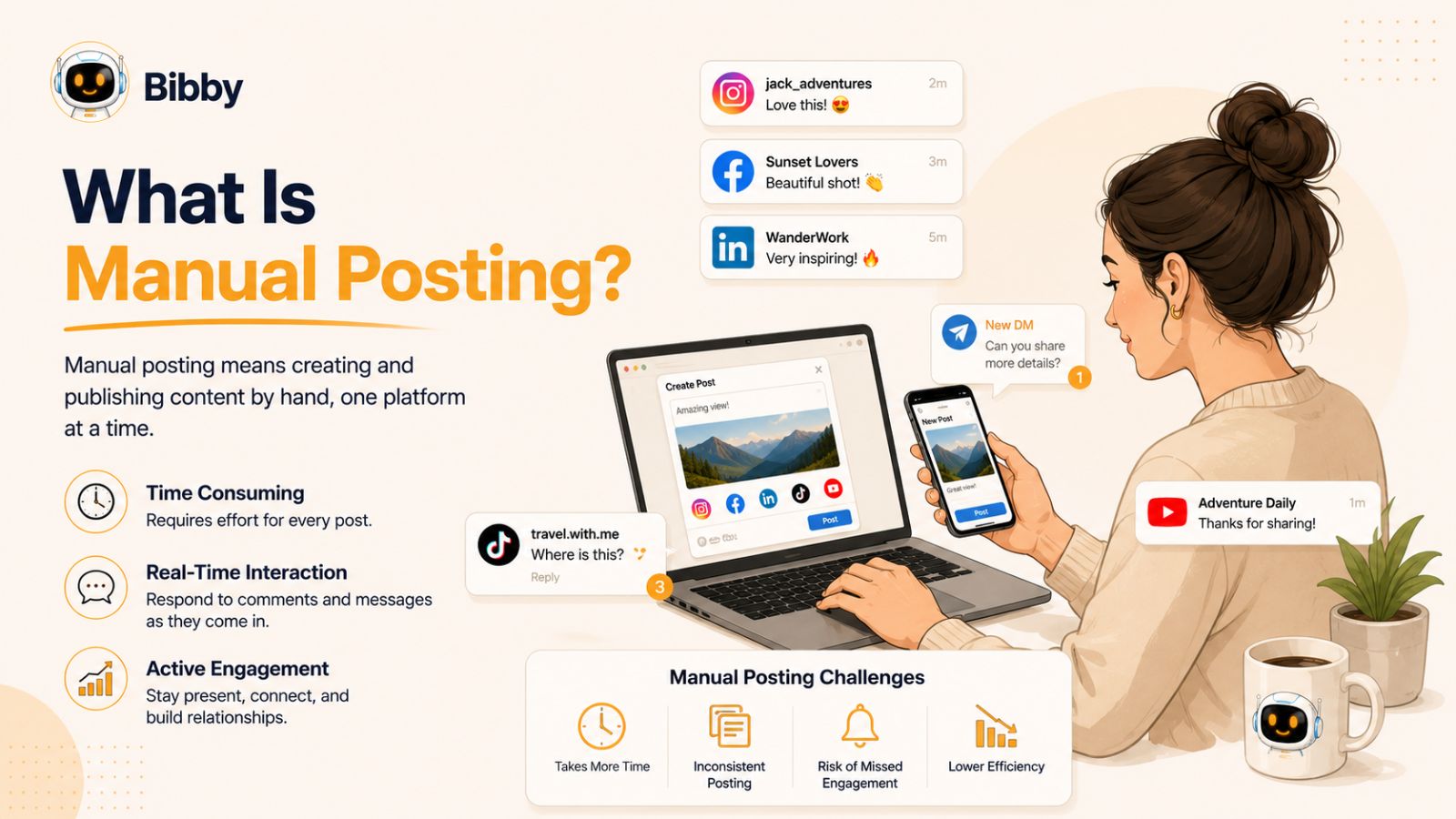
Before social media scheduling tools became popular, manual posting was the standard approach used by nearly every brand. Even in 2026, many businesses still rely on manual posting for specific situations where timing, authenticity, and direct audience interaction are essential.
While manual posting requires more day-to-day effort, it offers flexibility that automated scheduling cannot always replicate.
Benefits of Manual Posting
Real-Time Engagement
One of the biggest strengths of manual posting is the ability to engage with audiences immediately.
When content is published manually, businesses can actively monitor reactions, respond to comments, answer questions, and participate in conversations as they happen. This creates a more personal experience and helps strengthen relationships with followers.
For brands focused on community building, real-time interaction can be a major advantage.
Trend Participation
Social media trends can emerge and disappear within hours. Viral challenges, breaking industry news, cultural moments, and trending discussions often reward brands that respond quickly.
Manual posting allows businesses to join these conversations at the right moment rather than relying on pre-planned content calendars. This flexibility can increase visibility and help brands remain relevant in fast-moving industries.
Authentic Brand Presence
Audiences increasingly value authenticity. While scheduled content helps maintain consistency, manual posting can make a brand feel more human and responsive.
Sharing behind-the-scenes updates, reacting to current events, celebrating company milestones, or responding to customer achievements can create stronger emotional connections with followers.
These spontaneous interactions often generate higher engagement because they feel genuine and timely.
The Limitations of Manual Posting
Despite its advantages, manual posting comes with significant challenges. It requires ongoing attention, can be difficult to scale across multiple platforms, and often leads to inconsistent publishing schedules.
As businesses expand their social media presence across Facebook, Instagram, LinkedIn, TikTok, YouTube, and other channels, managing everything manually becomes increasingly time-consuming. This is why many marketers now combine manual posting with scheduling tools to achieve both consistency and flexibility.
The key question is not whether manual posting works—it clearly does. The real question is whether it can compete with the efficiency and scalability of modern scheduling solutions. To answer that, let's compare scheduled posts and manual posting side by side.
Scheduled Posts vs Manual Posting: Head-to-Head Comparison
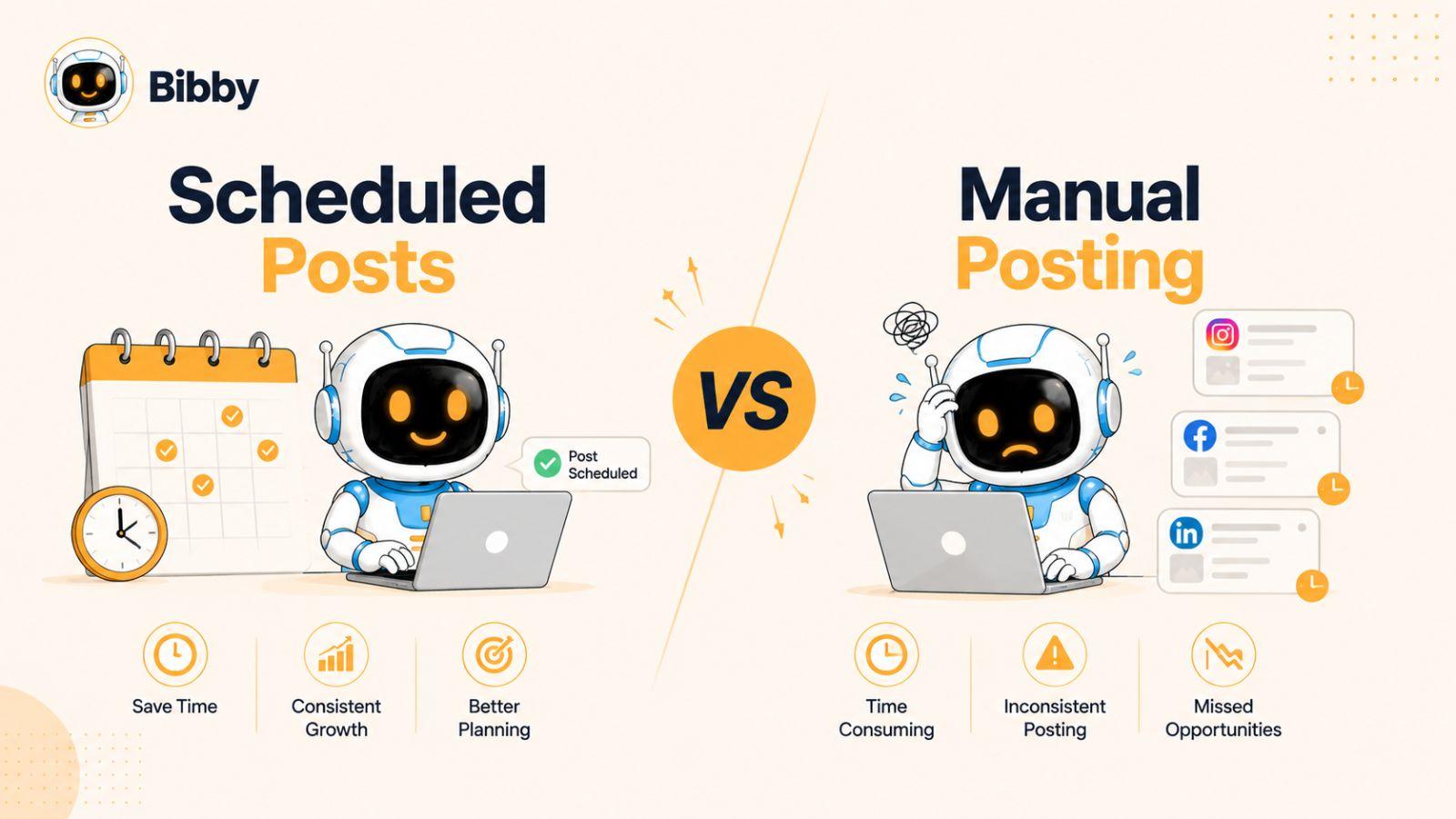
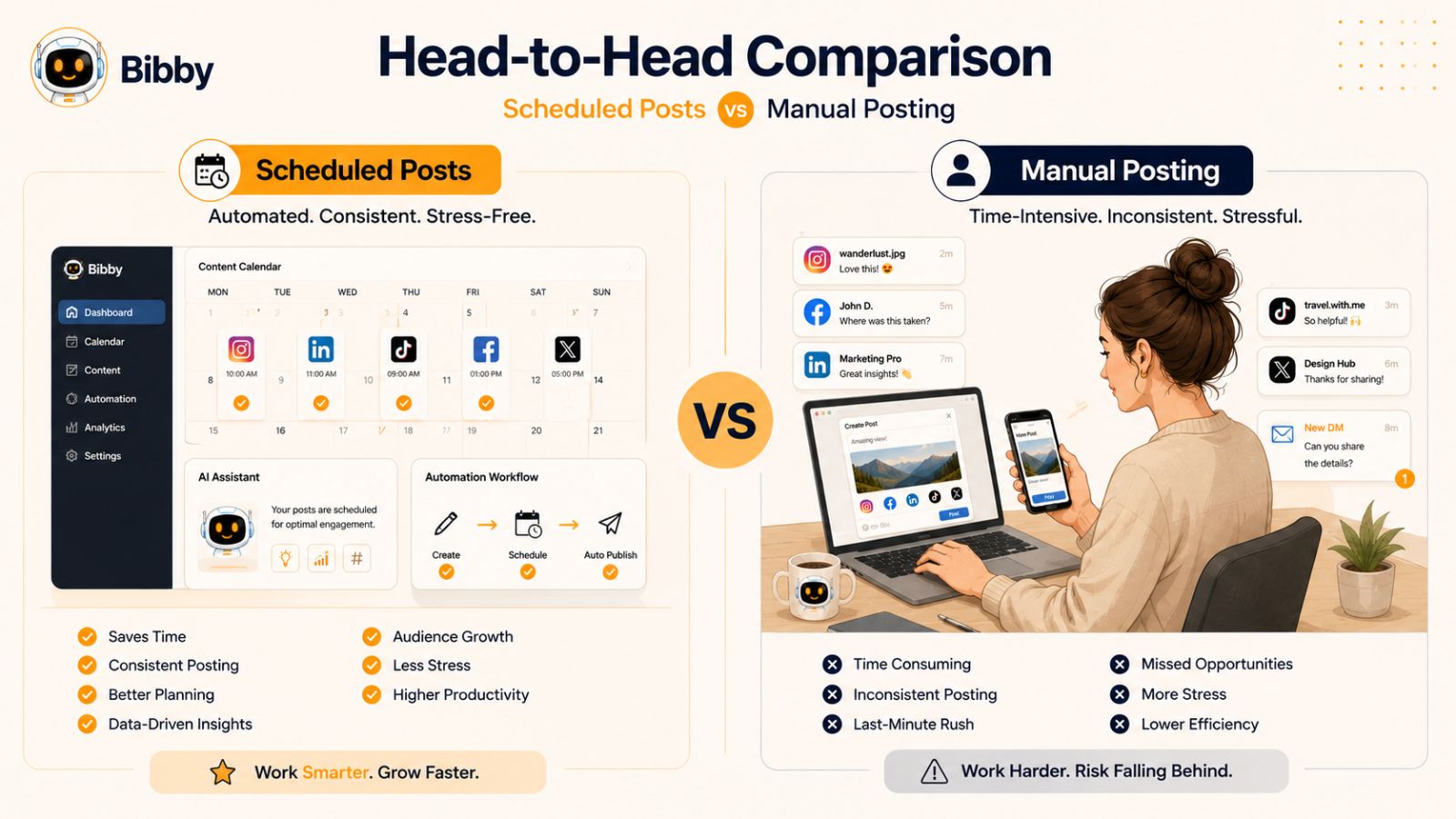
When comparing scheduled posts vs manual posting, there is no universal winner. The best approach depends on your goals, available resources, content strategy, and the number of platforms you manage. However, understanding how each method performs across key areas can help you determine which approach is most effective for your business.
Time Efficiency
Scheduled Posting
Scheduled posting is the clear winner when it comes to saving time. Content can be planned, created, and scheduled in batches, allowing marketers to manage weeks or even months of content in a single session.
This reduces daily workload and eliminates the need to log into multiple social media platforms every day. Businesses can focus more on strategy, customer engagement, and content creation rather than repetitive publishing tasks.
Manual Posting
Manual posting requires a continuous time investment. Every post must be created, reviewed, and published individually.
While this approach offers greater flexibility, it can quickly become overwhelming for businesses managing multiple accounts or posting several times per day.
Winner: Scheduled Posting
Consistency
Scheduled Posting
Consistency is one of the primary reasons businesses use scheduling tools. Content calendars help ensure a steady flow of posts regardless of vacations, holidays, meetings, or unexpected disruptions.
Regular posting also supports algorithm performance and helps maintain audience engagement over time.
Manual Posting
Manual posting often depends on availability and discipline. Busy schedules, unexpected priorities, or simple forgetfulness can lead to inconsistent publishing.
Over time, these gaps can negatively impact reach and audience growth.
Winner: Scheduled Posting
Engagement
Scheduled Posting
Scheduled content keeps audiences engaged through consistent communication. However, because posts are often prepared in advance, they may not always align with current conversations or trending topics.
Engagement can still be strong, but it may lack the immediacy of real-time interactions.
Manual Posting
Manual posting excels when immediate engagement is important. Brands can respond to trends, join conversations, and interact with audiences in real time.
This flexibility often creates stronger community relationships and can generate higher engagement during timely events.
Winner: Manual Posting
Scalability
Scheduled Posting
As businesses expand to multiple platforms, scheduling becomes increasingly valuable. A single piece of content can be adapted and distributed across Facebook, Instagram, LinkedIn, TikTok, and YouTube without requiring separate manual actions for each platform.
This makes growth far more manageable.
Manual Posting
Managing multiple channels manually becomes difficult as content volume increases. The more platforms you add, the more time and effort are required to maintain consistency.
For growing businesses, this approach often becomes unsustainable.
Winner: Scheduled Posting
Performance Optimization
Scheduled Posting
Modern scheduling tools use data and artificial intelligence to identify optimal publishing times. Rather than relying on guesswork, businesses can schedule content when their audience is most likely to engage.
This can lead to improved reach, impressions, and engagement rates.
Manual Posting
Manual posting often relies on availability rather than strategy. While experienced marketers may understand audience behavior, consistently posting at ideal times can be difficult without automation.
Winner: Scheduled Posting
Authenticity and Flexibility
Scheduled Posting
Pre-planned content provides structure, but it may not always reflect current events, industry developments, or trending conversations.
Without regular monitoring, scheduled posts can occasionally feel disconnected from what's happening in real time.
Manual Posting
Manual posting gives brands complete control over timing and messaging. Content can be adjusted instantly based on audience reactions, breaking news, or emerging trends.
This flexibility helps brands appear more authentic and responsive.
Winner: Manual Posting
Overall Verdict
If the goal is efficiency, consistency, scalability, and long-term growth, scheduled posting has a significant advantage. Businesses managing multiple platforms simply cannot maintain the same level of productivity through manual posting alone.
However, manual posting remains valuable for community engagement, trend participation, and real-time interactions that help humanize a brand.
This is why the most successful social media strategies in 2026 don't rely exclusively on either method. Instead, they combine the strengths of both approaches while using modern automation tools to eliminate unnecessary manual work.
The Biggest Challenges of Scheduled Posting
While scheduled posting offers significant advantages in terms of efficiency and consistency, it is not without its challenges. Understanding these limitations is important for creating a balanced social media strategy and avoiding common automation mistakes.
The good news is that most of these challenges can be minimized with proper planning, active monitoring, and the right scheduling platform.
Lack of Real-Time Context
One of the most common criticisms of scheduled posting is that content is planned in advance and may not reflect what's happening in the moment.
Social media moves quickly. Industry news, viral trends, cultural events, and unexpected developments can change the conversation overnight. A post that seemed relevant when it was scheduled may feel outdated or disconnected by the time it is published.
This is why successful marketers regularly review their content calendars and make adjustments when necessary.
Over-Automation Risks
Automation is designed to save time, but excessive automation can make a brand appear robotic.
When every post follows the same format or tone, audiences may begin to feel that there is no real person behind the account. Social media users still value authenticity, personality, and genuine interactions.
Scheduling should automate repetitive tasks, not replace meaningful engagement. The most effective brands use automation to handle publishing while continuing to interact with their communities manually.
Content Performance Variability
Not every scheduled post will perform as expected.
Audience behavior changes over time, and content that seems promising during planning may not resonate when it goes live. Engagement levels can vary due to competition, platform algorithm updates, seasonal trends, or shifts in audience interests.
Because of this, scheduling should never be a "set it and forget it" process. Regular performance reviews are essential for identifying what works and improving future content.
Platform-Specific Limitations
Different social media platforms have unique requirements, content formats, and audience expectations.
A post that performs well on LinkedIn may not generate the same results on Instagram or TikTok. Businesses that simply duplicate content across every platform often miss opportunities to optimize their messaging.
Modern scheduling tools help solve this challenge by allowing marketers to customize content for each platform while managing everything from a single dashboard.
Why These Challenges Are Becoming Less Important in 2026
Many of the traditional weaknesses of scheduled posting are being addressed through artificial intelligence and smarter automation tools.
Today's advanced platforms can recommend posting times, generate platform-specific captions, analyze engagement data, and help marketers adjust their strategies based on real-world performance. Instead of relying on static schedules, businesses can now use intelligent automation that continuously improves results.
As scheduling technology continues to evolve, the gap between automated publishing and real-time optimization is becoming smaller than ever.
Of course, scheduled posting isn't the only approach with limitations. Manual posting comes with its own set of challenges—many of which become even more difficult as businesses scale their social media presence.
The Biggest Challenges of Manual Posting
Although manual posting offers flexibility and real-time engagement, it also presents several challenges that can limit growth and efficiency. As social media becomes more demanding and businesses expand their presence across multiple platforms, these challenges become increasingly difficult to manage.
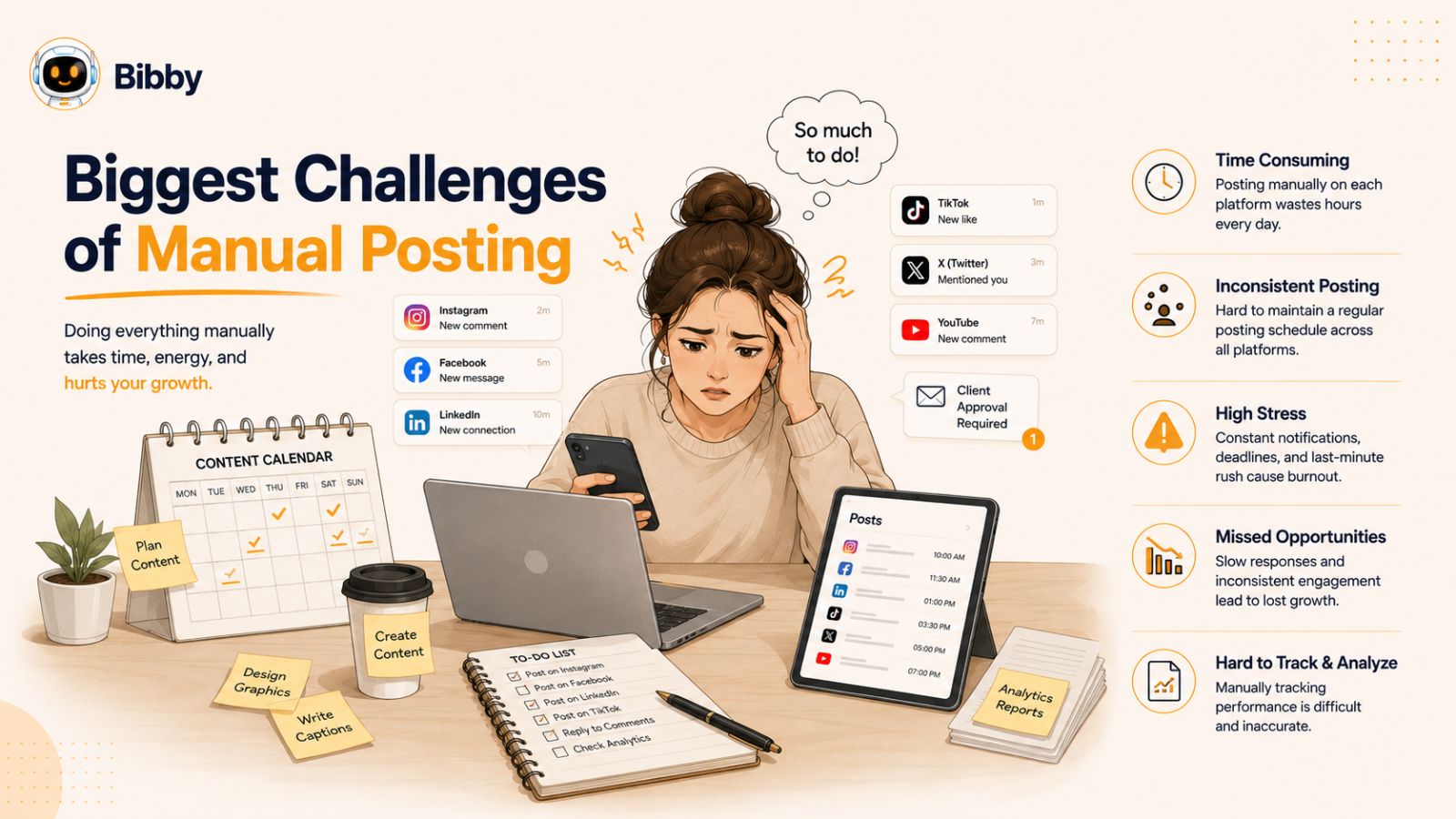
For many brands, manual posting works well in the early stages. However, maintaining that approach over the long term often becomes unsustainable.
Time Consumption
The most obvious drawback of manual posting is the amount of time it requires.
Every post must be created, reviewed, uploaded, formatted, and published individually. When managing accounts across Facebook, Instagram, LinkedIn, TikTok, and YouTube, these tasks quickly add up.
What starts as a few minutes per day can eventually become several hours each week. For business owners, creators, and marketing teams, that time could often be better spent on strategy, customer relationships, product development, or content creation.
Inconsistent Posting Schedules
Consistency is one of the most important factors in social media success, yet it is one of the hardest things to maintain with manual posting.
Busy workdays, meetings, vacations, unexpected emergencies, and shifting priorities can all disrupt publishing schedules. Missing posting opportunities may reduce visibility, weaken audience engagement, and slow overall growth.
Without a structured system in place, maintaining a consistent content calendar becomes challenging.
Difficulty Managing Multiple Platforms
Modern social media marketing rarely focuses on a single platform.
Businesses often need to publish content on Facebook, Instagram, LinkedIn, TikTok, YouTube, and additional channels to maximize reach. Managing each platform manually requires separate logins, content adjustments, publishing actions, and monitoring.
As the number of platforms grows, so does the complexity of managing them effectively.
Missed Optimal Posting Times
Every audience has specific times when they are most active online.
Unfortunately, those ideal posting windows do not always align with a marketer's schedule. If your audience is most active while you're asleep, attending meetings, or focused on other responsibilities, manually publishing content at the perfect moment becomes difficult.
This can lead to missed engagement opportunities and lower overall performance.
Limited Scalability
Manual posting may work for a single account or a small content volume, but scaling becomes increasingly difficult.
As businesses grow, content requirements expand. More platforms, more campaigns, more formats, and more audience segments all require additional effort. Without automation, the workload often increases faster than the team's capacity to manage it.
This is one of the primary reasons why growing brands eventually adopt scheduling and automation solutions.
The Reality of Social Media in 2026
The challenge isn't that manual posting is ineffective—it can be highly effective when used strategically. The problem is that it demands significant time, attention, and resources.
Most businesses simply cannot afford to spend hours every day publishing content manually across multiple channels. They need systems that allow them to maintain consistency, optimize performance, and scale efficiently without sacrificing quality.
This growing demand for efficiency has fueled the rise of AI-powered social media management tools. Instead of forcing marketers to choose between automation and engagement, modern platforms are helping them achieve both.
That's exactly why AI scheduling and automation tools have become one of the biggest trends in social media marketing in 2026.
Why AI Scheduling Tools Are Dominating in 2026
The social media landscape has become too complex for most businesses to manage manually. With multiple platforms, increasing content demands, changing algorithms, and growing competition for attention, marketers need solutions that help them work smarter rather than harder.
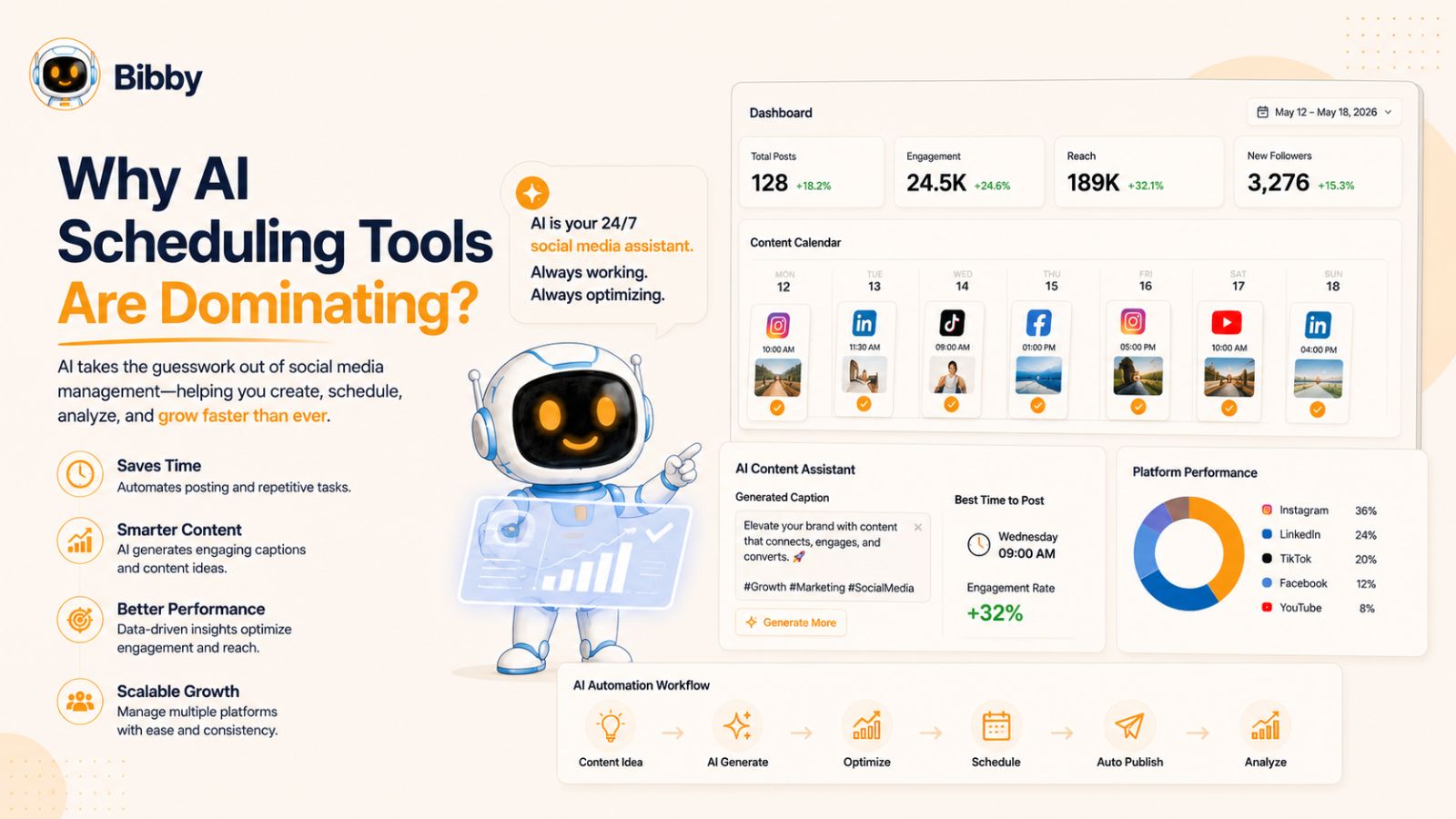
This is why AI-powered scheduling tools have rapidly become an essential part of modern social media management. Instead of simply automating publishing, today's platforms use artificial intelligence to help businesses create content, optimize performance, and scale their marketing efforts more efficiently.
The Shift From Basic Scheduling to Intelligent Automation
Traditional scheduling tools were designed primarily to publish content at a future date and time. While helpful, they still required significant manual effort for content creation, planning, optimization, and analysis.
In 2026, AI-powered platforms go much further.
Modern social media tools can assist with content generation, caption writing, publishing recommendations, audience analysis, and performance tracking. Rather than acting as simple scheduling software, they function as intelligent marketing assistants that help businesses achieve better results with less effort.
This shift has transformed social media management from a labor-intensive process into a streamlined workflow.
AI-Powered Caption Generation
Creating engaging captions across multiple platforms can be surprisingly time-consuming.
AI scheduling tools can now generate platform-specific captions based on the content being shared. Instead of writing separate captions for Facebook, Instagram, LinkedIn, TikTok, and YouTube, marketers can generate optimized copy in seconds.
This not only saves time but also helps maintain consistency in brand messaging.
Smarter Publishing Times
One of the biggest advantages of artificial intelligence is its ability to analyze large amounts of data.
Rather than relying on generic best-practice posting times, AI tools can evaluate audience behavior, engagement patterns, and historical performance data to determine when content is most likely to succeed.
This allows businesses to schedule posts at times that maximize visibility, engagement, and reach.
Automated Content Distribution
Managing content across multiple platforms has traditionally required repetitive work.
AI scheduling tools simplify this process by allowing users to create content once and distribute it across several channels from a single dashboard. Content can be customized for each platform while maintaining a centralized workflow.
This significantly reduces the administrative burden of social media management.
Performance Analytics and Continuous Optimization
Publishing content is only one part of a successful social media strategy.
AI-powered platforms also provide detailed analytics that help businesses understand what's working and what isn't. By tracking engagement, reach, clicks, conversions, and audience behavior, marketers can make informed decisions about future content.
Over time, these insights help improve performance and maximize return on investment.
Why Businesses Are Adopting AI Faster Than Ever
The biggest reason for the rapid adoption of AI scheduling tools is simple: they save time while improving results.
Businesses no longer want separate tools for content creation, scheduling, publishing, and analytics. They want a single platform that handles the entire workflow efficiently.
As social media continues to evolve, AI-powered automation is becoming less of a competitive advantage and more of a necessity. Brands that embrace intelligent automation can maintain consistency, scale their efforts, and focus more on strategy and creativity instead of repetitive manual tasks.
Among the newest generation of AI-powered social media platforms, some tools are taking automation even further by combining content creation, caption generation, scheduling, publishing, and analytics into one streamlined workflow. One platform that stands out in this category is Bibby.
Bibby: The Smartest Social Media Scheduling and Automation Tool in 2026
As businesses and creators look for ways to simplify social media management, many are turning to platforms that combine content creation, scheduling, publishing, and analytics in a single workflow. Among the latest generation of AI-powered social media tools, Bibby stands out by making the entire process remarkably simple and efficient.
Instead of juggling multiple applications for content creation, scheduling, and performance tracking, Bibby brings everything together in one platform, allowing users to manage their social media presence with minimal effort.
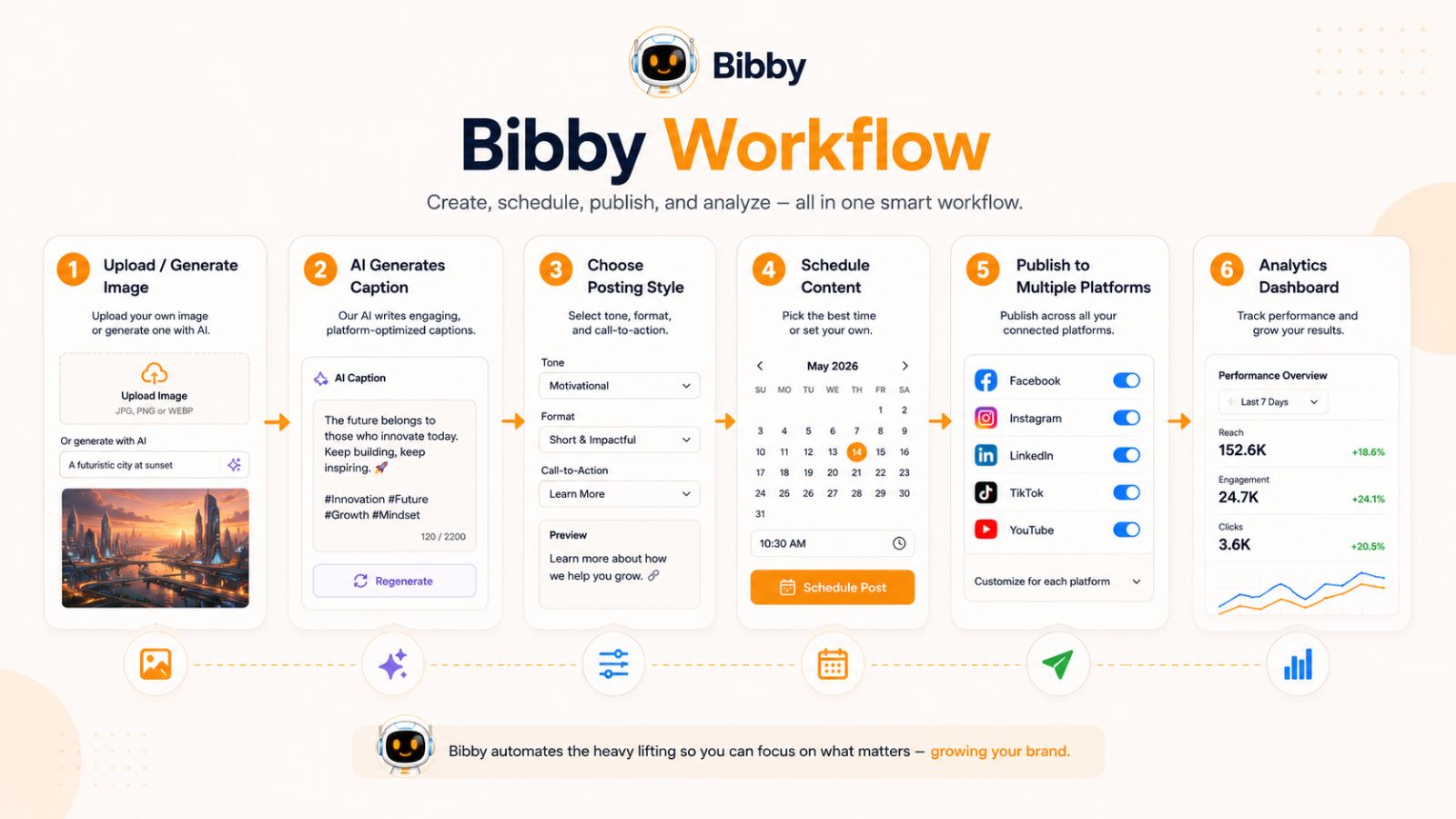
How Bibby Works
One of Bibby's biggest advantages is its straightforward workflow. The platform is designed to help users go from content creation to publishing in just a few steps.
Step 1: Upload or Generate Your Content
Users can either upload their own images and videos or generate visuals using AI directly within the platform.
This flexibility makes it easy for businesses, creators, and marketers to produce content consistently without needing additional design tools.
Step 2: Choose Your Posting Style
After selecting the media, users can choose their preferred posting style and brand voice.
Whether the goal is professional, educational, promotional, entertaining, or conversational content, Bibby helps tailor the messaging to match the intended audience.
Step 3: Let AI Generate Captions Automatically
Writing captions for multiple social media platforms can be one of the most time-consuming parts of content creation.
Bibby's AI automatically generates captions based on the uploaded content and selected posting style. This dramatically reduces content creation time while helping maintain consistency across platforms.
Step 4: Schedule Content at AI-Optimized Times
Instead of manually deciding when to publish, Bibby uses artificial intelligence to identify optimal posting times.
The platform automatically schedules content across different dates and publishing windows designed to maximize visibility and engagement.
This helps users reach their audience when they are most active without needing to monitor social media constantly.
Step 5: Publish Across Multiple Platforms
Once everything is scheduled, Bibby can distribute content across multiple social media channels from a single dashboard.
Supported platforms include:
- TikTok
- YouTube
This centralized workflow eliminates the need to publish separately on each platform.
More Than Just Post Scheduling
Bibby goes beyond traditional scheduling by supporting a variety of content formats.
Users can manage:
- Standard social media posts
- Videos
- Stories
- Short-form content
- Multi-platform campaigns
This allows businesses to maintain a comprehensive social media strategy without switching between different tools.
Built-In Analytics and Performance Tracking
Creating and publishing content is only part of the equation.
Bibby also provides analytics that help users understand how their content is performing across platforms. Engagement metrics, audience behavior, and performance insights make it easier to identify successful strategies and improve future campaigns.
Instead of relying on guesswork, users can make decisions based on real data.
Why Bibby Fits the Future of Social Media Management
The biggest challenge facing marketers in 2026 is balancing consistency with efficiency. Businesses need to publish regularly, engage audiences, create fresh content, and analyze performance—all while managing limited time and resources.
Bibby addresses these challenges by combining AI-powered content creation, automated caption generation, intelligent scheduling, multi-platform publishing, and analytics into a single streamlined workflow.
For businesses, creators, agencies, and personal brands looking to reduce manual work while maintaining a strong social media presence, Bibby represents the direction social media management is heading: smarter automation, better optimization, and significantly less effort.
Of course, even with powerful automation tools, there are situations where manual posting still plays an important role. The key is understanding when scheduling provides the greatest advantage and when real-time publishing is worth the extra effort.
When Scheduled Posting Is the Better Choice
While both scheduling and manual posting have their place in a successful social media strategy, there are many situations where scheduled posting is the clear winner. For businesses focused on growth, efficiency, and consistency, automation often delivers significant advantages that manual workflows simply cannot match.
As social media channels continue to demand more content across more formats, scheduled posting has become the preferred approach for many organizations.
Best for Businesses
Businesses need consistency to build brand awareness and maintain audience engagement.
Whether promoting products, sharing educational content, announcing updates, or running marketing campaigns, scheduled posting ensures that content is published regularly without requiring constant attention from the team.
A well-planned content calendar allows businesses to stay active even during busy periods, helping maintain momentum and visibility throughout the year.
Best for Marketing Campaigns
Successful campaigns often require multiple posts spread across several days or weeks.
Launching products, promoting events, running seasonal promotions, or supporting lead generation campaigns becomes far easier when content is planned and scheduled in advance.
Scheduling helps ensure that every piece of content is delivered at the right time and in the correct sequence, reducing the risk of missed opportunities or inconsistent messaging.
Best for Agencies Managing Multiple Clients
For agencies, efficiency is essential.
Managing social media accounts for multiple clients manually can quickly become overwhelming. Scheduled posting allows teams to organize content, streamline approvals, and maintain consistent publishing schedules across dozens of accounts.
Instead of spending time publishing posts individually, agency teams can focus on strategy, optimization, and client communication.
Best for Content Creators
Content creators often produce large volumes of content across multiple platforms.
Scheduling allows creators to batch-produce content, plan future posts, and maintain consistent activity even when they're focused on filming, editing, traveling, or working on other projects.
This approach reduces stress while ensuring followers continue receiving regular content.
Best for Multi-Platform Publishing
Modern social media strategies rarely depend on a single platform.
Businesses typically publish content across Facebook, Instagram, LinkedIn, TikTok, and YouTube simultaneously. Managing this process manually requires significant time and coordination.
Scheduling platforms simplify multi-platform distribution, allowing users to manage everything from one dashboard while maintaining platform-specific optimizations.
Best for Reaching Audiences at Optimal Times
Audience activity varies by platform, industry, and geographic location.
Many businesses struggle to publish consistently during high-engagement periods because those times may fall outside normal working hours. Scheduling solves this problem by ensuring content is published exactly when audiences are most likely to engage.
When combined with AI-powered optimization tools, scheduling can help maximize reach without requiring marketers to be online around the clock.
Why More Brands Are Choosing Scheduling First
The biggest advantage of scheduled posting is that it creates a predictable, scalable system for social media growth.
Instead of relying on memory, availability, or daily motivation, businesses can build structured workflows that support long-term consistency and efficiency. This allows teams to focus on creating better content rather than worrying about whether content gets published on time.
However, scheduled posting is not the answer to every situation. Certain types of content perform best when published in real time, and some opportunities simply cannot be planned in advance.
That's where manual posting continues to provide unique value.
When Manual Posting Is Still Valuable
Despite the rise of automation and AI-powered scheduling tools, manual posting remains an important part of a successful social media strategy. Some situations require immediate action, authentic interaction, and flexibility that simply cannot be fully automated.
The most effective brands in 2026 understand that while scheduling handles consistency, manual posting helps maintain a human connection with their audience.
Live Events and Real-Time Updates
Certain moments are impossible to predict weeks in advance.
Industry conferences, webinars, product launches, company events, live streams, and behind-the-scenes moments often generate the most engagement when shared in real time. Audiences enjoy experiencing events as they happen, making manual posting the preferred choice for live content.
Real-time updates also create a sense of authenticity and immediacy that scheduled content cannot always replicate.
Breaking News and Industry Developments
Social media moves fast, and opportunities can appear without warning.
When important industry news breaks or a major trend emerges, brands that respond quickly often benefit from increased visibility and engagement. Waiting for the next scheduled post may mean missing the conversation entirely.
Manual posting allows businesses to react instantly and position themselves as active participants within their industry.
Trend Participation
Viral trends can generate significant reach when executed correctly.
Whether it's a popular hashtag, social media challenge, trending meme, or emerging conversation, brands often need to act quickly to remain relevant. These opportunities are difficult to schedule in advance because trends evolve rapidly.
Manual posting gives marketers the flexibility to capitalize on timely opportunities before they lose momentum.
Community Engagement and Relationship Building
Social media is not just about publishing content—it's also about building relationships.
Responding to comments, answering questions, acknowledging customer feedback, and participating in discussions all help strengthen audience loyalty. While scheduled posts can start conversations, genuine engagement typically happens in real time.
Brands that actively interact with their communities often develop stronger relationships and higher levels of trust.
Crisis Communication and Sensitive Situations
Not every situation is suitable for automation.
During industry controversies, public relations issues, unexpected events, or sensitive news cycles, businesses may need to pause scheduled content and communicate carefully.
Manual posting provides the flexibility and oversight necessary to ensure messaging remains appropriate and aligned with current circumstances.
The Human Element Still Matters
One of the biggest concerns about increasing automation is the potential loss of authenticity.
Audiences want to interact with real people, not just automated systems. While AI can help streamline workflows, human creativity, empathy, humor, and emotional intelligence remain valuable assets that technology cannot fully replace.
The brands that perform best on social media are often those that combine the efficiency of automation with genuine human interaction.
Scheduling and Manual Posting Are Not Opponents
Many marketers mistakenly view scheduled posting and manual posting as competing strategies. In reality, they serve different purposes.
Scheduled content provides consistency, efficiency, and scalability. Manual posting provides flexibility, authenticity, and real-time engagement.
Rather than choosing one over the other, the most successful businesses combine both approaches to create a balanced social media strategy.
This hybrid model has quickly become the preferred approach for brands looking to maximize results in 2026.
The Winning Strategy in 2026: Hybrid Posting
After comparing scheduled posts and manual posting, one conclusion becomes clear: the most effective social media strategies in 2026 don't rely exclusively on either approach.
Brands that depend entirely on manual posting often struggle with consistency and scalability. On the other hand, businesses that automate everything risk missing opportunities for authentic engagement and real-time interaction.
The solution is a hybrid posting strategy that combines the strengths of both methods.
Why the Best Brands Use Both
Successful businesses understand that different types of content serve different purposes.
Some content benefits from careful planning, optimization, and automation. Other content performs best when it is timely, spontaneous, and interactive.
By combining scheduled and manual posting, brands can maintain a consistent presence while still participating in important conversations and engaging directly with their audience.
This approach delivers the best of both worlds: efficiency and authenticity.
The Recommended 80/20 Framework
Many marketers are adopting an 80/20 content management model.
Under this framework:
- 80% of content is planned and scheduled in advance.
- 20% of content is published manually in response to real-time opportunities.
This balance allows businesses to maintain consistency without sacrificing flexibility.
Content That Should Be Scheduled
The majority of social media content can be created and scheduled ahead of time.
Examples include:
Educational Content
- How-to posts
- Tutorials
- Industry tips
- Thought leadership content
Promotional Content
- Product announcements
- Sales promotions
- Service highlights
- Lead generation campaigns
Evergreen Content
- Frequently asked questions
- Customer success stories
- Case studies
- Brand awareness content
Recurring Content Series
- Weekly tips
- Monthly updates
- Scheduled newsletters
- Content repurposing campaigns
These content types benefit from planning and are ideal candidates for automation.
Content That Should Be Posted Manually
Some content performs best when shared in real time.
Examples include:
Trending Topics
- Viral conversations
- Industry news
- Trending hashtags
- Cultural moments
Live Event Coverage
- Conferences
- Webinars
- Product launches
- Behind-the-scenes content
Community Engagement
- Comment responses
- Audience questions
- Customer interactions
- User-generated content
Crisis and Reputation Management
- Sensitive announcements
- Urgent updates
- Public responses
- Brand communications
These situations require flexibility and human judgment that cannot always be automated.
Where Bibby Fits Into the Hybrid Strategy
The biggest challenge with a hybrid approach is managing the scheduled portion efficiently.
This is where Bibby becomes especially valuable.
Businesses can upload or generate images and videos, select their preferred posting style, and allow Bibby's AI to generate captions automatically. The platform can then schedule content across Facebook, Instagram, LinkedIn, TikTok, and YouTube at AI-optimized times designed to maximize engagement.
Instead of spending hours manually planning and publishing routine content, marketers can automate the majority of their workflow while reserving time for real-time engagement and relationship building.
Bibby also provides analytics that help users measure performance and continuously improve their content strategy over time.
The Future Belongs to Smart Automation
The debate between scheduled posts and manual posting is gradually becoming less relevant because modern social media strategies no longer require businesses to choose one or the other.
AI-powered platforms make it possible to automate repetitive tasks while still leaving room for authentic human interaction.
In 2026, the brands achieving the best results are not necessarily posting more content. They're using smarter systems, better workflows, and intelligent automation to maximize efficiency while staying connected to their audiences.
As social media continues to evolve, the hybrid approach is likely to become the standard model for businesses, creators, and agencies alike.
Future Trends in Social Media Posting
Social media management continues to evolve at a rapid pace, and the tools, workflows, and strategies used today may look very different just a few years from now. As artificial intelligence becomes more advanced and platforms continue to prioritize personalization, businesses will need to adapt to remain competitive.
Understanding where social media is heading can help brands build strategies that remain effective well beyond 2026.
AI-Powered Content Creation Will Become Standard
Creating content is becoming faster and more accessible thanks to artificial intelligence.
AI tools are already capable of generating captions, content ideas, hashtags, images, videos, and content variations tailored for different platforms. In the coming years, businesses will increasingly rely on AI to accelerate content production while maintaining quality and consistency.
Rather than replacing human creativity, AI will act as a powerful assistant that helps marketers produce more content in less time.
Predictive Publishing Will Improve Results
Today's scheduling tools can recommend posting times based on historical performance data. Future platforms will go much further.
Advanced AI systems will continuously analyze audience behavior, engagement patterns, and platform trends to predict which content is most likely to perform well and when it should be published.
This shift from reactive analytics to predictive optimization could significantly improve engagement and reach.
Cross-Platform Automation Will Continue to Expand
Managing multiple social media channels individually is becoming increasingly inefficient.
Businesses are looking for unified platforms that can create, optimize, publish, and analyze content across Facebook, Instagram, LinkedIn, TikTok, YouTube, and future social networks from a single dashboard.
As a result, all-in-one social media management solutions will continue to gain popularity.
Greater Personalization at Scale
Audiences expect more relevant and personalized content than ever before.
Future social media tools will use AI to help brands tailor content for specific audience segments, locations, industries, and user behaviors. This level of personalization will allow businesses to deliver more relevant experiences without dramatically increasing their workload.
The combination of automation and personalization is expected to become one of the most powerful advantages in digital marketing.
Analytics Will Become More Actionable
Many businesses already have access to large amounts of social media data, but interpreting that information remains challenging.
The next generation of analytics tools will focus less on reporting metrics and more on providing actionable recommendations. Instead of simply showing performance data, platforms will suggest content improvements, identify growth opportunities, and recommend optimization strategies automatically.
This will help marketers make faster and more informed decisions.
The Growing Importance of Workflow Simplicity
As social media becomes more complex, simplicity is becoming increasingly valuable.
Businesses are actively seeking platforms that reduce the number of tools required to manage their social media operations. Rather than using separate applications for content creation, caption writing, scheduling, publishing, and analytics, many marketers prefer integrated solutions that streamline the entire process.
This trend is one of the reasons platforms like Bibby are attracting attention. By combining AI-powered content generation, automated scheduling, multi-platform publishing, and analytics into a single workflow, businesses can manage their social media more efficiently while reducing operational complexity.
What the Future Means for Marketers
The future of social media posting is not about choosing between automation and human creativity. It is about combining both in ways that maximize efficiency and performance.
Businesses that embrace intelligent automation will be better positioned to maintain consistency, scale their content efforts, and respond to changing audience expectations. At the same time, authentic engagement and human connection will remain essential for building trust and long-term relationships.
The brands that succeed in the years ahead will be those that use technology strategically—automating repetitive tasks while focusing their time and energy on creativity, community, and meaningful interactions.
Final Thoughts
The debate around scheduled posts vs manual posting isn't really about choosing one strategy over the other. In 2026, the most successful brands understand that both approaches serve an important purpose within a modern social media strategy.
Scheduled posting remains the best solution for maintaining consistency, saving time, and scaling content across multiple platforms. Manual posting continues to play a valuable role in real-time engagement, trend participation, community building, and authentic audience interactions. Together, they create a balanced approach that combines efficiency with flexibility.
The rise of AI-powered social media management platforms has made this hybrid strategy easier than ever to implement. Tools like Bibby help businesses automate content creation, caption generation, scheduling, multi-platform publishing, and analytics, allowing marketers to spend less time on repetitive tasks and more time engaging with their audiences.
As social media becomes increasingly competitive, the brands that succeed won't necessarily be the ones posting the most content. They'll be the ones using smarter workflows, better automation, and more strategic engagement to maximize their results.
If you're ready to take your social media strategy to the next level, the natural next step is learning how AI-powered social media automation can help you create more content, reach more people, and grow your brand with significantly less effort.