
Social media has evolved from a marketing channel into one of the most powerful tools for building a recognizable and trusted brand.
Many businesses assume that posting more content leads to growth, but high-growth companies take a different approach. Instead of chasing trends and viral moments, they focus on creating a consistent brand presence, building audience trust, and using systems that scale their efforts across multiple platforms.
In this article, you will learn:
- Why consistency outperforms occasional viral success
- How high-growth brands build trust and authority online
- How AI and automation streamline social media growth
The companies that win on social media today aren't necessarily creating more content—they're building smarter systems, stronger brand identities, and more meaningful relationships with their audiences. Let's explore exactly how they do it.
Why Brand Building Matters More Than Ever on Social Media
The social media landscape has changed dramatically over the past decade. In the early days, businesses could generate significant attention simply by posting frequently or running promotional campaigns. Today, consumers are exposed to thousands of marketing messages every day, making attention harder to earn and even harder to keep.
As competition increases across platforms like Facebook, Instagram, LinkedIn, TikTok, and YouTube, companies that focus solely on generating views or followers often struggle to create lasting business results. High-growth companies understand that social media is no longer just a distribution channel—it's a brand-building engine.
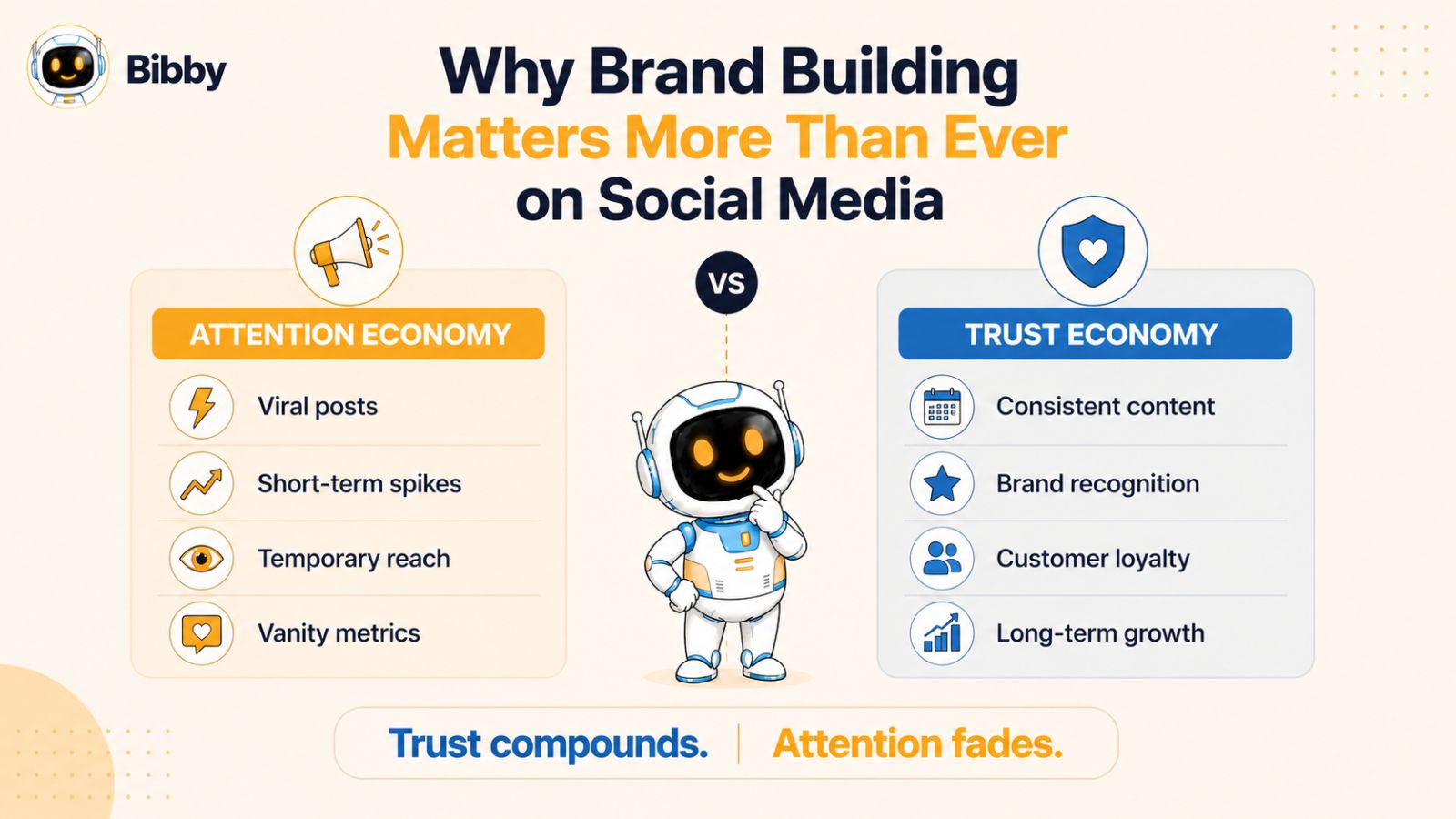
The Shift From the Attention Economy to the Trust Economy
For years, marketers competed for attention. The goal was simple: generate clicks, impressions, and reach. While attention remains important, modern consumers have become more selective about who they trust.
People research brands before purchasing. They read reviews, visit social profiles, watch videos, and evaluate how consistently a company communicates its message. Trust has become a major factor in buying decisions, especially in crowded markets where products and services often appear similar.
Strong social media branding helps businesses build credibility over time. Every post, video, story, and interaction contributes to how customers perceive a brand. Companies that consistently provide value are more likely to earn trust, loyalty, and long-term customer relationships.
Why Followers Don't Equal Brand Strength
One of the biggest misconceptions in social media marketing is that a large follower count automatically indicates a strong brand.
In reality, many accounts have hundreds of thousands of followers but struggle to generate meaningful engagement, leads, or revenue. Meanwhile, some smaller brands with highly engaged communities consistently outperform larger competitors.
Brand strength is measured by factors such as:
- Audience trust
- Customer loyalty
- Brand recognition
- Engagement quality
- Referral activity
- Repeat purchases
High-growth companies focus on building meaningful connections rather than accumulating vanity metrics. They understand that a smaller audience of highly engaged followers can be far more valuable than a large audience with little connection to the brand.
How Social Media Influences Modern Buying Decisions
Today's buyers rarely make purchasing decisions after seeing a single advertisement. Instead, they interact with brands multiple times before becoming customers.
A potential customer may:
- Discover a company through a LinkedIn post.
- Watch several videos on YouTube.
- Follow the brand on Instagram.
- Read customer testimonials.
- Visit the company website.
- Finally make a purchase weeks later.
This process highlights the importance of maintaining a consistent brand presence across all social platforms. Every interaction reinforces the company's credibility and helps move prospects closer to a buying decision.
Brands that show up consistently create familiarity. Familiarity creates trust, and trust often leads to conversions.
The Cost of Having No Clear Brand Identity
Many companies struggle on social media because they lack a clearly defined brand identity. Their content changes tone frequently, visuals are inconsistent, and messaging varies from one platform to another.
Without a cohesive brand strategy, businesses face several challenges:
- Lower audience recognition
- Reduced engagement rates
- Difficulty standing out from competitors
- Weak customer loyalty
- Inconsistent lead generation
A strong brand identity creates consistency across every customer touchpoint. It helps audiences instantly recognize your content regardless of where they encounter it.
This is one reason high-growth companies invest heavily in branding systems, content frameworks, and scalable publishing processes. They understand that successful social media branding is not about random posting—it's about creating a recognizable experience that audiences learn to trust over time.
As social media continues to evolve, the brands that thrive will be those that focus on building trust, authority, and consistency rather than simply chasing short-term attention. The next step is understanding exactly what high-growth companies do differently to achieve these results.
Also read: How to Automate Your Social Media Workflow from Creation to Posting
What High-Growth Companies Do Differently
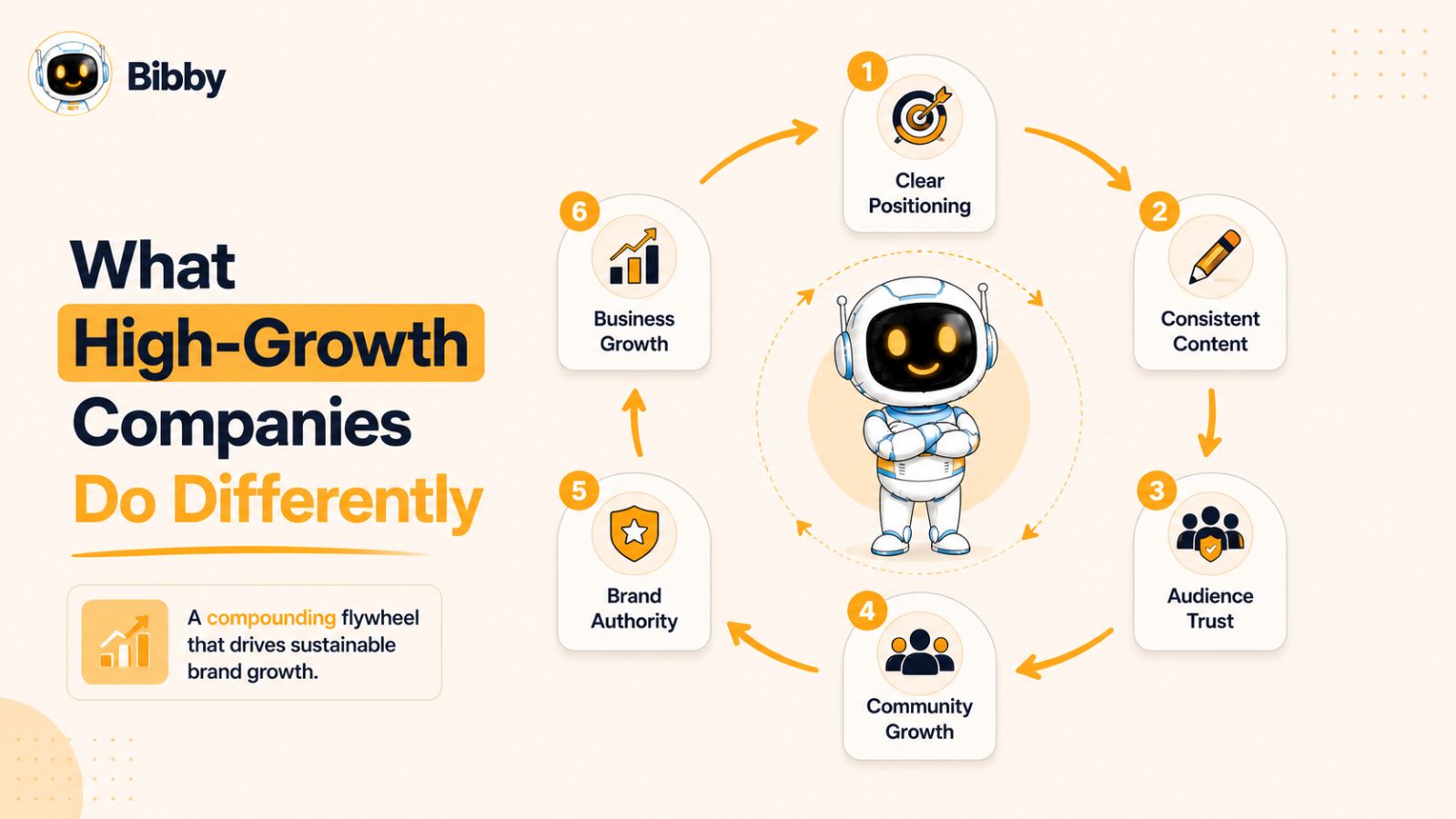
Many businesses use social media every day, yet only a small percentage successfully transform their social presence into a valuable brand asset. The difference isn't necessarily budget, team size, or posting frequency. More often, it's the strategy behind their content and the systems they use to execute it consistently.
High-growth companies approach social media differently. Rather than treating it as a channel for occasional promotions, they view it as a long-term investment in brand equity, customer trust, and market positioning.
Here are the key strategies that separate high-growth brands from everyone else.
They Lead With Clear Brand Positioning
One of the first things you'll notice about successful brands is that they know exactly who they are and what they stand for.
Their audience can immediately understand:
- What the company does
- Who it serves
- What makes it different
- Why customers should care
Strong positioning creates clarity. Every piece of content reinforces the same core message, making the brand easier to remember and recognize.
For example, some brands position themselves as innovators, while others emphasize affordability, expertise, customer service, or simplicity. Regardless of the angle, successful companies consistently communicate the same message across every platform.
When your positioning is unclear, your content becomes fragmented and forgettable. When your positioning is strong, every post contributes to a larger brand narrative.
They Prioritize Consistency Over Virality
Many businesses spend enormous amounts of time trying to create viral content. While viral posts can generate temporary attention, they rarely build sustainable brand growth on their own.
High-growth companies focus on consistency instead.
They understand that audiences develop trust through repeated exposure. The more frequently people encounter valuable, recognizable content, the stronger the brand association becomes.
Consistent brands benefit from:
- Higher audience recall
- Greater trust
- Improved engagement rates
- Increased referral activity
- Better long-term growth
A company that publishes valuable content three times per week for two years will typically outperform a company that produces a handful of viral posts and then disappears.
The goal isn't simply to be seen once. The goal is to become unforgettable.
They Build Content Pillars Instead of Posting Randomly
One of the most common mistakes businesses make is creating content without a structured strategy.
High-growth companies solve this problem through content pillars.
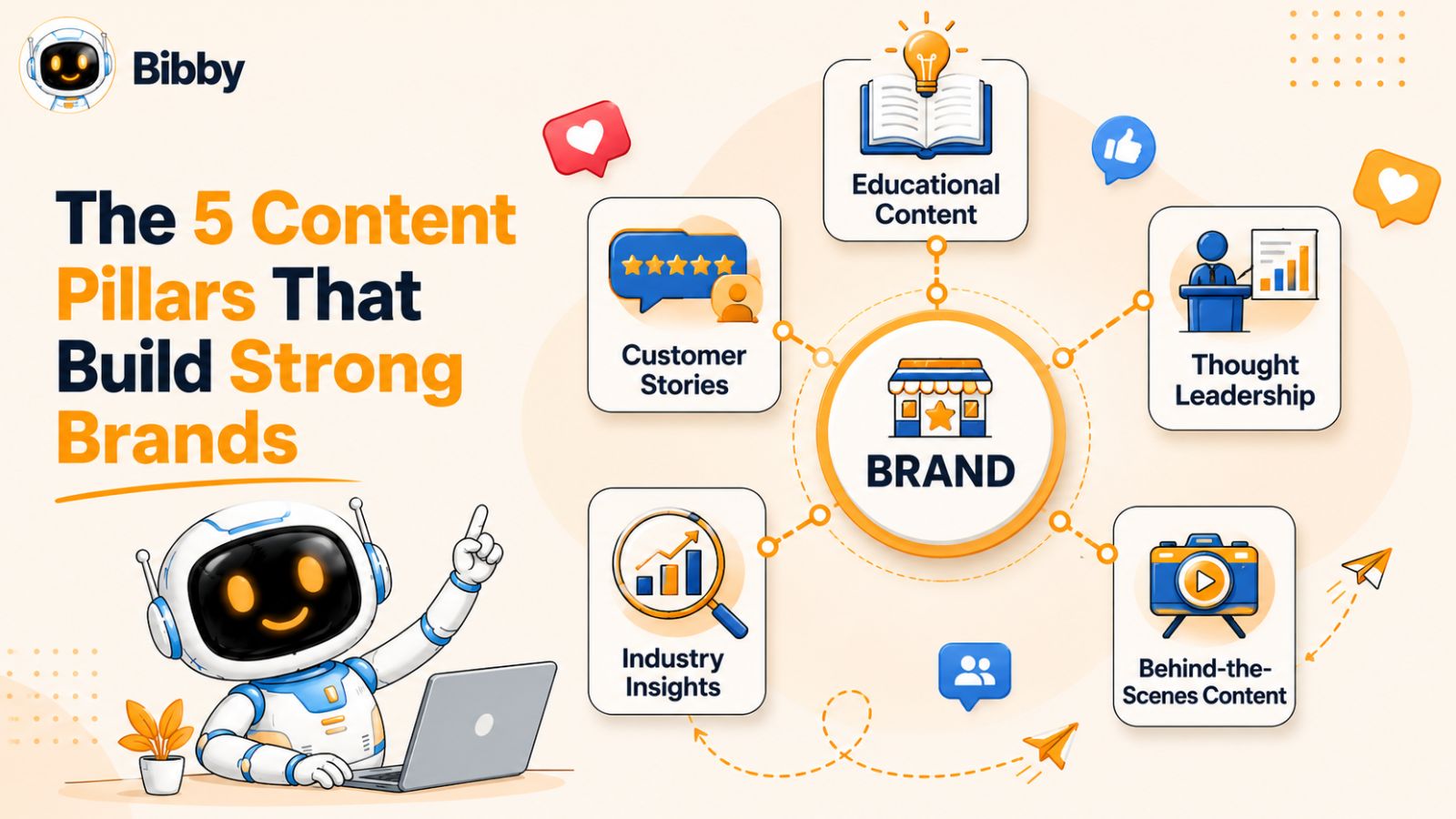
Content pillars are recurring categories of content that align with both audience interests and business objectives. They provide structure, consistency, and scalability.
Common content pillars include:
Educational Content
Educational content helps audiences solve problems, learn new skills, and make informed decisions.
Examples include:
- How-to guides
- Industry tips
- Tutorials
- Best practices
- Step-by-step frameworks
Educational content positions a brand as a trusted authority.
Industry Insights
High-growth brands regularly share observations, trends, and expert opinions about their industry.
This type of content demonstrates expertise and helps establish thought leadership.
Examples include:
- Market trends
- Industry predictions
- Data analysis
- Commentary on emerging technologies
Customer Success Stories
People trust other customers more than advertisements.
Sharing real customer experiences helps prospects visualize potential outcomes and increases credibility.
Examples include:
- Case studies
- Testimonials
- Transformation stories
- User-generated content
Behind-the-Scenes Content
Audiences connect with people more than logos.
Behind-the-scenes content humanizes a brand and helps build stronger emotional connections.
Examples include:
- Team highlights
- Company culture
- Product development updates
- Day-in-the-life content
Thought Leadership
Thought leadership content helps brands influence conversations within their industry.
Examples include:
- Original perspectives
- Strategic insights
- Expert analysis
- Contrarian viewpoints
Together, these content pillars create a balanced content strategy that supports both audience engagement and business growth.
They Build Communities Instead of Audiences
Traditional marketing focuses on attracting attention. High-growth companies focus on creating communities.
An audience consumes content.
A community participates in conversations.
Communities generate significantly more value because members:
- Engage regularly
- Recommend the brand to others
- Share content organically
- Provide feedback
- Become loyal customers
Successful brands actively encourage participation through:
- Comments and discussions
- Polls and surveys
- User-generated content campaigns
- Live events
- Exclusive groups and communities
The strongest brands don't simply talk to their audience—they create environments where audiences interact with each other.
They Use Data to Refine Their Brand Strategy
Successful companies rarely rely on guesswork.
Instead, they use analytics to understand:
- Which content performs best
- What messaging resonates most
- Which platforms drive engagement
- How audience preferences evolve over time
By continuously measuring performance, brands can refine their strategy and improve results without abandoning their core identity.
This data-driven approach allows high-growth companies to make smarter decisions and allocate resources more effectively.
They Build Systems That Scale
Perhaps the biggest difference between average companies and high-growth brands is their commitment to building repeatable systems.
Many businesses struggle because social media depends entirely on manual effort. Content creation, caption writing, scheduling, publishing, and analytics often consume hours every week.
High-growth companies reduce this burden by creating scalable workflows that allow them to maintain consistency without overwhelming their teams.
They leverage automation, scheduling tools, AI-assisted content creation, and centralized publishing systems to streamline operations and maintain a strong brand presence across multiple platforms.
By focusing on systems instead of sporadic effort, they create a sustainable framework for long-term growth.
The result is simple: stronger brand recognition, higher audience trust, and more predictable business outcomes from social media.
Also read: How Far Ahead Should You Schedule Social Media Posts?
The Social Media Brand Framework Used by Successful Companies
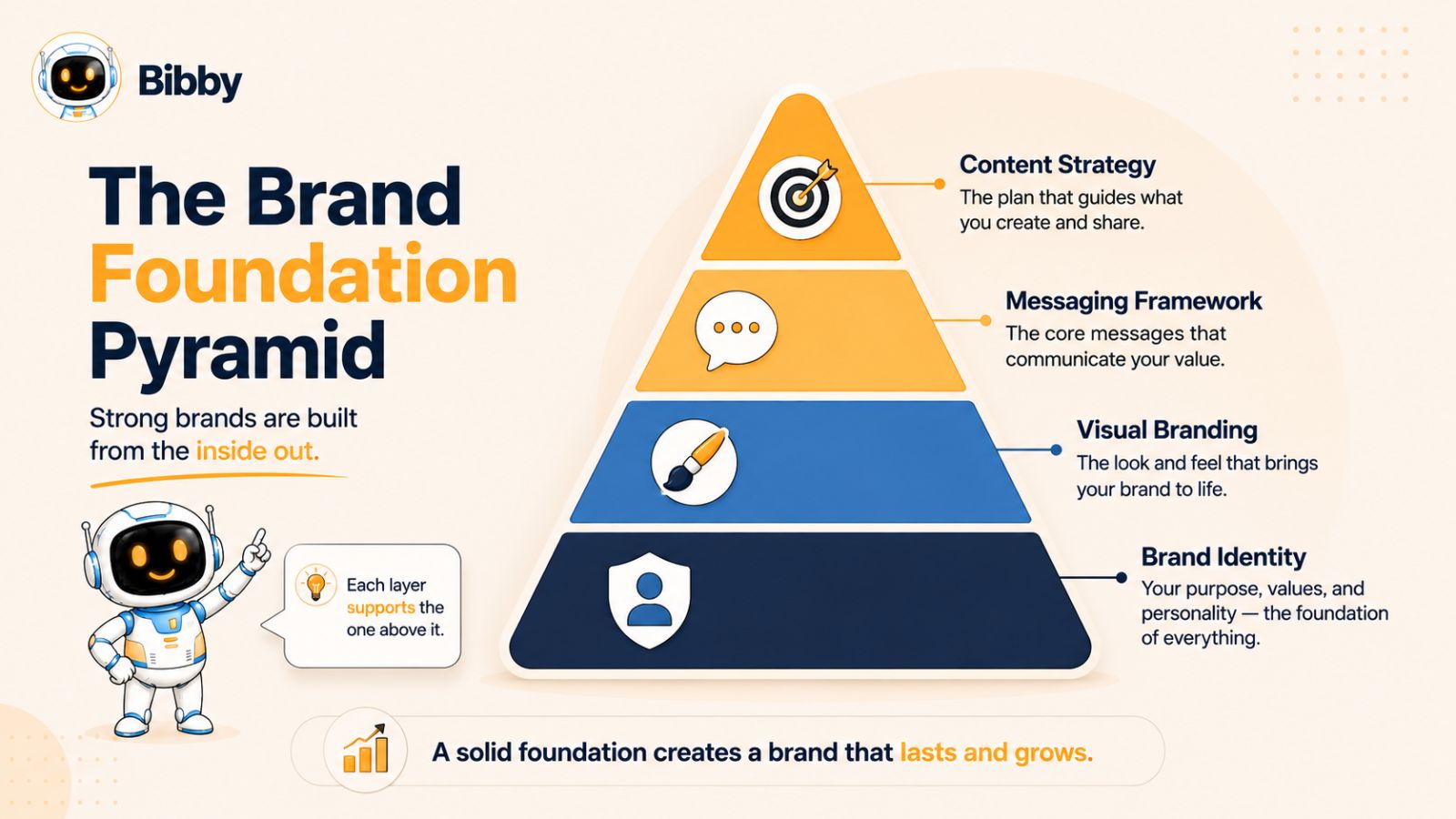
Building a recognizable brand on social media isn't about luck, creativity alone, or having an unlimited marketing budget. The fastest-growing companies follow a repeatable framework that ensures every piece of content strengthens their brand identity and supports long-term business goals.
While platforms and algorithms continue to evolve, the foundations of effective social media branding remain remarkably consistent. Companies that achieve sustainable growth focus on four core areas: brand identity, visual branding, messaging, and content execution.
Together, these elements create a system that helps audiences instantly recognize, trust, and remember a brand.
Brand Identity: Defining Who You Are
Before creating content, successful companies establish a clear brand identity.
Brand identity serves as the foundation for every social media decision. It defines how a company communicates, what it stands for, and how it wants to be perceived by its audience.
Without a clearly defined identity, content often becomes inconsistent and ineffective.
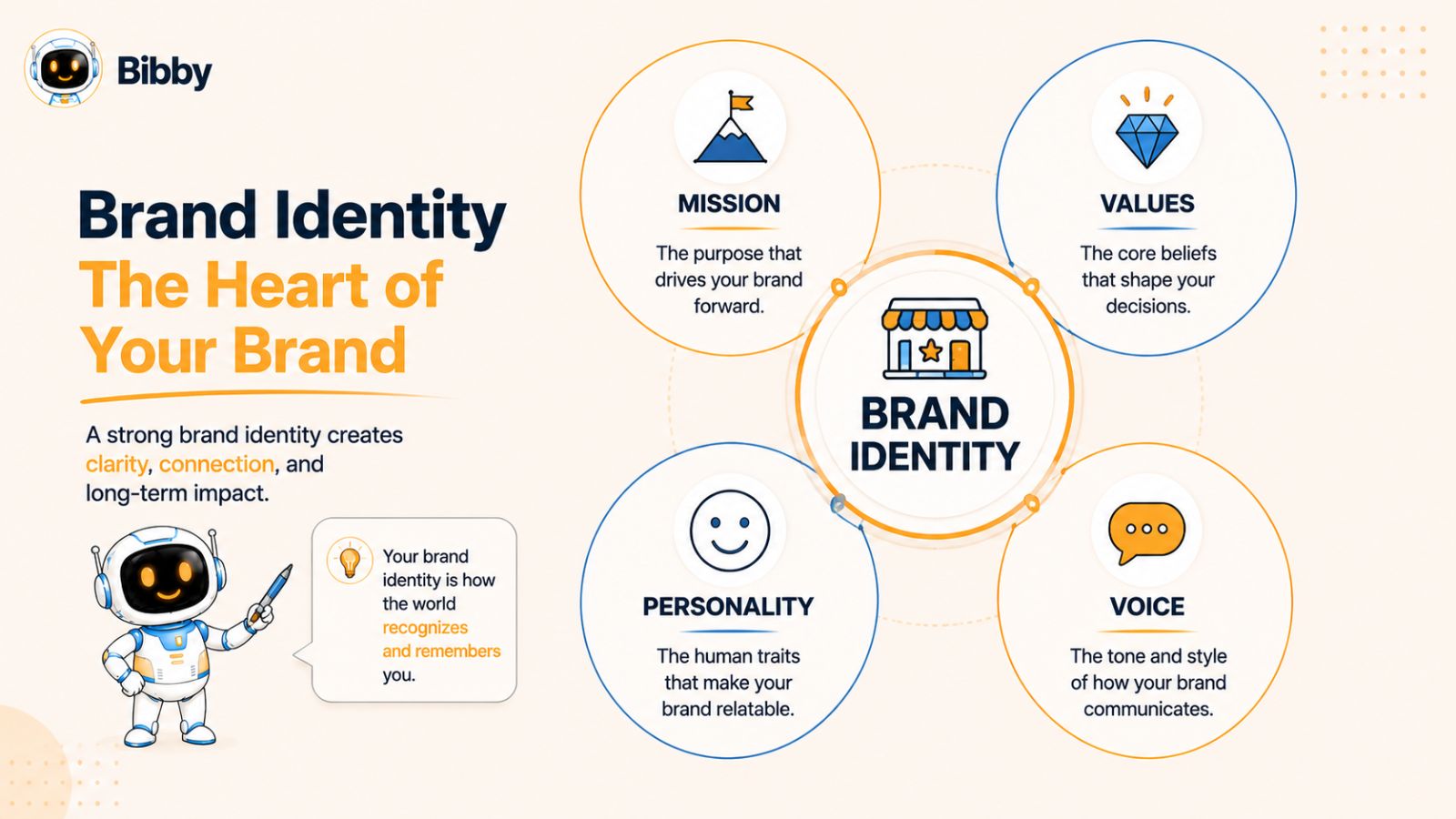
A strong brand identity typically includes:
Mission
Your mission explains why your company exists beyond making money.
Examples include:
- Helping businesses grow more efficiently
- Simplifying complex processes
- Improving customer experiences
- Empowering creators and entrepreneurs
A clear mission provides direction for content and messaging.
Core Values
Values influence how your company behaves and communicates.
Examples include:
- Innovation
- Transparency
- Simplicity
- Customer success
- Creativity
Values help audiences understand what your brand stands for and build deeper emotional connections.
Brand Personality
People naturally connect with personalities more than corporate messaging.
Successful brands intentionally define their personality traits.
Examples include:
- Professional and authoritative
- Friendly and approachable
- Innovative and forward-thinking
- Bold and disruptive
- Educational and helpful
A consistent personality makes content more relatable and memorable.
Brand Voice
Your voice determines how your content sounds.
Questions to consider include:
- Is the tone formal or conversational?
- Is the communication direct or storytelling-focused?
- Is humor appropriate for your audience?
- How technical should the content be?
A consistent voice creates familiarity and strengthens brand recognition over time.
Visual Branding: Creating Instant Recognition
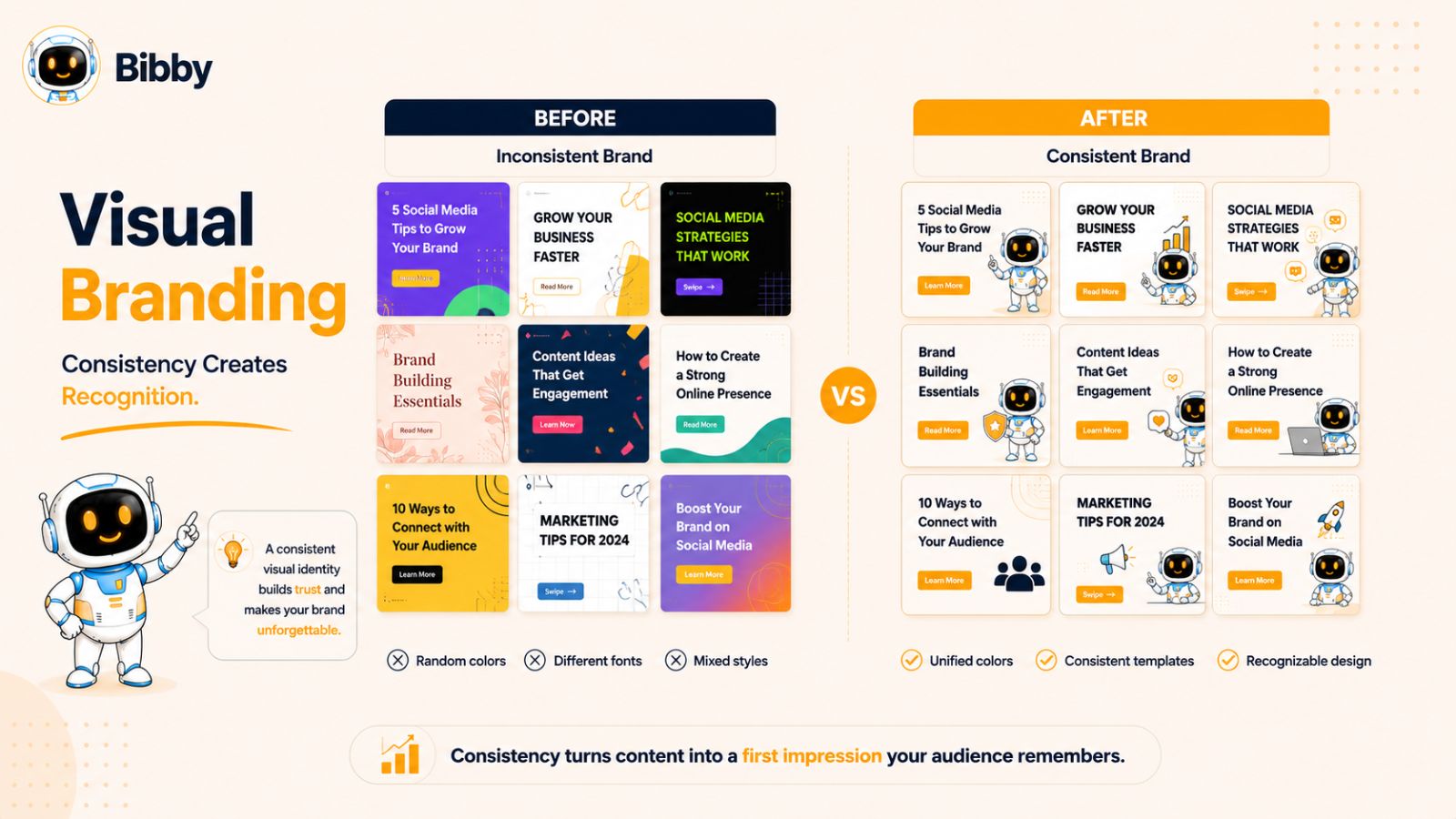
Visual consistency is one of the fastest ways to strengthen social media branding.
Think about the world's most recognizable companies. Even without seeing their logo, audiences often recognize their content instantly because of consistent visual elements.
Strong visual branding includes:
Consistent Color Palette
Using the same colors across platforms reinforces brand recognition and creates visual cohesion.
Typography
Consistent fonts create a professional appearance and make content easier to identify.
Design Templates
Many high-growth companies use standardized templates for:
- Social media posts
- Carousels
- Stories
- Video thumbnails
- Infographics
Templates improve efficiency while maintaining brand consistency.
Image Style
Brands should establish clear guidelines for imagery, including:
- Photography style
- Illustration style
- Graphic design elements
- Video editing approach
Consistency across these elements helps audiences recognize content immediately, even while scrolling quickly through crowded feeds.
Messaging Framework: Ensuring Consistent Communication
Many companies struggle with inconsistent messaging. One post focuses on product features, another discusses industry trends, while a third promotes unrelated topics.
High-growth brands solve this problem with a messaging framework.
A messaging framework defines the key ideas that should consistently appear throughout a company's content.
Core Brand Message
This is the central promise your brand delivers.
Examples:
- Save time through automation
- Simplify social media management
- Help businesses scale efficiently
- Deliver better customer experiences
Every piece of content should reinforce this promise in some way.
Customer Pain Points
Successful brands deeply understand their audience's challenges.
Examples include:
- Limited time
- Inconsistent content creation
- Difficulty managing multiple platforms
- Low engagement rates
- Lack of social media expertise
Addressing these pain points helps content resonate more effectively.
Transformation Promise
People don't buy products—they buy outcomes.
Instead of focusing only on features, high-growth companies emphasize the transformation customers can achieve.
Examples include:
- From inconsistent posting to a predictable content strategy
- From overwhelmed marketing teams to streamlined workflows
- From low visibility to stronger brand awareness
Differentiators
Every successful brand clearly communicates what makes it unique.
This could include:
- Superior technology
- Better customer support
- Simpler workflows
- Faster results
- More comprehensive solutions
Differentiation helps brands stand out in competitive markets.
Content Strategy Alignment: Turning Branding Into Action
A strong brand framework only creates value when it is consistently applied through content.
This is where many businesses struggle.
They understand branding in theory but lack a practical system for execution.
High-growth companies align content creation with business objectives by developing structured publishing processes.
Their content strategy typically answers four questions:
Who Are We Speaking To?
Understanding audience demographics, goals, and pain points helps ensure content remains relevant.
What Topics Matter Most?
Content pillars help maintain focus and prevent random posting.
What Business Goals Are We Supporting?
Content may support goals such as:
- Brand awareness
- Lead generation
- Customer retention
- Product education
- Community growth
How Will We Maintain Consistency?
Consistency is often the biggest challenge in social media marketing.
Creating content for Facebook, Instagram, LinkedIn, TikTok, and YouTube simultaneously can quickly become overwhelming without a clear workflow.
This is why high-growth companies invest heavily in systems, processes, and automation tools that make consistent publishing easier. Rather than relying on manual effort every day, they create scalable content operations that allow them to maintain a strong brand presence across multiple platforms while focusing on growth.
The companies that dominate social media are rarely the ones posting the most content. They're the ones with the strongest framework supporting every post, video, story, and interaction. Once this foundation is in place, brands can begin leveraging automation and AI to scale their efforts even further.
The Role of AI and Automation in Modern Brand Building
Building a strong brand on social media requires consistency, creativity, and continuous engagement. While the strategy may be straightforward, the execution can quickly become overwhelming.
Creating content, designing visuals, writing captions, publishing across multiple platforms, responding to engagement, and analyzing performance can consume dozens of hours every week. As a business grows, maintaining this level of activity manually becomes increasingly difficult.
This is why high-growth companies are turning to AI and automation. Rather than replacing human creativity, these technologies help teams execute faster, stay consistent, and scale their brand-building efforts without dramatically increasing workload.
Today, some of the fastest-growing brands are not necessarily creating more content than their competitors. They're simply using smarter systems to maximize their impact.
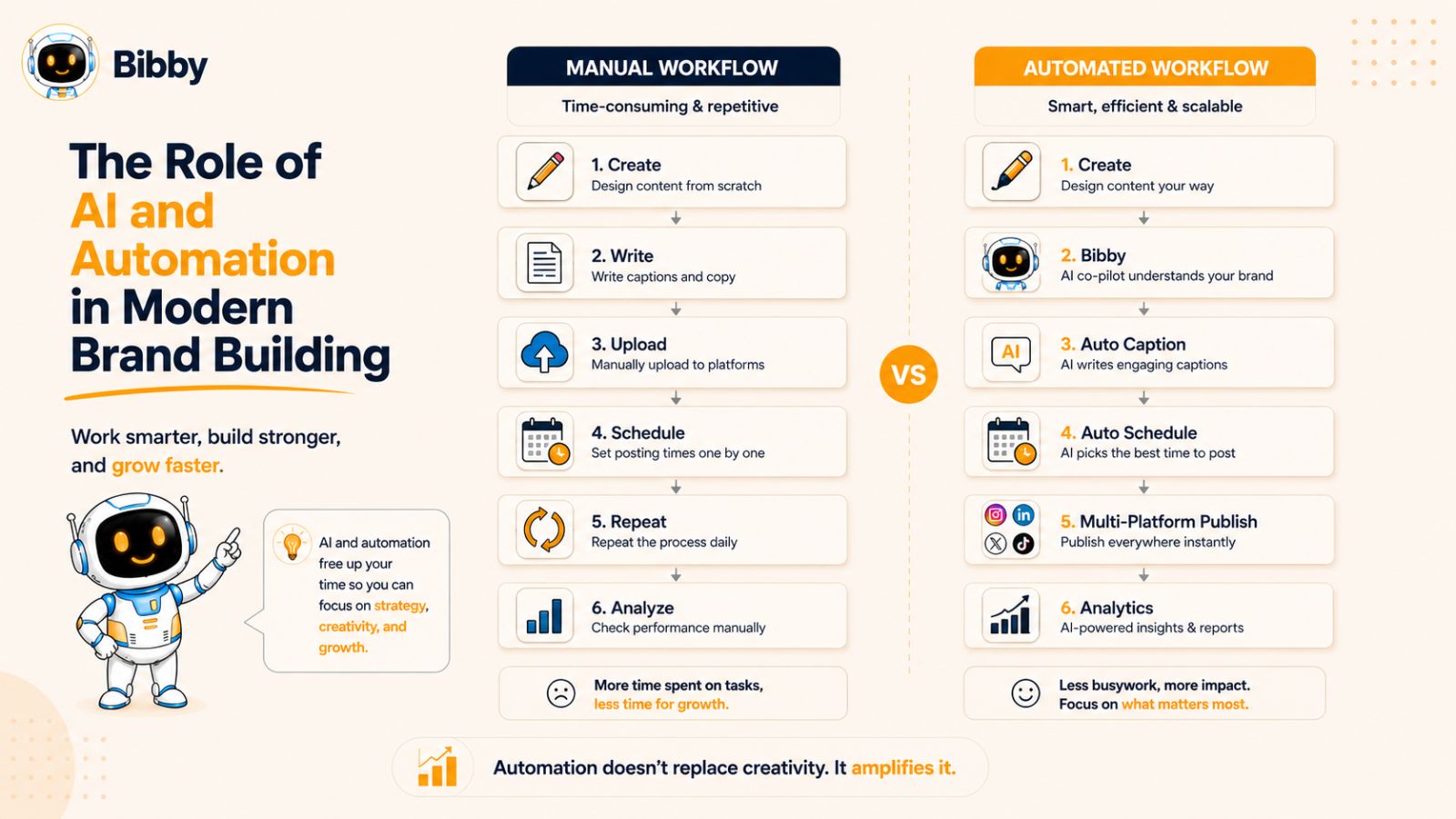
Why Manual Social Media Management Doesn't Scale
Many businesses begin their social media journey with a manual workflow.
A typical process might look like this:
- Create an image
- Write a caption
- Upload it to Facebook
- Repeat for Instagram
- Repeat for LinkedIn
- Adjust the format for TikTok
- Schedule posts individually
- Monitor performance separately
This approach may work initially, but it becomes unsustainable as content volume increases.
Common challenges include:
Time-Consuming Workflows
Marketing teams often spend more time managing content than creating value.
Hours disappear into repetitive tasks such as resizing images, scheduling posts, and copying captions between platforms.
Inconsistent Publishing
When social media relies entirely on manual effort, posting schedules often become irregular.
Inconsistent publishing can reduce engagement, weaken audience trust, and slow brand growth.
Platform Complexity
Every social media platform has different requirements, formats, and best practices.
Managing Facebook, Instagram, LinkedIn, YouTube, and TikTok separately creates unnecessary complexity.
Limited Optimization
Without automation, many businesses publish content whenever they have time rather than when audiences are most active.
This often results in lower reach and engagement.
How High-Growth Companies Automate Their Content Operations
Successful companies recognize that consistency is one of the most important factors in social media branding.
Instead of relying on memory, spreadsheets, or manual publishing, they build systems that automate repetitive tasks while maintaining quality and control.
Automation helps brands:
- Publish consistently
- Save time
- Scale content production
- Maintain brand standards
- Improve performance tracking
- Reach audiences across multiple platforms
By reducing operational friction, businesses can focus more on strategy, creativity, and customer engagement.
How Bibby Simplifies Social Media Brand Building
One of the biggest reasons businesses struggle with social media is that the process is fragmented. Content creation happens in one tool, scheduling happens in another, analytics live somewhere else, and teams spend valuable time moving between platforms.
Bibby solves this problem by providing a simple, streamlined workflow designed specifically for modern social media management.
Instead of managing multiple tools and processes, businesses can handle their entire content workflow from a single platform.
What Is Bibby?
Bibby is an AI-powered social media scheduling and automation platform that helps businesses create, publish, manage, and optimize content across multiple social media channels.
The platform is designed to simplify social media management while helping brands maintain a consistent presence across all major networks.
Whether you're a solo creator, startup, marketing agency, or growing business, Bibby helps reduce manual work while improving content efficiency.
The Simple Bibby Workflow
One of Bibby's biggest advantages is its simplicity.
The process is designed to eliminate unnecessary steps and make social media management as effortless as possible.
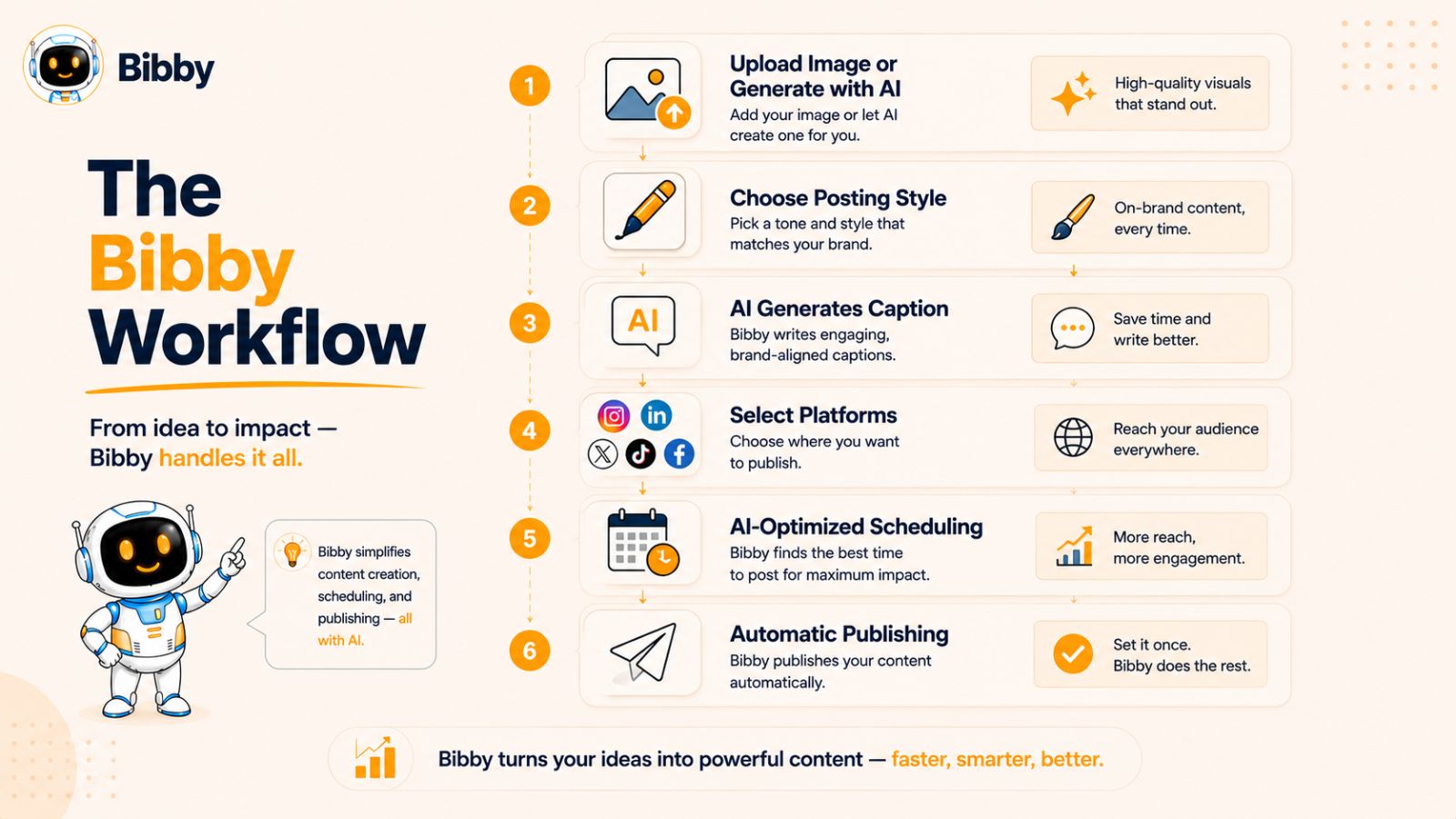
Step 1: Upload or Generate Your Content
Users can either:
- Upload their own images
- Create visuals using AI-generated imagery
This flexibility makes it easier to maintain a consistent content pipeline.
Step 2: Choose Your Posting Style
Different brands communicate differently.
Bibby allows users to select their preferred posting style, helping ensure content aligns with their brand voice and audience expectations.
Step 3: Automatically Generate Captions
Writing captions is often one of the most time-consuming parts of social media management.
Bibby's AI automatically generates captions based on the content and selected posting style, helping businesses create engaging posts faster.
Step 4: Select Your Social Media Platforms
Instead of uploading content individually to each platform, users can publish across multiple channels simultaneously.
Supported platforms include:
- YouTube
- TikTok
This centralized approach dramatically reduces publishing time.
Step 5: Schedule Content at AI-Optimized Times
Timing plays a significant role in content performance.
Rather than guessing when audiences are active, Bibby uses AI to identify optimal posting times based on engagement patterns.
This helps maximize visibility and reach without requiring manual analysis.
Step 6: Let Bibby Handle the Publishing
Once scheduled, content is automatically published according to the selected schedule.
This allows businesses to maintain a consistent presence without daily manual intervention.
Beyond Posts: Videos, Stories, and Multi-Format Content
Modern social media branding extends far beyond static images.
Audiences increasingly consume:
- Short-form videos
- Stories
- Reels
- Educational videos
- Long-form content
Bibby supports multiple content formats, enabling brands to manage a diverse content strategy from a single platform.
This flexibility helps businesses adapt to changing platform preferences while maintaining operational efficiency.
Analytics That Help Improve Brand Performance
Creating content is only half the equation.
Understanding what works is equally important.
High-growth companies continuously analyze performance data to refine their strategies and improve results.
Bibby provides analytics that help businesses track:
- Engagement trends
- Content performance
- Audience behavior
- Platform growth
- Campaign effectiveness
These insights make it easier to identify successful content patterns and optimize future campaigns.
Why Automation Creates a Competitive Advantage
Many businesses worry that automation will make their content feel less authentic. In reality, automation works best when it handles repetitive tasks while allowing humans to focus on strategy, creativity, and relationship-building.
The most successful brands use automation to:
- Maintain consistency
- Increase efficiency
- Scale faster
- Reduce operational costs
- Improve content quality
- Free up valuable time
Rather than spending hours managing social media every day, teams can focus on creating better content, serving customers, and growing the business.
The Future of Social Media Brand Building
As AI technology continues to evolve, the gap between manual workflows and automated systems will continue to widen.
Brands that embrace automation ga\in a significant advantage because they can publish more consistently, optimize performance more effectively, and scale their efforts without proportionally increasing workload.
The goal is not to automate creativity. The goal is to automate everything that gets in the way of creativity.
For high-growth companies, AI-powered platforms like Bibby are becoming an essential part of modern brand-building strategies, helping businesses stay visible, consistent, and competitive in an increasingly crowded digital landscape.
Content Strategies That Accelerate Brand Growth
A strong brand framework and efficient automation tools provide the foundation for success, but content remains the vehicle that carries your brand message to the market.
Every post, video, story, and comment contributes to how audiences perceive your business. The challenge is that most companies create content without a clear strategy. They post sporadically, jump between topics, and struggle to build momentum.
High-growth companies take a different approach. They use proven content strategies that consistently deliver value, strengthen brand positioning, and deepen audience relationships.
The following content types form the backbone of many successful social media brands.
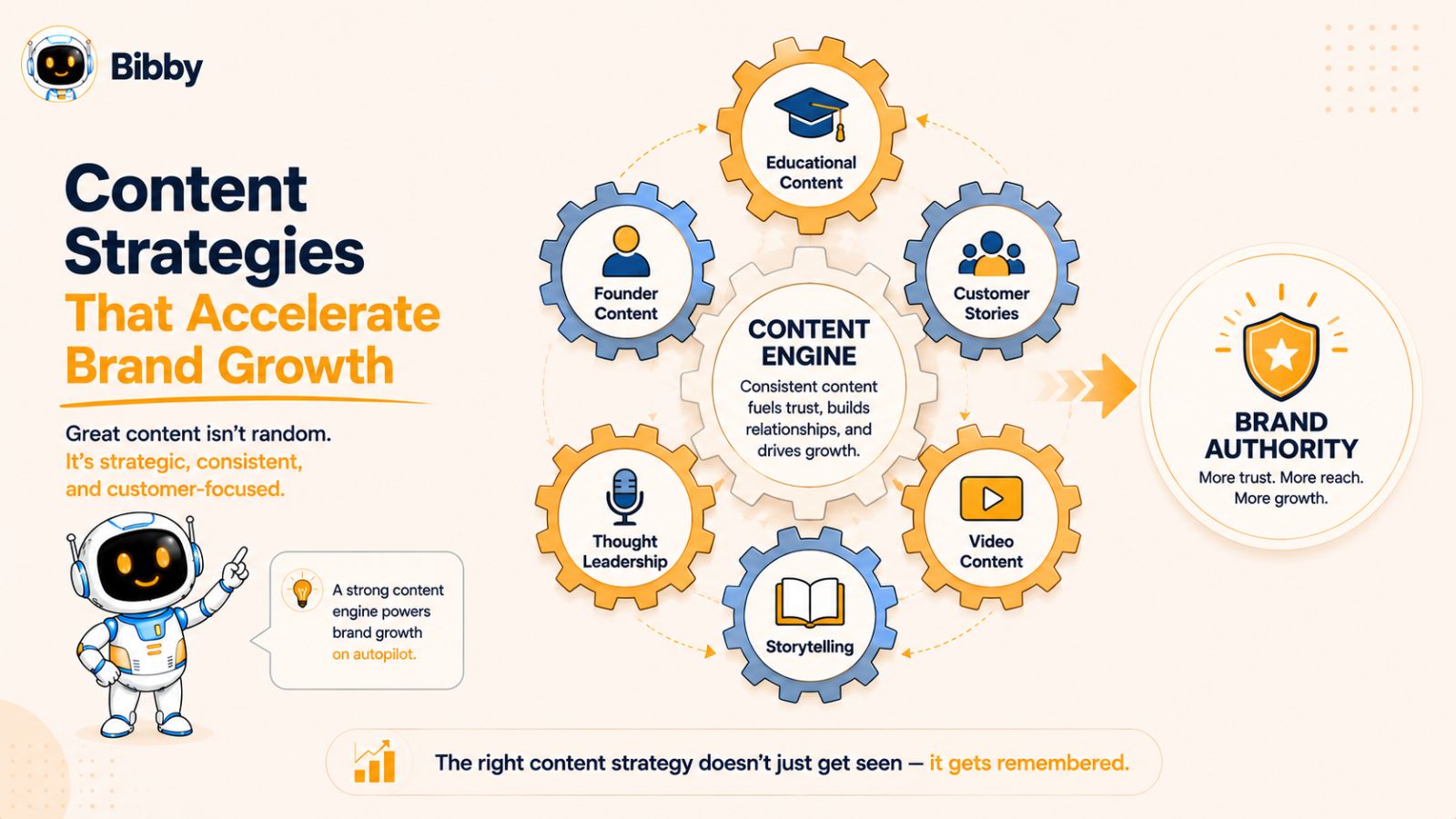
Educational Content: Become the Trusted Expert
Educational content is one of the most effective ways to build authority and trust on social media.
People follow brands that help them solve problems, answer questions, and improve outcomes. When your content consistently teaches something useful, audiences begin to see your company as a valuable resource rather than just another business trying to sell products or services.
Examples of educational content include:
- How-to guides
- Tutorials
- Industry best practices
- Common mistakes to avoid
- Step-by-step frameworks
- Frequently asked questions
For example, a social media software company might publish content about content planning, engagement strategies, platform algorithms, or marketing trends.
The more value you provide, the more likely your audience is to trust your expertise when they're ready to make a purchasing decision.
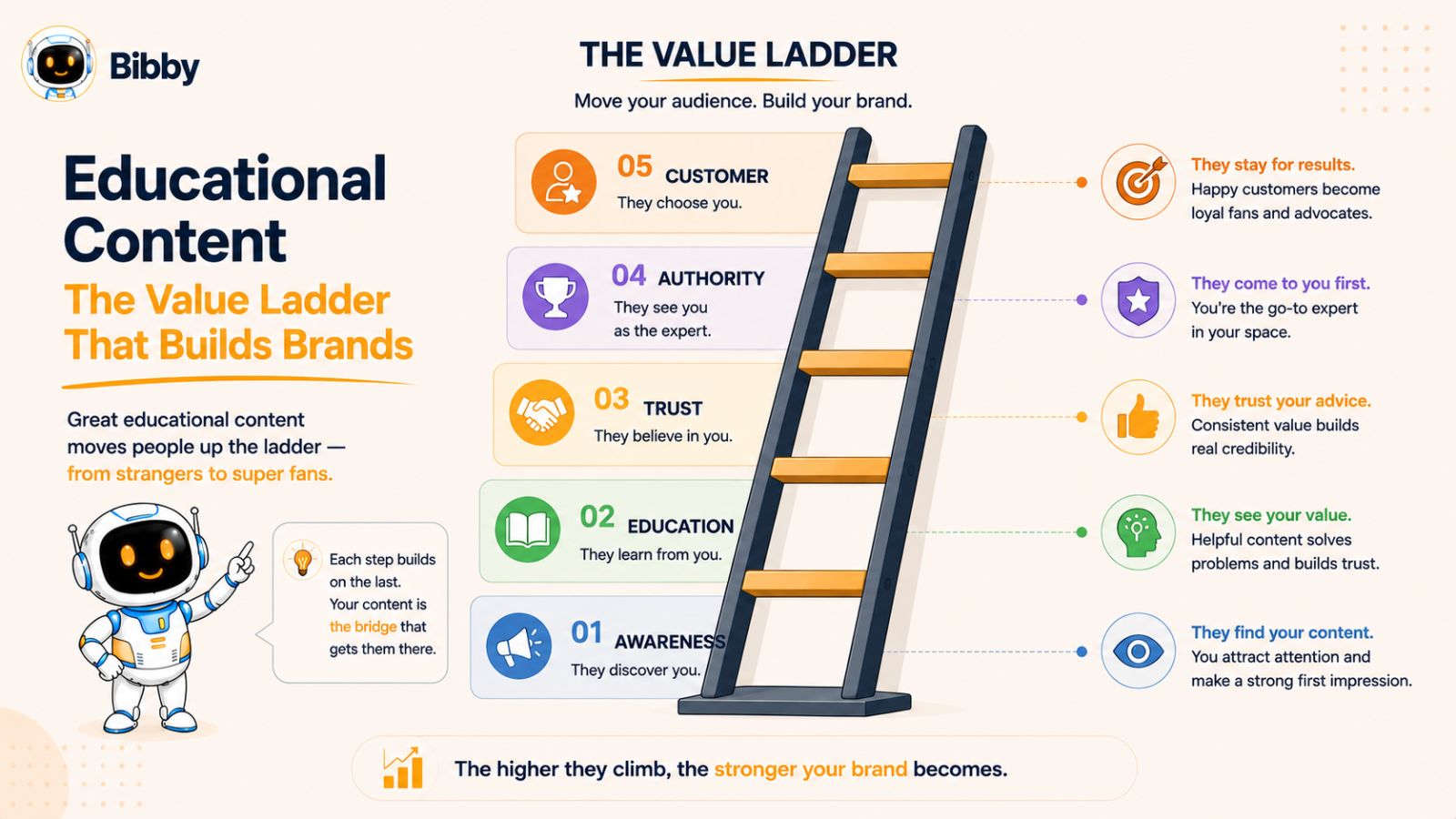
Founder-Led Content: Humanize the Brand
In today's digital landscape, people increasingly want to connect with people—not logos.
Founder-led content helps audiences understand the vision, values, and personality behind a company.
Many of the fastest-growing businesses leverage their founders as brand ambassadors because personal stories often generate stronger engagement than traditional corporate messaging.
Founder-led content can include:
- Personal lessons learned
- Business growth stories
- Industry observations
- Leadership insights
- Challenges and failures
- Future vision and goals
Authenticity is particularly important here. Audiences can quickly recognize when content feels overly scripted or promotional.
Sharing genuine experiences helps build credibility and emotional connection.
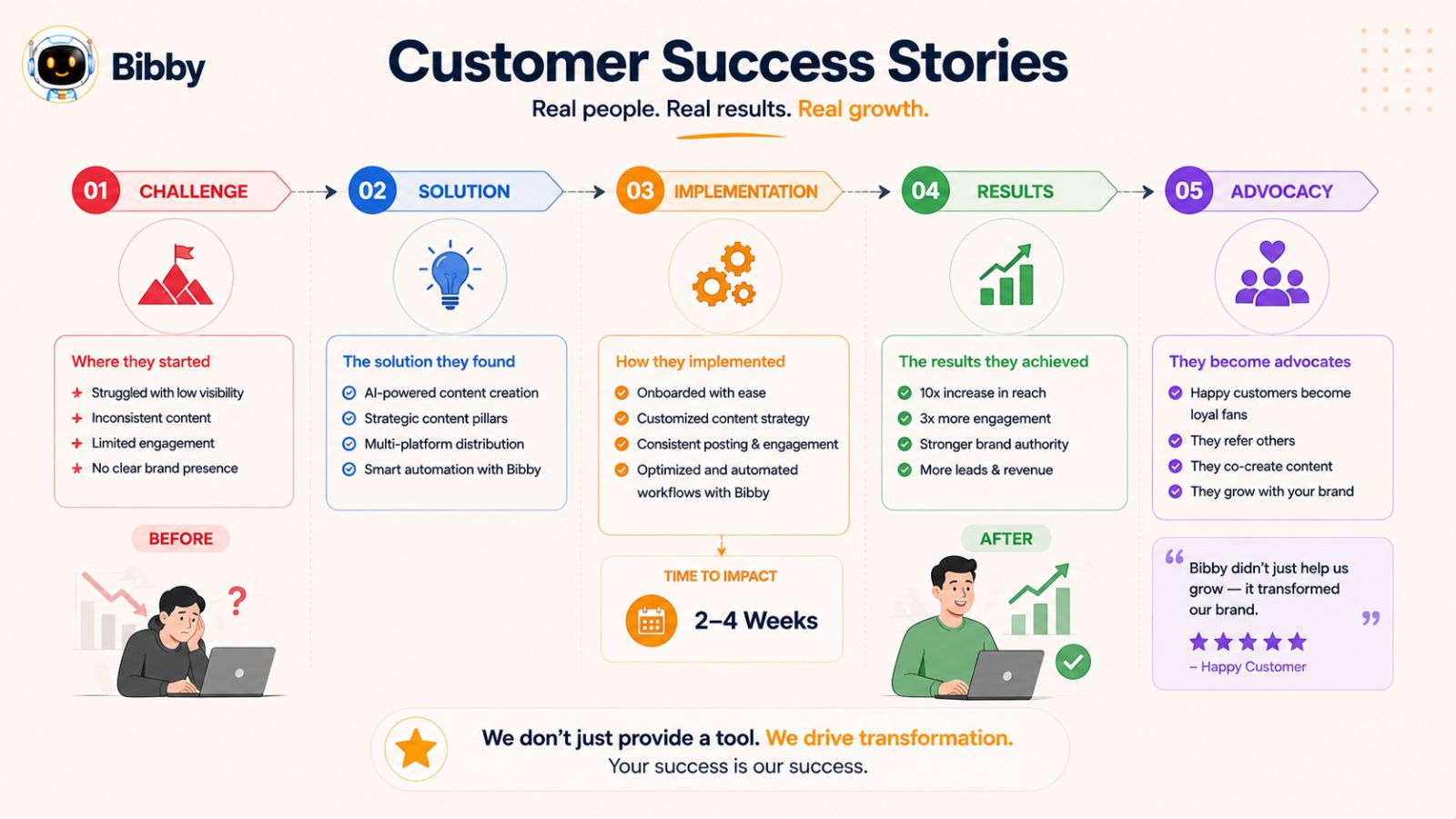
Customer Success Stories: Let Results Speak for Themselves
Few marketing assets are more persuasive than real customer outcomes.
Customer success stories provide social proof, demonstrating that your products or services deliver meaningful results.
Instead of simply telling audiences why they should trust your brand, customer stories show them.
Examples include:
Case Studies
Detailed breakdowns of how customers achieved specific outcomes.
Testimonials
Short quotes highlighting positive experiences.
Before-and-After Transformations
Stories that illustrate a clear improvement or success journey.
User-Generated Content
Content created by customers showcasing their experiences with your brand.
These formats help reduce uncertainty and increase confidence among potential buyers.
Industry Commentary: Position Your Brand as a Thought Leader
Thought leadership is one of the most powerful ways to differentiate your brand in competitive markets.
Rather than merely reporting news, successful companies offer unique perspectives on industry developments.
Examples include:
- Emerging trends
- Market shifts
- Technology advancements
- Industry predictions
- Regulatory changes
- Competitive insights
When audiences consistently turn to your brand for expert analysis, your authority naturally grows.
The goal isn't to comment on everything. It's to provide thoughtful, valuable insights that reinforce your expertise.
Video-First Content Strategy: Meet Audiences Where They Are
Video continues to dominate social media engagement across nearly every platform.
Consumers increasingly prefer watching content over reading lengthy text posts. As a result, high-growth companies prioritize video as a core component of their content strategy.
Effective video formats include:
Short-Form Videos
Ideal for platforms like TikTok, Instagram Reels, Facebook Reels, and YouTube Shorts.
Popular formats include:
- Quick tips
- Product demonstrations
- Industry insights
- Behind-the-scenes content
Long-Form Videos
Longer educational videos help establish deeper authority and create evergreen content assets.
Common examples include:
- Tutorials
- Webinars
- Interviews
- Product walkthroughs
- Expert discussions
Story-Based Videos
Storytelling remains one of the most effective communication methods because it combines information with emotion.
Brands that master video storytelling often achieve significantly higher engagement rates.
Storytelling: Create Emotional Connections
Facts help people understand.
Stories help people remember.
One reason storytelling is so powerful is that it transforms abstract information into relatable experiences.
Great brand stories often include:
- Challenges
- Obstacles
- Lessons learned
- Customer transformations
- Personal journeys
- Unexpected outcomes
For example, instead of saying a product saves time, a brand might tell the story of a small business owner who reclaimed hours every week by simplifying their workflow.
Stories make content more engaging, memorable, and shareable.
Create Content for Every Stage of the Customer Journey
Many businesses focus exclusively on attracting new audiences. High-growth companies create content that supports the entire customer journey.
Awareness Content
Designed to attract new audiences.
Examples:
- Educational posts
- Industry insights
- Trending discussions
Consideration Content
Designed to help prospects evaluate solutions.
Examples:
- Case studies
- Product comparisons
- Expert guides
Decision Content
Designed to help prospects take action.
Examples:
- Customer testimonials
- Product demonstrations
- Success stories
Retention Content
Designed to strengthen customer relationships.
Examples:
- Advanced tips
- Community engagement
- Product updates
- Exclusive content
This balanced approach ensures that content contributes to both audience growth and business growth.
Consistency Is the Ultimate Growth Multiplier
Even the best content strategy fails without consistent execution.
This is where many businesses struggle. They understand what content to create but find it difficult to maintain a regular publishing schedule across multiple platforms.
High-growth companies solve this challenge by combining strategic content planning with automation tools that simplify publishing, scheduling, and performance tracking.
By consistently delivering educational content, customer stories, industry insights, videos, and compelling narratives, brands can gradually build trust, authority, and recognition that compounds over time.
The result is a social media presence that not only attracts attention but also creates lasting business value and sustainable growth.
Building Brand Authority Across Different Social Platforms
One of the biggest mistakes businesses make is treating every social media platform the same way.
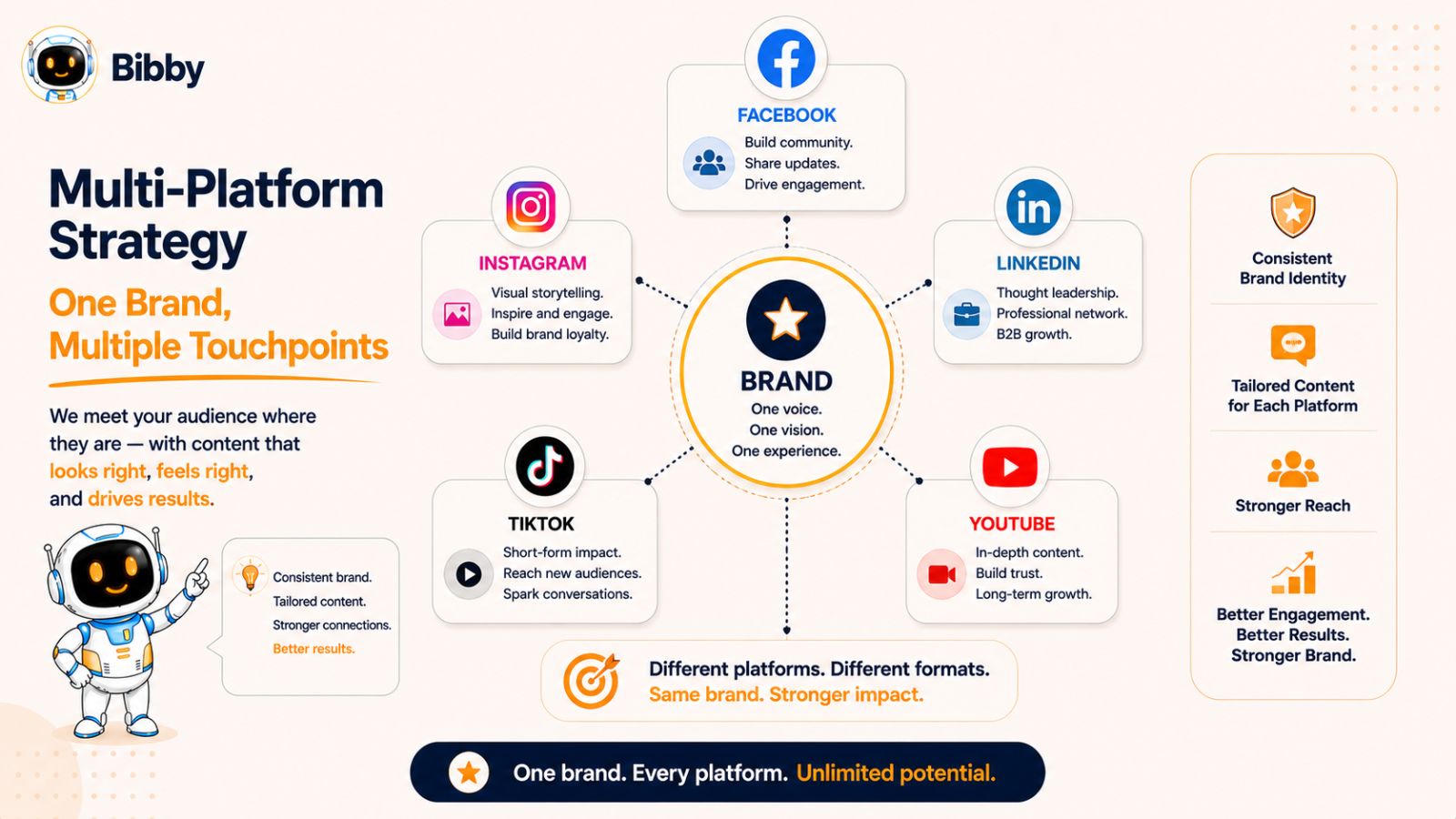
While consistency is essential for brand building, successful companies understand that each platform attracts different audiences, encourages different behaviors, and rewards different content formats.
High-growth brands maintain a consistent identity across all channels while adapting their content strategy to fit the unique strengths of each platform.
This approach allows them to maximize reach, engagement, and brand recognition without diluting their message.
Let's explore how successful companies build authority on the world's most influential social media platforms.
LinkedIn: Building Professional Authority and Trust
LinkedIn has evolved into one of the most powerful platforms for thought leadership, professional networking, and B2B brand building.
For many companies, LinkedIn is where expertise becomes visibility.
Brands that perform well on LinkedIn focus on:
Sharing Industry Insights
Professionals follow accounts that help them stay informed and competitive.
Popular content includes:
- Industry trends
- Market analysis
- Expert opinions
- Business lessons
- Future predictions
Founder and Executive Content
Many high-growth companies use their founders and leadership teams to build credibility.
Posts that share personal experiences, leadership lessons, and company growth stories often generate significant engagement.
Educational Content
LinkedIn audiences value practical insights they can immediately apply to their work.
Examples include:
- Frameworks
- Checklists
- Step-by-step guides
- Case studies
When executed consistently, LinkedIn can become a powerful channel for establishing authority, generating leads, and strengthening brand trust.
Instagram: Winning Through Visual Storytelling
Instagram remains one of the most effective platforms for visual branding.
Because users consume content quickly, visual consistency becomes especially important.
Successful brands on Instagram focus on:
Cohesive Visual Identity
Strong brands maintain consistent:
- Colors
- Design elements
- Photography styles
- Typography
This creates instant recognition as users scroll through their feeds.
Reels and Short-Form Videos
Instagram's algorithm heavily favors video content.
High-growth companies use Reels to:
- Share quick tips
- Demonstrate products
- Tell customer stories
- Showcase company culture
Stories for Daily Engagement
Stories provide an opportunity for more frequent and informal interactions.
Popular Story formats include:
- Polls
- Questions
- Behind-the-scenes updates
- Product announcements
- Community engagement
The most successful Instagram brands combine strong visual branding with authentic storytelling.
Facebook: Building Communities Around Your Brand
While newer platforms often receive more attention, Facebook remains a powerful channel for community building and customer engagement.
Many successful brands use Facebook to strengthen relationships with existing audiences.
Effective Facebook strategies include:
Community Groups
Facebook Groups allow brands to create dedicated spaces where customers can interact, ask questions, and share experiences.
Communities often become valuable assets because they generate engagement even when brands aren't actively publishing content.
Long-Form Discussions
Unlike some platforms that prioritize brevity, Facebook users often engage with longer posts and deeper discussions.
Brands can leverage this by sharing:
- Insights
- Stories
- Customer experiences
- Industry conversations
Event Promotion
Facebook remains an effective platform for promoting:
- Webinars
- Live streams
- Product launches
- Community events
For brands focused on relationship-building, Facebook continues to offer significant opportunities.
Also read: How to Grow a Facebook Business Page Faster with AI Social Media Automation
TikTok: Accelerating Reach and Discovery
TikTok has fundamentally changed how content is discovered online.
Unlike traditional social networks that primarily distribute content to followers, TikTok frequently introduces brands to entirely new audiences.
This makes it a powerful platform for increasing brand awareness.
Successful TikTok strategies include:
Educational Micro-Content
Short, informative videos often perform exceptionally well.
Examples include:
- Quick tips
- Industry insights
- Productivity hacks
- Myth-busting content
Authenticity Over Perfection
TikTok audiences generally prefer authenticity over polished production.
Content that feels genuine often outperforms highly produced advertisements.
Trend Participation
While brands shouldn't chase every trend, strategically participating in relevant conversations can increase visibility.
The key is aligning trends with brand identity rather than sacrificing consistency for short-term attention.
YouTube: Creating Long-Term Brand Equity
YouTube differs from most social media platforms because its content often generates value for months or even years after publication.
This makes it one of the strongest platforms for building long-term authority.
High-growth companies use YouTube to create:
Educational Content
Tutorials, guides, and explainers help brands establish expertise while attracting organic search traffic.
Product Demonstrations
Video demonstrations help audiences better understand products and services.
Thought Leadership
Interviews, discussions, and expert commentary position brands as trusted industry voices.
Evergreen Content Assets
Unlike content that disappears quickly in social feeds, YouTube videos often continue attracting views long after they're published.
This creates compounding returns on content investments.
Also read: How to Scale a YouTube Channel With Automation
Maintaining a Unified Brand Across Every Platform
Although each platform requires a unique approach, successful companies maintain consistency in key areas.
These include:
Visual Identity
Audiences should immediately recognize your content regardless of where they encounter it.
Messaging
Core brand messages should remain consistent across all channels.
Brand Voice
Whether posting on LinkedIn or TikTok, the personality behind the brand should feel familiar.
Customer Experience
Interactions should reflect the same values and standards across every platform.
This consistency helps reinforce brand recognition and build trust over time.
Managing Multiple Platforms Without Losing Consistency
One of the biggest challenges for growing brands is maintaining a consistent presence across multiple channels.
Creating platform-specific content while managing publishing schedules, captions, videos, stories, and analytics can quickly become overwhelming.
This is why many high-growth companies rely on centralized workflows and automation tools to simplify execution.
Platforms like Bibby help brands manage content across Facebook, Instagram, LinkedIn, TikTok, and YouTube from a single dashboard. Instead of manually publishing to each platform, teams can create content once, schedule it intelligently, generate captions automatically, and maintain a consistent brand presence without significantly increasing workload.
The brands that dominate social media aren't necessarily active on every platform. They're active on the right platforms and execute consistently with a unified strategy.
When combined with strong branding, quality content, and efficient workflows, a multi-platform approach can dramatically increase visibility, authority, and long-term business growth.
Also read: Best Platforms to Share Video Content and Grow Your Audience (+ Multi-Platform Strategy)
Common Social Media Branding Mistakes Companies Make
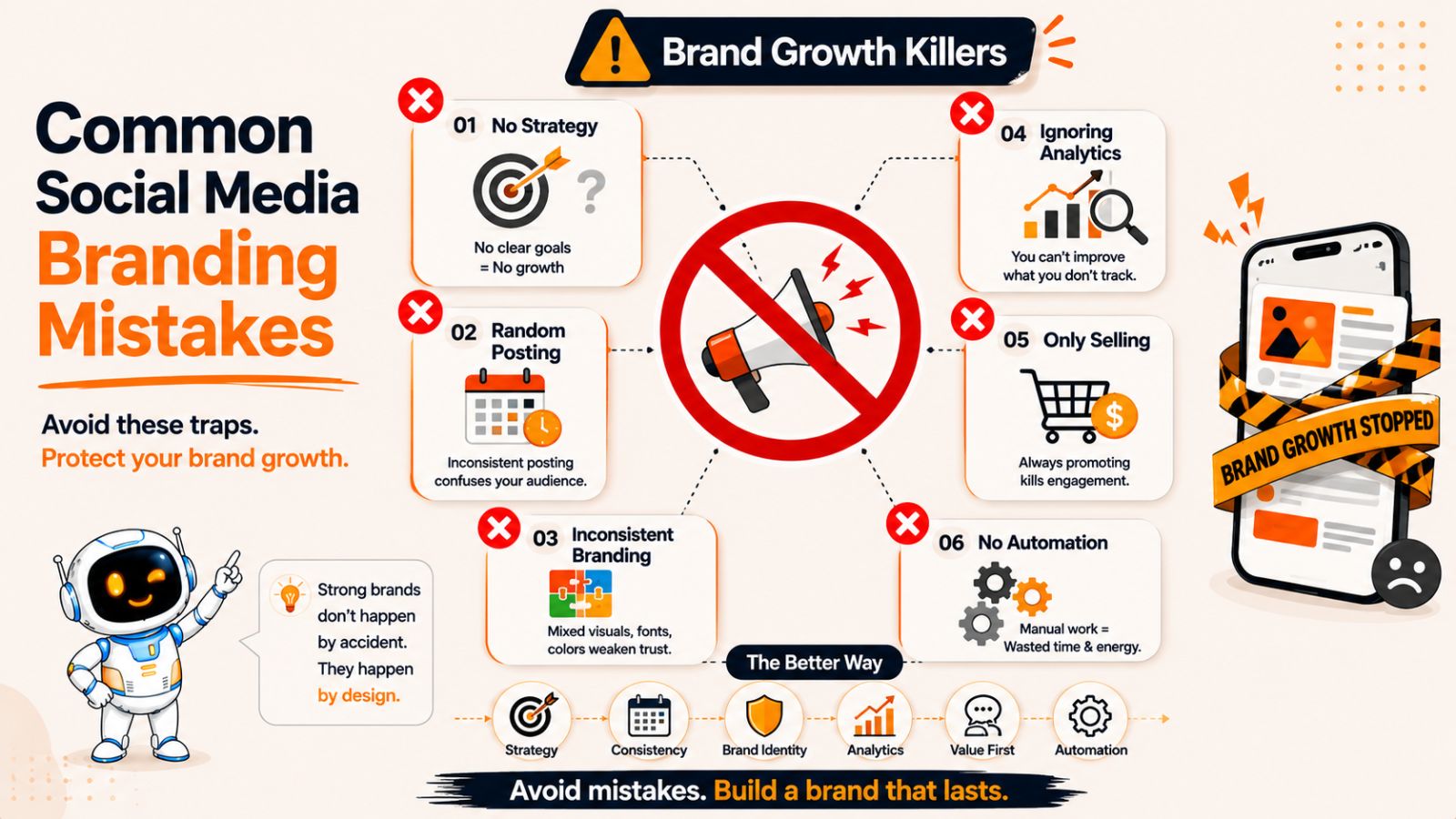
Building a strong brand on social media takes time, consistency, and strategic execution. Unfortunately, many businesses unknowingly undermine their own efforts by making avoidable mistakes that weaken brand recognition, reduce engagement, and slow growth.
The good news is that most social media branding mistakes are not caused by a lack of effort. They're usually the result of unclear strategy, inconsistent execution, or focusing on the wrong metrics.
Understanding these common pitfalls can help businesses build a stronger, more sustainable social media presence.
Posting Without a Clear Strategy
One of the most common mistakes businesses make is posting content without a defined purpose.
Many brands create content simply because they feel they need to post something. As a result, their social media feeds become a collection of unrelated updates, promotions, and random ideas.
Without a strategy, content often lacks:
- Consistent messaging
- Clear audience targeting
- Brand alignment
- Measurable objectives
High-growth companies take a different approach. Every piece of content supports a broader goal, whether it's increasing brand awareness, educating customers, generating leads, or strengthening community engagement.
Before publishing content, successful brands ask:
- Who is this for?
- What value does it provide?
- How does it support our brand?
- What outcome are we trying to achieve?
A clear strategy ensures that every post contributes to long-term brand growth.
Chasing Every Trend
Social media trends can generate short-term visibility, but blindly following every trend often damages brand consistency.
Many businesses jump from one viral format to another without considering whether the trend aligns with their audience, values, or positioning.
This creates confusion because audiences struggle to understand what the brand actually represents.
Successful companies evaluate trends carefully.
They participate when a trend:
- Aligns with their brand identity
- Provides value to their audience
- Supports their messaging
- Feels authentic
They avoid trends that may generate temporary attention but weaken long-term brand perception.
A strong brand should shape its content around its strategy—not the other way around.
Inconsistent Visual Branding
Visual consistency is one of the fastest ways to improve brand recognition.
Unfortunately, many businesses unintentionally create a fragmented visual identity by constantly changing:
- Colors
- Fonts
- Graphic styles
- Photography styles
- Video formats
When visual branding is inconsistent, audiences have difficulty recognizing content as it appears in their feeds.
High-growth brands establish clear design standards and apply them consistently across all platforms.
Over time, audiences begin to associate specific visual elements with the brand, increasing recognition and trust.
Consistency creates familiarity. Familiarity creates confidence.
Inconsistent Brand Voice
Just as visuals should remain consistent, messaging should also feel cohesive.
Many businesses sound professional one day, casual the next, and overly promotional the day after.
This inconsistency weakens brand personality and makes communication less memorable.
A consistent brand voice helps audiences understand:
- What the company stands for
- How it communicates
- What they can expect from future interactions
Whether your voice is educational, professional, conversational, or innovative, maintaining consistency strengthens your brand identity.
Focusing Only on Sales Content
Another common mistake is treating social media exclusively as a sales channel.
While promoting products and services is important, audiences rarely follow brands simply to receive advertisements.
When every post is focused on selling, engagement often declines because followers receive little value.
High-growth brands balance promotional content with:
- Education
- Entertainment
- Inspiration
- Industry insights
- Customer success stories
- Community engagement
A useful guideline is to provide significantly more value than promotion.
Brands that consistently help their audiences earn trust first and sales second.
Ignoring Audience Engagement
Social media is designed for conversation, yet many businesses use it as a one-way broadcasting platform.
They publish content but rarely respond to:
- Comments
- Questions
- Direct messages
- Mentions
- Community discussions
Ignoring engagement sends a message that the audience's participation doesn't matter.
Successful brands actively participate in conversations because engagement helps:
- Build relationships
- Increase loyalty
- Improve visibility
- Generate feedback
- Strengthen community connections
The most effective social media strategies treat engagement as an essential component of brand building rather than an optional task.
Neglecting Analytics and Performance Data
Many businesses create content without analyzing results.
As a result, they continue producing content that may not resonate with their audience.
Analytics provide valuable insights into:
- Engagement rates
- Audience behavior
- Content performance
- Growth trends
- Platform effectiveness
High-growth companies regularly review performance data to identify patterns and improve future content.
Data helps eliminate guesswork and enables smarter decision-making.
Trying to Be Everywhere at Once
Many brands believe they need to dominate every social media platform simultaneously.
In reality, spreading resources too thin often leads to mediocre performance everywhere.
Successful companies focus on platforms where their audience is most active and where their content naturally performs well.
Rather than trying to master every platform immediately, they prioritize quality and consistency on a few key channels before expanding.
A focused strategy typically delivers better results than a fragmented one.
Relying Entirely on Manual Processes
As content demands increase, manual workflows often become a major obstacle to growth.
Businesses frequently struggle with:
- Scheduling content
- Writing captions
- Managing multiple platforms
- Tracking analytics
- Maintaining consistency
These repetitive tasks consume valuable time and increase the likelihood of missed publishing opportunities.
High-growth companies solve this challenge through automation and centralized workflows.
Tools like Bibby help simplify content management by allowing businesses to create, schedule, publish, and analyze content from a single platform. With AI-generated captions, AI-optimized posting times, multi-platform publishing, video and story support, and integrated analytics, brands can maintain consistency without spending countless hours managing social media manually.
Measuring Success by Vanity Metrics Alone
Follower counts and impressions can provide useful context, but they rarely tell the full story.
Many businesses become overly focused on metrics that look impressive but have little impact on business outcomes.
Examples of vanity metrics include:
- Raw follower numbers
- Unqualified reach
- Temporary spikes in views
High-growth brands focus on metrics that reflect genuine brand strength, including:
- Engagement quality
- Audience retention
- Brand mentions
- Community growth
- Website traffic
- Lead generation
- Customer loyalty
These metrics provide a more accurate picture of long-term brand health.
Avoiding Mistakes Creates a Competitive Advantage
The most successful companies are not perfect. They simply avoid the mistakes that prevent growth.
By developing a clear strategy, maintaining consistency, engaging with audiences, leveraging analytics, and using efficient workflows, businesses can create a social media presence that strengthens brand awareness and drives meaningful business results.
The next step is understanding how to measure the impact of your efforts. After all, what gets measured gets improved, and the strongest brands use data to continuously refine their social media strategy.
You may also like looking into: Do Hashtags Still Matter?
Metrics That Actually Measure Brand Growth
One of the biggest challenges in social media marketing is determining whether your efforts are actually building a stronger brand.
Many businesses focus on surface-level metrics such as follower counts, likes, and impressions. While these numbers can provide useful context, they don't always reflect meaningful business impact.
A post can receive thousands of views and generate very little long-term value. Conversely, content with lower reach can create significant trust, engagement, and customer loyalty.
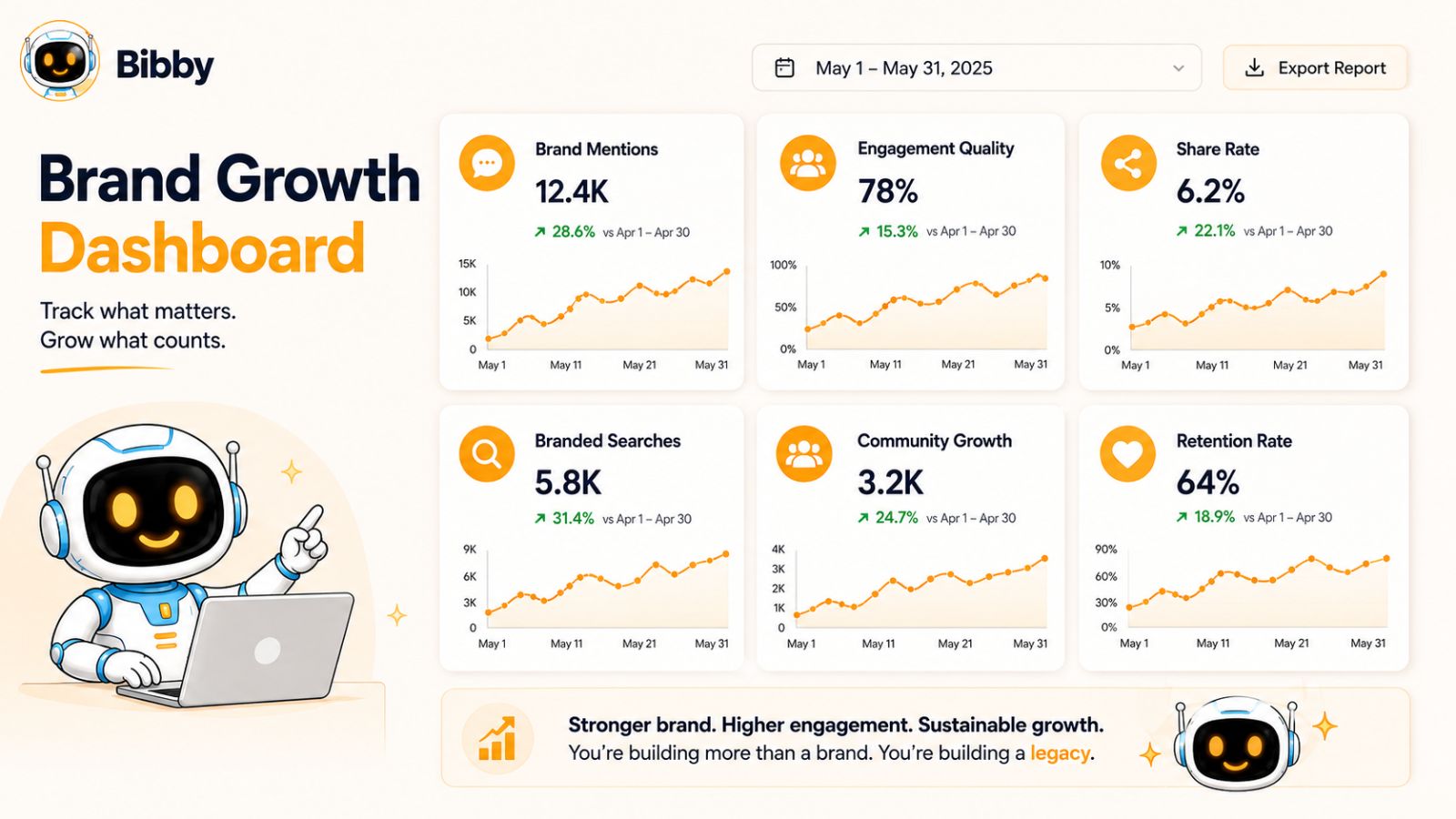
High-growth companies understand the difference between vanity metrics and growth metrics. Instead of measuring success solely by visibility, they track indicators that reveal whether their brand is becoming more recognizable, trusted, and influential.
The following metrics provide a more accurate picture of social media brand growth.
Brand Mentions: Measuring Brand Awareness
One of the strongest indicators of brand growth is how often people talk about your business.
Brand mentions occur whenever users reference your company online, whether through:
- Social media posts
- Comments
- Reviews
- Blog articles
- Industry discussions
- User-generated content
An increase in brand mentions often indicates growing awareness and relevance within your market.
Pay close attention to:
- Mention volume
- Mention sentiment
- Influencer mentions
- Industry recognition
A brand that people actively discuss is a brand that is gaining visibility and influence.
Engagement Quality: Measuring Audience Connection
Not all engagement is equal.
A simple "like" requires minimal effort. A thoughtful comment, share, or conversation demonstrates much deeper audience interest.
High-growth companies focus on engagement quality rather than engagement quantity.
Strong indicators include:
- Meaningful comments
- Direct messages
- Conversation threads
- Questions from followers
- Community participation
These interactions often signal stronger audience relationships and higher trust levels.
When people actively engage with your content, they are investing attention in your brand.
Share Rate: Measuring Content Value
Shares are one of the most valuable social media metrics.
When someone shares your content, they are effectively endorsing it to their own audience.
High share rates often indicate that content is:
- Helpful
- Insightful
- Entertaining
- Relevant
- Memorable
Content that consistently earns shares can dramatically expand brand reach while strengthening credibility.
Many high-growth brands prioritize creating highly shareable content because it amplifies visibility organically.
Branded Search Volume: Measuring Brand Recognition
Branded search volume refers to the number of people searching specifically for your company, products, or brand name.
Examples include searches such as:
- Your company name
- Your product name
- Your founder's name
- Brand-related keywords
Growing branded search volume often indicates that more people are becoming aware of your business and actively seeking information about it.
This metric is particularly valuable because it reflects genuine interest rather than passive exposure.
When people remember your brand enough to search for it directly, your branding efforts are working.
Direct Website Traffic: Measuring Brand Recall
Direct traffic occurs when visitors type your website address directly into their browser or access your site through saved bookmarks.
This often suggests strong brand recall because users already know who you are and where to find you.
Increasing direct traffic can indicate:
- Improved brand awareness
- Stronger customer loyalty
- Successful social media branding
- Greater audience familiarity
Many high-growth companies view direct traffic as one of the strongest indicators of long-term brand strength.
Audience Growth Quality: Measuring Relevance
Follower growth remains useful, but quality matters more than quantity.
A rapidly growing audience is only valuable if the followers align with your target market.
Successful brands evaluate:
- Audience relevance
- Industry fit
- Engagement levels
- Customer potential
An audience of highly engaged prospects is far more valuable than a large audience with little interest in your products or services.
Focus on attracting the right people rather than simply increasing numbers.
Community Growth: Measuring Loyalty
Strong brands don't just build audiences—they build communities.
Community growth can be measured through:
- Group membership
- Repeat engagement
- Returning viewers
- Active contributors
- User-generated content participation
A thriving community often leads to:
- Increased loyalty
- Stronger advocacy
- Higher retention
- Organic referrals
Communities create network effects that strengthen brand growth over time.
Customer Retention and Repeat Business
One of the clearest indicators of brand strength is customer retention.
People who trust your brand are more likely to:
- Purchase again
- Upgrade services
- Recommend your company
- Engage with content consistently
While retention is influenced by many factors, strong branding often plays a significant role.
Customers frequently remain loyal to brands they recognize, trust, and feel connected to.
Sentiment Analysis: Measuring Brand Perception
Awareness alone is not enough.
Businesses must also understand how audiences feel about their brand.
Sentiment analysis helps evaluate whether conversations are:
- Positive
- Neutral
- Negative
Monitoring sentiment can reveal:
- Customer satisfaction trends
- Reputation risks
- Content effectiveness
- Brand perception shifts
A growing brand with positive sentiment is generally in a strong position for long-term success.
Content Performance Trends
Instead of analyzing individual posts in isolation, successful companies focus on broader performance trends.
Questions they ask include:
- Which content pillars perform best?
- Which topics generate the most engagement?
- Which formats drive the strongest results?
- What posting times produce the highest reach?
Tracking long-term trends helps brands continuously improve their strategy and maximize results.
This is one reason why integrated analytics platforms have become so valuable. Tools like Bibby allow businesses to monitor performance across multiple social media platforms from a centralized dashboard, making it easier to identify successful content patterns and optimize future campaigns.
Building a Data-Driven Brand Strategy
Metrics should do more than measure success—they should guide future decisions.
High-growth companies use data to:
- Refine messaging
- Improve content quality
- Strengthen audience relationships
- Increase efficiency
- Allocate resources effectively
The goal is not to track every available metric. The goal is to focus on the indicators that best reflect brand awareness, trust, engagement, and business growth.
The Brands That Win Measure What Matters
The strongest brands are built intentionally.
They don't rely on assumptions or guesswork. They continuously evaluate performance, learn from audience behavior, and adapt their strategies based on real data.
While follower counts and impressions may look impressive, true brand growth is reflected in trust, loyalty, recognition, engagement, and customer advocacy.
When businesses focus on the right metrics, they gain a clearer understanding of what drives growth and how to strengthen their brand over time.
As social media continues to evolve, the companies that combine strong branding, valuable content, consistent execution, and data-driven optimization will be best positioned to outperform competitors and build lasting market influence.
Also read: 15 Proven Strategies to Create Viral Social Media Content
Future Trends in Social Media Brand Building
Social media has never stood still, and the pace of change continues to accelerate. New technologies, evolving consumer behaviors, and shifting platform algorithms are constantly reshaping how brands connect with audiences.
The companies that thrive over the next decade will be those that adapt early while remaining committed to the fundamentals of trust, consistency, and value creation.
Although no one can predict every change, several emerging trends are already transforming the future of social media brand building.
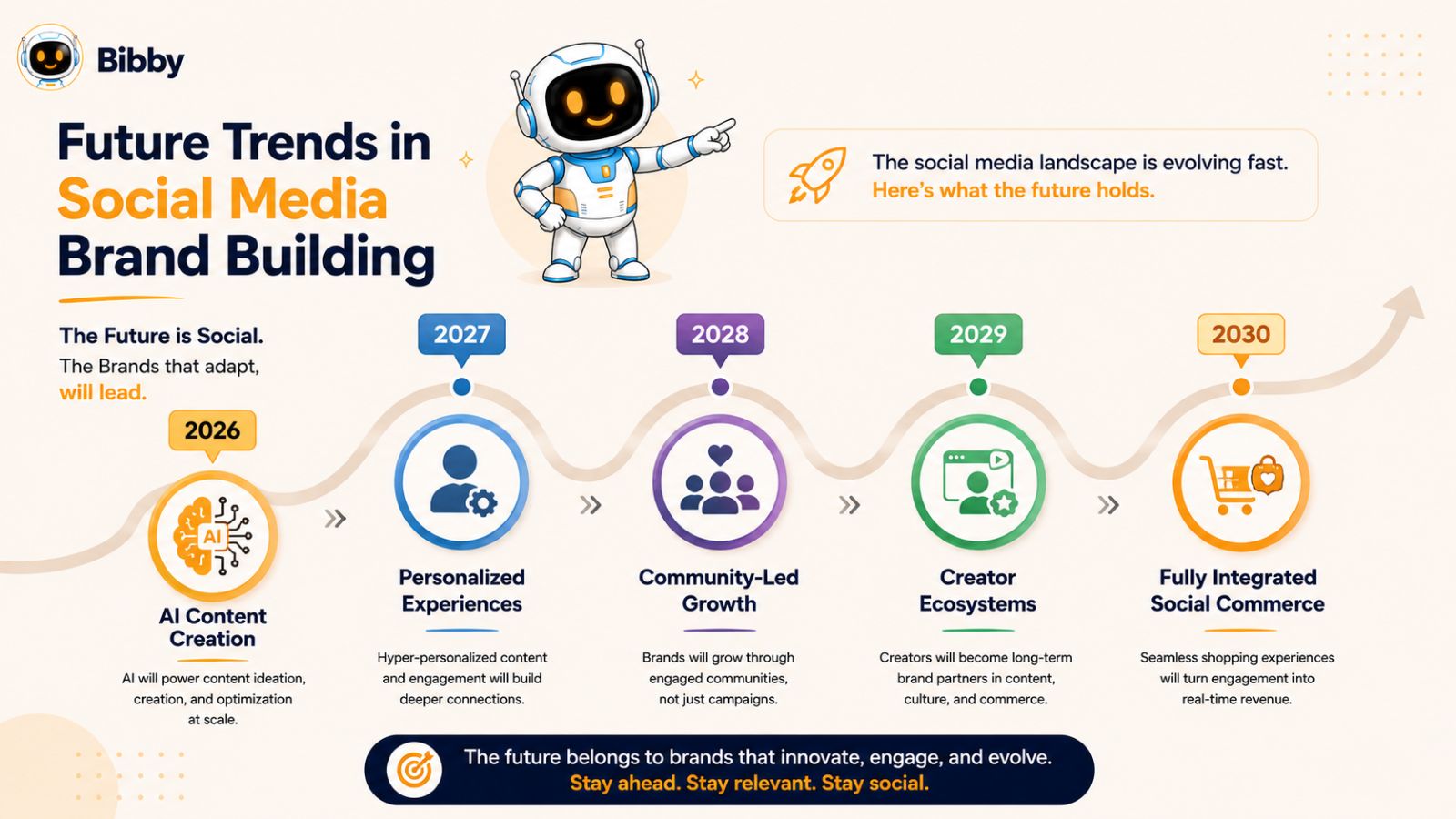
AI-Powered Content Creation Will Become the Norm
Artificial intelligence is rapidly changing how businesses create and distribute content.
What once required hours of manual work can now be completed in minutes with the right tools.
AI is helping brands:
- Generate content ideas
- Create captions
- Produce images
- Optimize publishing schedules
- Analyze performance data
- Personalize messaging
Rather than replacing marketers, AI is enabling teams to focus more on strategy, creativity, and audience relationships.
Businesses that successfully integrate AI into their workflows will gain significant efficiency advantages while maintaining consistent content production.
Personalization Will Drive Higher Engagement
Modern consumers expect personalized experiences.
Generic content is becoming less effective as audiences increasingly seek information that feels relevant to their specific interests and needs.
Future social media strategies will rely more heavily on:
- Audience segmentation
- Personalized recommendations
- Dynamic content delivery
- Behavioral targeting
- Context-aware messaging
Brands that understand their audiences deeply will be better positioned to create content that resonates and drives engagement.
Community-Led Growth Will Outperform Audience Building
For years, social media success was measured by audience size.
The future belongs to brands that build communities rather than simply accumulating followers.
Communities create stronger relationships because members:
- Engage more frequently
- Share content organically
- Provide feedback
- Advocate for the brand
- Support other community members
As algorithms become increasingly competitive, community engagement will become one of the most valuable growth assets a brand can possess.
Successful companies will invest more heavily in fostering conversations, encouraging participation, and creating spaces where customers feel connected.
Short-Form Video Will Continue to Dominate
Video consumption continues to grow across virtually every major platform.
Short-form formats have become particularly powerful because they align with modern content consumption habits.
Platforms such as:
- TikTok
- Instagram Reels
- Facebook Reels
- YouTube Shorts
have demonstrated that concise, engaging videos can generate massive reach and engagement.
Future social media strategies will increasingly prioritize:
- Educational micro-content
- Product demonstrations
- Behind-the-scenes videos
- Founder content
- Storytelling-based videos
Brands that become skilled at communicating value quickly will have a competitive advantage.
Authenticity Will Become Even More Important
As AI-generated content becomes more common, authenticity will become a stronger differentiator.
Audiences are becoming increasingly sophisticated and can often recognize content that feels overly automated or disconnected from real experiences.
Future brand-building efforts will place greater emphasis on:
- Human stories
- Transparent communication
- Customer experiences
- Founder-led content
- Real-world insights
The brands that combine technology with genuine human connection will be best positioned to earn trust.
Creator Partnerships Will Expand Brand Reach
Consumers increasingly trust creators and industry experts more than traditional advertising.
As a result, many brands are shifting resources toward creator collaborations and influencer partnerships.
These partnerships can help businesses:
- Access new audiences
- Increase credibility
- Generate authentic content
- Strengthen social proof
The most successful collaborations will feel natural and aligned with brand values rather than purely promotional.
Social Commerce Will Continue Growing
The line between content and commerce is becoming increasingly blurred.
Social platforms are investing heavily in shopping experiences that allow users to discover and purchase products without leaving the app.
Future brand strategies will likely incorporate:
- Shoppable posts
- Live shopping events
- Product demonstrations
- Creator-driven commerce
- Integrated checkout experiences
Brands that effectively combine storytelling with commerce will benefit from shorter customer journeys and increased conversions.
Automation Will Become a Competitive Necessity
As content demands continue to increase, manual workflows will become increasingly difficult to sustain.
Businesses will need systems that allow them to:
- Create content efficiently
- Publish consistently
- Manage multiple platforms
- Analyze performance
- Scale operations
This is where automation platforms will play a critical role.
Instead of managing separate tools for content creation, scheduling, publishing, and analytics, businesses will increasingly adopt centralized solutions that streamline the entire workflow.
Platforms like Bibby represent this shift toward simplified social media management. By enabling businesses to generate content, create captions, schedule posts at AI-optimized times, publish across multiple platforms, manage videos and stories, and track analytics from one dashboard, automation becomes a practical growth advantage rather than just a convenience.
Data-Driven Decision Making Will Separate Leaders From Followers
The future of social media marketing belongs to brands that can transform data into actionable insights.
Successful companies will increasingly rely on analytics to understand:
- Audience preferences
- Content performance
- Engagement patterns
- Customer behavior
- Platform opportunities
This data-driven approach allows brands to adapt faster, optimize more effectively, and allocate resources where they create the greatest impact.
The Future Belongs to Brands That Combine Technology and Trust
While technologies and platforms will continue evolving, one principle remains constant: people buy from brands they trust.
The most successful companies of the future will combine:
- Strong brand positioning
- Valuable content
- Authentic communication
- Community engagement
- AI-powered efficiency
- Data-driven decision making
Technology can help brands scale, but trust remains the foundation of sustainable growth.
Businesses that embrace innovation while maintaining genuine connections with their audiences will be best positioned to build influential brands in the years ahead.
The future of social media brand building isn't about choosing between human creativity and automation. It's about using technology to amplify creativity, strengthen relationships, and create consistent experiences that audiences remember and trust.
Conclusion
The brands that achieve exceptional growth on social media are rarely the ones chasing every trend or publishing the most content. Instead, they focus on building a recognizable identity, creating valuable content consistently, and developing systems that allow them to scale without sacrificing quality.
Throughout this guide, we've explored three critical lessons. First, consistency outperforms occasional viral success when it comes to long-term brand building. Second, successful companies create trust through strategic content, strong positioning, and meaningful audience engagement. Third, the fastest-growing brands leverage AI and automation to maintain momentum while reducing manual workload.
As social media becomes increasingly competitive, businesses that combine strong branding with efficient execution will have a significant advantage. Platforms like Bibby help make this possible by simplifying content creation, generating captions automatically, scheduling posts at AI-optimized times, publishing across Facebook, Instagram, LinkedIn, YouTube, and TikTok, and providing analytics that support smarter decision-making.
Brand building on social media is not a one-time campaign—it's an ongoing process that compounds over time. The businesses that invest in consistent execution today will be the brands audiences recognize, trust, and choose tomorrow.
The next step is learning how to build a scalable social media content strategy that turns your brand-building efforts into a predictable system for audience growth, engagement, and lead generation.