
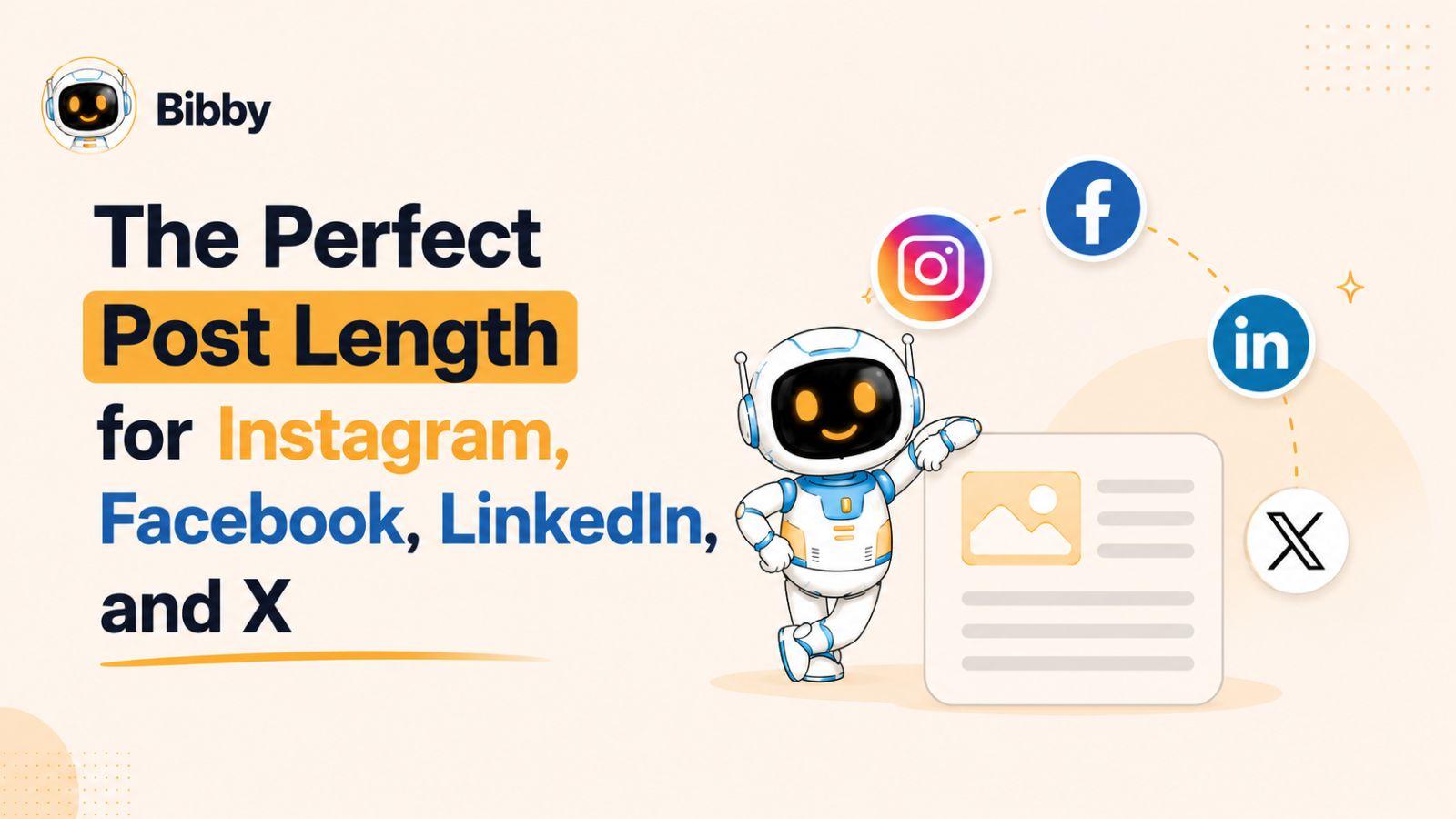
The ideal social media post length can be the difference between content that gets ignored and content that drives meaningful engagement.
If you've ever wondered why the same post performs well on one platform but falls flat on another, post length is often part of the answer. Each platform has unique audience behaviors, algorithms, and content formats, making it essential to optimize your captions and posts accordingly.
While there is no universal character count that works everywhere, there are proven guidelines that can help you maximize reach, engagement, and conversions. Let's explore the optimal post lengths for each major social media platform and how to streamline the entire process.
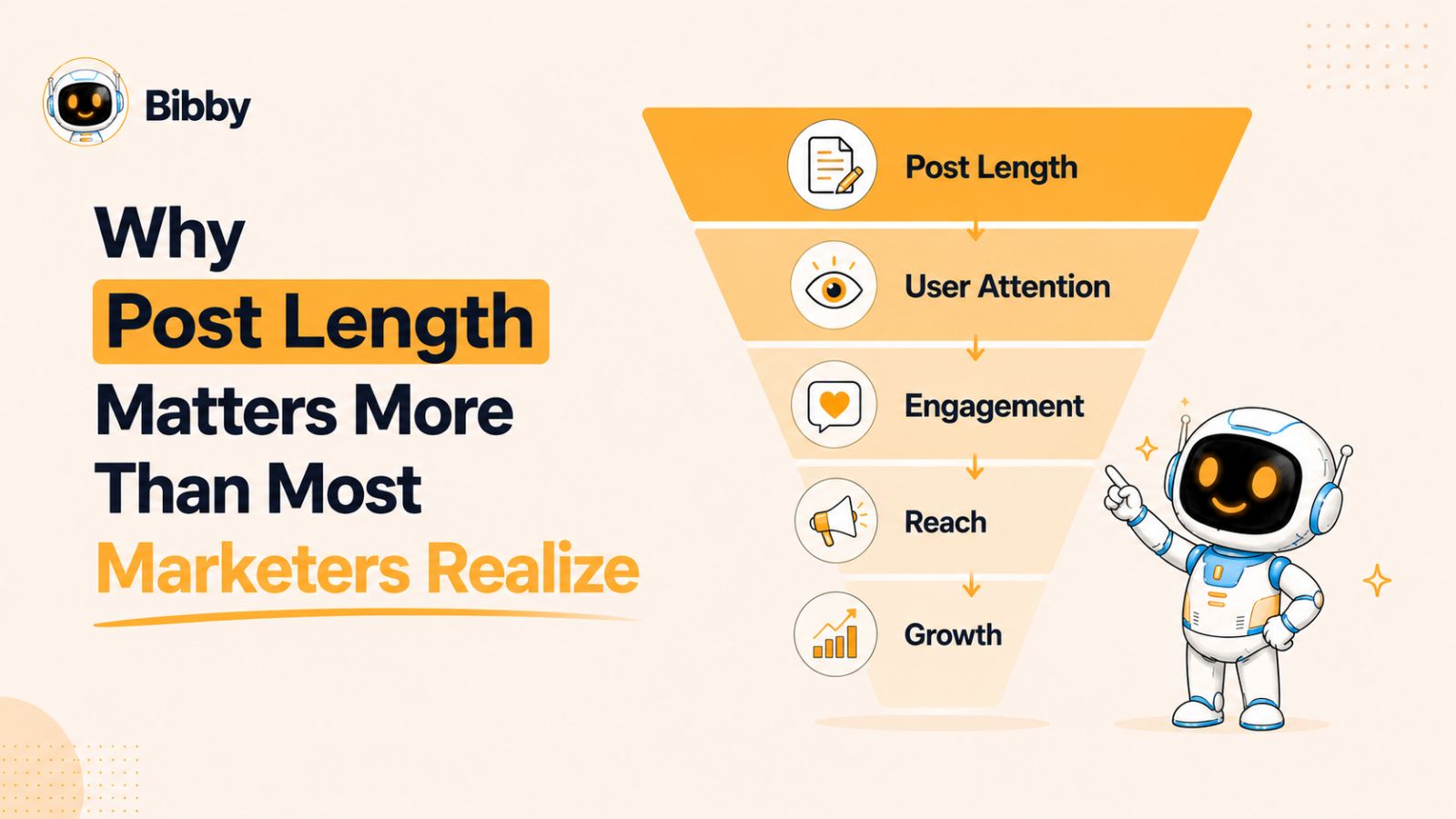
Why Post Length Matters More Than Most Marketers Realize
Many marketers focus heavily on visuals, hashtags, and posting frequency while overlooking one of the most influential factors behind social media performance: post length.
The number of characters in a post affects how users interact with your content, how much information they absorb, and whether platform algorithms consider your content engaging enough to show to more people. While a short caption may work exceptionally well on one platform, the same approach can significantly limit results on another.
Every Social Platform Has Different User Behavior
People use social media platforms for different reasons. Instagram users often engage with visual content and quick captions, while LinkedIn audiences are generally more willing to consume longer professional insights. Facebook users tend to respond well to conversational content, and X thrives on concise, attention-grabbing messages.
Understanding these differences helps you create content that matches audience expectations instead of forcing the same message everywhere.
Also read: Do Hashtags Still Matter? What Social Media Algorithms Really Want
Post Length Influences Engagement Rates
The right post length can encourage users to stop scrolling, read your content, and interact with it. If a post is too short, it may lack context or value. If it's too long, users may lose interest before reaching your main point.
Successful social media content strikes a balance between providing value and respecting the audience's attention span.
Why Copy-Pasting Across Platforms Often Fails
One of the most common mistakes businesses make is publishing identical captions on every social network. Although this saves time, it often reduces engagement because each platform rewards different content formats and user behaviors.
A caption that performs well on LinkedIn may feel overwhelming on Instagram, while a short X post may not provide enough detail for LinkedIn readers.
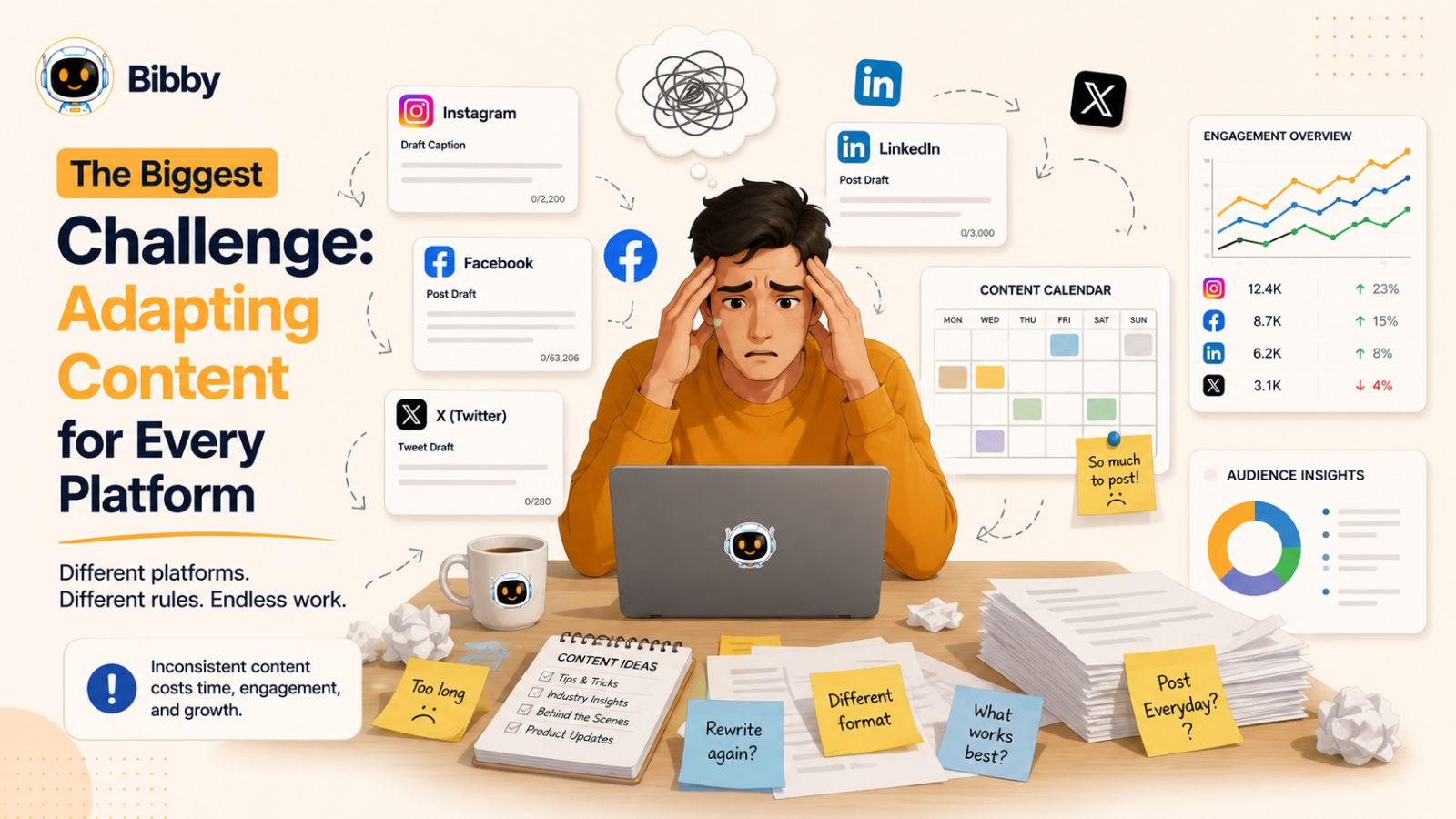
The Challenge of Optimizing Every Post
Creating unique content for every platform can quickly become overwhelming, especially for businesses managing multiple social accounts. Writing captions, resizing media, choosing posting times, and tracking performance all require significant effort.
This is where automation becomes valuable. Tools like Bibby simplify the entire workflow by allowing you to upload or generate images with AI, choose your preferred posting style, automatically generate platform-specific captions, and schedule content across Facebook, Instagram, LinkedIn, YouTube, TikTok, and other networks. Bibby can even publish content at AI-optimized times and provide analytics to help improve future performance.
The result is a more efficient content strategy that allows businesses to focus on growth instead of manual social media management.
Understanding Social Media Post Length Fundamentals
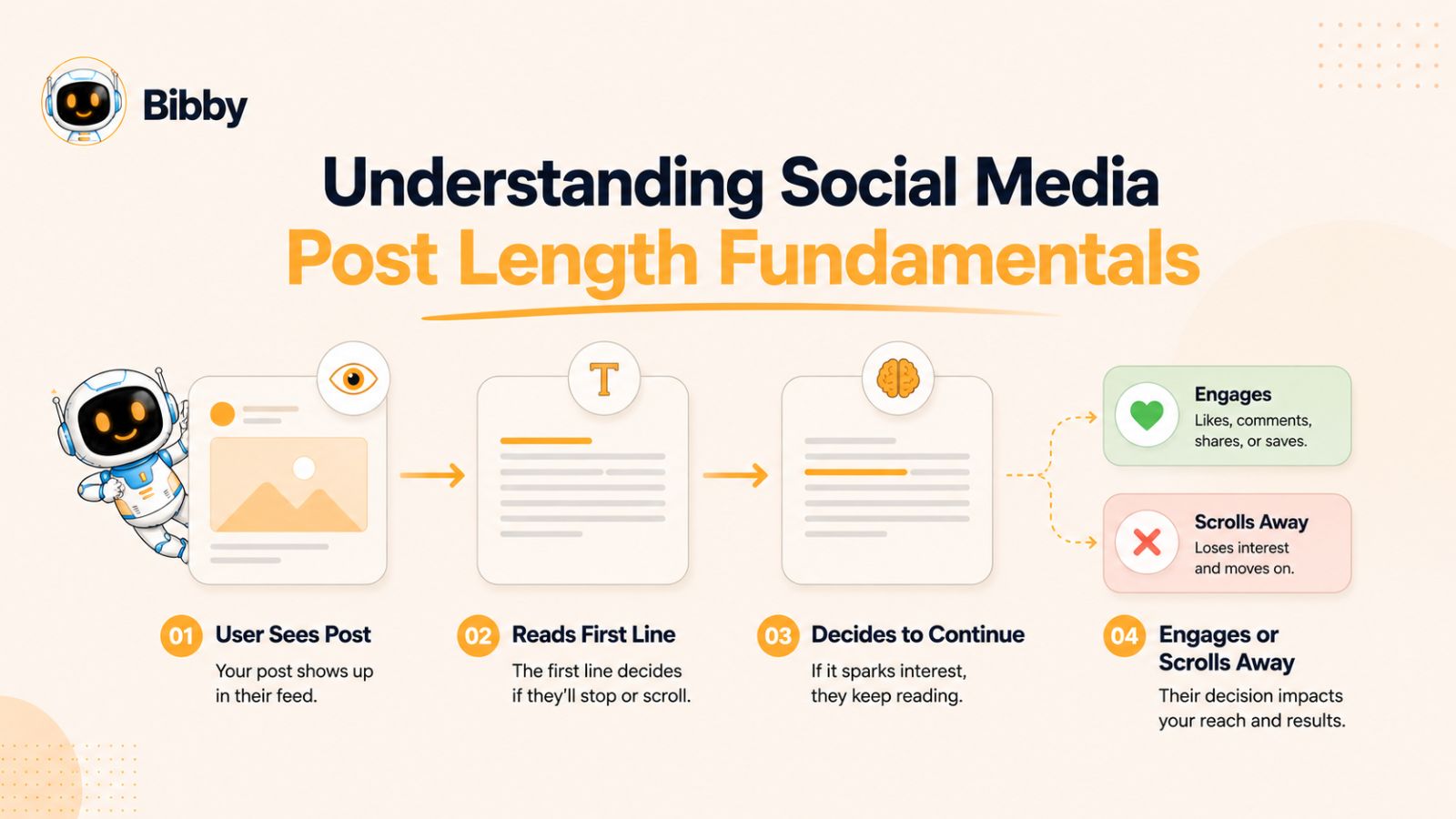
Before diving into the ideal character counts for each platform, it's important to understand what post length actually means and why it matters. The goal isn't simply to make posts shorter or longer. Instead, it's about delivering the right amount of information in a format that encourages engagement and aligns with how people consume content on each platform.
Characters vs. Words: What Really Matters?
Most social media platforms measure content using character limits rather than word counts. However, users don't read characters—they read ideas.
A post with 100 carefully chosen characters can outperform a 500-character post if it delivers a clear message quickly. At the same time, a longer post may generate more engagement when the audience expects deeper insights or storytelling.
When evaluating post length, focus on clarity, value, and readability rather than chasing a specific number.
Different Content Types Require Different Lengths
Not every social media format follows the same rules. A feed post, story, video description, and carousel caption all serve different purposes.
For example:
- Instagram feed posts often benefit from concise but engaging captions.
- LinkedIn posts can support detailed professional insights.
- Facebook discussions may require additional context.
- X posts perform best when they communicate a message quickly.
- Video descriptions often need more detail, keywords, and calls to action.
The ideal length depends not only on the platform but also on the content format you're publishing.
Audience Intent Shapes Content Consumption
People visit each platform with different expectations.
Someone scrolling Instagram may be looking for entertainment, inspiration, or quick updates. A LinkedIn user is often searching for industry insights, career advice, or professional discussions. Facebook audiences frequently engage with personal stories and community-focused content, while X users typically expect fast-moving conversations and timely information.
Matching your content length to audience expectations can significantly improve engagement.
Mobile Users Reward Readable Content
Most social media content is consumed on mobile devices. This means readability is just as important as length.
Large blocks of text can discourage users from reading, even when the information is valuable. Breaking content into shorter paragraphs, using line spacing, and placing important points near the beginning can improve readability across all platforms.
The easier your content is to consume, the more likely users are to engage with it.
Quality Always Beats Quantity
Many marketers become obsessed with finding the perfect character count. While platform-specific guidelines are useful, content quality remains the most important factor.
A compelling 50-character post will often outperform a boring 500-character post. Likewise, a valuable long-form post can generate excellent results when the audience is interested in the topic.
The best-performing social media content combines the right length with strong messaging, clear structure, and genuine value.
Why Automation Is Becoming Essential
As brands expand across multiple social networks, manually adapting content for every platform becomes increasingly difficult. Each network has different character recommendations, content formats, image dimensions, and posting schedules.
Rather than creating and managing everything separately, many businesses use tools like Bibby to streamline the process. With a simple workflow, you can upload an image or generate one with AI, select your preferred posting style, let Bibby generate captions automatically, and schedule content across Facebook, Instagram, LinkedIn, YouTube, TikTok, and other platforms. AI-powered scheduling helps determine optimal publishing times, while built-in analytics make it easier to measure results and improve performance over time.
Now that we've covered the fundamentals, let's examine the ideal post length for each major social media platform, starting with Instagram.
Perfect Instagram Post Length
Instagram may be one of the most visual social media platforms, but captions still play a major role in engagement, discoverability, and audience connection. The ideal Instagram caption length depends on your goals, content type, and audience, but understanding when to use short, medium, or long captions can significantly improve performance.
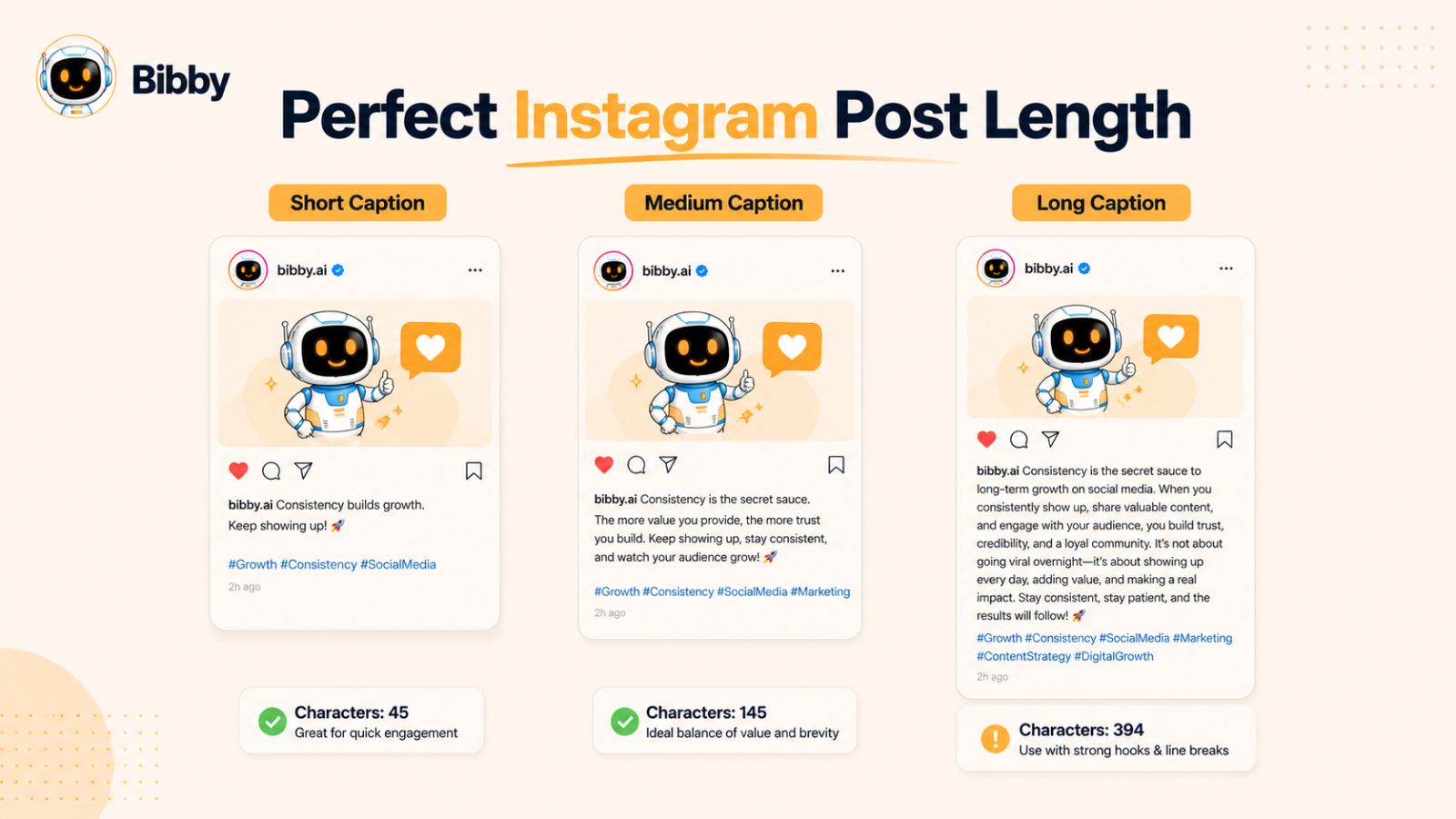
Short Instagram Captions (50–150 Characters)
Short captions work best when the image or video already communicates most of the message. They are quick to consume and can encourage users to focus on the visual content.
Short captions are ideal for:
- Product photos
- Lifestyle content
- Inspirational posts
- Simple announcements
- Brand awareness campaigns
A concise caption paired with a strong image can often generate higher engagement because users can absorb the message immediately without additional effort.
Medium Instagram Captions (150–500 Characters)
For many brands, this is the sweet spot. Medium-length captions provide enough space to tell a story, add context, or include a call to action without overwhelming readers.
These captions work well for:
- Customer success stories
- Educational content
- Product highlights
- Behind-the-scenes updates
- Community engagement posts
This length allows brands to create a stronger connection with their audience while maintaining readability.
Long Instagram Captions (500–2,200 Characters)
Long captions can perform exceptionally well when they provide meaningful value. Instagram users are increasingly willing to read longer content when it is educational, entertaining, or emotionally engaging.
Long-form captions are commonly used for:
- Personal stories
- Thought leadership content
- Detailed tutorials
- Case studies
- Brand storytelling
The key is ensuring that every sentence contributes value. Long captions should never feel long for the sake of being long.
The First 125 Characters Matter Most
Instagram typically truncates captions in the feed, meaning users often see only the opening portion before needing to tap "more."
Because of this, your first 125 characters should:
- Capture attention immediately
- Create curiosity
- Communicate a clear benefit
- Encourage users to continue reading
A strong opening hook often has a greater impact than the overall caption length.
Instagram Reels Caption Length Best Practices
Reels are designed for quick content consumption, but captions still provide important context and engagement opportunities.
For most Reels, aim for:
- A compelling first sentence
- A concise explanation of the video
- A clear call to action
- Relevant hashtags
Captions between 100 and 300 characters often perform well because they complement the video without distracting from it.
Instagram Stories Text Recommendations
Stories require an even shorter approach. Since viewers move through stories quickly, text should be easy to read within seconds.
Best practices include:
- Keep text concise
- Focus on one message per story
- Use clear calls to action
- Avoid overcrowding slides with text
The simpler the message, the easier it is for viewers to absorb.
Instagram Caption Best Practices
Regardless of length, successful Instagram captions often include:
- A strong opening hook
- Clear formatting and spacing
- A conversational tone
- A call to action
- Relevant hashtags when appropriate
The objective is not to maximize character count but to maximize engagement and value.
Creating Instagram Content Faster With Bibby
Writing unique Instagram captions consistently can become time-consuming, especially when managing multiple social platforms.
Bibby simplifies the process with an AI-powered workflow designed for modern content creators and businesses. Simply upload an image or generate one using AI, choose your preferred posting style, and Bibby automatically creates platform-optimized captions. From there, you can schedule content across Instagram, Facebook, LinkedIn, YouTube, TikTok, and other networks at AI-optimized posting times.
Whether you're publishing feed posts, Reels, Stories, videos, or other content formats, Bibby helps automate the creation, scheduling, and performance tracking process from a single dashboard.
Key Instagram Takeaways
- Short captions work best for visually driven content.
- Medium-length captions provide an effective balance of value and readability.
- Long captions can generate strong engagement when they offer meaningful insights or storytelling.
- The first 125 characters are often the most important part of the caption.
- Consistency matters more than finding one perfect character count.
Perfect Facebook Post Length
Facebook remains one of the most versatile social media platforms, supporting everything from short status updates and community discussions to videos, live streams, and long-form storytelling. Because users engage with a wide variety of content, there is no single perfect post length. However, certain ranges consistently perform better depending on the objective.
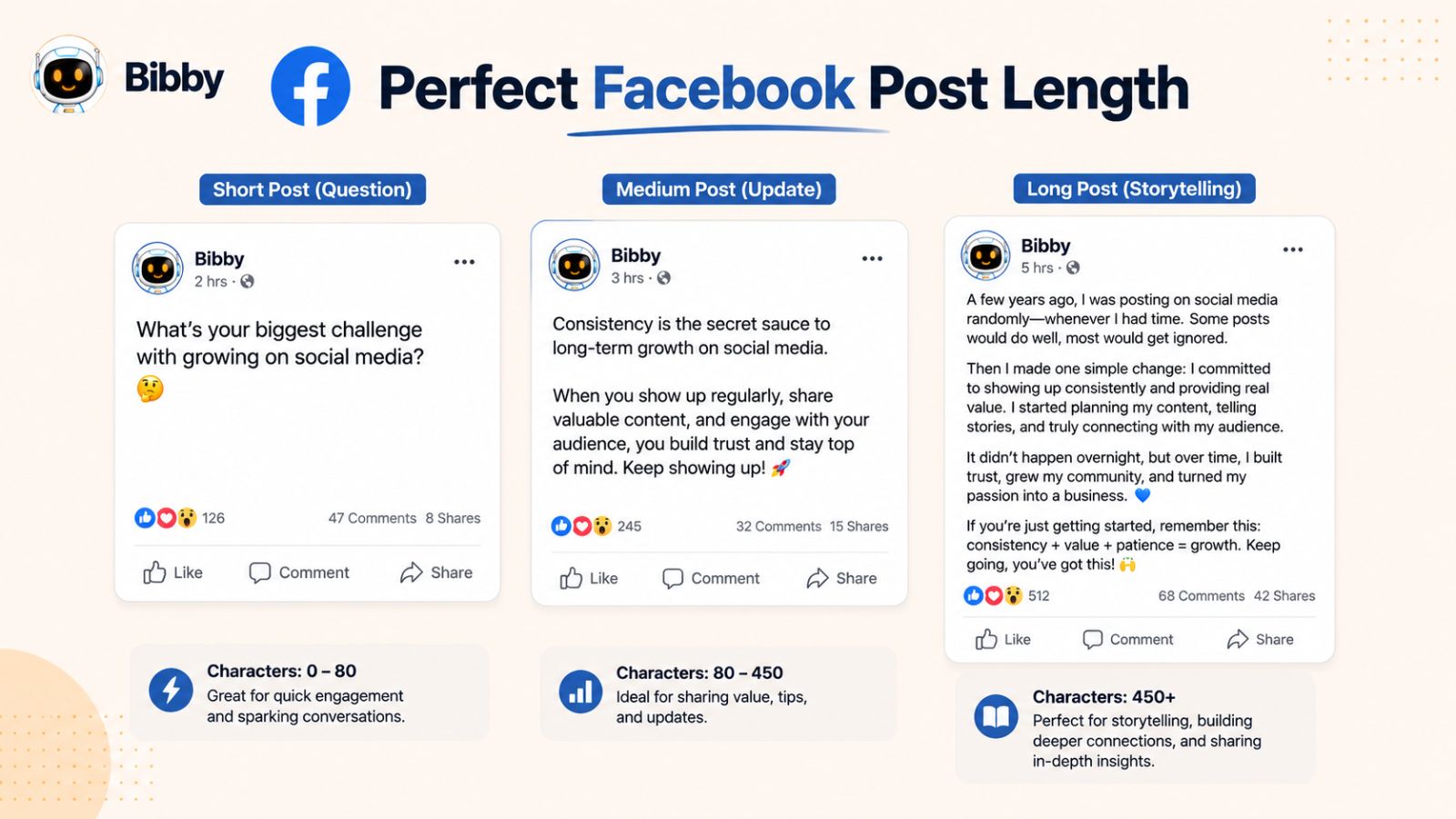
Short Facebook Posts (Under 80 Characters)
Short posts are easy to consume and often generate strong engagement because they quickly communicate a message without requiring much effort from the reader.
These posts work particularly well for:
- Questions
- Polls
- Event reminders
- Promotions
- Quick announcements
A concise post encourages users to react, comment, or share without feeling overwhelmed by information.
Medium-Length Facebook Posts (80–250 Characters)
For most businesses, medium-length posts provide the ideal balance between brevity and context.
This range gives you enough space to:
- Explain a key message
- Introduce a product or service
- Share valuable insights
- Encourage audience interaction
- Include a call to action
Many successful Facebook posts fall within this range because they are detailed enough to provide value while remaining easy to read on mobile devices.
Long Facebook Posts (250+ Characters)
Long-form Facebook content can perform exceptionally well when it tells a compelling story or provides meaningful information.
Longer posts are often effective for:
- Customer success stories
- Brand storytelling
- Educational content
- Case studies
- Community discussions
The secret is keeping the content engaging from the first sentence. If the opening fails to capture attention, readers may never reach the most valuable part of the post.
Facebook Video Description Length
Video content continues to dominate Facebook engagement, making descriptions an important component of your strategy.
An effective video description should:
- Explain the video's value quickly
- Include important keywords naturally
- Encourage viewers to watch
- Provide a clear call to action
Most successful video descriptions prioritize clarity over length and focus on driving viewers toward the content.
Facebook Group Post Best Practices
Facebook Groups often reward more detailed conversations than regular feed posts.
Within groups, longer posts may perform better because members are typically seeking:
- Advice
- Recommendations
- Industry discussions
- Community interaction
- Educational content
When posting in groups, focus on creating discussion rather than broadcasting promotional messages.
Why Facebook Engagement Depends on Relevance
While character counts can influence performance, relevance remains the biggest factor in Facebook engagement.
Posts that solve problems, answer questions, entertain audiences, or create conversations consistently outperform content that focuses solely on promotion.
Instead of asking, "How long should this post be?" ask, "How much information is needed to deliver value?"
Scaling Facebook Content With Bibby
Maintaining an active Facebook presence requires more than simply writing posts. Businesses must also create visuals, adapt content formats, schedule publications, monitor engagement, and analyze performance.
Bibby streamlines this entire workflow. Users can upload images or generate visuals with AI, select a preferred posting style, and let Bibby automatically generate optimized captions. Content can then be scheduled across Facebook, Instagram, LinkedIn, YouTube, TikTok, and other platforms at AI-optimized posting times.
In addition to feed posts, Bibby supports videos, stories, and multiple content formats while providing analytics that help businesses understand what content performs best.
Key Facebook Takeaways
- Posts under 80 characters work well for quick engagement.
- Posts between 80 and 250 characters often provide the best balance of readability and context.
- Long-form posts can generate strong results when they tell compelling stories.
- Video descriptions should focus on value and clarity.
- Relevance and audience interest matter more than character count alone.
- Consistent publishing becomes easier with automation and AI-powered scheduling.
Also read: How to Build a Strong LinkedIn Presence: Proven Strategies That Work
Perfect LinkedIn Post Length
LinkedIn is unique among major social media platforms because users actively seek professional insights, industry knowledge, career advice, and business discussions. As a result, LinkedIn generally rewards more thoughtful and informative content than platforms primarily focused on entertainment.
While there is no universal character count that guarantees success, understanding how different post lengths perform can help you create content that attracts attention, encourages engagement, and establishes credibility.
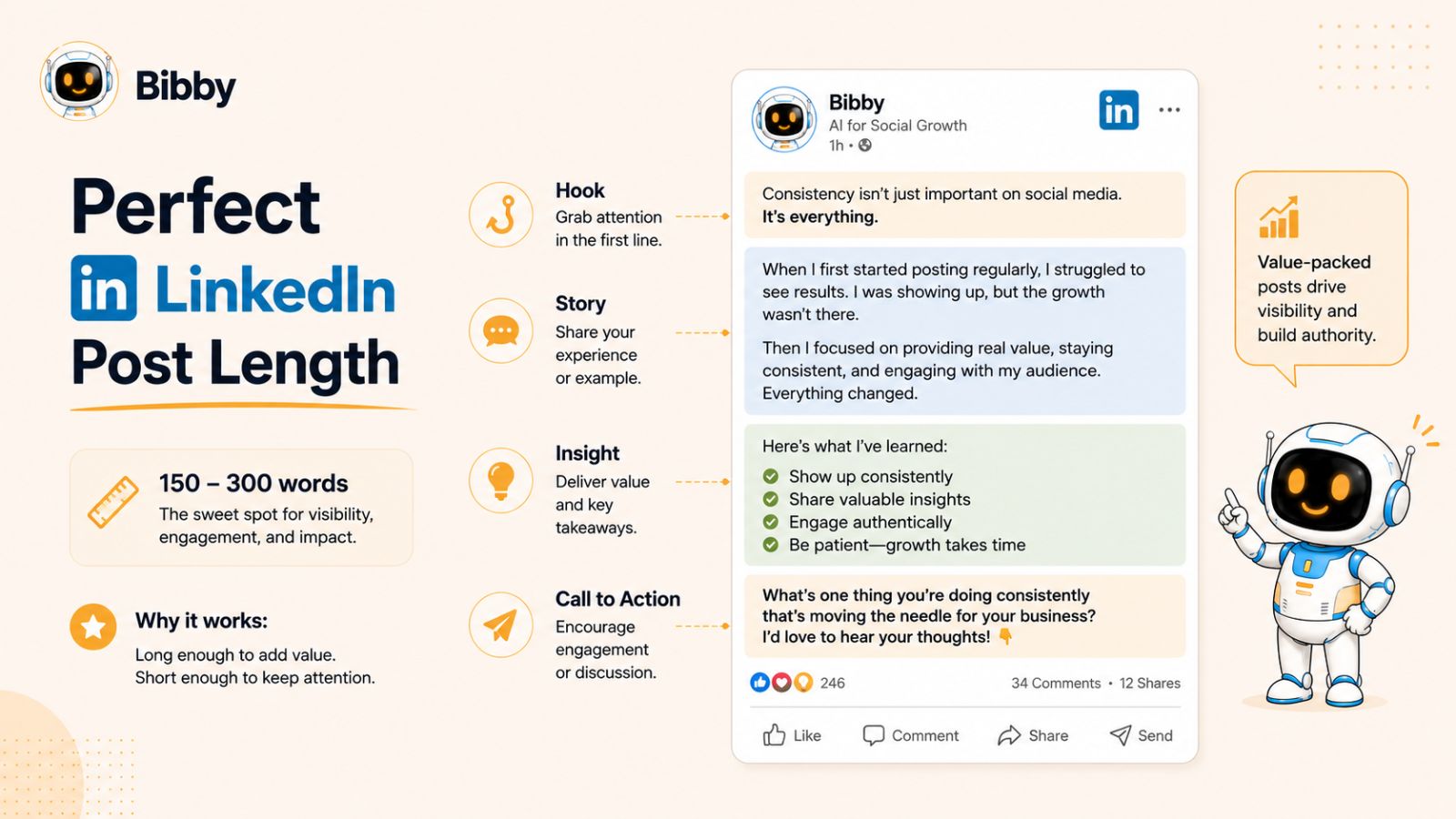
Short LinkedIn Posts (150–300 Characters)
Short LinkedIn posts are ideal for quick updates, observations, and announcements. They allow readers to consume information quickly while scrolling through their feeds.
Short posts work well for:
- Company announcements
- Industry news reactions
- Event updates
- Quick professional tips
- Motivational insights
The challenge with shorter posts is delivering enough value to encourage engagement without oversimplifying the message.
Medium-Length LinkedIn Posts (500–1,200 Characters)
For many professionals and businesses, this range produces the strongest results.
Medium-length posts provide enough space to:
- Share lessons learned
- Explain industry trends
- Offer actionable advice
- Tell short professional stories
- Demonstrate expertise
This format balances readability with substance, making it particularly effective for thought leadership content.
Long LinkedIn Posts (1,200–3,000 Characters)
Long-form LinkedIn content can perform exceptionally well when it delivers genuine value.
Longer posts are commonly used for:
- Detailed case studies
- Leadership insights
- Career lessons
- Industry analysis
- Business growth strategies
Because LinkedIn users often expect educational content, they are more willing to invest time reading longer posts compared to audiences on many other social platforms.
However, length alone does not create engagement. Every paragraph should provide useful information or advance the story.
The Importance of the Opening Hook
LinkedIn users decide within seconds whether a post is worth reading.
A strong opening can:
- Challenge conventional thinking
- Present an interesting statistic
- Ask a compelling question
- Highlight a common problem
- Introduce an unexpected lesson
The first few lines often determine whether someone clicks "see more" to continue reading.
LinkedIn Formatting Best Practices
Formatting can dramatically improve readability and engagement.
Effective LinkedIn posts often include:
- Short paragraphs
- Frequent line breaks
- Clear structure
- Conversational language
- A strong call to action
Large blocks of text can discourage readers, even when the content itself is valuable.
LinkedIn Articles vs. LinkedIn Posts
While standard LinkedIn posts are ideal for regular engagement, LinkedIn Articles provide opportunities for deeper exploration.
Articles are useful for:
- Comprehensive guides
- Industry research
- Thought leadership
- Educational content
- Long-form storytelling
Businesses and professionals often use a combination of posts and articles to maximize visibility and authority.
Why Authenticity Outperforms Corporate Messaging
One of the biggest mistakes brands make on LinkedIn is sounding overly corporate.
Modern LinkedIn audiences respond better to:
- Real experiences
- Personal lessons
- Transparent insights
- Practical advice
- Human-centered storytelling
People engage with people, not corporate jargon.
Using Bibby to Simplify LinkedIn Content Creation
Creating high-quality LinkedIn content consistently can be challenging, especially when you're also managing content for Instagram, Facebook, X, YouTube, TikTok, and other platforms.
Bibby simplifies the process through an AI-powered workflow. Users can upload an image or generate one with AI, choose a posting style, and let Bibby automatically create captions tailored to each platform. Content can then be scheduled at AI-optimized times across multiple social networks from a single dashboard.
Whether you're publishing professional insights, educational content, videos, stories, or promotional campaigns, Bibby helps automate content creation, scheduling, and performance tracking so you can focus on growing your audience.
Key LinkedIn Takeaways
- LinkedIn audiences are generally more receptive to longer content.
- Posts between 500 and 1,200 characters often provide an effective balance of depth and readability.
- Long-form posts can generate significant engagement when they offer valuable insights.
- Strong opening hooks are critical for encouraging readers to click "see more."
- Clear formatting improves readability and retention.
- Authentic, experience-driven content consistently outperforms overly promotional messaging.
Perfect X Post Length
X is built around speed, brevity, and real-time conversations. Unlike platforms where users may spend time reading longer stories or professional insights, X users often scan content quickly and decide within seconds whether to engage.
This makes concise and impactful writing especially important. Every character should contribute value, spark curiosity, or encourage interaction.
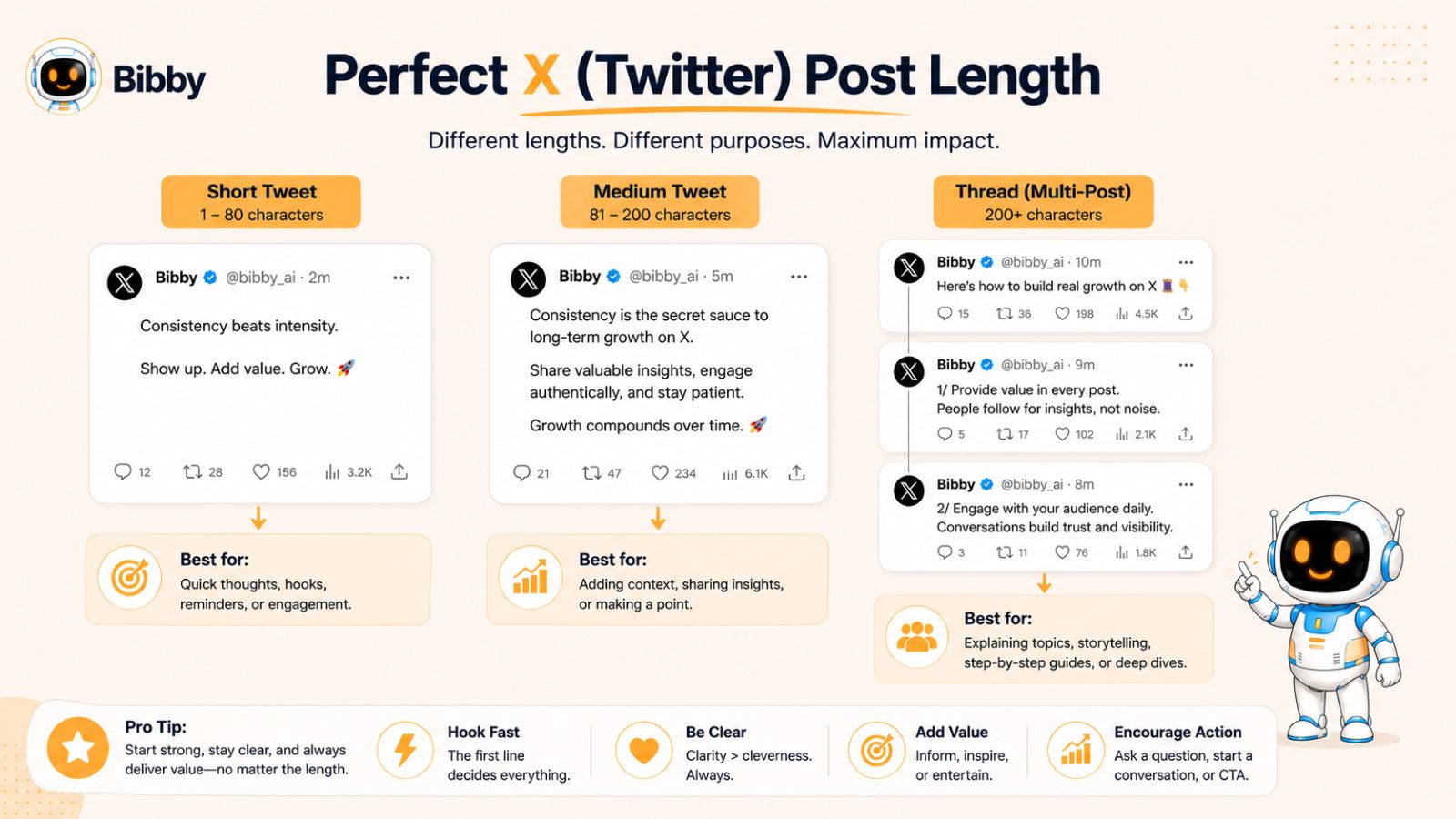
Short X Posts (40–70 Characters)
Short posts are often highly effective because they are easy to read, easy to share, and easy to understand at a glance.
These posts work particularly well for:
- Questions
- Opinions
- Breaking news reactions
- Quotes
- Simple announcements
Their simplicity encourages users to like, repost, and reply without investing significant time in reading.
Medium-Length X Posts (70–150 Characters)
Many marketers consider this range the sweet spot for engagement.
Medium-length posts provide enough room to:
- Share a complete idea
- Include a call to action
- Add context
- Encourage discussion
This format allows creators and brands to communicate clearly while maintaining the fast-paced nature of the platform.
Longer X Posts
Premium users can publish longer content on X, but that doesn't mean every post should be lengthy.
Longer posts may be useful for:
- Detailed explanations
- Industry commentary
- Educational content
- Product updates
- Thought leadership
However, users still expect content to be concise and easy to consume. Even when writing longer posts, strong formatting and clear structure remain essential.
Also read: 15 Proven Strategies to Create Viral Social Media Content
When X Threads Perform Better
Sometimes a single post isn't enough to communicate a complete idea.
Threads allow creators to:
- Break down complex topics
- Tell stories
- Share step-by-step guides
- Present case studies
- Build audience engagement over multiple posts
Instead of forcing too much information into one post, a well-structured thread can improve readability while increasing time spent interacting with your content.
The Importance of the First Line
Because users scroll quickly through their feeds, the opening line is often the most important part of any X post.
Effective opening lines may:
- Present a surprising fact
- Challenge a common belief
- Ask an intriguing question
- Make a bold statement
- Promise a valuable takeaway
The goal is to stop the scroll and encourage engagement.
Hashtags on X: Less Is Usually More
Unlike some platforms where multiple hashtags are common, X generally rewards a lighter approach.
Best practices include:
- Using only relevant hashtags
- Prioritizing readability
- Avoiding hashtag stuffing
- Focusing on conversation and value
In many cases, a strong message outperforms a post overloaded with hashtags.
Why Timing Matters on X
Because X is highly real-time, timing can significantly impact visibility.
Publishing when your audience is most active increases the likelihood of:
- Engagement
- Reposts
- Replies
- Profile visits
- Follower growth
This is one reason why many businesses rely on AI-powered scheduling tools to maximize reach without constantly monitoring activity patterns.
Scaling X Content With Bibby
Creating engaging content for X while simultaneously managing Instagram, Facebook, LinkedIn, YouTube, TikTok, and other platforms can become a full-time job.
Bibby helps simplify the process by combining content creation, scheduling, and analytics into a single workflow. Users can upload an image or generate one with AI, choose a preferred posting style, and let Bibby automatically generate captions tailored to each platform. Once approved, content can be scheduled at AI-optimized times across all selected networks.
Whether you're publishing posts, videos, stories, or promotional campaigns, Bibby helps eliminate repetitive manual work while maintaining a consistent social media presence.
Key X Takeaways
- Short and concise content often performs best on X.
- Posts between 70 and 150 characters frequently achieve strong engagement.
- Longer posts can work when they provide meaningful value.
- Threads are often better than forcing complex ideas into a single post.
- Strong opening lines are critical for capturing attention.
- Consistent posting at optimal times can significantly improve results.
- Automation tools can help maintain an active presence without increasing workload.
Comparing Post Lengths Across All Platforms
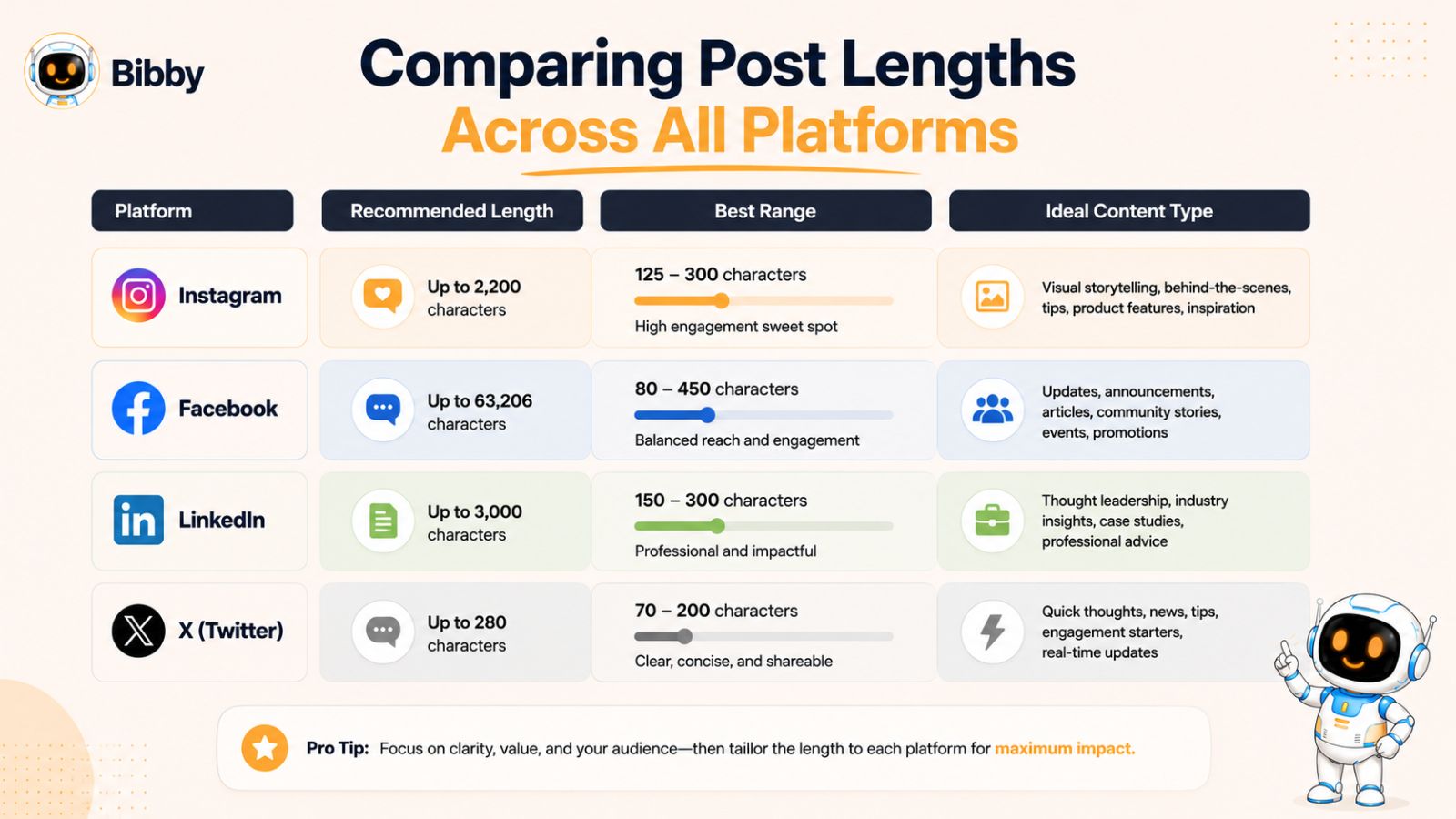
Now that we've explored each platform individually, it's clear that there is no universal post length that works everywhere. Every social network has different user behaviors, content formats, and engagement patterns.
The most effective social media strategies adapt content to each platform rather than publishing identical posts everywhere.
Quick Reference Guide for Ideal Post Lengths
| Platform | Recommended Length | Best Use Case |
|---|---|---|
| 150–500 characters | Storytelling, engagement, community building | |
| 80–250 characters | Discussions, promotions, audience interaction | |
| 500–1,200 characters | Thought leadership, professional insights | |
| X | 70–150 characters | Quick updates, conversations, engagement |
| Instagram Stories | Short text blocks | Fast content consumption |
| Instagram Reels | 100–300 characters | Video context and calls to action |
| Facebook Video Posts | Concise descriptions | Driving views and engagement |
| X Threads | Multiple connected posts | Deep dives and educational content |
While these ranges provide a useful starting point, your audience and content type should always influence the final length.
Why the Same Content Performs Differently Across Platforms
Many businesses assume that if a post performs well on one platform, it should perform equally well everywhere. In reality, each social network attracts users with different expectations.
Instagram users typically prioritize visuals and quick consumption.
Facebook users often engage with conversations, community content, and personal stories.
LinkedIn users are more likely to spend time reading professional insights and educational content.
X users expect concise messages that can be consumed within seconds.
Because of these differences, simply copying and pasting the same content across platforms often leads to inconsistent results.
The Role of Platform Algorithms
Social media algorithms are designed to maximize user engagement.
When content aligns with user expectations, platforms are more likely to increase its visibility. Conversely, content that feels out of place may struggle to gain traction regardless of quality.
This is why optimizing post length can contribute to stronger performance over time.
Quality Still Matters More Than Length
It is important to remember that post length is only one factor among many.
Successful content also requires:
- Strong visuals
- Compelling hooks
- Clear messaging
- Audience relevance
- Consistent publishing
- Effective calls to action
A perfectly sized post with weak content will rarely outperform a valuable post that genuinely helps the audience.
The Real Challenge: Optimizing Content for Every Platform
As businesses expand their social media presence, managing platform-specific content becomes increasingly difficult.
A single campaign may require:
- Different caption lengths
- Platform-specific formatting
- Multiple image sizes
- Video variations
- Separate scheduling times
- Ongoing performance analysis
Handling all of this manually can consume hours every week.
How Bibby Solves the Multi-Platform Content Problem
Bibby was built to eliminate much of the complexity involved in social media management.
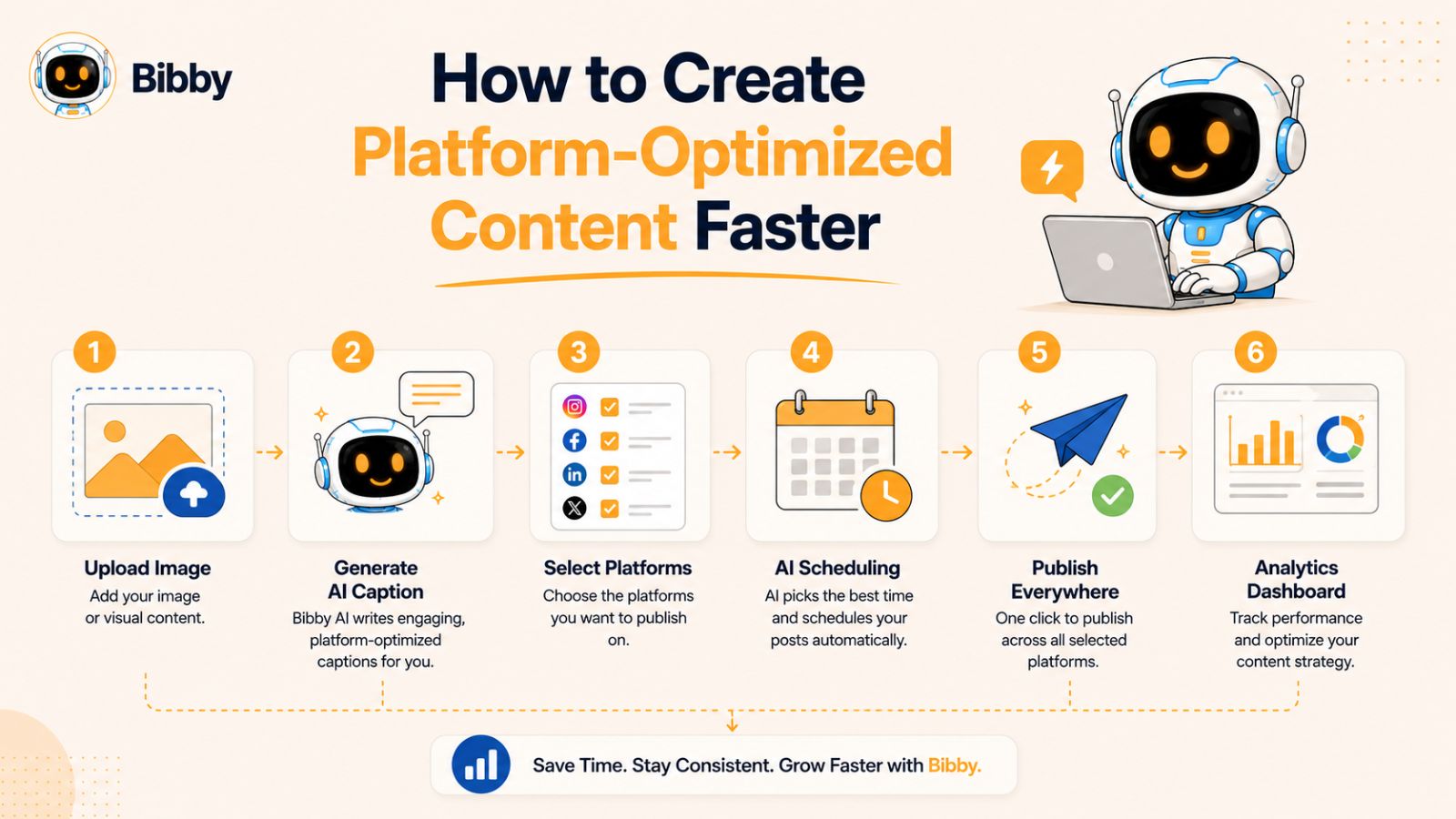
Instead of creating and scheduling content separately for each platform, users can follow a simple workflow:
- Upload an image or generate one with AI.
- Select a posting style that matches your brand.
- Let Bibby automatically generate captions.
- Choose your social media platforms.
- Schedule content at AI-optimized times.
- Track performance through built-in analytics.
Bibby supports publishing across Facebook, Instagram, LinkedIn, YouTube, TikTok, and other major platforms. Users can also manage videos, stories, and various content formats from a single dashboard.
By combining AI-powered content creation, scheduling, automation, and analytics, Bibby helps businesses maintain a consistent social media presence without the usual workload.
Key Takeaways
- Every social media platform has different ideal post lengths.
- Instagram favors visual-first content with flexible caption lengths.
- Facebook performs well with concise, conversational posts.
- LinkedIn generally rewards more detailed professional content.
- X thrives on concise messaging and fast engagement.
- Content should always be adapted to platform-specific audience behavior.
- Automation tools can significantly reduce the effort required to manage multiple social networks effectively.
Also read: Best Platforms to Share Video Content and Grow Your Audience (+ Multi-Platform Strategy)
How to Create Platform-Optimized Content Faster
Knowing the ideal post length for each social media platform is valuable. However, the real challenge begins when you need to create, customize, schedule, and analyze content across multiple networks consistently.
For many businesses, marketers, agencies, and content creators, the issue isn't understanding best practices—it's having enough time to implement them.
Why Multi-Platform Content Creation Is So Time-Consuming
A single piece of content often requires multiple adjustments before it can be published everywhere.
You may need to:
- Rewrite captions for different platforms
- Resize images for various formats
- Create platform-specific calls to action
- Schedule content at different times
- Track performance across multiple dashboards
- Analyze engagement metrics separately
What starts as a simple social media post can quickly turn into a lengthy production process.
The Hidden Cost of Manual Social Media Management
Managing social media manually often leads to several common problems:
- Inconsistent posting schedules
- Missed publishing opportunities
- Lower engagement rates
- Increased workload
- Content bottlenecks
- Difficulty scaling content production
As businesses grow, these challenges become even more difficult to manage without automation.
Why Platform-Specific Optimization Matters
Every social media platform rewards different content styles.
Instagram may require a visual-first approach with engaging captions.
LinkedIn often performs best with educational and professional content.
Facebook encourages community interaction and discussion.
X rewards concise messaging and real-time engagement.
Because each platform behaves differently, successful brands tailor content rather than publishing identical posts everywhere.
How Bibby Simplifies the Entire Process
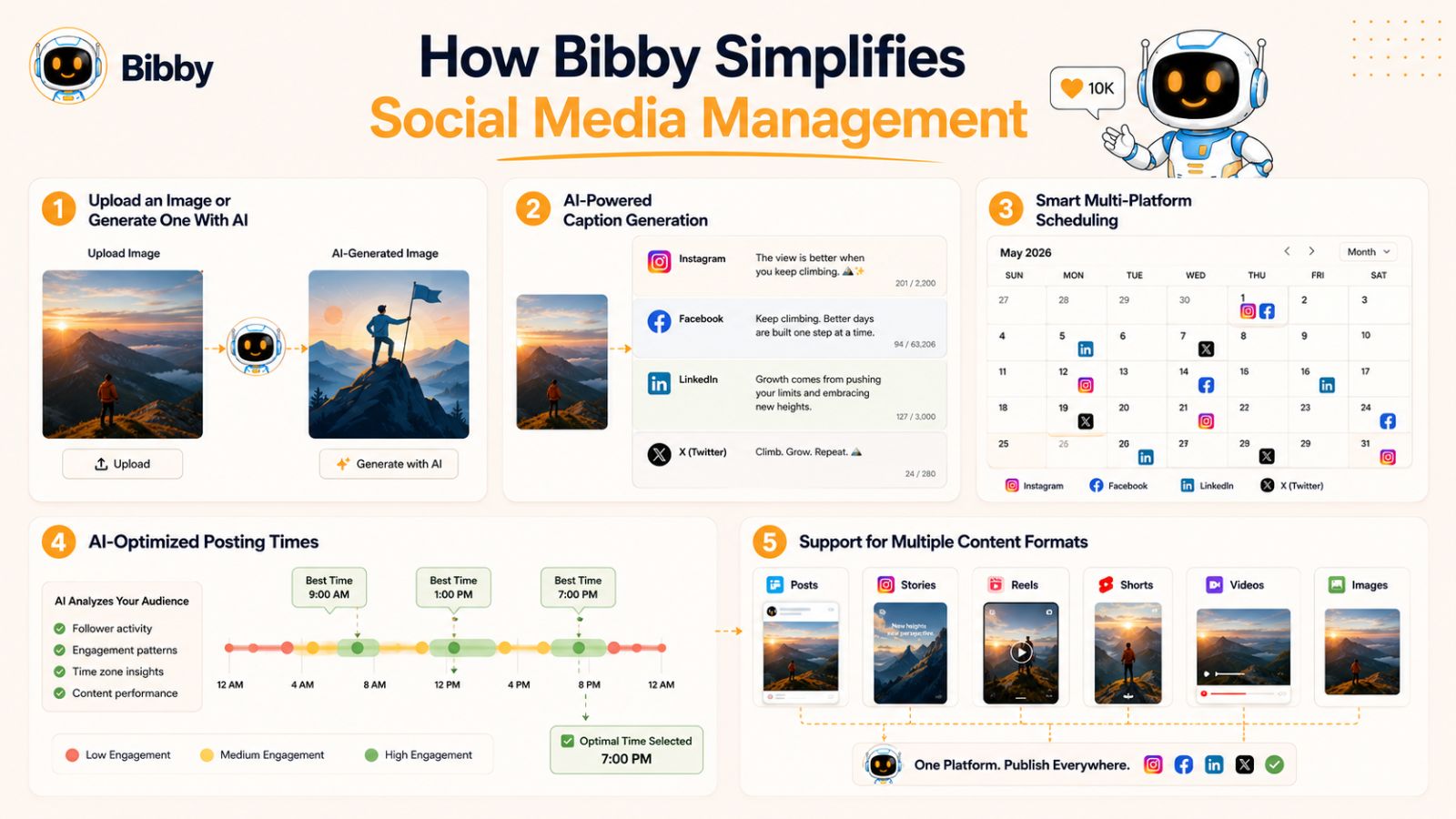
Bibby is designed to help businesses create, optimize, schedule, and analyze social media content from one simple platform.
Instead of juggling multiple tools and workflows, Bibby brings everything together into a streamlined experience.
Upload or Generate Content With AI
The process begins with content creation.
Users can:
- Upload existing images
- Generate new images with AI
- Create content assets quickly
- Prepare visuals for multiple platforms
This removes the need to switch between separate design and scheduling tools.
Automatically Generate Platform-Specific Captions
Writing captions for every social network can be one of the most time-consuming aspects of content marketing.
Bibby solves this by automatically generating captions based on your selected posting style.
Whether you're posting on:
- TikTok
- YouTube
Bibby creates platform-appropriate content without requiring manual rewrites for each network.
Schedule Content at AI-Optimized Times
Determining the best time to publish content is another challenge for social media managers.
Bibby uses AI-powered scheduling to identify optimal posting times for your selected platforms. Instead of guessing when your audience is online, the system helps maximize visibility by scheduling content when engagement opportunities are highest.
This helps businesses maintain consistency while improving overall reach.
Manage Multiple Content Formats
Modern social media strategies involve much more than standard feed posts.
Bibby supports:
- Images
- Videos
- Stories
- Reels
- Shorts
- Multi-platform campaigns
This allows users to manage their entire content strategy from a single dashboard.
Monitor Performance With Built-In Analytics
Creating content is only half the equation. Understanding what works is equally important.
Bibby provides analytics that help users:
- Track engagement
- Monitor audience growth
- Measure campaign performance
- Identify top-performing content
- Improve future posting strategies
These insights make it easier to refine your approach and achieve better results over time.
The Simple Bibby Workflow
One of Bibby's biggest advantages is its simplicity.
The workflow looks like this:
- Upload an image or generate one with AI.
- Choose your preferred posting style.
- Let Bibby generate captions automatically.
- Select the platforms you want to publish to.
- Schedule content at AI-optimized times.
- Monitor performance through analytics.
Once configured, much of the manual work associated with social media management disappears.
Why Automation Is Becoming Essential
As social media platforms continue to evolve, businesses are expected to create more content than ever before.
Without automation, maintaining an active presence across Instagram, Facebook, LinkedIn, X, YouTube, TikTok, and other networks can quickly become overwhelming.
Tools like Bibby help bridge the gap between content strategy and execution by reducing manual tasks while maintaining platform-specific optimization.
The result is a more efficient workflow, more consistent publishing, and more time available for growing your business.
Key Takeaways
- Creating platform-specific content manually requires significant time and effort.
- Different social networks demand different caption styles and post lengths.
- Automation improves consistency and scalability.
- Bibby combines AI content creation, caption generation, scheduling, analytics, and publishing in one platform.
- AI-optimized scheduling helps maximize engagement opportunities.
- A streamlined workflow allows businesses to focus on growth rather than repetitive social media tasks.
Common Social Media Post Length Mistakes
Understanding ideal post lengths is important, but many businesses still struggle to achieve strong engagement because of avoidable content mistakes. Even when posts fall within recommended character ranges, poor execution can limit their effectiveness.
By recognizing these common mistakes, you can create content that is more engaging, more relevant, and better optimized for each platform.
Using the Same Caption on Every Platform
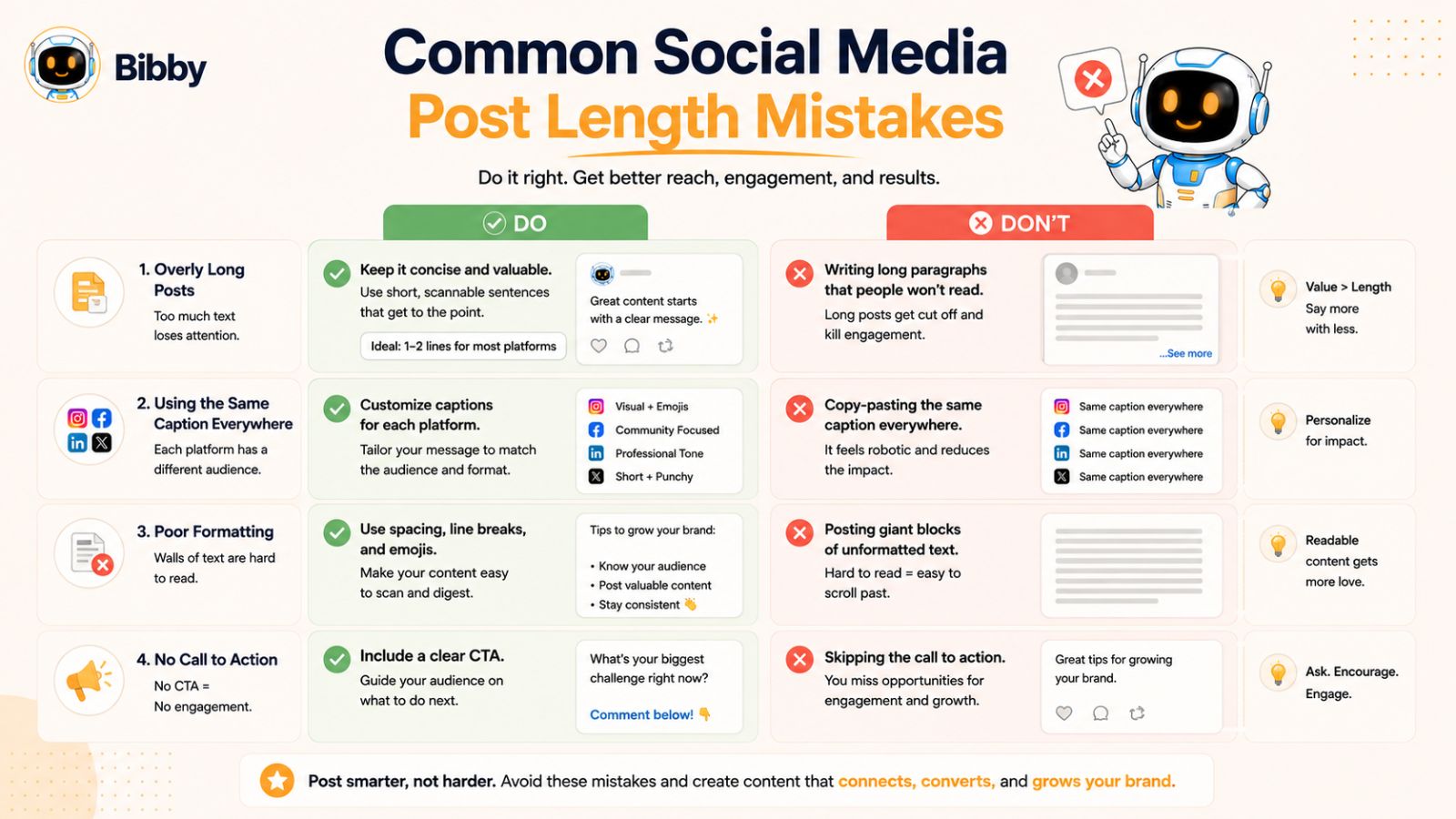
One of the biggest social media mistakes is publishing identical captions across all networks.
While this approach saves time, it often ignores how people use different platforms.
For example:
- A detailed LinkedIn post may feel overwhelming on Instagram.
- An Instagram-style caption may lack depth on LinkedIn.
- A long Facebook post may not perform well on X.
Each platform has unique audience expectations, which means content should be adapted accordingly.
Focusing on Character Count Instead of Value
Many marketers become obsessed with finding the perfect number of characters.
In reality, audiences care far more about value than length.
A short post that provides a useful insight can outperform a longer post filled with unnecessary information. Likewise, a detailed post can generate exceptional engagement when readers find it genuinely helpful.
Instead of asking how long a post should be, ask whether it delivers meaningful value to the audience.
Writing Weak Opening Lines
The beginning of a post often determines whether people continue reading.
If the first sentence fails to capture attention, users may scroll past regardless of how valuable the remaining content is.
Strong opening lines often:
- Present a surprising fact
- Ask an interesting question
- Challenge a common belief
- Highlight a problem
- Promise a useful takeaway
A compelling hook increases the likelihood that users will engage with your content.
Creating Large Blocks of Text
Long paragraphs can make social media content difficult to read, especially on mobile devices.
Even highly valuable content may be ignored if it appears overwhelming.
Improve readability by:
- Using shorter paragraphs
- Adding spacing between ideas
- Breaking information into sections
- Highlighting key points when appropriate
Making content easier to consume often improves engagement.
Ignoring Analytics
Many businesses publish content consistently but rarely analyze performance.
Without analytics, it becomes difficult to answer questions such as:
- Which post lengths perform best?
- Which topics generate engagement?
- Which platforms produce the highest reach?
- What posting times drive results?
Regular analysis allows you to make data-driven improvements instead of relying on assumptions.
Posting Inconsistently
Even great content can struggle if it is published irregularly.
Consistency helps:
- Build audience expectations
- Increase visibility
- Strengthen brand awareness
- Improve long-term engagement
Many businesses start strong but struggle to maintain momentum because manual content management requires significant effort.
Overcomplicating the Content Creation Process
Some teams spend more time managing workflows than creating valuable content.
Switching between design tools, caption generators, scheduling platforms, and analytics dashboards can reduce productivity and increase costs.
Simplifying your workflow often leads to better content and greater consistency.
How Bibby Helps Avoid These Mistakes
Bibby addresses many of the most common social media challenges through a streamlined, AI-powered workflow.
Instead of manually creating, adapting, and scheduling content for each platform, users can:
- Upload an image or generate one with AI
- Select a preferred posting style
- Automatically generate platform-specific captions
- Schedule content across multiple networks
- Publish at AI-optimized times
- Monitor performance through analytics
This approach helps businesses maintain consistency while ensuring content is optimized for platforms such as Facebook, Instagram, LinkedIn, YouTube, and TikTok.
Key Takeaways
- Avoid using identical captions across every platform.
- Prioritize value over character count.
- Invest time in creating stronger opening hooks.
- Improve readability with shorter paragraphs and better formatting.
- Use analytics to guide content decisions.
- Maintain a consistent publishing schedule.
- Simplify content management through automation whenever possible.
Also read: How to Grow a Facebook Business Page Faster with AI Social Media Automation
Frequently Asked Questions
What Is the Ideal Instagram Caption Length?
There is no single perfect Instagram caption length, but many marketers find that captions between 150 and 500 characters provide a strong balance between engagement and readability. Shorter captions work well for visual-first content, while longer captions can be effective for storytelling, education, and community building.
How Long Should a Facebook Post Be?
For most Facebook content, posts between 80 and 250 characters perform well because they provide enough context without overwhelming readers. However, longer posts can generate strong engagement when they tell compelling stories or encourage discussion.
What Is the Best LinkedIn Post Length?
LinkedIn users are generally more willing to consume detailed content than audiences on other social platforms. Posts between 500 and 1,200 characters often strike an effective balance between depth and readability, although longer thought leadership content can also perform exceptionally well.
How Many Characters Should an X Post Contain?
Many successful X posts fall between 70 and 150 characters. This range allows users to communicate a complete idea while maintaining the platform's fast-paced nature. Shorter posts can also perform well when they are engaging, timely, or thought-provoking.
Does Post Length Affect Engagement?
Yes, but only to a certain extent. While platform-specific post lengths can influence performance, engagement is also affected by factors such as content quality, audience relevance, visuals, timing, and calls to action. The best-performing posts combine the right length with valuable content.
Should I Post the Same Content on Every Social Media Platform?
Generally, no. Each platform has unique audiences, behaviors, and content preferences. Adapting your content for each network often produces better engagement than simply copying and pasting the same caption everywhere.
How Often Should Businesses Post on Social Media?
Posting frequency depends on your goals, audience, and available resources. Consistency is usually more important than volume. A sustainable publishing schedule that delivers quality content regularly tends to outperform sporadic bursts of activity.
What Is the Best Time to Post on Social Media?
The best posting times vary by platform, audience, industry, and geographic location. Testing different schedules and analyzing engagement data can help identify optimal publishing times. Many businesses use AI-powered scheduling tools to automate this process.
Can AI Help Create Better Social Media Content?
AI can significantly improve content creation efficiency by generating captions, suggesting content ideas, optimizing posting schedules, and analyzing performance data. However, human creativity and brand expertise remain essential for producing authentic and engaging content.
How Does Bibby Help With Social Media Management?
Bibby simplifies the entire social media workflow through AI-powered automation. Users can upload images or generate visuals with AI, choose a posting style, automatically generate captions, schedule content across multiple platforms, and track performance through analytics.
Bibby supports major social networks including Facebook, Instagram, LinkedIn, YouTube, and TikTok, helping businesses manage posts, videos, stories, and campaigns from a single dashboard while reducing the time spent on manual content management.
Is Bibby Suitable for Small Businesses and Agencies?
Yes. Bibby's streamlined workflow makes it useful for individual creators, small businesses, marketing teams, and agencies that need to manage multiple social media accounts efficiently. By automating repetitive tasks, users can focus more on strategy, audience growth, and business development.
You may also like reading: How to Automate Your Social Media Workflow from Creation to Posting
Conclusion
The perfect post length depends on the platform, the audience, and the type of content you're publishing. While Instagram often benefits from concise but engaging captions, Facebook rewards conversational content, LinkedIn supports deeper professional insights, and X thrives on clear, concise messaging.
The most important takeaway is that successful social media marketing isn't about finding one universal character count. It's about understanding how users consume content on each platform and adapting your message accordingly. Businesses that tailor their content to platform-specific behaviors typically achieve stronger engagement, better reach, and more meaningful audience interactions.
The second key lesson is that value matters more than length. Whether your post contains 50 characters or 1,500, it should provide useful information, tell a compelling story, or inspire action.
Finally, consistency is often the biggest challenge. Creating platform-optimized content, scheduling posts, publishing at the right times, and tracking performance can quickly become overwhelming as your social presence grows.
This is where tools like Bibby can make a significant difference. With AI-powered image generation, automatic caption creation, multi-platform publishing, AI-optimized scheduling, and built-in analytics, Bibby helps simplify the entire social media workflow so you can spend less time managing content and more time growing your audience.
As social media continues to evolve, businesses that combine platform-specific content strategies with intelligent automation will be best positioned to increase engagement, save time, and scale their marketing efforts effectively.
If you're looking to take the next step, consider exploring how AI-powered social media automation can help you create better content, maintain a consistent posting schedule, and maximize results across every platform you use.