
Social media has evolved from a simple networking tool into one of the most powerful marketing channels available to businesses of every size.
Whether you're a local business, startup, or established brand, social media provides a direct way to reach potential customers, build trust, and generate revenue without the massive budgets traditionally required for advertising. However, success doesn't come from posting randomly or chasing every trend—it comes from having a clear strategy, creating valuable content, and leveraging tools that help you stay consistent and efficient.
In this guide, we will share:
- How to build a social media strategy that supports business goals
- Which content types attract customers and drive engagement
- How automation tools like Bibby can save time and scale growth
By the end of this guide, you'll have a practical framework for turning social media from a time-consuming task into a predictable business growth engine.
Also read: How to Schedule Instagram Reels Automatically?
What Is Social Media Marketing for Businesses?
Social media marketing is the process of using platforms such as Facebook, Instagram, LinkedIn, TikTok, YouTube, and X to promote a business, connect with customers, and achieve specific business goals. These goals can include increasing brand awareness, generating leads, driving website traffic, improving customer loyalty, and ultimately increasing sales.
Unlike traditional advertising, social media creates opportunities for two-way communication. Businesses are no longer limited to broadcasting messages to their audience—they can engage directly with potential customers through comments, messages, polls, live streams, and community discussions. This interaction helps build trust and strengthen relationships over time.
Organic vs. Paid Social Media Marketing
There are two primary approaches to social media marketing:
Organic Social Media Marketing
- Publishing content without paying for distribution
- Building an audience through consistent posting and engagement
- Creating long-term brand awareness and customer relationships
- Generating traffic and leads through valuable content
Paid Social Media Marketing
- Running advertisements to reach targeted audiences
- Promoting products, services, events, or offers
- Accelerating lead generation and customer acquisition
- Retargeting people who have previously interacted with your business
The most successful businesses typically use a combination of both. Organic content builds trust and authority, while paid advertising expands reach and accelerates growth.
Why Social Media Matters More Than Ever
Today's consumers spend a significant portion of their time on social platforms, often researching brands before making purchasing decisions. A potential customer may discover your business through a social media post, read reviews, watch videos about your products, visit your website, and eventually make a purchase—all within the same ecosystem.
Social media also levels the playing field. Small businesses can compete with larger companies by creating valuable content, building engaged communities, and showcasing authentic expertise. Businesses that consistently provide helpful, relevant content often outperform competitors that rely solely on traditional advertising.
Rather than viewing social media as another marketing channel, modern businesses should see it as a core component of their customer acquisition and relationship-building strategy. When used effectively, social media becomes a powerful engine for sustainable business growth.
Also read: The Ultimate Guide to Social Media Management Tools for Small Businesses
Benefits of Marketing Your Business on Social Media
Businesses invest in social media because it delivers measurable results across every stage of the customer journey. From attracting new prospects to nurturing existing customers, social media provides opportunities that few other marketing channels can match.
Increase Brand Awareness
One of the biggest advantages of social media marketing is the ability to put your brand in front of new audiences consistently. Every post, video, story, or interaction creates another opportunity for potential customers to discover your business.
Unlike traditional advertising, social media content can continue generating visibility long after it's published through shares, comments, saves, and platform recommendations. Over time, this repeated exposure increases brand recognition and makes your business more memorable when customers are ready to buy.
Generate Leads and Sales
Social media is no longer just a branding tool—it's a powerful sales channel.
Businesses can use social media to:
- Drive traffic to landing pages and websites
- Promote products and services
- Capture leads through forms and offers
- Educate prospects before they make a purchase
- Retarget interested users with paid advertising
When paired with a clear conversion strategy, social media can become a consistent source of qualified leads and revenue.
Build Trust and Customer Relationships
Modern consumers prefer buying from brands they know and trust. Social media allows businesses to demonstrate expertise, share customer success stories, answer questions, and engage directly with their audience.
By responding to comments, participating in conversations, and providing valuable insights, businesses can create stronger relationships than traditional advertising channels typically allow. These interactions help humanize the brand and build credibility over time.
Improve Customer Retention
Acquiring a customer is only the beginning. Social media helps businesses stay connected with existing customers through ongoing communication and engagement.
Regular updates, educational content, product announcements, and community discussions keep customers engaged long after their initial purchase. This ongoing relationship can increase customer loyalty, encourage repeat purchases, and generate valuable word-of-mouth referrals.
Gather Valuable Market Insights
Social media provides direct access to customer feedback and industry conversations. Businesses can learn what customers care about, identify common challenges, and uncover opportunities for new products or services.
Key insights often come from:
- Comments and direct messages
- Customer reviews and testimonials
- Polls and surveys
- Competitor engagement patterns
- Trending industry discussions
These insights can help shape marketing campaigns, improve products, and guide broader business decisions.
Achieve Cost-Effective Growth
Compared to many traditional marketing methods, social media offers a relatively low-cost way to reach and engage potential customers. Even businesses with limited budgets can build an audience, establish authority, and generate leads through consistent content creation.
By combining strategic content with automation tools such as Bibby, businesses can maintain a consistent presence, streamline publishing workflows, and maximize marketing efficiency without significantly increasing costs.
The Bottom Line
The true value of social media marketing extends beyond likes and followers. When approached strategically, social media helps businesses increase visibility, generate leads, strengthen customer relationships, gather market intelligence, and create sustainable growth opportunities that compound over time.
You may also like looking into: How to Automate Instagram Posts for Your Restaurant (Without Losing the Personal Touch)
Choose the Right Social Media Platforms
One of the most common mistakes businesses make is trying to be active on every social media platform at once. While it may seem like a good way to maximize reach, spreading your efforts too thin often leads to inconsistent posting, lower-quality content, and poor results.
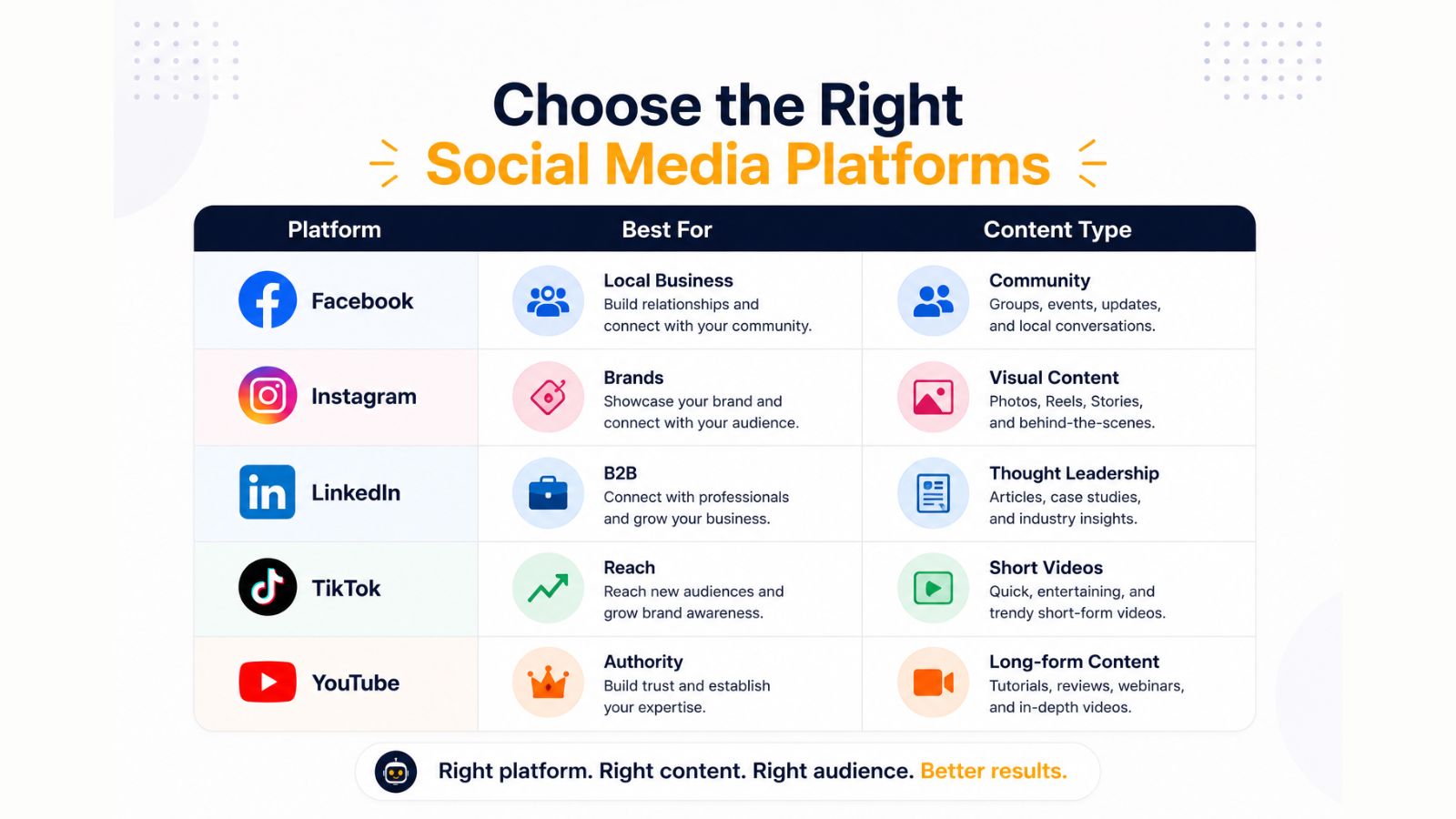
Instead, focus on the platforms where your target audience is most active and where your content naturally performs best.
Facebook remains one of the largest social media platforms and offers a variety of tools for businesses, including business pages, groups, events, and advertising options.
Best for:
- Local businesses
- Service providers
- Community building
- Lead generation campaigns
Content that performs well:
- Customer success stories
- Educational posts
- Live videos
- Promotions and events
- Community-focused content
Instagram is a highly visual platform that helps businesses build brand awareness and engage audiences through images, Stories, Reels, and short-form videos.
Best for:
- E-commerce brands
- Restaurants
- Fitness businesses
- Beauty and fashion brands
- Lifestyle-focused companies
Content that performs well:
- Reels
- Behind-the-scenes content
- Product showcases
- User-generated content
- Educational carousels
LinkedIn is the leading platform for professional networking and B2B marketing. Businesses can establish authority, generate leads, and connect with decision-makers through thought leadership content.
Best for:
- B2B companies
- Consultants
- Agencies
- SaaS businesses
- Professional service providers
Content that performs well:
- Industry insights
- Case studies
- Leadership perspectives
- Company updates
- Professional success stories
TikTok
TikTok has transformed how businesses reach audiences through short-form video content. Brands that educate, entertain, or inspire often experience significant organic reach.
Best for:
- Consumer brands
- Startups
- Personal brands
- E-commerce businesses
- Businesses targeting younger audiences
Content that performs well:
- Short tutorials
- Industry tips
- Trends and challenges
- Behind-the-scenes content
- Authentic storytelling
YouTube
YouTube functions as both a social platform and a search engine, making it one of the most valuable channels for long-term content marketing.
Best for:
- Educational businesses
- Coaches and consultants
- Software companies
- Service-based businesses
- Brands with expertise to share
Content that performs well:
- Tutorials
- Product demonstrations
- How-to guides
- Customer case studies
- Industry analysis
How to Choose the Right Platforms
Before investing time and resources into social media, answer the following questions:
Where does your audience spend time?
Focus on the platforms your ideal customers actively use.
What type of content can you consistently create?
Choose platforms that align with your strengths. For example, if your team excels at video creation, TikTok and YouTube may be ideal.
What are your business goals?
Different platforms support different objectives:
- Brand awareness: Instagram, TikTok, Facebook
- Lead generation: LinkedIn, Facebook
- Education and authority building: YouTube, LinkedIn
- Community building: Facebook Groups, Instagram
Start Small and Scale Strategically
Rather than managing five or six platforms at once, start with one or two primary channels. Develop a consistent content strategy, build momentum, and refine your process before expanding.
As your content operation grows, social media automation tools like Bibby can help manage publishing schedules across multiple platforms, making it easier to maintain consistency without dramatically increasing your workload.
The goal isn't to be everywhere—it's to be highly visible where your customers are most likely to engage with your business.
Also read: How to Stay Consistent on Social Media: A Practical System for Sustainable Growth
Create a Social Media Marketing Strategy
Posting content without a strategy is like setting out on a road trip without a destination. You may stay busy, but you'll struggle to measure progress or achieve meaningful business results.
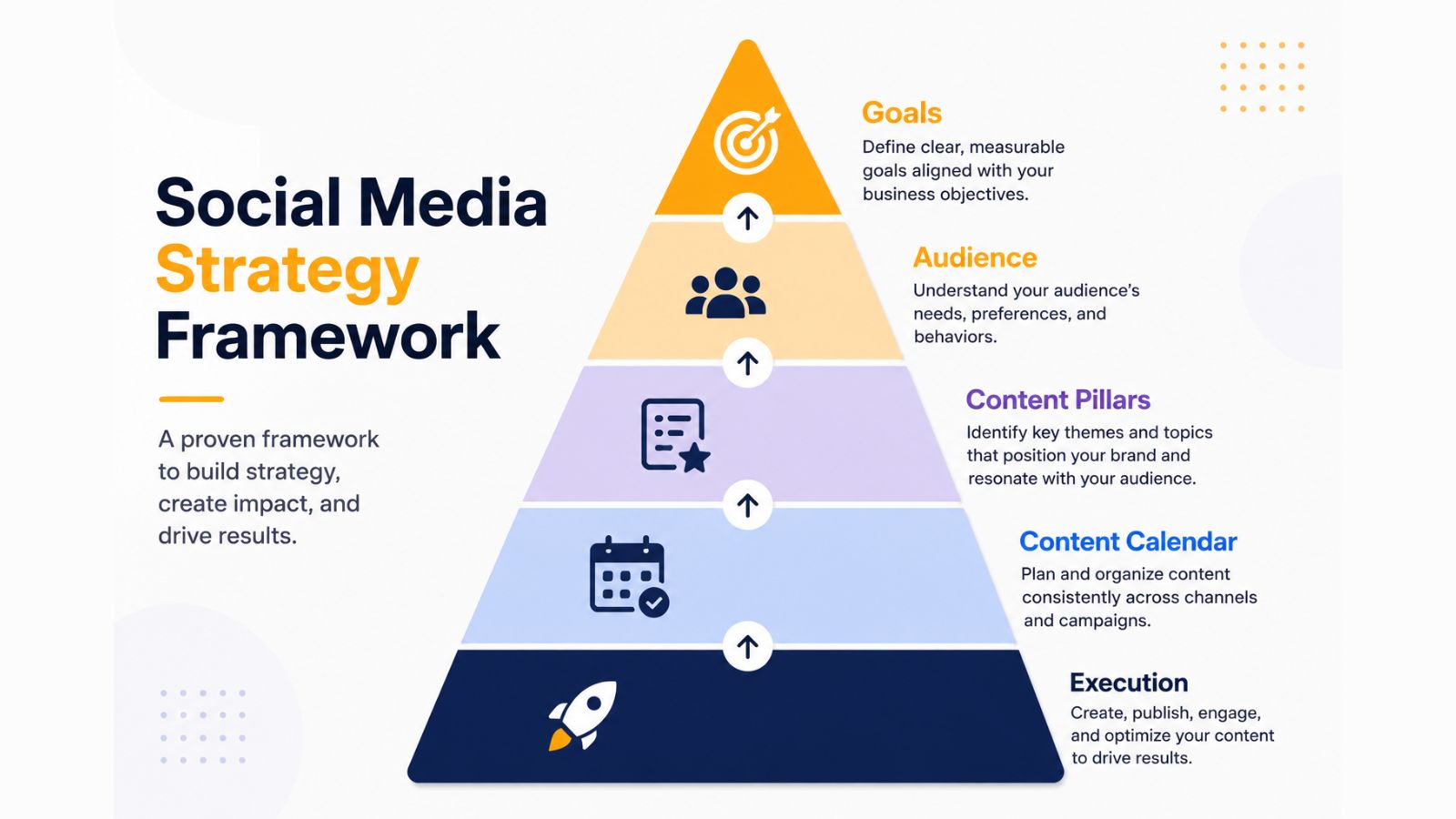
A successful social media marketing strategy aligns your content, audience, and business objectives into a clear plan that guides every post, campaign, and interaction.
Define Clear Business Goals
Before creating content, determine exactly what you want social media to accomplish for your business.
Common goals include:
- Increasing brand awareness
- Generating qualified leads
- Driving website traffic
- Growing an email list
- Increasing online sales
- Improving customer retention
- Building industry authority
Avoid vague objectives such as "getting more followers." While audience growth can be valuable, it should support a larger business goal. A smaller audience of qualified prospects is often more valuable than a large audience that never converts into customers.
For example:
Weak Goal:
- Gain 5,000 followers
Strong Goal:
- Generate 50 qualified leads per month through LinkedIn content
Clear goals make it easier to measure success and optimize your strategy over time.
Identify Your Target Audience
The most effective social media content speaks directly to a specific audience. Trying to appeal to everyone usually results in content that resonates with no one.
Start by defining:
Demographics
- Age
- Gender
- Location
- Occupation
- Income level
Psychographics
- Interests
- Motivations
- Goals
- Challenges
- Buying behaviors
Ask yourself:
- What problems does my audience face?
- What questions are they asking?
- What motivates them to purchase?
- What type of content do they consume regularly?
The more clearly you understand your audience, the easier it becomes to create content that attracts attention and drives engagement.
Develop a Strong Brand Message
Every successful social media presence is built around a clear and consistent message.
Your audience should quickly understand:
- Who you help
- What problem you solve
- Why you're different from competitors
- What outcomes customers can expect
Consistency in messaging helps build familiarity and trust. Whether someone sees your content on Instagram, LinkedIn, or YouTube, the brand experience should feel cohesive.
Create Content Pillars
Content pillars are the core topics your business will consistently discuss. They provide structure and ensure your content remains focused and relevant.
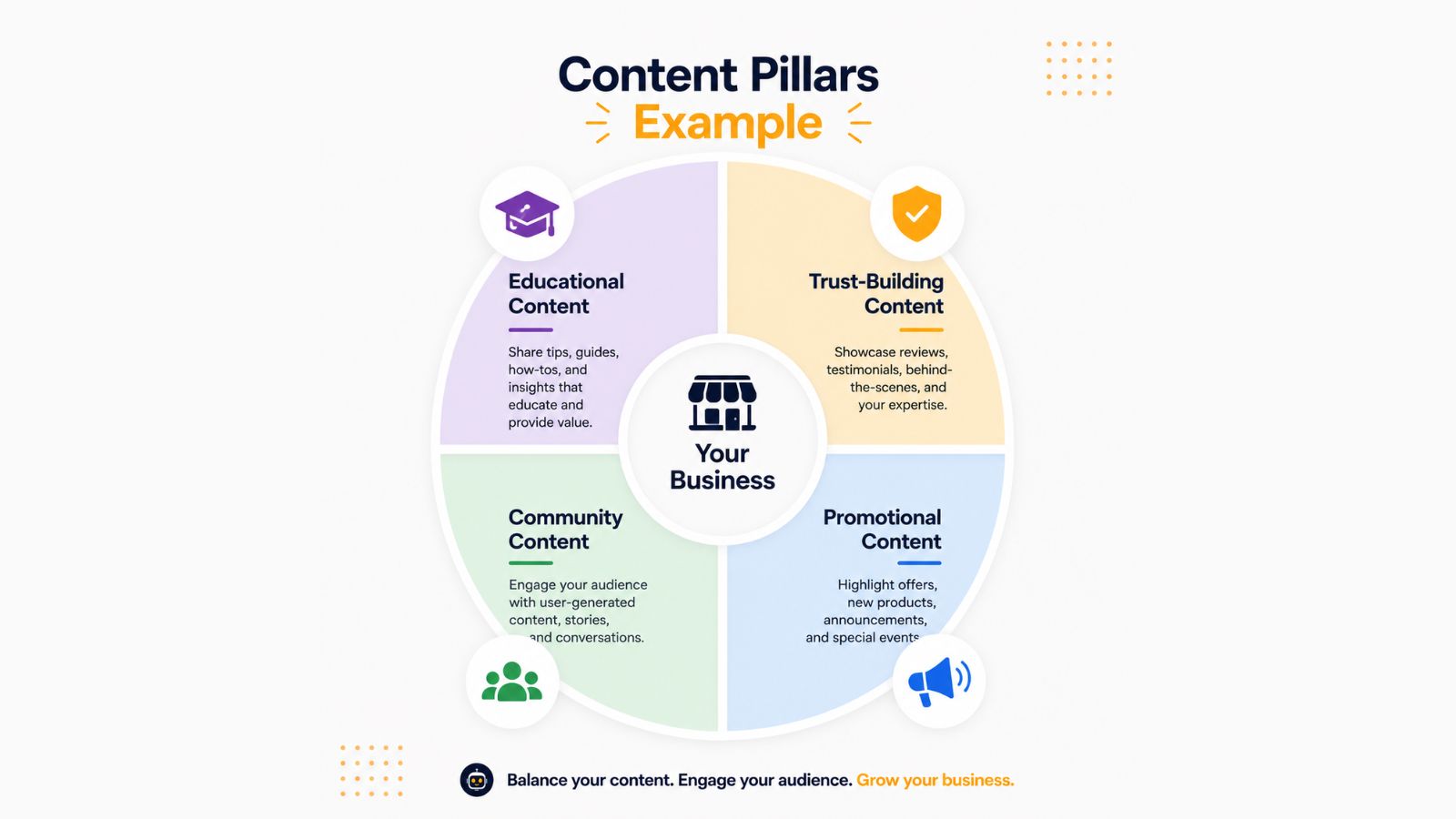
For example, a digital marketing agency might use:
Content Pillar 1: Education
- Marketing tips
- SEO strategies
- Advertising insights
Content Pillar 2: Social Proof
- Client success stories
- Testimonials
- Case studies
Content Pillar 3: Brand Building
- Behind-the-scenes content
- Team updates
- Company culture
Content Pillar 4: Promotion
- Service offers
- Product launches
- Lead magnets
Using content pillars makes content planning significantly easier while helping establish authority within your niche.
Build a Content Calendar
Consistency is one of the biggest drivers of social media success. A content calendar helps ensure that valuable content is published regularly instead of relying on last-minute ideas.
A simple content calendar should include:
- Publishing dates
- Content formats
- Target platforms
- Content topics
- Calls-to-action
- Campaign objectives
Planning content in advance reduces stress, improves quality, and creates a more consistent customer experience.
Establish a Posting Workflow
As content volume increases, businesses often struggle to maintain consistency. A structured workflow helps keep content production organized.
A typical workflow may include:
- Content planning
- Content creation
- Review and approval
- Scheduling
- Publishing
- Performance analysis
Businesses that implement repeatable workflows are able to produce more content while maintaining quality standards.
Use Automation to Execute Your Strategy
A strong strategy becomes far more effective when supported by the right systems and tools.
Social media automation platforms such as Bibby help businesses:
- Schedule content in advance
- Manage multiple social accounts
- Organize content calendars
- Streamline approval processes
- Maintain posting consistency
- Reduce manual administrative work
Rather than spending hours each day publishing content manually, teams can focus on strategy, creativity, and audience engagement while automation handles repetitive tasks.
Review and Refine Regularly
Social media trends, algorithms, and audience preferences change constantly. The best strategies are not static—they evolve based on performance data.
Review your strategy monthly or quarterly by analyzing:
- Engagement rates
- Reach and impressions
- Website traffic
- Lead generation
- Conversion rates
- Content performance by topic
Over time, these insights reveal what's working, what isn't, and where future opportunities exist.
Strategy First, Tactics Second
Many businesses focus on tactics before strategy. They chase trends, copy competitors, or experiment with random content ideas without understanding how those activities support business objectives.
The most successful brands take the opposite approach. They establish clear goals, understand their audience, create a structured content plan, and use tools like Bibby to execute consistently at scale.
Once your strategy is in place, every post has a purpose—and every piece of content contributes to measurable business growth.
Also read: Bibby vs Later: Which Social Media Tool Is Best for Small Business?
Content That Actually Drives Business Growth
Creating content is easy. Creating content that attracts customers, builds trust, and generates revenue is much harder.
Many businesses fall into the trap of constantly promoting their products and services. While promotional content has its place, audiences primarily follow brands that provide value. The most successful social media strategies focus on educating, entertaining, inspiring, and helping audiences before asking for a sale.
To consistently grow your business through social media, create a balanced mix of content that serves different stages of the customer journey.
Educational Content
Educational content is often the highest-performing type of content because it solves problems and demonstrates expertise.
When people learn something useful from your content, they begin to view your business as a trusted resource.
Examples include:
- How-to guides
- Industry tips
- Tutorials
- Step-by-step processes
- Frequently asked questions
- Common mistakes to avoid
- Expert insights
For example, a social media agency could share:
- How to improve Instagram engagement
- The best times to post on LinkedIn
- Common social media marketing mistakes
Educational content builds authority and attracts potential customers who are actively searching for solutions.
Entertaining Content
People use social media to be informed, but they also use it to be entertained.
Entertaining content helps increase reach, engagement, and brand awareness by making your business more memorable.
Examples include:
- Behind-the-scenes videos
- Team highlights
- Industry humor
- Trend participation
- Brand storytelling
- Day-in-the-life content
The goal is not simply to go viral. Instead, focus on creating content that aligns with your brand while keeping your audience engaged.
Trust-Building Content
Trust is one of the biggest factors influencing purchasing decisions.
Before buying from a business, customers often want proof that the company can deliver on its promises.
Trust-building content includes:
- Customer testimonials
- Case studies
- Client success stories
- Product reviews
- Before-and-after results
- User-generated content
This type of content reduces uncertainty and helps prospects visualize their own success with your products or services.
For example, instead of simply saying your service generates results, showcase a customer who achieved measurable outcomes after working with your business.
Promotional Content
Promotional content is essential because it directly drives conversions and revenue.
However, businesses often make the mistake of posting too much promotional content and not enough value-driven content.
Examples include:
- Product launches
- Service announcements
- Special offers
- Free consultations
- Lead magnets
- Webinar invitations
- Limited-time promotions
Promotional content tends to perform best when it's supported by a strong foundation of educational and trust-building content.
Community-Focused Content
Social media is designed for conversation, not one-way broadcasting.
Community-focused content encourages participation and helps build stronger relationships with followers.
Examples include:
- Polls
- Surveys
- Questions
- Live Q&A sessions
- Community challenges
- Discussion prompts
The more your audience interacts with your content, the more likely platforms are to increase its visibility.
The 80/20 Content Principle
A useful framework for many businesses is the 80/20 rule:
80% Value-Based Content
- Education
- Entertainment
- Inspiration
- Community engagement
20% Promotional Content
- Offers
- Product promotion
- Lead generation
- Sales campaigns
This balance helps maintain audience interest while still creating opportunities for conversions.
Repurpose High-Performing Content
One of the most effective ways to scale content production is through repurposing.
Instead of creating everything from scratch, transform successful content into multiple formats.
For example:
One blog post can become:
- A LinkedIn article
- Several social media posts
- An Instagram carousel
- Multiple short-form videos
- An email newsletter
- A YouTube video
Repurposing allows businesses to maximize the value of every piece of content while maintaining a consistent publishing schedule.
Create Content Around Customer Questions
If you're unsure what to post, start with customer questions.
Your audience is already telling you what they want to learn through:
- Sales calls
- Customer support inquiries
- Email conversations
- Online communities
- Social media comments
Each question can become a piece of content that attracts new prospects facing the same challenge.
Scale Content Creation with Automation
As businesses grow, managing content across multiple platforms becomes increasingly difficult.
Tools like Bibby can simplify content operations by helping teams:
- Plan content calendars
- Schedule posts in advance
- Manage multiple social channels
- Maintain publishing consistency
- Reduce repetitive manual tasks
This allows marketers to spend more time creating high-quality content and engaging with audiences instead of manually managing publishing schedules.
Focus on Value First
The most effective social media content doesn't begin with "What do we want to sell today?"
It begins with "How can we help our audience today?"
Businesses that consistently educate, entertain, and build trust create stronger relationships with their audience. Over time, those relationships translate into higher engagement, increased brand loyalty, more leads, and greater revenue growth.
Also read: Best Hootsuite Alternative for Small Business
How to Create a Consistent Posting Schedule
Consistency is one of the most important factors in social media marketing success. Even the best content strategy can fail if content is published sporadically or abandoned after a few weeks.
Businesses that show up consistently stay top-of-mind, build stronger audience relationships, and give social media algorithms more opportunities to distribute their content. The challenge isn't usually knowing that consistency matters—it's maintaining it over the long term.
Why Consistency Matters
Social media platforms reward accounts that publish content regularly. Consistent posting signals that your account is active and valuable to users.
Benefits of consistent publishing include:
- Increased brand visibility
- Higher audience engagement
- Better algorithm performance
- Improved audience trust
- More opportunities to generate leads and sales
Consistency also creates audience expectations. When followers know they'll regularly receive valuable content from your business, they're more likely to continue engaging with your brand.
Focus on a Realistic Publishing Frequency
Many businesses start with ambitious posting goals that quickly become unsustainable.
Instead of trying to publish multiple times per day immediately, choose a schedule your team can realistically maintain.
For example:
Small Business
- 3–5 posts per week
Growing Business
- 1 post per day
Established Brand
- Multiple daily posts across platforms
The ideal schedule is the one you can maintain consistently without sacrificing quality.
Create Content in Batches
One of the most effective ways to stay consistent is batch content creation.
Rather than creating content daily, dedicate specific time blocks to producing multiple pieces of content at once.
For example:
Weekly Batch Session
- Brainstorm content ideas
- Write captions
- Record videos
- Design graphics
- Schedule posts
This approach improves efficiency and reduces the stress of constantly searching for new content ideas.
Build a Monthly Content Calendar
A content calendar acts as a roadmap for your social media strategy.
Planning content in advance helps ensure that important topics, campaigns, and promotions are not overlooked.
A strong content calendar should include:
- Publishing dates
- Platforms
- Content formats
- Topics
- Calls-to-action
- Campaign goals
By mapping out content weeks or months ahead, businesses can maintain a more strategic and organized social media presence.
Use Content Themes
Creating content becomes easier when each day or week follows a theme.
For example:
Monday
- Industry tip
Tuesday
- Customer success story
Wednesday
- Behind-the-scenes content
Thursday
- Educational tutorial
Friday
- Promotional offer
Content themes reduce decision fatigue and make content planning more predictable.
Repurpose Existing Content
Consistency doesn't require constantly creating new content.
Many successful brands generate significant results by repurposing existing content into new formats.
For example:
A YouTube video can become:
- Multiple short-form clips
- LinkedIn posts
- Instagram carousels
- X posts
- Email content
- Blog articles
Repurposing allows businesses to maintain an active publishing schedule without dramatically increasing content production efforts.
Automate Your Publishing Process
Manual posting often becomes a bottleneck as businesses expand their social media efforts.
Scheduling content in advance helps maintain consistency even during busy periods, holidays, team absences, or unexpected disruptions.
Social media automation platforms such as Bibby can help businesses:
- Schedule posts across multiple platforms
- Organize content calendars
- Streamline content approvals
- Maintain publishing consistency
- Coordinate team workflows
- Reduce repetitive administrative work
Instead of logging into multiple platforms every day, businesses can prepare content in advance and allow automated workflows to handle publishing.
Leave Room for Real-Time Content
While planning is essential, flexibility is equally important.
Leave space in your schedule for:
- Industry news
- Trending topics
- Customer questions
- Product announcements
- Live events
- Community engagement opportunities
A balanced strategy combines planned content with timely, relevant interactions.
Monitor Performance and Adjust
A consistent posting schedule should evolve based on data.
Track metrics such as:
- Engagement rate
- Reach
- Click-through rate
- Website traffic
- Leads generated
- Conversions
You may discover that certain posting times, content formats, or frequencies perform significantly better than others.
Use these insights to refine your schedule and maximize results.
Consistency Beats Perfection
Many businesses delay publishing because they want every post to be perfect. In reality, consistent execution typically produces better results than occasional perfection.
A practical content schedule, supported by planning systems and automation tools like Bibby, helps businesses maintain momentum, build audience trust, and generate long-term growth through social media.
The brands that win on social media are rarely the ones that post the most—they're the ones that show up consistently with valuable content over time.
Using Social Media Automation to Scale Marketing
As businesses grow their social media presence, managing content manually becomes increasingly difficult. Publishing posts every day, coordinating multiple platforms, tracking performance, and maintaining a content calendar can quickly consume valuable time and resources.
This is where social media automation becomes a competitive advantage.
Automation allows businesses to streamline repetitive tasks, maintain consistency, and focus more energy on strategy, creativity, and audience engagement. Instead of spending hours managing social media operations, businesses can build efficient systems that support sustainable growth.
What Is Social Media Automation?
Social media automation involves using software to simplify and automate recurring marketing activities such as content scheduling, publishing, organization, and reporting.
Rather than manually logging into each platform every day, marketers can plan, prepare, and schedule content in advance while maintaining a consistent online presence.
When implemented correctly, automation helps businesses scale their marketing efforts without significantly increasing workload.
The Benefits of Social Media Automation
Businesses that leverage automation often experience:
- More consistent publishing schedules
- Increased productivity
- Better team collaboration
- Improved content organization
- Greater visibility across platforms
- Reduced manual administrative work
- More time for customer engagement and strategy
Automation doesn't replace human creativity—it enhances it by removing repetitive tasks from the workflow.
Schedule Content Weeks or Months in Advance
One of the biggest challenges in social media marketing is maintaining consistency.
Instead of creating and publishing content daily, businesses can plan campaigns and schedule posts weeks or even months ahead.
Advanced scheduling provides several benefits:
- Consistent brand visibility
- Reduced last-minute content creation
- Improved campaign planning
- Better workload management
- Greater marketing efficiency
By building content pipelines in advance, businesses can ensure that their social channels remain active even during busy periods.
Create Content Manually or Generate It with AI
Different businesses have different content creation needs.
Some teams prefer to upload and manage content manually, while others use AI-powered tools to accelerate content production and brainstorming.
A flexible workflow should support both approaches:
Manual Content Creation
- Full creative control
- Brand-specific messaging
- Customized campaigns
AI-Assisted Content Creation
- Faster content generation
- Idea development
- Caption assistance
- Workflow acceleration
Combining human expertise with AI capabilities often creates the most efficient content production process.
Simplify Content Calendar Management
Without a centralized content calendar, social media marketing can quickly become disorganized.
A content calendar provides a clear overview of:
- Upcoming posts
- Campaign timelines
- Publishing schedules
- Content gaps
- Team responsibilities
Centralized calendar management helps marketing teams stay aligned and ensures that content supports broader business objectives.
Publish Across Multiple Platforms
Managing several social media channels individually can be time-consuming.
Modern businesses often maintain a presence on:
- TikTok
- X
- YouTube
Multi-platform publishing allows teams to distribute content efficiently across multiple channels from a single workflow, reducing duplication and improving operational efficiency.
While content may still need platform-specific adjustments, centralized publishing significantly simplifies execution.
Keep Content Organized
As content libraries grow, organization becomes increasingly important.
Businesses often create hundreds—or even thousands—of pieces of content over time. Without proper organization, valuable content becomes difficult to locate, repurpose, or reuse.
An organized content system helps teams:
- Categorize content by topic
- Manage campaigns
- Store creative assets
- Repurpose successful content
- Improve collaboration
Strong organization systems reduce wasted effort and make content operations more scalable.
Track Performance and Improve Results
Publishing content is only half of the equation. Understanding what works is what drives long-term improvement.
Performance tracking helps businesses identify:
- High-performing content
- Audience preferences
- Engagement trends
- Traffic sources
- Conversion opportunities
By reviewing performance data regularly, marketers can make informed decisions about future content strategies and maximize return on investment.
How Bibby Helps Streamline Social Media Management
Bibby is designed to help businesses simplify and scale their social media operations through a centralized workflow.
With Bibby, businesses can:
- Schedule posts weeks or months in advance
- Upload content manually or generate content with AI
- Manage content calendars from one place
- Publish across multiple social media platforms
- Organize content efficiently for future use
- Track performance and identify growth opportunities
Instead of juggling multiple tools and disconnected workflows, businesses can manage key aspects of their social media strategy within a single platform.
Automation Supports Growth—It Doesn't Replace Strategy
One common misconception is that automation alone creates results.
The reality is that successful social media marketing still requires:
- Clear business goals
- Valuable content
- Audience engagement
- Ongoing optimization
Automation simply makes it easier to execute these activities consistently and at scale.
When combined with a strong strategy and high-quality content, tools like Bibby can help businesses save time, improve efficiency, and create a more sustainable approach to social media marketing.
Also read: How Often Should Businesses Post on LinkedIn? The Data-Backed Posting Frequency Guide
Social Media Engagement Strategies That Build Community
Many businesses focus heavily on content creation but overlook one of the most important aspects of social media marketing: engagement.
Social media was built for conversations. While publishing content helps attract attention, engagement is what turns followers into loyal customers and brand advocates. Businesses that actively interact with their audience often experience stronger customer relationships, higher visibility, and better long-term results.
The goal isn't simply to grow an audience—it's to build a community around your brand.
Respond to Comments and Messages
Every comment, direct message, and mention is an opportunity to strengthen a relationship.
When businesses respond consistently, they show customers that there are real people behind the brand who are willing to listen and help.
Benefits of active engagement include:
- Increased customer trust
- Higher audience loyalty
- Better customer experiences
- Improved brand perception
- More meaningful conversations
Even simple responses can make a significant difference in how customers view your business.
Start Conversations Instead of Broadcasting
Many brands treat social media as a one-way communication channel, posting content without encouraging interaction.
A more effective approach is to create content that invites participation.
Examples include:
- Asking questions
- Running polls
- Requesting opinions
- Encouraging discussions
- Gathering feedback
- Hosting Q&A sessions
The more your audience participates, the stronger the connection they develop with your brand.
Encourage User-Generated Content
User-generated content (UGC) refers to content created by customers, clients, or followers that features your business, products, or services.
Examples include:
- Customer reviews
- Product photos
- Testimonials
- Success stories
- Video reviews
- Social media mentions
UGC is powerful because it provides authentic social proof. Prospective customers often trust recommendations from other customers more than traditional advertising.
Businesses can encourage UGC by:
- Creating branded hashtags
- Running contests
- Highlighting customer stories
- Featuring customer content on social channels
- Requesting reviews and testimonials
Build Relationships Through Direct Messages
Direct messages provide a more personal way to connect with prospects and customers.
DMs can be used to:
- Answer questions
- Provide customer support
- Share helpful resources
- Follow up with leads
- Build relationships with industry partners
However, businesses should avoid overly aggressive sales tactics. Focus on providing value first and building trust before attempting to sell.
Create a Community Around Shared Interests
The strongest communities are built around common goals, challenges, and interests.
Rather than making every conversation about your products or services, create opportunities for people to connect around topics they care about.
For example:
- Marketing communities
- Fitness challenges
- Entrepreneur groups
- Industry discussion forums
- Customer success communities
When people feel connected to a community, they are more likely to remain engaged and advocate for the brand behind it.
Host Interactive Content
Interactive content encourages active participation rather than passive consumption.
Examples include:
- Live streams
- Webinars
- Ask Me Anything (AMA) sessions
- Contests and giveaways
- Quizzes
- Polls and surveys
These formats create opportunities for real-time engagement and deeper audience connections.
Recognize and Celebrate Your Audience
People appreciate being acknowledged.
Simple actions such as featuring customer stories, celebrating milestones, sharing user-generated content, or publicly thanking supporters can significantly strengthen community relationships.
Recognition helps followers feel valued and increases the likelihood that they will continue engaging with your brand.
Monitor Conversations Beyond Your Posts
Engagement shouldn't be limited to content published on your own profile.
Businesses can build visibility and authority by participating in:
- Industry discussions
- Relevant groups and communities
- Trending conversations
- Partner content
- Customer posts
Contributing helpful insights where your audience is already active can expand your reach and attract new followers organically.
Balance Automation and Human Interaction
Automation can streamline publishing and workflow management, but engagement should remain authentic.
Tools like Bibby can help businesses maintain a consistent content schedule and manage social media operations efficiently. However, comments, conversations, customer support interactions, and relationship-building efforts should remain personal whenever possible.
The most successful brands use automation to save time on administrative tasks while investing that time back into meaningful audience engagement.
Community Creates Long-Term Growth
Followers can disappear. Algorithms can change. Advertising costs can rise.
Communities, however, create long-term business value.
When people trust your brand, engage with your content, recommend your business, and participate in conversations, social media becomes more than a marketing channel—it becomes a sustainable growth engine.
Businesses that focus on building genuine relationships often generate stronger loyalty, more referrals, and greater long-term success than those focused solely on reach and follower counts.
Also read: How to Grow on Social Media With AI: A Complete Guide for Faster Audience Growth
Social Media Advertising for Faster Growth
Organic social media marketing is an excellent way to build trust, engage audiences, and establish long-term brand visibility. However, relying solely on organic reach can limit how quickly a business grows.
Social media advertising allows businesses to reach highly targeted audiences, accelerate lead generation, and drive sales more predictably. When combined with a strong organic content strategy, paid advertising can significantly amplify marketing results.
Why Businesses Invest in Social Media Advertising
Social media platforms give businesses access to audiences based on demographics, interests, behaviors, locations, job titles, and many other targeting factors.
This level of targeting makes social media advertising one of the most efficient forms of digital marketing.
Key benefits include:
- Faster audience growth
- Increased brand awareness
- More website traffic
- Higher lead generation
- Improved sales opportunities
- Better campaign scalability
Rather than waiting months for organic growth, businesses can immediately place their message in front of ideal customers.
Awareness Campaigns
Awareness campaigns are designed to introduce your business to new audiences.
The primary objective is visibility rather than immediate conversions.
Common awareness campaign goals include:
- Brand recognition
- Video views
- Reach and impressions
- Audience growth
- Market education
These campaigns are particularly useful for businesses entering new markets or launching new products and services.
Lead Generation Campaigns
Lead generation campaigns help businesses collect information from potential customers who are interested in learning more.
Examples include:
- Newsletter signups
- Consultation requests
- Demo bookings
- Webinar registrations
- Downloadable resources
Effective lead generation campaigns typically offer something valuable in exchange for contact information, such as a free guide, assessment, or consultation.
Conversion Campaigns
Conversion campaigns focus on driving specific actions that directly impact revenue.
Examples include:
- Product purchases
- Service bookings
- Free trial signups
- Appointment scheduling
- Subscription purchases
These campaigns often target users who already know about your business and are closer to making a buying decision.
Retargeting: One of the Most Powerful Advertising Strategies
Most people do not convert the first time they encounter a business.
Retargeting allows businesses to reconnect with individuals who have already interacted with:
- Your website
- Social media profiles
- Previous advertisements
- Email campaigns
- Video content
Because these audiences are already familiar with your brand, retargeting campaigns often produce higher conversion rates than campaigns targeting completely new users.
Creating Effective Social Media Ads
Successful advertising requires more than simply boosting a post.
Strong social media ads typically include:
A Clear Message
- Focus on one primary objective
- Avoid confusing or cluttered messaging
Compelling Visuals
- High-quality images
- Engaging videos
- Attention-grabbing creative assets
A Strong Offer
- Free consultation
- Discount
- Limited-time promotion
- Valuable resource
A Clear Call-to-Action
- Learn More
- Book Now
- Download Guide
- Start Free Trial
- Shop Now
The simpler and more focused the message, the more likely users are to take action.
Budgeting for Social Media Advertising
One of the advantages of social media advertising is flexibility.
Businesses can start with modest budgets and increase spending as campaigns prove successful.
A common approach includes:
- Launch small test campaigns
- Analyze performance data
- Identify winning audiences and creatives
- Scale successful campaigns gradually
Testing before scaling helps reduce wasted ad spend and improves overall return on investment.
Organic and Paid Strategies Work Best Together
Many businesses view organic and paid marketing as separate initiatives, but they are most effective when used together.
A balanced approach might look like this:
Organic Marketing
- Builds trust
- Establishes authority
- Engages audiences
- Creates community
Paid Advertising
- Expands reach
- Accelerates growth
- Generates leads
- Drives conversions
Organic content often informs advertising strategy by revealing which messages, topics, and formats resonate most with audiences.
Measure Advertising Performance
To maximize results, businesses should consistently monitor key performance indicators such as:
- Reach
- Click-through rate (CTR)
- Cost per click (CPC)
- Cost per lead (CPL)
- Conversion rate
- Return on ad spend (ROAS)
Regular analysis helps identify opportunities to improve targeting, creative assets, messaging, and campaign structure.
Support Advertising with Strong Operations
Advertising can increase demand rapidly. Businesses must be prepared to handle that growth.
This includes:
- Maintaining consistent content
- Following up with leads promptly
- Managing campaigns effectively
- Monitoring performance data
Tools like Bibby can help support these efforts by keeping content calendars organized, scheduling ongoing social content, and providing performance insights that contribute to more informed marketing decisions.
Growth Requires Both Reach and Trust
Advertising excels at generating reach. Content and engagement excel at building trust.
Businesses that combine paid promotion with consistent organic content often create the strongest results. Advertising introduces new people to your brand, while valuable content and community engagement turn those people into customers and long-term advocates.
When these strategies work together, social media becomes a powerful and scalable engine for business growth.
Measuring Social Media Marketing Success
One of the biggest advantages of social media marketing is that nearly every action can be measured. Unlike traditional marketing channels where results can be difficult to track, social media provides access to detailed performance data that helps businesses understand what's working and what needs improvement.
Without measurement, it's impossible to know whether your strategy is generating meaningful business results. Tracking the right metrics allows businesses to make smarter decisions, improve campaigns, and maximize return on investment.
Why Analytics Matter
Many businesses focus on publishing content but spend very little time analyzing performance.
Analytics help answer important questions such as:
- Which content generates the most engagement?
- Which platforms drive the most traffic?
- What content leads to conversions?
- Which campaigns produce the best results?
- How is audience behavior changing over time?
The answers to these questions provide valuable insights that can guide future marketing decisions.
Focus on Metrics That Support Business Goals
Not every metric is equally important.
The right metrics depend on your objectives.
For example:
Brand Awareness Goals
- Reach
- Impressions
- Video views
- Audience growth
Engagement Goals
- Likes
- Comments
- Shares
- Saves
- Engagement rate
Lead Generation Goals
- Form submissions
- Consultation requests
- Lead magnet downloads
- Cost per lead
Sales Goals
- Conversions
- Revenue
- Return on ad spend
- Customer acquisition cost
Tracking metrics that align with business goals helps ensure that social media activities contribute to meaningful outcomes.
Key Social Media Metrics to Monitor
Reach
Reach measures the number of unique users who see your content.
Growing reach typically indicates that your content is being distributed to larger audiences and increasing brand visibility.
Engagement Rate
Engagement rate measures how actively people interact with your content.
Engagement can include:
- Likes
- Comments
- Shares
- Saves
- Clicks
High engagement often signals that your content resonates with your audience.
Click-Through Rate (CTR)
CTR measures how many people click a link after seeing your content or advertisement.
A strong CTR generally indicates that your messaging, offer, and call-to-action are effective.
Conversion Rate
Conversion rate measures how many users complete a desired action after interacting with your content.
Examples include:
- Purchasing a product
- Booking a consultation
- Downloading a resource
- Signing up for a newsletter
Conversions connect social media activity directly to business results.
Audience Growth
Tracking follower growth helps businesses understand whether their audience is expanding over time.
While follower count should not be treated as the primary success metric, healthy audience growth often indicates increasing brand awareness.
Analyze Content Performance
Not all content performs equally.
Reviewing performance data regularly helps identify:
- Top-performing content formats
- Popular topics
- Effective calls-to-action
- Strong creative styles
- Audience preferences
For example, you may discover that educational videos consistently outperform static graphics or that customer success stories generate more engagement than promotional posts.
These insights allow you to create more of what works and less of what doesn't.
Measure Performance Across Platforms
Each social media platform attracts different audiences and behaviors.
Track platform-specific performance to determine:
- Where your audience is most active
- Which channels generate leads
- Which platforms drive conversions
- Where marketing resources should be invested
A platform with fewer followers may ultimately generate more revenue than a platform with a larger audience.
Create Regular Reporting Processes
Successful businesses establish reporting routines that make performance reviews consistent and actionable.
Many teams review metrics:
- Weekly for campaign performance
- Monthly for strategic analysis
- Quarterly for long-term planning
Regular reporting helps identify trends before they become opportunities or problems.
Simplify Reporting with Centralized Analytics
As businesses expand across multiple social platforms, gathering data manually can become time-consuming.
Centralized reporting solutions make it easier to monitor performance from a single location.
Tools like Bibby can help businesses:
- Track social media performance
- Monitor engagement trends
- Review content effectiveness
- Measure audience growth
- Analyze publishing results
- Support data-driven decision-making
Having access to organized performance data helps marketers spend less time compiling reports and more time optimizing strategy.
Turn Data Into Action
Collecting data is only valuable if it leads to better decisions.
After reviewing performance metrics, ask:
- Which content performed best?
- What patterns are emerging?
- Which campaigns exceeded expectations?
- Where are audiences disengaging?
- What should be tested next?
The most successful marketers treat every piece of content as a learning opportunity.
Measure What Matters
It's easy to become distracted by vanity metrics such as likes or follower counts. While these metrics can provide useful context, they should not be the primary indicators of success.
The ultimate purpose of social media marketing is to support business growth.
Whether your goal is awareness, leads, sales, or customer retention, focus on metrics that reflect real business outcomes. When combined with consistent execution, strong content, and tools like Bibby for performance tracking and reporting, data becomes one of your most valuable assets for continuous improvement.
Businesses that measure consistently improve consistently.
Common Social Media Marketing Mistakes to Avoid
Even businesses that invest significant time and resources into social media marketing can struggle to achieve results. In many cases, the problem isn't a lack of effort—it's a handful of common mistakes that limit growth and reduce effectiveness.
Understanding these pitfalls can help you avoid wasted time, improve performance, and create a more sustainable social media strategy.
Posting Without a Strategy
One of the most common mistakes is publishing content without a clear objective.
Businesses often post whenever inspiration strikes, resulting in inconsistent messaging and content that doesn't support larger business goals.
Without a strategy, it's difficult to answer questions such as:
- Who is the target audience?
- What business goal does this content support?
- What action should viewers take?
- How will success be measured?
A documented strategy provides direction and ensures that every piece of content contributes to meaningful outcomes.
Focusing on Followers Instead of Business Results
Many businesses become overly focused on vanity metrics.
While audience growth can be valuable, a large follower count does not automatically translate into leads, customers, or revenue.
For example:
- 1,000 engaged followers can outperform 100,000 inactive followers.
- A small audience of qualified buyers is often more valuable than a large audience with no purchasing intent.
Instead of obsessing over follower counts, prioritize metrics that directly support business objectives.
Being Too Promotional
Social media users rarely follow brands because they want to see constant advertisements.
Businesses that repeatedly promote products and services without providing value often experience declining engagement and audience fatigue.
A healthier content mix includes:
- Educational content
- Industry insights
- Customer success stories
- Community engagement
- Entertaining content
Promotional content should support the overall strategy, not dominate it.
Inconsistent Posting
Many businesses start strong but struggle to maintain momentum.
Long periods of inactivity can reduce visibility, weaken audience relationships, and make it more difficult to build trust.
Consistency is more important than intensity.
Publishing three valuable posts every week for a year is generally more effective than posting multiple times per day for a month and then disappearing.
Planning content in advance and using scheduling tools can help maintain consistency over the long term.
Ignoring Audience Engagement
Social media is designed for interaction.
Businesses that publish content but fail to respond to comments, messages, and conversations miss valuable opportunities to build relationships.
Ignoring engagement can make a brand appear disconnected or uninterested in its audience.
Successful businesses actively participate in conversations and treat engagement as a core part of their marketing strategy.
Trying to Be on Every Platform
Not every social media platform is right for every business.
Attempting to manage too many platforms often leads to:
- Lower content quality
- Inconsistent posting
- Burnout
- Poor performance
It's usually more effective to dominate one or two platforms than to perform poorly across six or seven.
Focus on the platforms where your target audience is most active and expand strategically over time.
Neglecting Analytics
Some businesses continue publishing the same content without reviewing performance data.
This often results in:
- Repeating ineffective strategies
- Missing growth opportunities
- Wasting marketing resources
Analytics provide critical insights into:
- Audience preferences
- Content performance
- Campaign effectiveness
- Conversion opportunities
Businesses that regularly analyze performance can make smarter decisions and improve results more quickly.
Failing to Repurpose Content
Creating every piece of content from scratch is inefficient.
Many businesses overlook opportunities to repurpose existing content into multiple formats.
For example:
- A blog article can become several social media posts.
- A webinar can become short-form videos.
- A customer case study can become a carousel, video, and LinkedIn post.
Repurposing extends the lifespan of content and increases return on content creation efforts.
Over-Automating Social Media
Automation is a valuable tool, but relying on it too heavily can create a robotic brand experience.
Businesses should automate:
- Scheduling
- Publishing
- Content organization
- Reporting
Businesses should keep human involvement in:
- Conversations
- Customer support
- Community building
- Relationship development
The most effective approach combines operational efficiency with authentic human interaction.
Operating Without a Content System
As social media efforts grow, content management can become chaotic.
Without systems for planning, organizing, scheduling, and tracking content, teams often encounter:
- Missed publishing opportunities
- Duplicate content
- Workflow bottlenecks
- Poor collaboration
Using structured processes and tools like Bibby can help businesses organize content, manage publishing schedules, and maintain operational efficiency as marketing activities scale.
Success Comes From Avoiding the Basics
Most social media marketing failures are not caused by complex problems. They are usually the result of simple mistakes repeated consistently over time.
Businesses that develop a strategy, publish consistently, engage authentically, monitor performance, and use automation intelligently position themselves for long-term success.
Avoiding these common mistakes won't guarantee viral growth, but it will create a stronger foundation for sustainable results and measurable business impact.
Future Trends in Social Media Marketing
Social media continues to evolve at a rapid pace. Platforms change their algorithms, user behaviors shift, and new technologies reshape how businesses connect with audiences.
While the fundamentals of social media marketing—providing value, building trust, and creating relationships—remain consistent, businesses that stay ahead of emerging trends are often better positioned to capture attention and drive growth.
Here are some of the most important trends shaping the future of social media marketing.
AI-Powered Content Creation
Artificial intelligence is becoming a valuable tool for marketers looking to increase efficiency and scale content production.
AI can assist with:
- Content ideation
- Caption generation
- Content repurposing
- Audience research
- Creative brainstorming
- Workflow automation
However, AI works best when combined with human expertise. Businesses that use AI to accelerate production while maintaining authentic brand messaging will likely gain a competitive advantage.
Greater Adoption of Marketing Automation
As social media operations become more complex, automation will play an increasingly important role.
Businesses are looking for ways to:
- Reduce repetitive tasks
- Improve publishing consistency
- Coordinate campaigns
- Manage multiple platforms efficiently
- Scale content production
Automation platforms will continue evolving to help businesses streamline operations while maintaining quality and consistency.
Short-Form Video Will Remain Dominant
Short-form video has become one of the most effective content formats across nearly every major social platform.
Businesses are increasingly investing in:
- Educational videos
- Product demonstrations
- Behind-the-scenes content
- Customer stories
- Quick tips and tutorials
Short-form video combines high engagement potential with strong discoverability, making it a valuable format for both brand awareness and customer acquisition.
Community-Led Growth
As consumers become more selective about the brands they support, community building will become even more important.
Businesses that focus on creating meaningful interactions and fostering audience participation will often outperform brands that rely solely on promotional content.
Future social media success will be driven by:
- Audience engagement
- Community participation
- Customer advocacy
- User-generated content
- Relationship building
Communities create loyalty that is difficult for competitors to replicate.
Personal Branding Will Continue to Grow
People often connect with people before they connect with companies.
Founders, executives, employees, and industry experts are increasingly becoming important extensions of brand marketing efforts.
Businesses that invest in personal branding can benefit from:
- Increased trust
- Greater reach
- Stronger thought leadership
- Improved audience engagement
Human-driven content frequently generates stronger engagement than purely corporate messaging.
Data-Driven Decision Making
Marketing decisions are becoming increasingly dependent on performance data.
Rather than relying on assumptions, businesses are using analytics to determine:
- Which content performs best
- Which platforms deserve investment
- Which audiences convert most effectively
- Which campaigns generate the highest ROI
Access to accurate reporting and performance insights will continue to be a major competitive advantage.
Content Repurposing Will Become Standard Practice
The demand for content continues to grow, making efficiency more important than ever.
Businesses are moving away from the "create once, publish once" approach and embracing content repurposing strategies.
A single piece of content can be transformed into:
- Blog posts
- Social media updates
- Videos
- Carousels
- Email newsletters
- Podcasts
Repurposing allows businesses to maximize content value while reducing production demands.
Integrated Marketing Workflows
Marketing teams increasingly prefer centralized systems that reduce complexity and improve collaboration.
Instead of using separate tools for planning, scheduling, publishing, organizing, and reporting, businesses are adopting platforms that consolidate these activities into a unified workflow.
Solutions like Bibby align with this trend by helping businesses:
- Plan content
- Generate or upload content
- Manage content calendars
- Schedule posts weeks or months ahead
- Publish across multiple platforms
- Organize content libraries
- Track performance metrics
Centralized workflows reduce friction and make social media management more scalable.
The Future Belongs to Consistent Brands
While technologies and platforms will continue evolving, one principle is unlikely to change: consistency wins.
Businesses that consistently provide value, adapt to changing trends, engage their audiences, and leverage tools that improve efficiency will be best positioned for long-term success.
The future of social media marketing isn't about chasing every new feature or trend. It's about combining strategy, creativity, data, and automation to build stronger relationships with customers and create sustainable business growth.
Conclusion
Social media marketing has become one of the most powerful ways for businesses to build brand awareness, generate leads, and drive sustainable growth. Success comes from more than simply posting content—it requires a clear strategy, valuable content, consistent execution, and ongoing performance measurement.
Throughout this guide, we've explored three key takeaways: choosing the right platforms and strategy for your business, creating content that builds trust and drives engagement, and using automation and analytics to scale your efforts efficiently. Businesses that focus on these fundamentals are far more likely to achieve meaningful results than those relying on random posting or short-term tactics.
As your social media presence grows, managing content, publishing schedules, and performance tracking becomes increasingly important. Tools like Bibby can help streamline these processes by supporting content planning, AI-assisted creation, multi-platform publishing, organization, and analytics from a centralized workflow.
The next step is simple: audit your current social media strategy, identify areas for improvement, and build a repeatable system that supports long-term growth. Once that foundation is in place, you'll be better positioned to explore advanced topics such as social media lead generation funnels, content repurposing systems, and scaling marketing operations across multiple channels.