
Social media marketing is moving from manual scheduling and content management toward AI-powered systems that can create, organize, schedule, and publish content with far less human intervention.
For businesses managing Facebook, Instagram, LinkedIn, YouTube, TikTok, and other platforms, the real opportunity isn’t simply using AI to write captions—it’s building an autonomous social media workflow that continuously handles repetitive marketing tasks while your team focuses on strategy, creativity, and growth. In this article, we’ll explore the ROI of autonomous marketing, what modern AI social media automation can actually handle, and how platforms such as Bibby can turn social media management into an almost hands-free system.
In this article, you will learn:
- How AI automation can reduce the cost of social media management
- Which social media tasks AI can automate today
- How to build a social media workflow on autopilot
Let’s start by understanding what autonomous marketing actually means and why it represents a major shift in how businesses approach social media.
What Is Autonomous Marketing With AI?
Autonomous marketing is the next step beyond traditional marketing automation. Instead of simply following rules that a marketer has programmed in advance, AI-powered systems can make decisions, generate content, execute repetitive tasks, and continuously manage parts of the marketing workflow with minimal human involvement.
Traditional social media automation might let you schedule 30 posts in advance. Autonomous marketing aims to go further: AI can help create the content, write the captions, adapt the content for different platforms, determine when it should be published, and organize the entire publishing workflow.
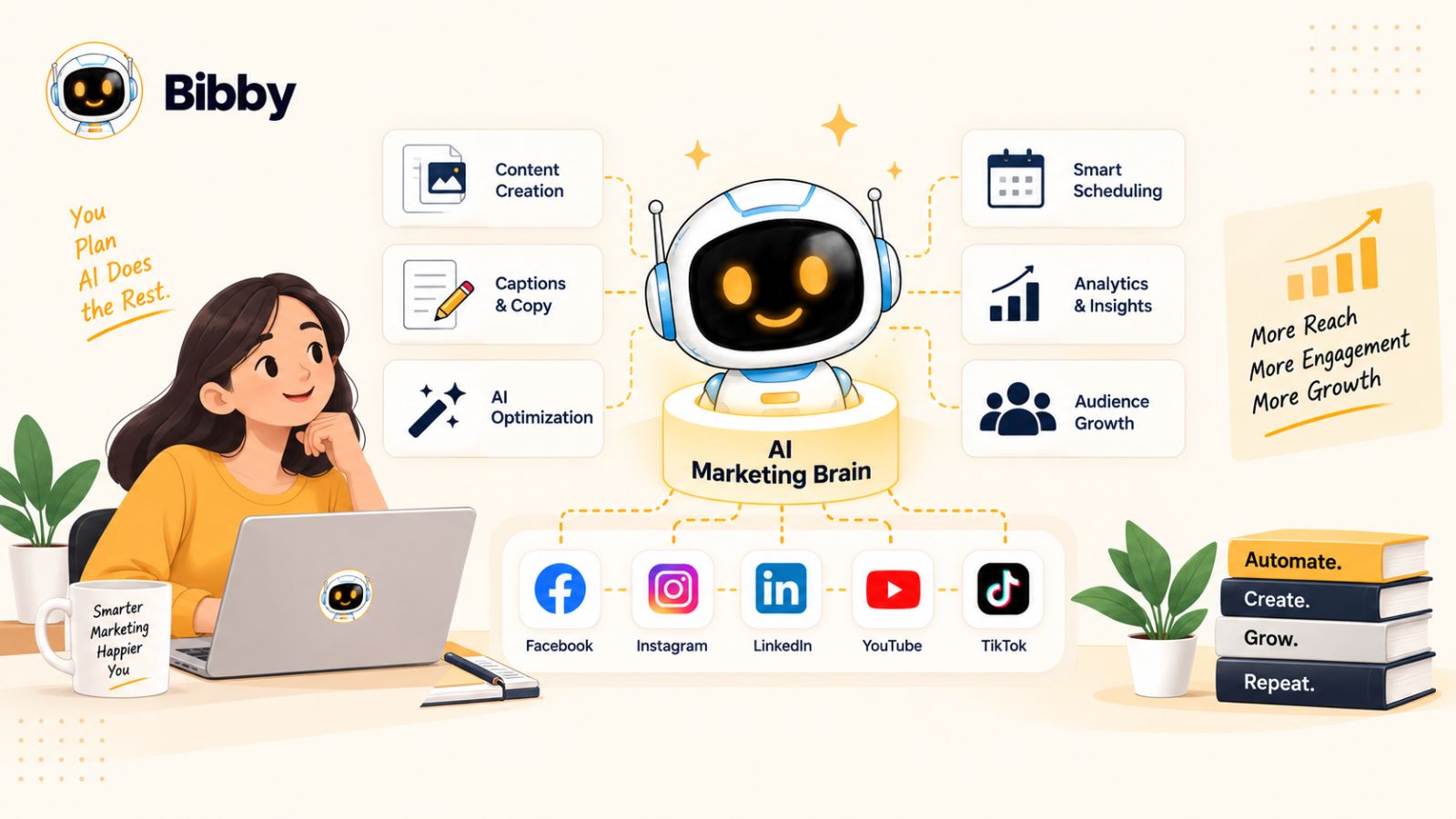
Autonomous marketing vs. traditional marketing automation
The difference is easiest to understand through the role of the human.
With traditional automation, the marketer typically does the thinking and the software does the execution. You create the content, write the caption, choose the platforms, select the publishing dates, and configure the automation. The software then carries out those predetermined instructions.
With autonomous marketing, AI can participate in more of the decision-making process.
For example, imagine you have a product image ready to publish. Instead of manually creating separate captions for Facebook, Instagram, LinkedIn, TikTok, and YouTube, an AI-powered social media system can turn that single creative asset into a broader content workflow.
You provide the asset and your preferred content style. The system can then help generate the captions, organize the posts, schedule them across your selected platforms, and determine appropriate publishing times.
That changes the role of social media software from a simple scheduler into something closer to an AI social media manager.
How AI agents are changing social media management
Social media has traditionally required marketers to perform dozens of small tasks every week.
A marketer might need to:
- Create or source visual content
- Write captions
- Adapt content for different platforms
- Create carousels and videos
- Decide what to publish and when
- Build a content calendar
- Schedule individual posts
- Repurpose existing content
- Maintain brand consistency
- Coordinate campaigns
- Review and revise content
None of these tasks necessarily requires a human to spend hours doing them manually.
AI changes the economics by allowing many of these repetitive activities to happen within a connected workflow.
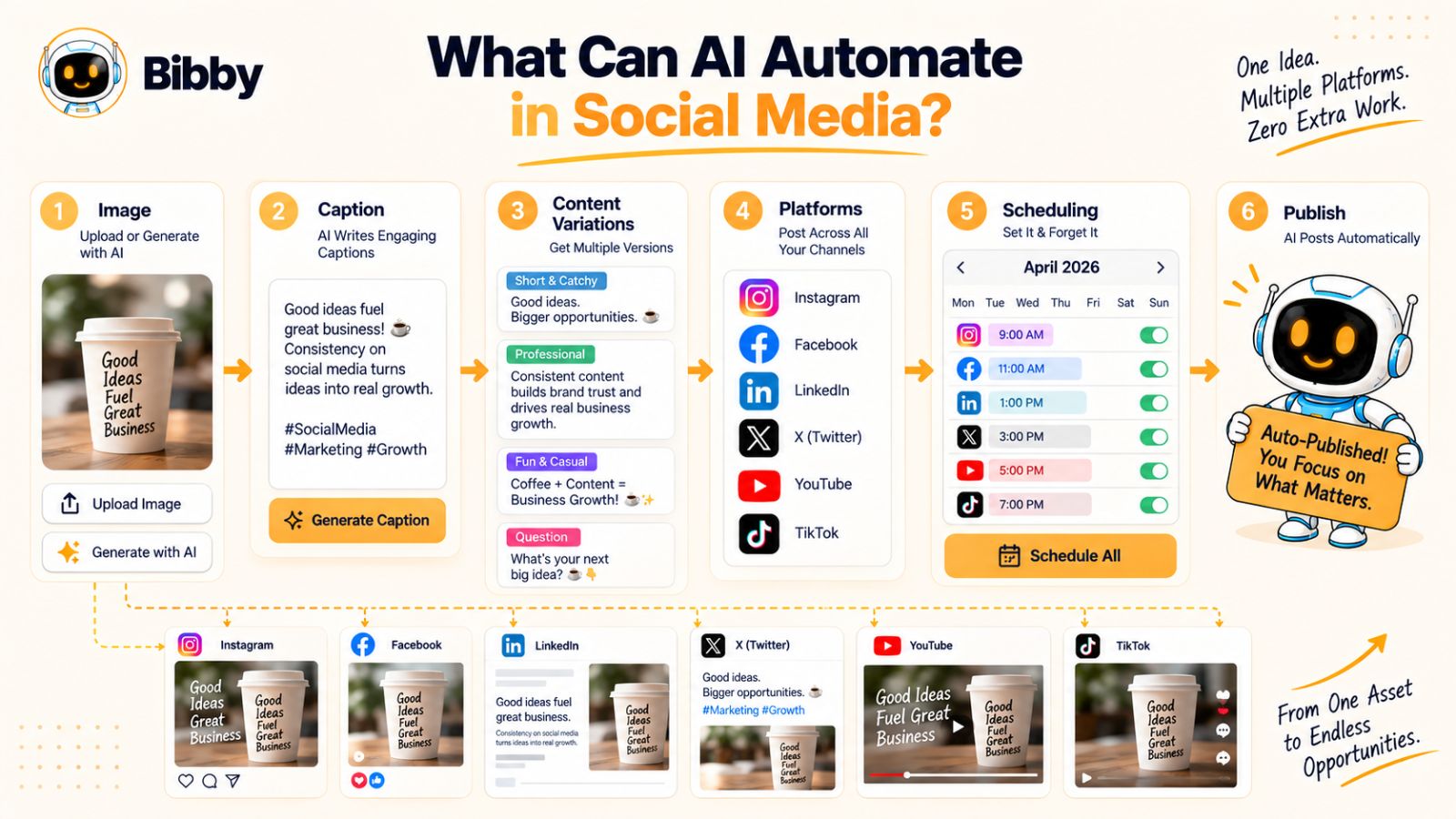
This is where tools such as Bibby become particularly relevant. Instead of treating image creation, caption writing, scheduling, and publishing as separate tasks, Bibby brings them into a single social media automation workflow. You can upload an image or generate one with AI, select a posting style, and have captions generated automatically before scheduling the content across your selected social platforms.
The result is not simply “AI-generated content.” It is a connected process that takes content from creation to publication with considerably less manual work.
What does “social media on autopilot” actually mean?
Putting your social media on autopilot does not mean abandoning your marketing strategy.
It means removing yourself from the repetitive operational work that makes social media management unnecessarily time-consuming.
A useful autonomous social media workflow looks something like this:
Content idea → creative asset → AI caption → platform selection → scheduling → publishing → performance review
The more of this workflow your technology can handle reliably, the less time your team needs to spend moving content from one tool to another.
Bibby takes this concept further through its chat interface. Instead of navigating through multiple menus for every task, you can interact with the system conversationally to manage activities such as creating a brand kit, launching a campaign, creating posts, regenerating captions, and handling other social media tasks.
That conversational layer is important because the future of marketing automation is unlikely to be defined solely by complicated dashboards and scheduling calendars. Increasingly, marketers will be able to tell AI what they want to accomplish and let the system handle the underlying execution.
What still requires human oversight?
Autonomous does not mean completely unsupervised.
Your brand strategy, positioning, creative direction, important announcements, sensitive customer communications, and major campaign decisions still benefit from human judgment. AI is most valuable when it removes repetitive execution without removing the person responsible for the business outcome.
The goal, therefore, isn't to replace the marketer.
The goal is to give the marketer leverage.
And that leverage becomes particularly valuable when we look at how much time and money traditional social media management can consume.
Also read: Social Media Growth With AI: The New Rules Every Brand Must Know
Why Social Media Management Has Become So Expensive
Social media looks simple from the outside: create a post, write a caption, publish it, and move on.
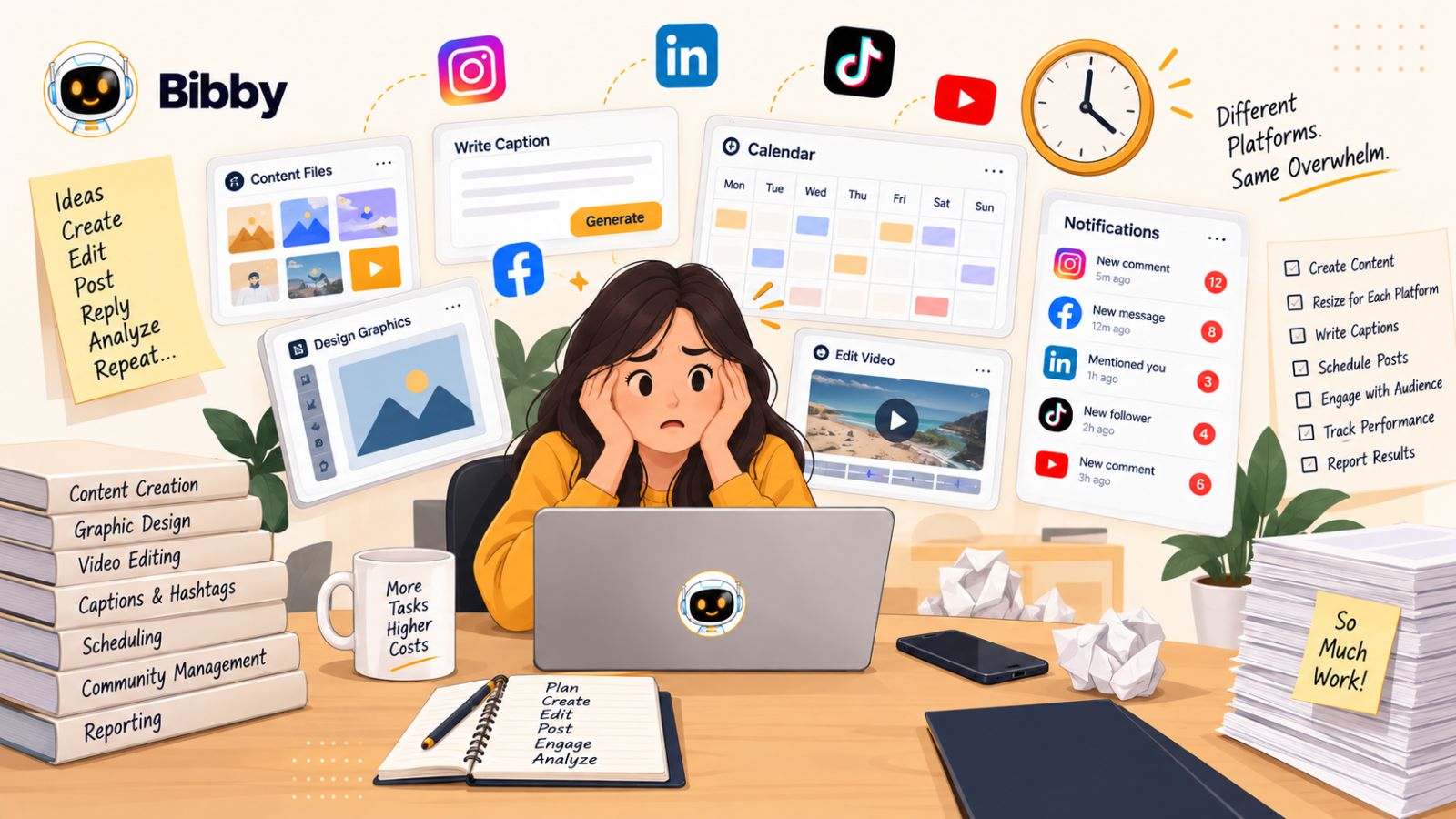
In practice, maintaining a consistent presence across multiple platforms can become a surprisingly large operational workload. The challenge isn't usually one individual task. It's the accumulation of dozens of small tasks that have to be repeated every day, week, and month.
A business publishing consistently across Facebook, Instagram, LinkedIn, YouTube, and TikTok may need to manage different content formats, audiences, publishing schedules, captions, creative requirements, and workflows for each platform.
That is where the true cost of social media management starts to appear.
Content creation
Every social media strategy begins with content.
Someone has to decide what to publish, create the visual, record the video, design the carousel, or source the relevant creative assets. For businesses publishing frequently, producing enough content to maintain a consistent presence can consume a significant amount of time.
The challenge becomes even greater when every platform requires a different format.
A single marketing idea might become an Instagram post, LinkedIn update, TikTok video, YouTube Short, Facebook post, or Story. Creating all of those variations manually can turn one idea into hours of production work.
AI can reduce some of this friction by helping generate visuals, transform ideas into content, and repurpose existing creative assets.
Caption writing
Creating the image is only part of publishing.
Every post needs accompanying copy, and effective social media captions aren't simply blocks of text. They need to fit the platform, audience, content format, brand voice, and purpose of the post.
Writing captions manually for dozens of posts can become repetitive.
It also creates a common bottleneck: businesses may have plenty of ideas and visual assets but lack the time to turn those assets into finished, publishable posts.
AI caption generation can turn this into a much faster process. Instead of starting every caption from a blank document, marketers can provide the content and desired style and allow AI to produce an initial version that can be reviewed or refined.
Platform-specific publishing
Publishing on one platform is relatively straightforward.
Managing several platforms simultaneously is different.
Facebook, Instagram, LinkedIn, YouTube, and TikTok each have different audiences and content conventions. A social media manager may need to move between multiple platforms or tools simply to get the week's content published.
That creates unnecessary operational overhead.
A centralized social media automation platform can reduce this by allowing marketers to manage multiple platforms from one workflow.
With Bibby, for example, a marketer can select the social platforms they want to publish on and schedule content across them rather than manually managing every platform independently.
Scheduling and timing
Publishing content consistently requires more than creating posts.
Someone has to decide when those posts should go live.
Manual scheduling requires maintaining a content calendar, selecting dates, choosing times, checking for conflicts, and repeating the process for every piece of content.
For a business publishing several times per week across multiple platforms, these decisions quickly add up.
AI-powered scheduling introduces another possibility: instead of manually selecting every publishing time, the system can use AI-optimized timing as part of the scheduling workflow.
This shifts the marketer's role from manually operating the calendar toward setting the overall publishing strategy and letting the system handle much of the execution.
Repurposing content
One of the biggest missed opportunities in Social media marketing is failing to get enough value from content that has already been created.
A single idea can potentially support multiple pieces of social content.
A product announcement could become a LinkedIn post, Instagram carousel, Facebook update, short-form video, Story, and TikTok. A blog post could become several educational posts. A customer success story could become a series of social updates.
But repurposing takes time when done manually.
Autonomous marketing changes the economics by making it easier to turn one creative input into multiple publishing opportunities.
The objective isn't necessarily to publish identical content everywhere. It's to reduce the amount of manual work required to adapt and distribute the underlying idea.
Maintaining consistency
Consistency is another hidden cost.
A social media presence can look effortless to an audience, but maintaining that consistency requires an ongoing system behind the scenes.
Someone needs to make sure:
- Content is published regularly
- Brand messaging remains consistent
- Visual assets follow the brand identity
- Campaigns are coordinated
- Posts don't become repetitive
- Different platforms receive enough attention
- Content doesn't stop when the team gets busy
This is one reason an AI-powered brand workflow can be valuable.
For example, Bibby allows users to create a brand kit through its chat interface, helping establish a centralized foundation for generating and managing social content. Instead of repeatedly explaining the brand's identity from scratch, the system can become part of a more consistent content-production workflow.
The hidden cost of managing multiple social platforms
The biggest cost isn't always the software subscription or the salary of the person managing social media.
It is the opportunity cost of human attention.
Consider a founder who spends several hours each week creating captions, formatting posts, scheduling content, and moving assets between platforms. Those hours have an economic value even if no additional employee is hired.
The same applies to a marketing employee who spends Monday morning scheduling posts instead of working on campaign strategy, customer research, creative experimentation, or conversion optimization.
This is why the ROI of AI social media automation shouldn't be measured only by how much money a business spends on software.
The more important question is:
How much valuable human time can the system return to the business?
That question takes us directly to the economics of autonomous marketing—and why reducing repetitive social media work can have an impact far beyond simply publishing posts faster.
Also read: How to Keep Your Feed Consistent and Viral Using Autonomous AI Tools
The ROI of Autonomous Marketing
The most interesting thing about autonomous marketing isn't that AI can write a caption in a few seconds. The real value comes from what happens when hundreds of small marketing tasks become faster, cheaper, and easier to execute.
For social media, the ROI of AI automation can be viewed through four interconnected areas: time, cost, output, and scalability.
When a business can produce and distribute more content without proportionally increasing its workload, the economics of social media management begin to change.
The traditional cost of social media management
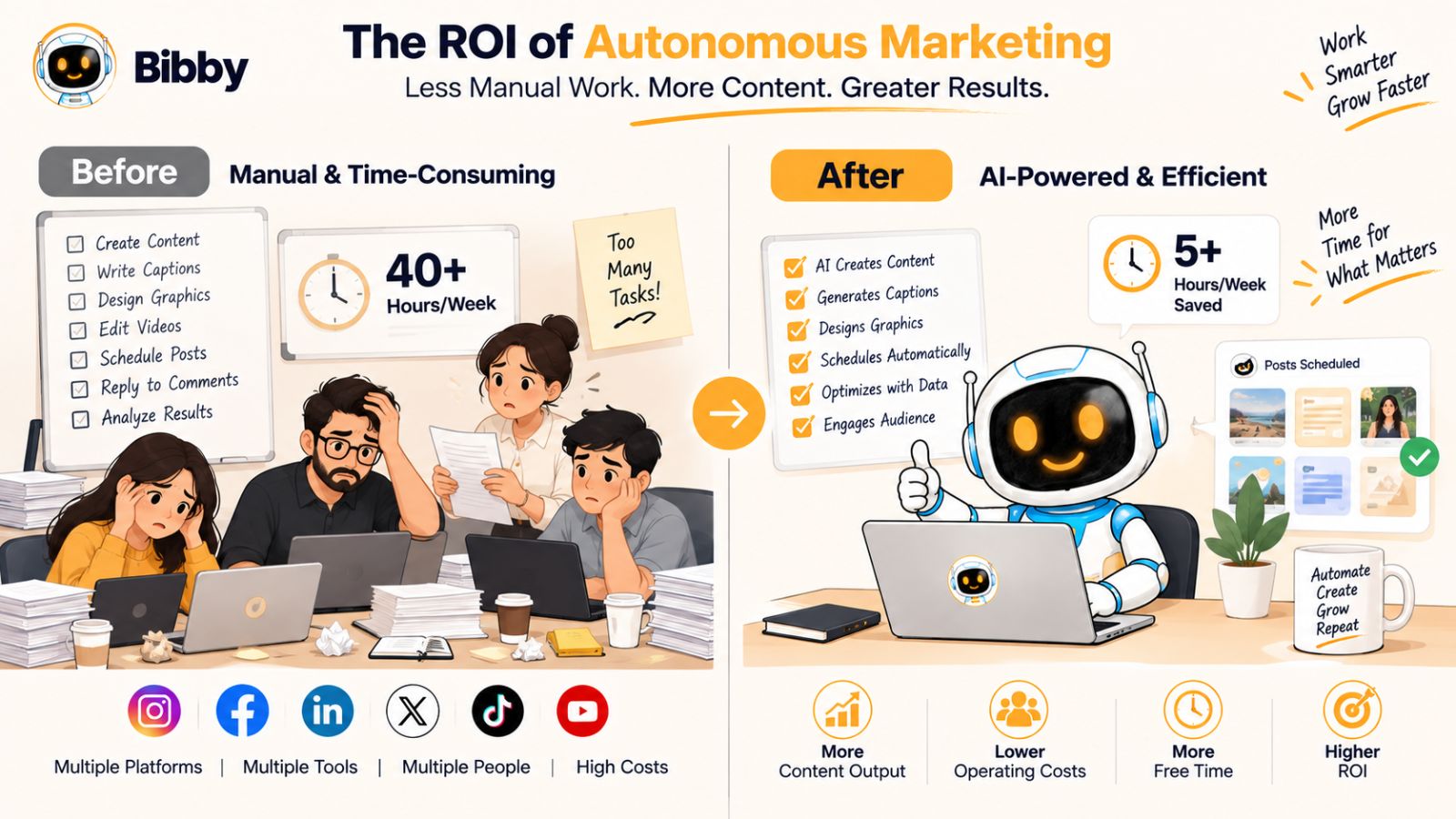
A traditional social media workflow often involves several people or tools.
A marketer might create the content. A designer might prepare the visuals. A copywriter might write captions. Another person might schedule the posts. A manager might review everything before publication.
For a small business, one person may perform all of these jobs.
That doesn't make the work free.
It simply means the business is paying for it through the employee's or founder's time.
Consider a simplified example.
Suppose a marketer spends 10 hours every week managing social media. If that person costs the business $30 per hour in salary and associated overhead, the operational cost is approximately $300 per week, or around $1,200 per month.
Now imagine an AI-powered workflow reduces the repetitive workload by half.
The business hasn't necessarily eliminated its marketing role. Instead, it has recovered approximately five hours per week that can be redirected toward higher-value activities.
That's an important distinction.
Automation ROI isn't only about replacing expenses. It's about increasing the amount of productive work a team can accomplish with the same resources.
Time saved as an ROI metric
Time is one of the easiest benefits of AI social media automation to overlook.
Imagine that a marketer previously needed to:
- Create an image.
- Write a caption.
- Adapt the copy.
- Open several social platforms.
- Schedule each post.
- Choose dates and times.
- Repeat the process for the next post.
An automated workflow can compress many of those steps.
With a platform such as Bibby, the workflow can begin with uploading an image or generating one with AI. The user can then select a posting style, have captions generated automatically, choose the relevant platforms, and schedule the content.
Instead of spending time operating the publishing machinery, the marketer can spend more time deciding what the business should say and why.
That distinction is fundamental to autonomous marketing.
Increasing content output without increasing headcount
The second major source of ROI is increased output.
Suppose a business currently publishes 10 social posts per month because that's all its marketing team has time to produce.
If automation makes the production and scheduling process significantly more efficient, the same team may be able to manage substantially more content.
That creates additional opportunities to:
- Test different messages
- Educate potential customers
- Promote products
- Share customer stories
- Repurpose existing content
- Build brand awareness
- Experiment with different creative formats
The important metric isn't simply the number of posts.
The real question is whether the business can increase its useful marketing output without increasing operational complexity at the same rate.
The economics of repurposing one asset
Consider a company that creates a product image.
Without automation, the team might create one Instagram post and stop there.
With a more autonomous workflow, that same asset could become part of a broader campaign across Facebook, Instagram, LinkedIn, TikTok, and YouTube.
The underlying creative idea remains the same, but its distribution expands.
This is where tools like Bibby can change the economics of content distribution. Rather than requiring a marketer to manually schedule every version, the system can help turn the original asset into scheduled social content across selected platforms.
The value comes from extracting more distribution opportunities from work the business has already paid to create.
A simple framework for calculating autonomous marketing ROI
Businesses don't need a complicated financial model to estimate the potential value of social media automation.
A simple framework is:
Automation ROI = Value of time saved + value of additional output − cost of automation
For example, imagine:
- Current social media workload: 40 hours per month
- Automated workload: 20 hours per month
- Time recovered: 20 hours
- Estimated value of recovered time: $40/hour
- Monthly value recovered: $800
- Automation cost: $100/month
The direct operational value would be:
$800 − $100 = $700 per month
That's only the first layer.
If the additional time allows the team to create more campaigns, respond faster to opportunities, test more content, or focus on activities that generate revenue, the potential business value can extend beyond the direct labor savings.
Of course, these numbers will vary significantly by business. Automation doesn't automatically produce revenue, and publishing more content doesn't guarantee better marketing performance.
The ROI needs to be measured against actual business outcomes.
The bigger ROI: buying back attention
Perhaps the most valuable benefit of autonomous marketing is difficult to capture in a spreadsheet.
It's attention.
Founders, marketers, and social media teams can spend enormous amounts of time operating systems instead of improving them.
AI automation can move that balance in the opposite direction.
Instead of asking:
“How can I get all these social media posts scheduled?”
the marketer can focus on:
“What should we be communicating to our audience next?”
That is the fundamental promise of autonomous marketing.
The technology handles more of the repetitive execution so humans can spend more of their limited attention on strategy, creativity, judgment, and growth.
And as AI becomes capable of handling more parts of the social media workflow, the question is no longer whether individual tasks can be automated. The more interesting question is how much of the entire social media operation can be connected into one autonomous system.
What Can AI Automate in Social Media?
AI social media automation has evolved beyond simply scheduling posts in advance. Modern tools can now assist with multiple stages of the content lifecycle, from creating visual assets and writing captions to organizing campaigns and publishing content across multiple platforms.
The important distinction is between automating individual tasks and automating an entire workflow.
A caption generator might save a few minutes. An interconnected AI social media system can potentially remove an entire sequence of repetitive tasks.
AI image generation
Visual content is one of the biggest requirements of social media marketing.
AI image generation allows marketers to create visual assets from a description rather than starting every design from scratch. This can be particularly useful for businesses that need a steady stream of social content but don't have a designer available for every post.
Instead of searching for an image, opening a design application, creating a layout, and exporting the asset, a marketer can describe the visual they need and use AI to generate a starting point.
This doesn't eliminate the need for creative direction. It simply makes the production stage faster.
Social media captions
Writing captions is another highly repetitive part of social media management.
AI can generate captions based on the underlying content, desired tone, audience, and posting style. Marketers can then review, edit, or regenerate the copy when necessary.
This is particularly useful when the same idea needs to be communicated repeatedly without making every post sound identical.
With Bibby, for example, you can provide your visual content and choose a posting style, allowing the system to generate captions automatically as part of the publishing workflow.
Content calendars
Consistency requires planning.
A social media content calendar helps businesses decide what to publish, where to publish it, and when it should go live. Traditionally, maintaining this calendar can require considerable manual effort.
AI can help organize content into a more structured publishing workflow.
Rather than treating every post as an isolated task, marketers can think in terms of campaigns, themes, content categories, and publishing sequences.
This makes it easier to turn individual pieces of content into an ongoing social media system.
AI-optimized publishing times
Choosing when to publish is another task that can be automated.
Instead of manually selecting a date and time for every post, AI-powered scheduling systems can incorporate optimized publishing times into the workflow.
The advantage is not simply convenience.
Automated scheduling allows marketers to prepare content in advance while the system handles the operational details of distributing that content according to the selected schedule.
This is especially valuable for teams managing several social networks simultaneously.
Facebook and Instagram publishing
Managing Facebook and Instagram separately can create unnecessary duplication.
A centralized automation workflow can allow marketers to organize content for both platforms from one place, while adapting the publishing process to the selected content formats.
For businesses already producing regular visual content, this can significantly reduce the repetitive work involved in maintaining a consistent presence.
LinkedIn content
LinkedIn often requires a different communication style from visually oriented social networks.
Professional insights, educational content, company updates, and thought leadership need to be presented differently from a short promotional post.
AI can help transform an underlying idea into platform-appropriate copy while allowing the marketer to maintain control over the message and brand voice.
This is particularly useful for companies that want to maintain a LinkedIn presence without creating every post manually.
YouTube content
Video introduces additional complexity because content needs to be planned, packaged, and distributed differently from a static image.
An increasingly autonomous social media workflow can incorporate video content alongside images and other formats, allowing marketers to manage more of their content distribution from a centralized system.
The goal isn't necessarily to create every video automatically.
It is to make video distribution less operationally demanding.
TikTok content
TikTok adds another important dimension to social media automation because short-form video is highly content-intensive.
For brands already producing short-form video, automation can help reduce the administrative work around organizing and publishing that content.
Instead of manually coordinating every publishing date and platform, marketers can incorporate TikTok into the same broader content workflow.
Images, carousels, videos, and Stories
A modern social media strategy rarely depends on one format.
Businesses may use:
- Single-image posts
- Carousels
- Short-form videos
- Stories
- Educational posts
- Promotional content
- Product content
- Customer-focused content
An effective automation system therefore needs to support more than simple text posts.
Bibby is designed around this broader approach, allowing users to work with images, carousels, videos, and Stories while managing distribution across selected social platforms.
That makes the workflow closer to content operations than traditional post scheduling.
Campaign creation and content repurposing
The most powerful form of automation happens when individual posts become part of a larger campaign.
Instead of creating one post at a time, marketers can define a campaign around a product launch, promotion, educational topic, or brand initiative.
AI can then assist with creating and organizing the content required to support that campaign.
Bibby's chat interface pushes this concept further. Rather than requiring the user to navigate through separate workflows for every task, the user can interact conversationally with the system to create a brand kit, create campaigns, create posts, regenerate captions, and manage other social media activities.
This represents an important shift in how marketers interact with automation software.
The interface is no longer just:
Click → configure → schedule → repeat.
It can increasingly become:
Tell the AI what you want → review the result → let the system execute.
That change may ultimately be more significant than any individual AI feature.
When content creation, caption generation, campaign management, scheduling, and publishing are connected, social media automation stops being a collection of isolated shortcuts and starts becoming an autonomous marketing workflow.
Also read: Social Media Habits of Fast-Growing Companies (That You Can Copy Today)
How to Put Your Social Media on Autopilot
Knowing that AI can automate social media is one thing. Building a workflow that actually runs with minimal manual effort is another.
The key is to connect the major stages of social media management into one repeatable process. Instead of creating a post, finding a scheduler, opening five different platforms, and manually repeating the same steps, you create a system where each stage naturally leads into the next.
Here is what that workflow can look like.
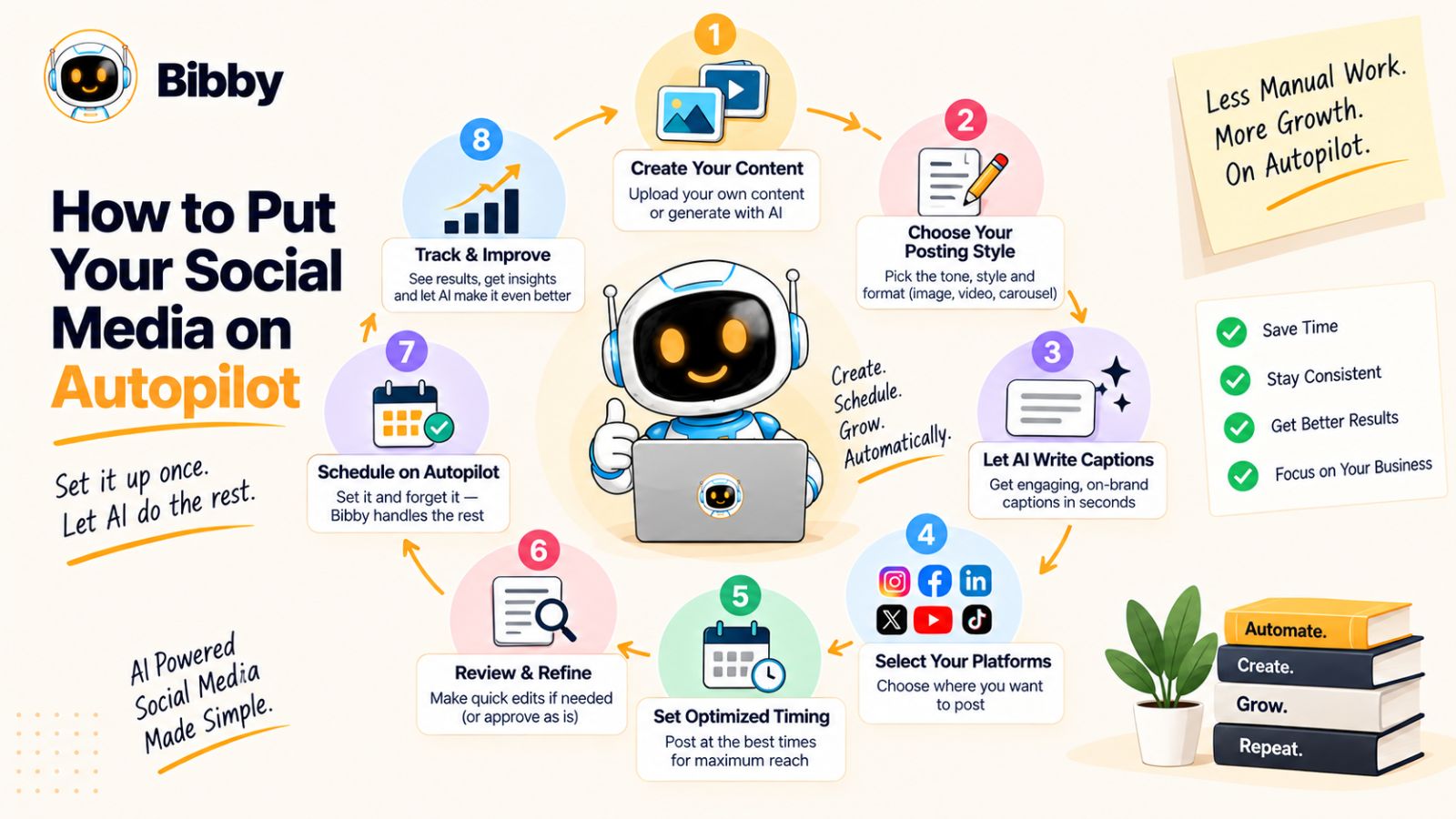
Step 1: Upload or generate your visual content
Every social media workflow needs an input.
That might be a product image, promotional graphic, carousel, video, customer testimonial, educational visual, or another creative asset.
With an AI-powered workflow, you don't necessarily need to have every visual prepared before you begin. AI image generation can help create visuals when you don't already have an asset available.
For example, you might start with a simple instruction:
Create a clean social media visual explaining three benefits of AI automation for small businesses.
Instead of spending time building the initial concept manually, AI can provide a visual starting point that can then be reviewed and refined.
The objective is simple: get the creative asset into the workflow.
Step 2: Choose your posting style
Once the content is ready, the next step is determining how you want it communicated.
A product announcement might require a promotional style. An educational post might need a more informative tone. A personal brand might prefer a conversational style.
Giving AI this context helps it generate content that is aligned with the purpose of the post rather than producing generic copy.
This is also where your brand identity becomes important.
The more clearly your system understands your brand voice, audience, and communication preferences, the more useful its generated content can become.
Step 3: Let AI generate captions
Instead of writing every caption from scratch, AI can create an initial version automatically.
The system can use the visual asset, selected style, and other available context to produce the accompanying social media copy.
The marketer can then review it, make changes where necessary, or regenerate it.
This creates a much faster feedback loop:
Generate → review → refine → publish.
That is very different from staring at a blank caption box for every post.
Step 4: Select your social platforms
Next, determine where the content should be distributed.
Depending on the campaign, you might choose Facebook, Instagram, LinkedIn, YouTube, TikTok, or several platforms simultaneously.
A centralized system makes this significantly easier because you don't need to manually recreate the publishing process on every network.
With Bibby, for example, users can select their desired platforms as part of the scheduling workflow and manage the distribution of their content from one system.
The result is a single publishing workflow instead of several disconnected ones.
Step 5: Let AI determine publishing times
Once the platforms are selected, scheduling becomes the next step.
Rather than manually deciding the exact time for every post, an AI-powered scheduling system can use optimized publishing times as part of the workflow.
This is particularly useful when you have dozens of posts prepared in advance.
Instead of maintaining a spreadsheet and manually assigning dates and times, you can allow the scheduling system to organize the publishing calendar.
The human still determines the overall content strategy.
The AI handles more of the calendar mechanics.
Step 6: Review your content
Autonomous doesn't have to mean uncontrolled.
A review step can remain part of the workflow, particularly for important campaigns, brand announcements, or sensitive topics.
Before content goes live, you can check whether:
- The message is accurate
- The visual represents the brand correctly
- The caption matches the intended tone
- The call to action makes sense
- The correct platforms are selected
- The campaign timing is appropriate
This creates an important balance between automation and human oversight.
Step 7: Automate the publishing schedule
Once everything looks right, the system can take over the repetitive publishing work.
Instead of returning to the scheduler every morning, the marketer can prepare content in batches and let the system distribute it according to the planned schedule.
This is where the concept of social media autopilot becomes tangible.
Your social channels can continue receiving content even when you're working on something else.
You don't need to be online at the exact moment every post needs to be published.
Step 8: Monitor and improve the system
Automation shouldn't mean “set it and forget it forever.”
The final component is learning.
Review which content gets attention, which formats generate engagement, which topics resonate with your audience, and which campaigns contribute to meaningful business outcomes.
Then use those insights to improve the next batch of content.
The most effective autonomous marketing systems therefore operate as a loop:
Create → generate → schedule → publish → measure → improve → repeat.
This is also where the distinction between a traditional social media scheduler and an AI-powered social media automation platform becomes important.
A scheduler primarily answers:
“When should this post be published?”
An autonomous workflow aims to answer a much broader question:
“How can this entire social media process run with as little repetitive human effort as possible?”
That is the problem platforms such as Bibby are designed to address—and the next step is looking at how its workflow brings these individual pieces together.
Also read: Why Every Business Needs an AI Social Media Agent →
Bibby: Turning Social Media Automation Into an Autonomous Workflow
Most social media tools solve one part of the publishing problem. One tool helps you design content, another generates captions, another manages scheduling, and the social platforms themselves handle publishing.
The problem is that marketers still have to connect all those pieces.
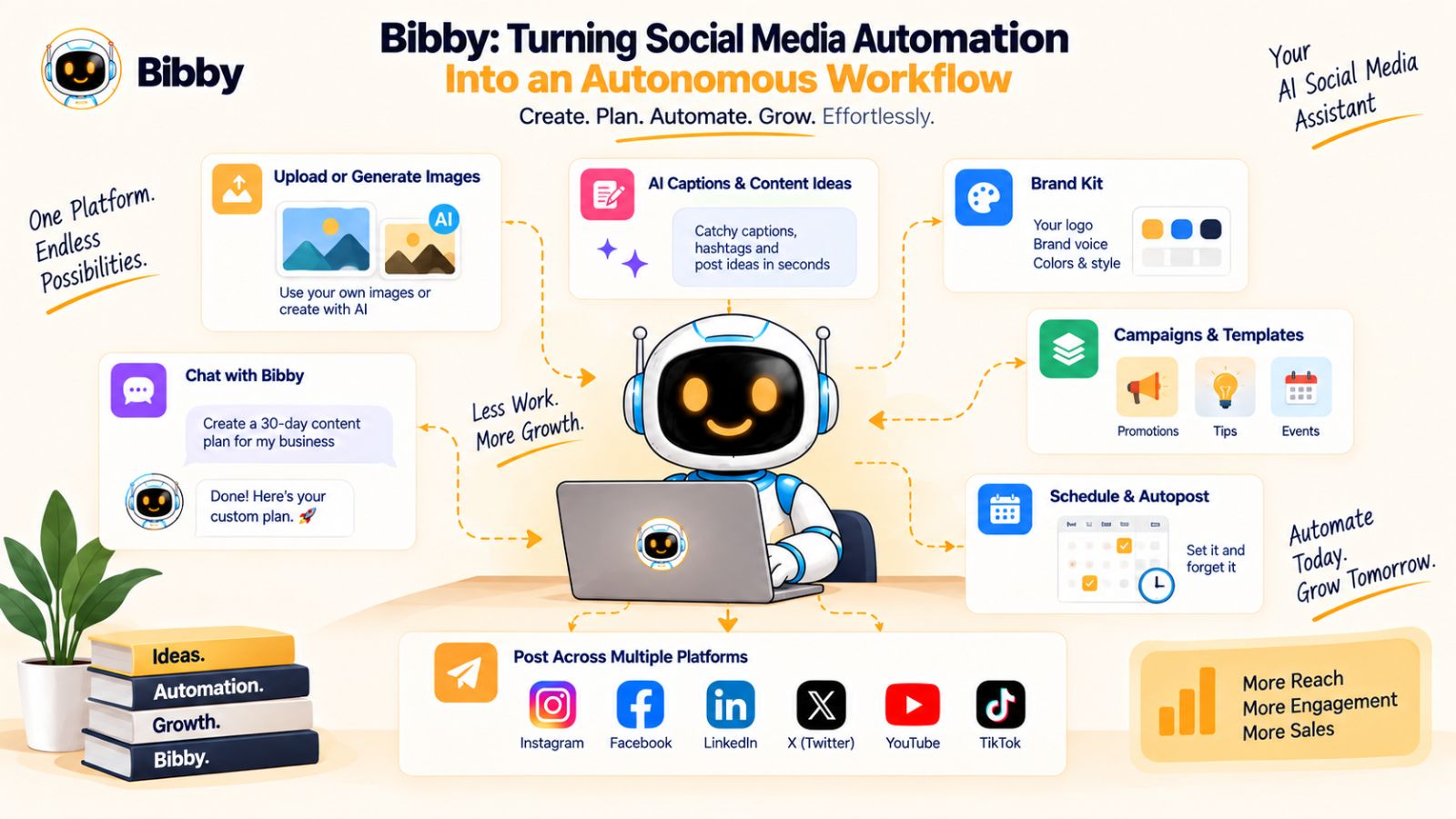
Bibby takes a different approach by bringing content creation, AI-generated captions, scheduling, publishing, and conversational social media management into a single workflow.
The basic idea is straightforward: give Bibby your content or create it with AI, tell it how you want to communicate, select your platforms, and let the system handle much of the repetitive execution.
The simple Bibby workflow
The workflow starts with the content itself.
You can upload an image or generate an image with AI. From there, you choose the posting style you want, and Bibby can automatically generate captions for the content.
You then select the social platforms where you want the content published.
Instead of manually assigning a date and time to every post, Bibby can schedule the content across different dates using AI-optimized publishing times.
That creates a simple sequence:
Create → choose style → generate caption → select platforms → schedule → publish.
The advantage isn't any individual step.
It's having the steps connected.
Creating captions automatically
Caption writing can become one of the most repetitive parts of social media management.
A marketer might have the perfect image ready but spend several minutes—or much longer—trying to find the right words for each platform.
Bibby's AI-generated captions can remove that blank-page problem.
Rather than starting with an empty text field, marketers can generate a caption based on the content and selected posting style. If the result isn't right, it can be regenerated and refined.
This creates a much faster content-production loop while keeping the marketer in control of the final message.
Scheduling content across multiple platforms
Managing multiple social networks is where social media scheduling can become particularly time-consuming.
A business may want to publish content on Facebook, Instagram, LinkedIn, YouTube, and TikTok, but manually coordinating all those publishing schedules creates unnecessary work.
Bibby allows users to select their desired platforms and manage the scheduling process from a centralized workflow.
Instead of asking:
“Did I remember to schedule this everywhere?”
the marketer can work from a single system designed around multi-platform distribution.
AI-optimized publishing times
Choosing publishing times manually can also become a repetitive process.
Bibby incorporates AI-optimized times into its scheduling workflow, allowing content to be distributed across different dates and times without requiring the marketer to manually build every publishing slot.
This matters when the volume of content increases.
Scheduling five posts manually isn't particularly difficult. Scheduling hundreds of posts across several platforms is a different operational challenge.
Automation becomes increasingly valuable as that volume grows.
Supporting images, carousels, videos, and Stories
Social media isn't limited to static images.
Modern brands may use carousels to educate, videos to demonstrate products, Stories to maintain engagement, and individual images for announcements or promotions.
An effective social media automation platform therefore needs to support a range of content formats.
Bibby supports images, carousels, videos, and Stories, allowing businesses to manage different types of social content within the same broader workflow.
That makes the platform relevant not just for scheduling individual posts, but for managing a more complete content operation.
Managing social media through Bibby's chat interface
One of the more interesting developments in Bibby is its chat interface.
Instead of navigating through a conventional software dashboard for every task, users can interact with the system conversationally.
This changes the interaction model.
Rather than thinking:
“Which button do I need to click to create this campaign?”
you can think:
“Create a campaign for our new product and prepare the social content for it.”
The difference may seem small, but conversational interfaces can make complex software easier to operate because the user focuses on the desired outcome rather than the sequence of interface actions required to achieve it.
Creating a brand kit through chat
Brand consistency becomes increasingly important as AI generates more content.
A business needs its content to feel like it belongs to the same company—not like a collection of unrelated AI outputs.
Bibby's chat interface can be used to create a brand kit, giving the social media workflow a centralized understanding of the brand's identity.
This provides a foundation for producing content more consistently rather than treating every post as an isolated creation.
Creating campaigns through chat
Campaigns are another area where conversational management can simplify the workflow.
Instead of manually setting up every individual component, users can interact with Bibby through chat to create campaigns and organize the associated social content.
This is particularly useful for launches, promotions, seasonal campaigns, educational series, and other initiatives where multiple posts need to work together.
The shift is from managing posts individually to managing marketing objectives.
Creating and regenerating posts through chat
The conversational workflow can also be used to create posts and regenerate content when the first version isn't right.
That's important because AI-generated content should not be treated as a one-shot process.
The first output is often a starting point.
A marketer might ask for a different tone, a stronger hook, a shorter caption, a more educational approach, or a different version for another audience.
A chat interface makes that iteration feel more natural:
Create → review → ask for changes → regenerate → approve.
The marketer remains involved in the important decisions while AI handles more of the mechanical work.
Bibby vs. manually managing multiple social platforms
The biggest difference becomes clear when the entire workflow is considered.
Without centralized automation, a marketer may have to:
Create content → write caption → open scheduler → select platform → choose date → choose time → repeat → publish → repeat across platforms.
With an autonomous workflow, many of those repetitive steps can be consolidated:
Provide content → select style and platforms → generate → schedule → publish.
Bibby's role is therefore broader than simply being a social media scheduler.
It is an example of how social media management can evolve from a collection of manual tasks into a connected AI-powered workflow.
And that is ultimately where the ROI of autonomous marketing becomes most interesting: when the technology doesn't just make one task faster, but reduces the amount of human effort required to move an entire piece of content from idea to publication.
AI Social Media Automation vs. Hiring a Social Media Team
The question isn't necessarily whether AI should replace a social media team.
For most businesses, that's the wrong comparison.
The more useful question is: which parts of social media management require human expertise, and which parts can be handled more efficiently by AI?
A modern marketing operation can use AI to reduce repetitive execution while keeping humans responsible for strategy, creative direction, brand decisions, and important customer interactions.
Cost comparison
A traditional social media operation can involve several different costs.
Depending on the business, you might need:
- A social media manager
- A copywriter
- A graphic designer
- Video editing resources
- Scheduling software
- Content management systems
- Agency or freelancer support
Not every business needs all of these roles, but the costs can accumulate quickly as the publishing volume increases.
AI automation introduces another model.
Instead of adding people every time content volume increases, businesses can use software to absorb some of the repetitive workload.
For example, a small business might not need a dedicated copywriter to produce every social media caption if AI can generate a strong first draft. A marketer may not need to manually schedule every post across five platforms if an automated system can handle the distribution.
The result isn't necessarily “AI costs less than employees.”
The more accurate proposition is:
AI can reduce the amount of human time required to execute repetitive marketing work.
That distinction matters because the value of a human marketing professional often comes from activities that are difficult to automate completely.
Speed and scalability
Human teams have a natural capacity limit.
If one person can reasonably produce and schedule 50 posts in a month, doubling the publishing volume usually requires either more time or additional resources.
Software doesn't experience that limitation in the same way.
Once the workflow is established, an AI-powered system can help process significantly more content without requiring a proportional increase in manual operations.
This is one of the strongest arguments for social media automation.
A business can increase its content output without turning every additional post into another manual administrative task.
Content consistency
Consistency is another area where automation can help.
A human team may understand the brand extremely well, but maintaining consistency across hundreds of pieces of content requires ongoing attention.
AI-powered workflows can help standardize elements such as:
- Brand voice
- Content styles
- Publishing processes
- Caption structures
- Campaign organization
- Scheduling workflows
For example, a brand kit can provide a centralized foundation for content creation.
Bibby's chat-based workflow allows businesses to create a brand kit and use it as part of their broader social media management process.
This can help reduce the problem of every post being created from a completely blank starting point.
Human creativity vs. AI execution
There is an important line between creativity and execution.
A human might come up with the campaign concept:
“We want to show how our product saves small businesses five hours every week.”
AI can then help execute that concept across multiple pieces of social content.
It can assist with captions, visual concepts, variations, scheduling, and distribution.
The human provides the strategic direction.
AI handles more of the production machinery.
This hybrid approach is often more useful than treating the choice as humans versus machines.
Where a hybrid model makes sense
A practical social media operation can divide responsibilities according to the strengths of each side.
Humans can focus on:
- Brand strategy
- Positioning
- Creative concepts
- Customer understanding
- Original insights
- Major campaign decisions
- Sensitive communications
- Final approval
AI can assist with:
- Caption generation
- Content variations
- Image generation
- Scheduling
- Content organization
- Repurposing
- Publishing
- Campaign administration
This creates a useful division of labor.
The human isn't spending their best hours clicking through scheduling screens. At the same time, the business isn't handing its entire brand identity over to an automated system without oversight.
Instead, AI becomes the execution layer underneath the marketing strategy.
That distinction is central to the ROI of autonomous marketing.
The goal isn't to build a marketing department with no humans.
The goal is to build a marketing department where humans spend more time on decisions that require human judgment and less time on repetitive tasks that software can execute.
Also read: Social Media Automation for Franchises and Multi-Location Businesses: The Complete Guide
The Real ROI: What Happens When Social Media Runs Continuously?
The biggest benefit of autonomous social media marketing isn't simply that a post can be scheduled automatically.
It is the ability to create a system that keeps your brand active consistently without requiring someone to manually operate it every day.
That changes the economics of social media.
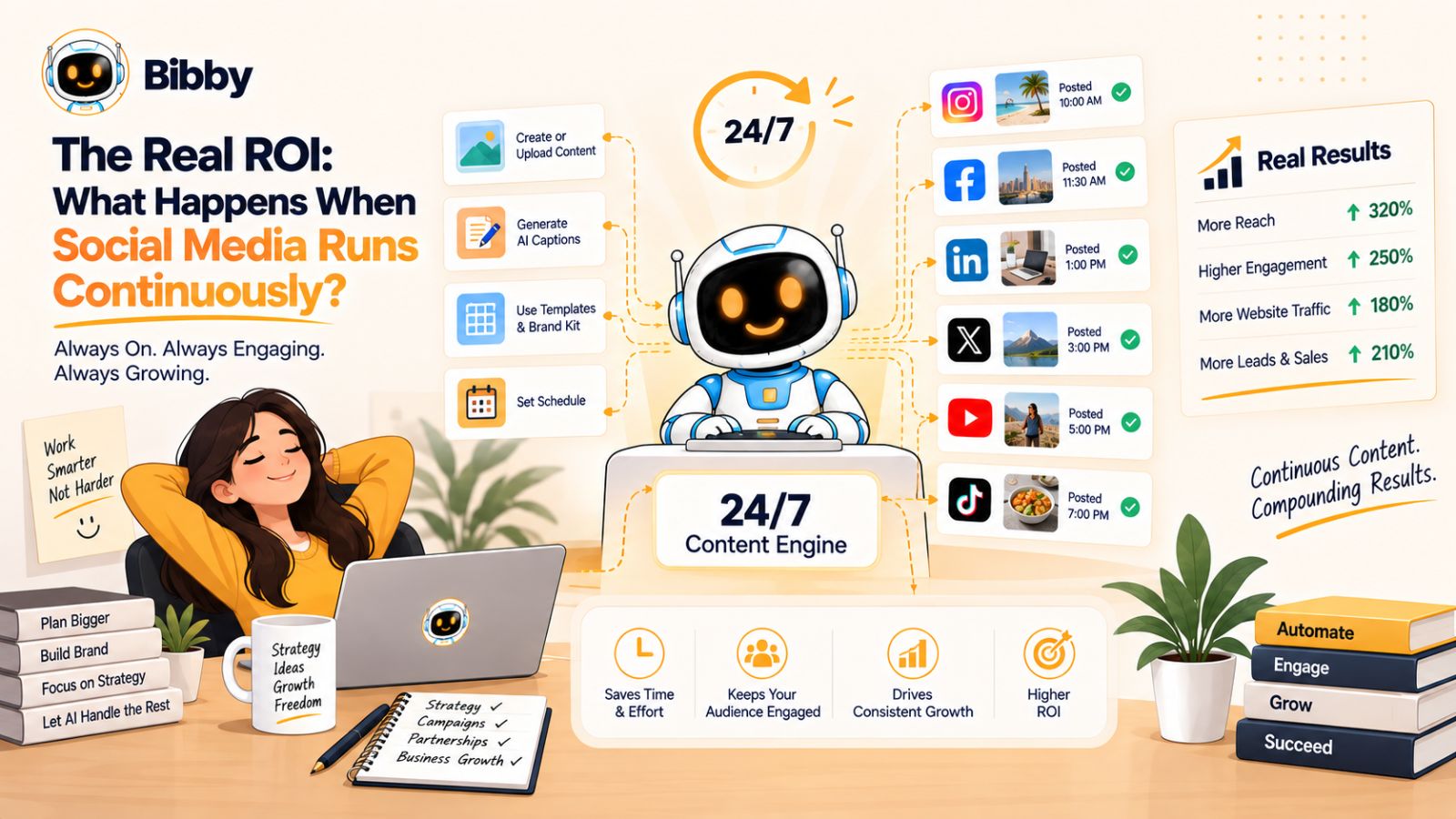
Instead of treating every post as a separate project, businesses can build a continuous content engine that creates, schedules, publishes, and learns over time.
More consistent publishing
Consistency is one of the hardest parts of social media marketing.
Businesses often begin with enthusiasm, publish frequently for a few weeks, and then slow down when other priorities take over.
The problem isn't always a lack of ideas.
It's the operational effort required to turn those ideas into published content.
Automation can reduce that friction.
When content is prepared in advance and scheduled automatically, the business doesn't need someone available every day to remember what needs to be posted.
With a platform such as Bibby, content can be scheduled across selected platforms and distributed at AI-optimized times, allowing the publishing process to continue even when the marketing team is focused elsewhere.
More opportunities to reach audiences
Publishing consistently creates more opportunities for a business to communicate with its audience.
That doesn't mean publishing as much as possible.
It means having the operational capacity to maintain a deliberate publishing cadence.
A business that can efficiently produce educational posts, product content, videos, carousels, Stories, and other formats has more opportunities to test different messages and discover what resonates with its audience.
Automation makes experimentation less expensive in terms of human time.
Instead of asking whether the team has enough hours to test another content idea, marketers can focus more directly on whether the idea is worth testing.
Lower operational workload
This is where the time-saving benefit becomes tangible.
Imagine a marketer who normally spends several hours every week:
- Writing captions
- Formatting content
- Scheduling posts
- Choosing publishing times
- Switching between platforms
- Checking the content calendar
- Repeating the same workflow
If automation removes a significant portion of that work, those hours become available for other activities.
The marketer can spend more time on strategy, audience research, campaign planning, creative development, or analyzing results.
In other words, automation doesn't necessarily reduce the amount of marketing you do.
It can reduce the amount of administrative work required to do it.
Faster experimentation
Marketing improves through experimentation.
Different audiences respond to different messages. Different creative formats produce different outcomes. Different hooks, topics, calls to action, and content styles can perform differently.
The challenge is that experimentation requires production capacity.
If creating and scheduling one additional experiment takes an hour of manual work, teams naturally become selective about how many experiments they run.
AI can lower the operational cost of creating variations.
A marketer can generate multiple caption approaches, content variations, or publishing sequences and test them without manually building every version from scratch.
The result is a shorter distance between:
“What if we tried this?”
and
“Let's test it.”
More content from the same creative assets
Another important source of ROI is content utilization.
Businesses frequently create valuable assets that are used once and then forgotten.
A product photograph might appear in one Instagram post. A customer testimonial might be published once. A video might receive a single round of distribution.
An autonomous workflow can encourage a different mindset.
Instead of asking:
“What should we create next?”
marketers can also ask:
“What can we get more value from?”
One creative asset can potentially support multiple posts, formats, platforms, and campaign touchpoints.
The goal isn't to duplicate the exact same post everywhere.
It is to extract more useful marketing opportunities from the original creative investment.
Giving founders and marketers their time back
Ultimately, this is where the ROI of autonomous marketing becomes most compelling.
For a founder, social media can become a constant background task.
For a marketing manager, it can become a never-ending list of operational jobs.
For an agency, it can become dozens of repetitive workflows multiplied across clients.
Automation can reduce that burden.
Imagine being able to tell your social media system what you want to accomplish, provide the necessary creative assets, and then let the system handle much of the execution.
That's the direction tools such as Bibby are moving toward with conversational social media management.
Instead of manually navigating through a series of interfaces, users can interact with the platform through chat to create brand kits, campaigns, posts, regenerate captions, and manage other parts of their social media workflow.
The ultimate ROI isn't just a lower cost per post.
It's more productive human attention.
When social media can continue operating without requiring constant manual intervention, marketers get something that traditional scheduling alone can't provide: the ability to step away from the machinery without stepping away from the marketing strategy.
Also read: How to Create a Social Media Funnel That Actually Converts (Step-by-Step Guide) →
What Autonomous Social Media Marketing Cannot Do Alone
The phrase “social media on autopilot” can sound like a promise that AI can run an entire marketing operation without human involvement.
That isn't the most useful way to think about autonomous marketing.
AI is exceptionally valuable for repetitive execution, content generation, organization, scheduling, and distribution. But effective marketing also involves judgment, context, creativity, and an understanding of people that cannot simply be reduced to automated workflows.
The strongest approach is therefore not human versus AI.
It is human strategy supported by AI execution.
Brand strategy
AI can help execute a marketing strategy, but the strategy itself still needs direction.
A business needs to understand:
- Who it serves
- What problem it solves
- Why customers should care
- How it wants to be positioned
- What makes it different
- What it wants social media to accomplish
Without those answers, automation can simply produce more content without producing more meaningful marketing.
Before automating social media, businesses should therefore establish the strategic foundation that the AI system will operate within.
Original thought leadership
AI can generate content based on information and instructions, but businesses shouldn't rely entirely on AI-generated ideas to establish authority.
Original experiences, opinions, customer insights, research, case studies, and industry knowledge are valuable because they come from the business itself.
A strong autonomous workflow should make it easier to distribute those insights—not replace them.
For example, a founder might provide an original observation about an industry trend. AI can then help turn that insight into multiple social posts, captions, and formats.
The human supplies the source of expertise.
AI helps turn it into distributed content.
Sensitive customer communication
Not every social media interaction should be automated.
Complaints, sensitive customer situations, public criticism, unusual requests, and emotionally charged conversations can require context and empathy.
These situations benefit from human review.
Automation is most appropriate when the task is predictable and repeatable. The more a situation depends on nuanced judgment, the more important human involvement becomes.
Crisis management
Crisis communication is another area where businesses should maintain strong human oversight.
When something unexpected happens, the objective isn't simply to produce content quickly.
The business needs to understand what happened, determine what can be communicated, assess the potential consequences, and decide how to respond.
An AI system can potentially assist with drafting or organizing information, but important crisis communications should not be treated like ordinary scheduled social posts.
Creative direction
AI can generate images, captions, variations, and content ideas.
But someone still needs to determine what the brand should feel like.
Creative direction establishes the difference between content that merely fills a calendar and content that contributes to a recognizable brand.
This is where tools such as Bibby can become more useful when paired with a clearly defined brand identity.
Features such as a brand kit and conversational content management can help operationalize the brand's existing direction, but the underlying identity still needs to come from the business.
Why human oversight still matters
The best autonomous social media system is not one that removes humans completely.
It is one that removes humans from tasks where their attention provides little additional value.
A useful rule is:
Automate repetition. Review importance. Own the strategy.
AI can handle a large amount of repetitive execution while humans remain responsible for the decisions that affect the brand most.
That balance also makes the ROI calculation more realistic.
The objective isn't to create a social media department that never needs a person.
The objective is to make every hour a person spends on social media more valuable.
Once that principle is established, businesses can build an AI-powered workflow that combines automation with the human judgment needed to produce genuinely useful marketing.
How to Build an AI-Powered Social Media System That Actually Works
Buying an AI social media tool is easy.
Building a social media system that consistently produces useful content with minimal manual effort requires more thought.
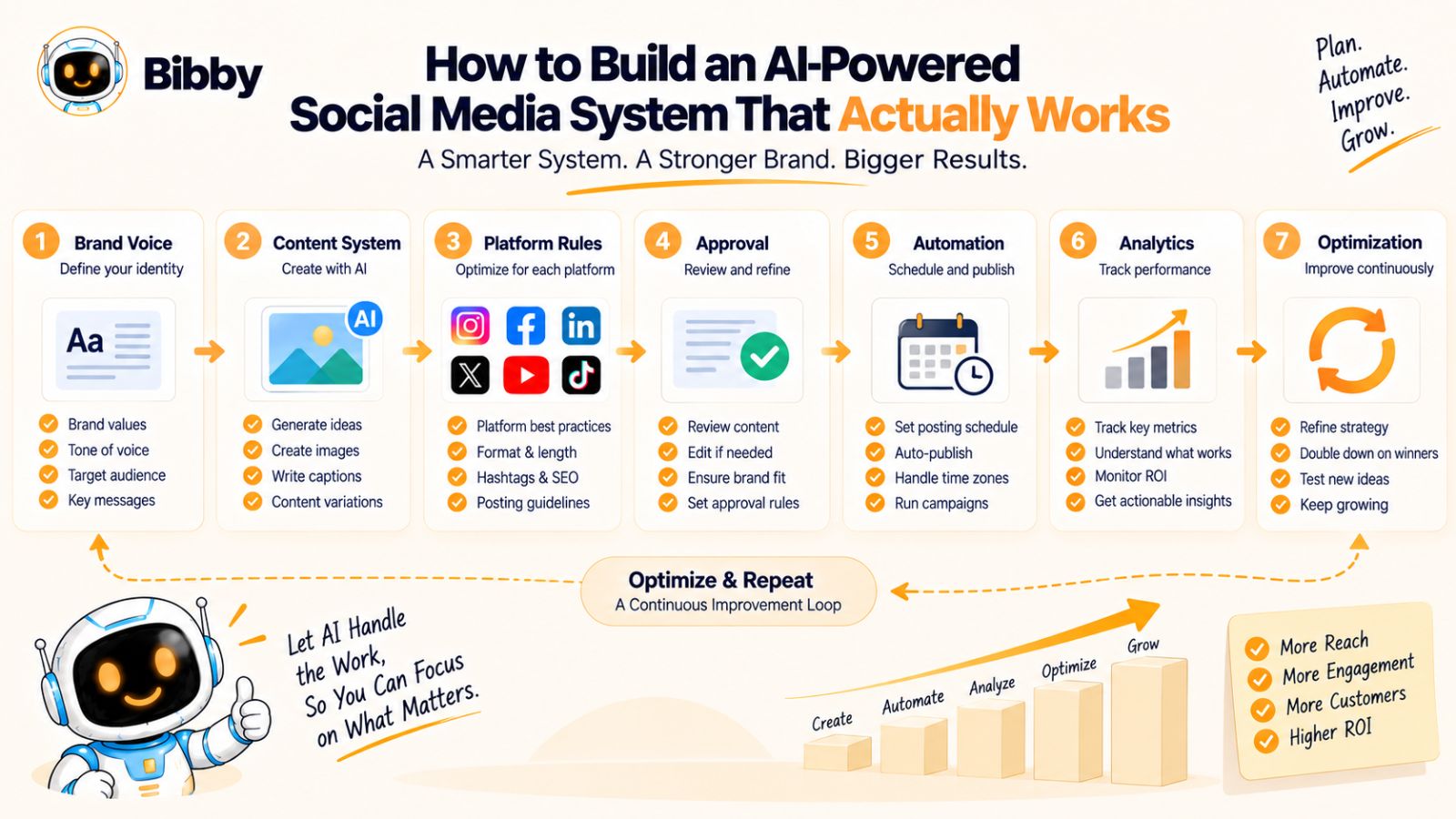
The technology is only one part of the equation. The real results come from combining the right strategy, content inputs, automation rules, and human oversight into a repeatable workflow.
Define your brand voice
Before automating content creation, establish how your brand should communicate.
Your brand voice might be:
- Professional and authoritative
- Friendly and conversational
- Educational and practical
- Bold and opinionated
- Simple and approachable
The more clearly this is defined, the easier it becomes for AI to generate content that sounds consistent.
A brand voice should also include practical guidelines. For example, identify words your brand frequently uses, phrases it avoids, how formal the writing should be, and how directly it should communicate with customers.
This information can become part of your brand kit and provide context for future content generation.
Build a reusable content system
Don't build your social media strategy around individual posts.
Build it around content categories.
For example, a SaaS company might have:
- Educational content
- Product demonstrations
- Customer stories
- Industry insights
- Company updates
- Promotional content
- Behind-the-scenes content
Once these categories exist, creating a new content calendar becomes much easier.
Instead of asking, “What should we post today?” you can ask, “Which content category should we publish next?”
AI can then help turn those categories into specific content ideas.
Create platform-specific content rules
Publishing the same content everywhere isn't necessarily a social media strategy.
Different platforms have different audiences and expectations.
A LinkedIn post may need a professional, insight-driven approach. An Instagram carousel may need strong visual storytelling. A TikTok video may depend heavily on the opening hook and pacing.
Your autonomous workflow should therefore define what should remain consistent across platforms and what should change.
The core idea can remain the same.
The presentation can adapt.
This allows automation to improve efficiency without turning every social channel into an identical copy of the others.
Establish approval boundaries
Not every piece of content needs the same level of review.
You might allow low-risk educational posts to move through the workflow with minimal intervention while requiring approval for:
- Product announcements
- Pricing changes
- Sensitive topics
- Major campaigns
- Customer-related content
- Crisis communications
This creates a practical balance between speed and control.
The more predictable the content, the more automation can handle.
The more consequential the content, the more human review makes sense.
Automate repetitive execution
Once the strategy and boundaries are established, automate as much of the repetitive workflow as practical.
This can include:
- Generating captions
- Creating visual assets
- Organizing content
- Scheduling posts
- Selecting publishing times
- Repurposing content
- Publishing across platforms
- Regenerating content variations
This is where a platform such as Bibby can become the operational layer for the system.
Instead of stitching together separate tools for content, captions, scheduling, and publishing, marketers can use a centralized workflow to move content toward publication.
The chat interface also provides a more direct way to interact with the system. Tasks such as creating a brand kit, creating a campaign, generating posts, and regenerating captions can be managed conversationally rather than requiring the marketer to manually navigate every step.
Review performance data
Automation doesn't mean you stop measuring results.
In fact, automation makes measurement more important.
If your system is publishing more content, you need to understand which content is actually contributing value.
Track metrics such as:
- Reach
- Engagement
- Clicks
- Leads
- Conversions
- Content output
- Cost per published asset
- Time saved
Don't confuse activity with results.
Publishing 100 posts instead of 20 is not automatically a marketing success.
The goal is to create a system that produces more useful marketing output with less unnecessary operational effort.
Continuously improve prompts, content, and campaigns
An autonomous marketing system should become better over time.
If certain captions consistently require editing, improve the instructions.
If particular content formats perform poorly, reconsider their role.
If a certain topic generates strong engagement, create more content around it.
If the team spends too much time reviewing a particular type of post, improve the generation process.
This creates a continuous optimization cycle:
Strategy → content → automation → publishing → measurement → learning → improved strategy.
That's what separates a genuine autonomous social media system from a collection of AI features.
The technology should not simply automate today's workflow.
It should help the business gradually build a better workflow with less manual effort.
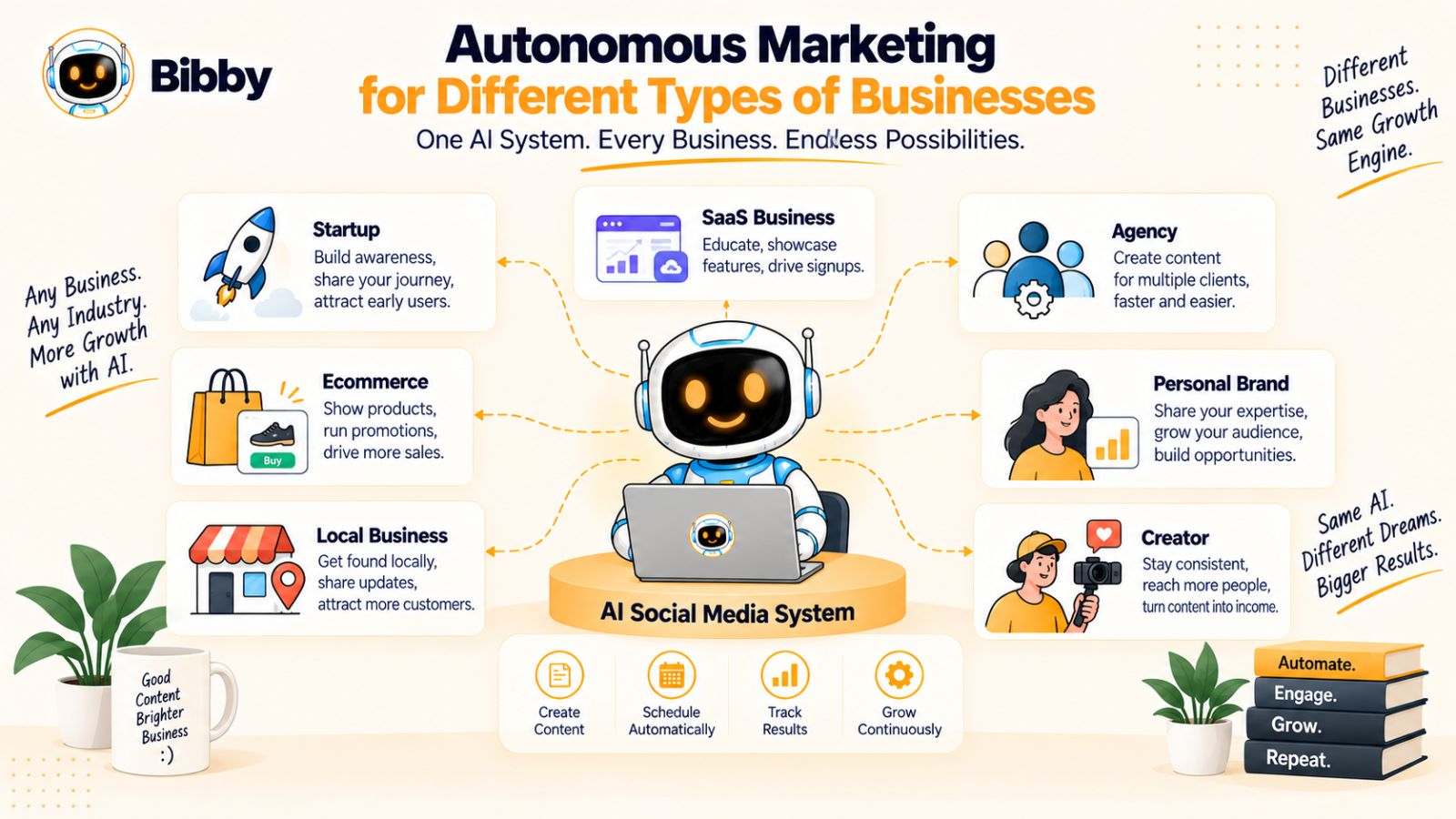
And once that system is established, its applications extend well beyond one type of company. Startups, agencies, ecommerce brands, creators, SaaS companies, and local businesses can all adapt autonomous social media workflows to their specific needs.
Also read: Employee Advocacy Automation: The Complete Guide to Scaling Social Media in 2026 →
Autonomous Marketing for Different Types of Businesses
AI social media automation isn't limited to large marketing departments.
In fact, smaller businesses can often benefit significantly because they have fewer people available to manage repetitive marketing tasks.
The workflow may look different from one business to another, but the underlying principle remains the same: use AI to reduce repetitive execution while keeping humans responsible for strategy and important decisions.
Startups
Startups often have limited resources and ambitious growth targets.
A founder or small marketing team may be responsible for everything from product development and customer research to social media and content marketing.
An autonomous social media workflow can reduce the operational burden.
Instead of spending hours creating captions and scheduling individual posts, the team can prepare content in batches and let AI handle more of the repetitive publishing process.
This allows a small team to maintain a more consistent social presence without turning social media into a full-time administrative responsibility.
SaaS companies
SaaS businesses often have a large amount of educational material to communicate.
Features, product updates, use cases, customer stories, tutorials, industry insights, and product comparisons can all become social content.
The challenge is turning that knowledge into a consistent publishing schedule.
AI can help transform existing product information into different content formats and distribute it across multiple platforms.
For example, one product feature announcement could become an educational LinkedIn post, an Instagram carousel, a short-form video, and additional supporting social content.
The business gets more distribution from the same underlying idea.
Agencies
Agencies have a particularly obvious automation opportunity.
An agency managing social media for 10 clients doesn't simply manage one content calendar.
It potentially manages 10 brands, 10 sets of brand guidelines, multiple platform combinations, different approval processes, and dozens or hundreds of individual posts.
The repetitive work multiplies with every additional client.
An AI-powered workflow can help agencies reduce that operational overhead.
Instead of manually performing the same scheduling and content-production tasks for every account, teams can standardize repeatable processes while preserving client-specific brand guidelines.
This can make scaling an agency less dependent on adding manual hours at the same rate as client growth.
Ecommerce brands
Ecommerce businesses often have large product catalogs and a constant need for promotional content.
Product images, new arrivals, seasonal campaigns, customer stories, promotions, educational content, and product benefits can all become social media assets.
The challenge is maintaining a consistent publishing cadence without constantly creating everything from scratch.
AI automation can help turn existing product assets into a larger content pipeline.
A single product image can become part of several different social posts, while campaigns can be scheduled across multiple platforms.
This is particularly useful for businesses where the number of products and promotional opportunities is constantly changing.
Personal brands
Creators, consultants, coaches, executives, and founders often understand the value of consistent publishing but struggle with the time required to maintain it.
The person themselves is frequently the source of the content.
That means completely removing the human isn't realistic.
But the repetitive execution surrounding that content can be automated.
A founder could provide an idea, observation, video, or image and use AI to help turn it into captions, variations, and scheduled posts.
The person remains the source of expertise.
AI becomes the distribution engine.
Local businesses
Restaurants, gyms, salons, clinics, retailers, real estate businesses, and other local companies often need regular social media content but may not have dedicated marketing teams.
For these businesses, simplicity is especially important.
A complicated content-production system can create more work than it removes.
An AI-powered workflow can help simplify the process by allowing the owner or employee to provide a visual, select a posting style, generate the caption, and schedule content across the relevant platforms.
This makes social media more accessible to businesses that cannot justify a full-time social media specialist.
Creators and influencers
Creators already produce large amounts of content, but distribution can become a bottleneck.
A video might be created for one platform and then need to be adapted or distributed across several others.
Automation can reduce the administrative work surrounding that process.
Instead of manually maintaining multiple publishing calendars, creators can organize their content into a centralized workflow and spend more time creating.
The common denominator
These businesses are very different, but their automation problem is remarkably similar.
They all need to answer the same questions:
What should we publish?
How should we present it?
Where should it go?
When should it be published?
How can we do all of this without spending our entire week managing the process?
Autonomous marketing doesn't provide one universal answer to those questions.
Instead, it provides a framework for moving more of the repetitive execution into software.
Whether you're running a startup with three employees, an agency managing dozens of brands, or a personal brand built around one creator, the underlying opportunity is the same: turn social media from a recurring manual chore into a repeatable system.
Also read: How to Improve Social Media Discoverability and Reach More People
A Practical Autonomous Social Media Workflow
The easiest way to understand autonomous social media marketing is to follow a piece of content from its starting idea to its final publication.
Imagine a SaaS company has launched a new feature that helps small businesses automate a repetitive administrative task.
Traditionally, the marketing team might create a graphic, write a caption, schedule an Instagram post, create a separate LinkedIn post, prepare a short video, and then repeat the process across other platforms.
An autonomous workflow approaches the same campaign differently.
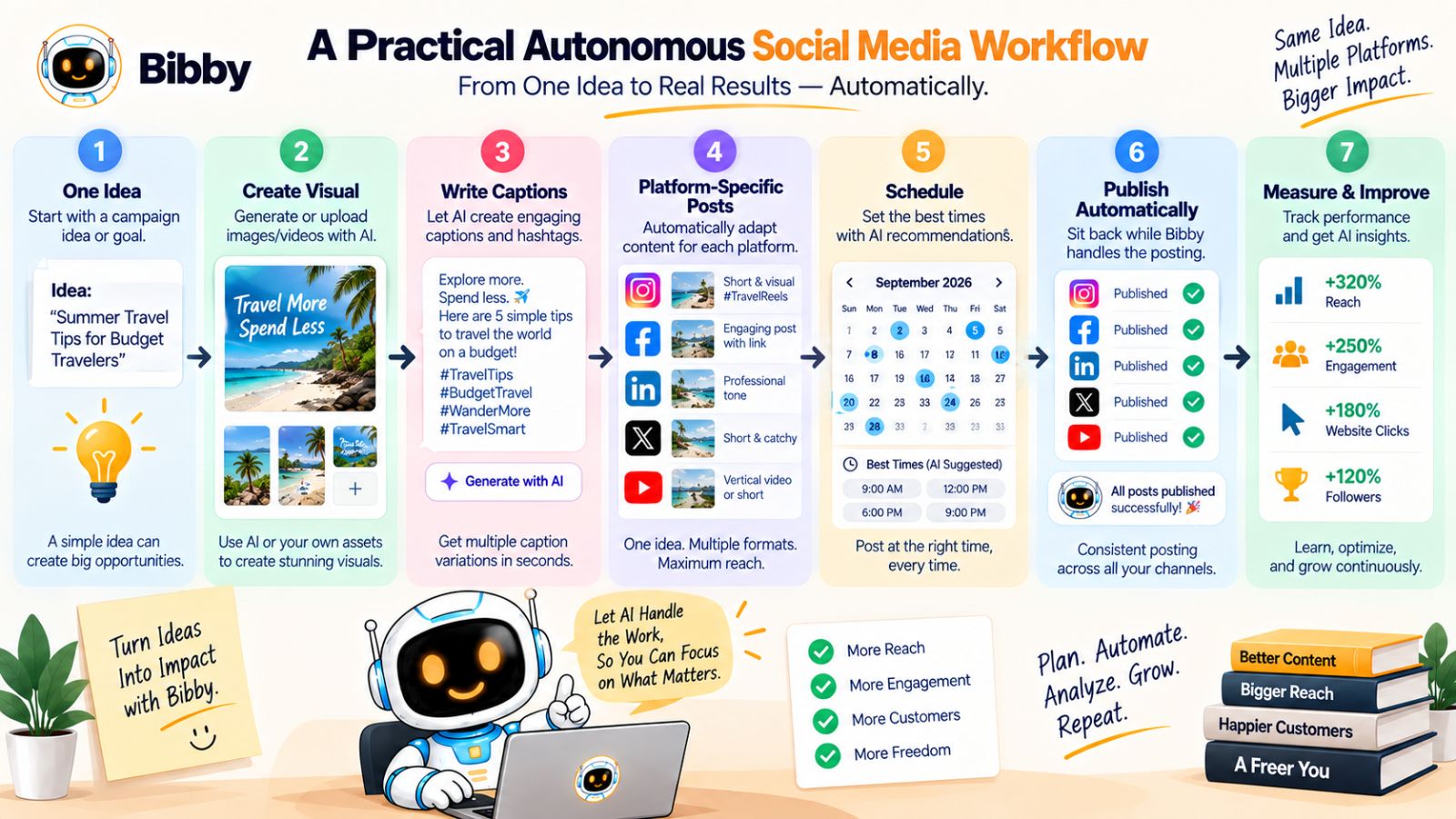
One idea becomes the content foundation
The process starts with one core marketing idea:
“Our new feature helps small businesses eliminate hours of repetitive work every month.”
That idea becomes the foundation for the campaign.
The team can then decide what they want the campaign to accomplish—perhaps product awareness, education, or generating interest in the new feature.
The strategic decision remains human.
The repetitive execution can increasingly be handled by AI.
One idea → visual
The first step is creating the visual asset.
The marketing team could upload an existing product image or generate a new visual with AI.
For example, the campaign might use a clean graphic showing the old manual process alongside the new automated workflow.
The important thing is that the creative asset now exists as an input for the social media workflow.
Visual → captions
Next comes the copy.
Rather than manually writing five different captions, AI can generate social media copy based on the asset and the selected posting style.
The marketer can review the generated content and regenerate it if the tone or message isn't quite right.
This reduces the amount of time spent moving from a visual asset to a finished post.
Captions → platform-specific content
The same campaign can then be distributed across multiple channels.
For example:
Instagram: A visual carousel explaining the problem and showing how the feature works.
LinkedIn: An educational post discussing the cost of repetitive administrative work.
Facebook: A concise product-focused update.
TikTok: A short-form video demonstrating the workflow.
YouTube: A video explaining the feature in greater detail.
The underlying campaign remains consistent.
The format and presentation can change according to the platform.
Platform-specific content → scheduling
Once the content is prepared, the next challenge is distribution.
Instead of manually opening each platform and assigning individual publishing dates, an AI-powered scheduling workflow can organize the content across the selected networks.
With Bibby, the marketer can select the relevant platforms and schedule content across different dates using AI-optimized publishing times.
The campaign therefore becomes a coordinated publishing sequence rather than a collection of unrelated posts.
Scheduling → continuous publishing
Once the campaign has been approved, the system can handle the scheduled publishing.
The marketing team doesn't need to be sitting at a computer when each individual post is supposed to go live.
This is where the “autopilot” concept becomes practical.
The team has made the strategic decisions.
The content has been prepared.
The publishing workflow has been configured.
The system handles the repetitive execution.
Publishing → measurement
The process shouldn't end when the content is published.
The team can review performance and ask questions such as:
- Which platform generated the most meaningful engagement?
- Which content format attracted the most attention?
- Which message produced the most clicks?
- Which posts generated leads?
- Which creative should be reused?
- Which content should be changed?
Those answers can influence the next campaign.
The workflow therefore becomes:
One idea → visual → captions → platform adaptations → scheduling → publishing → measurement.
Where Bibby fits into the workflow
This is the type of workflow Bibby is designed to simplify.
Instead of requiring marketers to manually coordinate every stage, Bibby combines AI-assisted content creation, caption generation, multi-platform scheduling, and publishing into one workflow.
Its chat interface adds another layer.
A marketer can interact with Bibby conversationally to create a brand kit, create a campaign, create posts, regenerate captions, and manage other social media tasks.
That means the workflow can increasingly be expressed in terms of outcomes rather than individual software operations.
Instead of:
“Open the scheduler, create a post, paste the caption, choose Instagram, choose a date, repeat.”
the interaction can move closer to:
“Create a campaign around our new feature and prepare the social content for our selected platforms.”
The difference is more than convenience.
It represents a shift from software that waits for individual instructions to software that can help coordinate a larger marketing objective.
And that is ultimately the point of autonomous marketing: not to automate one isolated social media task, but to connect enough tasks together that the entire workflow becomes dramatically less dependent on manual execution.
How to Measure the ROI of AI Social Media Automation
Automation only becomes a business advantage when you can measure what it changes.
Saving time is valuable, but businesses should also understand whether that saved time, increased content output, and improved consistency contribute to meaningful marketing outcomes.
The simplest approach is to measure AI social media automation across several layers: efficiency, output, engagement, conversions, and revenue.
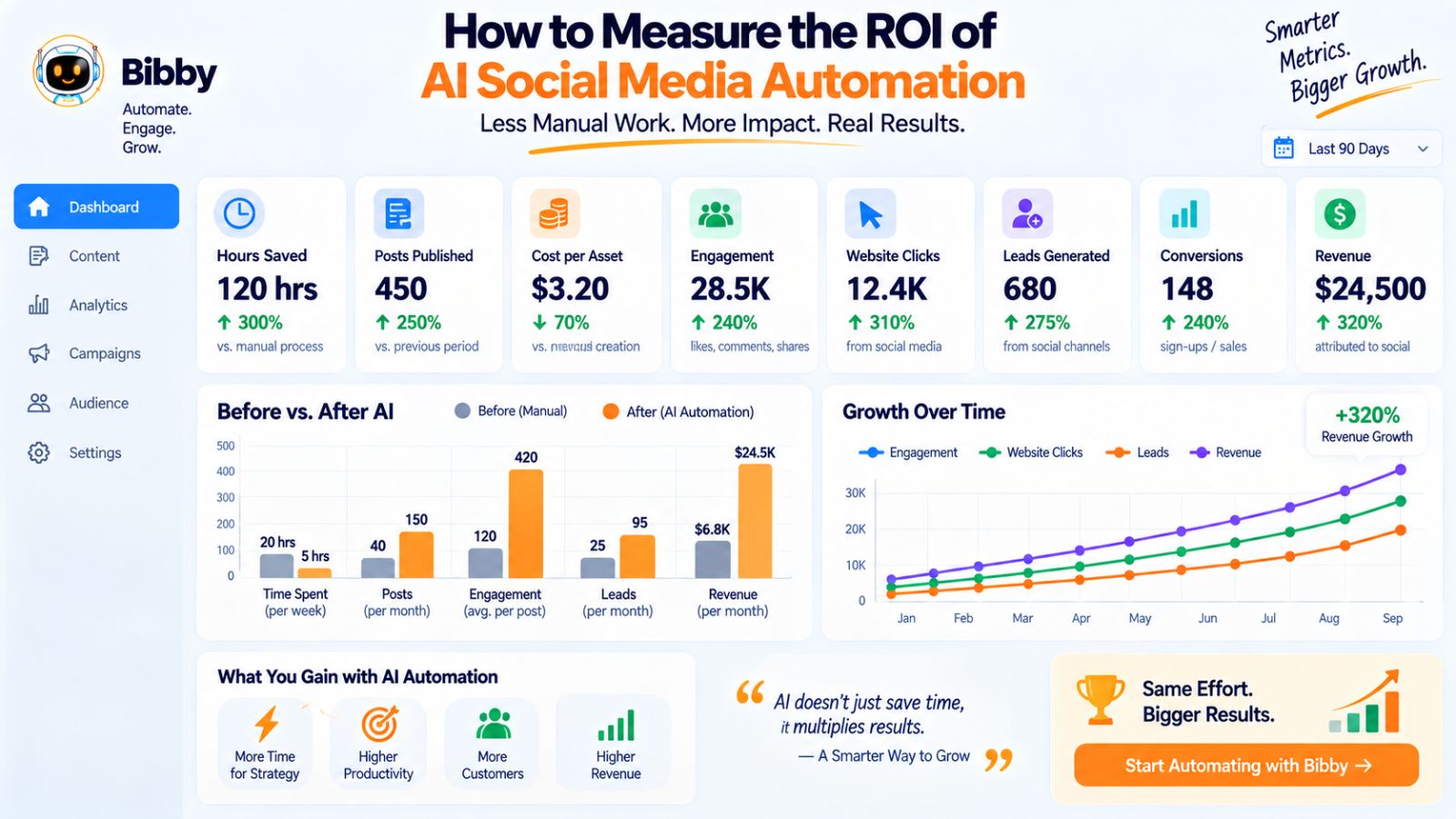
Hours saved
Start with the easiest metric to measure: time.
Track how long your team spends on social media before and after introducing automation.
For example, measure the monthly time spent on:
- Creating captions
- Preparing social posts
- Scheduling content
- Publishing across platforms
- Repurposing content
- Managing content calendars
- Creating routine content variations
Then compare that figure with the time required after automation.
If your team previously spent 40 hours per month on repetitive social media operations and now spends 20, you've recovered 20 hours.
That recovered time has an economic value.
Cost per published asset
Another useful metric is the cost required to produce and distribute each piece of content.
A simple calculation is:
Cost per published asset = total social media production cost ÷ number of published assets
Automation can reduce the labor component of this equation.
If a team previously spent significant manual time producing and scheduling each post, an automated workflow can potentially reduce the cost of getting each asset from creation to publication.
This becomes particularly meaningful at higher publishing volumes.
Content volume
Track how much content your team produces before and after implementing automation.
Suppose your business previously published:
20 posts per month
and after introducing an AI-powered workflow can comfortably manage:
60 posts per month
That is a threefold increase in publishing output.
But volume alone isn't the goal.
A higher number of posts only matters if the additional content contributes useful marketing outcomes.
That's why output should always be evaluated alongside engagement, leads, conversions, and revenue.
Engagement
Engagement can help you understand whether your increased content production is actually resonating with the audience.
Depending on the platform and content type, relevant metrics may include:
- Likes
- Comments
- Shares
- Saves
- Video views
- Watch time
- Profile visits
Compare these metrics across content types and campaigns rather than looking only at an overall monthly number.
The goal is to identify patterns.
If AI automation allows your team to publish more content, you can use that additional capacity to test more topics, formats, and creative approaches.
Clicks and leads
Engagement isn't necessarily the final business objective.
For many companies, the more important question is whether social media generates meaningful traffic and leads.
Track metrics such as:
- Link clicks
- Website visits
- Landing-page visits
- Form submissions
- Demo requests
- Newsletter signups
- Product inquiries
This helps connect social media activity to the broader marketing funnel.
A post with fewer likes may still be more valuable if it generates significantly more qualified traffic.
Conversions
The next layer is conversion.
Depending on the business model, a conversion could be:
- A purchase
- A booked call
- A software trial
- A demo
- A subscription
- A qualified lead
Tracking conversions helps prevent a common mistake in social media reporting: assuming that attention automatically equals business value.
The purpose of automation is not to maximize the number of posts.
It is to make marketing execution more efficient while contributing to meaningful business outcomes.
Revenue attributable to social media
For businesses with reliable attribution, revenue is the most direct financial metric.
If social media contributes $10,000 in attributable revenue and the associated content and distribution costs $2,000, the business can begin evaluating the return more directly.
The calculation might look like:
ROI = (Revenue − Marketing Cost) ÷ Marketing Cost × 100
However, attribution isn't always straightforward.
A customer might see a LinkedIn post, visit the website several days later through Google, return through a direct visit, and eventually purchase.
That means social media may influence a conversion without receiving direct last-click attribution.
Businesses should therefore avoid interpreting any single attribution model as a perfect representation of marketing impact.
Cost of automation vs. cost of manual execution
Finally, compare the cost of the technology against the cost of the workflow it replaces or accelerates.
Suppose your existing process requires 30 hours of manual work each month.
After introducing AI social media automation, that falls to 12 hours.
The software cost is only one part of the equation.
You should also consider the value of the 18 hours recovered.
This is particularly important for founders and senior marketers.
If a founder spends five hours each week scheduling social media posts, the opportunity cost can be substantially higher than the software subscription required to automate those tasks.
A simple ROI dashboard
A practical AI social media ROI dashboard could track:
| Metric | Before automation | After automation |
|---|---|---|
| Hours spent per month | 40 | 20 |
| Posts published | 20 | 60 |
| Cost per published asset | $X | $Y |
| Engagement | X | Y |
| Website clicks | X | Y |
| Leads | X | Y |
| Conversions | X | Y |
| Social-attributed revenue | $X | $Y |
The exact numbers will vary from business to business.
What matters is establishing a baseline before automation and then measuring the same metrics afterward.
That gives you evidence rather than assumptions.
And once the business can demonstrate that automation reduces repetitive work while maintaining or improving meaningful marketing outcomes, the argument for autonomous social media becomes much stronger.
The final question then becomes bigger than ROI alone:
What happens when social media management evolves from a scheduling tool into an AI-powered marketing system that you can operate through conversation?
The Future of Social Media: From Scheduling Tools to AI Social Media Managers
Social media scheduling has traditionally been about one question: When should this post go live?
AI is expanding that question.
The next generation of social media tools is increasingly focused on what happens before scheduling: creating content, generating captions, organizing campaigns, adapting content, choosing publishing times, and coordinating multiple channels.
This points toward a broader shift from social media scheduling to AI-powered social media management.
From calendars to autonomous systems
A traditional scheduler is essentially a calendar with publishing capabilities.
You create the content, write the caption, choose the platform, select the date, and schedule the post.
The software handles the final publishing step.
An autonomous system can participate in much more of that workflow.
It can help create the content, generate copy, organize the campaign, select publishing times, and distribute the finished material.
The calendar doesn't disappear.
It simply becomes one component of a much larger system.
This is an important distinction because the value of AI isn't necessarily that it makes scheduling faster.
It's that it can reduce the number of manual decisions and actions required to move an idea from conception to publication.
From commands to conversational marketing
Another major shift is the interface.
For years, marketing software has required users to learn how the software works.
You click through menus, open different sections, configure settings, create assets, and move between workflows.
Conversational AI changes that model.
Instead of learning every feature, the user can describe the desired outcome.
For example:
“Create a campaign promoting our new product feature and prepare social content for Instagram, LinkedIn, Facebook, TikTok, and YouTube.”
The software can then help translate that request into a series of marketing tasks.
Bibby's chat interface reflects this direction.
Users can interact conversationally to create a brand kit, create campaigns, create posts, regenerate captions, and manage other social media activities.
The important innovation isn't simply that you can chat with software.
It's that conversation can become the interface for executing a multi-step marketing workflow.
Why chat-based social media management matters
Traditional software interfaces require users to know where to go.
Conversational interfaces allow users to describe what they want.
That distinction becomes increasingly valuable as marketing systems become more sophisticated.
Imagine that you want to turn a product announcement into a week-long campaign.
In a traditional workflow, you might need to:
- Create the campaign.
- Prepare the creative assets.
- Write several captions.
- Create platform variations.
- Open the scheduling tool.
- Assign dates.
- Assign publishing times.
- Review everything.
- Schedule the posts.
A conversational AI system can potentially coordinate much of this process from a single interaction.
The marketer still reviews and approves important decisions.
But the interface moves from operating software toward directing software.
What fully autonomous marketing could eventually look like
The long-term vision goes beyond automatically publishing posts.
Imagine a system that understands your brand, audience, campaigns, content library, publishing preferences, and marketing objectives.
You could provide a goal such as:
“Promote our new product throughout October and increase awareness among small-business owners.”
The system could potentially help turn that objective into:
- A campaign structure
- Content themes
- Creative concepts
- Social posts
- Platform-specific variations
- Publishing schedules
- Content experiments
- Performance analysis
- Recommendations for the next campaign
Human involvement would still matter.
Someone needs to define the business objective, establish the boundaries, approve important content, and evaluate the results.
But the amount of manual coordination required could become dramatically smaller.
That's the larger meaning of autonomous marketing.
It's not simply AI that writes your social media posts.
It's a marketing system that can increasingly understand what needs to happen and help coordinate the steps required to make it happen.
The shift from “posting” to “marketing operations”
This is ultimately where social media automation is heading.
Businesses won't necessarily think about every Instagram post, LinkedIn update, or TikTok video as a separate task.
They'll think about campaigns, audiences, goals, and outcomes.
The AI system becomes responsible for more of the operational layer connecting those goals to execution.
Tools like Bibby are part of this transition because they combine content creation, AI-generated captions, multi-platform scheduling, publishing, and conversational management into a broader workflow.
The result is a fundamental change in how social media can be operated.
Instead of spending your day asking:
“What do I need to publish today?”
you can increasingly focus on:
“What do I want my marketing to accomplish?”
That is the real promise of autonomous marketing.
And when the repetitive machinery of social media becomes automated, the ROI isn't simply measured in the number of posts published.
It's measured in the time recovered, the experiments enabled, the content distributed, and the attention returned to the people responsible for growing the business.
Final Words
Autonomous marketing is changing the economics of social media. The biggest opportunity isn't simply generating AI captions or scheduling posts faster—it is connecting content creation, caption generation, campaign management, scheduling, publishing, and optimization into one repeatable workflow.
Three ideas matter most:
- AI can reduce repetitive social media work and return valuable time to marketers.
- Automation can increase content output without requiring the same increase in manual effort.
- The best systems combine AI execution with human strategy, creativity, and oversight.
Platforms such as Bibby show what this shift can look like in practice. Instead of manually managing every post across Facebook, Instagram, LinkedIn, YouTube, and TikTok, marketers can use AI-assisted creation, captions, scheduling, optimized publishing times, multiple content formats, and a conversational interface to manage more of the workflow from one place.
The next step is to turn these ideas into an actual system.
If you're ready to go beyond simply scheduling posts, the natural next step is learning how to build an AI-powered social media content system that automatically turns your ideas into a consistent, multi-platform publishing engine.