Over the years, I've worked with businesses across multiple industries, and one thing has become increasingly clear: social media is no longer optional for hotels and hospitality brands. Today's travelers discover destinations, compare accommodations, read reviews, and often form their first impression of a property long before they ever visit its website.
Many hotel marketers still struggle with the same challenge—how to consistently create engaging content, manage multiple social media platforms, and turn followers into paying guests without spending countless hours every week on marketing tasks. I've seen hospitality teams invest heavily in beautiful properties and guest experiences, only to miss opportunities because their social media strategy wasn't keeping pace with how modern travelers make decisions.
In this blog, you will learn:
- How successful hotels use social media to attract more guests
- Which content types generate the highest engagement and bookings
- How AI and automation can simplify hotel social media management
The reality is that winning on social media isn't about posting more content. It's about creating the right content, distributing it consistently, and using modern tools and workflows that allow your team to focus on delivering exceptional guest experiences while your marketing operates efficiently in the background.
Why Social Media Matters More Than Ever for Hotels
If there's one thing I've learned from working with businesses on their digital marketing strategies, it's that customer behavior changes much faster than most companies realize. The hospitality industry is no exception.
A decade ago, travelers primarily discovered hotels through search engines, travel agents, and online travel agencies (OTAs). Today, social media plays a major role in shaping travel decisions long before someone starts comparing room rates.
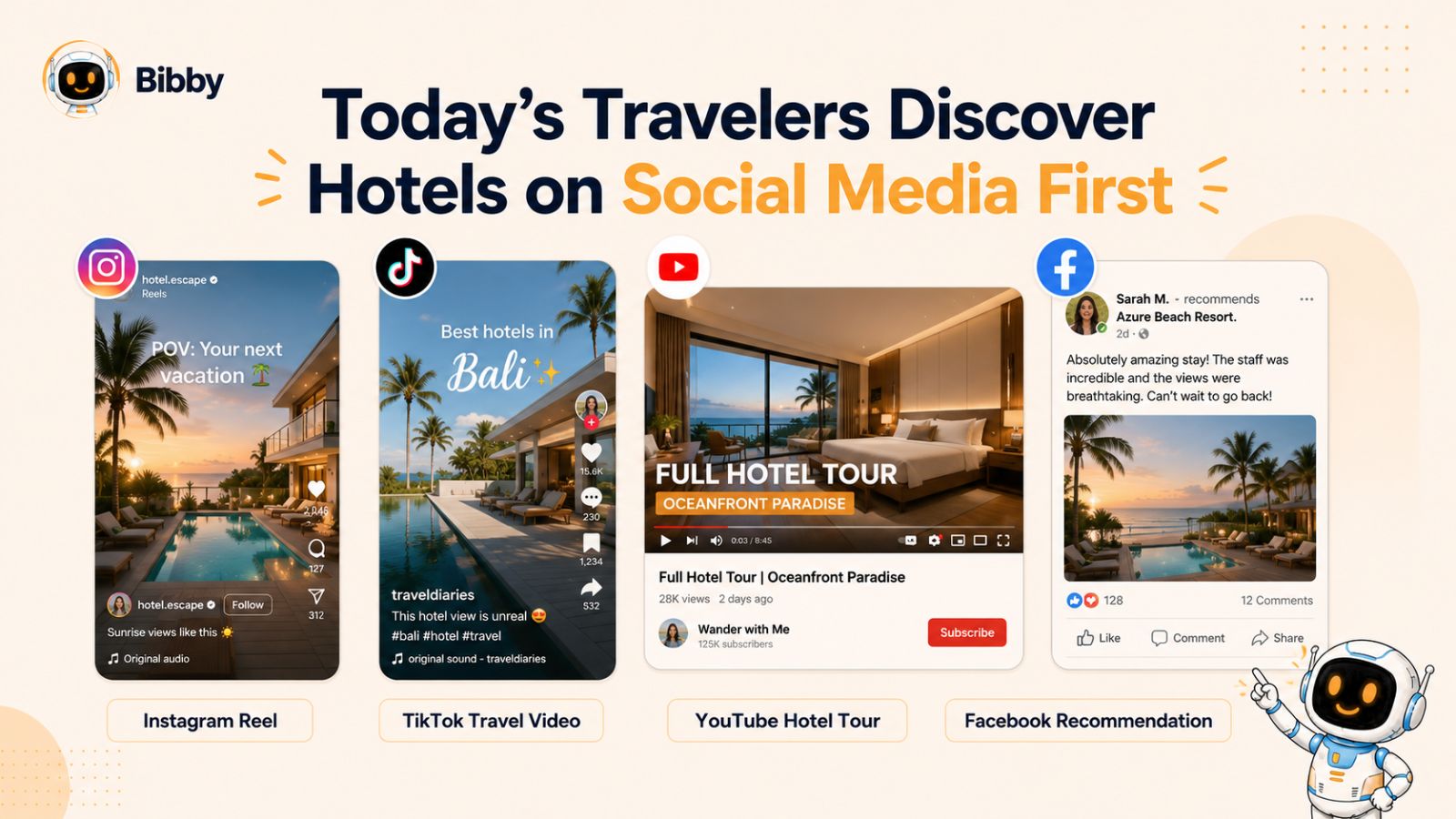
Whether it's a traveler saving a destination on Instagram, watching hotel tours on TikTok, or researching local experiences on YouTube, social media has become one of the most influential touchpoints in the guest journey.
For hotels that understand how to leverage social media effectively, the opportunity is enormous.
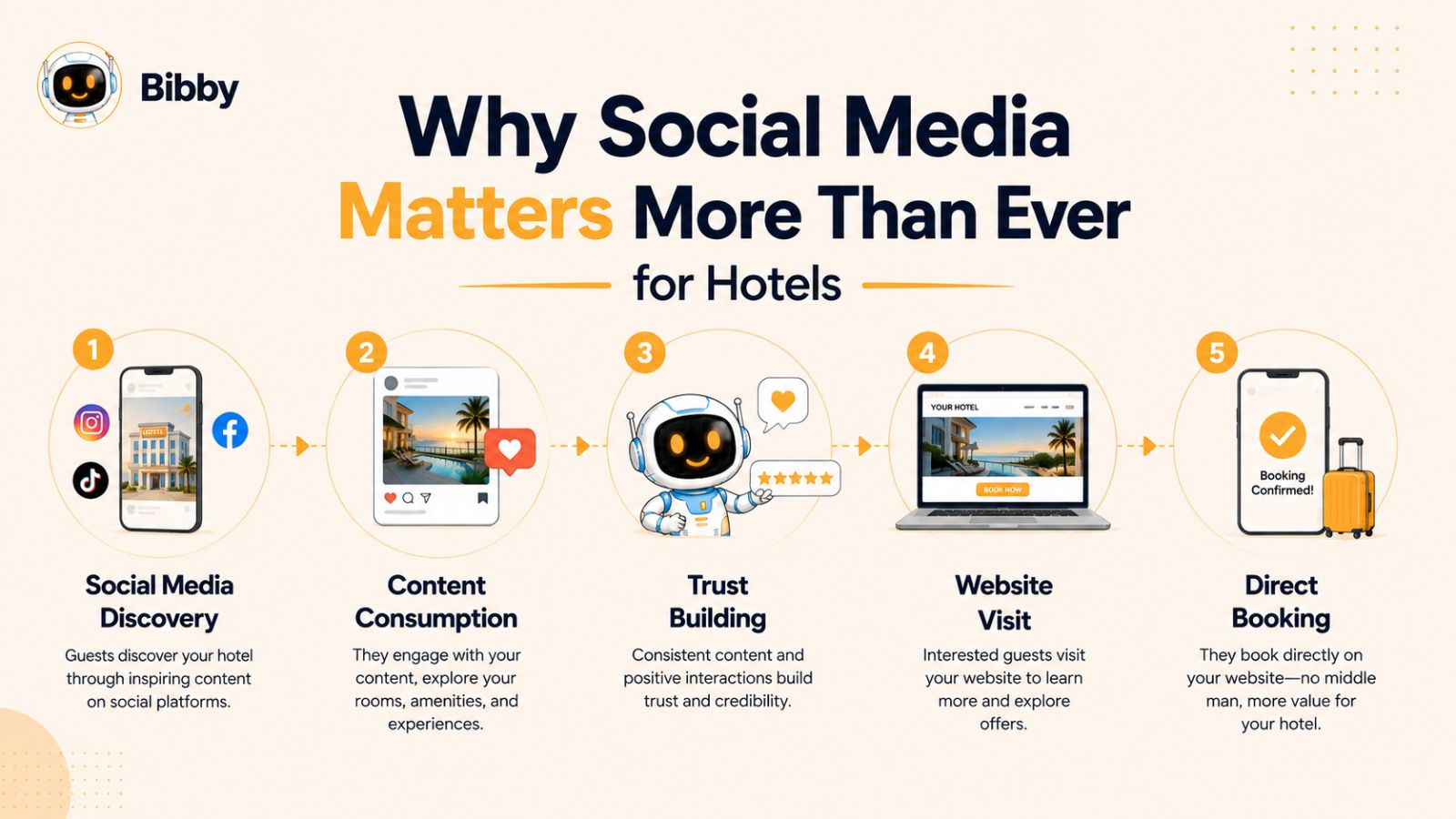
Today's Travelers Discover Hotels on Social Media First
One of the biggest shifts I've observed is that travelers are no longer searching only for accommodations—they're searching for experiences.
Before booking a stay, potential guests want to see:
- What the rooms actually look like
- What the surrounding area offers
- What dining experiences are available
- What previous guests have experienced
- Whether the property aligns with their lifestyle and expectations
Social media allows hotels to showcase all of this in a way that traditional advertising simply cannot.
A beautifully shot room tour, a behind-the-scenes video from your restaurant, or a guest-generated reel from the rooftop pool can create an emotional connection long before a booking occurs.
That's powerful because hospitality has always been about selling experiences, not rooms.
Social Proof Has Become a Major Booking Factor
In my experience, travelers trust other travelers more than they trust marketing messages.
This is why social proof has become one of the most valuable assets a hotel can build online.
When prospective guests see:
- Positive guest reviews
- User-generated content
- Tagged photos and videos
- Influencer collaborations
- Real guest testimonials
they gain confidence that your property can deliver on its promises.
Every photo shared by a happy guest becomes a form of marketing. Every positive comment becomes a recommendation. Every tagged story helps build credibility.
The most successful hospitality brands don't just publish content—they create experiences worth sharing.
Social Media Supports Direct Bookings
Many hotels rely heavily on OTAs to fill rooms, but that often comes at the cost of reduced margins and limited ownership of the customer relationship.
A strong hotel social media marketing strategy can help reduce that dependency.
When guests follow your brand on Instagram, Facebook, TikTok, LinkedIn, or YouTube, you gain direct access to an audience that has already expressed interest in your property.
Over time, that audience can be nurtured through:
- Destination content
- Seasonal offers
- Guest success stories
- Event promotions
- Exclusive packages
The result is a stronger brand presence and more opportunities to generate direct bookings without paying commissions to third-party platforms.
The Competitive Landscape Is Changing
Another trend I've noticed is that travelers increasingly compare social media profiles before making booking decisions.
Two hotels may offer similar rooms, similar amenities, and similar pricing.
Yet the property with:
- Better visual storytelling
- More engaging content
- Stronger guest interaction
- Consistent posting
- Authentic brand personality
often wins the booking.
Social media has become a competitive differentiator.
Hotels that treat social media as a core marketing channel are creating stronger brand recognition, deeper customer relationships, and more opportunities to influence purchase decisions throughout the traveler journey.
The challenge, however, is that maintaining a consistent presence across multiple platforms requires significant time and resources—which is where many hospitality brands begin to struggle.
Also read: The Perfect Post Length for Instagram, Facebook, LinkedIn, and X
The Biggest Social Media Challenges Hotels Face
Over the years, I've spoken with hotel owners, marketing managers, resort operators, and hospitality teams of all sizes. While their properties, budgets, and target audiences may differ, the challenges they face on social media are remarkably similar.
Most hotels understand that social media is important. The real struggle is executing a consistent strategy while managing the countless responsibilities that come with running a hospitality business.
The reality is that social media success requires far more than posting a few photos every week.
Limited Time and Resources
One of the most common issues I see is a lack of dedicated resources.
Unlike large hospitality brands with specialized marketing departments, many hotels rely on a small team—or sometimes a single person—to handle all marketing activities.
That person is often responsible for:
- Social media management
- Website updates
- Email marketing
- Event promotion
- Guest communications
- Partnership management
- Reputation management
When social media becomes just one task among many, consistency often suffers.
As a result, accounts become inactive, posting schedules become irregular, and valuable opportunities to engage potential guests are missed
Creating Content Consistently Is Difficult
Content creation sounds simple in theory.
In practice, it's one of the biggest bottlenecks in hotel social media marketing.
Every platform requires fresh content that captures attention and encourages engagement. Hotels need a steady stream of:
- Photos
- Videos
- Reels
- Stories
- Guest testimonials
- Promotional campaigns
- Destination content
Many hospitality teams eventually run into the same question:
"What should we post next?"
I've seen hotels with stunning properties struggle to maintain an active social presence simply because they don't have a repeatable content creation process.
Without a system in place, content production becomes reactive instead of strategic.
Managing Multiple Social Media Platforms
Modern travelers don't spend their time on a single platform.
Some discover hotels on Instagram.
Others spend hours watching travel content on TikTok.
Business travelers may engage on LinkedIn.
Many consumers still rely on Facebook groups and recommendations.
Meanwhile, YouTube remains one of the most influential platforms for travel research.
This creates a significant challenge for hospitality marketers.
Each platform has:
- Different content formats
- Different audience expectations
- Different image sizes
- Different posting schedules
- Different engagement patterns
Managing all of these platforms manually can quickly become overwhelming.
Caption Writing and Scheduling Take More Time Than Expected
Many marketers underestimate how much time is spent after the content is created.
Once a photo or video is ready, the work is far from finished.
Teams still need to:
- Write captions
- Add hashtags
- Optimize for each platform
- Upload content
- Schedule posts
- Monitor publishing dates
- Track performance
Multiply this process across Facebook, Instagram, LinkedIn, TikTok, and YouTube, and the workload becomes substantial.
I've seen hospitality teams spend several hours every week simply preparing and scheduling content.
That's time that could otherwise be spent improving guest experiences, developing partnerships, or executing larger marketing initiatives.
Keeping Up With Platform Changes
Social media platforms evolve constantly.
Algorithms change.
Content formats change.
Best practices change.
What worked six months ago may not work today.
For hotels already stretched thin, staying current with every platform update can feel like a full-time job.
Many businesses end up chasing trends without a clear strategy, while others stop experimenting altogether because they don't have the bandwidth.
Neither approach leads to sustainable growth.
Measuring What Actually Works
Another challenge I frequently encounter is analytics overload.
Most platforms provide access to large amounts of data, including:
- Reach
- Impressions
- Engagement
- Click-through rates
- Audience growth
- Video views
But data alone doesn't improve results.
Hotels need actionable insights that answer important questions:
- Which content drives the most engagement?
- Which campaigns generate bookings?
- What posting times perform best?
- Which platforms deserve more investment?
Without a clear way to analyze performance, it's difficult to improve results over time.
Why Many Hotels Struggle to Scale Their Social Media Efforts
When you combine content creation, publishing, scheduling, platform management, engagement, and analytics, it's easy to see why so many hospitality brands struggle to maintain momentum.
The issue isn't a lack of effort.
In most cases, it's a lack of systems.
The hotels that consistently succeed on social media are rarely the ones posting the most content. They're the ones that have built efficient processes that allow them to create, distribute, and optimize content at scale.
That's why developing a structured social media strategy is so important.
Before worrying about tools, automation, or content calendars, hotels need a clear plan that aligns their social media efforts with business goals.
Also read: Most Effective Ways to Integrate Social Media Into Your Sales
How to Build a Winning Hotel Social Media Strategy
One of the biggest mistakes I see hotels make is jumping straight into content creation without having a clear strategy.
They start posting room photos, sharing promotions, or following the latest social media trends without first defining what success actually looks like.
The result is usually the same: inconsistent results, low engagement, and a growing sense that social media isn't delivering a meaningful return on investment.
In my experience, the most successful hospitality brands approach social media the same way they approach guest experience—with intention, consistency, and a clear understanding of their audience.
Before creating your next post, take the time to build a strategy that supports your business goals.
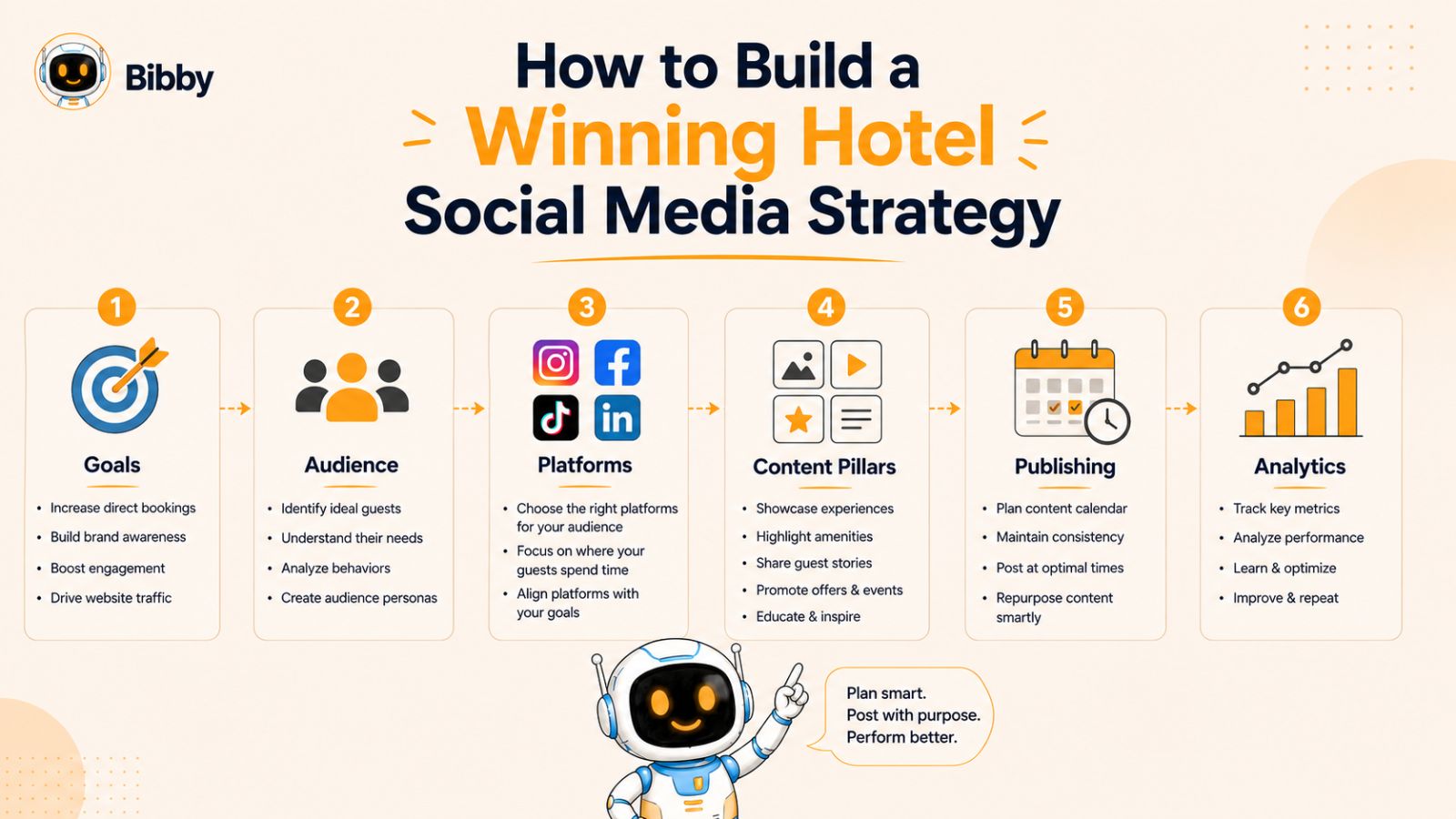
Start With Clear Business Objectives
Social media should never exist in isolation.
Every post, campaign, and platform should support a broader business objective.
For hotels and hospitality brands, common goals include:
- Increasing direct bookings
- Building brand awareness
- Generating qualified leads
- Promoting events and experiences
- Improving guest loyalty
- Increasing occupancy during slower seasons
- Strengthening relationships with past guests
I've worked with businesses that focused heavily on vanity metrics such as likes and follower counts, only to realize those numbers weren't contributing to revenue growth.
While engagement is important, the ultimate goal should be to create business outcomes.
For example, a boutique hotel may focus on driving direct bookings through Instagram, while a luxury resort may prioritize brand awareness and destination marketing through YouTube and TikTok.
The strategy should always reflect the business objective.
Understand Your Ideal Guest
One reason many hotel social media campaigns underperform is that they try to appeal to everyone.
The truth is that effective marketing becomes much easier when you know exactly who you're trying to attract.
Ask yourself:
- Are you targeting leisure travelers?
- Business travelers?
- Families?
- Couples?
- Luxury guests?
- Adventure travelers?
- Destination wedding clients?
Each audience consumes content differently and responds to different messaging.
For example, a business traveler may care about:
- Fast Wi-Fi
- Meeting facilities
- Convenient location
- Productivity-focused amenities
Meanwhile, a leisure traveler may be more interested in:
- Local attractions
- Pool experiences
- Dining options
- Scenic views
Understanding your audience helps you create content that resonates instead of content that simply fills a calendar.
Choose the Right Social Media Platforms
Another common mistake is trying to be everywhere at once.
Not every platform deserves equal attention.
In most cases, hotels should focus on the channels where their target audience is most active.
Instagram remains one of the strongest platforms for hospitality marketing.
The platform is built around visual storytelling, making it ideal for showcasing:
- Rooms and suites
- Property highlights
- Amenities
- Guest experiences
- Local attractions
Instagram Reels and Stories are particularly effective for increasing visibility and engagement.
TikTok
TikTok has become a major discovery engine for travelers.
Many users now search for travel recommendations directly on the platform.
Hotels can use TikTok to create:
- Property tours
- Behind-the-scenes content
- Travel tips
- Local destination guides
- Staff highlights
Authenticity often performs better than highly polished promotional content.
Despite the rise of newer platforms, Facebook remains valuable for many hospitality brands.
It's particularly effective for:
- Community building
- Event promotion
- Retargeting campaigns
- Customer service
- Sharing guest reviews
For properties targeting older demographics, Facebook often continues to generate strong results.
LinkedIn is frequently overlooked by hospitality marketers.
However, it can be highly effective for:
- Business travel marketing
- Corporate partnerships
- Event promotion
- Hospitality leadership content
- Recruitment initiatives
Hotels that serve business travelers can benefit significantly from a strong LinkedIn presence.
YouTube
YouTube is one of the most powerful platforms for travel research.
Prospective guests often watch videos before making booking decisions.
Content ideas include:
- Hotel walkthroughs
- Room tours
- Destination guides
- Event coverage
- Guest experiences
Long-form video content can continue generating traffic and visibility for months or even years after publication.
Develop Content Pillars
One framework I consistently recommend is building content around a set of core content pillars.
Instead of wondering what to post every day, you create categories that align with your audience and business objectives.
For most hotels, effective content pillars include:
Guest Experience
Show potential guests what staying at your property actually feels like.
Rooms and Amenities
Highlight accommodations, dining, spa services, pools, fitness centers, and other amenities.
Destination Content
Promote local attractions, events, restaurants, and experiences.
Guest Stories and Testimonials
Leverage social proof to build trust and credibility.
Behind-the-Scenes Content
Introduce your team and showcase the people behind the guest experience.
Promotions and Offers
Share seasonal campaigns, special packages, and limited-time opportunities.
With clear content pillars in place, content creation becomes far more manageable and strategic.
Build a Consistent Posting System
Consistency matters more than volume.
I've seen hotels achieve excellent results by posting consistently three to five times per week rather than posting heavily for a month and disappearing for the next two.
The key is creating a sustainable workflow.
Your team should know:
- What content is being published
- When it's being published
- Which platforms it will appear on
- Who is responsible for approvals
- How performance will be measured
When systems replace guesswork, social media becomes significantly easier to manage.
And this is where technology and automation can become a competitive advantage. Modern hospitality brands are increasingly using AI-powered tools to streamline content creation, scheduling, publishing, and performance tracking—allowing them to maintain a strong social media presence without dramatically increasing workload.
The Best Types of Content for Hotels
After helping businesses improve their social media performance, I've found that one challenge comes up repeatedly:
Most hospitality brands don't struggle because they lack content opportunities. They struggle because they don't know which content consistently attracts engagement, builds trust, and influences booking decisions.
The good news is that hotels generate valuable content every single day.
Guests are checking in, enjoying amenities, attending events, dining at restaurants, exploring destinations, and creating memorable experiences. The opportunity lies in turning those moments into content that showcases your brand and inspires future guests.
Here are the content types I consistently see performing well across hotel social media channels.
Showcase the Guest Experience
People don't book hotel rooms.
They book experiences.
One of the most effective content strategies is helping potential guests visualize themselves at your property.
The more vividly you can demonstrate the experience, the easier it becomes for travelers to imagine staying there.
Content ideas include:
- Room walkthrough videos
- Property tours
- Pool and spa experiences
- Restaurant highlights
- Rooftop views
- Beachfront experiences
- Luxury amenities
- Exclusive guest services
Instead of focusing solely on features, focus on outcomes.
Don't just show the pool.
Show guests relaxing by the pool.
Don't just show the restaurant.
Show the atmosphere, presentation, and dining experience.
This approach creates emotional engagement, which often drives booking decisions.
Create Room Tours and Property Walkthroughs
One content format I almost always recommend is video tours.
Travelers want transparency.
They want to know exactly what they're booking before they arrive.
Room tours can help answer questions such as:
- How spacious is the room?
- What amenities are included?
- What views are available?
- What makes this accommodation unique?
Property walkthroughs can also highlight:
- Lobby areas
- Event spaces
- Restaurants
- Fitness facilities
- Pools
- Outdoor areas
These videos perform particularly well on Instagram Reels, TikTok, YouTube Shorts, and YouTube.
Highlight Local Attractions and Experiences
A hotel is often just one part of a travel experience.
Many travelers choose accommodations based on proximity to activities, landmarks, restaurants, and attractions.
That's why destination content can be incredibly effective.
I've seen hotels significantly increase engagement by becoming a trusted source of local recommendations.
Content ideas include:
- Weekend itineraries
- Local attractions
- Hidden gems
- Restaurant recommendations
- Seasonal events
- Cultural experiences
- Outdoor adventures
This type of content provides value even before someone becomes a guest, helping establish trust and authority.
Leverage User-Generated Content
If I had to choose one underutilized asset in hospitality marketing, it would be user-generated content.
Guests are already creating content about your property.
They're posting photos, sharing videos, uploading stories, and leaving reviews.
The smartest hotels actively encourage and repurpose this content.
User-generated content works because it feels authentic.
Prospective guests often trust real guest experiences more than professionally produced marketing campaigns.
Examples include:
- Guest photos
- Guest videos
- Testimonials
- Reviews
- Tagged social media posts
- Travel influencer collaborations
Always request permission when appropriate and give proper credit when sharing guest content.
Showcase Your Team Behind the Scenes
Hospitality is ultimately a people-driven industry.
Yet many hotel social media accounts focus almost exclusively on facilities and amenities.
Some of the strongest engagement I've seen comes from showcasing the people who make guest experiences possible.
Behind-the-scenes content can include:
- Employee spotlights
- Chef interviews
- Housekeeping stories
- Event setup preparation
- Team celebrations
- Day-in-the-life content
This type of content humanizes your brand and helps build emotional connections with your audience.
Use Seasonal Content and Promotions
Seasonality plays a major role in hospitality marketing.
Every season creates new opportunities to engage travelers.
Hotels should proactively build content around:
- Summer vacations
- Winter getaways
- Holiday travel
- Local festivals
- Wedding season
- Corporate event season
- School breaks
- Long weekends
Promotional content should feel valuable rather than overly sales-focused.
Instead of constantly pushing discounts, focus on highlighting experiences, packages, and unique offerings.
Prioritize Short-Form Video Content
If there's one trend that continues to dominate social media, it's short-form video.
Across virtually every platform, video content receives higher visibility and engagement than static posts.
For hotels, this presents a huge opportunity because hospitality is inherently visual.
Some of the highest-performing video formats include:
- Room transformations
- Before-and-after event setups
- Scenic drone footage
- Guest experiences
- Local travel tips
- Staff stories
- Dining experiences
- Day-in-the-life videos
You don't always need expensive production equipment.
Authenticity often outperforms perfection.
Build a Content Library
One recommendation I frequently make is creating a centralized content library.
Instead of creating content from scratch every week, capture and organize assets continuously.
This includes:
- Photos
- Videos
- Testimonials
- Guest reviews
- Event footage
- Seasonal content
- Brand assets
A well-organized content library makes it easier to maintain consistency and scale your social media efforts.
And this is where many hospitality brands begin exploring AI-powered solutions. As content volumes increase and the number of platforms grows, manually creating captions, resizing assets, scheduling posts, and managing publishing calendars can quickly become overwhelming.
Fortunately, modern AI tools are making it possible to automate much of this process while still maintaining a strong and consistent brand presence.
How AI Is Transforming Social Media for Hospitality Brands
Over the past few years, I've watched artificial intelligence move from being a futuristic concept to becoming a practical tool that hospitality marketers can use every day.
At first, many businesses were skeptical. They assumed AI-generated content would sound robotic, lack creativity, or damage brand authenticity.
What I've actually seen is quite different.
When used correctly, AI doesn't replace creativity. It removes repetitive tasks so marketers can spend more time focusing on strategy, storytelling, guest experiences, and business growth.
For hotels and hospitality brands, this shift couldn't have come at a better time.
The demand for content continues to increase, while marketing teams are often expected to accomplish more with the same resources.
AI is helping bridge that gap.
Content Creation Is Becoming Faster
One of the biggest bottlenecks in social media marketing has always been content production.
Even when hotels have plenty of photos and videos available, turning those assets into published social media content requires significant effort.
Teams typically need to:
- Develop content ideas
- Write captions
- Adapt messaging for different platforms
- Add hashtags
- Create publishing schedules
These tasks may seem small individually, but they add up quickly.
AI can dramatically accelerate these workflows by helping generate ideas, draft captions, suggest variations, and streamline content planning.
This allows hospitality teams to maintain a more consistent social media presence without significantly increasing workload.
AI Helps Maintain Consistency
Consistency is one of the most important factors in social media success.
Unfortunately, it's also one of the hardest things for busy hospitality teams to maintain.
I've seen many hotels start strong with frequent posting, only to become inconsistent when operations become busy.
AI-powered workflows help solve this problem by making content production and scheduling more efficient.
Instead of scrambling to create posts at the last minute, teams can plan and automate content weeks in advance.
The result is a more reliable publishing schedule and a stronger brand presence across every platform.
Smarter Scheduling Improves Visibility
Timing matters.
Even great content can underperform if it's published when your audience isn't active.
Historically, marketers had to manually analyze engagement data and experiment with posting schedules.
Today, AI can assist by identifying optimal publishing windows based on audience behavior and platform trends.
This allows hotels to improve content visibility without constantly monitoring analytics dashboards.
More visibility often leads to:
- Higher engagement
- Increased reach
- Greater brand awareness
- More website visits
- More booking opportunities
Multi-Platform Publishing Is Easier Than Ever
Modern hospitality brands rarely focus on a single social media platform.
Most are managing a combination of:
- TikTok
- YouTube
The challenge is that every platform has different requirements.
Images need different dimensions.
Captions need different formats.
Publishing schedules vary.
Managing everything manually can quickly become a full-time job.
AI-powered social media platforms help streamline these processes, allowing a single piece of content to be adapted and distributed across multiple channels with significantly less effort.
Data and Analytics Are Becoming More Actionable
One area where AI is creating tremendous value is analytics.
Most social media platforms provide large amounts of performance data.
The challenge isn't accessing data.
The challenge is knowing what to do with it.
AI can help identify patterns, surface insights, and highlight opportunities that marketers might otherwise overlook.
Instead of manually reviewing dozens of metrics, hospitality teams can focus on answering more strategic questions:
- Which content drives the most engagement?
- Which campaigns influence bookings?
- Which platforms deliver the best results?
- What content should we create more often?
This allows businesses to make smarter decisions based on evidence rather than assumptions.
The Future of Hotel Social Media Management
Based on what I'm seeing across the industry, AI is quickly becoming a competitive advantage rather than a luxury.
Hotels that embrace automation are often able to:
- Publish more consistently
- Respond faster to trends
- Produce more content
- Improve efficiency
- Scale marketing efforts without expanding headcount
The goal isn't to remove the human element from hospitality marketing.
In fact, the opposite is true.
By automating repetitive tasks, AI gives hospitality teams more time to focus on creating memorable guest experiences and building stronger customer relationships.
One of the most practical examples of this shift is the emergence of AI-powered social media management platforms designed to simplify content creation, scheduling, publishing, and analytics for businesses that need to maintain a presence across multiple social networks.
For hotels looking to save time while increasing consistency, these tools can completely transform how social media is managed.
How Bibby Helps Hotels Simplify Social Media Management
After working with businesses that manage multiple social media platforms, I've learned that the biggest challenge is rarely a lack of ideas.
The real challenge is execution.
Hotels need to create content, write captions, resize images, schedule posts, manage publishing calendars, monitor analytics, and maintain consistency across multiple channels. Even for experienced marketing teams, this process can become overwhelming.
That's why I'm seeing more hospitality brands adopt AI-powered social media management platforms that simplify the entire workflow.
One tool that stands out is Bibby.
Rather than forcing marketers to juggle multiple tools and manual processes, Bibby brings content creation, scheduling, publishing, and analytics into a single workflow.
Create Content Without Complicated Workflows
One of the things I like about Bibby is its simplicity.
Most social media tools require users to jump between different platforms for content creation, image editing, scheduling, and analytics.
Bibby streamlines the process.
The workflow starts with content.
Users can either:
- Upload their own images
- Upload videos
- Use existing brand assets
- Generate new visuals using AI
This flexibility makes it easier for hospitality teams to keep content flowing, even when they don't have a professional designer available.
For hotels that need to maintain an active presence year-round, this can be a significant advantage.
AI-Generated Captions Save Hours Every Week
Writing captions consistently is one of the most time-consuming parts of social media management.
Every platform requires slightly different messaging.
What works on LinkedIn may not work on Instagram.
What performs well on TikTok may need adjustments for Facebook.
With Bibby, users simply select their preferred posting style and the platform automatically generates captions.
This helps hospitality teams:
- Publish faster
- Maintain consistency
- Reduce manual effort
- Scale content production
Instead of spending hours brainstorming post copy, marketers can focus on refining messaging and strategy.
Automatic Social Media Sizing Across Platforms
One issue I frequently encounter with social media publishing is platform-specific sizing requirements.
Each platform has its own preferred dimensions and formats.
That means marketers often spend unnecessary time resizing images before publishing.
Bibby solves this problem by automatically handling social media sizes across major platforms.
Whether you're publishing to:
- TikTok
- YouTube
the platform takes care of formatting requirements for you.
This not only saves time but also helps ensure that content appears professional and optimized everywhere it's published.
Schedule Content Across Multiple Platforms
Consistency is one of the strongest predictors of social media success.
The problem is that manually scheduling content across multiple platforms becomes increasingly difficult as content volume grows.
Bibby allows hospitality brands to schedule content across multiple channels from a single dashboard.
Instead of logging into individual platforms, marketers can manage publishing from one place.
This includes:
- Facebook posts
- Instagram posts
- LinkedIn content
- TikTok videos
- YouTube content
The result is a more streamlined workflow and significantly less administrative work.
AI-Optimized Posting Times
One feature I find particularly valuable is AI-optimized scheduling.
Many marketers spend a considerable amount of time trying to determine the best time to post.
The reality is that audience behavior varies by platform and can change over time.
Bibby uses AI to help determine optimal publishing times, allowing content to be scheduled when engagement opportunities are highest.
This removes much of the guesswork associated with social media scheduling and helps maximize the visibility of each post.
Publish More Than Just Standard Posts
Modern social media marketing extends far beyond static images.
Hotels increasingly rely on:
- Videos
- Reels
- Stories
- Short-form content
- Promotional campaigns
Bibby supports a variety of content formats, allowing hospitality brands to maintain a diverse and engaging content strategy without managing multiple tools.
This is especially valuable as video continues to dominate social media engagement across nearly every platform.
Monitor Analytics and Improve Performance
Publishing content is only half the equation.
The other half is understanding what works.
One of the reasons many social media strategies fail is that businesses don't consistently review performance data.
Bibby includes analytics capabilities that help marketers monitor:
- Engagement
- Reach
- Audience growth
- Content performance
- Campaign effectiveness
These insights help hospitality brands make more informed decisions and continuously improve their content strategy.
Why Bibby Makes Sense for Hospitality Brands
If I look at the biggest social media challenges hotels face—limited time, content creation demands, multi-platform publishing, inconsistent posting, and performance tracking—Bibby addresses each of them through a simple and efficient workflow.
The process is straightforward:
- Upload your content or generate content with AI.
- Choose your preferred posting style.
- Let Bibby generate captions automatically.
- Schedule content across your selected platforms.
- Publish at AI-optimized times.
- Track performance through analytics.
For hospitality teams that want to maintain a professional social media presence without spending countless hours every week managing content, this type of workflow can be transformative.
The key, however, is remembering that tools alone don't create results. Success still depends on creating content that resonates with your audience, encourages engagement, and supports your broader business objectives.
Hotel Social Media Best Practices for Maximum Engagement
Over the years, I've reviewed hundreds of social media accounts across different industries, and one pattern consistently stands out.
The hotels that generate the most engagement aren't necessarily the ones with the biggest budgets, the most luxurious properties, or the largest marketing teams.
They're the ones that understand how to connect with their audience consistently.
Social media success isn't about chasing every trend or posting as much content as possible. It's about creating content that resonates with potential guests and delivering it in a way that builds trust over time.
Here are the best practices I recommend for hospitality brands looking to improve their social media performance.
Focus on Consistency Over Volume
One of the biggest mistakes I see hotels make is posting heavily for a few weeks and then disappearing for long periods.
Consistency matters far more than short bursts of activity.
Social media algorithms reward accounts that publish regularly, and audiences are more likely to engage with brands that consistently appear in their feeds.
Rather than trying to post multiple times every day, create a realistic publishing schedule your team can maintain.
For many hotels, consistency looks like:
- Three to five posts per week
- Daily Stories
- Regular short-form video content
- Ongoing community engagement
A predictable publishing rhythm often outperforms sporadic content bursts.
Prioritize Video Content
If I were starting a hotel social media strategy today, video would be a major focus.
Video allows hospitality brands to showcase experiences in a way that photos simply cannot.
Potential guests can:
- Explore rooms
- Experience amenities
- View local attractions
- See event spaces
- Visualize their stay
Short-form videos are especially effective because they align with how people consume content today.
Consider creating:
- Room tours
- Property walkthroughs
- Dining experiences
- Destination guides
- Guest experiences
- Behind-the-scenes footage
Video content often generates higher reach and engagement across Instagram, TikTok, Facebook, and YouTube.
Encourage User-Generated Content
Some of the most effective marketing content is created by your guests.
User-generated content provides authenticity that traditional advertising often struggles to match.
When prospective guests see real travelers enjoying your property, they gain confidence in the experience you're offering.
Encourage guests to:
- Tag your property
- Use branded hashtags
- Share photos and videos
- Leave reviews
- Post Stories during their stay
Many hotels even create photo-worthy spaces specifically designed to encourage social sharing.
The more guests share their experiences, the more social proof your brand accumulates.
Engage With Your Audience
Social media is called social for a reason.
Unfortunately, many brands focus entirely on publishing and forget about engagement.
I've seen hotels invest heavily in content creation while neglecting comments, messages, and guest interactions.
Every interaction is an opportunity to strengthen relationships.
Make it a priority to:
- Reply to comments
- Respond to direct messages
- Acknowledge guest feedback
- Thank users for sharing content
- Participate in conversations
Engagement not only strengthens customer relationships but also sends positive signals to social media algorithms.
Showcase Authentic Experiences
Modern travelers are becoming increasingly skilled at identifying overly polished marketing content.
Authenticity often performs better than perfection.
Instead of relying exclusively on highly produced promotional material, showcase genuine moments from your property.
Examples include:
- Staff interactions
- Guest celebrations
- Event preparation
- Behind-the-scenes operations
- Local recommendations
- Day-to-day hotel life
Authentic content helps build trust and makes your brand feel more approachable.
Use Analytics to Guide Decisions
One of the most valuable lessons I've learned in digital marketing is that assumptions are rarely as reliable as data.
Many hospitality brands continue creating content based on what they think will work rather than what actually performs.
Regularly review your analytics to identify:
- Top-performing posts
- Most engaging content formats
- Best posting times
- Audience demographics
- Traffic-driving content
Over time, these insights help refine your strategy and improve overall results.
Repurpose Your Best Content
Creating fresh content every day isn't realistic for most hospitality teams.
Fortunately, it isn't necessary.
Some of your highest-performing content can often be repurposed into multiple formats.
For example:
- A room tour video can become several short clips.
- A guest testimonial can become a graphic, reel, and story.
- A destination guide can become multiple social posts.
- A YouTube video can generate content for Instagram, TikTok, and LinkedIn.
Repurposing allows hotels to maximize the value of every content asset they create.
Automate Where It Makes Sense
While creativity and guest engagement should remain human-driven, many publishing tasks can be automated.
I've found that hotels achieve the best results when they automate repetitive processes such as:
- Scheduling
- Publishing
- Caption generation
- Content organization
- Performance tracking
This allows teams to focus on strategy and guest experiences rather than administrative tasks.
Platforms like Bibby make this particularly effective because they combine content creation, AI-generated captions, automatic sizing, multi-platform scheduling, and analytics into a single workflow.
The result is a more efficient social media operation that remains active and consistent without consuming countless hours each week.
Think Long-Term
The most successful hotel social media strategies aren't built overnight.
Building an engaged audience takes time.
Establishing trust takes time.
Creating a recognizable brand presence takes time.
Hotels that view social media as a long-term investment rather than a short-term campaign are typically the ones that see the strongest results.
Every post contributes to brand awareness.
Every interaction strengthens relationships.
Every piece of content increases the likelihood that a future traveler will choose your property over a competitor.
The key is showing up consistently and continuously improving your approach based on what your audience responds to.
Unfortunately, many hotels unknowingly undermine their efforts by making a handful of avoidable mistakes that limit reach, engagement, and overall performance.
Common Social Media Mistakes Hotels Should Avoid
I've worked with enough businesses to know that success on social media isn't just about doing the right things. It's also about avoiding the wrong ones.
Many hotels invest significant time and resources into social media marketing but fail to see meaningful results because a few critical mistakes continue to hold them back.
The good news is that most of these mistakes are completely avoidable.
By recognizing them early, hospitality brands can improve engagement, strengthen their online presence, and create a more effective hotel social media marketing strategy.
Treating Social Media Like a Digital Brochure
One of the most common mistakes I see is using social media purely as a promotional channel.
Every post talks about:
- Room discounts
- Special offers
- Packages
- Amenities
- Booking opportunities
While promotional content has its place, audiences don't follow hotel accounts simply to see advertisements.
People follow hospitality brands because they want:
- Travel inspiration
- Destination ideas
- Local recommendations
- Guest experiences
- Behind-the-scenes content
- Valuable insights
A healthy social media strategy balances promotional content with educational, entertaining, and engaging content.
As a general rule, the majority of your content should provide value, while a smaller percentage focuses on direct promotion.
Ignoring Video Content
At this point, it's difficult to overstate the importance of video.
Yet many hotels still rely primarily on static images.
While professional photography remains valuable, video often generates significantly more engagement and visibility across modern social platforms.
Travelers want to experience your property before they book.
Video helps make that possible.
Hotels that consistently publish:
- Reels
- TikToks
- YouTube Shorts
- Property tours
- Guest experiences
typically gain a significant advantage over competitors who rely exclusively on images.
Posting Inconsistently
Consistency remains one of the strongest indicators of long-term social media success.
Unfortunately, many hospitality brands fall into a familiar cycle:
- Post frequently for a few weeks
- Get busy with operations
- Stop posting
- Return months later
- Repeat the process
This inconsistency makes it difficult to build momentum with both audiences and platform algorithms.
A smaller volume of consistent content almost always outperforms sporadic bursts of activity.
This is one reason why automation and scheduling tools have become so valuable for hospitality marketers.
Focusing Only on Follower Counts
Follower numbers can be exciting.
However, they don't always reflect business performance.
I've seen accounts with relatively small audiences generate strong booking inquiries and engagement because their followers were highly relevant.
At the same time, I've seen larger accounts struggle to create meaningful business outcomes.
Instead of obsessing over follower counts, focus on metrics such as:
- Engagement rate
- Website traffic
- Direct inquiries
- Booking conversions
- Audience quality
- Repeat engagement
These metrics provide a much clearer picture of social media effectiveness.
Neglecting Community Engagement
Social media is a two-way conversation.
Unfortunately, some brands treat it as a one-way broadcasting platform.
When comments go unanswered and messages sit unread, opportunities to build relationships are lost.
Hospitality is built on customer service.
That same mindset should extend to social media.
Responding to:
- Comments
- Questions
- Reviews
- Direct messages
helps strengthen trust and encourages future interactions.
Even simple responses can contribute to a more engaged community.
Trying to Be Everywhere at Once
Another mistake I frequently encounter is platform overload.
Hotels create accounts on every social network without having the resources to maintain them properly.
The result is often:
- Inactive profiles
- Inconsistent branding
- Outdated information
- Poor engagement
It's usually better to perform exceptionally well on a few key platforms than poorly on many.
Start by identifying where your target audience spends time and focus your efforts there.
As your processes mature, you can expand to additional channels.
Not Measuring Performance
One of the fastest ways to waste marketing resources is to ignore analytics.
Without performance data, it's impossible to know:
- What's working
- What's underperforming
- What should be repeated
- What should be improved
Every hospitality brand should regularly review social media performance and use those insights to refine future content strategies.
The goal isn't simply to publish content.
The goal is to continually improve results.
Managing Everything Manually
Perhaps the biggest mistake I see today is attempting to manage every aspect of social media manually.
As content demands continue to increase, manual workflows become increasingly difficult to sustain.
Tasks such as:
- Caption writing
- Image formatting
- Scheduling
- Multi-platform publishing
- Performance tracking
can consume enormous amounts of time.
This is where automation can create a significant competitive advantage.
Tools like Bibby help eliminate much of the repetitive work by allowing hospitality teams to upload content, generate captions, automatically format assets, schedule across multiple platforms, and track performance from a single dashboard.
The result is more consistency, better efficiency, and more time available for activities that directly impact guest satisfaction and business growth.
Small Mistakes Add Up Over Time
Most hotels don't fail on social media because of one major mistake.
Instead, performance is often affected by dozens of small inefficiencies and missed opportunities.
The hospitality brands that consistently succeed are the ones that continuously refine their strategy, adapt to changing consumer behavior, and embrace tools that help them operate more efficiently.
As social media continues to evolve, this ability to adapt will become even more important. The next few years are likely to bring significant changes to how hospitality brands create content, engage audiences, and leverage artificial intelligence to drive growth.
The Future of Hospitality Social Media Marketing
If there's one thing I've learned from years of working in digital marketing, it's that change is constant.
The tactics that worked five years ago are very different from what works today, and the strategies that drive results today will continue to evolve.
For hotels and hospitality brands, social media is no longer just a marketing channel. It's becoming a critical part of the guest experience, brand perception, and booking journey.
The businesses that adapt fastest will have a significant advantage over those that continue relying on outdated marketing approaches.
Here are the trends I believe will shape the future of hospitality social media marketing.
AI Will Become a Standard Marketing Tool
A few years ago, AI was viewed as an emerging technology.
Today, it's rapidly becoming a core component of modern marketing workflows.
In the hospitality industry, AI is helping teams:
- Create content faster
- Generate captions
- Improve scheduling
- Analyze performance
- Streamline workflows
- Maintain publishing consistency
As AI continues to improve, I expect it to become a standard part of every hotel's social media strategy.
The goal won't be replacing marketers.
The goal will be helping marketers accomplish more with fewer manual tasks.
Video Will Continue to Dominate
Every major social platform is prioritizing video.
Instagram promotes Reels.
TikTok is built around video.
Facebook increasingly favors video content.
YouTube continues to expand its Shorts ecosystem.
From what I'm seeing, this trend is unlikely to slow down anytime soon.
Hotels have a natural advantage here because hospitality experiences are highly visual.
Properties that consistently create:
- Room tours
- Destination guides
- Guest experiences
- Event coverage
- Behind-the-scenes content
will continue to capture attention and build stronger relationships with prospective guests.
Authenticity Will Matter More Than Perfection
One of the most interesting shifts I've observed is the growing preference for authentic content.
Highly polished advertisements still have value, but audiences increasingly respond to genuine experiences.
Travelers want to see:
- Real guests
- Real experiences
- Real recommendations
- Real staff members
- Real moments
This creates an opportunity for hotels to showcase their personalities rather than relying exclusively on traditional marketing assets.
Authenticity builds trust, and trust remains one of the most powerful drivers of booking decisions.
Personalization Will Become More Important
Consumers are becoming accustomed to personalized digital experiences.
The same expectation is extending to hospitality marketing.
In the future, successful hotels will increasingly tailor content based on:
- Audience interests
- Travel preferences
- Geographic location
- Customer behavior
- Previous interactions
Rather than delivering the same message to everyone, brands will focus on delivering more relevant experiences to specific audience segments.
Social Commerce and Direct Booking Opportunities Will Expand
Social media platforms continue adding features that reduce friction between discovery and purchase.
As these capabilities evolve, I expect social platforms to play an even larger role in generating direct bookings.
Hotels that build engaged audiences today will be better positioned to benefit from these opportunities as they become more widely adopted.
The relationship between social media and revenue generation will likely become even stronger over the coming years.
Automation Will Become a Competitive Advantage
As content demands continue to increase, manual workflows will become increasingly difficult to maintain.
The hospitality brands that scale successfully will be the ones that build efficient systems around content creation, publishing, and performance optimization.
This is where automation platforms are likely to play a growing role.
Instead of spending hours each week on repetitive tasks, marketers will increasingly rely on tools that help automate:
- Caption generation
- Content scheduling
- Multi-platform publishing
- Image formatting
- Performance tracking
This allows teams to focus on higher-value activities such as strategy, creativity, guest engagement, and brand building.
The Hotels That Win Will Be the Ones That Adapt
Technology will continue to evolve.
Platforms will continue to change.
Consumer expectations will continue to rise.
But the core principles of successful hospitality marketing will remain the same.
The hotels that win on social media will be the ones that:
- Understand their audience
- Create valuable content
- Build authentic relationships
- Embrace innovation
- Operate consistently
Social media is becoming increasingly competitive, but it is also creating unprecedented opportunities for hospitality brands to connect directly with travelers, strengthen brand loyalty, and drive business growth.
The question is no longer whether hotels should invest in social media.
The question is how efficiently and effectively they can execute their strategy in a rapidly changing digital landscape.
Conclusion
Social media has fundamentally changed how travelers discover, evaluate, and choose hotels.
Throughout this article, I've shown how modern hospitality brands can use social media to build awareness, create stronger guest relationships, and generate more direct booking opportunities. The most successful hotels aren't necessarily the ones with the largest marketing budgets. They're the ones that consistently create valuable content, engage with their audiences, and leverage technology to operate more efficiently.
The three biggest takeaways are simple:
- Travelers increasingly discover and evaluate hotels through social media.
- Consistent, experience-driven content builds trust and influences booking decisions.
- AI and automation can dramatically simplify social media management while improving results.
As the hospitality industry becomes more competitive, efficiency will matter just as much as creativity. That's why many hotels are turning to platforms like Bibby to streamline content creation, caption generation, multi-platform scheduling, analytics, and publishing from a single workflow.
The next step is turning strategy into execution. Start by evaluating your current social media process, identifying areas where time is being lost, and building a system that allows your team to stay consistent at scale. The hotels that combine great guest experiences with efficient social media operations will be the ones that stand out in the years ahead.