
Social media automation is changing from a simple way to schedule posts into a system that can continuously learn from what it publishes.
Traditional automation follows the instructions you give it, but AI-powered social media automation can potentially use past performance to influence what gets created, when it gets published, and where it gets distributed next. The result is a feedback loop where every post can become useful information for improving the next one.
The real shift begins when publishing stops being the end of the workflow and becomes the beginning of the next learning cycle.
Social Media Automation Used to Mean “Schedule and Forget”
For years, social media automation has largely meant one thing: create your posts in advance and schedule them to go live later.
The workflow is familiar. You prepare an image or video, write a caption, choose the social platforms, pick a date and time, and add everything to a publishing calendar. Once the posts are scheduled, the tool takes care of publishing them while you move on to the next task.
That is useful. It removes repetitive work and makes it easier to maintain a consistent publishing schedule.
But there is a fundamental limitation.
Traditional automation can execute your decisions without necessarily improving them.
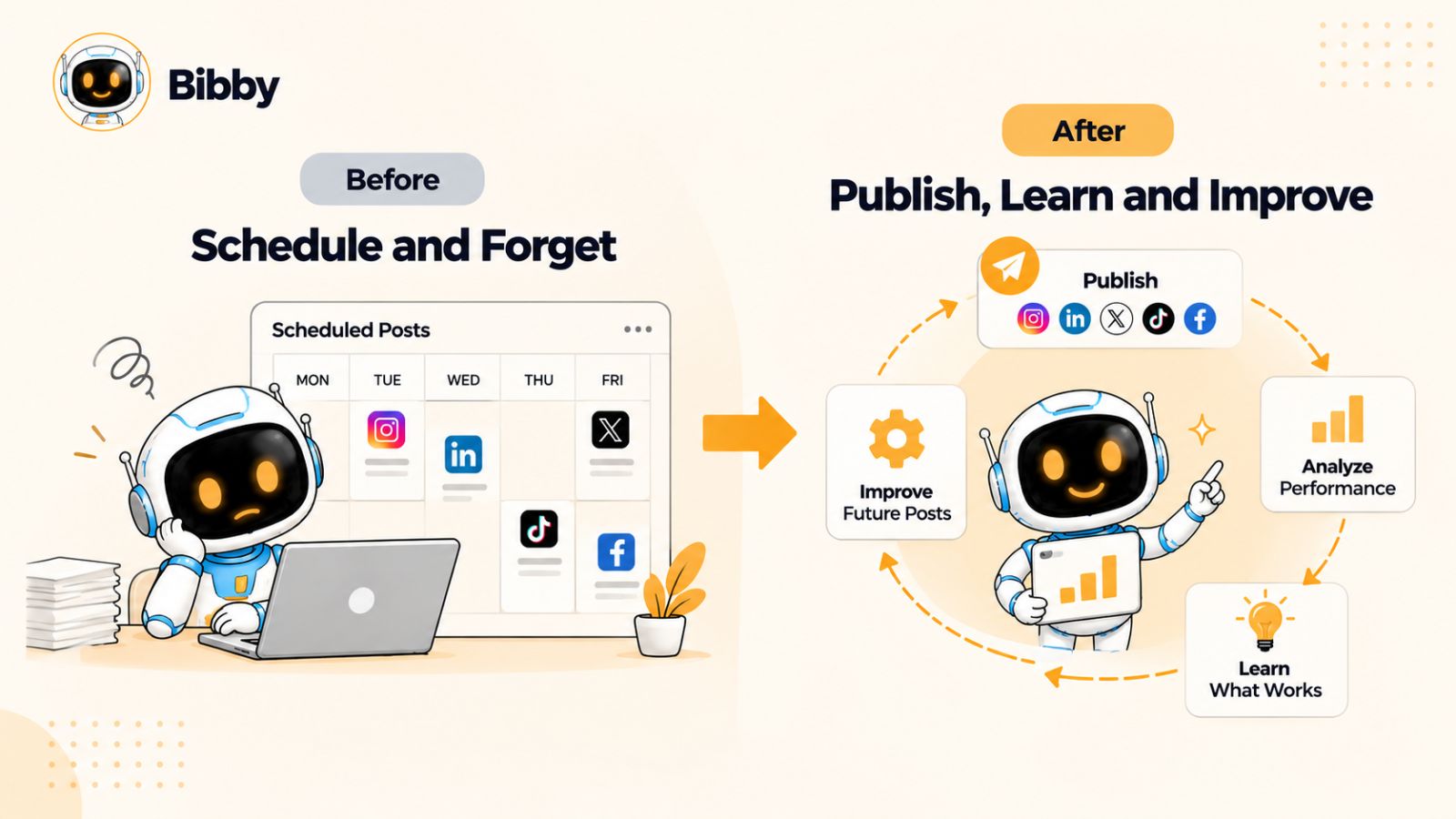
The original social media scheduling workflow
Imagine a business planning its content for the next two weeks.
The team might decide to publish:
- A product image on Monday
- An educational carousel on Wednesday
- A short video on Friday
- A promotional post the following Monday
A social media scheduling tool can take those assets, attach captions, assign platforms, and publish everything automatically.
The calendar gets filled.
The posts go out.
The workflow is technically automated.
But what happens next?
Someone still needs to look at the results and decide what those results mean.
Did the carousel perform better because of its format? Was the topic more relevant? Did the audience respond to the hook? Was Wednesday actually a better publishing day? Did the video generate meaningful engagement or simply accumulate views?
The scheduling system itself may not answer those questions.
Why traditional automation still requires so much human decision-making
Even when publishing is automated, many of the most important decisions remain manual.
Someone has to decide:
What should we post?
The system may publish the content, but the content strategy still comes from a person.
Which platform should receive it?
A post designed for LinkedIn may need a different treatment from one intended for TikTok or Instagram.
When should it be published?
A fixed schedule can keep a brand consistent, but audiences don't necessarily behave according to a fixed calendar.
Which format should we use?
An idea that works as a single image might perform very differently as a carousel or video.
What should we do after seeing the results?
This is perhaps the biggest gap.
Analytics can tell you what happened. Someone still has to turn those observations into the next set of decisions.
That means the workflow often looks like this:
Create → Schedule → Publish → Analyze manually → Decide → Create again
The learning step sits outside the automation.
The limitation of rule-based automation
This distinction is important because automation and intelligence are not the same thing.
A rule-based system might be told:
Publish this post every Monday at 9 AM.
It can reliably follow that instruction.
But it doesn't necessarily mean Monday at 9 AM will remain the best choice six months later.
An AI-assisted system can go further by helping generate a caption, suggest a posting time, or repurpose an idea into different formats.
But the bigger opportunity is what happens when the system can use the outcomes of previous decisions to inform future ones.
That creates a fundamentally different model:
Create → Publish → Measure → Learn → Adjust → Publish again
Now, publishing isn't the end of the workflow.
It becomes a source of information.
And that is where social media automation starts becoming much more interesting.
What Is AI-Powered Social Media Automation?
AI-powered social media automation is the next step beyond simply scheduling content.
Instead of treating social media as a series of isolated tasks—write a caption, upload an image, schedule a post, check the analytics—an AI-powered system can connect more of those tasks into a single workflow.
It can help create content, generate captions, choose formats, organize publishing, analyze results, and support decisions about what should happen next.
The important distinction, however, isn't that AI can perform more tasks.
It's that AI can potentially connect those tasks into a continuous feedback loop.
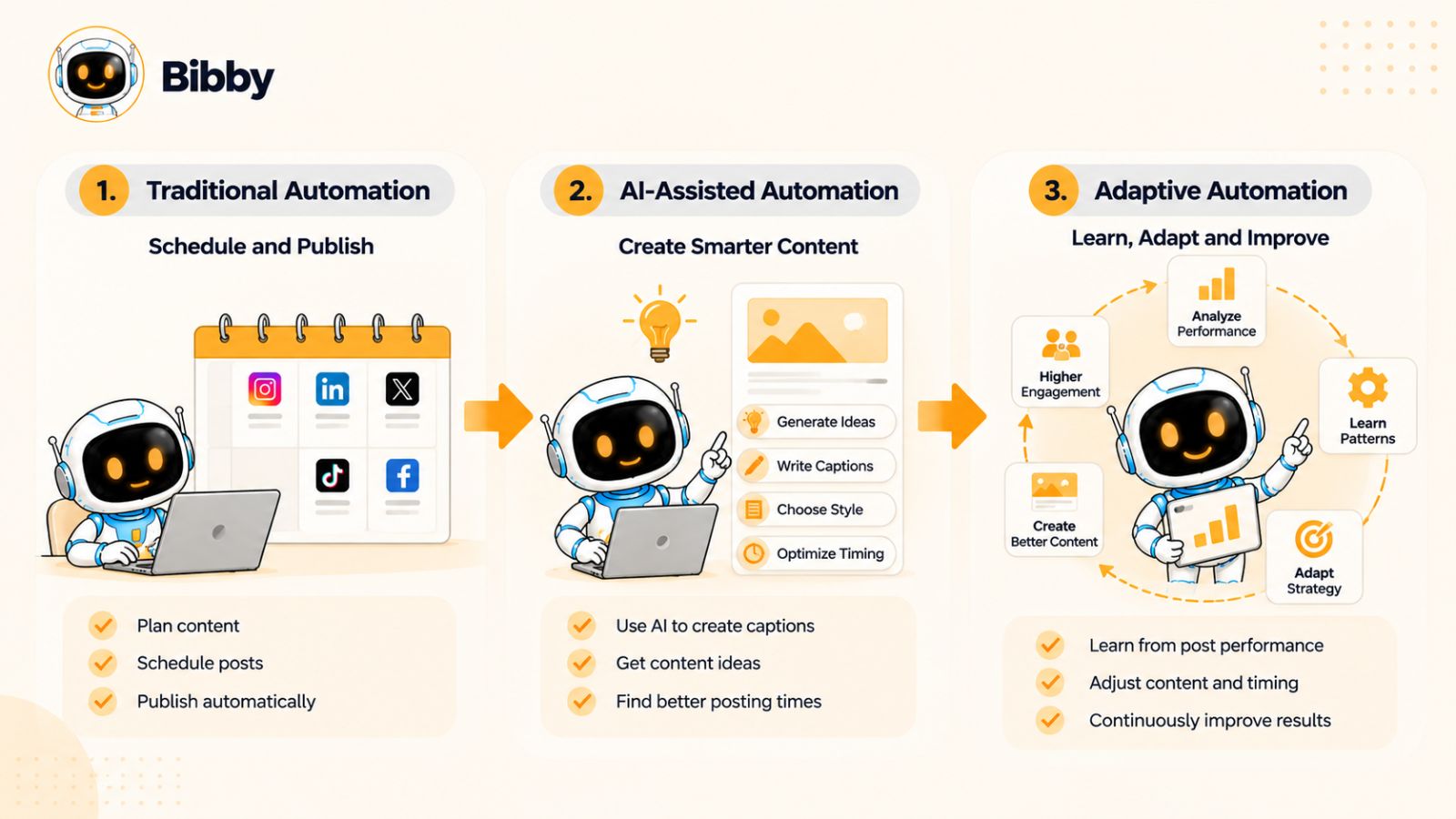
From automation to adaptive automation
There are three useful ways to think about the evolution of social media automation.
Traditional automation follows instructions.
You tell a scheduling tool what to publish and when. It performs those actions consistently without requiring you to manually publish every post.
AI-assisted automation helps with individual decisions.
For example, AI can generate a caption from an image, suggest content ideas, rewrite a post for a different platform, or recommend a publishing time.
Adaptive automation connects decisions to outcomes.
This is where things become more interesting.
If a system knows what content was published, where it was published, when it went live, and how audiences responded, those results can potentially influence future recommendations and actions.
The difference can be summarized simply:
Automation: “Do what I told you.”
AI assistance: “Help me decide what to do.”
Adaptive automation: “Learn from what happened and help improve what we do next.”
That final stage is what turns a collection of automated features into something closer to a social media operating system.
What can an AI social media system automate?
Modern AI-powered social media workflows can potentially connect many parts of the publishing process.
For example, a workflow might begin with an image or video and continue through:
- Content creation or AI image generation
- Caption generation
- Content repurposing
- Platform selection
- Scheduling
- Publishing
- Performance analysis
- Future content planning
Some platforms are also moving toward conversational interfaces, where instead of navigating through separate menus, users can describe what they want in natural language.
A request such as:
“Turn these product images into a week's worth of social posts.”
can become the starting point for a much larger workflow.
The system could potentially help transform the assets into different posts, generate accompanying captions, organize the publishing schedule, and prepare the content for multiple platforms.
Tools such as Bibby illustrate this broader direction by bringing content generation, caption creation, scheduling, and multi-platform publishing into a connected workflow. Its chat interface also reflects a growing shift toward managing social media through conversation rather than jumping between individual functions.
The significance isn't that one tool can perform several tasks.
The significance is that the distance between an idea and its execution is getting smaller.
Why the feedback loop matters more than any individual AI feature
An AI caption generator is useful.
An AI image generator is useful.
An automated scheduler is useful.
Analytics are useful.
But each capability becomes considerably more powerful when they are connected.
Consider a simplified workflow.
You create a post.
The system publishes it.
The post receives a particular response.
That response becomes another piece of information.
The next content decision can take that information into account.
Then the new post produces another result.
And the cycle continues.
Create → Publish → Measure → Learn → Adjust → Create again
This is the feedback loop that separates a static social media workflow from a potentially adaptive one.
The goal isn't simply to automate more actions.
The goal is to make each publishing cycle more informed by the cycles that came before it.
And once a system starts accumulating those signals, something interesting happens: individual posts stop being isolated pieces of content and start becoming data points in a much larger social media strategy.
What Happens When Your Social Media System Learns From Every Post?
The biggest change happens when a social media system stops treating every post as a one-off piece of content.
Instead, every published post becomes part of a growing body of evidence.
A post can reveal something about the audience, the topic, the format, the platform, the messaging, or the timing. One result may not tell you much. But hundreds of results can begin to reveal patterns that are difficult to see when social media decisions are made manually.
This creates a simple but powerful idea:
Every post can teach you something about the next post.
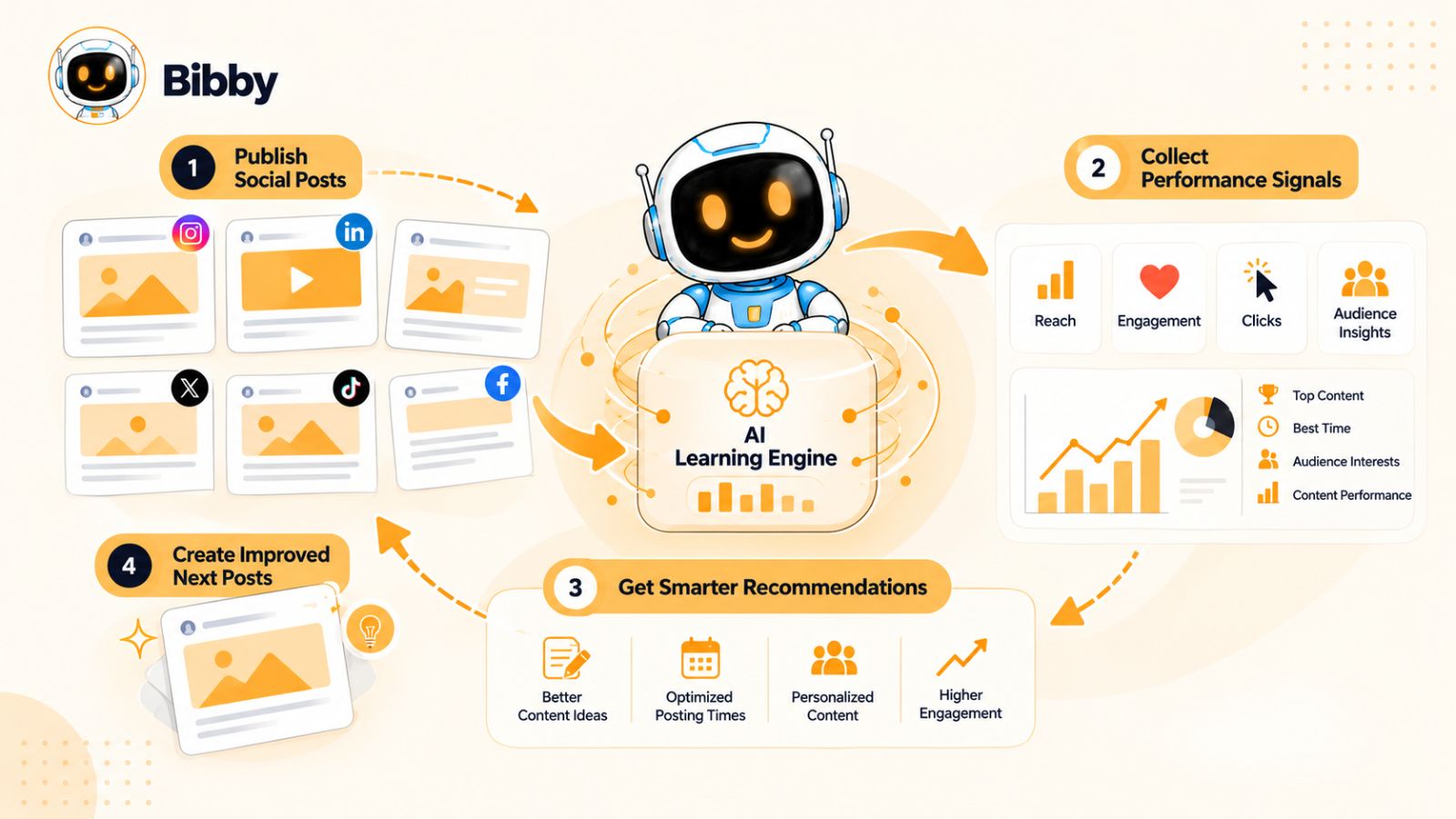
Every post becomes a data point
Consider what happens after a piece of content is published.
It may generate impressions, views, likes, comments, shares, saves, clicks, or other forms of engagement. Video content may provide additional signals such as watch time or completion rates.
These numbers aren't just a report card for the post that has already been published.
Used correctly, they can become inputs for future decisions.
For example, suppose a brand publishes several different types of content over a few months.
It might discover that:
- Educational carousels consistently generate saves.
- Short videos attract more initial reach.
- Founder-led posts generate more comments.
- Product-focused posts receive impressions but comparatively little interaction.
- Certain topics repeatedly outperform others.
- A particular content format works better on one platform than another.
None of these observations necessarily matters because of one post.
The value comes from seeing the pattern repeatedly.
The system starts recognizing patterns
Humans can recognize patterns in social media performance, but doing this consistently across hundreds or thousands of posts becomes difficult.
A learning-oriented system can potentially examine much larger sets of historical information and identify relationships between different variables.
For example, it might find that a particular combination of:
topic + format + platform + audience + publishing time
has repeatedly produced stronger results.
That doesn't mean the system has discovered a permanent formula.
Social media doesn't work that way.
Audience behavior changes. Platforms change. Trends come and go. A strategy that works in January may produce different results in July.
But historical performance can still provide a useful starting point for the next decision.
This is the crucial difference between a static recommendation and an adaptive one.
A static recommendation says:
“This is generally a good time to post.”
An adaptive approach asks:
“Based on what has happened with this audience and this type of content, what should we try next?”
The system can adapt future content
This is where the feedback loop becomes valuable.
Imagine that a brand has published 100 posts.
After analyzing those posts, it finds that practical, educational content consistently performs better than heavily promotional content.
A traditional workflow might record that insight in an analytics report.
Someone then has to remember it when planning next month's calendar.
A more connected system could potentially use the insight when generating future recommendations.
The next content plan might contain more educational topics.
The captions might use a less promotional tone.
More carousels might be suggested if that format repeatedly performs well for educational content.
The publishing schedule might prioritize the time periods associated with stronger historical results.
The system isn't simply producing more content.
It is using previous outcomes to influence future decisions.
The social media calendar becomes dynamic
This changes the meaning of a content calendar.
A traditional calendar might look like this:
Monday: Product post
Wednesday: Educational post
Friday: Video
Once those posts are scheduled, the plan is largely fixed.
A learning-oriented workflow is different.
It can begin with a plan, but the plan doesn't have to be treated as permanent.
The cycle becomes:
Plan → Publish → Observe → Learn → Adjust the remaining plan
If Wednesday's content produces an unexpected response, that information can potentially influence what happens on Friday.
If a particular topic consistently underperforms, future content can be adjusted.
If a format starts gaining traction, more experiments can be created around it.
This makes the social media calendar less like a fixed timetable and more like a living system.
The important caveat: learning doesn't mean blindly copying the past
There is an important distinction here.
A smart system shouldn't simply say:
“This post performed well, so make more posts exactly like it.”
That can quickly create repetitive content.
Instead, the useful question is:
“What did this result teach us?”
Perhaps the topic was valuable.
Perhaps the format was effective.
Perhaps the timing helped.
Perhaps the post succeeded because of an external event that won't happen again.
Perhaps the result was simply an outlier.
Good social media automation therefore isn't about blindly optimizing for yesterday's numbers.
It's about using historical evidence to make better-informed experiments tomorrow.
That distinction matters because the ultimate goal isn't to make every post identical to the last successful post.
It's to make the overall content system progressively better at discovering what works for a particular audience.
And once the system can learn from those patterns, the next question becomes even more important: what exactly should it learn when deciding what to publish next?
How a Learning Social Media System Decides What to Post
Knowing that a social media system can learn from previous posts is only useful if that learning affects real publishing decisions.
The most valuable decisions aren't simply about whether a post received 500 or 5,000 views. A smarter system needs to understand the context around those results: what was posted, who saw it, where it appeared, how it was presented, and what the audience actually did afterward.
Over time, these signals can help shape several parts of a social media strategy.
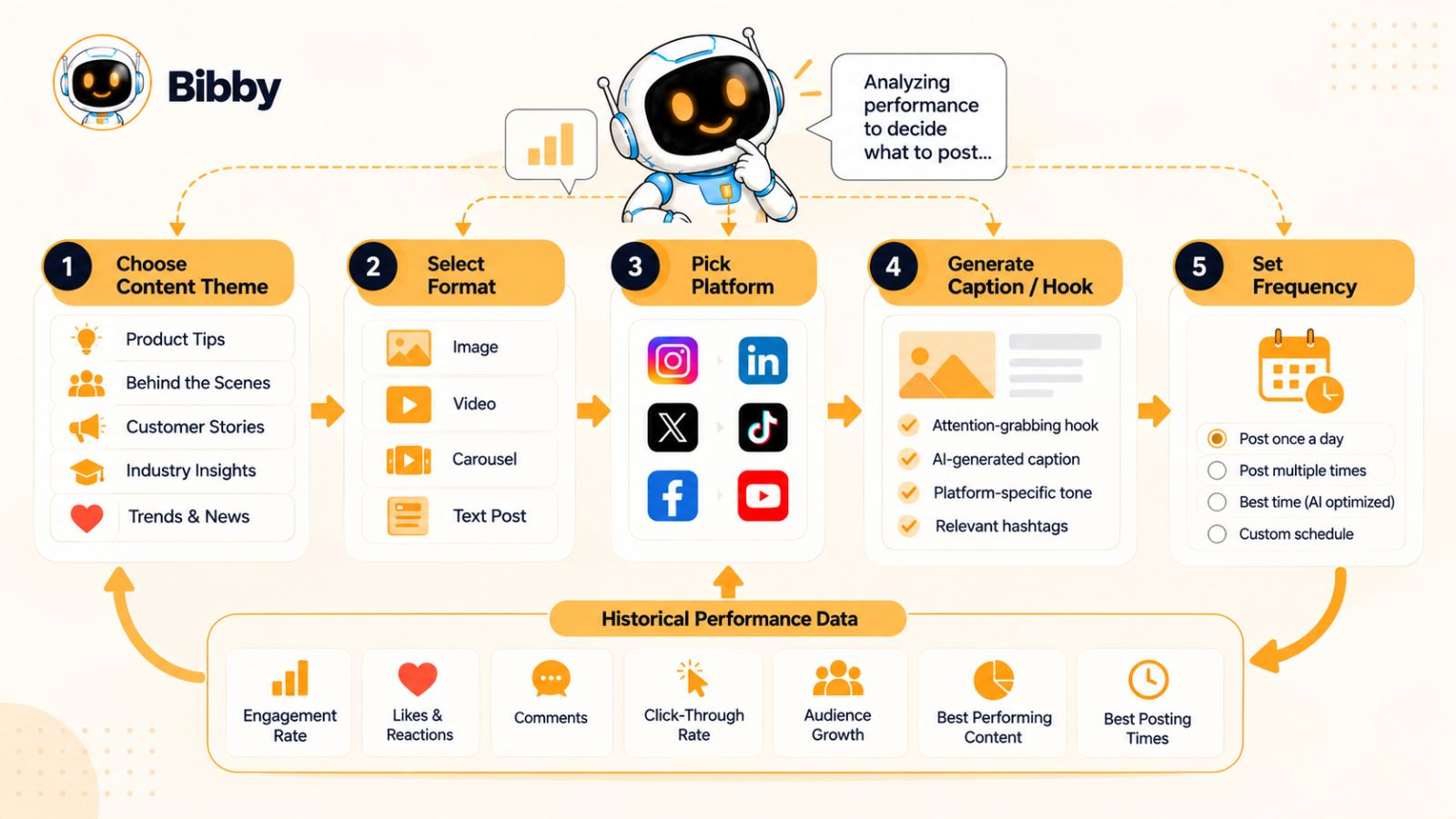
Content themes
Not every topic deserves equal space in a content calendar.
Suppose a business regularly publishes content across five themes:
- Educational advice
- Industry news
- Product updates
- Customer stories
- Promotional offers
After enough publishing cycles, performance may reveal that educational advice consistently generates saves and shares, while promotional posts generate fewer interactions.
That doesn't mean promotional content should disappear.
It means the system has learned something about the relative value of different content themes.
The content strategy might gradually shift toward more educational material while using promotional content more selectively.
This is more useful than simply asking an AI to generate “10 social media posts.”
The better question is:
Which subjects have earned more attention from this particular audience, and what should we explore next?
Content formats
The same idea can perform very differently depending on how it is presented.
An educational concept might work as:
- A single image
- A carousel
- A short video
- A text post
- A story
A learning-oriented system can compare the performance of these formats instead of treating every piece of content as equivalent.
For example, if a brand repeatedly sees educational carousels generating more saves than single-image posts, that is a useful signal.
The next content plan could experiment with more carousel-based education.
But again, the goal isn't to conclude that carousels are universally better.
It's to understand:
Which format appears to work best for which type of content, on which platform, for which audience?
That level of context is what makes the learning useful.
Platform-specific behavior
Cross-platform publishing creates another opportunity for optimization.
A piece of content might perform well on LinkedIn but poorly on TikTok.
A short video might receive strong engagement on Instagram while a detailed text-based explanation performs better on LinkedIn.
That doesn't necessarily mean the content itself is bad.
The platform may simply change how the audience discovers and consumes it.
This is why modern social media automation increasingly needs to think beyond:
“Publish everywhere.”
A more intelligent approach is:
“Distribute appropriately everywhere that makes sense.”
The content idea can remain consistent while the format, caption, presentation, and timing adapt to each platform.
Captions and hooks
The same principle applies to messaging.
Over time, a brand may discover that its audience responds more strongly to practical hooks than generic promotional introductions.
For example:
Generic:
“Here are five ways to improve your social media strategy.”
More specific:
“Your social media calendar may be full—and still be wasting your time.”
The point isn't that one sentence will always outperform another.
It's that repeated experimentation can reveal which communication patterns tend to attract attention from a particular audience.
An AI system can then use those observations when helping create future captions and hooks.
Posting frequency
One of the easiest mistakes in social media marketing is assuming that more automation should result in more publishing.
It doesn't necessarily work that way.
If a brand publishes three useful posts per week and then starts publishing three times per day without improving the quality or relevance of the content, automation hasn't solved the underlying problem.
It has simply increased the speed at which the problem is repeated.
A learning system should therefore help answer a more useful question:
How much content is actually worth publishing?
The answer can depend on the audience, platform, content quality, business objectives, and historical performance.
The goal isn't maximum output.
It's useful output at a sustainable frequency.
From “What should we post?” to “What should we learn next?”
This is ultimately the biggest change.
A traditional social media workflow begins with a content idea.
A learning workflow can begin with both an idea and a hypothesis.
For example:
“Our audience seems to save educational carousels more often than promotional images. Let's test another educational carousel around a related topic.”
Now the post serves two purposes.
It delivers content to the audience.
And it generates another piece of evidence.
That turns social media publishing into an ongoing process of experimentation and refinement.
The system isn't simply filling a calendar.
It is gradually building an understanding of what deserves to be on that calendar in the first place.
AI-Optimized Posting Times: What Changes?
“What's the best time to post on social media?” sounds like a simple question.
It isn't.
There is no single posting time that works equally well for every business, audience, platform, and piece of content. An audience in one industry may be most active during working hours, while another may engage more heavily in the evening. A global brand may also have to account for several time zones at once.
This is where AI-powered social media scheduling can become more useful than a fixed publishing calendar.
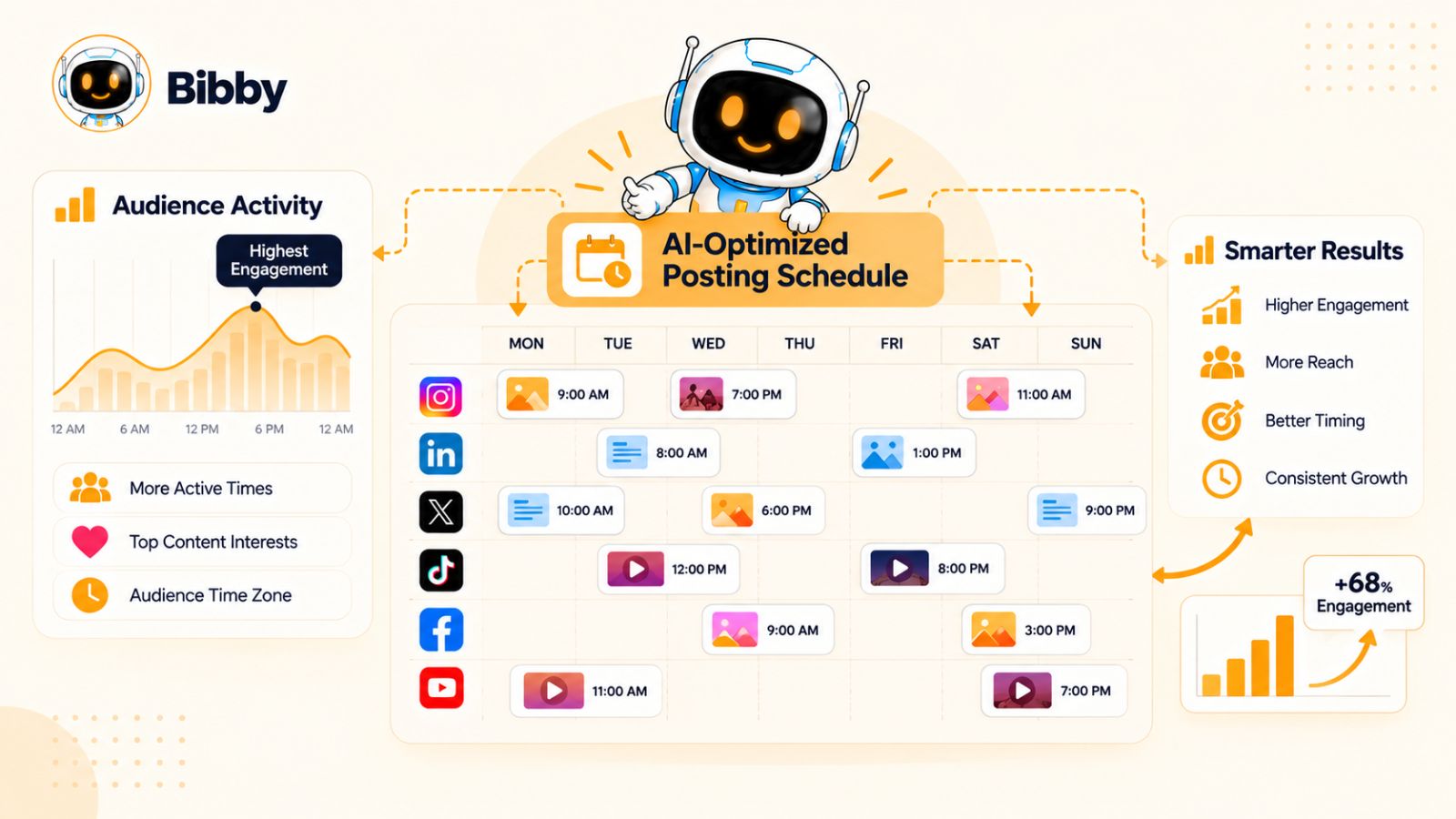
Why “the best time to post” is not universal
Many social media recommendations rely on broad averages.
You might see advice suggesting that businesses should post at 9 AM, avoid weekends, or publish during a particular weekday.
These recommendations can be useful as starting points.
But they are not personalized strategies.
Your audience may behave differently.
A B2B company's LinkedIn audience might interact with content during working hours. A consumer brand's Instagram audience might be more active later in the day. A creator targeting several countries may have completely different engagement windows.
Even within the same account, different content types can behave differently.
A short video may attract attention at a different time from an educational carousel.
So the useful question isn't:
“What is the best time to post on social media?”
It is:
“When does this particular audience tend to respond to this particular type of content?”
Static recommendations vs. personalized timing
Imagine two social media strategies.
The first uses a fixed rule:
Publish every weekday at 10 AM.
It's simple, predictable, and easy to automate.
But it doesn't change when the audience changes.
The second strategy continuously evaluates historical performance.
It might discover that educational content tends to perform well in one time window, while entertainment-oriented content performs better in another.
That doesn't guarantee future success.
But it gives the system more relevant information to work with.
This is where AI-optimized scheduling becomes interesting.
Instead of selecting a publishing time once and leaving it there indefinitely, the system can potentially use historical performance as an input when determining future schedules.
Why timing should continuously change
Audience behavior isn't static.
People change their routines.
Businesses change their target markets.
Platforms change their algorithms and recommendation systems.
Seasonality can change engagement.
A product launch can create a temporary spike in attention.
A holiday can completely alter normal behavior.
Even changes in a brand's audience can affect when people are most likely to interact.
A schedule that worked six months ago therefore shouldn't automatically be treated as the optimal schedule forever.
A learning-oriented approach treats timing as something that can be tested and refined.
This creates another feedback loop:
Publish → measure response → identify timing patterns → adjust schedule → publish again
Over enough cycles, the system can build a more personalized understanding of the account rather than relying exclusively on generic industry averages.
What AI-optimized scheduling should actually mean
There is an important distinction between genuine optimization and simply attaching the word “AI” to a scheduling feature.
AI-optimized scheduling should ideally consider more than a generic recommendation.
Useful signals might include:
- Historical engagement
- Audience activity
- Platform differences
- Content format
- Content topic
- Previous publishing results
- Time zones
- Frequency of recent posts
The objective shouldn't be to predict the exact minute when a post will go viral.
That isn't realistic.
The objective is to make increasingly informed scheduling decisions based on the evidence available.
This also explains why a tool that automatically schedules content at different times can be more useful than a simple calendar.
For example, a workflow such as the one offered by Bibby can take a set of social media assets, generate accompanying captions, and schedule the content across selected platforms at different times rather than requiring the user to manually assign every post to a slot.
The important idea isn't the automation itself.
It's the movement away from treating the content calendar as a fixed set of appointments and toward treating scheduling as another variable that can be tested, measured, and improved.
And once timing becomes part of the feedback loop, the system can begin learning something even more valuable: not just when people respond, but what kinds of content they respond to at different moments.
What Happens to the Social Media Manager?
The natural fear around AI-powered social media automation is that it will make social media managers unnecessary.
But the more interesting possibility is different.
The role changes from managing tasks to managing the system.
Social media management has always involved two very different kinds of work. There is the repetitive operational work—uploading assets, writing variations of captions, scheduling posts, moving content between platforms—and there is the strategic work that requires judgment.
AI is particularly well suited to the first category.
That creates an opportunity to spend more time on the second.
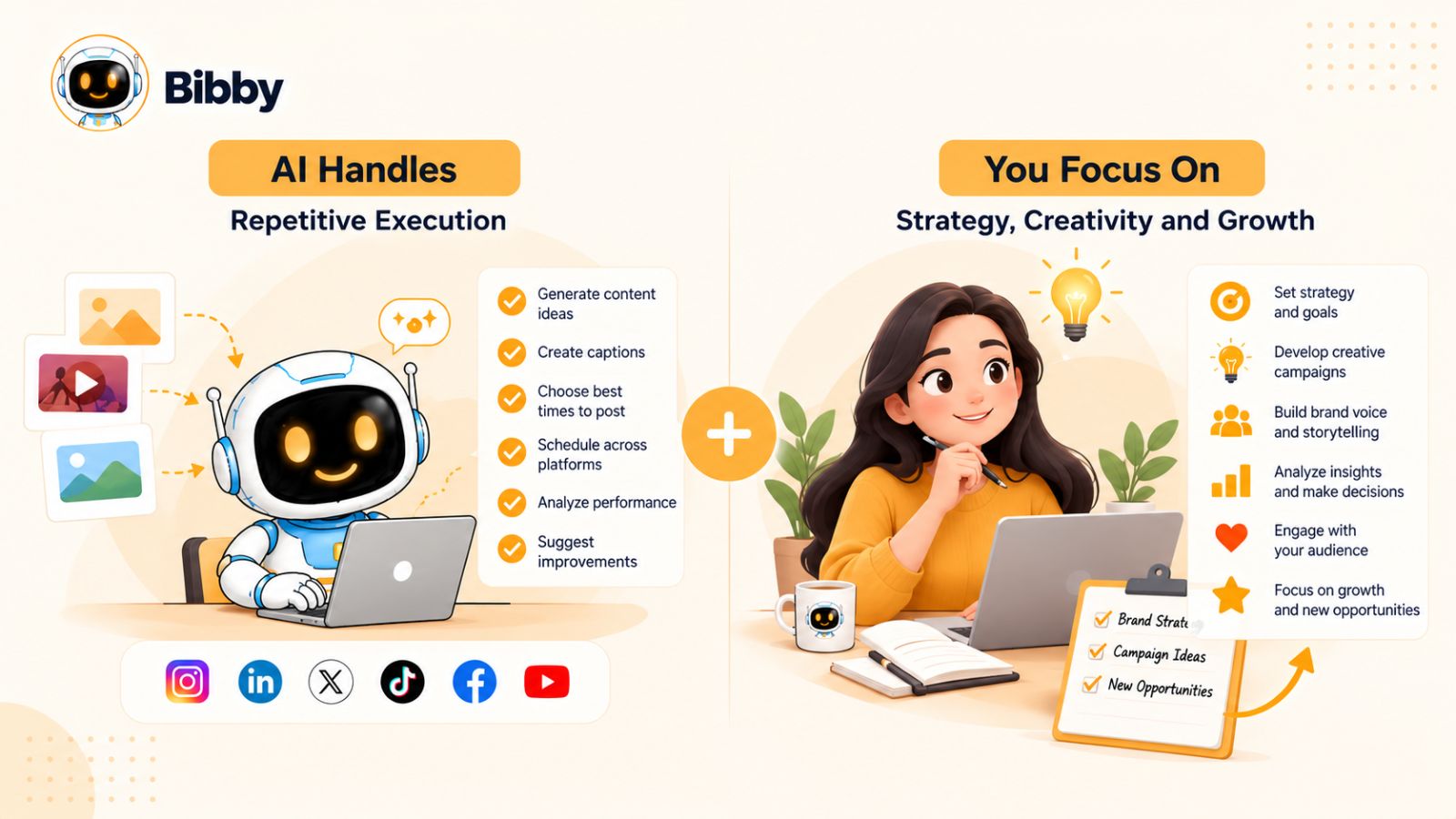
The job shifts from execution to direction
Consider how much time can disappear into operational tasks.
A social media manager may need to:
- Upload images and videos
- Resize or adapt assets
- Write captions
- Create multiple variations
- Copy content between platforms
- Build a publishing calendar
- Assign dates and times
- Check scheduled posts
- Review analytics
- Repeat the process next week
None of these tasks is necessarily difficult individually.
The problem is repetition.
When there are dozens or hundreds of posts involved, these small tasks can consume a significant amount of working time.
AI-powered social media automation can reduce some of that workload by connecting these activities into a single workflow.
That changes what the human needs to focus on.
Instead of spending the afternoon moving posts around a calendar, the social media manager can spend more time asking:
What should our brand be known for?
Which audience are we trying to reach?
What ideas deserve deeper creative treatment?
What should we test next?
What does our audience actually need from us?
Those are much harder questions—and much more valuable ones.
AI becomes an operating layer rather than another tool
There is another important shift happening.
For years, social media teams have accumulated separate tools for separate jobs.
One tool creates images.
Another generates captions.
Another manages the content calendar.
Another schedules posts.
Another provides analytics.
Another stores brand guidelines.
The problem isn't necessarily the number of tools.
It's the number of disconnected workflows.
Every handoff introduces friction.
You create an image in one place, download it, upload it somewhere else, generate a caption, copy the caption into a scheduler, choose a date, then repeat the process for another platform.
A more integrated AI social media system can reduce some of those handoffs.
The user can start with an idea or asset and move through more of the workflow without constantly switching between applications.
This is one reason conversational interfaces are becoming particularly interesting.
Instead of thinking in terms of individual buttons—Create, Schedule, Generate, Analyze—the user can describe the desired outcome.
For example:
“Create a week's worth of educational posts from these images and schedule them across our social channels.”
The system can then become an execution layer between the user's intention and the final published content.
The emerging AI social media manager
This is where the phrase AI social media manager becomes more meaningful.
It shouldn't simply mean “an AI that writes captions.”
A genuine AI social media manager would need to operate across a broader workflow.
It could help with:
- Brand setup
- content planning
- Campaign creation
- Content generation
- Caption writing
- Content repurposing
- Scheduling
- Publishing
- Performance analysis
- Future recommendations
Conversational tools such as Bibby point toward this model by allowing users to manage activities such as creating a brand kit, setting up campaigns, creating posts, and regenerating captions through a chat interface.
The interface is important, but the larger change is the workflow behind it.
Instead of asking:
“Which tool should I open to do this?”
the user can increasingly ask:
“What do I want to accomplish?”
The system handles more of the operational path between those two points.
But humans still need to remain in the loop
More automation doesn't mean less responsibility.
In fact, the more decisions a system can automate, the more important good human oversight becomes.
A human should still have the ability to review important campaigns, correct inaccurate assumptions, protect the brand voice, and reject recommendations that don't make strategic sense.
This matters particularly for sensitive topics, major announcements, customer complaints, crisis communication, and content that involves nuanced brand positioning.
The goal isn't to build a system where humans disappear.
It's to build a system where humans don't have to spend their best hours doing work a machine can reliably handle.
That distinction leads to a much healthier vision for AI-powered social media management:
AI handles more of the repetition. Humans provide the direction.
And when those roles are separated properly, the social media manager doesn't become less important.
Their judgment becomes more valuable.
Where Tools Like Bibby Fit Into This Evolution
The shift toward intelligent social media automation is also changing what a social media tool is expected to do.
A scheduler used to have a relatively narrow job: take finished content and publish it at the times you specify.
Modern platforms are increasingly trying to connect more of the workflow—from creating the content to preparing it for different channels and managing its publication.
Bibby is an example of this broader approach.
The interesting part isn't any single feature. It's the way several normally separate social media tasks can be brought into one workflow.
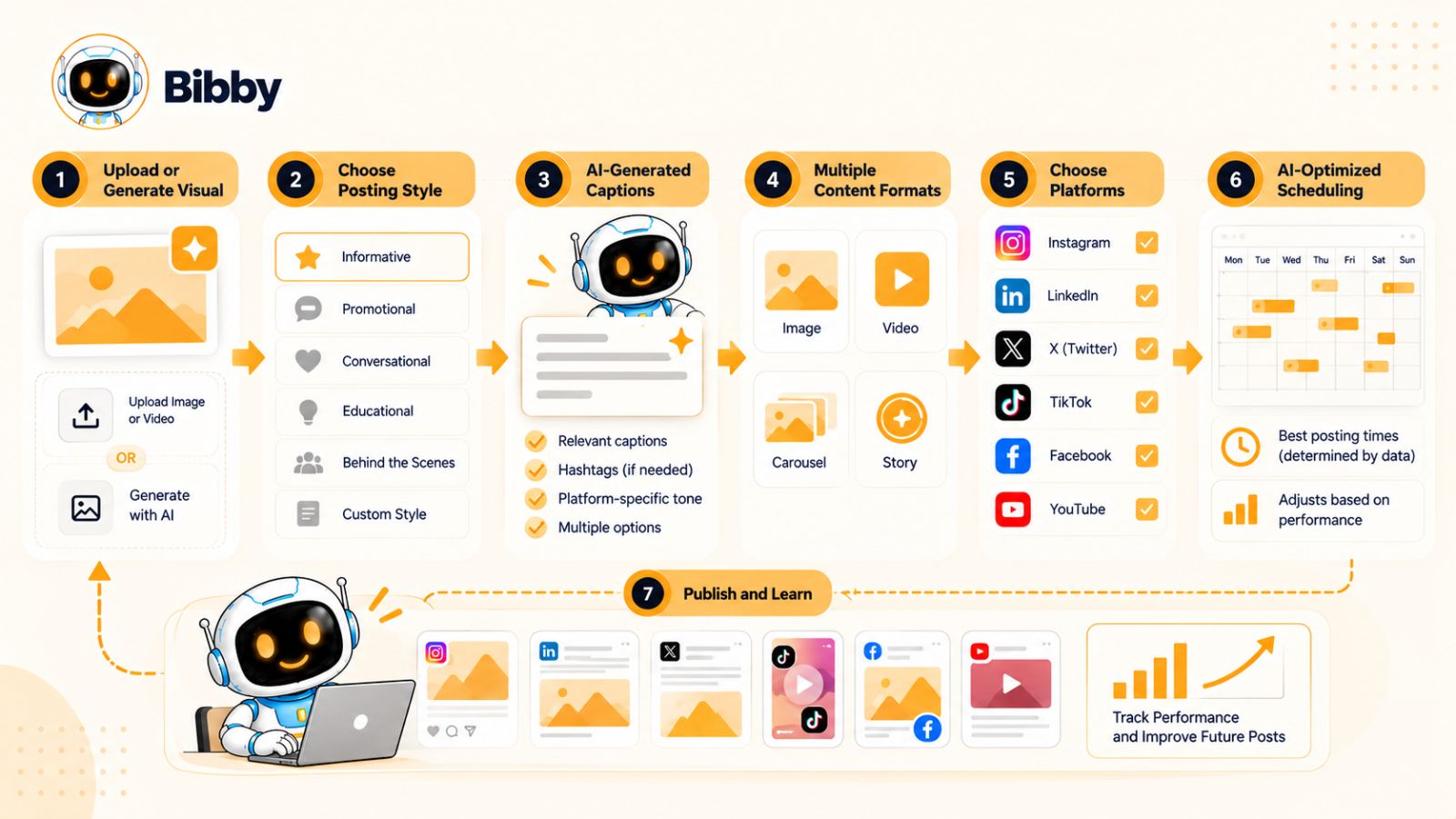
From individual tasks to one connected workflow
A typical workflow can begin with something as simple as an image.
Instead of creating the visual in one application, writing the caption somewhere else, and then moving everything into a scheduling tool, an integrated system can connect those steps.
With Bibby, for example, a user can upload an image or generate one with AI, choose a preferred posting style, and have captions generated as part of the workflow. The resulting content can then be organized and scheduled across selected social platforms.
That might include platforms such as:
- YouTube
- TikTok
The practical benefit is straightforward: fewer disconnected steps between having an idea and getting it published.
But there's a larger implication.
When creation, captioning, scheduling, and publishing exist inside the same workflow, the system has more context about what is happening.
That creates the foundation for a more connected approach to social media management.
One piece of content can become a multi-platform publishing system
A social media idea doesn't necessarily belong to one format.
A useful concept could become:
- A single image
- A carousel
- A video
- A story
- A platform-specific variation
The challenge is managing all of those variations without turning the process into a manual production line.
An integrated social media workflow can reduce that complexity.
Rather than treating every platform as a completely separate publishing destination, the marketer can start with the underlying idea and then organize how it should be distributed.
This is particularly useful for teams that need to maintain a consistent presence across several platforms without manually rebuilding the same publishing workflow for each one.
The important distinction is that cross-platform automation shouldn't mean blindly publishing identical content everywhere.
Each platform has its own Audience behavior, content conventions, and strengths.
The better goal is to make distribution easier while preserving room for platform-specific decisions.
Conversational social media management
Perhaps the more interesting development is what happens when the interface itself becomes conversational.
Instead of navigating through a sequence of menus, a user can describe what they want the system to do.
For example:
“Create a campaign around our new product.”
Or:
“Regenerate these captions with a more educational tone.”
Or:
“Create several posts from these images.”
Or:
“Set up our brand kit.”
These aren't fundamentally different requests from what social media software has always allowed users to do.
What's changing is how the user communicates the intention.
A conversational interface can make the software feel less like a collection of separate functions and more like an assistant that coordinates them.
Bibby's chat interface follows this direction, allowing users to work with areas such as brand kits, campaigns, posts, and caption regeneration through conversation.
Why this matters beyond convenience
It would be easy to view all of this simply as a way to save time.
That is certainly part of the benefit.
But reducing friction can also change how people approach social media strategy.
When creating and scheduling a single post requires ten manual steps, marketers naturally think in terms of individual posts.
When a system can turn one idea into an organized sequence of content with much less manual effort, the marketer can start thinking in terms of campaigns, themes, experiments, and longer-term content systems.
That's a meaningful change.
The software isn't just helping someone publish faster.
It can change the unit of work from:
“I need to create another post.”
to:
“I have an idea. How should this idea become a useful piece of content across my social channels?”
And that is where integrated social media automation starts connecting back to the larger idea of this article.
The ultimate advantage isn't having more buttons automated.
It's having a system where content creation, publishing, measurement, and future decisions can eventually become part of the same continuous loop.
The Feedback Loop: The Real Engine Behind Intelligent Social Media Automation
The most important part of intelligent social media automation isn't the ability to generate a caption or schedule a post.
It is what happens after the post goes live.
A system becomes significantly more useful when the result of one publishing decision can inform the next decision. Instead of starting every content cycle from scratch, the system can carry forward what it has learned.
This creates a feedback loop:
Create → Publish → Measure → Learn → Adjust → Create again
The loop is simple.
Building a useful system around it is much harder.
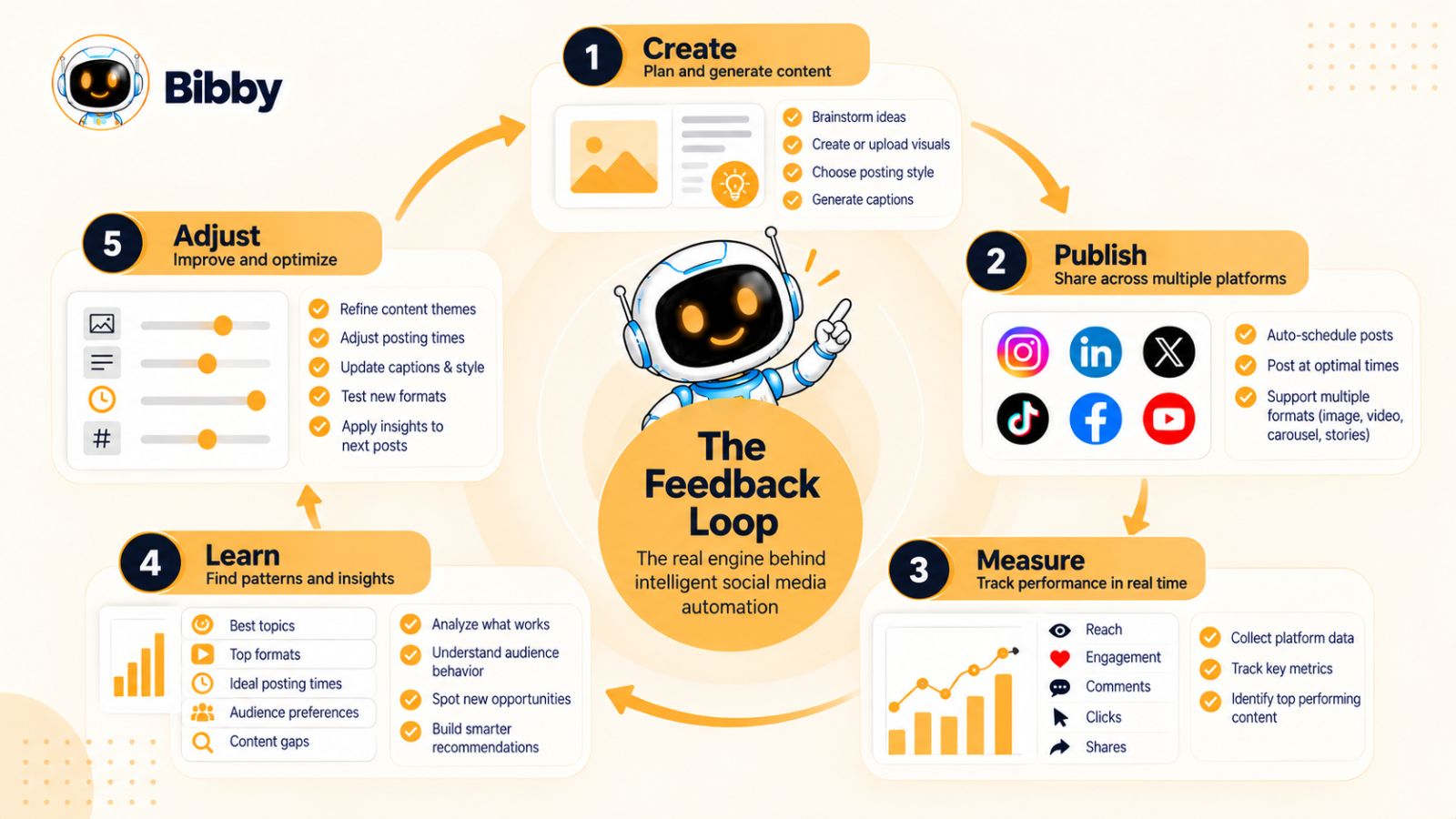
Stage 1: Create
Every learning cycle begins with content.
That might mean uploading an existing image, generating a visual with AI, creating a carousel, recording a video, or developing an idea into several pieces of content.
At this stage, the system can also capture useful context:
- What the content is about
- Which content pillar it belongs to
- What format it uses
- Which audience it targets
- Which platforms it is intended for
- What objective it is designed to support
That context becomes important later.
Performance data without context can be misleading.
Stage 2: Publish
The content is distributed to the selected platforms according to the publishing strategy.
This is where social media scheduling and automation remove much of the repetitive work.
Instead of manually opening several platforms and publishing each post individually, an automated workflow can coordinate the process.
Scheduling can also vary by platform rather than forcing every piece of content to appear everywhere at exactly the same time.
At this point, the content has left the planning stage.
Now it starts generating evidence.
Stage 3: Measure
Once content is published, the system can observe what happens.
Depending on the platform and available data, relevant signals might include:
- Reach
- Impressions
- Views
- Engagement
- Comments
- Shares
- Saves
- Clicks
- Watch time
- Conversion-related actions
The important point is that these metrics should not be treated as interchangeable.
A post with enormous reach isn't necessarily more valuable than one with fewer views but significantly more qualified engagement.
Measurement therefore needs to happen in context.
Stage 4: Learn
This is the stage that separates a feedback loop from a basic analytics report.
The question changes from:
“How did this post perform?”
to:
“What does this result teach us?”
Perhaps educational content consistently receives more saves.
Perhaps short videos produce more reach but fewer clicks.
Perhaps a particular topic generates unusually strong discussion.
Perhaps promotional posts work better when surrounded by several educational pieces.
Perhaps a certain publishing window repeatedly produces stronger initial engagement.
One result doesn't prove a rule.
Repeated results can create a useful hypothesis.
Stage 5: Adjust
The information becomes valuable when it changes something.
The next content plan might contain more of a successful topic.
A format might be tested again.
A caption style might be adjusted.
A publishing window might change.
A platform might receive a different version of the content.
An underperforming approach might be reduced rather than repeated indefinitely.
This is where the system starts becoming adaptive.
The output of one cycle becomes an input to another.
Then the loop starts again
After adjustments are made, new content is created and published.
That content produces new results.
Those results create new information.
The system adjusts again.
Over time, the process looks less like a sequence of disconnected campaigns and more like a continuously evolving system.
Post 1 → Learn
Post 2 → Learn
Post 3 → Learn
Post 50 → Learn
Post 100 → Learn
The goal isn't that the 100th post will automatically be perfect.
The goal is that the strategy behind the 100th post should have access to considerably more evidence than the strategy behind the first.
Why this creates a compounding advantage
A single successful post can be useful.
A history of hundreds of posts can be much more useful because it creates a larger base of evidence from which to identify patterns.
That doesn't mean more data automatically produces better decisions.
Bad data can produce bad conclusions.
But when the data is relevant, consistent, and interpreted correctly, every publishing cycle has the potential to improve the information available for the next one.
This is the real promise of intelligent social media automation.
The system doesn't just automate the work. It can potentially make the work more informed over time.
And once that feedback loop is running, an even more interesting question emerges: what exactly can the system learn from all those publishing cycles?
What a Self-Learning Social Media System Could Learn Over Time
The phrase “AI learns from your social media” can sound impressive without actually explaining what the system is learning.
The useful question is much more specific:
What decisions could become better informed after months of publishing data?
The answer can span almost every part of a social media strategy—from the subjects you talk about to the formats you use and the way you distribute them.
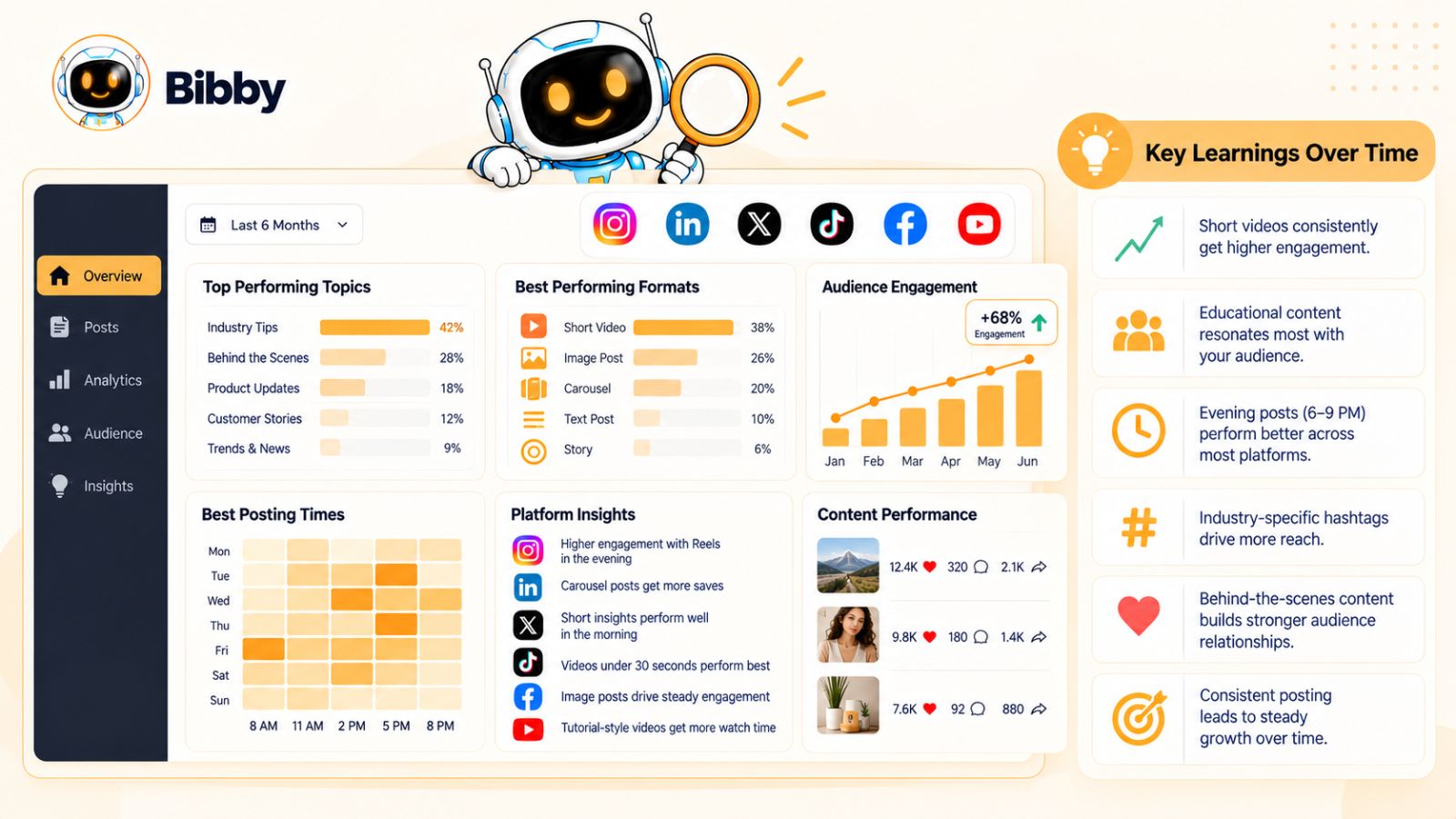
“Our audience prefers educational carousels.”
Imagine a business publishes educational content in several formats.
Some topics are posted as single images. Others become carousels. Some are turned into short videos.
After enough experiments, a pattern begins to emerge: educational carousels consistently generate more saves and shares than the equivalent single-image posts.
That doesn't mean every future post should become a carousel.
It does suggest something worth testing.
The content system might prioritize carousels when the goal is to explain a concept, while continuing to experiment with other formats.
The important learning isn't simply:
“Carousels are good.”
It is:
“For this audience and this type of educational content, carousels have repeatedly produced a particular kind of response.”
That is much more useful.
“Short videos work better on this platform.”
A business may discover that the same underlying idea performs differently depending on where it is published.
A short video could generate strong reach on one platform while a text-heavy version of the idea performs better on another.
Over time, the system can begin treating the platforms differently.
Instead of:
One idea → identical post everywhere
the workflow can become:
One idea → appropriate format and presentation for each platform
That is a more sophisticated form of cross-platform social media automation.
“Product-heavy posts get reach but fewer meaningful interactions.”
This is where simply looking at views can lead to the wrong conclusion.
Suppose promotional posts consistently receive high impressions but generate relatively few comments, saves, or clicks.
At the same time, educational posts receive fewer impressions but generate stronger engagement from people who interact with them.
A system focused only on reach might conclude that promotional posts are winning.
A broader analysis might suggest something different.
Perhaps promotional content is good at generating awareness, while educational content is better at creating deeper engagement.
That distinction can influence the role each content type plays in the overall strategy.
The lesson becomes:
Different posts can serve different purposes.
“Founder-led posts generate more comments.”
A company might discover that posts featuring a founder's perspective consistently generate more discussion than generic branded content.
That could lead to more experimentation with:
- Personal opinions
- Lessons learned
- Behind-the-scenes stories
- Industry observations
- Founder experiences
The system isn't replacing the founder's expertise.
It's identifying that the audience responds to it.
That insight can then influence the future content mix.
“Certain topics consistently produce saves.”
Imagine an account publishes content across several educational subjects.
One topic repeatedly generates saves.
Another generates likes.
A third produces comments.
Those aren't necessarily competing outcomes.
They may indicate different types of audience value.
A high-save topic might suggest that people consider the information useful enough to return to later.
A high-comment topic might suggest that the subject encourages discussion.
A learning-oriented system can therefore begin distinguishing between different types of performance instead of reducing everything to a single engagement score.
“Posting more isn't necessarily producing better results.”
This may be one of the most valuable things a social media system can learn.
Automation makes it extremely easy to publish more.
But more content isn't automatically better content.
Suppose a brand increases publishing frequency from three posts per week to two posts every day.
If total output rises but meaningful engagement, clicks, or conversions don't improve, the additional publishing may not be creating much value.
The lesson isn't necessarily “post less.”
It is:
More publishing should have a reason.
A mature social media strategy asks whether additional content is adding value, testing a meaningful hypothesis, reaching a different audience segment, or simply filling an empty slot on the calendar.
The system can also learn what doesn't work
This is often overlooked.
Learning isn't only about identifying winners.
Repeatedly underperforming topics, formats, hooks, or publishing patterns can also provide useful information.
If a certain approach consistently produces weak results despite multiple variations, continuing to repeat it simply because it is easy to automate doesn't make much sense.
The system can gradually narrow the range of strategies worth testing.
That creates a more efficient form of experimentation.
But patterns are not permanent rules
There is one important caveat.
A learning system should never assume that yesterday's pattern is a permanent law.
Audience interests change.
New competitors enter the market.
Platforms evolve.
Content trends shift.
A business changes its positioning.
A new product can attract a different audience.
So the best learning systems should treat historical patterns as evidence, not commandments.
The goal isn't to discover one perfect social media formula.
It is to continuously improve the quality of the questions being asked.
And that leads to an equally important question: what should an AI system deliberately avoid learning from?
What It Should Not Learn From
If a social media system can continuously learn from publishing data, there is an obvious danger.
It can learn the wrong lesson.
More data doesn't automatically produce better decisions. If the system treats every spike, click, or viral post as a permanent signal, it can gradually optimize a social media strategy in the wrong direction.
A genuinely useful social media automation system therefore needs to understand not only what to learn from, but also what not to overreact to.
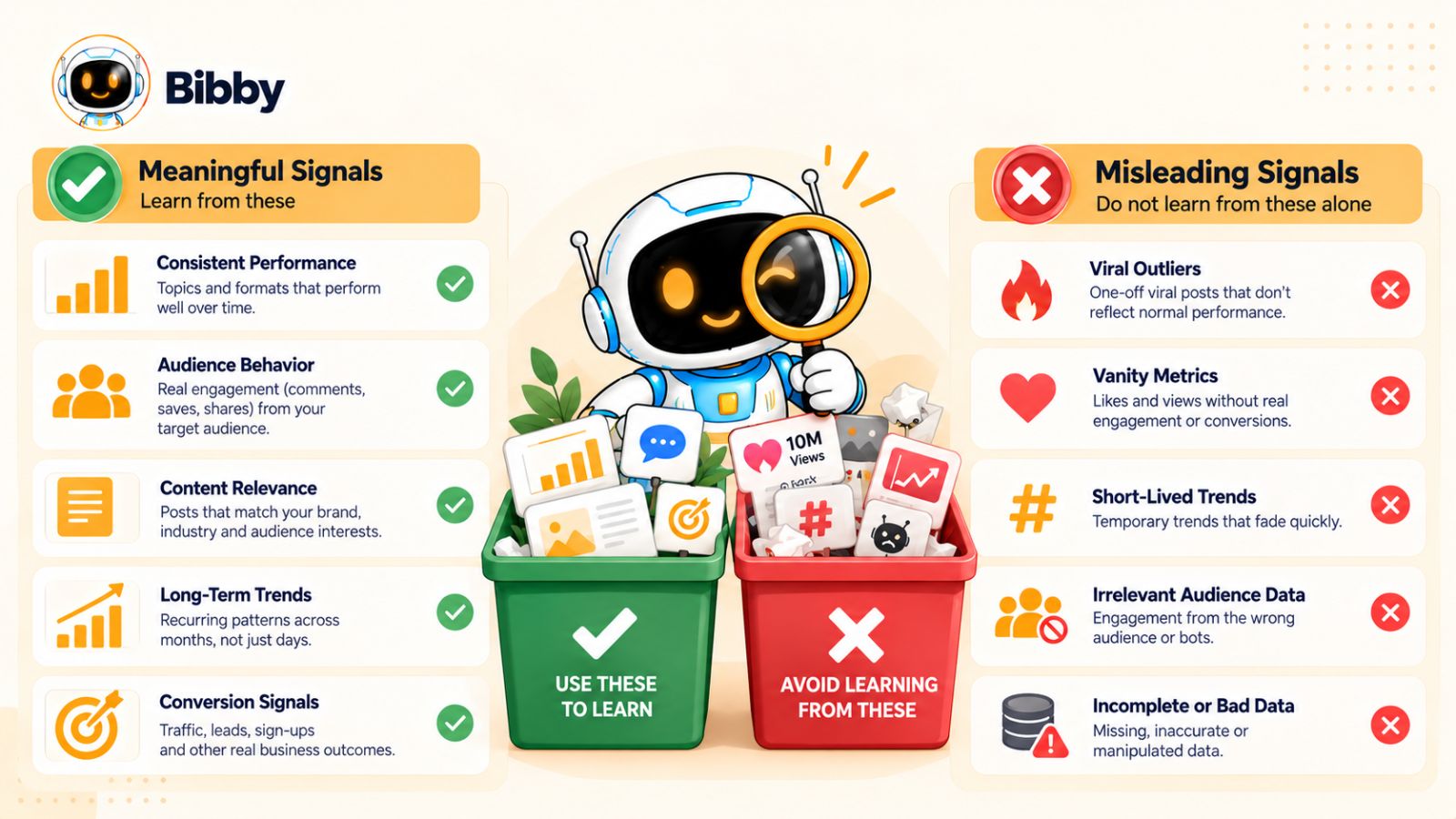
Vanity metrics
A large number can be seductive.
A post receives 100,000 impressions, and it looks like a huge success.
But what did those impressions produce?
If the post generated little meaningful engagement, few qualified visits, and no measurable business outcome, its reach may not tell the whole story.
This doesn't mean impressions or views are useless.
They can be valuable awareness signals.
The problem comes when a system treats them as the ultimate definition of success.
Different content can have different objectives.
A brand-awareness video might be judged primarily on reach and watch time.
An educational post might be more valuable for saves and shares.
A product post might be evaluated through clicks or conversions.
The learning system needs context.
Otherwise, it risks optimizing for whatever metric happens to be easiest to increase.
One viral post
Viral content is another potential trap.
Imagine a brand publishes one unusual post that suddenly receives ten times its normal reach.
An overly aggressive system might interpret that as:
“Our audience wants this type of content. Create more of it.”
But perhaps the post went viral because of a temporary trend.
Perhaps an influential account shared it.
Perhaps the topic was unusually timely.
Perhaps the audience response was driven by circumstances that won't exist again.
One extraordinary result shouldn't automatically rewrite an entire content strategy.
It should create a hypothesis worth testing.
The smarter response is:
“Something about this worked. Let's understand what—and test whether it works again.”
Short-term trends
Social media rewards relevance, but trends have a short shelf life.
A topic can explode today and disappear next month.
If an automation system continuously chases every trending subject, the brand can quickly lose its identity.
Instead of building a recognizable point of view, the account becomes a collection of whatever happens to be popular.
Trends can be useful.
But they should be evaluated against the brand's audience, positioning, and objectives before becoming a permanent part of the strategy.
Engagement bait
There is another danger in optimizing too aggressively for interaction.
If a system learns that provocative questions generate more comments, it may gradually produce more provocative questions.
If controversial statements generate more reactions, it may discover that controversy is an efficient growth mechanism.
That can produce impressive numbers while damaging trust.
A social media system shouldn't be rewarded simply for generating activity.
It should be optimized around the type of activity that actually matters to the business and its audience.
More engagement isn't always better engagement.
Bad data
Perhaps the biggest problem is also the simplest.
If the underlying data is incomplete, inaccurate, or poorly attributed, the conclusions can be wrong.
Imagine a system concludes that one platform consistently produces more valuable traffic—but tracking is broken on another platform.
The apparent insight isn't actually an insight.
It is a measurement problem.
The same applies to inconsistent campaign tagging, missing conversion data, changing attribution models, and other gaps in the measurement process.
Automation can amplify good processes.
It can also amplify bad ones.
The danger of optimization without judgment
This is why “self-learning” should never mean “self-directing without limits.”
A system can identify correlations.
It can detect patterns.
It can make recommendations.
It can automate decisions.
But someone still needs to decide what the business actually values.
For example, a company might deliberately choose to publish more original thought leadership even if short-term engagement is lower.
A creator might prioritize a smaller, highly relevant audience over maximum reach.
A brand might refuse to use engagement bait even if it performs well.
Those aren't failures of optimization.
They're strategic choices.
The best role for AI is therefore not to decide what matters.
It's to help humans make better decisions about what matters, what to test, and what to change.
A system that learns quickly can become extremely powerful.
But the real objective isn't to make it learn everything.
It's to make sure it learns the right lessons.
How to Build a Smarter Social Media Automation Workflow
The idea of a social media system that learns from every post sounds advanced, but the underlying workflow is surprisingly straightforward.
You don't need to automate every decision on day one.
The better approach is to build a system where each stage creates useful information for the next stage.
The objective is simple:
Automate the repetitive work while creating a reliable feedback loop for strategic improvement.
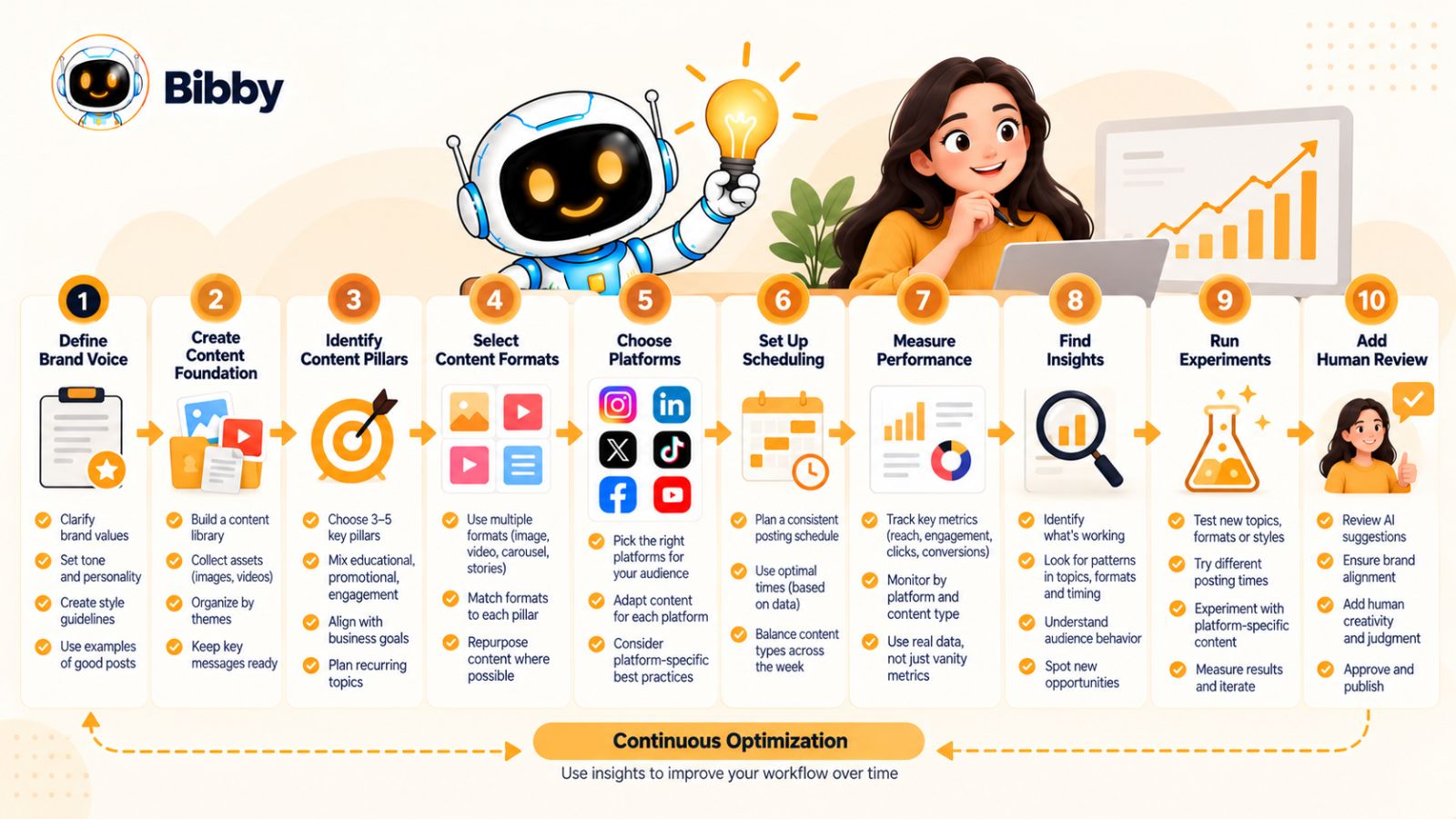
Step 1: Define your brand voice
Before automating content creation, establish what the brand should sound like.
Define things such as:
- Tone
- Vocabulary
- Writing style
- Topics you want to own
- Topics you avoid
- Audience
- Positioning
- Content principles
This becomes particularly important when AI is generating captions or content ideas.
Automation without a clear brand voice can produce a large amount of content that feels interchangeable.
Step 2: Build a reusable brand and content foundation
Give the system enough context to understand what it is creating.
That might include:
- Brand assets
- Visual guidelines
- Product information
- Target audiences
- Content pillars
- Key messages
- Previous successful content
A reusable foundation means you don't have to explain the same context every time you create a new post.
It also makes automation more consistent.
Step 3: Create multiple content pillars
Don't build an entire social media strategy around one type of post.
Instead, establish several recurring themes.
For example:
Education
Teach the audience something useful.
Authority
Demonstrate expertise and point of view.
Community
Create opportunities for conversation.
Product
Explain what you offer and why it matters.
Storytelling
Share experiences, lessons, or behind-the-scenes content.
These pillars give an AI social media workflow boundaries to work within while leaving room for experimentation.
Step 4: Produce multiple formats
The same underlying idea can often become several different pieces of content.
A useful concept might become:
- A carousel
- A short video
- A single-image post
- A story
- A text-based post
This makes the content production system more flexible.
It also gives you something important to measure.
You can learn whether the audience responds differently to the same type of idea when its presentation changes.
Step 5: Distribute across relevant platforms
Cross-platform publishing shouldn't mean blindly copying and pasting.
Decide which platforms actually matter to your audience.
Then consider how each piece of content should be adapted.
A professional insight might become a detailed LinkedIn post.
The same idea could become a visual carousel on Instagram.
A concise version might become a short-form video.
The underlying idea stays consistent, while the presentation changes.
This is where social media automation can save significant operational time without requiring a completely identical experience on every platform.
Step 6: Automate scheduling and publishing
Once the content is ready, automate the repetitive distribution work.
A modern social media scheduling workflow can handle multiple posts, dates, platforms, and formats without requiring someone to manually publish every piece of content.
AI can also help make scheduling decisions based on historical performance rather than relying entirely on a fixed calendar.
But automation should still leave room for human review when the content is particularly important or sensitive.
Step 7: Measure meaningful outcomes
Don't track everything simply because it is available.
Decide which metrics actually matter for each content objective.
For example:
Awareness: reach, impressions, views
Engagement: comments, shares, saves
Traffic: clicks and qualified visits
Video: watch time and completion
Business outcomes: leads, conversions, revenue-related actions
The important thing is to connect the metric to the purpose of the content.
Step 8: Feed insights into future content decisions
This is the step that turns automation into a learning workflow.
Don't let analytics become a report that gets opened once a month and forgotten.
Ask:
- Which topics repeatedly performed well?
- Which formats worked?
- Which platforms responded?
- Which hooks attracted attention?
- Which posts generated meaningful actions?
- Which approaches consistently underperformed?
Then use those observations when planning the next content cycle.
Step 9: Keep experimenting
A system that only repeats what already worked can become predictable.
Reserve some portion of your content strategy for experimentation.
Test:
- New topics
- New hooks
- New formats
- New publishing windows
- Different creative styles
- Different platform adaptations
The goal is to balance exploitation—doing more of what appears to work—with exploration—discovering what might work next.
Step 10: Keep humans in the strategic loop
This is the final and most important step.
AI can help automate execution and identify patterns.
Humans still need to decide what those patterns mean for the business.
A useful division of responsibility looks something like this:
AI: Create, organize, schedule, analyze, recommend.
Human: Decide, approve, challenge, refine, and set direction.
That balance prevents two common problems.
The first is under-automation, where humans spend most of their time doing repetitive administrative work.
The second is over-automation, where the system produces enormous amounts of content without enough strategic oversight.
The strongest workflow sits between the two.
It uses automation to reduce friction, AI to increase the amount of useful work that can be done, and human judgment to keep the entire system pointed in the right direction.
Once that foundation is in place, the next question becomes much bigger: what happens when social media automation stops being primarily about calendars and starts becoming an adaptive content system?
What the Future of Social Media Automation Looks Like
The future of social media automation probably isn't about removing humans from the publishing process.
It's about removing the friction between an idea, its execution, and the lessons that come from the result.
The tools are already moving in that direction. Social media software is increasingly combining content creation, AI assistance, scheduling, publishing, analytics, and conversational interfaces.
The next evolution is connecting those capabilities into a system that can continuously improve.
From content calendars to content systems
A traditional content calendar answers:
What are we publishing, and when?
A more advanced content system needs to answer additional questions:
Why are we publishing it?
Who is it for?
What are we testing?
What happened after we published it?
What should change next time?
The calendar doesn't disappear.
It becomes one component of a larger system.
Instead of treating each month as a fresh planning exercise, the strategy can carry information forward from previous publishing cycles.
From scheduled posts to adaptive publishing
Scheduling will remain useful.
Businesses still need consistency, campaigns still need deadlines, and content still needs to go live at specific times.
But scheduling can become more flexible.
Rather than creating a calendar months in advance and treating it as fixed, future systems can increasingly adjust based on new information.
A strong-performing topic might earn additional content.
An underperforming format might be reduced.
A campaign might be extended if its audience response is strong.
A publishing window might change as audience behavior changes.
This doesn't mean every post should be decided at the last second.
It means the system can remain responsive instead of being locked into assumptions made weeks earlier.
From dashboards to conversations
Another major shift is happening at the interface level.
Traditional social media management often requires users to navigate dashboards, menus, calendars, filters, and separate tools.
Conversational interfaces offer a different model.
Instead of finding the right control, the user can describe the desired outcome.
For example:
“Create a campaign for our new product.”
Or:
“Turn these assets into ten social posts.”
Or:
“Show me which content themes performed best this month.”
Or:
“Regenerate these captions in our brand voice.”
The underlying software may still be performing many individual operations.
But the user doesn't have to think about every operation separately.
That makes social media software increasingly resemble an assistant rather than a collection of utilities.
From individual AI tools to integrated workflows
The early wave of AI tools often focused on individual capabilities.
One tool generates images.
Another writes captions.
Another creates videos.
Another schedules posts.
Another analyzes performance.
The next opportunity is integration.
When these capabilities operate as connected parts of the same workflow, information doesn't have to be manually transferred between systems as often.
An image can become a post.
The post can become a campaign.
The campaign can become a schedule.
The published content can produce performance data.
That data can inform future content.
The entire process starts looking less like a collection of tools and more like an operating system for social media.
From “create more content” to “learn what deserves to exist”
This may be the most important change.
AI makes content creation faster.
That creates an obvious temptation:
If we can create more, we should publish more.
But abundance doesn't solve a relevance problem.
If anything, it makes relevance more important.
When everyone can generate dozens of posts in minutes, the advantage shifts toward understanding which ideas are actually worth publishing.
That means future social media automation systems may become less focused on maximizing output and more focused on improving selection.
Which idea?
Which audience?
Which format?
Which platform?
Which timing?
Which objective?
And, after publishing:
What did we learn?
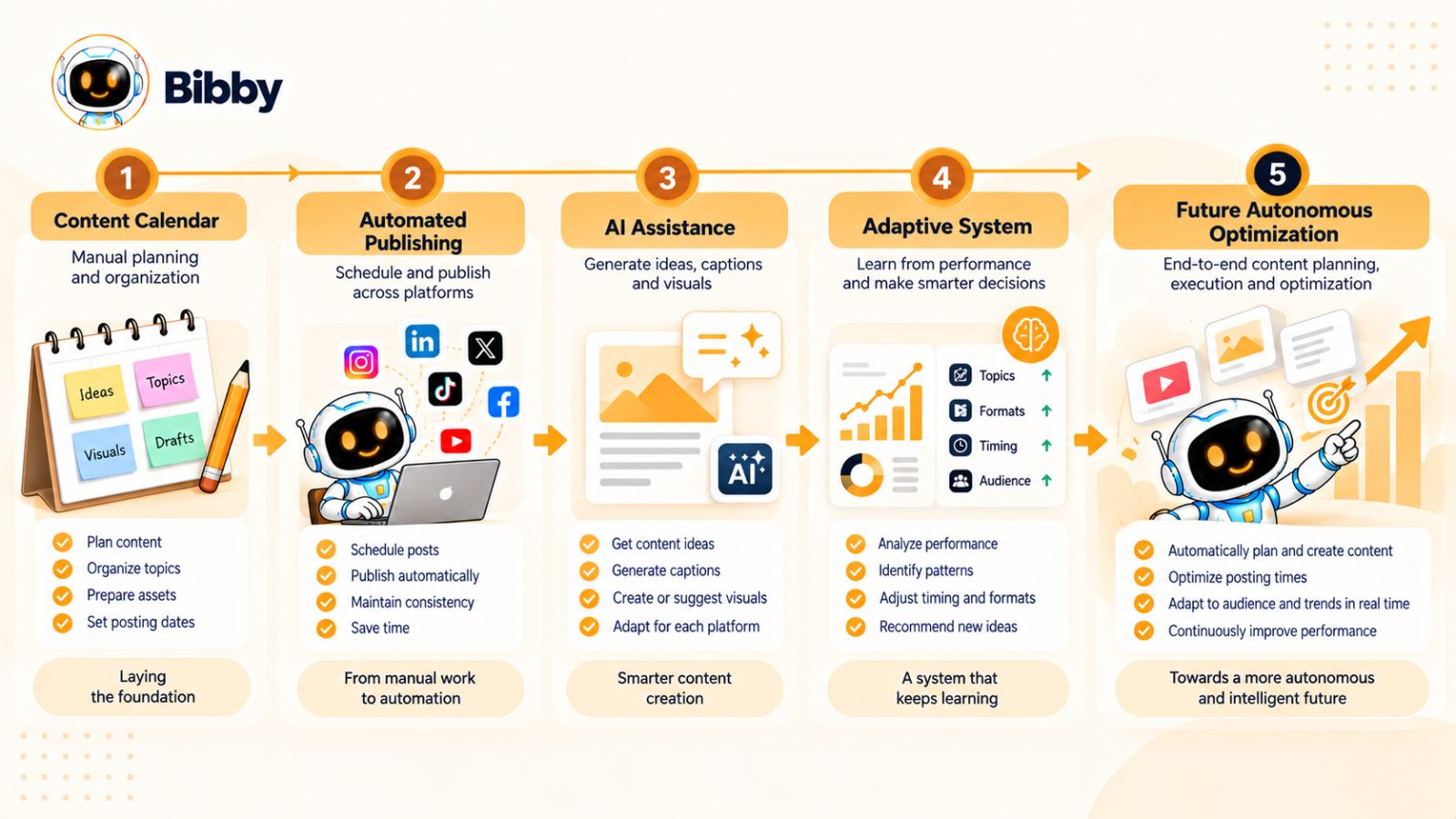
From automation to autonomous optimization
There is a natural progression here.
Stage 1: Scheduling
The system publishes what you tell it to publish.
Stage 2: AI assistance
The system helps you create and organize content.
Stage 3: Adaptive automation
The system uses historical information to improve recommendations and workflows.
Stage 4: Autonomous optimization
The system could eventually handle more decisions independently within clearly defined goals and boundaries.
That final stage is still a direction rather than a universal reality.
And it comes with significant challenges around measurement, brand safety, strategic judgment, and accountability.
But the direction is clear.
The long-term value of social media automation is unlikely to come from simply publishing faster.
It will come from building systems that can execute, observe, learn, and adapt.
And that raises an important practical question for anyone evaluating social media automation tools today: how do you tell the difference between a tool that simply automates tasks and one that is actually helping you build a smarter social media system?
Social Media Automation vs. AI Social Media Management vs. Traditional Scheduling
The terms social media scheduling, social media automation, and AI social media management are often used interchangeably.
They aren't quite the same thing.
Understanding the difference makes it easier to evaluate whether a tool is simply helping you publish content faster or actually helping you improve the way you manage social media.
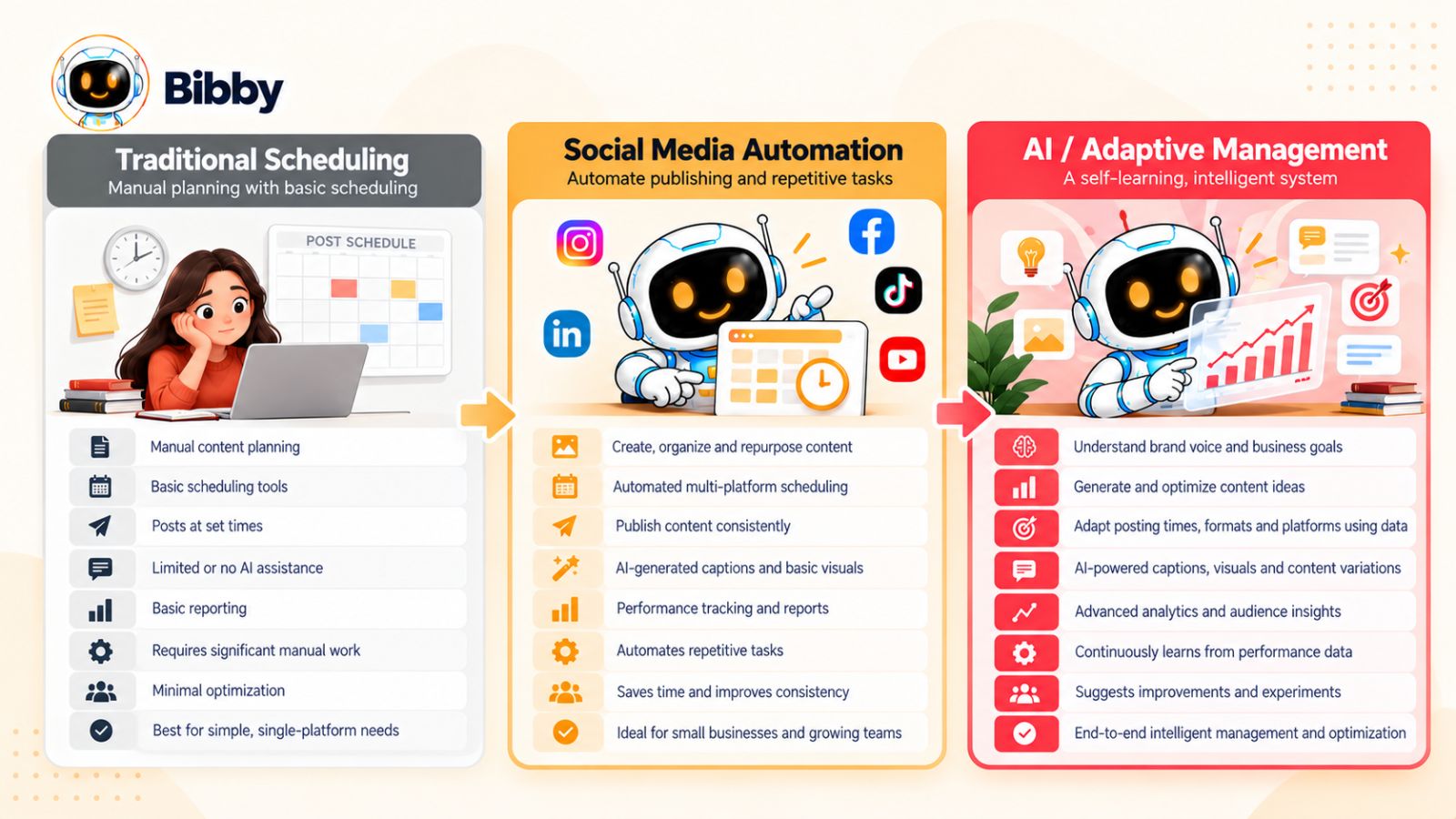
Traditional scheduling
Traditional scheduling is primarily about when content gets published.
You create the content.
You write the caption.
You select the platform.
You choose the date and time.
The scheduling tool handles publication.
This solves an important operational problem: you don't need to be available at the exact moment every post needs to go live.
But most of the strategic decisions still happen outside the scheduler.
Social media automation
Social media automation goes further.
Instead of automating only publication, it can connect multiple repetitive activities.
For example:
- Content organization
- Caption generation
- Post creation
- Scheduling
- Cross-platform publishing
- Content repurposing
- Workflow management
The objective is to reduce the amount of manual work required to maintain a consistent social presence.
Automation is therefore broader than scheduling.
But automation alone doesn't necessarily mean the system learns.
A workflow can be highly automated while still following the same instructions every time.
AI social media management
AI social media management adds another layer.
AI can assist with tasks that traditionally required more manual decision-making, such as:
- Generating content ideas
- Writing captions
- Creating visuals
- Repurposing content
- Analyzing performance
- Identifying patterns
- Suggesting publishing times
- Recommending future content
The system isn't simply following a predefined calendar.
It can help the user make decisions.
Adaptive or learning-oriented automation
This is the concept explored throughout this article.
An adaptive system connects publishing outcomes to future decisions.
It doesn't just ask:
“What should we publish?”
It can also ask:
“What have we learned from everything we've published so far?”
That creates a more continuous workflow.
| Capability | Traditional Scheduler | AI-Assisted Tool | Adaptive System |
|---|---|---|---|
| Schedule posts | ✓ | ✓ | ✓ |
| Generate captions | Limited | ✓ | ✓ |
| Generate content | Limited | ✓ | ✓ |
| Cross-platform publishing | ✓ | ✓ | ✓ |
| Analyze performance | Limited | ✓ | ✓ |
| Adapt future decisions | Limited | Partial | Core capability |
| Conversational management | Rare | Increasing | Increasing |
| Continuous optimization | Limited | Partial | Core concept |
The distinctions aren't absolute.
A modern platform can combine several of these capabilities, and the boundaries will continue to change as AI becomes more integrated into social media software.
The important thing is to look beyond the feature list.
Two tools can both advertise “AI scheduling” while offering very different experiences.
One may simply suggest a time based on a generic model.
Another may incorporate account-specific historical information.
One may generate captions as an isolated feature.
Another may connect caption generation to the brand's broader content workflow.
One may show analytics in a dashboard.
Another may use those insights to influence future recommendations.
That difference is ultimately more important than whether a tool has the word AI somewhere on its homepage.
The real question is:
Does the system merely automate what you already decided, or does it help you make better decisions over time?
How to Know Whether Your Social Media Automation Is Actually Getting Smarter
Calling a tool “AI-powered” doesn't necessarily mean it is learning from your social media activity.
A system can generate captions with AI, create images with AI, and schedule posts automatically while still operating as a collection of disconnected features.
If you're evaluating social media automation tools, the better question is not:
“Does this tool use AI?”
It's:
“Does the system become more useful as it learns more about my content, audience, and results?”
Here are the questions worth asking.
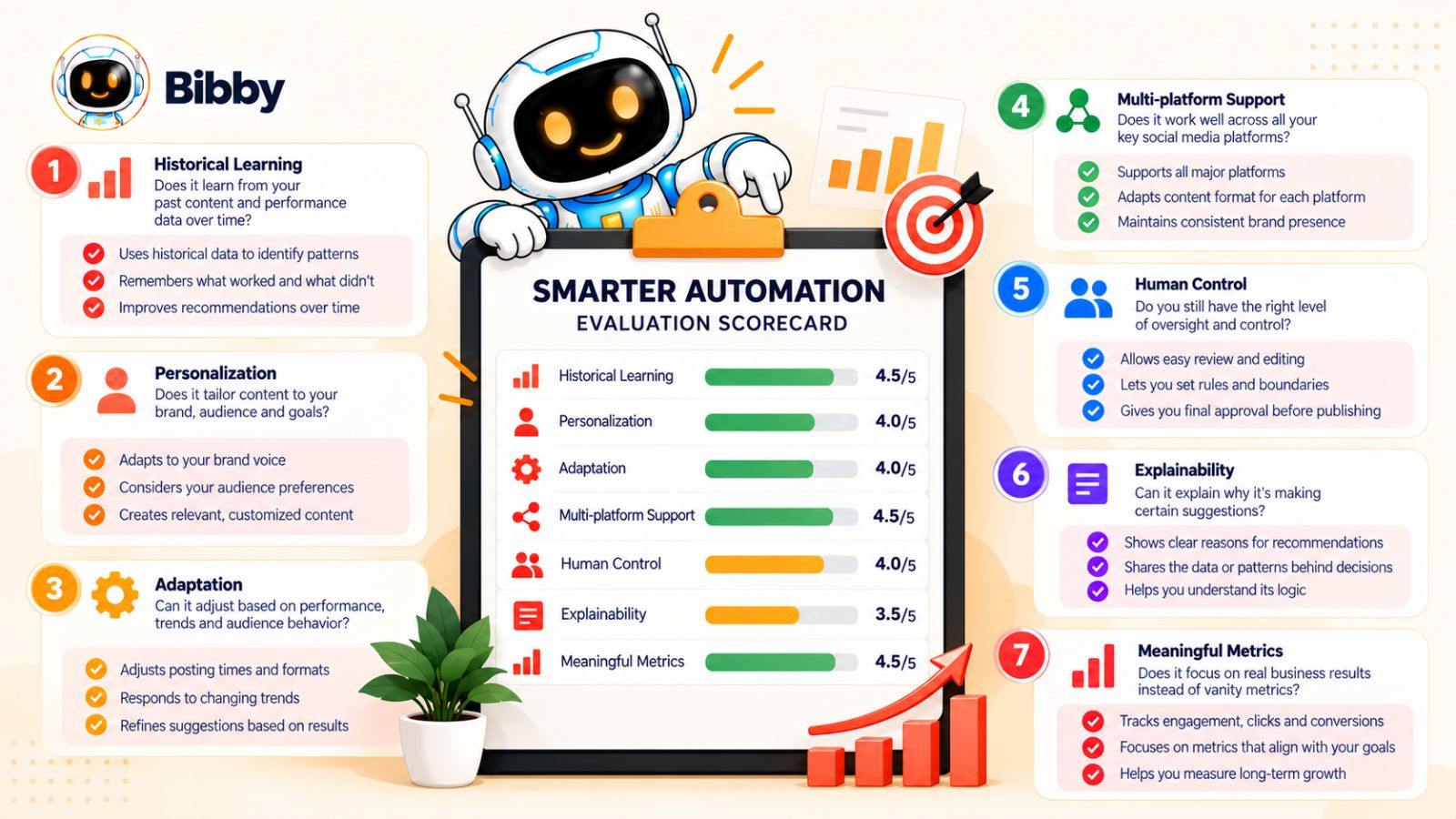
1. Does it learn from historical performance?
A genuinely intelligent workflow should have some way of using historical information.
That could include previous post performance, audience behavior, content formats, publishing patterns, or other relevant signals.
If every recommendation is identical regardless of what happened previously, the system isn't really taking advantage of the feedback loop.
2. Does it personalize recommendations?
Generic social media advice can be useful.
But your audience isn't generic.
A good system should increasingly be able to distinguish between broad industry patterns and what appears to work for your particular account.
For example, instead of simply recommending a universally popular posting time, it should ideally have a way to account for your historical audience behavior.
Personalization is what makes automation more useful than a collection of generic best practices.
3. Does performance influence future publishing decisions?
This is perhaps the most important question.
Ask what happens after a post performs well—or poorly.
Does that information disappear into an analytics dashboard?
Or can it influence future content recommendations, scheduling, formats, or experiments?
The difference is substantial.
Analytics tells you what happened.
A learning system can potentially use what happened to influence what happens next.
4. Can it adapt across platforms?
A modern social media strategy rarely lives on one platform.
But publishing everywhere doesn't mean publishing the exact same thing everywhere.
Look for workflows that allow content to be adapted for different platforms and formats.
The underlying idea might remain consistent while the presentation changes.
That can make cross-platform social media management much more efficient without turning it into copy-and-paste automation.
5. Can it handle multiple content formats?
A social media system shouldn't be limited to one type of post.
Depending on the business, the workflow may need to support:
- Images
- Carousels
- Videos
- Stories
- Text-based content
The ability to move between formats matters because performance often depends on how an idea is presented, not just what the idea is.
6. Can humans override its decisions?
More automation should not mean less control.
A useful system should allow humans to review, edit, reject, or change important decisions.
This is particularly important for brand-sensitive content, campaigns, announcements, and situations where context matters more than historical performance.
The strongest model isn't:
AI decides everything.
It's:
AI handles more execution and provides better information; humans retain strategic control.
7. Can you understand why it made a recommendation?
This is an increasingly important question.
If an AI system recommends a particular publishing time or content format, understanding the reasoning behind that recommendation can make it easier to evaluate.
For example:
“This format has consistently generated more saves for your educational content.”
is more useful than:
“AI recommends this format.”
The first gives you something you can question.
The second simply asks you to trust the system.
8. Does it optimize for meaningful outcomes rather than vanity metrics?
A system that learns to maximize likes can become very good at generating likes.
That doesn't necessarily make it good at marketing.
Before evaluating automation, define what success means.
It might be:
- Brand awareness
- Engagement
- Qualified traffic
- Leads
- Sales
- Community growth
- Thought leadership
The automation should support those objectives rather than optimizing whichever metric is easiest to increase.
The real test
Ultimately, the easiest way to evaluate an AI social media automation system is to look at the entire cycle:
Create → Publish → Measure → Learn → Adjust
If the system only helps with the first two steps, it's primarily an automation tool.
If it helps with the first four, it's becoming an AI-assisted management system.
If information from the entire cycle consistently influences future decisions, you're getting closer to the adaptive model described throughout this article.
That's the distinction worth paying attention to—not how many AI features a platform lists, but whether those features work together to make the overall system more useful over time.
Frequently Asked Questions About Social Media Automation
What is social media automation?
Social media automation is the use of software to automate repetitive social media tasks such as content scheduling, publishing, caption creation, content organization, and cross-platform distribution. Modern AI-powered systems can go further by helping with content creation, analysis, recommendations, and optimization.
How does AI social media automation work?
AI social media automation combines artificial intelligence with publishing workflows. Depending on the system, AI can help generate content and captions, organize posts, recommend publishing times, analyze performance, and use historical information to improve future decisions.
Can AI automatically create and schedule social media posts?
Yes. Some AI-powered social media platforms can generate captions and visuals, organize content, and schedule posts across multiple platforms. The amount of automation varies by tool, so important campaigns and brand-sensitive content should still receive human oversight.
What is the difference between social media scheduling and automation?
Social media scheduling primarily focuses on publishing content at predetermined times. Social media automation covers a broader set of repetitive tasks, including content creation, caption generation, scheduling, publishing, and workflow management.
Can AI learn from social media post performance?
It can, provided the system has access to relevant performance data and is designed to use that information. Historical performance can potentially help identify patterns involving topics, formats, platforms, audience behavior, and publishing times.
What is an AI social media manager?
An AI social media manager is a system that uses AI to assist with multiple parts of social media management rather than performing only one task. Depending on the platform, this can include content creation, campaign planning, caption writing, scheduling, publishing, analytics, and recommendations.
Is social media automation worth it for small businesses?
It can be, particularly when a small team spends significant time on repetitive publishing tasks. Automation can reduce manual work and make consistent publishing easier, while AI can help small teams produce and manage more content without requiring every task to be done manually.
Can one tool manage multiple social media platforms?
Many modern social media management tools support multiple platforms from one workflow. The exact platforms and supported formats vary, but the broader benefit is reducing the need to manage each social network independently.
What is the best way to automate social media posting?
Start by defining your brand voice, content pillars, target platforms, and business objectives. Then automate repetitive creation, scheduling, and publishing tasks while measuring meaningful results and using those insights to improve future content.
Will AI replace social media managers?
AI is more likely to change the role than eliminate it entirely. Automation can handle more repetitive execution, while humans remain important for strategy, creative direction, brand judgment, audience understanding, and decisions where context matters.
Conclusion: Social Media Automation Is Becoming a Learning System
Social media automation started with a simple promise: schedule your posts and save time. AI is expanding that promise into something much more powerful.
The most important shift is the feedback loop. When a system can connect creating, publishing, measuring, learning, and adapting, every post has the potential to contribute something to the next publishing decision. That doesn't mean AI should blindly copy whatever performed well yesterday. It means historical results can become evidence for making better decisions tomorrow.
The second shift is how we think about social media management. The goal isn't necessarily to publish more content or remove humans from the process. It's to automate repetitive execution while giving people more time for strategy, creativity, and judgment.
And the third shift is that social media tools are becoming increasingly integrated. Instead of separate tools for creation, captions, scheduling, publishing, and management, platforms such as Bibby illustrate a broader movement toward connected workflows and conversational social media management.
The next logical step is to stop thinking about social media as a collection of individual posts and start thinking about it as a system that continuously improves.
The natural question from here is: how do you actually build an AI-powered social media content system from scratch?