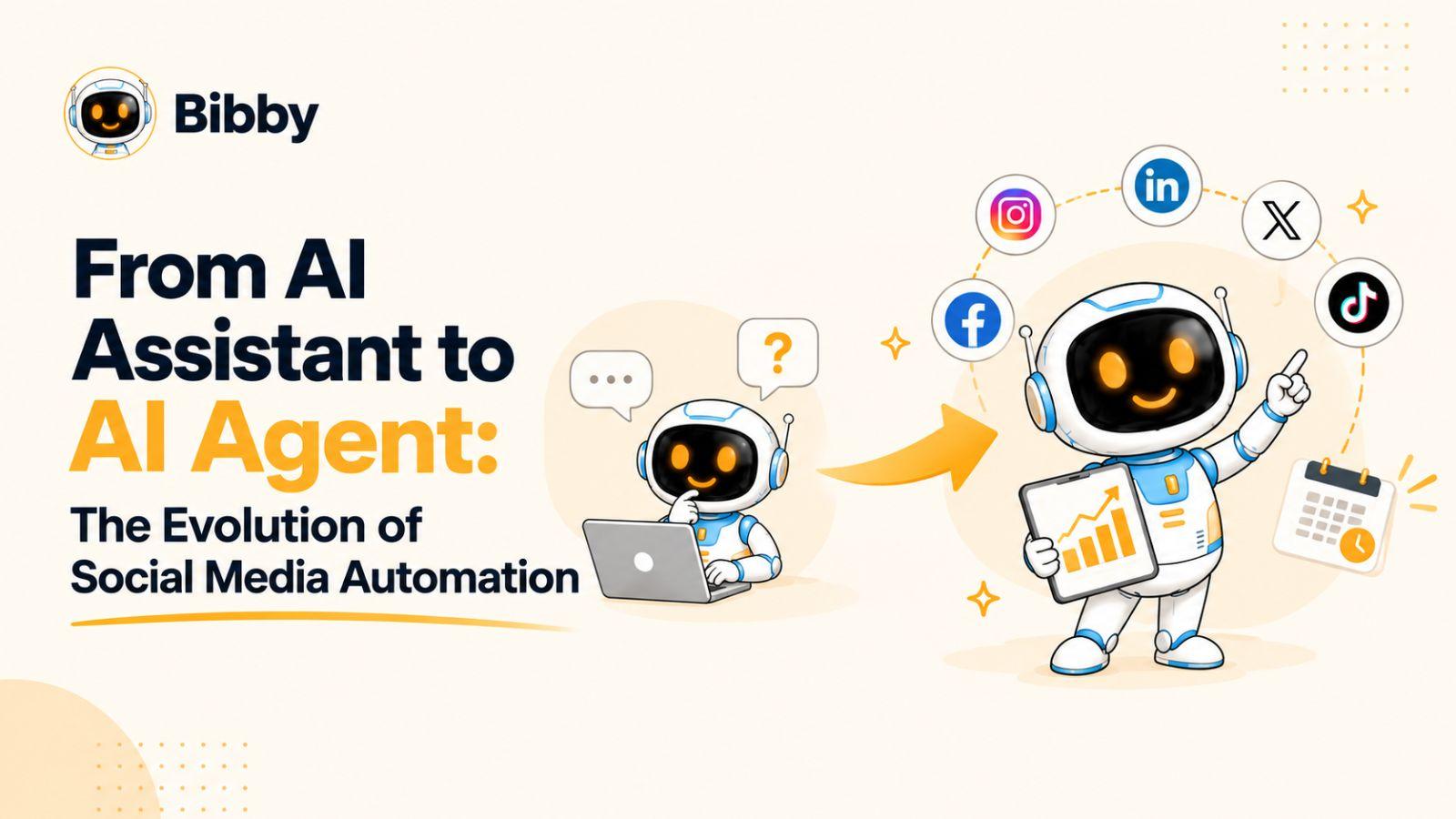
Social media automation has evolved from simple post scheduling into a much broader system for creating, managing, and distributing content across multiple platforms.
For years, automation meant preparing posts in advance and letting a scheduling tool publish them. AI changed that by introducing assistants that could write captions, generate ideas, and help with content creation—but the next shift is bigger: AI agents can increasingly handle entire social media workflows, from creating content and campaigns to scheduling and publishing it. The result is a move from telling software what to do at every step to giving an AI system an outcome and letting it manage the work.
Here we will look into:
- How social media automation evolved from scheduling to AI-powered execution
- The difference between AI assistants and AI agents for social media
- What the next generation of automated social media workflows looks like
The key to understanding where social media automation is going is to first understand how it got here.
What Social Media Automation Used to Mean
Before AI entered the social media workflow, automation was mostly about timing and repetition.
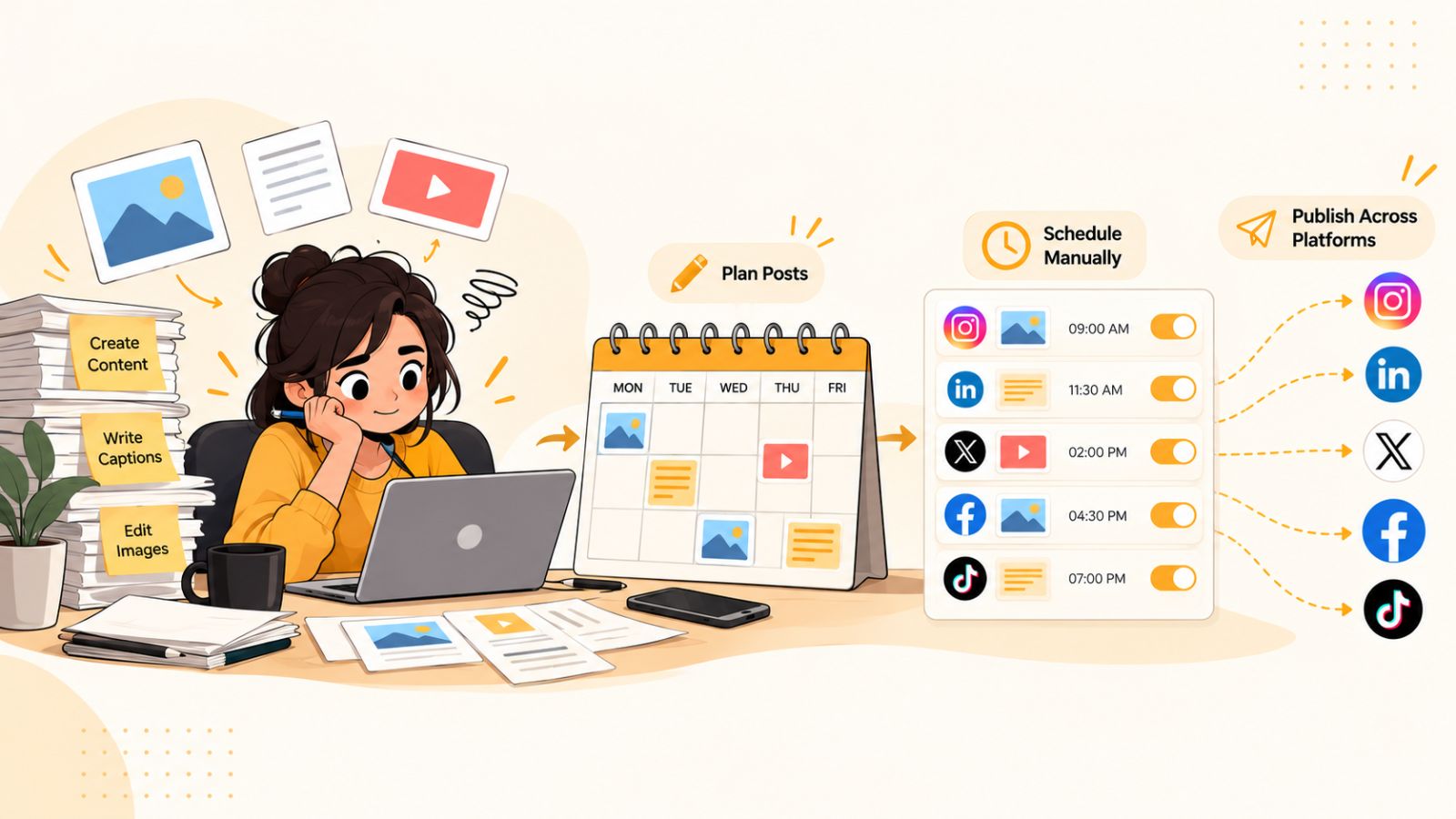
A social media manager could create a batch of posts, write the captions, choose the platforms, set publishing dates, and let a scheduling tool handle the distribution. Instead of manually publishing the same content every day, they could plan a week—or even a month—of content in advance.
That was a significant improvement. But it also revealed the basic limitation of traditional social media automation: the software could execute a workflow, but it generally could not create or manage the workflow itself.
Scheduling Was the Foundation
Traditional social media scheduling tools solved one of the most repetitive parts of social media management: publishing.
A typical workflow looked something like this:
Create content → write caption → select platform → choose date and time → schedule → repeat.
If a business wanted to maintain an active presence across Facebook, Instagram, LinkedIn, YouTube, or TikTok, the process became even more demanding. Each platform could require different formats, captions, dimensions, publishing requirements, and timing.
Automation reduced the publishing burden, but much of the decision-making remained manual.
The marketer still had to decide:
- What should be posted?
- Which creative should be used?
- What should the caption say?
- Which platforms should receive it?
- When should it be published?
- How should the content be adapted for each platform?
- What should be posted next?
The scheduling tool was essentially waiting for instructions.
The Problem With “Set It and Forget It”
The phrase “set it and forget it” captures the appeal of early social media automation—but also its limitations.
Scheduling 30 posts in advance could save hours of repetitive work, yet someone still had to produce those 30 posts. Someone had to write the captions, organize the content calendar, maintain brand consistency, and decide how the same campaign should appear across different channels.
In other words, automation removed manual execution without necessarily removing manual decision-making.
That distinction matters because social media management is not just a publishing problem. It is a continuous workflow involving strategy, creativity, production, distribution, and adaptation.
Traditional automation handled one part of that system particularly well: execution of predefined instructions.
The next generation of tools would begin tackling the work that came before those instructions.
That is where AI assistants entered the picture.
AI Assistant vs. AI Agent: What Actually Changed?
The difference between an AI assistant and an AI agent can seem subtle until you look at what each one is actually responsible for.
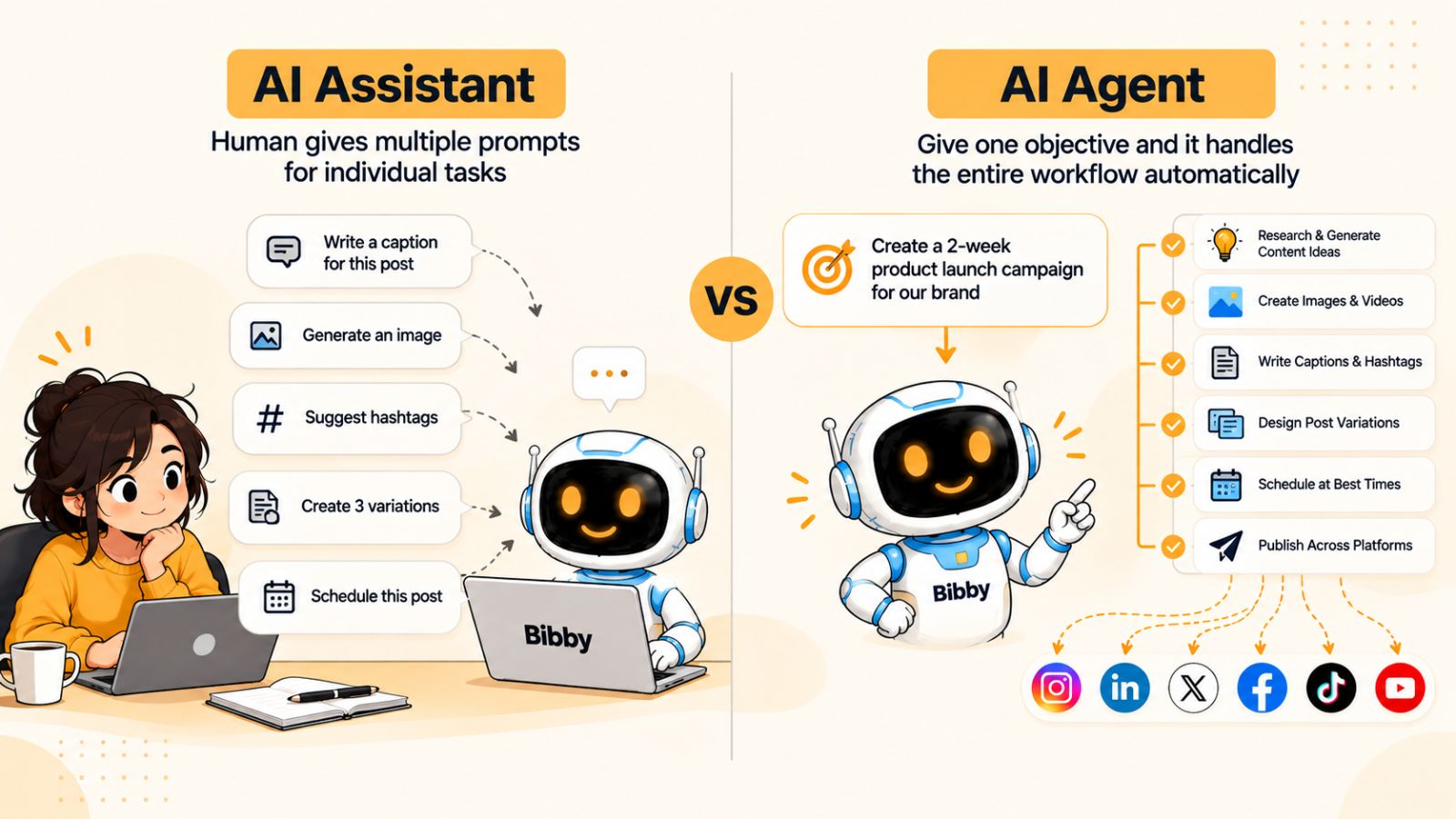
An AI assistant primarily helps you perform a task. An AI agent is designed to pursue an objective by coordinating multiple actions to complete that task or workflow.
That difference changes the role AI can play in social media automation.
An AI Assistant Responds to Instructions
An AI assistant is typically reactive.
You provide an instruction, the AI processes it, and it gives you an output.
For example:
“Write five Instagram captions for this product.”
The assistant generates the captions.
You review them, choose one, perhaps ask for another version, and then move to the next step.
The same pattern applies to content ideas, hooks, scripts, hashtags, or platform-specific copy. AI can make each individual task dramatically faster, but the human generally remains responsible for connecting those tasks together.
The workflow might look like this:
Ask → generate → review → ask again → generate → review → execute.
The AI is useful throughout the process, but the human remains the workflow coordinator.
An AI Agent Starts With an Objective
An AI agent operates at a different level.
Instead of asking:
“Write a caption.”
you might give it an outcome:
“Turn this campaign into a week of social media content and schedule it across my selected platforms.”
That objective contains multiple tasks.
The system may need to understand the campaign, work with the available creative assets, generate appropriate copy, determine which content belongs on which platform, organize the publishing schedule, and execute the resulting workflow.
The important change is not simply that the AI can perform more tasks.
It is that the AI can connect those tasks together around a larger goal.
A simplified comparison looks like this:
| AI Assistant | AI Agent |
|---|---|
| Responds to individual requests | Works toward a broader objective |
| Generates an output | Coordinates multiple actions |
| Often requires step-by-step prompting | Can manage a multi-step workflow |
| Helps with tasks | Helps execute processes |
| Human connects the steps | AI can connect the steps |
| Primarily reactive | More goal-oriented |
This does not mean every AI agent operates completely autonomously. In real-world social media management, human review can remain important, particularly for brand-sensitive, regulated, or high-stakes communications.
The meaningful shift is where the human's attention is required.
From Task Completion to Workflow Completion
Consider a simple social media campaign.
With an AI assistant, you might ask for:
- Ten content ideas.
- Captions for the selected ideas.
- Variations for LinkedIn.
- Shorter versions for Instagram.
- Video scripts for TikTok.
- A publishing calendar.
Each request is useful, but the human is still moving the project from one stage to another.
With an agentic workflow, the instruction could instead describe the desired outcome:
“Create and schedule a seven-day campaign around this product launch across my selected social channels.”
The system's job becomes understanding the sequence required to reach that outcome.
That is the deeper evolution of social media automation.
Why This Matters for Social Media
Social media is particularly suited to this transition because the work is inherently multi-step.
Creating a single post is only one part of the job.
A complete workflow might involve:
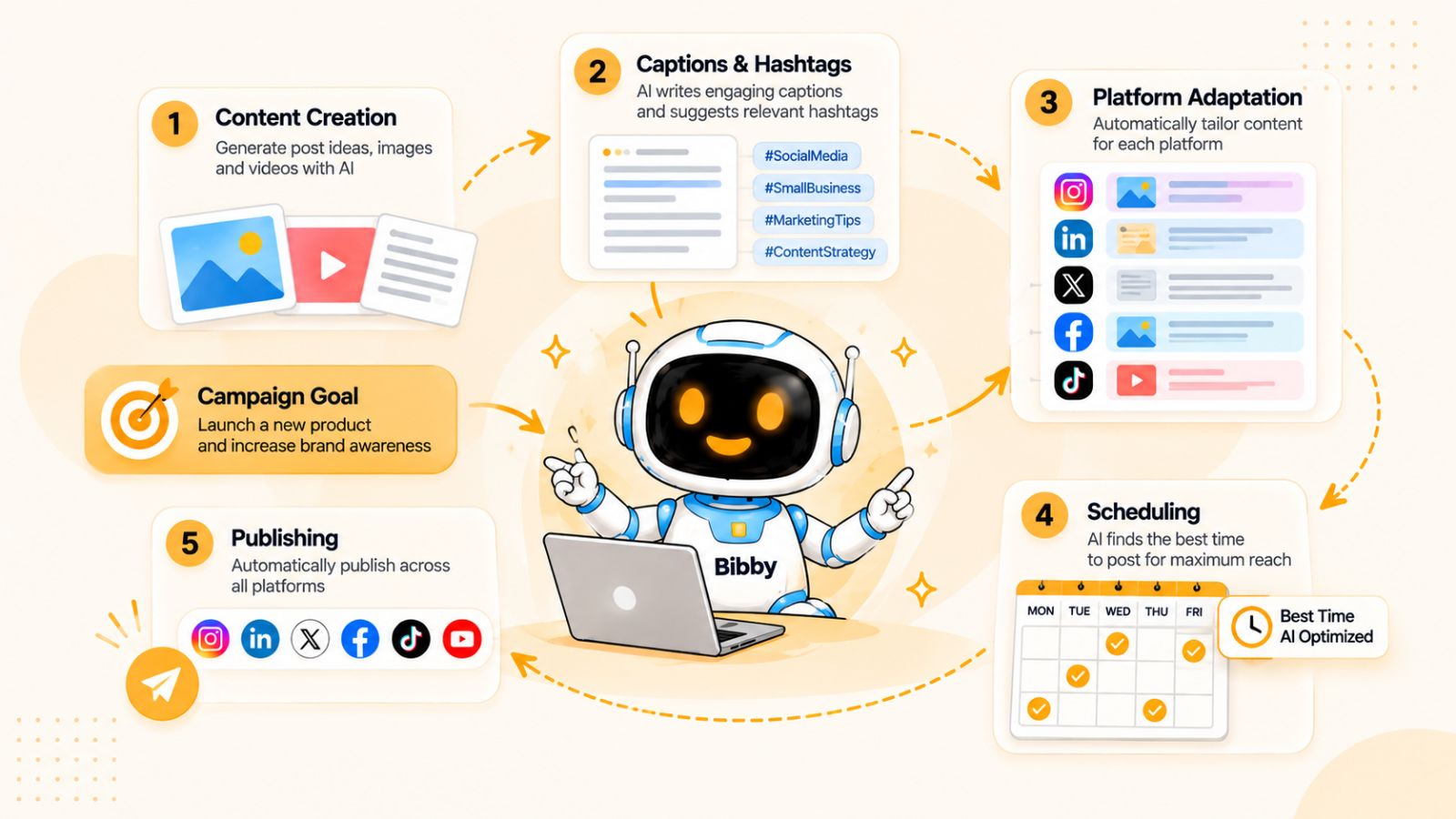
Idea → creative → caption → platform adaptation → scheduling → publishing → campaign management.
Traditional automation primarily handled the final stages.
AI assistants helped with individual stages throughout the workflow.
AI agents can potentially connect those stages into a single system.
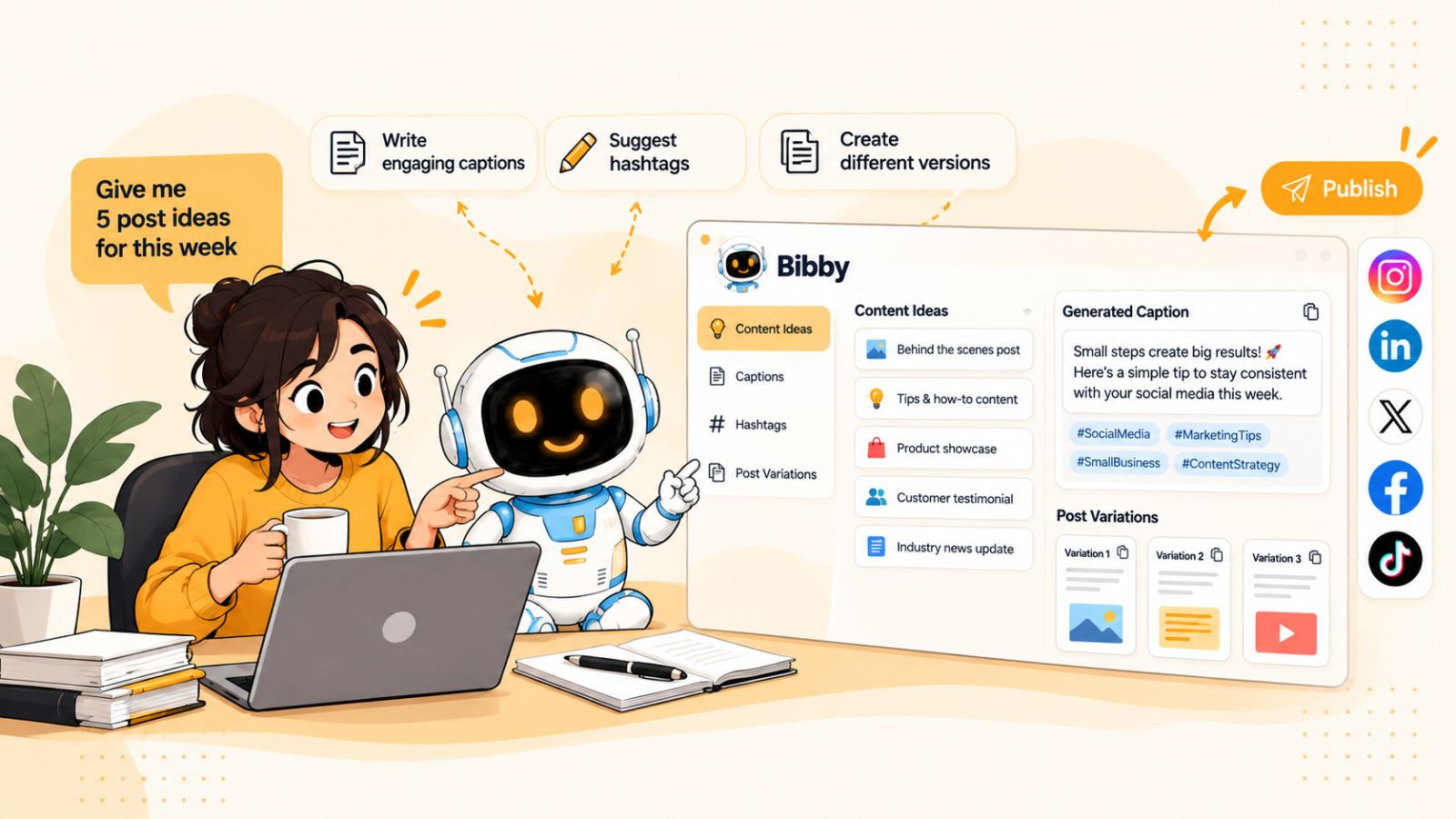
Tools such as Bibby illustrate this emerging model by combining content creation, caption generation, scheduling, multiple content formats, and cross-platform publishing within a single workflow. Its conversational interface also allows users to manage activities such as creating a brand kit, setting up campaigns, creating posts, and regenerating captions through chat rather than navigating each function independently.
The significance is not that one tool happens to combine several features.
It is that the unit of automation is changing.
Instead of automating a post, marketers can increasingly automate a process.
Instead of asking AI to perform one action, they can give AI enough context to help coordinate an entire workflow.
And instead of spending their time moving information from one tool to another, they can spend more of that time deciding what they actually want their social media to accomplish.
That is the foundation of the AI-agent approach to social media automation.
How AI Agents Are Changing Social Media Automation
The biggest change AI agents bring to social media automation is not simply better content generation. It is the ability to connect multiple social media tasks into a continuous workflow.
A marketer no longer has to think about content creation, captions, scheduling, and publishing as completely separate jobs. Increasingly, these activities can become parts of one coordinated process.
That changes what automation means.
From Individual Tasks to Complete Workflows
Traditional automation typically focuses on a specific action.
For example:
- Schedule this post.
- Publish this video tomorrow.
- Send this content to Instagram.
- Repeat this post next week.
AI-powered automation can operate at a higher level.
A user might start with an image, video, campaign idea, or piece of existing content and provide some context about what they want to achieve. The system can then help turn that starting point into multiple publishing actions.
The workflow becomes closer to:
Content → interpretation → creation → adaptation → scheduling → publishing.
This is particularly valuable for marketers managing several social networks because the amount of repetitive coordination grows with every additional platform.
One Campaign, Multiple Platforms
Social media platforms do not all work the same way.
A caption that works on LinkedIn may need a different tone on Instagram. A long-form idea might become a short video for TikTok. A visual campaign could require a carousel on one platform and a video or story on another.
That means cross-platform social media automation cannot simply mean publishing an identical post everywhere.
The more useful approach is coordinated adaptation.
An AI-driven workflow can take the central idea of a piece of content and help transform it into platform-appropriate variations while maintaining the underlying campaign message.
This creates a more scalable process:
One campaign → multiple content assets → multiple platforms → coordinated publishing.
The human still defines the campaign's direction and brand boundaries, while automation handles more of the repetitive execution.
Automating More Than Text
Another important development is that social media automation is no longer limited to written posts.
Modern workflows can involve multiple content formats, including:
- Images
- Carousels
- Videos
- Stories
- Short-form content
- Platform-specific variations
This matters because social media teams increasingly operate as content production systems rather than simple publishing departments.
A tool that can only schedule text posts solves one part of that problem. A system that can work with different media formats can participate in much more of the actual content workflow.
For example, a marketer might upload an image or generate a visual with AI, select a preferred posting style, and let the system help create captions and organize the content across different publishing dates.
The automation becomes less about when to publish one piece of content and more about how to distribute an entire collection of content.
AI-Optimized Scheduling
Scheduling is another area where the concept of automation is expanding.
Traditional scheduling requires the user to choose a date and time for every post or manually build a content calendar.
AI-powered scheduling can instead use available information and predefined goals to help determine when content should be published.
The objective is not simply to fill a calendar.
It is to reduce the amount of manual decision-making involved in managing that calendar.
For a marketer handling dozens of pieces of content across several platforms, that distinction can remove a substantial amount of repetitive work.
The exact value of AI-optimized timing will naturally depend on the data, audience, platform, and implementation behind the system. It should therefore be viewed as an automation capability rather than a guarantee of higher engagement.
Campaigns Become the Unit of Automation
Perhaps the most important change is the move from post-level automation to campaign-level automation.
A single post is relatively easy to manage manually.
A campaign might contain:
- Several creative assets
- Multiple messages
- Different content formats
- Multiple platforms
- Several publishing dates
- Different audience considerations
- Dozens of individual posts
Managing all of those pieces manually creates coordination overhead.
An AI agent can potentially treat the campaign as one connected objective rather than a collection of unrelated posts.
This is where the distinction between an AI assistant and an AI agent becomes practical.
The assistant helps you create the pieces.
The agentic system can help coordinate the pieces into a workflow.
The Social Media Manager Becomes the Director
This does not necessarily make the social media manager less important.
It changes where their time can be spent.
Instead of manually moving every post through the publishing process, they can focus more heavily on:
- Campaign strategy
- Brand positioning
- Creative direction
- Audience understanding
- Content quality
- Reviewing important outputs
- Measuring results
- Deciding what the brand should say next
The machine handles more of the operational workload.
The human remains responsible for the direction.
That is arguably the most meaningful evolution in social media automation: the goal is no longer simply to automate publishing. It is to automate enough of the workflow that humans can spend less time operating social media software and more time thinking about social media strategy.
What an AI-Powered Social Media Workflow Looks Like
The easiest way to understand the difference between traditional social media automation and an AI-powered workflow is to follow the process from beginning to end.
Imagine a business has a new campaign to promote. In a traditional workflow, the team might create the assets, write the copy, adapt the content for different platforms, build a publishing calendar, and then schedule every piece individually.
An AI-powered workflow can bring many of those steps together.
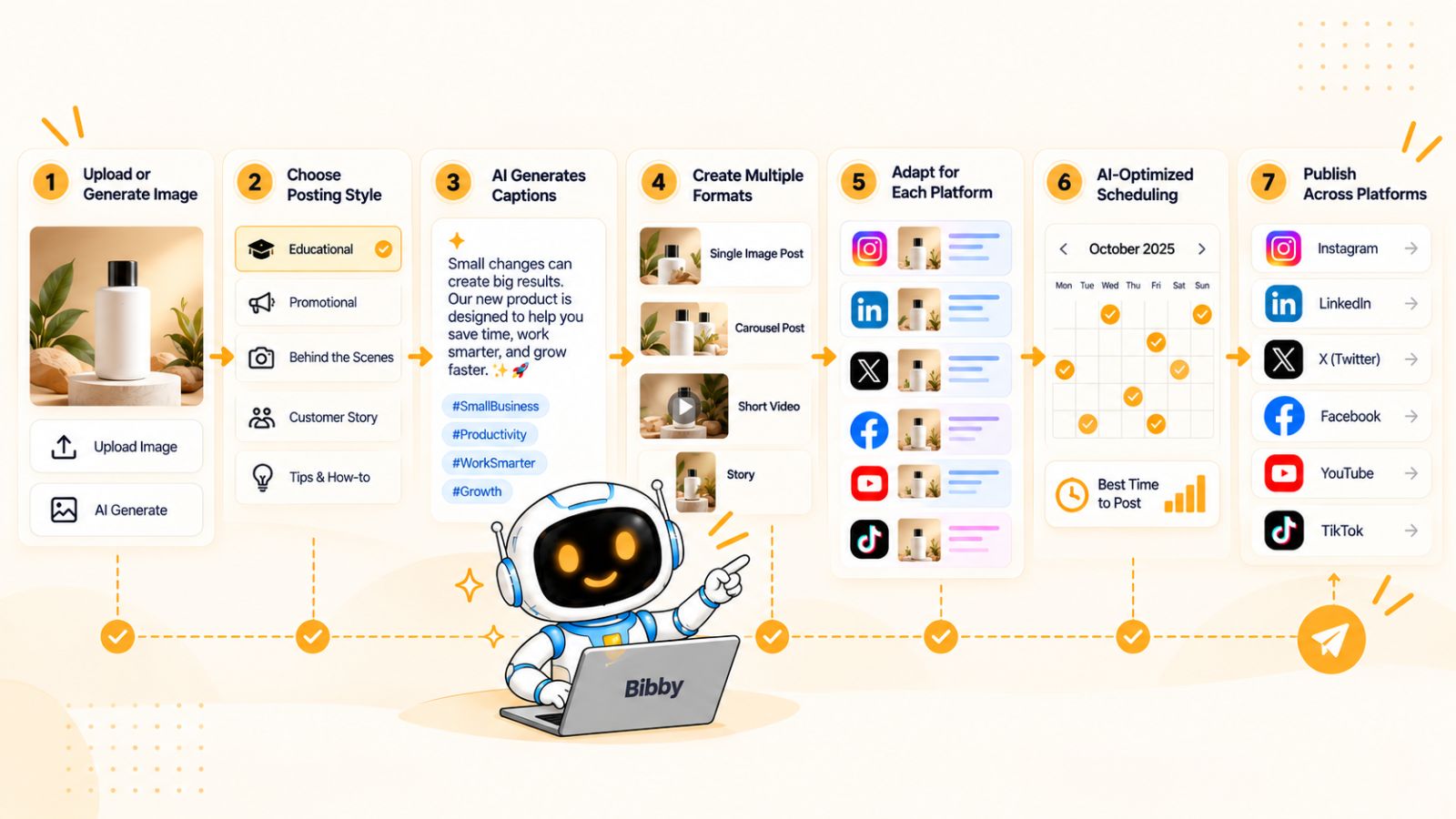
Step 1: Start With the Creative
The workflow can begin with something as simple as an image, video, product asset, or campaign idea.
The marketer might upload an existing image or use an AI image-generation capability to create a visual from scratch.
The important change is that the creative asset no longer has to be treated as the end of the content-production process. It becomes the starting point for a larger publishing workflow.
Step 2: Define the Posting Style
Once the creative is available, the system needs context.
A brand may want its social content to sound educational, conversational, playful, authoritative, concise, or promotional.
Giving the system a defined posting style helps connect automated content creation with the brand's broader communication approach.
This is one reason brand context matters so much in AI social media automation.
Without context, AI can generate technically acceptable content that still feels disconnected from the company behind it.
Step 3: Generate the Captions
The next step is turning the creative and its context into social media copy.
Instead of manually writing every caption, an AI system can generate captions based on the content, selected style, and intended platform.
The marketer can then review the output, make changes where necessary, or regenerate it.
This creates a much faster feedback loop:
Create → generate → review → refine.
The important distinction is that the caption is now being produced as part of the larger workflow rather than as an isolated task.
Step 4: Adapt the Content Across Platforms
The same campaign may need to appear on Facebook, Instagram, LinkedIn, YouTube, TikTok, or other selected channels.
But cross-platform publishing should not necessarily mean copying and pasting identical content everywhere.
Each platform has its own audience expectations, content formats, and communication patterns.
An AI-powered workflow can help transform the core campaign idea into appropriate versions for the selected channels.
The result is a coordinated campaign without requiring the marketer to manually rebuild every piece of content.
Step 5: Choose the Content Formats
Modern social media automation also needs to account for different types of media.
Depending on the campaign, the workflow might include:
- Single-image posts
- Carousels
- Videos
- Stories
- Short-form social content
This expands the scope of automation considerably.
The system is no longer simply deciding when a text-and-image post should be published. It is helping manage a broader content ecosystem.
Step 6: Build the Publishing Schedule
Once the content is prepared, the next challenge is distribution.
Instead of manually selecting a date and time for every individual post, an AI-powered system can organize the content across a publishing calendar and use AI-assisted timing to determine appropriate publishing slots.
For someone managing a large content library, this can eliminate a substantial amount of calendar management.
The marketer's role shifts from entering dozens of individual scheduling instructions to reviewing the overall publishing plan.
Step 7: Publish Across Selected Channels
The final execution layer is distribution.
The system can take the prepared content and publish it to the selected social platforms according to the schedule.
This is where traditional scheduling software has historically been strongest.
The difference is that, in an agentic workflow, scheduling and publishing are no longer necessarily isolated from the earlier creative steps.
They are connected to the same process.
Step 8: Manage the Workflow Conversationally
The most interesting development may be what happens when the entire workflow becomes accessible through conversation.
Instead of navigating through separate dashboards for different tasks, a marketer can interact with an AI-powered social media system more like a colleague.
For example:
“Create a brand kit for this business.”
“Create a campaign around our new product.”
“Turn these images into posts.”
“Regenerate the captions with a more educational tone.”
“Schedule the campaign across my selected platforms.”
A conversational interface such as the one available in Bibby illustrates this direction. Its chat-based workflow allows users to perform tasks such as creating brand kits, creating campaigns and posts, and regenerating captions without treating each capability as an entirely separate workflow.
The significance goes beyond convenience.
A conversational interface can make the goal the primary interaction rather than the software's menu structure.
The New Workflow
Put the entire process together and the difference becomes clearer:
Traditional workflow:
Create → write → adapt → schedule → publish
with a human manually coordinating almost every transition.
AI-powered workflow:
Provide creative and context → AI assists with creation and adaptation → AI organizes the publishing workflow → human reviews and directs → system executes.
That is the broader evolution from social media scheduling to social media automation.
The software is moving from being a place where marketers put posts on a calendar to becoming a system that can help coordinate the work required to get an entire campaign from an idea to publication.
From Social Media Scheduling to Social Media Orchestration
For a long time, social media scheduling was treated as the destination of automation.
Create the content, choose a date, schedule the post, and move on.
That model still has value. Scheduling removes repetitive publishing work and gives marketers more control over their content calendars. But as social media strategies become more complex, scheduling represents only one part of the problem.
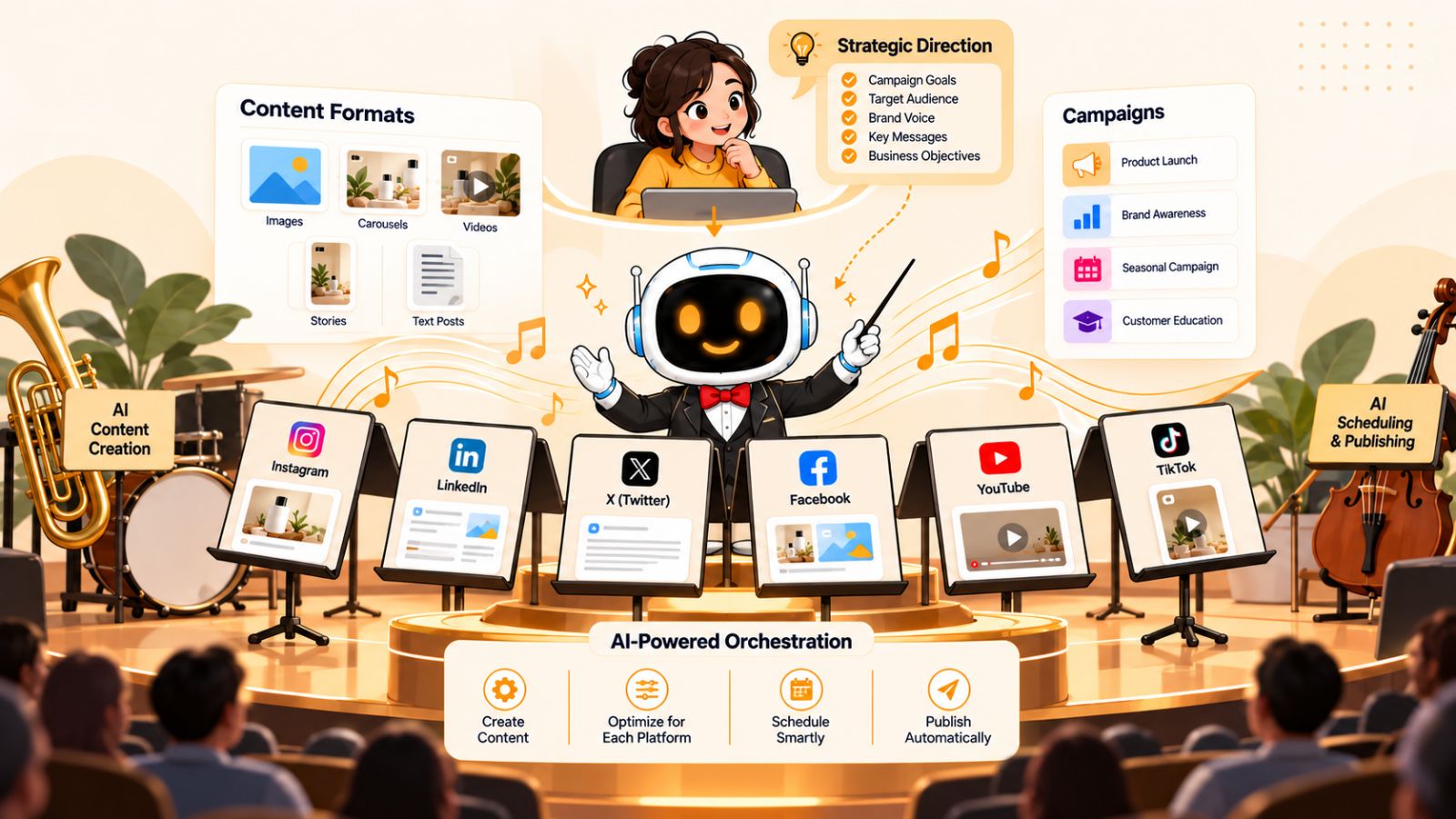
The bigger challenge is orchestration.
Orchestration means coordinating multiple moving parts so they work together as one system.
Scheduling Solves the “When”
A scheduling tool primarily answers one question:
When should this content be published?
But a modern social media workflow has many other questions:
- What should we publish?
- What creative should we use?
- Which platforms should receive it?
- How should the message change between platforms?
- Which format should we use?
- How many posts belong to this campaign?
- How should the content be distributed over time?
- Does the content match the brand?
- What should happen after the campaign is created?
Once you look at social media this way, scheduling becomes one component inside a much larger system.
Orchestration Connects the “What,” “Where,” and “When”
AI-powered social media automation can potentially connect these decisions.
A campaign might begin with a single idea or collection of creative assets.
From there, the workflow can expand into multiple pieces of content, each adapted for different platforms and formats, and then organized across a publishing calendar.
The underlying structure looks something like:
Campaign goal → content → platform adaptation → format → schedule → publication
Instead of treating each step as an independent operation, orchestration connects them.
That distinction becomes increasingly important as a business adds more social channels.
One Brand, Many Social Networks
Managing one platform manually is relatively straightforward.
Managing five or six platforms is a different problem.
Facebook, Instagram, LinkedIn, YouTube, and TikTok can all play different roles in a content strategy. They also have different formats and audience behaviors.
A single campaign might therefore require:
- A professional explanation for LinkedIn
- A visual-first post for Instagram
- A community-oriented version for Facebook
- A longer video for YouTube
- A short-form video for TikTok
The campaign remains the same, but its execution changes.
AI can help bridge that gap by working from the central idea rather than requiring the marketer to recreate every asset independently.
Why Cross-Platform Automation Is More Difficult Than It Looks
Simply publishing the same content everywhere is not the same as having a cross-platform strategy.
Good automation needs to preserve the core message while allowing the presentation to change.
That requires context.
The system needs to understand the campaign, the brand, the intended audience, and the characteristics of the destination platform.
This is one reason AI agents have the potential to be more useful than simple rule-based automation.
Rules can tell software:
“Publish this post to these five platforms at 9 a.m.”
An AI-driven system can potentially work with a higher-level instruction:
“Distribute this campaign across our selected platforms while adapting the content to each channel.”
The second instruction describes an outcome rather than a sequence of clicks.
The Content Calendar Becomes Dynamic
Traditional content calendars are often built manually.
A marketer decides what to publish, assigns dates, and adjusts the calendar whenever something changes.
An AI-powered system can make the calendar more dynamic.
New content can be added to an existing campaign. Captions can be regenerated. Publishing times can be adjusted. A campaign can be expanded or modified without necessarily rebuilding the entire calendar from scratch.
This is especially useful when social media activity is frequent.
The more content a brand produces, the more valuable coordination becomes.
From Tool Collection to Workflow
This evolution also changes how marketers think about their software stack.
Historically, a social media workflow might involve separate tools for:
Design → copywriting → AI generation → scheduling → publishing → campaign management
Each tool can be useful, but the marketer becomes the integration layer connecting them.
That creates friction.
Every time content moves from one system to another, someone—or something—has to carry the context with it.
The promise of agentic social media automation is to reduce that fragmentation by bringing more of the workflow into one connected environment.
The objective is not necessarily to eliminate every specialized tool.
It is to reduce the amount of manual coordination required between them.
The Real Shift: From Automation to Delegation
This is ultimately why the evolution from scheduling to orchestration matters.
Automation says:
“I have already decided what needs to happen. Make it happen automatically.”
Delegation says:
“Here is the outcome I want. Help manage the work required to get there.”
That is a much bigger change.
It moves social media software closer to the role of an operational partner rather than a digital calendar.
And as AI becomes better at understanding context, maintaining brand information, creating content, and executing multi-step workflows, the distinction between a social media tool and an AI-powered social media manager becomes increasingly important.
The Conversational Social Media Manager
The evolution of social media automation is not only changing what software can do. It is also changing how people operate it.
For years, using social media management software meant learning its interface. You opened a dashboard, found the content calendar, selected a platform, uploaded an asset, entered a caption, chose a time, and repeated the process.
AI introduces another possibility: conversation as the interface.
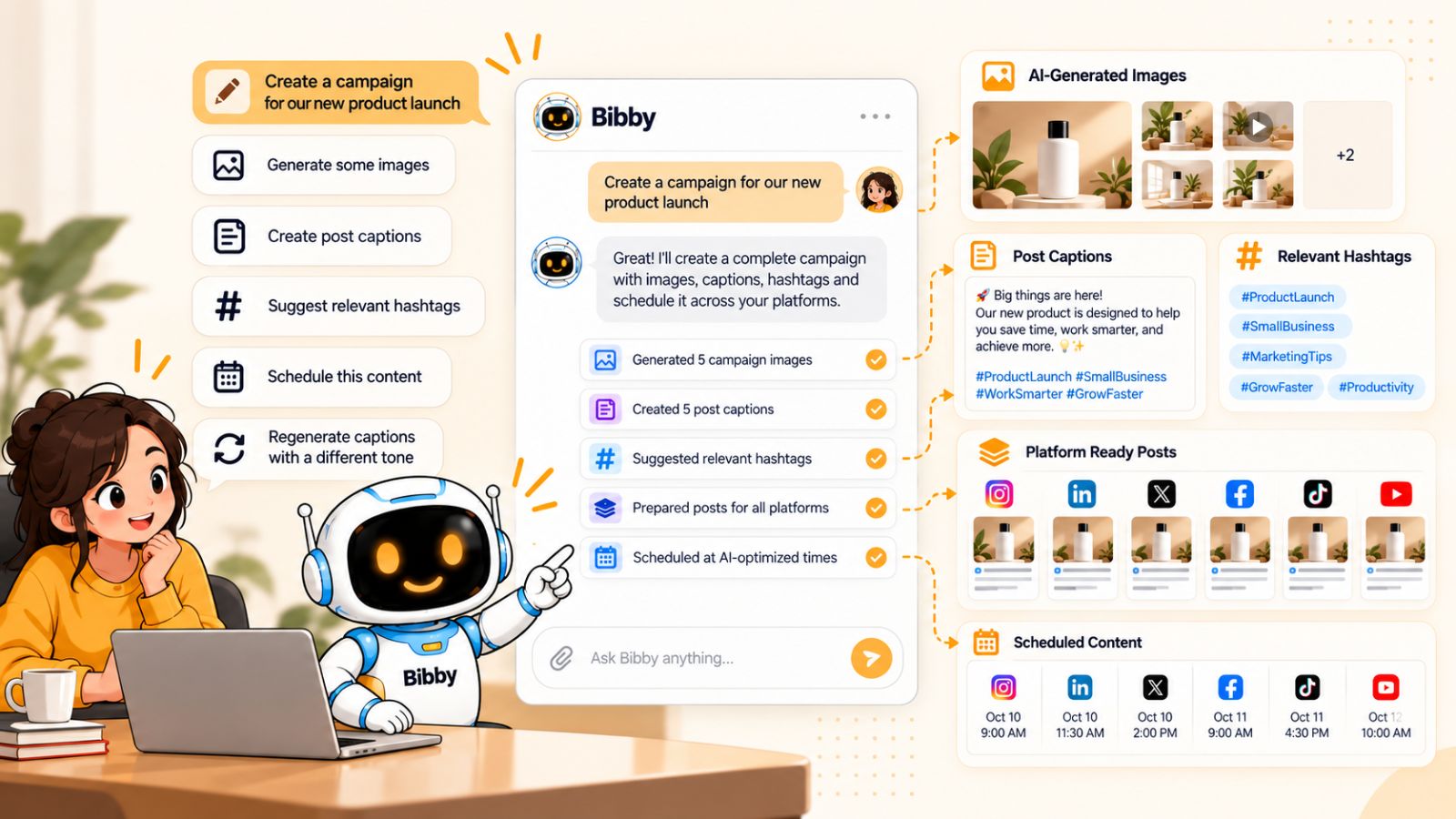
Instead of learning where every function lives, users can increasingly describe what they want in natural language.
From Clicking Buttons to Giving Instructions
Consider the difference between these two workflows.
In a traditional interface, creating a campaign might involve navigating through several screens:
Campaigns → New Campaign → Add Content → Select Platforms → Write Captions → Schedule → Review
In a conversational interface, the same intention could begin with:
“Create a campaign for our new product launch and prepare posts for our selected platforms.”
The underlying tasks still need to happen. The difference is that the user is describing the objective rather than manually coordinating every step.
This is one of the defining characteristics of agentic software.
Conversation Becomes the Control Layer
A capable conversational social media system can act as a control layer across different functions.
Instead of opening separate sections for different tasks, a marketer can use the same interaction to move between them.
For example:
“Create a brand kit using these assets.”
Then:
“Use that brand style for a new campaign.”
Then:
“Create social posts from these images.”
Then:
“Regenerate the captions and make them more conversational.”
Then:
“Schedule the campaign across Instagram, Facebook, LinkedIn, YouTube, and TikTok.”
The conversation provides continuity between the instructions.
That continuity is important because social media tasks are rarely isolated. The campaign created in one step should influence the posts created in the next. The brand kit should influence the captions. The selected platforms should influence the content variations.
Managing a Brand Through Context
One of the biggest challenges in AI-generated social media content is consistency.
A brand is more than a logo and a color palette.
It has a voice, audience, positioning, vocabulary, personality, and set of communication preferences.
An AI system that understands this context can produce more consistent outputs than one receiving a completely new prompt for every post.
This is where a brand kit can become more than a design feature.
It can provide AI with persistent context about how a business wants to present itself.
The marketer does not have to repeatedly explain:
“Make this sound like our brand.”
The system can work from the context already established.
Chat Makes Iteration Faster
Another advantage of a conversational workflow is the speed of iteration.
Social media content rarely comes out perfectly on the first attempt.
A marketer might want a caption to be:
- Shorter
- More educational
- Less promotional
- More conversational
- More direct
- Better suited to a particular platform
With a traditional workflow, changing the content may involve opening the post, editing it manually, saving it, and potentially repeating the process across multiple versions.
In a conversational environment, the interaction can be much simpler:
“Make the caption less promotional.”
“Give me three alternatives.”
“Keep the same idea but make it suitable for LinkedIn.”
“Regenerate this with a stronger opening.”
The software becomes something the marketer can collaborate with rather than simply operate.
Bibby and the Conversational Workflow
This is also where tools such as Bibby demonstrate how the category is evolving.
Bibby's chat interface allows social media tasks to be managed conversationally, including creating a brand kit, creating campaigns and posts, and regenerating captions. Rather than treating these capabilities as disconnected features, the chat experience brings them into the same interaction.
That does not mean conversation automatically makes a tool an AI agent.
The more important question is whether the system can use context, connect multiple actions, and move toward a broader objective without requiring the user to manually orchestrate every step.
Conversation is simply a more natural interface for that kind of workflow.
The Social Media Manager as a Director
This creates a different relationship between humans and social media software.
The marketer becomes less of an operator and more of a director.
They define:
What are we trying to achieve?
Who are we speaking to?
What should the brand sound like?
What campaign are we running?
Which channels matter?
The AI system can then take responsibility for more of the operational work.
That does not eliminate the need for human judgment.
In fact, as more execution becomes automated, strategic judgment becomes more important. Someone still needs to decide whether the campaign is worth running, whether the message is appropriate, whether the content represents the brand accurately, and whether the final output should be published.
The interface may become conversational, but the relationship remains collaborative.
From Software Literacy to Intent Literacy
There is a broader implication here.
Traditional software rewards people who learn the interface.
AI-powered software increasingly rewards people who can clearly express an objective.
That means the valuable skill is shifting from knowing which button to press toward knowing what outcome to ask for.
For social media professionals, this could become one of the most important changes brought by AI.
The future social media manager may spend less time learning the mechanics of publishing software and more time learning how to give AI the right context, constraints, goals, and feedback.
The interface gets simpler.
The work behind the interface becomes more sophisticated.
AI Agents and the Future of Social Media Content Creation
The evolution of social media automation is gradually changing the boundary between content creation and content distribution.
In the past, these were usually treated as separate activities. A creative team produced the content, a copywriter prepared the messaging, and a social media manager scheduled and published the finished assets.
AI is beginning to connect those stages.
Instead of thinking about content creation and social media management as two separate workflows, businesses can increasingly treat them as parts of the same system.
Content Creation and Distribution Start to Converge
Consider a typical campaign.
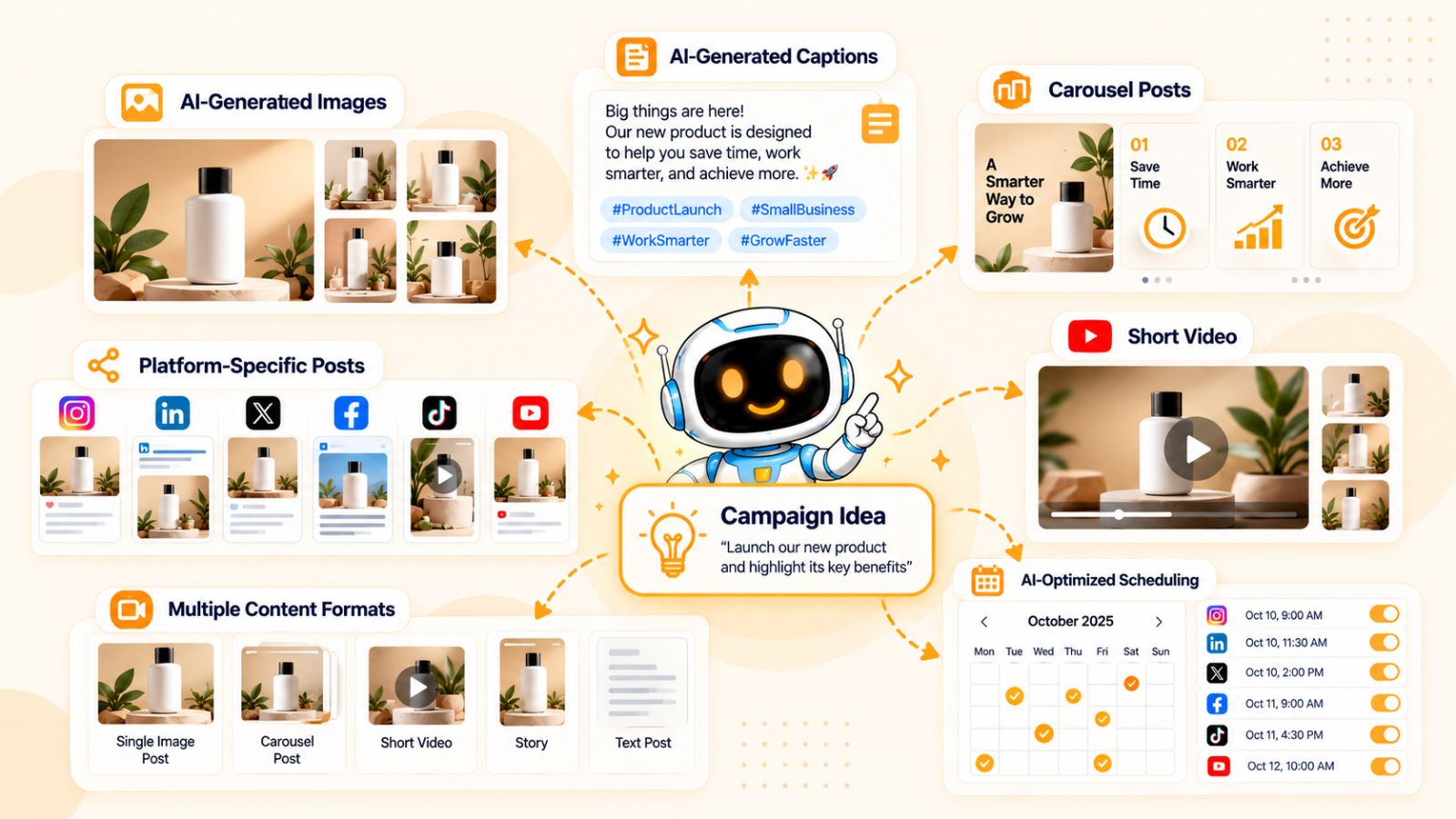
Someone has an idea for a product announcement. That idea needs to become a visual, a caption, several platform-specific versions, and eventually a publishing schedule.
Historically, each stage might have belonged to a different tool or person.
AI can increasingly assist across the entire chain.
A workflow could begin with:
Campaign idea → AI-generated creative → captions → platform variations → scheduling → publishing
The significance is not that AI can generate any one of these assets.
It is that the same system can potentially maintain context while moving between them.
That reduces the friction between creating content and distributing it.
AI-Generated Visuals Become Part of the Workflow
Image generation adds another dimension to social media automation.
Previously, automation generally assumed that the creative asset already existed.
AI image generation changes that assumption.
A marketer can start with a concept rather than a finished image and use AI to create a visual that can then become part of the social publishing workflow.
This creates a much shorter path between:
“We need content about this idea.”
and
“Here is the content ready for distribution.”
The quality and suitability of AI-generated creative will still depend heavily on the prompt, brand context, creative direction, and human review. But the production bottleneck can be substantially different when generating an initial asset no longer requires starting with a blank design canvas.
Repurposing Becomes More Scalable
Another major opportunity is Content repurposing.
A single piece of source material can contain enough information to create multiple social assets.
For example, a long-form article could become:
- A LinkedIn post
- An Instagram carousel
- Several short social posts
- A video concept
- A series of visual posts
- Short-form video scripts
Traditionally, repurposing required someone to manually identify the useful ideas and rewrite them for each channel.
AI can accelerate that process.
The agentic approach takes this one step further by connecting repurposing with distribution.
Instead of simply asking AI:
“Turn this article into five posts.”
a marketer could eventually work at the campaign level:
“Turn this article into a week's worth of social content and organize it across our selected channels.”
The distinction is subtle but important.
The first request produces content.
The second describes a workflow.
Brand Consistency Becomes More Important
As content production becomes easier, another problem becomes more visible: content volume can increase faster than content quality.
A business can potentially generate dozens of captions and creative variations very quickly.
But more content does not automatically mean better communication.
Without clear brand guidelines, AI-generated content can become repetitive, generic, inconsistent, or disconnected from the company's actual voice.
This makes brand context increasingly important.
AI agents need more than access to content-generation capabilities. They need useful information about the brand they are working for.
That can include:
- Brand voice
- Visual identity
- Audience
- Positioning
- Products and services
- Preferred terminology
- Content preferences
- Topics to avoid
The more context the system can use appropriately, the more useful automation can become.
Campaigns Could Become More Adaptive
Traditional campaigns are often planned in advance.
The marketer decides what will be published, when it will be published, and how the campaign will unfold.
AI agents could make campaigns more flexible by making it easier to modify the workflow as circumstances change.
A marketer might decide to:
- Add another post to a campaign
- Change the tone of upcoming content
- Regenerate several captions
- Introduce a new creative asset
- Extend the campaign
- Adapt content for another platform
The key is not that AI independently decides the entire marketing strategy.
Rather, the system can make changes to an existing workflow easier to execute.
That distinction keeps human strategy at the center while allowing automation to handle more operational complexity.
The Role of the Social Media Professional Changes
As AI takes on more repetitive production and distribution work, the social media professional's responsibilities can shift.
Less time may be spent on:
Copying → formatting → uploading → scheduling → repetitive adaptation
and more time can be spent on:
Strategy → creative direction → audience understanding → brand development → experimentation → analysis
This is not necessarily a simple replacement story.
Social media still depends heavily on human understanding.
Trends can be contextual. Humor can be culturally specific. Brand decisions can involve nuance. Public responses can require empathy and judgment.
AI can accelerate production, but the quality of the underlying strategy still matters.
The Future May Be About Delegating Outcomes
This brings us back to the fundamental difference between assistants and agents.
An assistant makes the individual tasks faster.
An agentic workflow can make the entire process more delegable.
That could eventually change the basic question marketers ask their social media software.
Instead of:
“How can this tool help me create a post faster?”
the question becomes:
“How much of this campaign can I delegate while keeping the right level of human control?”
That is a much more consequential question.
The future of social media automation is therefore unlikely to be defined by whether AI can write a caption or generate an image. Those capabilities are becoming components of a much larger system.
The more important development is the emergence of software that can connect creation, context, coordination, scheduling, and execution into one workflow.
Social media automation is moving from automating individual actions toward delegating increasingly complete processes.
What AI Agents Still Cannot Replace Humans
The more capable AI-powered social media automation becomes, the easier it is to imagine a workflow where everything happens automatically.
But that is not necessarily the most useful goal.
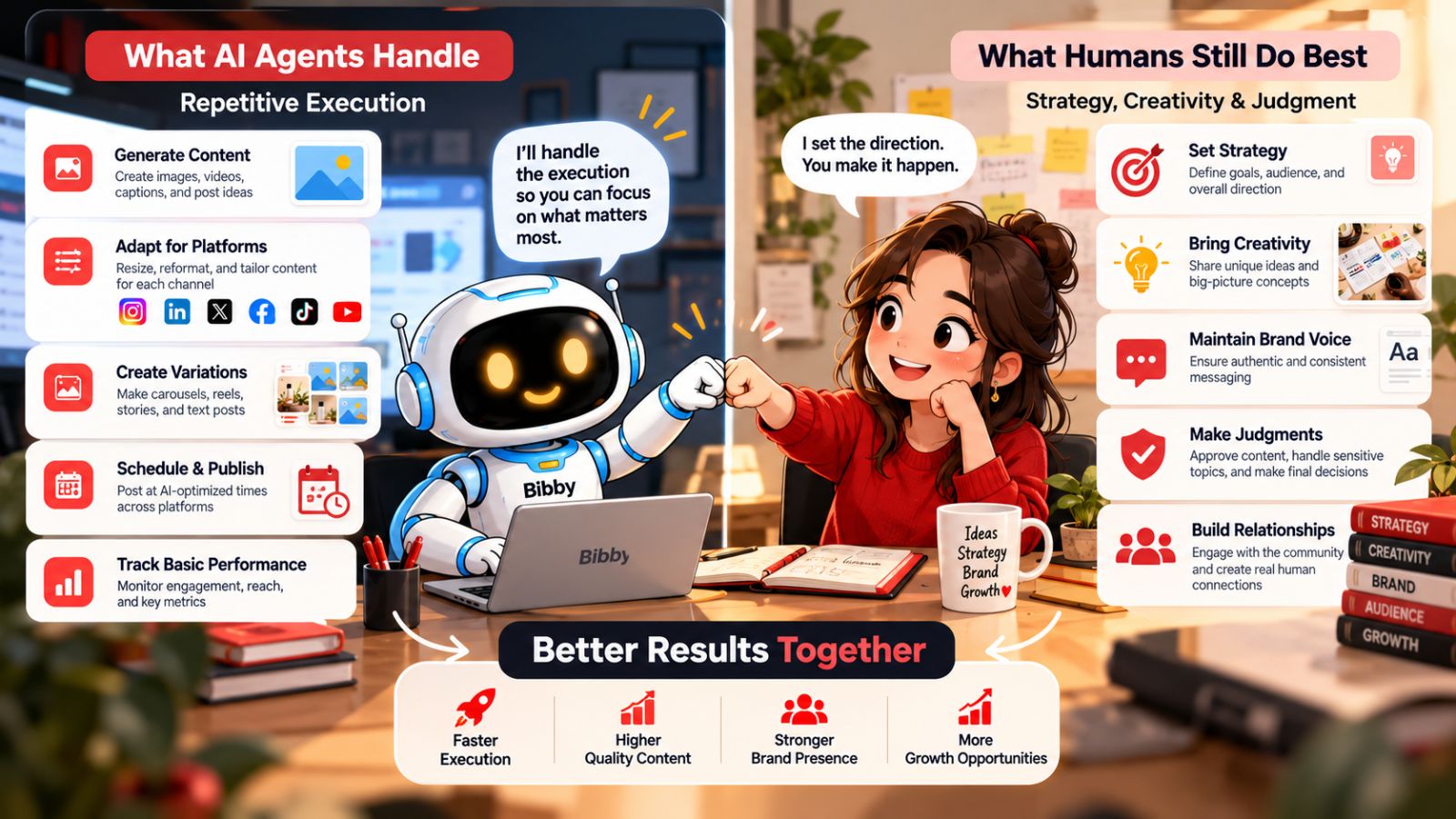
Social media is not only an execution problem. It is also a human communication problem. Brands need to understand people, make strategic decisions, respond to unexpected situations, and create ideas that actually mean something to their audience.
AI agents can automate more of the operational work, but automation does not remove the need for judgment.
Strategy Still Starts With Humans
An AI system can help execute a campaign.
It does not automatically know whether that campaign should exist in the first place.
Questions such as these remain strategic:
- Who are we trying to reach?
- What do we want the audience to understand?
- Why should they care?
- What differentiates our brand?
- What should we say—and what should we avoid saying?
- What business objective does this campaign support?
These decisions provide the context within which automation becomes useful.
Without a clear strategy, greater automation can simply produce more content without producing better marketing.
Brand Voice Needs More Than a Prompt
AI can generate content in a particular tone, but brand voice is more complicated than choosing adjectives such as “professional,” “friendly,” or “bold.”
A strong brand voice develops through consistency, experience, audience understanding, and creative judgment.
A brand may deliberately break its usual tone for a particular campaign. It may use humor in one situation and restraint in another. It may reference a cultural moment that requires context rather than a generic content formula.
AI can assist with these decisions when given appropriate context, but human oversight remains valuable.
Original Creative Direction Still Matters
AI can generate images, captions, concepts, and variations quickly.
But speed of generation is not the same as originality.
Someone still needs to decide what the brand should create in the first place.
The strongest social media ideas often come from observations about customers, culture, products, competitors, communities, or unexpected moments.
AI can help develop those ideas.
It should not automatically become the source of all of them.
A useful division of labor is often:
Human chooses the direction → AI expands and executes the possibilities.
Sensitive Content Requires Judgment
Not every social media task should be fully automated.
Public communication can involve sensitive subjects, customer complaints, controversial events, legal considerations, or rapidly changing circumstances.
In these situations, publishing automatically without appropriate review can create unnecessary risk.
A responsible workflow can therefore include approval points.
The more consequential the communication, the more important human oversight becomes.
Automation Should Reduce Repetition, Not Responsibility
This may be the most important principle for the future of AI social media automation.
Automation can reduce repetitive work.
It can make content production faster.
It can coordinate publishing.
It can help manage campaigns.
But accountability should not automatically be delegated along with execution.
Someone still needs to own the outcome.
That means the best AI-powered workflows may not be completely autonomous. They may instead be human-directed and AI-executed, with the level of human involvement determined by the importance and risk of the task.
The Human Role Moves Up the Workflow
There is an interesting paradox here.
The more operational work AI can handle, the more valuable higher-level human decisions can become.
A social media manager who previously spent hours scheduling posts may have more time to analyze the audience.
A content marketer who previously spent an afternoon adapting captions may have more time to develop a campaign concept.
A founder who previously had no practical way to maintain several social channels may be able to participate in a much more structured content workflow.
The human role does not necessarily disappear.
It can move upward—from doing every individual task to setting direction, reviewing important decisions, and improving the system.
The Goal Isn't Maximum Autonomy
This is why “fully autonomous social media” should not necessarily be treated as the ultimate objective.
The better question is:
Which parts of the workflow should be automated, and where should humans remain involved?
For routine publishing, automation can be highly useful.
For repetitive content variations, AI can save substantial time.
For campaign coordination, agentic workflows can reduce operational complexity.
For strategic positioning, sensitive communication, and important creative decisions, human judgment remains central.
The future of social media automation is therefore unlikely to be a simple handoff from humans to machines.
It is more accurately a shift in how humans and AI divide the work.
AI agents can take responsibility for more execution.
Humans can retain responsibility for direction.
How to Choose a Social Media Automation Tool in the AI-Agent Era
The growing number of AI-powered social media tools makes one thing increasingly difficult: figuring out what a tool actually automates.
A platform might describe itself as an AI social media manager because it generates captions. Another might use AI to recommend publishing times. Another might combine content creation with scheduling. These capabilities are useful, but they do not necessarily represent the same level of automation.
The better approach is to evaluate a tool based on the workflow it can actually handle.
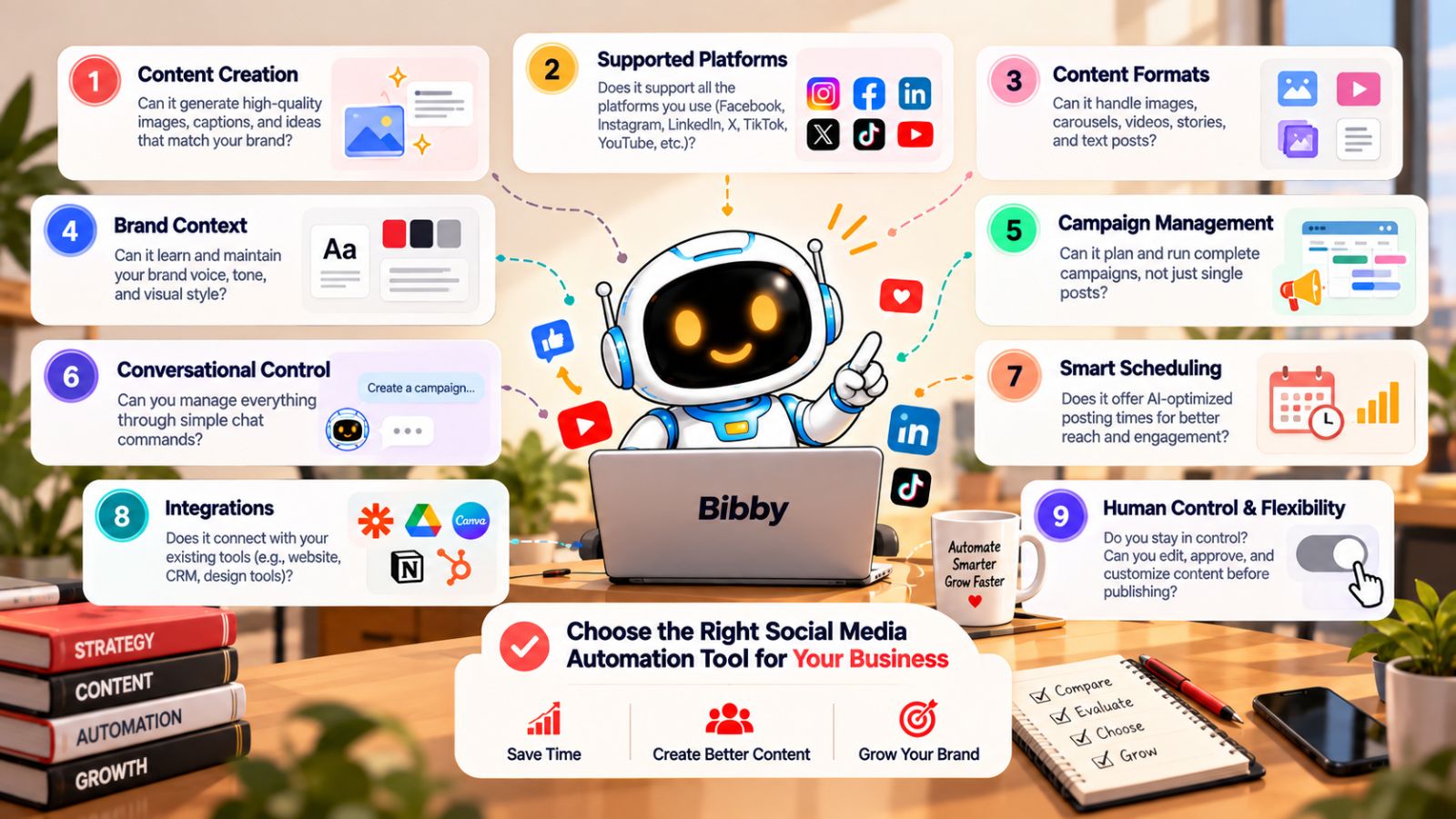
Does It Only Schedule, or Does It Help Create?
The first question is simple:
Where does the automation begin?
If you have to create every image, write every caption, and prepare every variation before the tool becomes useful, you are primarily looking at a scheduling system.
That is not necessarily a problem. Scheduling remains an important part of social media management.
But AI-powered tools can potentially move further upstream by helping with:
- Content ideas
- Images
- Captions
- Creative variations
- Platform-specific content
- Content repurposing
The more of these stages a system can connect, the more complete the workflow becomes.
Can It Work Across Multiple Platforms?
Managing several social networks is one of the biggest sources of operational complexity.
A useful social media automation tool should therefore be evaluated based on the platforms it supports and how well it handles differences between them.
Look beyond the number of platform integrations.
Ask:
Can the system actually adapt content for each channel?
Publishing the same caption everywhere is technically cross-platform automation, but it may not produce a strong cross-platform strategy.
The more useful systems can maintain the central campaign idea while adapting its execution to different channels.
Does It Support Different Content Formats?
Social media is not limited to a single post type.
Depending on the platform and campaign, you may need:
- Images
- Carousels
- Videos
- Stories
- Short-form content
A tool that handles only one format may force you to maintain additional tools for the rest of your content workflow.
When evaluating an automation platform, consider whether it can support the formats your actual content strategy requires.
Can AI Understand Your Brand?
AI-generated content is only useful when it sounds appropriate for the business using it.
A good social media automation workflow should therefore provide some way to establish brand context.
Look for capabilities related to:
- Brand voice
- Visual identity
- Audience
- Messaging
- Brand guidelines
- Preferred content styles
This is where a brand kit can become particularly useful.
Rather than explaining the brand from scratch for every post, the system can use established information as part of the content-generation workflow.
Can It Manage Campaigns Rather Than Individual Posts?
A campaign is larger than a post.
It may include dozens of content pieces, several platforms, multiple formats, and a specific publishing sequence.
If a tool forces you to manage every post independently, you are still doing much of the coordination yourself.
Campaign-level capabilities can make a significant difference because they allow the marketer to think in terms of objectives and content systems rather than individual publishing events.
How Much Can You Control Through Conversation?
A conversational interface is not automatically evidence that a tool is an AI agent.
The important question is what the conversation can actually accomplish.
Can you say:
“Create a campaign from these assets.”
and have the system do meaningful work?
Can you then say:
“Regenerate the captions with a more educational tone.”
and have the system understand which content you mean?
Can you ask it to:
“Schedule these posts across my selected platforms.”
and have it execute the appropriate workflow?
The more context the system can maintain between these instructions, the more useful conversational control becomes.
Does It Reduce the Number of Manual Handoffs?
This is perhaps the most practical test.
Look at your current workflow and count the points where you move from one tool or process to another.
For example:
Design tool → AI writer → image editor → scheduling tool → platform dashboard
Every handoff creates another opportunity for context to be lost.
An integrated AI workflow can potentially reduce those handoffs.
The goal isn't necessarily to find one tool that does absolutely everything.
It is to find a workflow where the tools you use require less manual coordination.
Does It Automate the Calendar Intelligently?
Scheduling remains important even in an AI-agent workflow.
But instead of asking only whether a tool supports scheduled publishing, look at how much work is required to create the schedule.
Can it:
- Organize multiple posts?
- Distribute content across dates?
- Support multiple platforms?
- Use AI-assisted timing?
- Make changes without rebuilding the entire calendar?
These capabilities determine whether scheduling is genuinely automated or simply digitized manual work.
Does It Keep Humans in Control?
Finally, automation should not mean losing visibility.
A useful system should make it clear what is being created, changed, and scheduled.
Human review can remain important for:
- Major campaigns
- Sensitive content
- Brand announcements
- Important customer communications
- High-stakes messaging
The strongest workflow is not necessarily the one that requires the fewest clicks.
It is the one that removes unnecessary work while preserving meaningful control.
A Better Way to Evaluate AI Social Media Tools
Instead of asking:
“Is this an AI social media tool?”
ask:
“How much of my actual social media workflow can this system handle?”
That question produces a much more useful evaluation.
A basic scheduler might automate publishing.
An AI assistant might automate content creation.
A more advanced AI-powered system can connect content creation, brand context, campaign management, scheduling, and publishing.
And an increasingly agentic system aims to let the user describe an outcome while the software coordinates more of the work required to achieve it.
That is the standard by which the next generation of social media automation should be evaluated.
The New Social Media Automation Stack
The traditional social media stack was built around specialized tools.
One tool handled design. Another helped with copy. A scheduling platform handled publishing. Analytics lived somewhere else. Campaign management might require yet another system.
That approach made sense when each stage of social media work required a different type of software.
AI is beginning to change the structure of that stack.
Instead of connecting more and more tools together, businesses can increasingly look for systems that connect more stages of the workflow themselves.
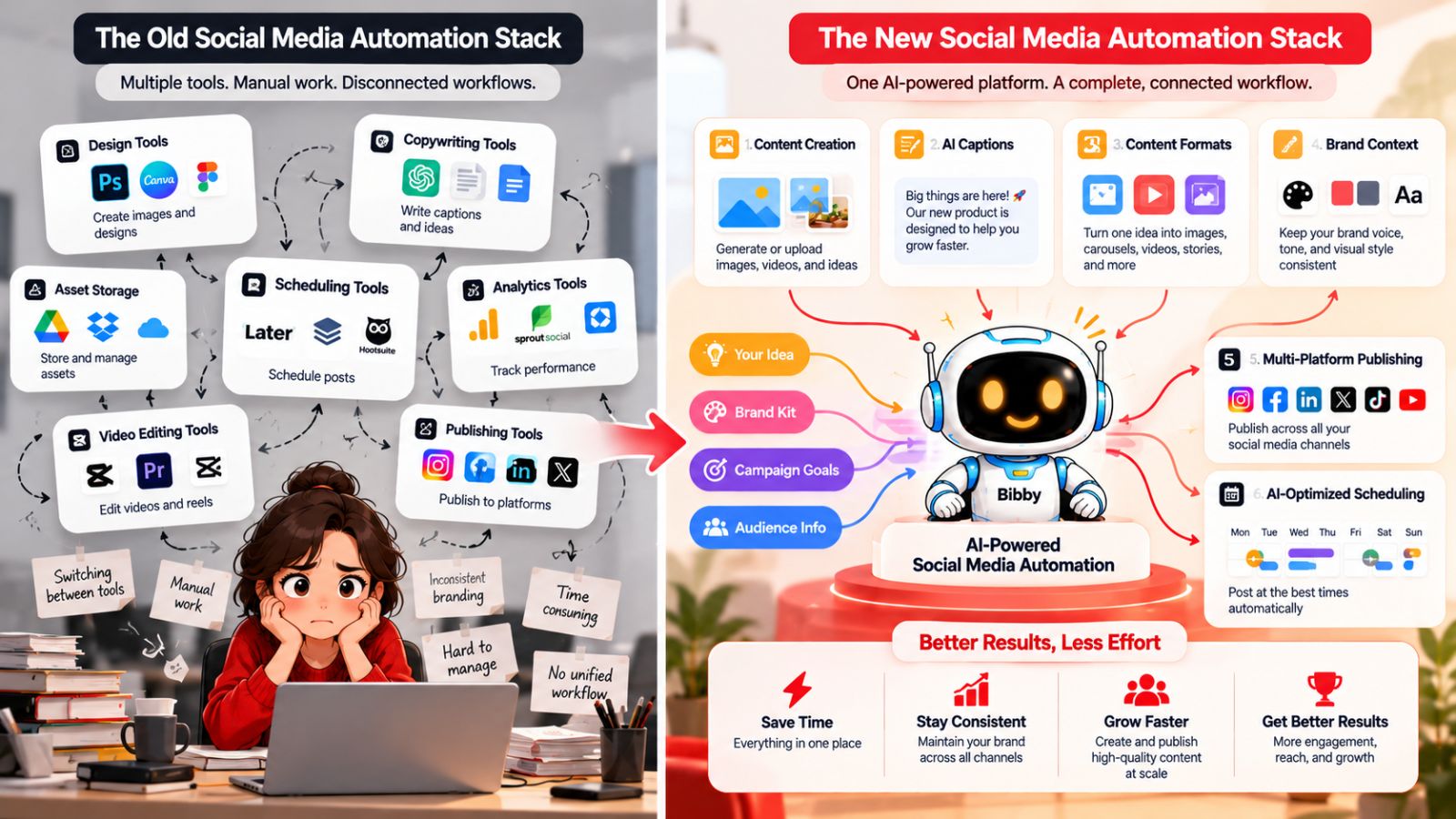
The Traditional Social Media Stack
A typical workflow might look like this:
Design tool → copywriting tool → content storage → scheduling platform → social networks → analytics
The marketer sits in the middle, moving content and information from one system to another.
For a single post, that might not be a major problem.
For a campaign containing dozens of assets across multiple platforms, the amount of coordination can become significant.
Every handoff requires attention.
Every new tool introduces another interface.
Every disconnected system creates another place where context can be lost.
The AI-Centered Stack
An AI-powered workflow can consolidate more of these functions.
The structure becomes closer to:
Brand context → content creation → content adaptation → campaign → scheduling → publishing
The major difference is that the marketer does not necessarily need to manually connect every stage.
The system can maintain context as content moves through the workflow.
For example, the same brand information can influence the generated creative, captions, campaign messaging, and platform variations.
That creates a more connected operating model.
A Simple Comparison
| Earlier social media stack | AI-centered social media workflow |
|---|---|
| Separate design workflow | AI-assisted creative workflow |
| Separate caption creation | Context-aware caption generation |
| Manual content adaptation | AI-assisted platform adaptation |
| Individual post scheduling | Campaign-level scheduling |
| Multiple disconnected dashboards | More unified workflow |
| Human connects the tools | AI can connect more workflow steps |
| Software executes instructions | Software can help coordinate objectives |
This does not mean specialized tools are disappearing.
Professional teams will continue to use tools designed for specific creative, analytical, advertising, or production requirements.
The change is that the coordination layer can increasingly become intelligent.
The Marketer Becomes the Orchestrator
In a fragmented workflow, the marketer often acts as the integration layer.
They take an idea from one tool, move it into another, rewrite it for another platform, schedule it somewhere else, and then check the results in another dashboard.
In an AI-centered workflow, more of that coordination can be delegated.
The marketer can instead focus on questions such as:
What campaign are we running?
What should this content accomplish?
Which audience are we trying to reach?
What should the brand sound like?
The system handles more of the operational translation.
This is one of the most important consequences of agentic automation.
The human is no longer simply operating individual pieces of software.
They are increasingly orchestrating an AI-powered workflow.
Why Consolidation Matters
Using fewer tools is not automatically better.
A single platform can become a limitation if it sacrifices capabilities that a specialized tool provides.
The more important benefit is reducing unnecessary friction.
If a marketer can upload creative content, establish a posting style, generate captions, organize a campaign, select platforms, and schedule the resulting content within one connected workflow, fewer manual handoffs are required.
Bibby is an example of this broader direction. Its workflow brings together content creation, AI-generated captions, multiple content formats, cross-platform scheduling, and conversational management rather than requiring each activity to be handled independently.
The significance of that model is less about having a long feature list and more about the underlying workflow design.
The closer the tools get to understanding the entire process, the less the user needs to act as the bridge between individual functions.
The Stack Is Becoming a System
This is ultimately the difference between a collection of automation features and an AI-powered social media system.
A collection of features might give you:
AI captions + scheduling + image generation + analytics.
A system tries to connect those capabilities around a common objective:
Create the campaign → produce the content → adapt it → organize it → schedule it → publish it.
That is a much more powerful way to think about social media automation.
The future stack may not be defined by how many tools a marketing team uses.
It may be defined by how much workflow those tools can understand and coordinate.
What Social Media Automation Could Look Like Next
The evolution from scheduling to AI assistants to AI agents suggests that the next stage of social media automation will be less about adding individual AI features and more about making the entire workflow increasingly connected.
The important question will no longer be whether software can generate a caption or schedule a post.
Those are individual capabilities.
The bigger question will be:
How much of the social media operation can an AI system understand, coordinate, and execute while keeping humans in control?
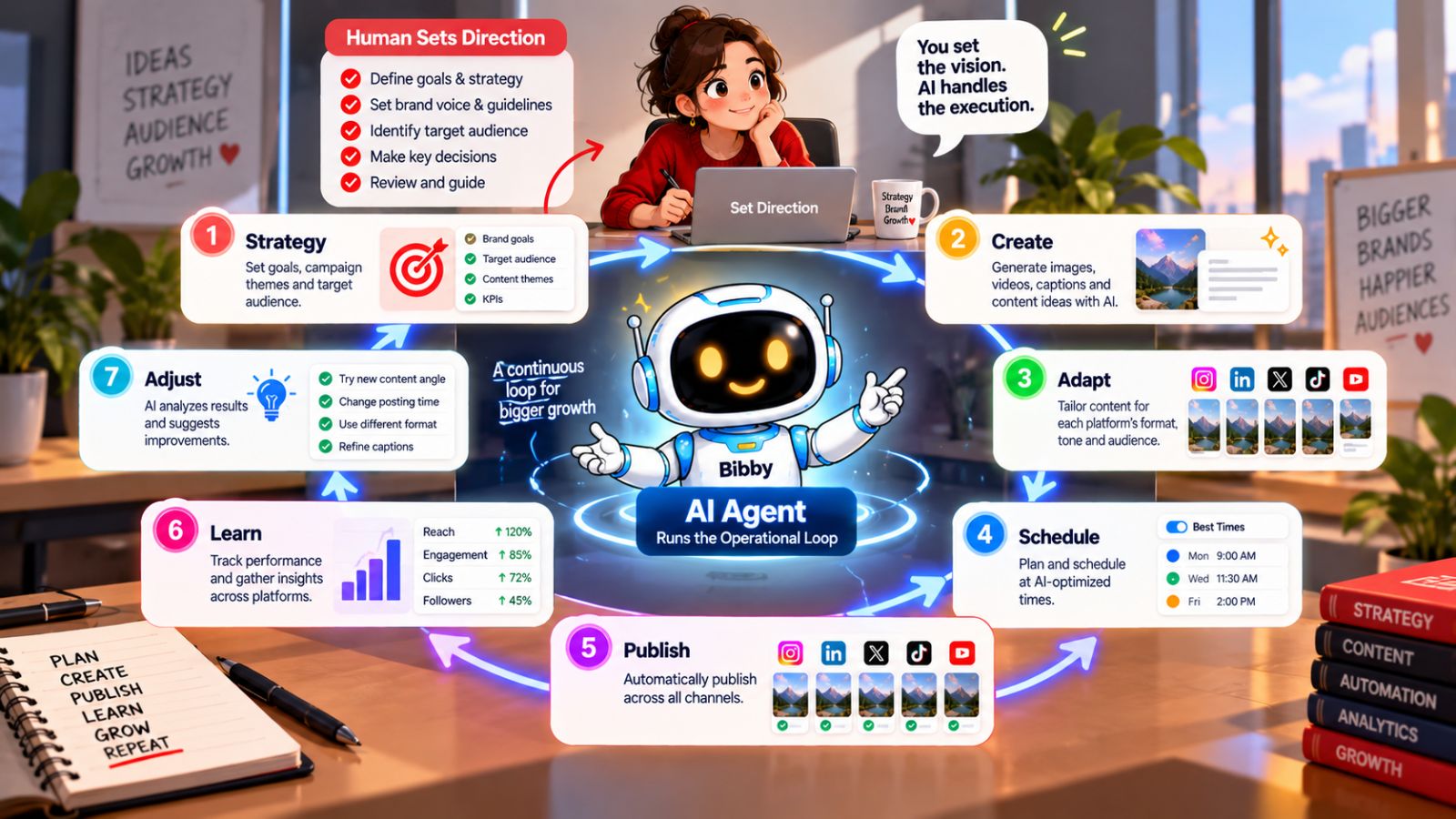
From Content Generation to Continuous Workflows
Today's AI tools can already help generate individual pieces of content.
The next evolution is likely to focus more heavily on what happens between those pieces.
Instead of generating a caption and stopping, an AI-powered workflow could connect that caption to the campaign, platform, publishing schedule, and broader content strategy.
The workflow becomes continuous rather than transactional.
For example:
Create campaign → generate content → adapt content → schedule → publish → evaluate → adjust future content
The more tightly those stages are connected, the less manual coordination is required.
Agents Could Become More Brand-Aware
One of the biggest limitations of generic AI-generated content is lack of context.
A system can produce grammatically correct copy while still sounding nothing like the company using it.
Future social media agents will therefore need to work with richer brand context.
That could include:
- Brand voice
- Visual identity
- Audience information
- Product information
- Content preferences
- Campaign history
- Approved messaging
- Topics to avoid
The objective is not simply to make AI-generated content sound more polished.
It is to make the system understand what the brand is trying to communicate and why.
Content Could Become More Adaptive
Another possible direction is more dynamic content workflows.
Instead of creating a fixed collection of posts and leaving them untouched, marketers could increasingly use systems that make it easier to adjust upcoming content based on new information.
A campaign might need to change because:
- A product launch date moved
- A new creative asset became available
- The messaging changed
- A campaign was extended
- A particular topic became more relevant
- The team decided to shift the campaign's tone
In an increasingly agentic workflow, these changes could become instructions rather than manual reconstruction projects.
The marketer might simply communicate the change, while the system handles more of the downstream work.
More Automation Does Not Mean Zero Oversight
There is an important distinction between autonomous execution and unsupervised execution.
An AI system may be capable of performing many steps automatically while still operating within boundaries established by a human.
For example, a team might allow an AI system to automatically generate and schedule routine content but require approval for major announcements.
That creates a tiered approach to automation.
Low-risk tasks: more automation.
Strategic tasks: more human review.
Sensitive tasks: explicit approval.
This kind of structure is likely to remain important as AI systems become more capable.
Social Media Management Could Become More Conversational
The interface itself may also continue to change.
Instead of interacting with a collection of dashboards, users could increasingly manage social media through ongoing conversations.
A marketer might ask:
“What campaigns are currently scheduled?”
Then:
“Move the launch campaign back three days.”
Then:
“Regenerate the posts that mention the old launch date.”
Then:
“Show me the content scheduled for LinkedIn this week.”
The important capability is not simply understanding language.
It is maintaining enough context to understand what the user is referring to and what actions need to follow.
That is where conversational interfaces and agentic workflows begin to overlap.
Social Media Automation May Become Outcome-Oriented
The most significant shift may ultimately be philosophical.
Traditional software is organized around tasks.
AI agents are increasingly organized around outcomes.
Instead of:
“Schedule this post.”
the interaction could become:
“Make sure this campaign is distributed across our selected channels this week.”
Instead of:
“Write five captions.”
it could become:
“Create a week's worth of social content around this topic in our brand voice.”
The user describes the destination.
The system manages more of the route.
The Human Role May Move Further Upstream
As more execution becomes automated, human involvement can move toward the beginning and end of the workflow.
At the beginning:
Set the strategy, goals, audience, brand direction, and constraints.
During execution:
Review important decisions and intervene when necessary.
At the end:
Evaluate results and decide what should happen next.
This creates a new division of labor.
AI handles more of the operational middle.
Humans provide direction, judgment, and accountability.
The Future of Social Media Automation Is Delegation
That may be the clearest way to describe the direction of the industry.
The first generation automated publishing.
The next generation automated individual content tasks.
The emerging generation is focused on delegating workflows.
That does not mean social media will become completely autonomous.
It means marketers may increasingly be able to say what they want to accomplish and let AI handle a larger portion of the repetitive work required to get there.
The winning social media workflow will therefore not necessarily be the one with the most AI features.
It will be the one that can turn human intent into reliable execution with the least unnecessary friction.
Conclusion: From Posting Content to Delegating Social Media
Social media automation has come a long way from simply scheduling posts on a calendar. Traditional automation removed repetitive publishing work, AI assistants accelerated individual content tasks, and AI agents are beginning to connect those tasks into broader workflows.
The biggest shift is therefore not that AI can write captions, generate images, or schedule posts. It is that social media software is increasingly moving from executing individual instructions to helping coordinate complete outcomes.
For marketers, that means less time spent moving content between tools, formatting posts, writing repetitive captions, and manually managing publishing calendars—and more time available for strategy, creative direction, audience understanding, and oversight.
Tools such as Bibby represent this broader transition by bringing content creation, captions, campaign management, scheduling, multiple formats, and conversational control into a more connected workflow.
The next step is not to automate everything blindly. It is to identify which parts of your social media process are repetitive, determine where AI can safely take over execution, and keep humans responsible for strategy and judgment.
That is where the next generation of AI-powered social media workflows begins.