
How to Sync Your Content Strategy Across Platforms with AI Scheduling
Imagine this: you've spent hours crafting the perfect post for Instagram — the visuals are on point, the caption is witty, and the timing feels right. But when it comes time to publish on LinkedIn, you realize the tone doesn't quite fit, your Twitter thread needs reformatting, and your TikTok teaser is still waiting for subtitles.
Sound familiar? You're not alone. For most brands and creators, managing a consistent, on-brand content strategy across multiple platforms feels like a full-time job. Each channel speaks a different language, demands different content formats, and operates on different algorithms. Keeping everything in sync — from captions and visuals to timing and analytics — can feel impossible without help.
That's where AI scheduling changes the game. With machine learning and predictive insights, AI tools can automatically align your content calendars, schedule posts at the optimal times, and even adjust your publishing strategy in real time based on performance. Instead of juggling platforms, you start orchestrating them — effortlessly.
If you've ever wished for a way to make your content strategy smarter, not harder, AI scheduling might just be the missing piece. Let's explore how it can help you create a seamless, cross-platform strategy that works for you — not the other way around.
The Challenge of Multiplatform Content Management
In today's digital ecosystem, your audience doesn't live on one platform — they live across many. They scroll through Instagram for inspiration, hop to LinkedIn for professional insights, check X for trending news, and unwind on TikTok for entertainment. For brands, that means one thing: showing up everywhere — and doing it consistently.
But here's the problem. Each platform has its own personality, content style, and algorithmic quirks. What thrives on LinkedIn might flop on TikTok. The ideal posting time on Instagram won't necessarily align with what works on Facebook. And trying to manually manage all of it? That's where chaos starts creeping in.
Most marketers begin with good intentions — maybe a shared content calendar or a color-coded spreadsheet. But as soon as campaigns start scaling, things get messy. Posts get missed. Hashtags are inconsistent. Captions get copy-pasted without context. Before long, your "unified brand message" feels scattered, and your analytics reflect it.
The truth is, multiplatform management isn't just a logistics problem — it's a strategic one. Without synchronization, brands lose cohesion. Audiences experience disjointed messaging. And valuable insights from one platform never inform the strategy on another.
The result? A fragmented brand presence that confuses your audience instead of connecting with them.
AI scheduling tools were designed to solve exactly this challenge. By centralizing your content strategy, they help brands maintain consistency in tone, timing, and visual identity — across every platform, without the burnout.
What AI Scheduling Actually Does (and Why It's a Game-Changer)
At its core, AI scheduling is far more than a fancy auto-posting tool. It's an intelligent system that learns from data — your audience's behavior, your past performance, and even current trends — to make your content strategy faster, smarter, and more consistent.
Think of it as your behind-the-scenes strategist. Instead of simply queuing posts, AI scheduling tools analyze engagement data to determine the best time, platform, and format for each piece of content. They can predict when your audience is most active, when your competitors are quiet, and when your post is most likely to cut through the noise.
This transforms the way you plan content. Traditionally, teams spend hours poring over analytics, guessing what might perform best. But AI scheduling eliminates the guesswork. It continuously monitors your data, identifies patterns, and makes real-time adjustments — ensuring that your next post is always smarter than your last.
Here's what makes it revolutionary:
- Adaptive learning: AI uses your performance history to refine future posting strategies automatically.
- Cross-platform optimization: It aligns publishing times across different channels so your message lands with maximum impact.
- Automation with context: Instead of posting blindly, it considers platform-specific nuances — tone, hashtags, post length, and timing.
- Predictive analytics: It can forecast which type of content (video, carousel, story, etc.) will perform best at specific times.
Imagine having a tool that not only tells you what to post, but also when and where to post it — all backed by data. That's the power of AI scheduling.
And here's the real beauty: it's not just for big brands. Even solo creators and small businesses can use these tools to scale their online presence without burning out. Whether you're managing one brand or ten, AI scheduling levels the playing field, giving you the insights and efficiency once reserved for enterprise marketing teams.
Building a Unified Content Strategy for All Platforms
Before automation can make your marketing more efficient, your content needs to speak a single, cohesive language — even when it's expressed differently across platforms. That's the heart of a unified content strategy: ensuring that every post, story, and video reflects the same message, tone, and brand identity, no matter where your audience encounters it.
But achieving that unity is tricky. Every platform caters to a unique audience mindset.
- On Instagram, users crave visual storytelling and quick inspiration.
- On LinkedIn, they look for credibility, thought leadership, and professional insight.
- On TikTok, they want authenticity and entertainment.
- And on X, they expect immediacy and conversation.
So how do you stay true to your brand while adapting to each environment? The answer lies in structure — and smart automation.
Start by defining your content pillars, the 3–5 core themes that consistently represent your brand (for example: education, culture, customer stories, and innovation). Once those pillars are clear, use AI scheduling tools to distribute those themes across different platforms in the right tone and format.
Here's how it looks in practice:
Your "education" pillar might take the form of a long-form post on LinkedIn, a quick tip carousel on Instagram, and a short explainer video on TikTok — all scheduled by AI to hit peak engagement times.
Your "customer stories" pillar could appear as a testimonial on Facebook and a behind-the-scenes reel on Instagram — posted within hours of each other to create a unified narrative.
With this approach, AI scheduling doesn't just keep your posts consistent — it synchronizes your storytelling. It ensures that audiences moving from one platform to another experience a seamless brand journey.
Finally, maintain brand voice consistency by defining tone and style parameters within your AI tools. The best systems allow you to tag content with specific tones ("informative," "playful," "authoritative") and automatically adjust copy to fit platform expectations.
When done right, your social ecosystem begins to function like a single organism — one voice, many expressions.
Step-by-Step Guide to Syncing Your Content Strategy with AI Scheduling
Building a synchronized, AI-powered content strategy doesn't happen overnight — but it's simpler than it looks when you follow the right process. The goal is to merge human creativity with AI efficiency so that your brand message flows consistently across every channel, automatically and intelligently.
Here's a proven five-step framework for getting started:
Step 1: Audit Your Current Content Calendar
Before AI can optimize your schedule, you need to know what's already working — and what's not.
Review your past 30–90 days of content performance. Look for patterns in engagement, reach, and timing. Which posts resonated the most? Which platforms lagged behind?
This audit helps your AI scheduler learn from real data, not guesswork. You'll start to see where automation can plug the biggest gaps.
Step 2: Identify Overlaps and Gaps in Your Posting Plan
Most brands have either too much overlap (posting the same message everywhere) or too many gaps (leaving some platforms silent).
AI scheduling tools can highlight these blind spots automatically by mapping your posting frequency across platforms. This visibility helps you balance your content — ensuring no channel feels neglected or redundant.
Step 3: Integrate AI Scheduling Tools to Manage Timing and Cadence
Once your foundation is clear, connect your AI scheduling platform of choice. Modern tools don't just schedule — they analyze. They learn your audience's behavior on each platform and automatically adjust post timing to when engagement is highest.
This is where features like predictive analytics, queue balancing, and post recycling save you hours each week while maximizing visibility.
Step 4: Create Automation Rules for Different Content Types
You don't need to schedule every post manually. Instead, define automation rules. For example:
- Repost top-performing content every 30 days.
- Publish videos on weekends, carousels on Mondays, and polls on Fridays.
- Adjust tone automatically when posting to LinkedIn vs. Instagram.
These "smart rules" allow AI to execute your strategy while you focus on creating better content — not managing logistics.
Step 5: Monitor, Measure, and Refine Continuously
AI thrives on feedback. Review your analytics weekly or biweekly, not just to see what worked, but to teach the algorithm. The more input it receives, the smarter it becomes.
You'll start noticing patterns: which formats your audience prefers, which times outperform others, and where engagement dips. Feed this data back into your AI scheduler to keep evolving your strategy in real time.
When these steps work together, your content machine starts running itself — with AI scheduling quietly orchestrating it all behind the scenes. You'll spend less time on manual posting and more time crafting high-quality content that actually converts.
Integrating AI Tools for Complete Content Harmony
Once your AI scheduling system is in place, the next step is to integrate the right supporting tools that amplify its impact. Think of AI scheduling as the conductor — and these tools as the instruments that make your brand's digital symphony sound polished, consistent, and unforgettable.
The goal isn't just to post content faster. It's to create, schedule, and optimize smarter — from visuals and captions to timing and analytics. When each part of your process works in sync, you build true cross-platform harmony.
Let's break down how different AI tools can work together within your ecosystem:
1. Carousel Post Generator
Visual storytelling is more important than ever. A Carousel Post Generator helps you transform static content into scroll-stopping slides that keep audiences engaged longer. Pair this with AI scheduling, and you can distribute carousel posts on the days and times your audience is most likely to swipe through, maximizing visibility and dwell time.
2. AI Caption Generator
Consistency in voice is critical when managing multiple platforms. An AI Caption Generator can craft platform-specific copy that retains your brand tone while adapting to each audience. For example, it can make LinkedIn posts more professional and Instagram captions more conversational — all while your scheduler ensures perfect timing.
3. Best Time to Post Tool
Timing is everything, and this is where the [BEST_TIME:Best Time to Post Tool] complements AI scheduling beautifully. While your scheduler automates publishing, this tool feeds it data-driven insights about audience activity peaks. Together, they eliminate guesswork and ensure that your message lands when your audience is most attentive.
4. Social Media Bio Generator
Before anyone engages with your posts, they visit your profile. A [BIO_GEN:Social Media Bio Generator] helps create unified, on-brand bios across all platforms — ensuring that no matter where a follower discovers you, they experience the same tone, message, and authority. It's a small but powerful step toward complete brand alignment.
5. Social Media Report Card
Finally, to keep everything improving, a [REPORT_CARD:Social Media Report Card] provides a holistic analysis of your performance. It benchmarks your results against competitors, identifies trends, and even gives actionable suggestions for your next campaign. Integrate it with your AI scheduler, and your strategy evolves automatically — guided by performance data, not assumptions.
Example Workflow in Action
Let's say you're launching a new product campaign. Here's how it might flow:
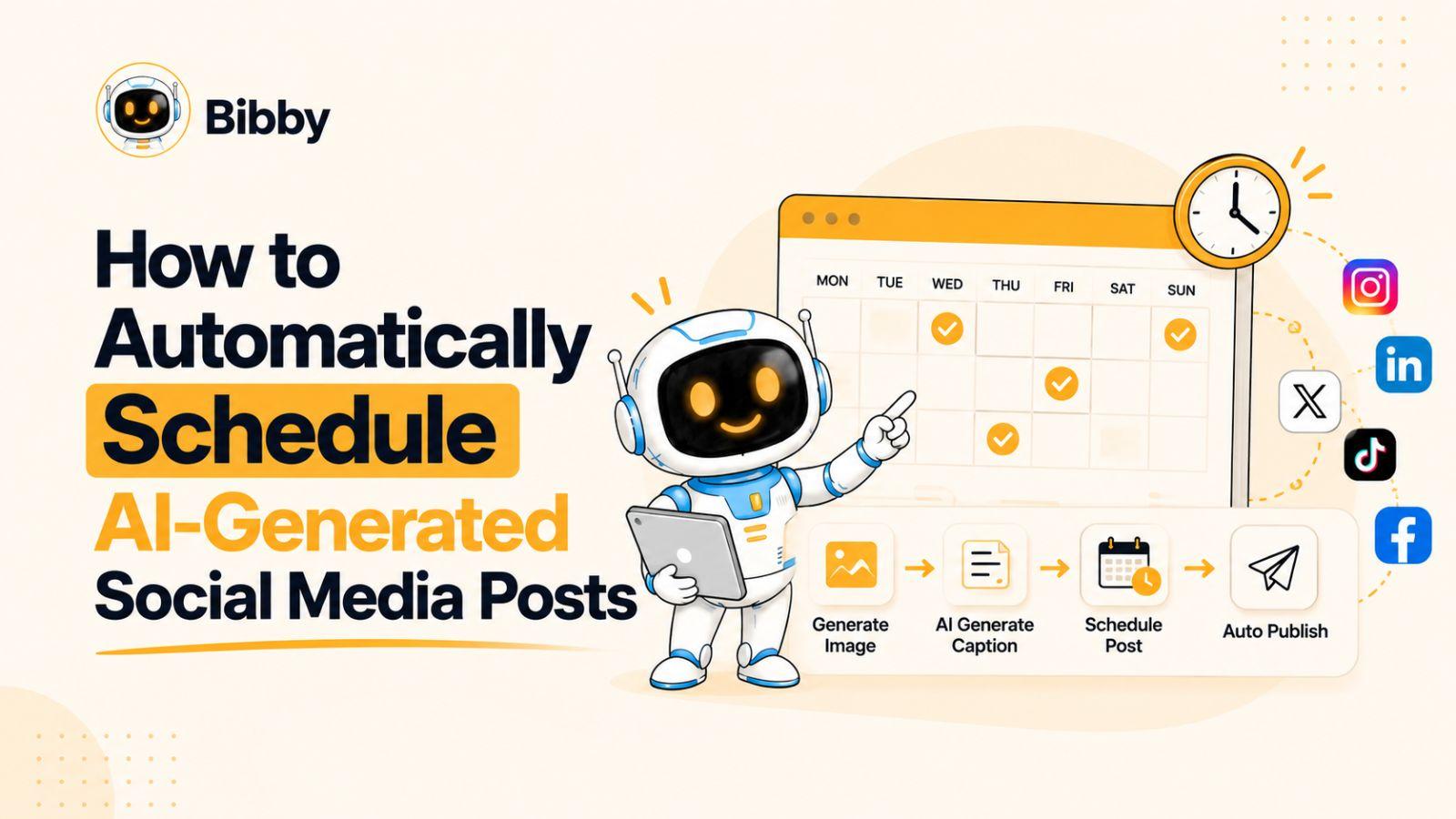
1. Use the Carousel Post Generator to design your core visual story.
2. Generate platform-appropriate captions with the AI Caption Generator.
3. Schedule posts using AI automation, enhanced by the [BEST_TIME:Best Time to Post Tool].
4. Refresh all your bios for brand consistency using the [BIO_GEN:Social Media Bio Generator].
5. Review weekly performance via your [REPORT_CARD:Social Media Report Card], letting AI refine the schedule for next time.
The result? A fully automated, intelligent system that operates like a living organism — constantly learning, adjusting, and improving. You stay focused on creativity while AI handles the heavy lifting behind the scenes.
Measuring Success and Optimizing with AI Insights
Once your AI scheduling system is up and running, the real magic begins: optimization through feedback. The power of AI isn't just in automating content — it's in its ability to learn from every post, every interaction, and every metric. Over time, these insights become your competitive advantage.
But to make that happen, you need to know what success looks like — and how to measure it.
1. Define the Right KPIs for Your Strategy
Not every brand should measure success the same way. Your key performance indicators (KPIs) should align with your business goals.
- For awareness, track impressions, reach, and follower growth.
- For engagement, focus on likes, comments, shares, and saves.
- For conversion, analyze click-through rates, lead form completions, or purchases.
AI scheduling tools can automatically tag and categorize these metrics across platforms, saving you from manually pulling reports and spreadsheets.
2. Use AI to Identify What's Working (and What Isn't)
Instead of manually combing through analytics, let your AI tools find patterns. For example:
- Which hashtags consistently boost engagement?
- What post length performs best on LinkedIn vs. Instagram?
- Do reels outperform carousels for your brand?
AI doesn't just collect this data — it interprets it. It can detect subtle engagement shifts and suggest adjustments like changing post timing, refining your content mix, or tweaking hashtags. This continuous improvement loop ensures your strategy evolves alongside your audience.
3. Leverage Cross-Platform Insights
The biggest mistake many marketers make is viewing each platform in isolation. AI scheduling unifies your analytics, showing you the bigger picture — how audiences behave across channels.
For example, you might discover that people who engage with your TikTok videos are more likely to comment on your Instagram reels or click through on your LinkedIn posts. Those insights help you craft smarter, interconnected campaigns.
4. Automate Reporting for Real-Time Decisions
AI tools now go beyond static analytics dashboards. They generate dynamic reports that visualize trends in real time. You'll know instantly when a campaign starts underperforming — and your scheduler can automatically adjust posting frequency or content type in response.
This makes your content strategy proactive, not reactive. Instead of chasing results after the fact, you're continuously optimizing while your campaigns are live.
5. Benchmark Against Competitors
Another key advantage of AI insights is benchmarking. By analyzing public engagement data from competitors, your tools can reveal industry trends and help you stay one step ahead. Whether it's average engagement rates, hashtag usage, or post frequency, these benchmarks help refine your goals with precision.
In short, AI doesn't just automate — it amplifies intelligence. Every like, view, or click becomes a data point feeding back into your system. Over time, that feedback loop builds an ever-sharper strategy, one that's personalized for your brand and perfectly aligned with your audience's evolving behavior.
Common Mistakes to Avoid with AI Scheduling
AI scheduling is a powerful ally, but like any tool, it's only as effective as the strategy guiding it. When brands rely too heavily on automation or misuse it, they risk losing the very thing audiences crave most — authenticity.
Let's look at the most common mistakes marketers make when implementing AI scheduling — and how to avoid them.
1. Over-Automation (Losing the Human Touch)
It's tempting to set your AI scheduler and forget it — but that's where many brands stumble.
Audiences don't want to interact with robots; they want real conversations. When every post is automated, you risk sounding robotic or detached.
Avoid it: Use automation for logistics (timing, posting, republishing) — not for connection. Schedule your content, but still engage manually. Respond to comments, jump into discussions, and show personality.
2. Ignoring Platform-Specific Nuances
One of the biggest strengths of AI scheduling is cross-platform management, but a "copy-paste" approach can kill engagement. A witty caption that thrives on Instagram might fall flat on LinkedIn.
Avoid it: Train your AI system with platform-specific rules. Customize tone, hashtags, and formatting for each audience. Remember: consistency doesn't mean uniformity — it means coherence.
3. Failing to Update Your AI's Learning Data
AI thrives on data. If you never refresh your performance metrics or update your content library, the tool can't learn effectively. Outdated patterns will lead to subpar recommendations.
Avoid it: Regularly feed your scheduler with new data — recent posts, engagement results, and competitor insights. Treat it as an evolving system, not a static calendar.
4. Neglecting Real-Time Trends
AI can optimize for timing and performance, but it can't (yet) replicate human intuition for cultural moments. Ignoring real-world context can make your brand appear tone-deaf.
Avoid it: Blend automation with awareness. If a trending topic or major event aligns with your brand, pause your queue and jump in manually. AI is your planner; you're still the storyteller.
5. Measuring Quantity Over Quality
Some brands mistake AI's efficiency for an excuse to post more frequently. But if your content quality drops, audience fatigue follows.
Avoid it: Let AI help you post smarter, not more. Focus on engagement and resonance — not sheer output.
6. Skipping Manual Review
Automation should never replace strategy review. Without human oversight, errors like repeated captions, outdated promotions, or mismatched visuals can slip through unnoticed.
Avoid it: Always review your queue before publishing. A few minutes of oversight ensures that your content stays fresh, relevant, and perfectly on-brand.
By avoiding these pitfalls, you'll use AI scheduling as it's meant to be used — as an enhancer of human creativity, not a replacement for it. The most successful brands find the balance between automation and authenticity, allowing AI to handle the repetitive tasks while humans focus on connection, storytelling, and innovation.
The Future of Content Strategy — Fully Synced, AI-Driven Marketing
We're standing at the edge of a new era in digital marketing — one where content strategy will no longer revolve around scheduling posts, but around orchestrating intelligent, adaptive systems that think and act in real time.
In the near future, AI-driven content ecosystems will become the backbone of brand communication. Imagine a setup where your scheduler doesn't just post content — it predicts what to post next. It learns from your audience's reactions, adjusts your visuals and tone automatically, and synchronizes campaigns across all platforms based on what's trending right now.
This isn't fantasy. It's already starting to happen.
AI tools are becoming more collaborative and interconnected. Soon, instead of managing multiple apps for captions, analytics, and scheduling, you'll have a single, unified system that manages your entire content lifecycle — from ideation to performance tracking — without human intervention.
Here's what's coming:
- Predictive personalisation: AI will deliver platform-specific variations of the same post in real time, optimizing content on the fly for different audience segments.
- Emotionally intelligent scheduling: Advanced systems will recognize audience sentiment trends and adjust messaging tone automatically.
- Real-time content orchestration: Instead of static calendars, marketers will work with living schedules that evolve daily based on engagement data.
- Collaborative AI assistants: Tools that can brainstorm creative concepts, draft post series, and analyze campaign ROI — all within one interface.
This evolution doesn't replace human creativity — it enhances it. The human role will shift from "content scheduler" to "content conductor" — focusing on vision, narrative, and authenticity, while AI handles the data-heavy logistics.
The future of marketing will be less about managing content and more about mastering synergy — a perfectly aligned brand presence across every digital touchpoint, powered by smart automation.
And as this future unfolds, one thing is certain: those who embrace AI early won't just save time — they'll set the pace.
Conclusion
The chaos of managing multiple social platforms doesn't have to define your marketing. With the rise of AI scheduling, you now have the power to transform your content workflow into a well-orchestrated system — one that runs efficiently, adapts intelligently, and keeps your brand voice consistent everywhere your audience listens.
Throughout this guide, we've uncovered three essential truths:
1. AI scheduling brings clarity to complexity — synchronizing your content across platforms with precision and ease.
2. Unified strategy beats scattered effort — when tone, timing, and visuals align, your brand message becomes unmistakable.
3. Optimization never stops — the smartest marketers let AI learn, adapt, and evolve with their audience.
Together, these principles form the backbone of a modern, AI-driven content strategy — one where creativity and technology work hand in hand.
And if you're ready to put it all into action, Bibby is your next step forward.
Bibby is an intelligent, all-in-one social media assistant that helps you plan, schedule, and analyze your content effortlessly. It syncs your posts across platforms, recommends the best times to publish, crafts captions tailored to each channel, and provides clear performance insights — so your content strategy runs like clockwork while you stay focused on creativity.
In a world where every second online counts, Bibby ensures every post has purpose, every platform feels connected, and every piece of content moves your brand forward.
So, the next move is yours: stop juggling platforms — and start orchestrating them.
Your audience is already waiting. Let Bibby help you show up — everywhere, in perfect sync.