
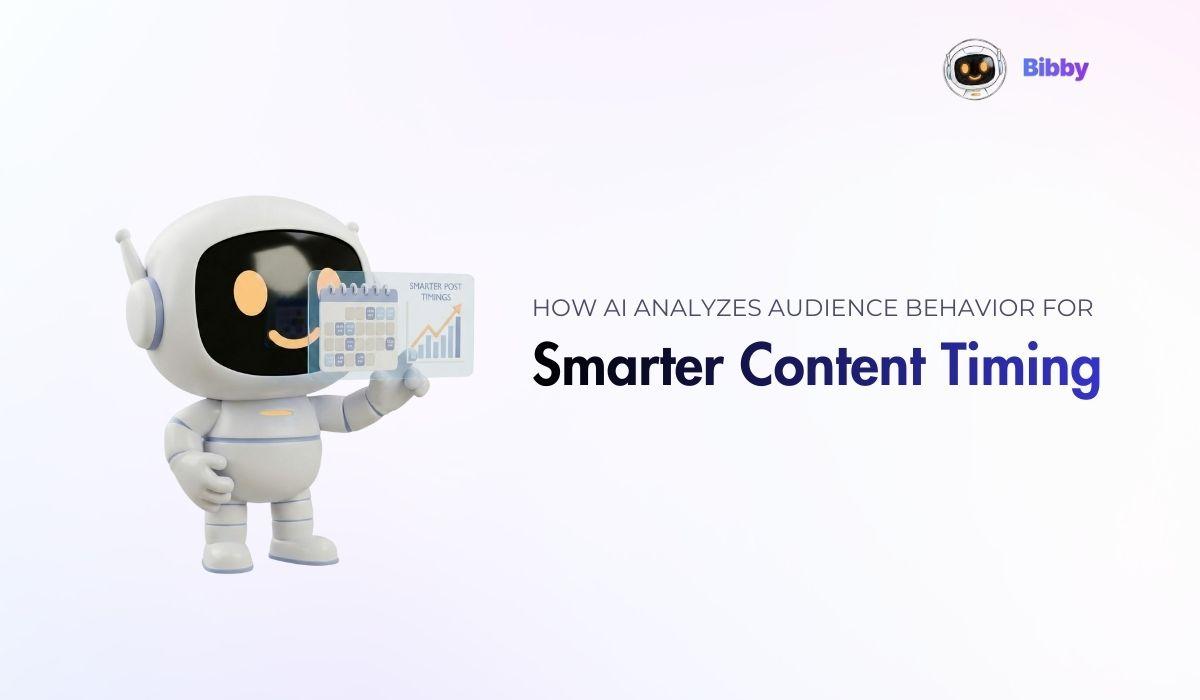
How AI Analyzes Audience Behavior for Smarter Content Timing
Posting great content isn't enough anymore—when you publish can matter just as much as what you publish.
As feeds grow more crowded and algorithms become more selective, timing has quietly become one of the strongest drivers of visibility and engagement. Audiences don't scroll randomly; they follow habits, routines, and behavioral patterns that influence when they notice, interact with, or ignore content. Miss those windows, and even high-quality posts can disappear without impact.
This is where AI changes the equation. Instead of relying on generic "best time to post" advice or manual analytics, AI examines real audience behavior at scale—learning when people are most active, most responsive, and most likely to engage. By turning behavioral data into predictive insights, content timing shifts from trial-and-error to a repeatable, strategic advantage. Tools like Bibby use this approach to help creators and brands align publishing with when their audience is actually online.
With that foundation in place, it's time to explore why content timing now matters more than ever.
Why Content Timing Matters More Than Ever
A few years ago, posting frequently was often enough to maintain visibility. Today, that approach rarely works. Social platforms now prioritize relevance, early engagement, and sustained interaction, which means timing plays a critical role in whether content gains momentum or fades instantly.
Most algorithms evaluate how a post performs shortly after it's published. If engagement signals—such as likes, comments, saves, or clicks—arrive quickly, the content is more likely to be shown to a wider audience. When those signals are delayed because the post went live while your audience was inactive, reach is limited regardless of quality.
At the same time, audiences have developed predictable consumption habits. People check platforms during commutes, lunch breaks, evenings, or specific work intervals depending on the channel. Posting outside these windows doesn't just reduce engagement; it trains algorithms to treat your content as less relevant over time.
This is why smarter content timing has become a competitive advantage. Instead of posting more to compensate for poor reach, brands and creators who align publishing times with audience behavior often see stronger results with fewer posts. Timing isn't a finishing touch—it's a multiplier that determines whether content even gets the chance to perform.
Let AI find your best posting times — try Bibby's smart scheduling free
Ready to automate your social media?
Start for FreeWhat "Audience Behavior" Really Means in Content Marketing
Audience behavior is often oversimplified as likes, comments, or follower counts, but these surface-level metrics only tell part of the story. True audience behavior includes how people interact with content, when they interact, and what patterns repeat over time.
Some behaviors are active and visible—commenting, sharing, clicking links. Others are passive but just as important, such as how long someone pauses on a post, whether they scroll past it quickly, or if they return to similar content later. These subtle signals reveal attention, intent, and interest far more accurately than demographics alone.
Behavior also varies by context. A professional audience may engage during work hours on one platform, while the same people consume lighter content late at night on another. Over time, these interactions form behavioral rhythms that indicate when your audience is most receptive.
Understanding audience behavior for smarter content timing means shifting focus from who your audience is to how they act. When content is published in sync with those behaviors, engagement feels natural rather than forced—and performance becomes more consistent instead of unpredictable. For more on keeping your message aligned across channels, see how to maintain brand consistency across social platforms.
How AI Understands Audience Behavior at Scale
Analyzing audience behavior manually becomes nearly impossible as content volume and data complexity increase. Every post generates hundreds or thousands of micro-interactions, each tied to timing, format, platform, and audience context. This is where AI becomes essential rather than optional.
AI systems can process massive datasets across weeks or months of content performance, identifying patterns that aren't visible in standard analytics dashboards. Instead of looking at isolated posts, AI evaluates trends—such as when engagement consistently spikes, how quickly interactions occur after publishing, and which time windows produce sustained attention rather than brief reactions.
Another key advantage is AI's ability to learn continuously. As audience habits change due to seasons, platform updates, or lifestyle shifts, machine learning models adapt. What worked three months ago may no longer be optimal, and AI adjusts timing recommendations accordingly without requiring constant manual analysis. For a deeper look at how AI enables smarter content scheduling, the same behavioral insights apply.
At scale, AI transforms audience behavior data into actionable insights. Rather than asking creators or marketers to interpret complex charts, AI translates behavioral patterns into clear guidance—helping teams publish content when audiences are most likely to notice, engage, and respond.
Behavioral Signals AI Uses to Identify Optimal Posting Times
To determine the best time to publish content, AI doesn't rely on a single metric. Instead, it analyzes a combination of behavioral signals that together reveal when an audience is most receptive.
One of the strongest signals is engagement velocity—how quickly people interact with a post after it goes live. Rapid early engagement often indicates that content was published during an active usage window. AI tracks these patterns across multiple posts to identify time slots that consistently trigger faster responses.
AI also evaluates dwell time and scroll behavior. When users pause on content or spend more time viewing it, platforms interpret that as a sign of relevance. Posting when audiences are relaxed and attentive, rather than rushed, often leads to stronger dwell-time signals.
Another critical input is habitual usage windows. Over time, audiences develop routines—checking platforms before work, during breaks, or in the evening. AI clusters these behaviors by time zone and location, allowing timing recommendations to reflect real-world habits rather than averages.
Finally, AI looks at content-type performance by time. Educational posts, promotional updates, and short-form entertainment often perform best at different times. By combining these signals, AI pinpoints not just when to post—but when specific types of content are most likely to succeed. Tools like the best AI social media content scheduling tools often build these signals into their recommendations.
Predicting the Best Time to Publish with AI
Traditional posting strategies rely on historical averages—what performed well last month or what generic studies claim works best. AI takes a fundamentally different approach by focusing on prediction rather than repetition.
Using machine learning models, AI analyzes past audience behavior alongside real-time signals to forecast when engagement is most likely to occur. Instead of asking, "When did this work before?" the system asks, "When is this most likely to work now?" That distinction matters because audience habits shift constantly due to trends, seasonal changes, and platform algorithm updates.
AI-driven timing is also account-specific. Two brands in the same industry can have completely different optimal posting windows because their audiences behave differently. Predictive models adapt to each account's unique engagement patterns rather than applying one-size-fits-all rules.
Another advantage is goal-based optimization. AI can adjust timing recommendations depending on whether the objective is reach, clicks, or deeper engagement. Over time, this predictive approach reduces trial-and-error, allowing content to perform more consistently without increasing posting volume.
Publish at the right time, every time — try Bibby free
Ready to automate your social media?
Start for FreePlatform-Specific Audience Behavior and Timing
Audience behavior doesn't translate evenly across platforms. The same person may scroll quickly through one app during short breaks while spending longer, more focused sessions on another. AI accounts for these differences by analyzing behavior within each platform's unique context.
On visually driven platforms, engagement often peaks during leisure hours when users are more relaxed. Professional networks tend to see stronger activity during workday windows, especially around mid-morning or early afternoon. Short-form video platforms, on the other hand, experience bursts of engagement tied to habitual scrolling moments throughout the day.
Because of these variations, copying posting times from one platform to another often leads to inconsistent results. AI evaluates platform-specific signals—such as session length, engagement speed, and content consumption patterns—to recommend timing that aligns with how users naturally behave in each environment.
This adaptive approach becomes especially valuable for teams managing multiple channels. Rather than maintaining separate manual schedules, AI can dynamically adjust publishing times per platform. Many modern content workflows quietly incorporate tools like Bibby to handle this complexity, using behavioral data to align posts with platform-specific audience rhythms without adding operational overhead. If you're focused on one channel, learning how to automate your Instagram posts, Reels, and captions can still benefit from the same timing principles.
Real-World Impact of Smarter Content Timing
Smarter content timing doesn't just improve metrics—it changes how content strategies perform over time. When posts consistently reach audiences during high-attention windows, engagement becomes more predictable and less dependent on luck.
Many brands and creators see noticeable reach increases without posting more frequently. Instead of flooding feeds, they focus on alignment—publishing when audiences are already active and receptive. This often leads to faster engagement, which in turn signals algorithms to extend distribution further.
There's also a sustainability benefit. Posting less but at optimal times reduces burnout for creators and marketing teams while still delivering strong results. Over time, this consistency compounds, training both audiences and algorithms to expect relevant content at the right moments.
For agencies or teams managing multiple accounts, the impact is even more pronounced. AI-driven timing removes much of the manual analysis required to optimize schedules across different audiences and platforms. Tools such as Bibby are often used behind the scenes to translate behavioral data into actionable timing recommendations, helping teams focus on content quality while timing optimization runs continuously in the background.
The Limitations of Manual and Traditional Scheduling Approaches
Manual scheduling and traditional content calendars were designed for a time when platforms were simpler and audiences were less fragmented. Today, they struggle to keep up with the speed and complexity of real audience behavior.
Static schedules assume that what worked once will continue to work indefinitely. In reality, audience habits evolve weekly due to algorithm changes, seasonal shifts, and external factors like work patterns or global events. Manually updating schedules to reflect these changes is time-consuming and often reactive rather than proactive.
Traditional analytics also place a heavy interpretation burden on creators and marketers. Dashboards show what happened, but they rarely explain why it happened or what to do next. Translating charts into actionable timing decisions requires experience, intuition, and constant monitoring—something few teams can sustain at scale.
As content operations grow, these limitations become more visible. Without adaptive systems, timing optimization turns into guesswork disguised as process. This is why many teams gradually move toward AI-assisted workflows that continuously learn from audience behavior and adjust publishing times automatically instead of relying on fixed schedules.
Applying AI-Driven Timing Without Overcomplication
One of the biggest misconceptions about AI-driven content timing is that it requires complex setups or deep data expertise. In practice, the most effective systems are designed to simplify decisions, not add more layers of analysis.
The key is focusing on behavioral insights that translate directly into action. Instead of reviewing multiple analytics dashboards, AI-powered workflows surface clear recommendations—when to publish, which time windows to prioritize, and how timing should shift based on content type or platform. This removes the need for constant manual interpretation while still keeping creators in control of what gets published.
Modern tools handle this quietly in the background. By continuously analyzing audience behavior, they adapt posting schedules as engagement patterns change. Platforms like Bibby are often used in this way, helping teams move from static calendars to flexible, behavior-informed timing without disrupting existing content processes.
The result is a more efficient workflow. Content teams spend less time debating schedules and more time improving ideas, messaging, and creativity. AI doesn't replace strategy—it supports it by ensuring that strong content is delivered at moments when audiences are most likely to pay attention.
How to Transition from Guesswork to Smarter Content Timing
Transitioning to smarter content timing starts with a mindset shift. Instead of relying on intuition or inherited posting schedules, successful teams treat timing as a variable that can be tested, learned, and optimized.
The first step is prioritizing the right metrics. Early engagement speed, consistency of interaction windows, and performance by content type provide far more insight than vanity metrics alone. These indicators reveal when your audience is most responsive, not just what they respond to.
Next, reduce manual friction. While basic analytics show past performance, AI helps turn that information into forward-looking guidance. By automating behavioral analysis, teams can adapt faster to changes without constantly reworking calendars or second-guessing decisions.
Finally, build timing into your content workflow rather than treating it as an afterthought. Whether through internal systems or tools like Bibby, using audience behavior to inform publishing decisions allows timing to support creativity instead of competing with it. Over time, this shift replaces guesswork with confidence—and makes consistent performance far easier to achieve.
Final Takeaway
Smarter content timing is no longer about finding a single "perfect" posting hour—it's about understanding how audiences behave and using that insight consistently. When AI analyzes engagement patterns, usage habits, and platform-specific behavior, timing becomes a strategic lever instead of a guessing game.
The most effective content strategies share three traits: they align publishing times with real audience behavior, they rely on predictive insights rather than static schedules, and they adapt continuously as habits change. Together, these elements allow content to perform better without requiring more volume or effort.
The natural next step is expanding this behavioral approach beyond timing alone. Once audience patterns are understood, the same AI-driven insights can be applied to content formats, hooks, and messaging—helping teams create content that not only appears at the right time, but resonates more deeply when it does.