


If your social media posts are starting to feel like different versions of the same post, you may have a repetition problem.
The goal of a social media strategy is not to make every post completely different, but to stay recognizable without making your audience feel like they have already seen the same idea. A repetition audit helps you identify where your content is becoming predictable, understand what is actually being repeated, and create more variety without abandoning the messages that matter to your brand.
Let’s start by looking at what social media content repetition actually means—and why it is easier to miss than you might think.
What Is Social Media Content Repetition?
Social media content repetition happens when your posts repeatedly communicate the same idea, use the same creative pattern, or approach your audience from the same angle—even when the actual words are different.
That distinction matters because repetition is not automatically bad. In fact, some repetition is necessary. Your audience will not see every post you publish, and important brand messages often need to appear multiple times before they are remembered. A company selling project-management software, for example, should not be afraid to talk about productivity, collaboration, or reducing manual work more than once.
The problem starts when your content changes on the surface but stays essentially the same underneath.
You might publish five different Instagram captions about "saving time," but if all five posts use the same hook, tell the same story, show similar visuals, and end with "Try it today," your content may feel repetitive even though none of the captions are technically identical.
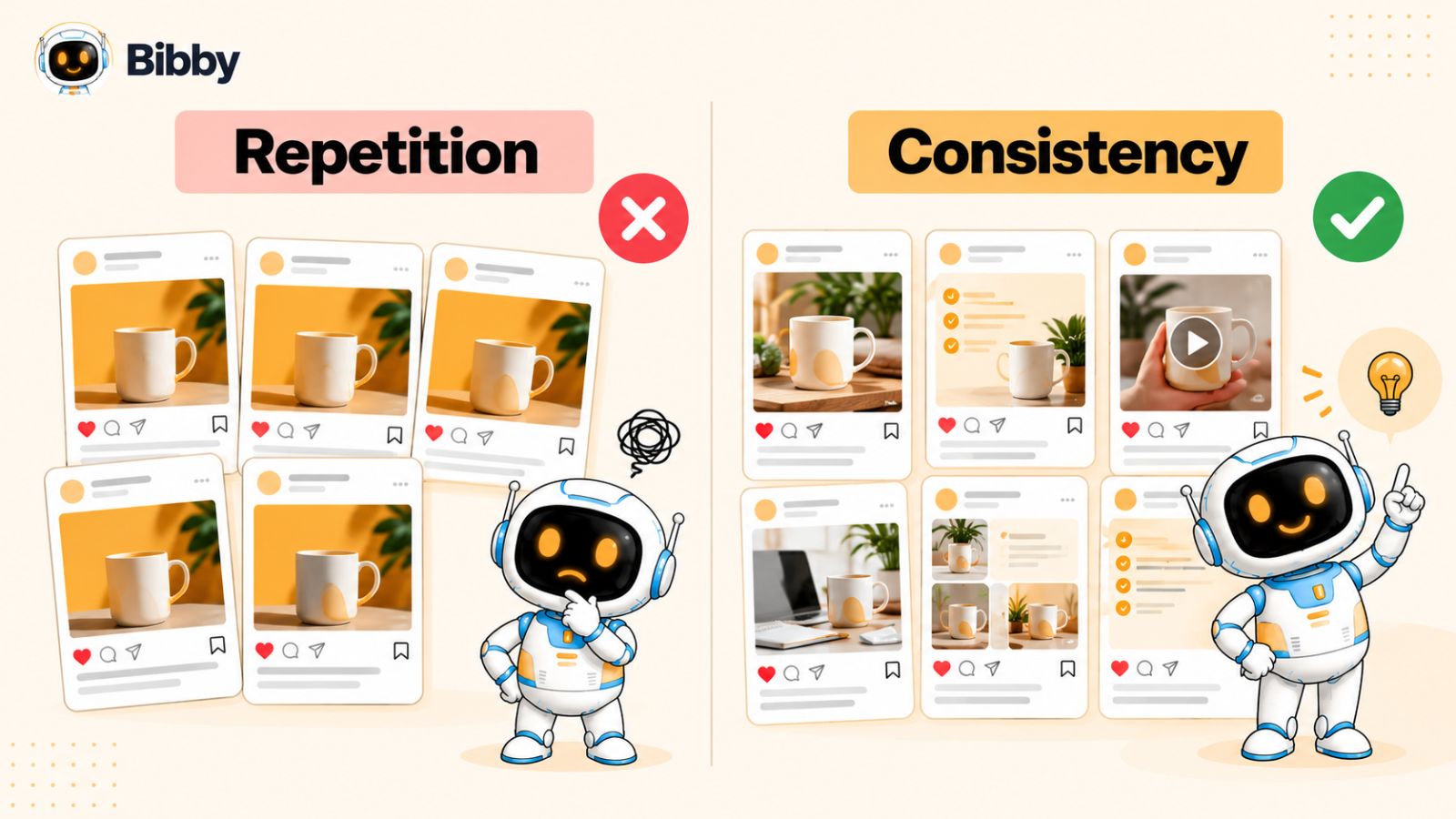
Repetition vs. consistency
Consistency and repetition are often confused.
Consistency means your audience can recognize what your brand stands for. Your tone, visual identity, core positioning, and key messages remain coherent across your content.
Repetition means you keep delivering substantially the same experience.
For example, a fitness brand could consistently focus on helping beginners become stronger. That is a positioning choice. But if every post tells beginners to "work out for 30 minutes a day" using the same before-and-after image and the same motivational CTA, the strategy has moved from consistency toward repetition.
The goal of a repetition audit is therefore not to eliminate repeated ideas. It is to identify unproductive repetition.
The hidden forms of repetition
Most social media audits focus on whether the same post has been published twice. That is only the most obvious form of repetition.
A more useful audit looks at several layers:
- Topic repetition: You keep discussing the same subject.
- Message repetition: Different posts make essentially the same argument.
- Hook repetition: Your posts repeatedly begin with similar attention-grabbing statements.
- Format repetition: Your feed relies heavily on one type of post, such as carousels or talking-head videos.
- Visual repetition: The same layouts, images, colors, compositions, or creative concepts appear again and again.
- CTA repetition: Almost every post asks the audience to perform the same action.
- Audience-angle repetition: You keep speaking to the same problem, motivation, objection, or level of awareness.
This is why a social media feed can look busy while still feeling repetitive.
You may have published 30 posts in the last month, but if those posts revolve around five ideas presented in nearly identical ways, you effectively have a much smaller content library than your publishing volume suggests.
Why repetition becomes difficult to notice
There is another reason this problem can go undetected: you know your content better than your audience does.
As the person creating or managing a brand's social media, you see every post. You remember the caption you wrote last Tuesday, the carousel from two weeks ago, and the video you published last month.
Your audience usually does not.
This creates the opposite problem, too. Because you are so close to the content, you may assume that changing a few words makes a post meaningfully different when an outside viewer would immediately recognize the same underlying idea.
A repetition audit creates distance between you and your content. Instead of asking, "Have we technically posted this before?" you start asking a more valuable question:
"If I were seeing this brand for the first time, how many of these posts would actually feel different?"
That question becomes the foundation for finding repetition before it turns your social media strategy into a cycle of saying the same thing in slightly different words.
How to Know When Your Social Media Content Is Becoming Repetitive
The easiest way to spot repetitive social media content is not to look for duplicate posts. It is to look for patterns that keep appearing across your content.
A post can be completely original and still contribute to a repetitive content strategy. If your last 20 posts repeatedly use the same ideas, hooks, formats, visuals, and calls to action, changing the wording does not necessarily create meaningful variety.
Here are the most important warning signs to look for during a social media content repetition audit.
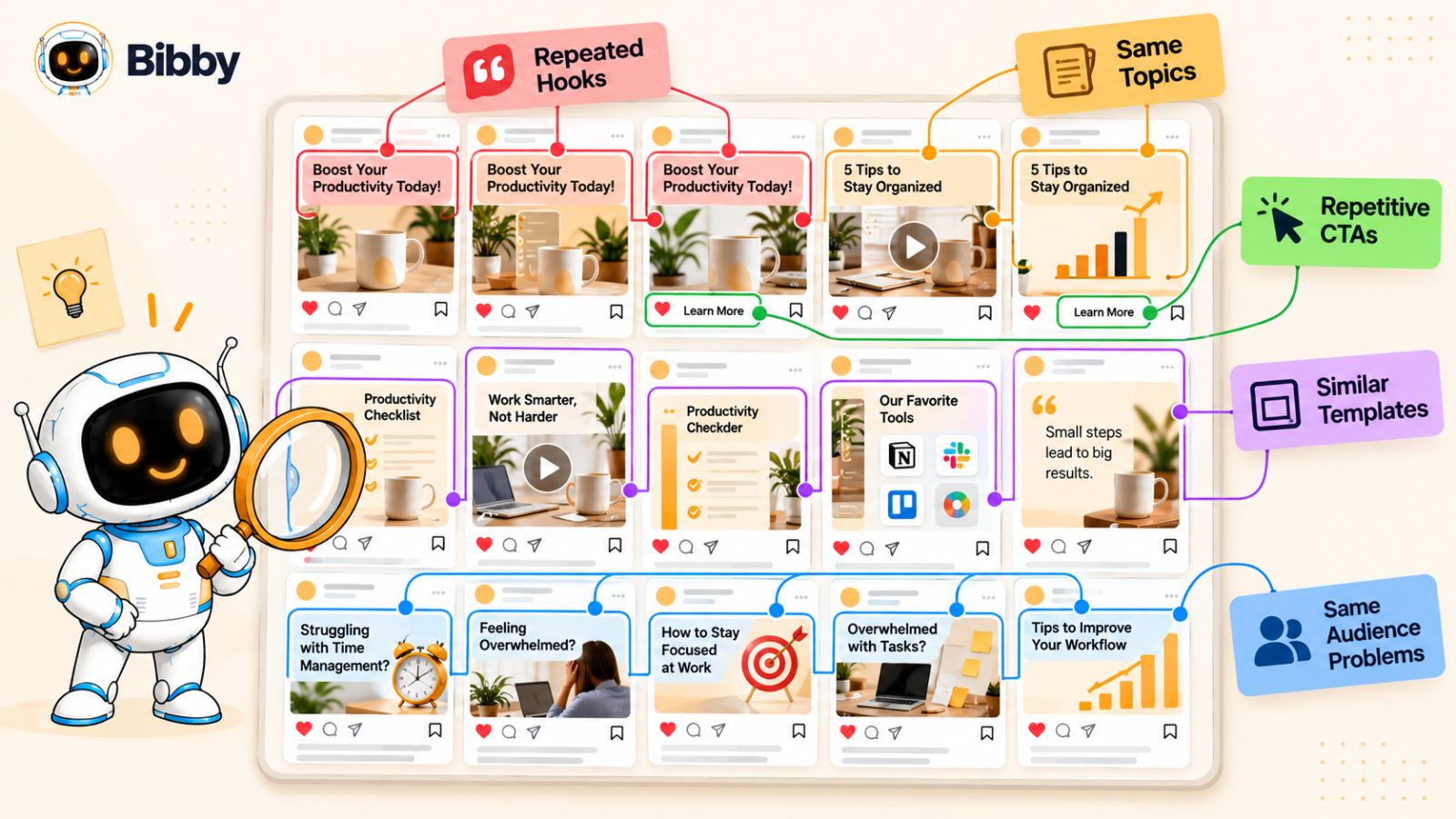
1. You keep explaining the same idea
The first warning sign is obvious once you know what to look for: different posts keep making the same point.
For example, a marketing agency might publish:
- "Why your business needs a content strategy"
- "Stop posting without a content strategy"
- "The reason your social media isn't growing"
- "You need a strategy before you post"
- "Random posting is killing your results"
These are different headlines, but they may all deliver essentially the same message.
Look beyond the wording and ask:
What is this post actually teaching the audience?
If you repeatedly arrive at the same answer, you have message repetition.
2. Your hooks start sounding interchangeable
Hooks are particularly easy to repeat because successful formats tend to get reused.
Imagine the first line of your posts repeatedly follows patterns such as:
"Stop doing X if you want Y."
"Here's why your X isn't working."
"You don't need X. You need Y."
There is nothing inherently wrong with these formulas. They become a problem when your audience can predict the structure of your next post before reading it.
During your audit, compare the first sentence or opening three seconds of your recent posts. Don't just compare individual words. Compare the idea and structure of the hook.
3. You rely on the same content format
Publishing only one format can create repetition even when your topics vary.
For example, a brand might publish:
- Monday: carousel
- Wednesday: carousel
- Friday: carousel
- Monday: carousel
- Wednesday: carousel
The subjects may change, but the audience receives essentially the same content experience every time.
This does not mean you need to use every format available. It means your format mix should support your strategy rather than becoming an accidental publishing habit.
Depending on the platform and audience, that could include images, carousels, short-form videos, longer videos, stories, text-based posts, or other native formats.
4. Your visuals follow the same pattern
Visual repetition is often overlooked because marketers tend to audit captions separately from creative.
Look at your last 20 or 30 posts as a grid rather than reading them individually.
Do you see the same:
- image composition?
- text placement?
- background style?
- stock-photo style?
- thumbnail structure?
- template?
- facial pose?
- product angle?
- color treatment?
A recognizable visual identity is valuable. But there is a difference between brand recognition and visual monotony.
Your audience should be able to recognize your content without feeling that every post came from the same template.
5. Your calls to action rarely change
CTAs can create repetition even when the content itself changes.
If every post ends with "Comment below," "Book a demo," "Learn more," or "Follow for more," your audience eventually becomes accustomed to the same behavioral request.
Review your CTAs alongside your content objectives.
Some posts may be better suited to:
- saving the post
- sharing it with someone
- commenting with an opinion
- visiting a resource
- watching another piece of content
- trying a product
- joining a conversation
- simply consuming the information
Not every post needs a CTA, either. Sometimes the most natural action is simply to let useful content stand on its own.
6. You keep talking to the same audience problem
This is a subtler form of repetition.
Suppose a SaaS company creates content for small business owners. It may have several different topics available:
- getting more leads
- reducing administrative work
- improving customer retention
- training employees
- saving money
- improving reporting
But if 80% of its content talks about generating more leads, the content may feel repetitive even though every post contains a different tip.
The issue is not just what you are saying. It is which part of your audience's world you are talking about.
A strong content strategy gives the audience multiple ways to understand the brand.
7. Your engagement starts becoming predictable
Audience behavior can provide another clue.
If the same type of post consistently gets the same type of response—or increasingly little response—it may be worth examining whether your content has become predictable.
That does not mean declining engagement automatically proves repetition. Platform distribution, audience changes, topic relevance, creative quality, and many other factors can affect performance.
Instead, use performance as a signal that tells you where to investigate further.
The simplest test: remove the captions
There is one surprisingly effective way to test for repetition.
Take your recent posts and remove the captions. Look only at the headlines, thumbnails, images, or opening frames.
Then ask:
"Would these still look like meaningfully different pieces of content?"
Next, do the opposite. Hide the visuals and read only the core ideas behind the captions.
If both versions look remarkably similar, you probably have a repetition problem.
The purpose of this exercise is not to make every post radically different. Your brand needs recurring themes and recognizable positioning. The objective is to find where repetition is happening without adding meaningful value.
Once you know what to look for, you can move from subjective judgment to a systematic repetition audit.
The Repetition Audit: A Step-by-Step Method
Knowing that your social media content feels repetitive is useful. Knowing exactly where the repetition occurs is much more useful.
A repetition audit gives you a structured way to examine your recent content and identify patterns that are difficult to see when you evaluate posts one at a time.
You do not need sophisticated analytics software to begin. A spreadsheet containing your recent posts is enough.
The important part is to evaluate the content from several different angles rather than judging each post individually.
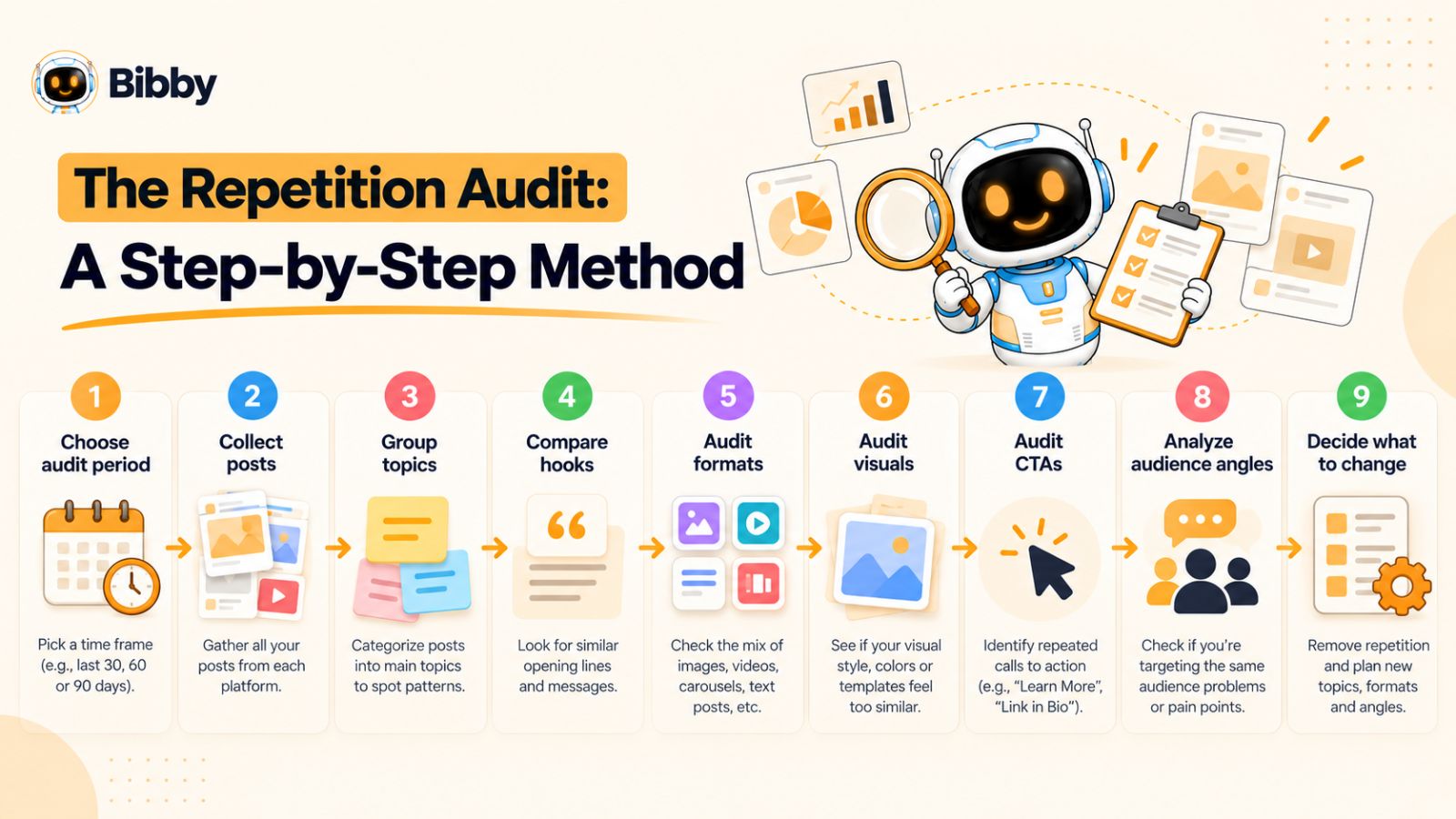
Step 1: Choose a realistic audit period
Start with a defined period rather than reviewing everything your brand has ever published.
For most brands, the previous 30 to 90 days provides enough content to reveal meaningful patterns.
If you publish several times a day, 30 days may give you plenty of material. If you publish only a few times a week, use a longer period so your sample is large enough to be useful.
Record:
- Date
- Platform
- Post URL
- Content format
- Main topic
- Core message
- Hook
- CTA
- Target audience or audience problem
- Visual concept
You are creating a content inventory before you start judging it.
Step 2: Group posts by topic
Now ignore the dates and group your posts according to what they are actually about.
For example, a social media software company might discover that its last 50 posts break down like this:
| Topic | Number of posts |
|---|---|
| Saving time | 16 |
| Social media growth | 12 |
| Content planning | 9 |
| AI features | 7 |
| Customer stories | 4 |
| Industry insights | 2 |
The numbers immediately reveal something that individual post reviews may not.
The company technically published 50 different posts, but 28 of them revolve around just two themes.
That does not automatically mean the strategy is wrong. A core topic may legitimately deserve more attention. But now you have something specific to investigate.
Step 3: Identify the core message of every post
This is one of the most important steps in the entire audit.
Write down the one thing the audience is supposed to understand after consuming each post.
Do not copy the caption. Summarize the idea.
For example:
- "Batch your content to save time."
- "Planning content reduces stress."
- "Create posts in advance."
- "Schedule your social media ahead of time."
These may look like four separate posts in your content calendar.
At the message level, however, they are extremely similar.
Once you reduce posts to their underlying ideas, repetition becomes much easier to spot.
Step 4: Compare your hooks
Next, create a separate list of your hooks.
Look for repeated:
- opening phrases
- questions
- headline structures
- emotional triggers
- claims
- contrarian statements
- list formats
You may discover that your team has unconsciously developed a favorite formula.
For example, if 40% of your posts begin with some variation of "Stop doing X," the issue is not necessarily that the formula is bad. The issue is that your audience may be receiving too much of the same opening experience.
Step 5: Audit your formats
Create a simple format count.
You might find:
- 45% carousels
- 30% single-image posts
- 20% short-form videos
- 5% other formats
Then compare that distribution with your strategy.
A heavily skewed format mix is not automatically a problem. Some platforms or audiences may strongly favor particular formats.
The question is whether your format selection is intentional or habitual.
If you are publishing carousels because they are the right format for your audience, that is strategy.
If you are publishing carousels because your template makes them easiest to produce, that is a workflow problem.
Step 6: Examine your visual repetition
Now review the actual creative.
Put your posts next to each other rather than scrolling through them individually.
Look for repeated:
- templates
- layouts
- image types
- compositions
- typography patterns
- product screenshots
- poses
- backgrounds
- thumbnail structures
This is where a visual content board can be particularly useful.
You may discover that your captions are diverse while your feed still looks remarkably repetitive.
Step 7: Audit your CTAs
Create another column for your calls to action.
Then count them.
You might find that 70% of your posts ask people to click something, while only a handful encourage discussion, saving, sharing, or other forms of engagement.
Again, there is no universal ideal percentage.
The purpose of the exercise is to determine whether your CTA strategy reflects the different jobs your content is supposed to perform.
Step 8: Look for audience-angle repetition
Now ask a harder question:
Are we repeatedly addressing the same problem from the same perspective?
Imagine you sell accounting software.
You could create content around:
- saving time
- avoiding errors
- preparing for tax season
- managing cash flow
- understanding financial reports
- reducing administrative work
- making better business decisions
But if nearly every post approaches accounting through "save time," you are leaving other useful perspectives unexplored.
Try categorizing posts by the audience need they address rather than simply the product feature they mention.
This often exposes repetition that topic-based audits miss.
Step 9: Decide what to keep, refresh, combine, or retire
The final step is turning observations into decisions.
Put each repeated content pattern into one of four categories:
Keep: The repetition is intentional and strategically valuable.
Refresh: The core idea is useful, but the angle, format, example, or creative needs to change.
Combine: Several posts communicate nearly the same idea and could be consolidated into a stronger resource.
Retire: The idea has been exhausted, is no longer relevant, or consistently fails to provide meaningful value.
This prevents the audit from becoming an exercise in eliminating everything that appears more than once.
The goal is not maximum variety
A common mistake is to finish an audit and conclude that every future post needs to be completely different.
That creates a different problem: a fragmented content strategy.
Your audience should encounter recurring themes. Your brand should have recognizable ideas. Your best concepts should be repeated in ways that help more people understand them.
The goal is meaningful variation.
You want the same strategic message to have enough different angles, examples, formats, and contexts that it continues to provide value rather than feeling like a copy of something the audience has already seen.
And once you have completed this audit, you can go one level deeper by separating repetition into its major categories—which makes it much easier to determine exactly what needs to change.
The 5 Types of Social Media Repetition You Should Audit
Not all repetition is the same.
Two posts can look completely different but communicate the same message. Conversely, two posts can use the same format while serving completely different purposes.
That is why a useful social media repetition audit should not rely on a single question such as, "Have we posted this before?"
Instead, examine five different layers of repetition: message, format, creative, CTA, and audience angle.
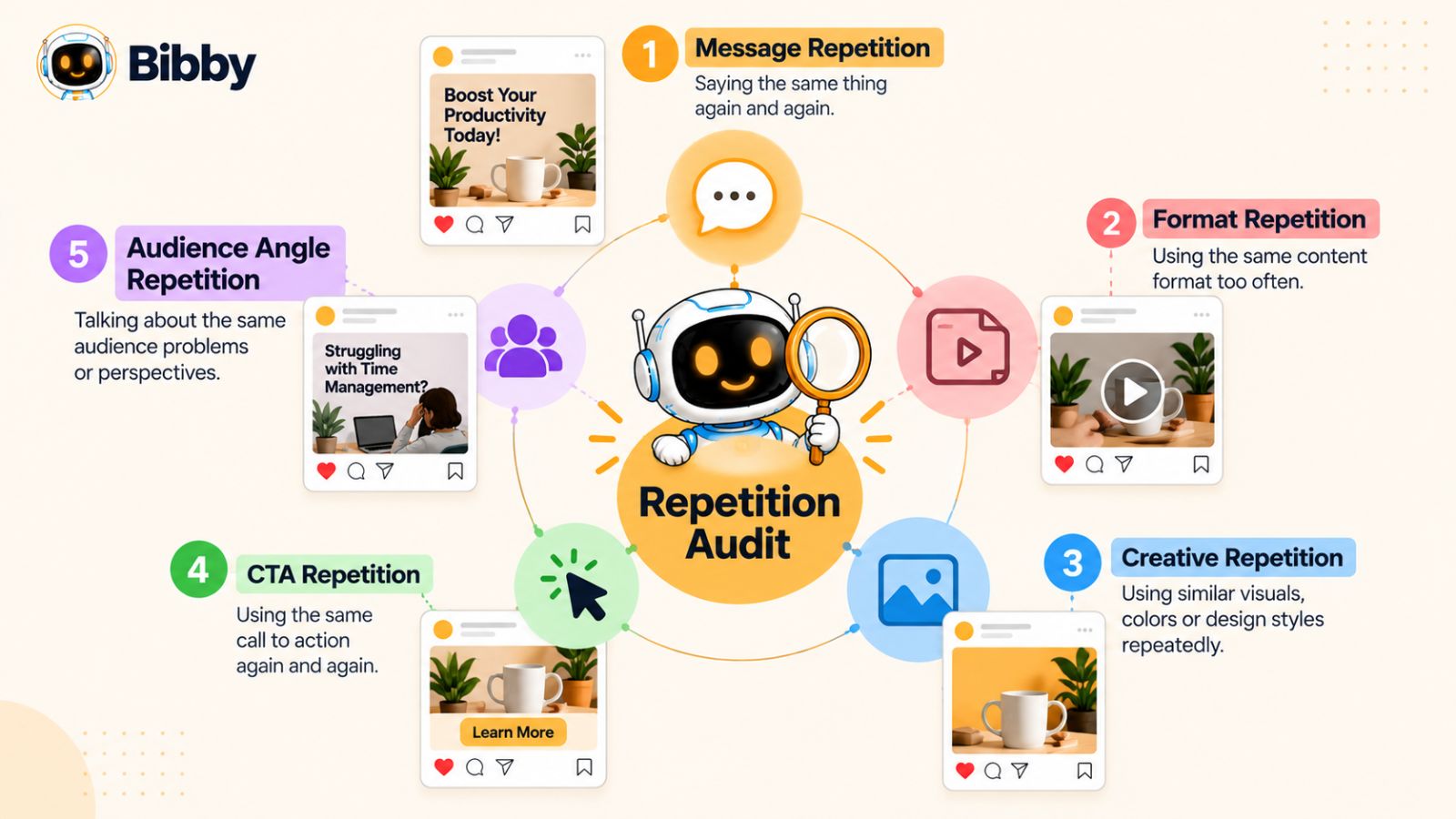
1. Message repetition
Message repetition occurs when multiple posts communicate essentially the same idea, even when the wording changes.
For example:
- "Save hours every week with automation."
- "Automate repetitive tasks and get your time back."
- "Stop wasting time on manual work."
- "Let automation handle the busywork."
These could easily become four separate social media posts. But from the audience's perspective, they may deliver the same fundamental promise.
Message repetition is particularly common when a company has a strong value proposition. Once marketers discover a message that performs well, they naturally want to repeat it.
That instinct is not wrong.
The problem is repeating the same argument without adding a new reason to care.
When auditing message repetition, ask:
"What new information does the audience get from this post compared with the previous three?"
If the answer is "not much," you may need a new angle.
2. Format repetition
Format repetition occurs when you repeatedly deliver content in the same structural form.
For example, your publishing schedule might look like:
- Monday — carousel
- Wednesday — carousel
- Friday — carousel
- Monday — carousel
- Wednesday — carousel
Even if the topics are different, the experience becomes predictable.
Format repetition is not inherently bad. If carousels consistently communicate your ideas better than other formats, there is a legitimate reason to use them frequently.
The audit question is therefore not:
"Am I using this format too often?"
It is:
"Is this format being used because it is strategically effective, or because it is simply the easiest format for us to produce?"
That distinction matters.
3. Creative repetition
Creative repetition happens when the visual experience becomes too similar.
This can happen even when your content topics are diverse.
Imagine a brand publishes 30 different educational posts, but every post uses:
- the same background
- the same headline placement
- the same stock-photo style
- the same character illustration
- the same template
- the same product screenshot
The content may be strategically varied while the feed still feels monotonous.
Creative consistency is important for brand recognition. But your visual system should ideally provide recognition without requiring sameness.
One useful solution is to create a small family of visual systems rather than one universal template.
For example, educational posts could have one visual treatment, customer stories another, data-driven posts another, and opinion-based content another.
4. CTA repetition
Your call to action is another potential source of content fatigue.
If every post ends with:
"Book a demo today."
or:
"Follow for more tips."
the CTA itself eventually becomes invisible.
Your CTA should reflect what you want the audience to do and what the content naturally invites them to do.
A tutorial might encourage saving.
An opinion post might encourage discussion.
A case study might encourage someone to explore a related resource.
A product-focused post might encourage a trial or demonstration.
Some posts may not need an explicit CTA at all.
During your audit, calculate how often each CTA appears and ask whether your audience is repeatedly being asked to perform the same action.
5. Audience-angle repetition
This is arguably the most important—and most frequently overlooked—type of repetition.
Audience-angle repetition happens when you repeatedly discuss a topic from the same perspective.
Consider a social media scheduling tool.
You could discuss:
- saving time
- reducing manual publishing
- planning campaigns
- maintaining consistency
- coordinating multiple platforms
- analyzing performance
- creating content faster
- managing content as a team
- avoiding missed publishing opportunities
Now imagine 80% of your posts talk about "saving time."
The topic may technically be social media management, but the audience is repeatedly being exposed to the same benefit.
Changing the audience angle gives you much more room to explore the same subject.
You could talk about the problem from the perspective of:
- a solo creator
- a social media manager
- a small business owner
- an agency
- a marketing team
- a creator managing multiple platforms
The underlying product or topic does not need to change. The reason the audience should care changes.
How the five types interact
These categories are most useful when you analyze them together.
Suppose you publish two posts about content scheduling.
The first is a carousel explaining how scheduling saves time.
The second is a short video showing a social media manager scheduling a week's worth of posts.
They share a topic and message, but their format, creative, and presentation are different.
That might be healthy repetition.
Now imagine a third post that says, "Stop wasting time posting manually," uses the same visual template, repeats the same time-saving argument, and ends with the same CTA.
The problem is no longer one repeated element. Several layers are overlapping.
That is the pattern your repetition audit should uncover.
The objective is not to eliminate every overlap. It is to identify clusters of overlap where multiple dimensions of your content are repeating simultaneously.
Once you can see those clusters, the next question becomes much more practical: how much repetition is actually too much?
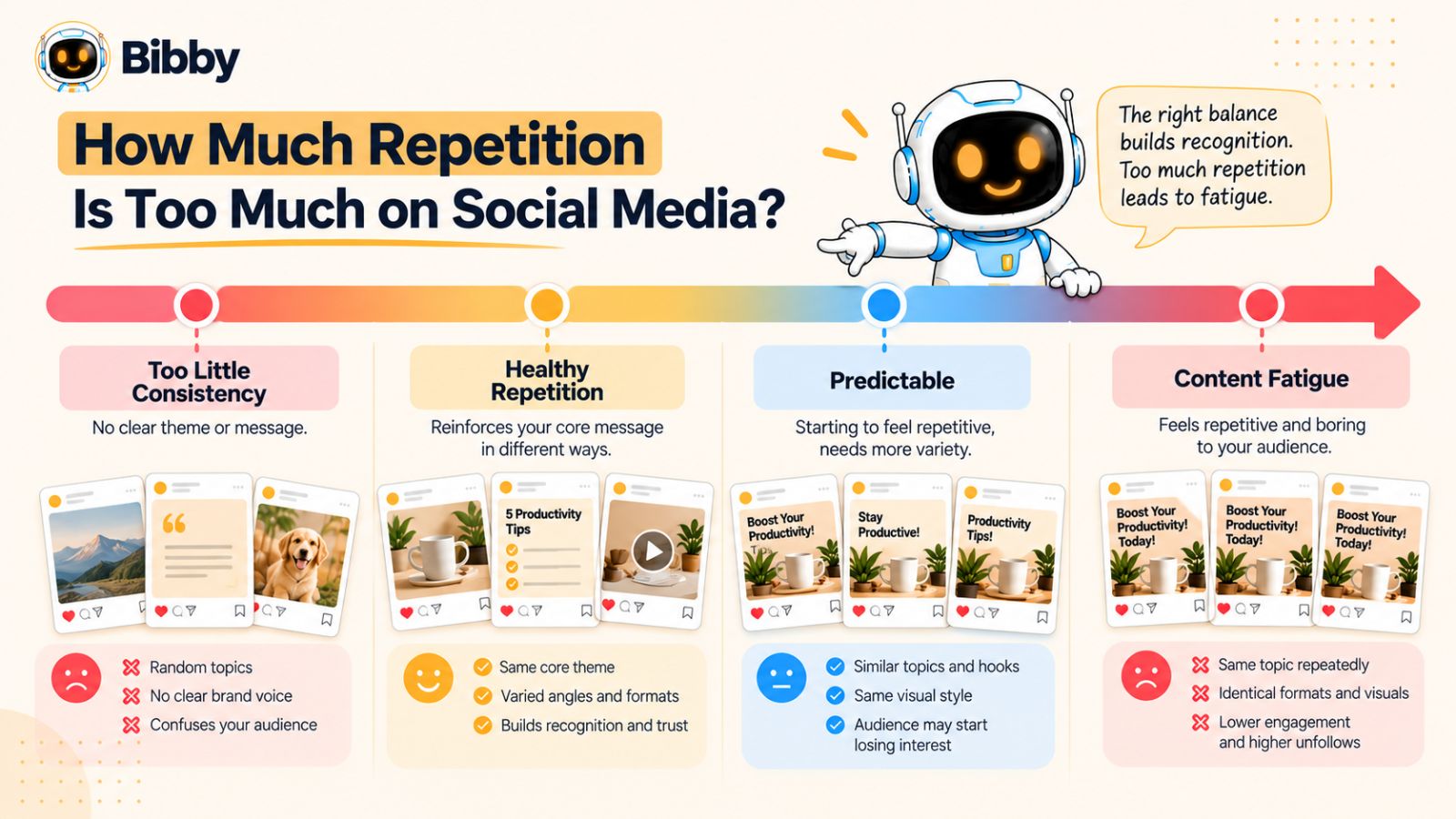
How Much Repetition Is Too Much on Social Media?
There is no universal rule that says you can repeat an idea three times, five times, or ten times before your social media content becomes repetitive.
The right amount depends on your audience, publishing frequency, platform, content type, message, and how much new value each repetition provides.
That is why rules such as "never repeat yourself" are just as unhelpful as "repeat your best post every week."
The better question is:
How much new value does each repetition create?
Frequency and repetition are not the same thing
One of the easiest mistakes is confusing how often you publish with how often you repeat an idea.
Suppose you publish five posts about productivity in one month.
That might be perfectly reasonable if each post approaches productivity differently:
- A practical workflow for saving time
- A common productivity mistake
- A customer story
- A data point about wasted time
- A step-by-step tutorial
The topic repeats, but the audience experience changes.
Now imagine five posts that all say:
"Save time by automating your social media."
The publishing frequency is identical, but the repetition is much stronger.
This is why a repetition audit should measure conceptual overlap, not simply count how many times a keyword appears.
Repetition can actually improve marketing
Repetition has an important role in communication.
People do not see every post you publish. They may discover your brand for the first time today, miss your post tomorrow, or only remember part of what they saw last week.
Important messages therefore need to come back.
A company should not abandon its strongest positioning simply because it mentioned it last month.
Instead, repeat the strategic idea while changing the way the audience encounters it.
For example, a social media scheduling brand could communicate the value of planning content through:
- a tutorial showing how to plan a week
- a customer story about reducing publishing workload
- a comparison between manual and scheduled workflows
- a checklist for preparing content in advance
- an opinion post about why consistency is difficult without systems
The underlying idea is similar. The value delivered by each post is different.
The diminishing-return problem
Repetition becomes problematic when each additional version contributes less value than the one before it.
Think of your content like a conversation.
The first time you explain an idea, the audience learns something.
The second time, they may understand it better.
The third time, a new example may make the idea relevant to someone who missed the earlier explanation.
But eventually, another version may simply confirm what the audience already knows.
That is the point where repetition begins producing diminishing returns.
A useful audit question is:
"If someone has seen our last five posts, what does this post give them that they did not already get?"
If you cannot answer that clearly, the post may need a stronger angle.
Consider audience awareness
The same repetition can also have different effects depending on how familiar your audience is with your brand.
Someone discovering your company for the first time needs foundational information.
A long-time follower may already understand your basic value proposition and need more advanced material.
This means your content should not assume that everyone is at the same stage.
For example, a beginner-level post might explain:
"What is social media scheduling?"
A more experienced audience might be ready for:
"How to build a multi-platform content system without creating duplicate content."
Both belong to the same broad topic, but they serve different information needs.
A practical repetition threshold
Rather than setting a rigid numerical limit, use three questions to evaluate repeated ideas:
1. Is the core message repeated?
If yes, identify what is different.
2. Is the audience receiving new information, context, or perspective?
If no, the post probably needs work.
3. Does the repetition serve a strategic purpose?
For example, reinforcing a core brand promise may be intentional. Reusing a template because nobody had time to create another one is not.
You can also use a simple traffic-light system:
Green: The idea is familiar, but the post adds meaningful value.
Yellow: The post overlaps significantly with recent content and needs a stronger angle.
Red: The post essentially repeats a recent message, format, and presentation without adding anything meaningful.
This approach is much more useful than declaring a universal repetition limit.
When repeating your best content is smart
There is one important exception to remember: high-performing content deserves to be revisited.
If a post performs exceptionally well, that is evidence that the topic, framing, or problem resonated with your audience.
The answer is not necessarily to archive the idea forever.
Instead, deconstruct why it worked.
Was it:
- the topic?
- the hook?
- the timing?
- the format?
- the example?
- the opinion?
- the emotional appeal?
- the audience problem?
Then create a new piece of content that captures the underlying insight without simply reproducing the original.
This is especially useful when managing content across multiple platforms. A strong idea can often be transformed into a carousel, short video, story, text post, or longer educational piece rather than copied word-for-word everywhere.
The real goal: familiar, not predictable
The healthiest social media strategy sits somewhere between two extremes.
At one end, every post is completely unrelated to the previous one. The account feels random, and the audience has difficulty understanding what the brand stands for.
At the other end, every post reinforces exactly the same message in exactly the same way. The account becomes predictable.
The goal is familiarity without predictability.
Your audience should recognize your themes, expertise, and point of view while still having a reason to stop and pay attention to the next post.
That is the standard your repetition audit should ultimately measure.
How to Build a Social Media Content Repetition Score
A repetition audit becomes much more useful when you can compare posts against one another instead of relying entirely on instinct.
You do not need a complicated algorithm. A simple scoring system can help you identify where your content is overlapping and which patterns deserve attention first.
The goal is not to produce a scientifically perfect number. The goal is to create a consistent way to spot repetition.
Start with five repetition dimensions
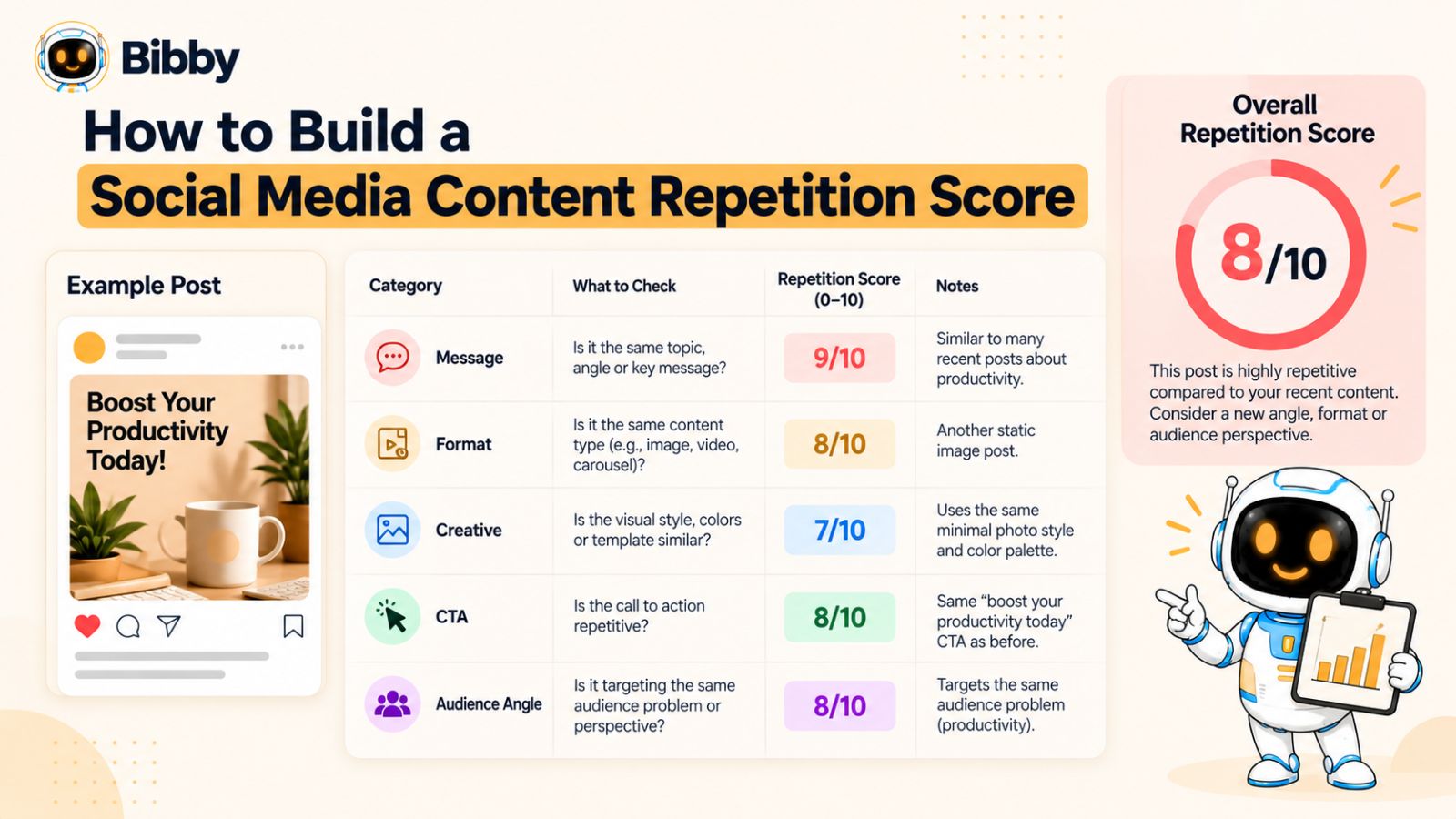
For each new post, score its similarity to your recent content across five dimensions:
| Dimension | What to compare |
|---|---|
| Message | Is the core idea substantially the same? |
| Format | Is the content delivered in the same format? |
| Creative | Does it use a similar visual treatment? |
| CTA | Does it ask the audience to do the same thing? |
| Audience angle | Does it address the same need or perspective? |
You can score each dimension from 0 to 2:
- 0 = Little or no overlap
- 1 = Some overlap
- 2 = Strong overlap
That gives every post a potential repetition score from 0 to 10.
Example: scoring a new post
Imagine a social media software company publishes a carousel about scheduling posts in advance.
Its previous three posts included:
- a carousel about scheduling a week's content
- a graphic about saving time through scheduling
- a video demonstrating scheduled publishing
You might score the new post like this:
| Dimension | Score | Reason |
|---|---|---|
| Message | 2 | Strongly overlaps with recent scheduling content |
| Format | 2 | Another carousel |
| Creative | 1 | Similar educational design, but different visuals |
| CTA | 1 | Similar call to action |
| Audience angle | 2 | Again focused on saving time through scheduling |
| Total | 8/10 | High overlap |
An 8/10 does not automatically mean "do not publish."
It means the post deserves another look.
Could you change the audience angle? Could the same idea become a customer story? Would a short video demonstrate something the carousel cannot?
The score tells you where to investigate. It does not make the strategic decision for you.
How to interpret the score
You can use a simple framework:
0–3: Low repetition
The post is sufficiently different from recent content.
4–6: Moderate repetition
Some overlap exists. Consider whether the repeated elements are intentional and whether the post adds enough new value.
7–10: High repetition
Multiple dimensions overlap. Look for opportunities to change the message, format, creative treatment, CTA, or audience perspective before publishing.
The thresholds are guidelines rather than universal rules.
A brand publishing highly educational content may naturally have more topic overlap than an entertainment account. A product launch may intentionally create several posts around the same message.
Context matters.
Measure patterns across your content, not just individual posts
The bigger benefit comes when you score a collection of posts.
Suppose you audit 30 posts and discover:
- Average message overlap: 1.7
- Average format overlap: 1.2
- Average creative overlap: 1.6
- Average CTA overlap: 1.4
- Average audience-angle overlap: 1.8
The overall score tells you something useful.
Your biggest problem may not be your formats or CTAs. It may be that your content repeatedly addresses the same audience need.
That changes your solution.
Instead of creating ten new templates, you might need to expand your content pillars or identify additional audience problems worth discussing.
Look for clusters, not just averages
An average can hide the most important information.
Imagine your average repetition score is 4.8/10. That sounds manageable.
But perhaps eight consecutive posts score between 7 and 9.
That cluster matters much more than the overall average.
Look for sequences such as:
Post 1 → 4/10
Post 2 → 5/10
Post 3 → 7/10
Post 4 → 8/10
Post 5 → 9/10
You may have unintentionally created a content streak where the same idea keeps getting repeated.
This is why reviewing your posts chronologically is important even after calculating the scores.
Use the score to improve your content calendar
The most valuable use of a repetition score is not judging content after it has been published.
Use it while planning.
Before approving a new post, compare it with the previous five to ten pieces of content.
If the new post scores highly across several dimensions, ask:
"What can we deliberately change?"
You might keep the message but change the format.
Or keep the topic but change the audience angle.
Or keep the core idea but introduce a new example.
This turns repetition auditing into a Content planning tool, rather than a monthly post-mortem.
A simple rule for your team
If multiple people create content for your brand, you can make the process even simpler.
Before publishing, require every post to answer these five questions:
- What is the core idea?
- What recent post is most similar?
- What is different about this version?
- What new value does the audience receive?
- Why is this the right format for this idea?
If the creator cannot answer those questions, the post may not be ready.
This is particularly useful when content production becomes highly automated or distributed across a team. The more content you produce, the easier it becomes for similar ideas to slip through without anyone noticing.
A tool can help with the production side—generating captions, scheduling different formats, or organizing content across platforms—but the strategic judgment still comes from understanding what your audience has already seen.
The repetition score simply gives that judgment a structure.
And once you know where your repetition is coming from, the next challenge is more important: how do you fix it without throwing away the brand messages that are already working?
How to Fix Repetitive Social Media Content Without Losing Your Brand Message
Discovering repetition is only useful if you know what to do about it.
The obvious solution—"just create different content"—sounds simple but rarely works. Brands have a limited number of products, customer problems, differentiators, and areas of expertise. You cannot invent a completely new subject every time you publish.
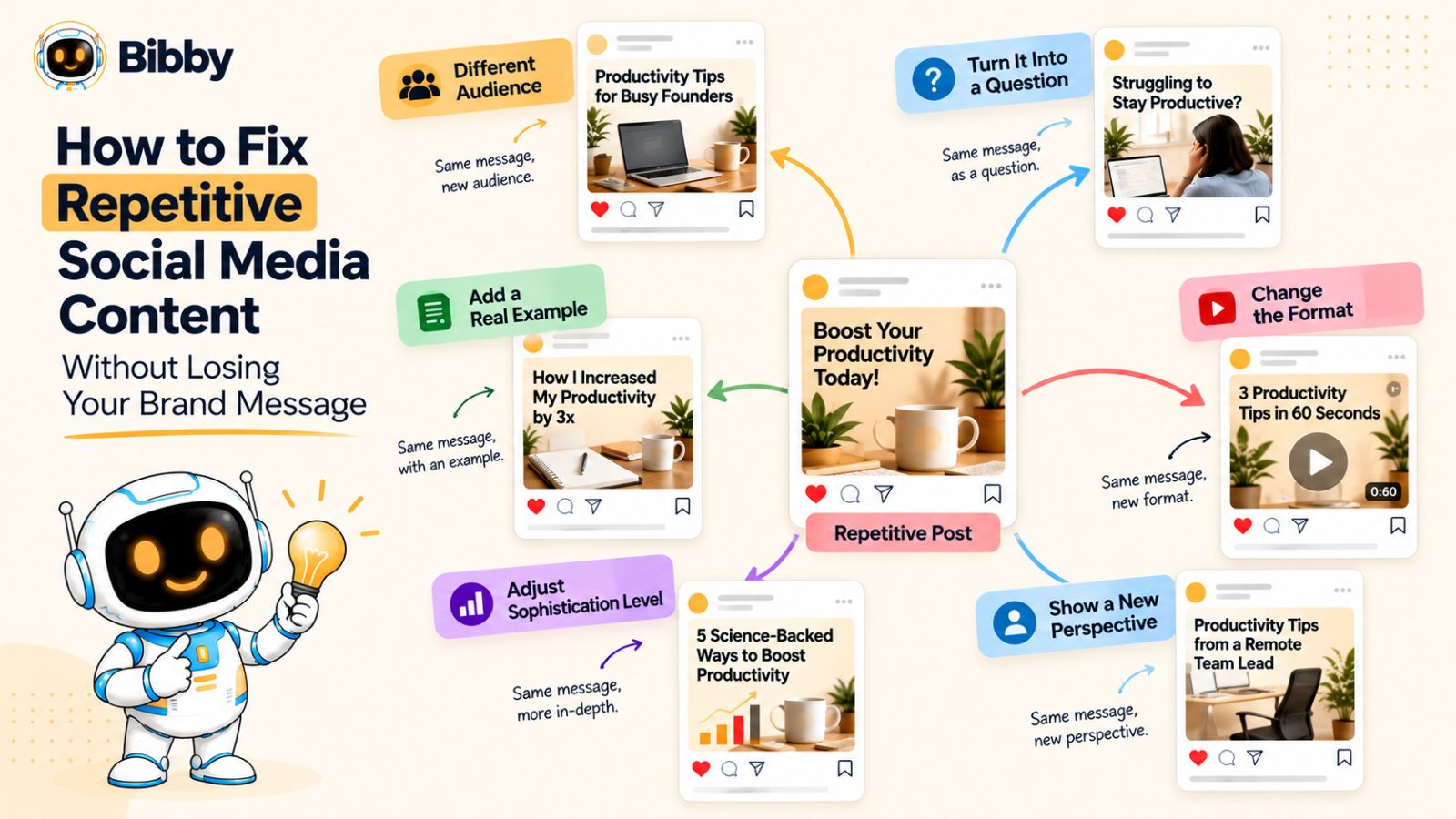
The better approach is to keep the strategic message while changing the way you explore it.
1. Change the audience angle
Start with the same topic, then ask how a different person might experience it.
For example, instead of repeatedly discussing social media scheduling as a time-saving tool, you could explore it from several perspectives:
- A solo creator trying to maintain consistency
- A small business owner managing marketing alone
- A social media manager handling several brands
- An agency coordinating multiple clients
- A marketing team managing several platforms
The underlying subject remains the same.
The audience's problem changes.
This gives you substantially more content without forcing you to abandon your core positioning.
2. Change the question you're answering
A topic becomes repetitive when every post answers the same question.
Instead of continually explaining what something is, move through different stages of audience understanding.
For example:
What: What is social media automation?
Why: Why would a business need it?
How: How does it work?
When: When should you use it?
Who: Who benefits most from it?
What if: What happens when you do it badly?
Comparison: How does it differ from manual publishing?
Troubleshooting: Why isn't your current workflow working?
The topic stays consistent while the information need changes.
3. Change the format
A strong idea does not have to remain trapped in the format in which it was originally created.
A detailed tutorial might become:
- a carousel
- a short video
- a checklist
- a story sequence
- a text-based opinion post
- a visual diagram
- a longer YouTube explanation
The important distinction is that you should adapt the idea to the format, not simply copy the same post everywhere.
A carousel might explain five steps.
A video might demonstrate those steps.
A story might ask the audience which step they struggle with.
A text post might challenge a common assumption about the process.
That is repurposing with transformation rather than duplication.
4. Change the level of sophistication
Not every member of your audience knows the same amount about your subject.
That gives you another way to revisit an important topic.
You might create:
Beginner: "What is a social media content calendar?"
Intermediate: "How to organize content pillars inside your calendar."
Advanced: "How to identify content gaps using performance and audience data."
The topic is related, but the value increases as the reader's understanding increases.
This is particularly useful for brands with audiences that include both newcomers and experienced professionals.
5. Replace generic advice with specific examples
Generic advice is one of the easiest forms of content to repeat.
"Be consistent."
"Know your audience."
"Create valuable content."
"Use strong hooks."
These statements can be useful, but publishing them repeatedly produces very little additional value.
Instead, make the advice concrete.
Show:
- an example
- a before-and-after
- a real workflow
- a mistake
- a hypothetical scenario
- a case study
- a comparison
- a step-by-step process
The more specific the content becomes, the easier it is to explore a familiar topic from a genuinely new angle.
6. Turn one idea into multiple perspectives
Suppose your core idea is:
"Scheduling social media content can reduce the amount of manual publishing work."
You could approach that idea through several different pieces of content:
The tutorial: How to schedule a week's posts.
The mistake: Why manually publishing every post creates unnecessary work.
The comparison: Manual publishing versus scheduled publishing.
The story: A hypothetical social media manager managing five accounts.
The checklist: What to prepare before scheduling content.
The opinion: Why consistency is often a systems problem rather than a motivation problem.
The workflow: How content moves from idea to scheduled post.
These posts share a strategic theme, but they are not interchangeable.
That is the distinction you want.
7. Build content around problems, not just products
Product-centered content can become repetitive quickly because the product has a finite set of features.
Problem-centered content gives you much more room.
Instead of repeatedly talking about a scheduling feature, explore the problems around social media management:
- inconsistent publishing
- content bottlenecks
- last-minute posting
- managing multiple platforms
- creating captions
- maintaining brand consistency
- coordinating campaigns
- repurposing content
- content approval
- planning ahead
A product can solve multiple problems. Your content should be able to explore those problems independently.
8. Use a content system that makes variety deliberate
Variety should not depend on remembering to "be creative."
Create rules that make variety part of the workflow.
For example, your content calendar might deliberately rotate:
- educational content
- opinions
- examples
- stories
- tutorials
- customer-focused content
- product education
- industry observations
You could also rotate audience angles and formats.
This creates a system where repetition becomes visible before it becomes a problem.
Tools that automate social media production can make this system easier to execute at scale. For example, a workflow such as Bibby can take media, generate captions based on a chosen posting style, and schedule content across multiple platforms. That can remove much of the repetitive operational work.
But automation does not replace the repetition audit.
If the underlying content strategy contains the same five ideas, automating the workflow simply helps you publish those five ideas faster.
The best use of automation is therefore to increase execution capacity while keeping strategic variety intentional.
9. Create variations before you need them
One of the best ways to avoid repetitive content is to stop creating every post from scratch.
When you develop an important content pillar, immediately brainstorm several possible angles.
For one topic, create:
- three audience perspectives
- three problems
- three formats
- three examples
- three hooks
- three CTAs
You now have a matrix of possibilities rather than one idea.
This makes your content calendar more resilient because you are not forced to use the same angle simply because it is the easiest one available.
The goal is not to say something completely new every day
Your brand should have ideas it returns to repeatedly.
The difference is that each return should give the audience another reason to care.
Same strategic territory. Different value.
That is the principle that allows brands to remain recognizable without becoming predictable.
And once you understand that distinction, the next question becomes especially important for modern social media teams: when does repurposing a successful idea become useful content, and when does it simply become repetition?
Content Repurposing vs. Repetitive Content: What’s the Difference?
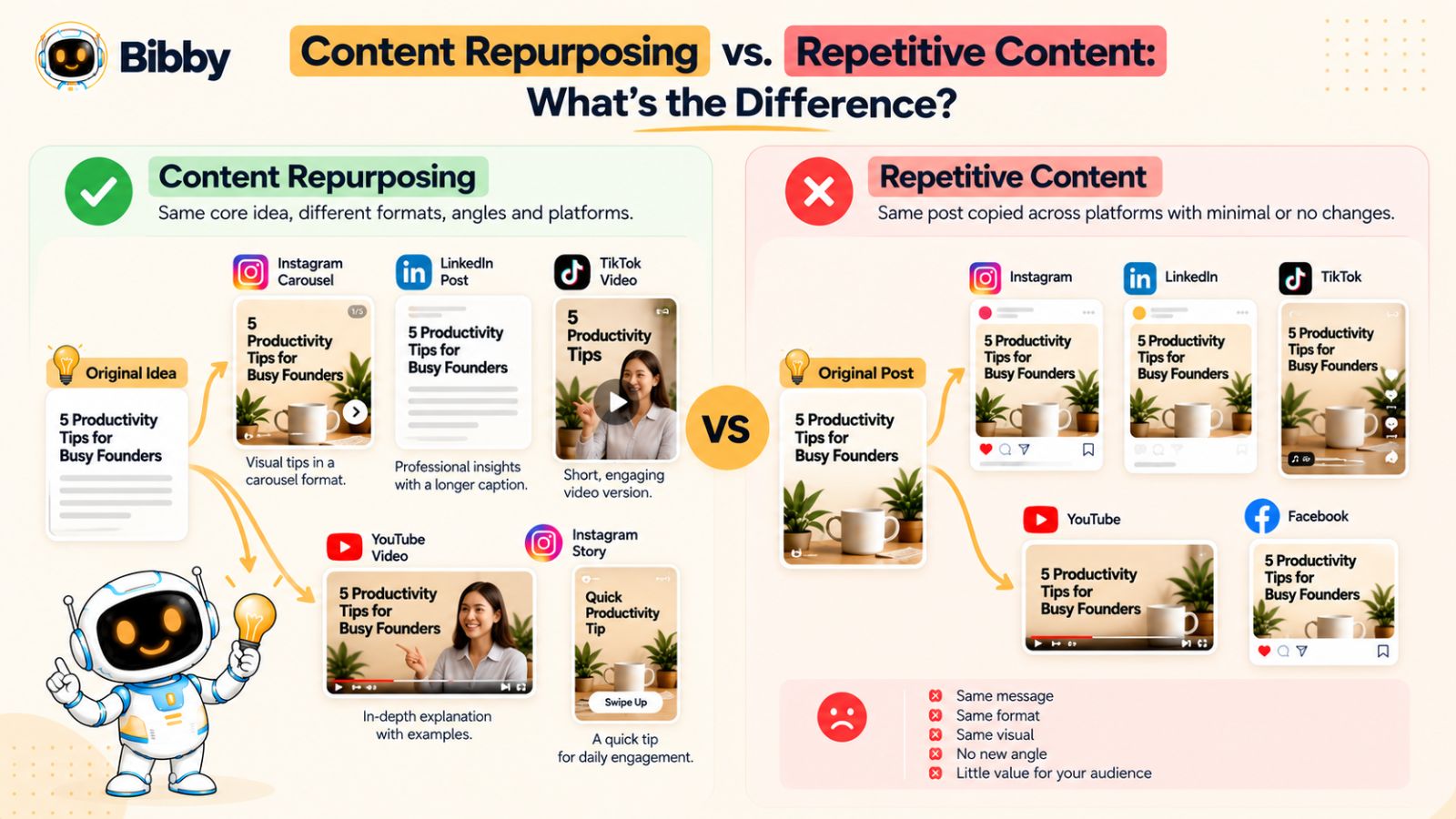
Repurposing content is one of the most efficient ways to maintain a consistent social media presence.
But there is a fine line between transforming an idea for a new context and simply publishing the same content again.
That distinction becomes increasingly important as brands publish across Instagram, Facebook, LinkedIn, YouTube, TikTok, and other platforms.
The fact that one idea appears more than once does not automatically make it repetitive.
What content repurposing actually means
Content repurposing means taking an existing idea, insight, or piece of content and adapting it into something useful for another context.
Imagine you publish a detailed article about creating a social media content calendar.
You could turn the same underlying knowledge into:
- a LinkedIn post explaining the biggest planning mistake
- an Instagram carousel showing the steps
- a TikTok explaining one common misconception
- a YouTube video demonstrating the workflow
- a Story sequence asking followers about their planning habits
The source idea is shared.
The content experience is not.
That is healthy repurposing.
What repetitive repurposing looks like
Now imagine copying the same caption, image, and message to every platform with almost no adaptation.
The content may be efficient to produce, but it is not necessarily optimized for the audience or context of each platform.
Even worse, if you repeatedly repost that same material to the same audience without adding anything new, you may eventually create content fatigue.
The issue is not that the idea has appeared before.
The issue is that the audience has no new reason to engage with it.
Use the "new value" test
A simple test can help you decide whether you are repurposing or repeating.
Ask:
"What is different for the person consuming this version?"
The answer could be:
- a different format
- a different example
- a different audience
- a different level of sophistication
- a different question
- a different platform context
- a different opinion
- a new piece of information
If the answer is simply, "The caption has been rewritten," you may not have changed enough.
One idea, multiple platform experiences
Different social platforms can also change how the same idea should be communicated.
For example, a LinkedIn audience may respond well to a professional observation or detailed argument.
Instagram may make a visual carousel or concise educational post more natural.
TikTok may favor a quick demonstration, story, or opinion delivered through video.
YouTube can support a deeper explanation, tutorial, comparison, or case study.
Facebook may support a mix of community-oriented, educational, visual, and conversational content.
The strategy is not to create an entirely different brand message for every platform.
It is to translate the idea into the language of the platform.
Repurposing can actually reduce repetition
Done correctly, repurposing can help solve a repetition problem rather than cause one.
Suppose you have one strong idea but only ever publish it as a promotional graphic.
That creates one narrow content experience.
Instead, you could turn the idea into several pieces:
Original idea: Why businesses struggle to maintain consistent social media publishing.
Educational version: Five reasons consistency breaks down.
Opinion version: Consistency is a systems problem, not a motivation problem.
Tutorial: How to build a weekly publishing workflow.
Story: A hypothetical example of a small business managing content manually.
Video: A demonstration of what a more efficient workflow looks like.
The central theme remains consistent, but the audience receives multiple forms of value.
The 80% rule is not the point
You may come across rules suggesting that a certain percentage of your content should be original or that you should wait a specific number of days before reposting something.
Treat those rules cautiously.
There is no universal interval that makes repetition acceptable.
What matters more is:
- how frequently your audience encounters the idea
- whether the content adds something new
- whether the format fits the platform
- whether the audience has already acted on or understood the idea
- whether the content serves a different stage of the customer journey
A strong piece of educational content may deserve to be revisited months later.
A weak promotional message may feel repetitive after two appearances.
Automation makes this distinction even more important
Modern social media tools make it easier to transform and distribute content at scale.
For example, a scheduling workflow can take one piece of media, generate different captions, select posting styles, and distribute content across several platforms at different times. A tool such as Bibby can handle much of that operational workflow, including scheduling images, carousels, videos, and Stories.
That efficiency is valuable—but it also creates a strategic risk.
When publishing becomes easier, content repetition can scale faster too.
The solution is not to avoid automation. It is to build variety into what you automate.
Instead of telling an automation system to repeatedly publish the same message, give it a broader content system:
- multiple content pillars
- multiple audience angles
- multiple formats
- multiple hooks
- multiple CTA types
- multiple examples
Then automation handles distribution and execution while the underlying strategy remains varied.
A simple rule to remember
Think of repurposing this way:
Repetition: "Here is the same thing again."
Repurposing: "Here is the same useful idea in a way that helps you differently."
That distinction allows you to get much more value from the ideas you have already created without making your social media feed feel like an endless loop.
And as AI becomes increasingly involved in creating and distributing social content, that distinction becomes even more important—because producing more content does not automatically mean producing more variety.
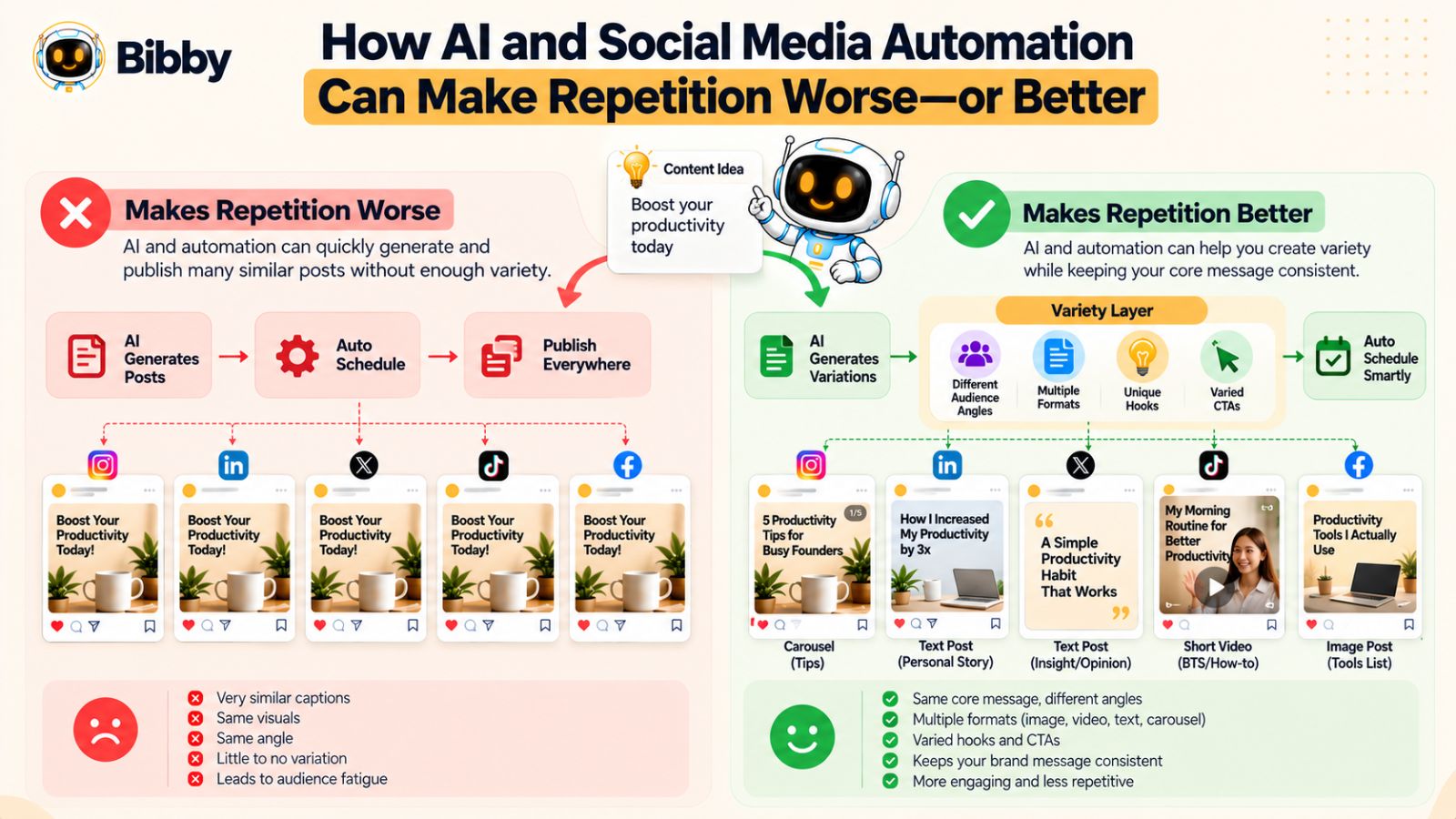
How AI and Social Media Automation Can Make Repetition Worse—or Better
AI and social media automation can solve one of the biggest problems in content marketing: the amount of repetitive work required to keep publishing consistently.
But there is an important catch.
Automation can make a good content system more efficient—or make a repetitive content system repetitive at a much larger scale.
If your strategy already relies on the same five ideas, automating the process does not create five new ideas. It simply makes those five ideas easier to publish.
That is why content variety needs to be designed before automation is applied.
The scale problem
Manual publishing naturally limits how much content a team can produce.
Someone has to:
- Create or select the media.
- Write the caption.
- Adapt the content for different platforms.
- Decide when to publish it.
- Upload everything.
- Repeat the process.
Because this takes time, teams may unconsciously repeat familiar formats and messages simply because they are easier to produce.
Automation removes much of that friction.
That is useful—but it introduces a new question:
Are you automating a thoughtful content system or automating a content habit?
The distinction can have a significant impact on repetition.
AI can create more content without creating more ideas
Generative AI is particularly good at producing variations.
You can ask it to rewrite a caption, generate alternative hooks, shorten a post, change the tone, or create another version of an existing idea.
But changing the wording does not necessarily change the content.
Consider these three statements:
- "Schedule your social media posts to save time."
- "Automate your social media publishing and free up your day."
- "Stop manually publishing every post and get more time back."
They sound different.
Strategically, they may be almost identical.
This is why AI-generated variation should not be confused with conceptual variation.
A better workflow is to ask AI to explore different dimensions of an idea:
- Find a new audience angle.
- Challenge the common assumption.
- Create a practical example.
- Explain the problem from the customer's perspective.
- Turn the concept into a tutorial.
- Compare two approaches.
- Identify a common mistake.
- Develop a counterargument.
Now AI is helping expand the idea rather than simply rewriting it.
Build variety into the workflow
A strong AI-assisted content workflow should include deliberate variation.
For example, before generating a month's content, define several dimensions:
Content pillars: What subjects will you cover?
Audience angles: Who are you speaking to?
Formats: How will each idea be presented?
Hooks: How will different posts earn attention?
Objectives: Is the post educating, entertaining, building trust, generating discussion, or supporting a conversion?
CTAs: What action, if any, should the audience take?
This creates a content matrix.
Instead of asking AI for 30 random posts, you can ask it to create content across specific combinations within that matrix.
The result is much less likely to become 30 slightly different versions of the same post.
Where a tool like Bibby fits
A social media workflow can become particularly repetitive when a marketer is managing several platforms at once.
Creating media, writing captions, adapting posts, scheduling them, and keeping track of publishing dates can consume a significant amount of time.
Tools such as Bibby are designed to reduce that operational workload. A workflow can start with uploading an image or generating one with AI, choosing a posting style, generating captions, and scheduling the resulting content across selected platforms.
That can be useful when the bottleneck is execution rather than strategy.
Bibby can also support different content formats, including images, carousels, videos, and Stories, which gives a content team more ways to distribute an idea.
Its chat-based workflow is another example of where AI can reduce operational friction. Instead of navigating every individual publishing task, a marketer can use conversation to work on things such as creating a brand kit, setting up a campaign, creating posts, or regenerating captions.
The important point, however, is that convenience does not replace editorial judgment.
If your repetition audit tells you that the last 20 posts all revolve around the same audience problem, generating another 20 posts more efficiently is not the solution.
The solution is to expand the content strategy first.
Then automation becomes genuinely useful because it allows you to execute that broader strategy without multiplying the manual workload.
AI can also help you detect repetition
Automation is not only useful for creating content.
AI can also be useful on the analysis side.
Given a structured collection of your previous posts, an AI system can help identify patterns such as:
- recurring topics
- similar hooks
- repeated claims
- overused CTAs
- repeated audience problems
- similar content structures
- frequently used phrases
- content pillars receiving too much or too little attention
This is where AI becomes particularly valuable for a repetition audit.
A human may remember individual posts, but it is difficult to mentally compare hundreds of captions and creative concepts.
AI can help surface patterns that would otherwise remain invisible.
The final decision should still belong to a human who understands the brand and audience. A repeated message might be intentional because it is central to the company's positioning. An apparently unusual post might be strategically important because it supports a campaign.
AI can identify the pattern.
It cannot automatically determine whether the pattern is strategically correct.
Automate execution, not judgment
A useful principle is:
Automate the repetitive work. Keep the strategic decisions deliberate.
Let automation help with:
- scheduling
- distribution
- caption variations
- media organization
- publishing workflows
- content production tasks
- cross-platform execution
But keep human attention on:
- positioning
- audience needs
- content priorities
- brand voice
- campaign strategy
- originality
- deciding what deserves to be repeated
This balance becomes increasingly important as publishing tools become more capable.
The goal of automation is not to fill every available publishing slot.
It is to make it easier to publish better, more varied content consistently.
And once your content is being produced and distributed efficiently, you need a repeatable way to check whether that efficiency is actually creating variety. That is where a practical repetition audit template becomes useful.
A Practical Social Media Repetition Audit Template
A repetition audit is most useful when it becomes part of your regular content workflow rather than a one-time exercise.
You do not need an expensive analytics platform to get started. A spreadsheet containing your recent posts can give you enough information to identify the biggest sources of repetition and decide what to change.
The following framework works particularly well as a 30-day social media content audit.
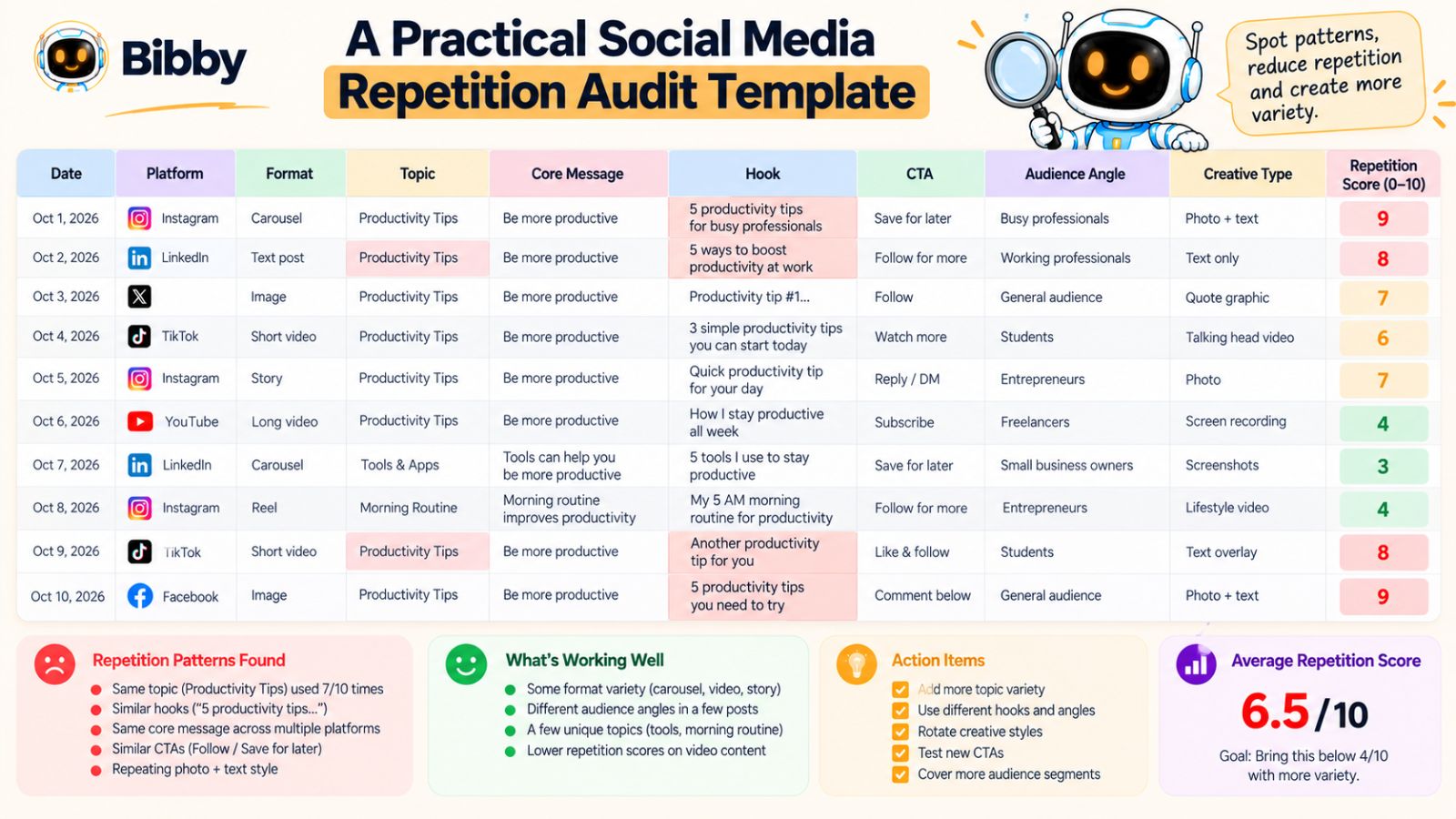
Step 1: Create your content inventory
Start by listing every post published during the audit period.
Your spreadsheet can include these columns:
| Date | Platform | Format | Topic | Core Message | Hook | CTA | Audience Angle | Creative Type |
|---|
You can add performance metrics such as impressions, reach, engagement, saves, shares, clicks, or conversions if they are relevant to your strategy.
Do not worry about making the spreadsheet complicated.
The purpose is to make patterns visible.
Step 2: Categorize your topics
Assign every post to a broad topic or content pillar.
For example:
| Content Pillar | Posts |
|---|---|
| Social media strategy | 12 |
| Content creation | 9 |
| Automation | 8 |
| Case studies | 5 |
| Industry insights | 4 |
| Product education | 2 |
Now look for concentration.
If one pillar represents half of your recent content, ask whether that is intentional.
There may be a perfectly good strategic reason. Perhaps the topic is central to your positioning or currently supports a campaign.
But if the concentration happened because your team keeps returning to the same easy topic, you have identified an opportunity.
Step 3: Summarize the core message
This is where the audit becomes more revealing.
For every post, reduce the content to one sentence.
For example:
"Scheduling content reduces manual work."
"Planning content makes publishing more consistent."
"Batching posts saves time."
"A content calendar prevents last-minute publishing."
These sentences may look different at first.
Place them next to each other and the overlap becomes obvious.
If several posts can be summarized using almost the same sentence, they probably need different angles.
Step 4: Audit your hooks
Create a hook category for each post.
You might classify them as:
- Question
- Contrarian statement
- How-to
- Mistake
- Statistic
- Story
- Bold claim
- List
- Problem/solution
- Direct advice
Then count them.
If almost every post uses the same category, your audience may be experiencing predictable openings even when the subjects vary.
You can also record the actual first line so repeated structures become easier to spot.
Step 5: Track your formats
Record the format of each post:
- Single image
- Carousel
- Short-form video
- Long-form video
- Story
- Text post
- Poll
- Infographic
- Other
Then calculate the percentage represented by each.
The objective is not to achieve a perfect distribution.
Instead, ask whether the distribution reflects your audience and strategy.
If 90% of your content is one format, you should at least know why.
Step 6: Track visual patterns
This part is harder to capture numerically, so use simple categories.
For example:
- Product screenshot
- Founder photo
- Customer image
- Text graphic
- Illustration
- Stock image
- Screen recording
- AI-generated visual
- Data visualization
You can also add a note about the design system or template used.
This makes visual repetition much easier to identify.
A content calendar can look diverse in spreadsheet form while looking almost identical when viewed as a social media grid.
Ideally, review both.
Step 7: Audit your CTAs
Create a CTA category for every post.
For example:
| CTA | Number of Posts |
|---|---|
| Comment | 8 |
| Save | 3 |
| Share | 2 |
| Click | 10 |
| Follow | 5 |
| No CTA | 2 |
Now ask whether your CTAs match the purpose of the content.
An educational post does not necessarily need the same CTA as a promotional post.
Step 8: Add a repetition score
For each post, score the five repetition dimensions from 0–2:
- Message overlap
- Format overlap
- Creative overlap
- CTA overlap
- Audience-angle overlap
Add the numbers together.
This gives you a score from 0–10.
You can then sort your spreadsheet from highest to lowest score.
Your highest-scoring posts deserve the closest review.
Step 9: Find your repetition clusters
Once your posts are categorized, look for clusters.
You may discover that:
- Mondays are always educational carousels.
- Most product posts focus on the same benefit.
- Every video uses the same hook.
- Your last eight posts address the same customer problem.
- Nearly every post ends with the same CTA.
- One visual template appears in half your content.
These are much more useful findings than simply saying, "Our content feels repetitive."
You now know where the repetition lives.
Step 10: Turn the audit into your next content plan
The audit should end with decisions.
For every repetition cluster, choose one of four actions:
Keep: The repetition is intentional and valuable.
Expand: Keep the topic but add new angles, audiences, examples, or formats.
Transform: Take existing ideas and turn them into meaningfully different content experiences.
Retire: Stop producing the idea because it no longer adds enough value.
Then use those decisions to build your next content calendar.
A simple 30-day review checklist
At the end of every month, ask:
Topics
- Did we over-focus on one content pillar?
- Did we neglect important audience problems?
Messages
- Did multiple posts make the same argument?
- Did we add new information when repeating a core idea?
Formats
- Did we rely too heavily on one format?
- Are different formats being used intentionally?
Creative
- Does the content look too similar when viewed together?
- Are we using enough visual concepts?
Hooks
- Are our openings becoming predictable?
- Are we relying on the same hook formula?
CTAs
- Are we asking for the same action too frequently?
- Does each CTA fit the content?
Audience
- Are we speaking to different segments and levels of awareness?
- Are we addressing different customer problems?
Performance
- Which repeated ideas performed well?
- Which repeated ideas consistently underperformed?
Keep the audit simple enough to repeat
The biggest mistake is turning the repetition audit into another complicated marketing process that nobody maintains.
You do not need to analyze every possible variable every week.
A practical approach is to perform a deeper audit monthly or quarterly, then use a lightweight version before approving new content.
The objective is simple:
Know what your audience has recently seen before deciding what they should see next.
That single habit can prevent months of accidental repetition.
And once the audit becomes part of your content workflow, the next challenge is avoiding the common mistakes that make even well-intentioned social media strategies repetitive.
Social Media Content Repetition: Common Mistakes
Most repetitive social media strategies are not created intentionally.
They happen because a team is trying to stay consistent, produce content efficiently, repeat messages that have performed well, or simply keep up with the publishing calendar.
The problem is that these sensible decisions can create repetition when they are not balanced with enough variation.
Here are some of the most common mistakes to watch for.
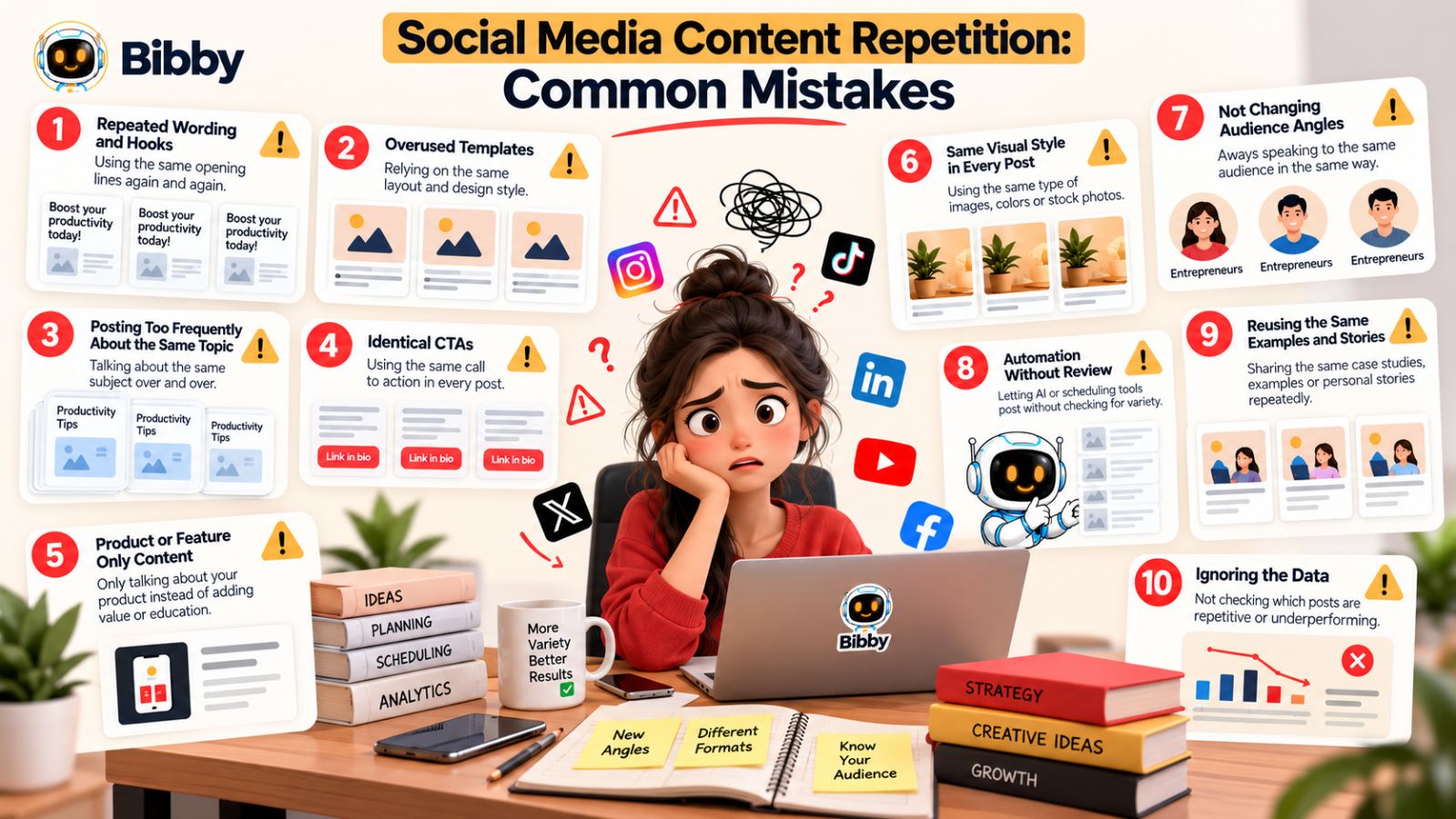
Mistake 1: Confusing consistency with repetition
Consistency is valuable.
Your audience should understand what your brand talks about, who it helps, and what makes it different.
But consistency does not require every post to look and sound the same.
If your brand is known for practical social media advice, you can consistently teach social media while discussing strategy, creative development, analytics, audience research, content planning, trends, mistakes, and real-world examples.
The subject area remains consistent.
The content experience changes.
When marketers interpret consistency as "repeat our core message as often as possible," their content can become predictable very quickly.
Mistake 2: Only changing the wording
This is one of the easiest traps to fall into with AI-assisted content creation.
A marketer takes an existing post and asks for five variations.
The AI produces five different captions.
Technically, the posts are different.
Strategically, they may be identical.
Changing:
"Save time by scheduling your social media."
to:
"Free up your day by automating your social media publishing."
does not create a new idea.
Before approving a variation, ask whether the thought has changed—not just the sentence.
Mistake 3: Measuring repetition only through captions
Your captions can be completely different while your content still feels repetitive.
Imagine a brand publishes 20 posts using different captions but the same:
- template
- product screenshot
- headline structure
- visual composition
- video format
- CTA
The audience experiences the complete post, not the caption in isolation.
A proper repetition audit therefore needs to consider both what you say and how you present it.
Mistake 4: Assuming more content solves content fatigue
When engagement declines, some teams respond by increasing publishing frequency.
If they were publishing four times a week, they move to seven.
If that does not work, they publish twice a day.
But more content does not solve a content-quality or repetition problem.
In some cases, it makes it worse.
If your content strategy has become repetitive, increasing the volume simply gives the audience more repetitive material to encounter.
Before increasing frequency, examine what you are publishing.
Mistake 5: Reusing successful posts too literally
Successful content should absolutely influence future content.
But copying a successful post too closely can remove the very quality that made it successful.
Instead, identify the underlying reason it worked.
Maybe the audience responded to:
- the problem
- the timing
- the emotional angle
- the example
- the format
- the strong opinion
- the practical advice
Then build something new around that insight.
Think "repeat the insight", not "repeat the post."
Mistake 6: Letting templates dictate your strategy
Templates are useful because they reduce production time and make branding easier.
But when the template becomes the starting point for every post, content strategy can become secondary.
You start asking:
"What can we put into this template?"
instead of:
"What is the best way to communicate this idea?"
That subtle shift can produce a feed where every post has the same visual rhythm.
A healthy system should contain enough flexibility that the idea can influence the format—not the other way around.
Mistake 7: Treating every platform identically
Cross-platform publishing is efficient, but copying content without considering the platform can create both repetition and poor audience experiences.
The same idea may need a different treatment on LinkedIn, Instagram, TikTok, YouTube, or Facebook.
That does not mean creating completely separate strategies for every platform.
It means adapting the presentation to the environment.
A short demonstration may work better as video.
A multi-step explanation may work better as a carousel.
A detailed professional argument may work better as a text-led post.
The idea can remain connected while the experience changes.
Mistake 8: Letting automation replace editorial review
Automation can make publishing dramatically easier.
But automated workflows can also remove the moment when someone notices:
"Didn't we just publish something almost identical to this?"
This is especially important when content is being generated, scheduled, and distributed at scale.
Automation should remove repetitive operations, not remove strategic oversight.
Even a highly automated workflow should include periodic content reviews.
Mistake 9: Creating content around features instead of problems
Feature-led content can become repetitive because the same feature gets explained repeatedly.
Suppose a tool has an AI caption generator.
You could create ten posts about the feature.
Or you could explore the problems surrounding caption creation:
- What makes a caption difficult to write?
- Why do generic captions fail?
- How should captions differ by platform?
- What makes a strong opening?
- How can brands maintain a consistent voice?
- When should you use a short versus detailed caption?
- What should you do when the first draft is weak?
The second approach creates much more useful territory.
Mistake 10: Never reviewing old content
Perhaps the biggest mistake is simply assuming you will notice repetition naturally.
You probably won't.
When you create content one post at a time, every post can seem reasonable on its own.
Repetition becomes obvious only when you step back and examine the collection.
That is why the repetition audit should become a recurring part of your content process.
You do not need to obsess over it.
A monthly review can be enough for many brands.
The objective is to periodically zoom out and ask:
"What have we been saying, and what have we not said yet?"
That question moves the conversation from publishing more content to building a more complete content strategy.
Once these mistakes are under control, the final step is to build a system that prevents repetition before it happens—rather than discovering the problem after dozens of posts have already been published.
How to Create a Social Media Content System That Stays Fresh
The best way to reduce social media content repetition is not to become better at spotting it after the fact.
It is to build a content system where meaningful variety is part of the process from the beginning.
A strong system gives your brand enough structure to stay consistent while creating enough flexibility to keep your content from becoming predictable.
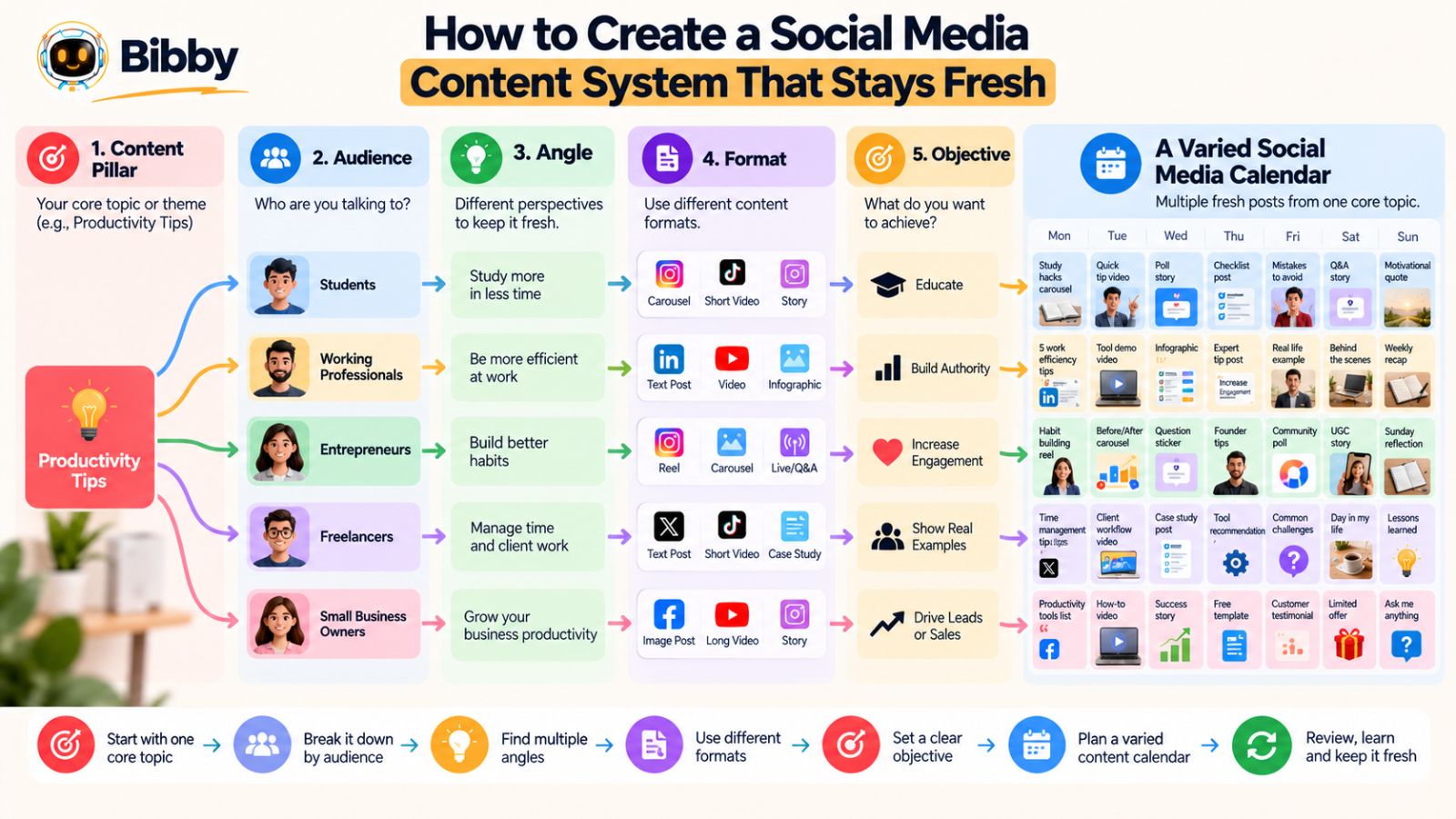
Start with content pillars
Content pillars give you a strategic foundation.
Instead of deciding what to post from scratch every morning, identify the major subjects your audience needs to hear from you about.
For example, a social media management brand might build pillars around:
- Social media strategy
- Content creation
- Automation
- Platform-specific tactics
- Productivity
- Analytics
- Industry insights
- Customer education
The exact pillars will depend on the brand.
The important part is to avoid creating so many pillars that none receives enough attention—or so few that everything eventually circles back to the same idea.
Give every pillar multiple angles
A content pillar should not be treated as a single topic.
It should be a collection of questions, problems, opinions, examples, and use cases.
For a pillar such as social media automation, you could explore:
Educational: What is social media automation?
Practical: How to automate a weekly publishing workflow.
Problem-focused: Why manual publishing becomes difficult as your account grows.
Opinion: Why automation should reduce repetitive work rather than replace strategy.
Comparison: Manual publishing versus an automated workflow.
Case-based: How a small marketing team could organize its publishing process.
Advanced: How to combine automation with a content approval system.
Now the pillar becomes a source of ideas rather than a single recurring message.
Build an angle library
Keep a running list of angles that your team can use when developing content.
Useful angle categories include:
- How-to
- Mistake
- Myth
- Checklist
- Framework
- Comparison
- Case study
- Example
- Behind the scenes
- Opinion
- Prediction
- Question
- Data
- Story
- Before and after
When a new topic enters the content calendar, choose an angle deliberately.
This prevents your content from becoming "another five tips" simply because that is the format everyone reaches for first.
Rotate your audience perspectives
If your brand serves multiple types of customers, make those perspectives visible in the content calendar.
For example:
Solo creator
What would make this person's workflow easier?
Small business owner
What would save this person time or reduce complexity?
Social media manager
What would make managing multiple accounts easier?
Agency
What would improve client workflows and scale?
Marketing team
What would improve collaboration and consistency?
The same product or subject can be relevant to all of them without requiring the same message.
Create a hook library—but don't overuse it
A hook library can speed up content creation, especially when you publish frequently.
But the purpose should be to increase options, not create a new formula that appears in every post.
Instead of having one favorite hook structure, maintain several categories:
- Question
- Surprising observation
- Strong opinion
- Mistake
- Story
- Challenge
- Data point
- Demonstration
- Contrarian idea
- Direct solution
Then review the mix periodically.
If half your recent posts start with the same structure, deliberately change it.
Rotate formats intentionally
You do not need to publish every format available.
You do need to understand why you are choosing a format.
For example:
Carousel: Best when the audience needs multiple steps or ideas.
Short video: Useful for demonstrations, stories, reactions, and quick explanations.
Story: Useful for interaction, behind-the-scenes content, questions, and lightweight updates.
Single image: Useful when one idea can be communicated visually and quickly.
Long-form video: Useful when the subject benefits from depth or demonstration.
The right format depends on the platform and audience.
The important principle is:
Let the content determine the format whenever possible.
Create recurring series carefully
Recurring series can be an excellent way to build familiarity.
For example:
- Monday marketing mistake
- Weekly industry observation
- Customer question of the week
- One-minute tutorial
- Tool breakdown
- Behind-the-scenes workflow
But a series should have a recognizable structure without producing identical content every time.
The audience should know what the series is while still wondering what today's example will be.
That is the difference between a recurring format and a repetitive format.
Use a content matrix
One of the simplest ways to operationalize all of this is to build a content matrix.
For each planned post, choose:
Pillar × Audience × Angle × Format × Objective
For example:
Automation × Social media manager × Mistake × Short video × Education
Another might be:
Automation × Small business owner × Case example × Carousel × Awareness
Another:
Automation × Agency × Workflow × Long-form video × Consideration
You can quickly see how much variety exists before anything is published.
Make repetition reviews part of the workflow
Do not wait until engagement drops to perform an audit.
Build a lightweight review into your regular process.
Before publishing:
Check the last 5–10 posts.
After each month:
Review the content mix.
Every quarter:
Perform a deeper repetition audit.
This creates three layers of protection.
The first catches obvious repetition.
The second identifies trends.
The third reveals structural problems in your content strategy.
Separate content creation from content distribution
Another useful principle is to distinguish between creating ideas and distributing them.
Your content strategy determines:
- What should be said?
- Why should it be said?
- Who needs to hear it?
- What is the best angle?
- What format communicates it best?
Your publishing workflow handles:
- Where should it be published?
- When should it be published?
- How should it be scheduled?
- Which platforms should receive it?
Keeping these responsibilities conceptually separate makes automation much safer.
A scheduling tool can distribute content efficiently, but it should not determine what your audience needs to hear.
Build a system that makes repetition visible
Ultimately, a fresh social media strategy is not one where every post is completely original.
It is one where repetition is intentional.
Your audience should repeatedly encounter your core ideas because those ideas matter. But they should encounter those ideas through different questions, examples, formats, stories, perspectives, and levels of depth.
That gives you the best of both worlds:
Consistency creates recognition.
Variation creates interest.
Strategic repetition creates memory.
When those three work together, you no longer need to choose between staying on-brand and keeping your social media content fresh.
Final thoughts
Social media content repetition is not a problem because you talk about the same subjects more than once. It becomes a problem when your audience keeps receiving the same message, format, creative experience, or perspective without enough new value.
A useful repetition audit gives you a way to see those patterns. First, look beyond duplicate posts and examine message, format, creative, CTA, and audience-angle repetition. Second, use a simple scoring system and content inventory to identify where overlap is concentrated. Third, fix repetition by changing the angle, example, audience, format, or depth while keeping the core ideas your brand needs to own.
The goal is not to make every post completely different. It is to create familiarity without predictability.
Once you know where your content is repeating itself, the natural next step is to turn those findings into a stronger publishing system. A practical social media content calendar can help you balance content pillars, audience angles, formats, and recurring themes before repetition becomes a problem again.