
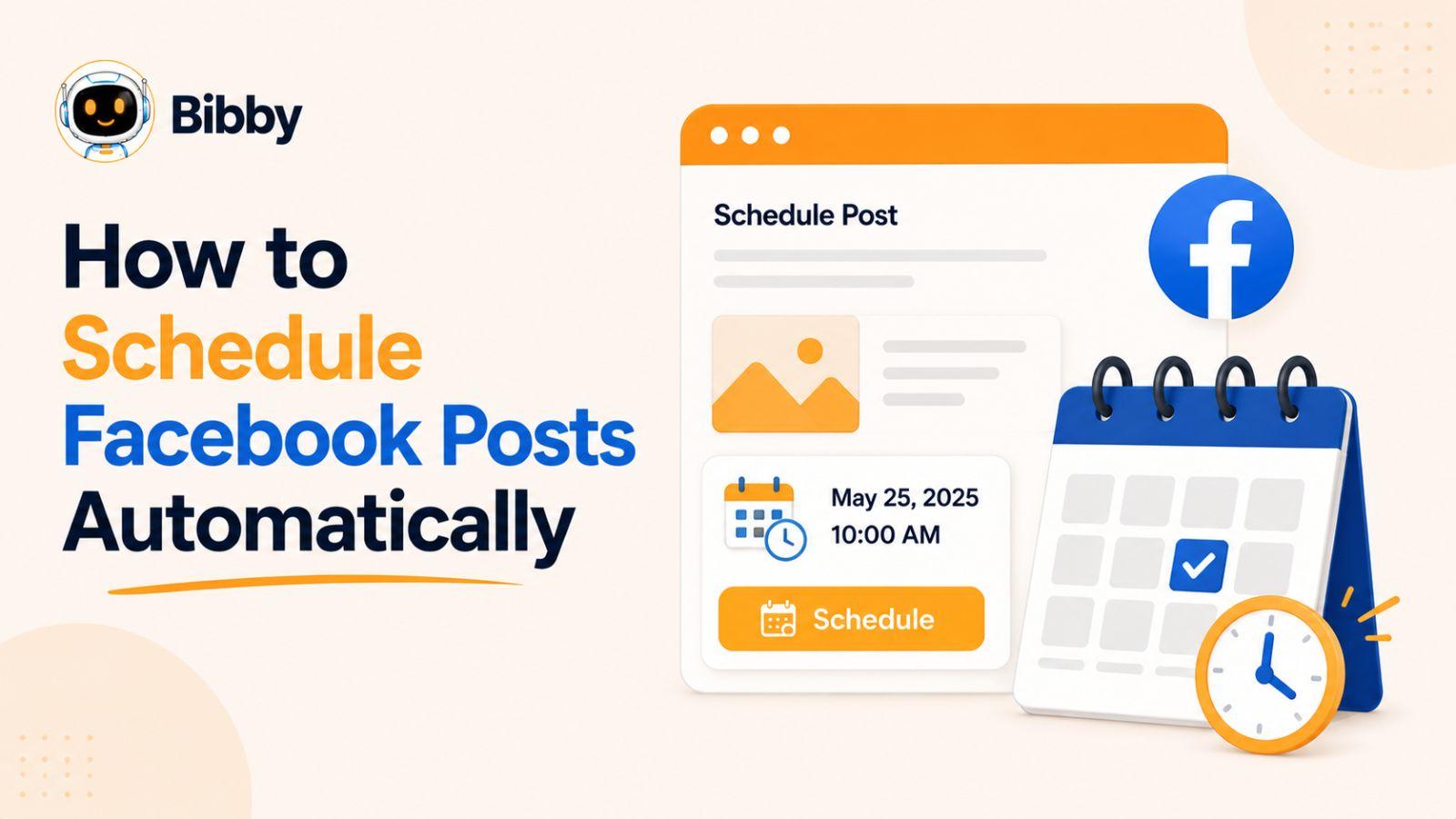
Scheduling Facebook posts automatically has become one of the easiest ways for businesses, creators, and marketers to save time while maintaining a consistent social media presence.
If you're still logging into Facebook every day to publish content manually, you're spending valuable time on tasks that can be fully automated. The good news is that modern scheduling tools make it possible to plan weeks or even months of content in advance while ensuring your posts go live at the best possible times for engagement.
In this article, you will learn:
- How to schedule Facebook posts automatically in minutes
- The benefits of AI-powered social media automation
- How to manage multiple social platforms from one dashboard
Whether you're running a business, building a personal brand, or managing client accounts, automatic scheduling can dramatically simplify your content workflow. Tools like Bibby take automation even further by allowing you to upload or generate AI images, automatically create captions based on your preferred posting style, and schedule content across Facebook, Instagram, LinkedIn, TikTok, and YouTube at AI-optimized posting times. Instead of worrying about what to post and when to post it, you can focus on growing your audience while your content calendar runs on autopilot.
Let's start by understanding what automatic Facebook post scheduling actually is and why it has become an essential part of modern social media marketing.
What Does It Mean to Schedule Facebook Posts Automatically?
Scheduling Facebook posts automatically means creating your content in advance and setting it to publish at a future date and time without requiring any manual action when the post goes live.
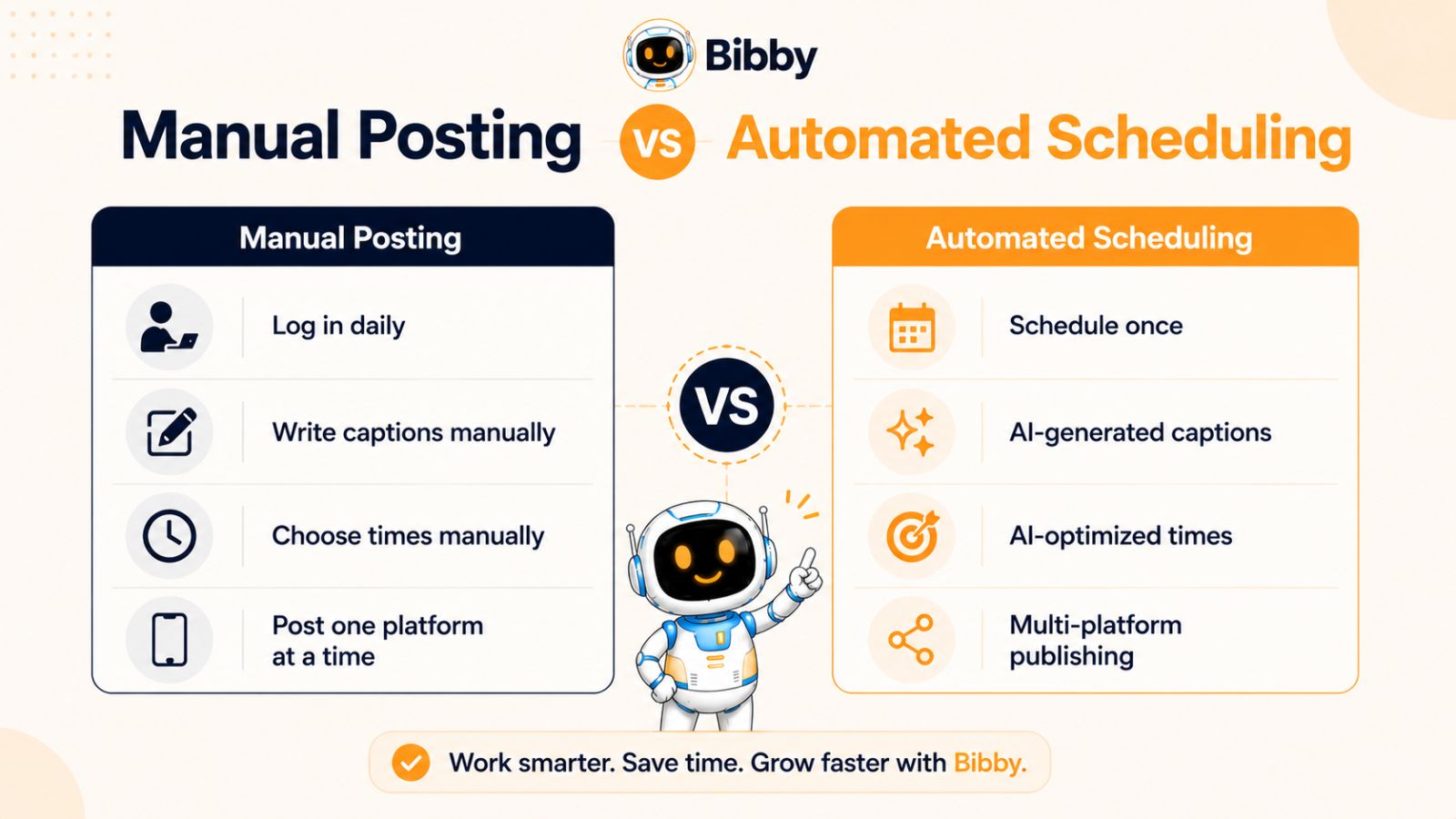
Instead of logging into Facebook every day to upload images, write captions, and publish content, scheduling tools allow you to prepare everything ahead of time. Once your schedule is set, the software handles the publishing process automatically, ensuring your content is posted exactly when planned.
Understanding Facebook Post Scheduling
At its core, Facebook scheduling is a content management process that helps individuals and businesses maintain a consistent online presence.
A scheduled post typically includes:
- Images or graphics
- Videos
- Captions and hashtags
- Links
- Stories or other content formats
- A predefined publishing date and time
Once scheduled, the content remains in a queue until it is automatically published.
Scheduling vs. Social Media Automation
While many people use these terms interchangeably, there is an important difference.
Scheduling refers to choosing when content will be published.
Automation goes a step further by helping create, organize, optimize, and distribute content with minimal human involvement.
For example, a traditional scheduling tool may require you to:
- Create an image.
- Write a caption.
- Choose a posting time.
- Schedule the post.
An AI-powered automation platform like Bibby streamlines the entire process.
With Bibby, you can:
- Upload your image or generate one using AI.
- Select your preferred posting style.
- Let AI generate captions automatically.
- Schedule content across multiple social networks.
- Publish at AI-optimized posting times.
- Track performance through built-in analytics.
This significantly reduces the amount of time required to manage social media content.
Why Businesses Are Automating Facebook Posting
Social media has become more competitive than ever. Consistency is one of the most important factors influencing audience growth and engagement.
Automatic scheduling helps businesses:
- Stay active even during busy periods
- Maintain a predictable posting schedule
- Reach audiences at optimal times
- Reduce manual workload
- Scale content production efficiently
- Improve overall marketing productivity
Whether you're a small business owner, content creator, freelancer, or marketing agency, automated scheduling allows you to spend less time publishing content and more time focusing on strategy, engagement, and growth.
As social media platforms continue to evolve, businesses are increasingly adopting AI-powered scheduling tools that not only publish content automatically but also assist with content creation, optimization, and performance analysis.
Benefits of Automatically Scheduling Facebook Posts
Consistently publishing high-quality content is one of the biggest challenges for businesses and creators. Between creating content, managing campaigns, responding to customers, and handling day-to-day operations, finding time to post on Facebook manually can quickly become overwhelming.
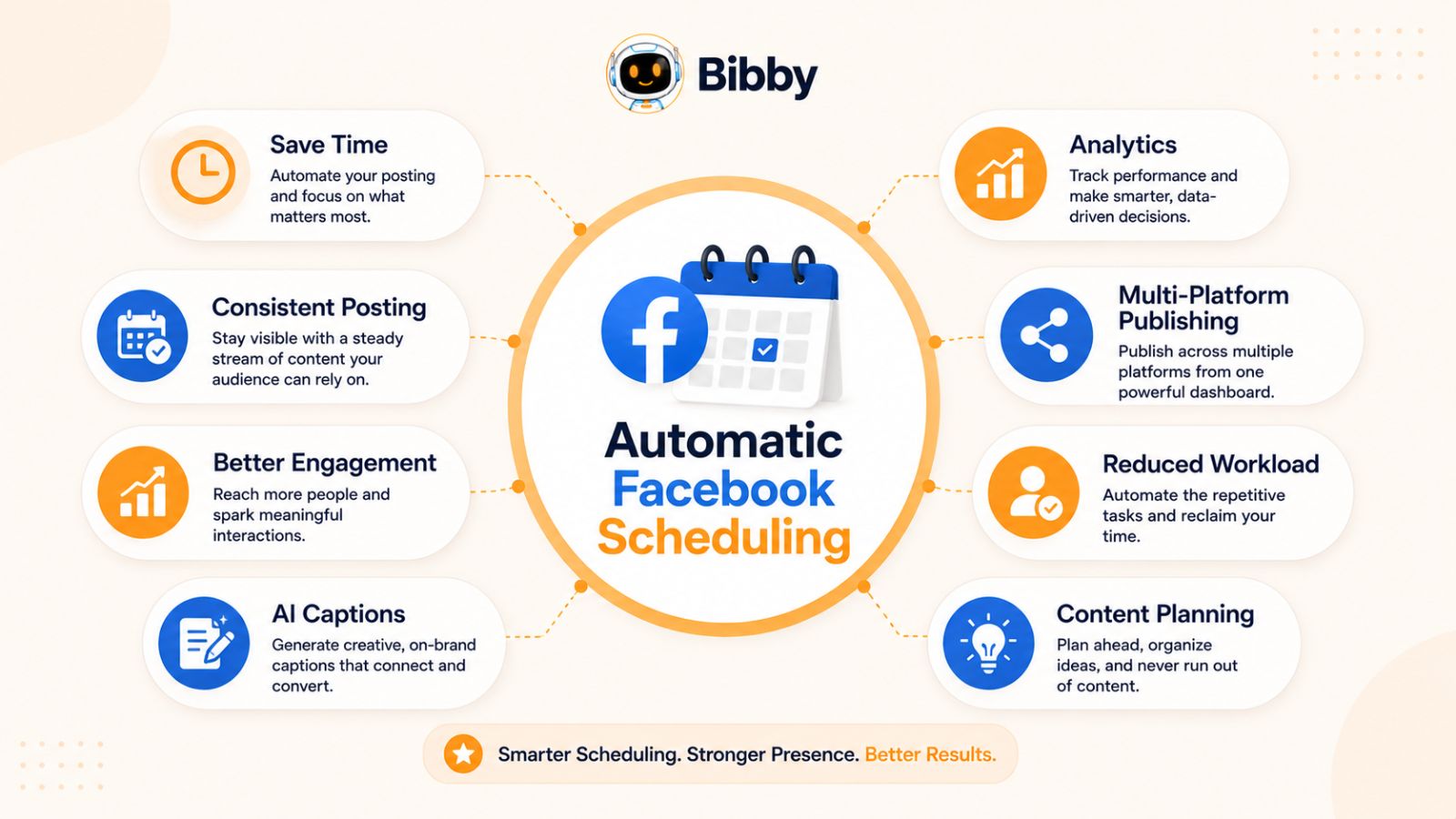
This is why automatic Facebook scheduling has become an essential part of modern social media marketing. It helps you save time, stay consistent, and achieve better results with less effort.
Save Hours Every Week
One of the biggest advantages of scheduling Facebook posts is the amount of time it saves.
Instead of interrupting your day every time you need to publish a post, you can create multiple pieces of content in a single session and schedule them weeks or even months in advance.
For example, rather than spending 15–20 minutes every day creating and publishing a post, you could dedicate a few hours at the beginning of the month to planning your entire content calendar.
This approach allows you to:
- Batch-create content efficiently
- Reduce repetitive tasks
- Eliminate daily posting responsibilities
- Focus on higher-value business activities
Maintain Consistent Posting
Consistency is one of the most important factors in social media growth.
When followers see regular content from your brand, they are more likely to engage with your posts, remember your business, and trust your expertise.
Unfortunately, manual posting often leads to inconsistent schedules because life and work priorities get in the way.
Automatic scheduling helps ensure that:
- Content is published on time
- Your audience hears from you regularly
- Marketing campaigns stay on track
- Brand visibility remains strong
Even during holidays, vacations, or busy work periods, your content continues to reach your audience.
Reach Followers at the Best Times
Publishing great content is only part of the equation. Timing also plays a major role in determining how much engagement a post receives.
Different audiences are active at different times of the day. Posting when your audience is online increases the likelihood of:
- Likes
- Comments
- Shares
- Link clicks
- Video views
Many advanced scheduling platforms now use data and AI to identify optimal posting windows.
For example, Bibby can automatically schedule content at AI-optimized times, helping users maximize visibility and engagement without having to analyze audience behavior manually.
Reduce Social Media Stress
Many marketers experience the constant pressure of figuring out:
- What to post
- When to post
- Which platforms to post on
This daily decision-making process can lead to burnout and inconsistent execution.
Scheduling content in advance removes much of this stress by creating a clear content plan that runs automatically.
When your posts are already scheduled, you can spend less time worrying about publishing and more time engaging with your audience and improving your strategy.
Improve Content Quality
When content is created under pressure, quality often suffers.
Scheduling allows you to slow down and focus on producing thoughtful, valuable content instead of rushing to meet daily publishing deadlines.
Benefits include:
- Better captions
- Stronger visuals
- Improved messaging
- More strategic content planning
- Fewer mistakes and last-minute edits
Many AI-powered platforms further enhance quality by assisting with content creation.
For instance, Bibby can generate captions automatically based on your chosen posting style, helping you maintain a consistent brand voice while reducing the effort required to create content.
Manage Multiple Platforms More Efficiently
Most businesses are no longer focused solely on Facebook.
Today's brands typically maintain a presence on:
- TikTok
- YouTube
Managing each platform separately can become extremely time-consuming.
Modern social media automation tools simplify this process by allowing users to manage multiple platforms from a single dashboard.
With Bibby, users can upload content once, generate captions with AI, and schedule posts, videos, and stories across multiple social networks without switching between different applications.
Gain Valuable Performance Insights
Scheduling tools are no longer just publishing platforms.
Many now include analytics features that help users understand:
- Which posts perform best
- When audiences are most active
- Which content generates engagement
- How campaigns are performing over time
This data enables smarter decision-making and continuous improvement.
Instead of guessing what works, you can use real performance data to refine your content strategy and achieve better results.
The Bottom Line
Automatic Facebook scheduling is about much more than convenience. It creates a scalable system for publishing content consistently, improving engagement, reducing workload, and maximizing the return on your social media efforts.
As your content strategy grows, the ability to automate creation, scheduling, publishing, and analytics becomes increasingly valuable. This is why many businesses eventually move beyond Facebook's native scheduling tools and adopt dedicated social media management platforms.
Native Facebook Scheduling vs. Third-Party Tools
If you want to schedule Facebook posts automatically, you have two primary options: use Facebook's built-in scheduling features or use a dedicated social media management platform.
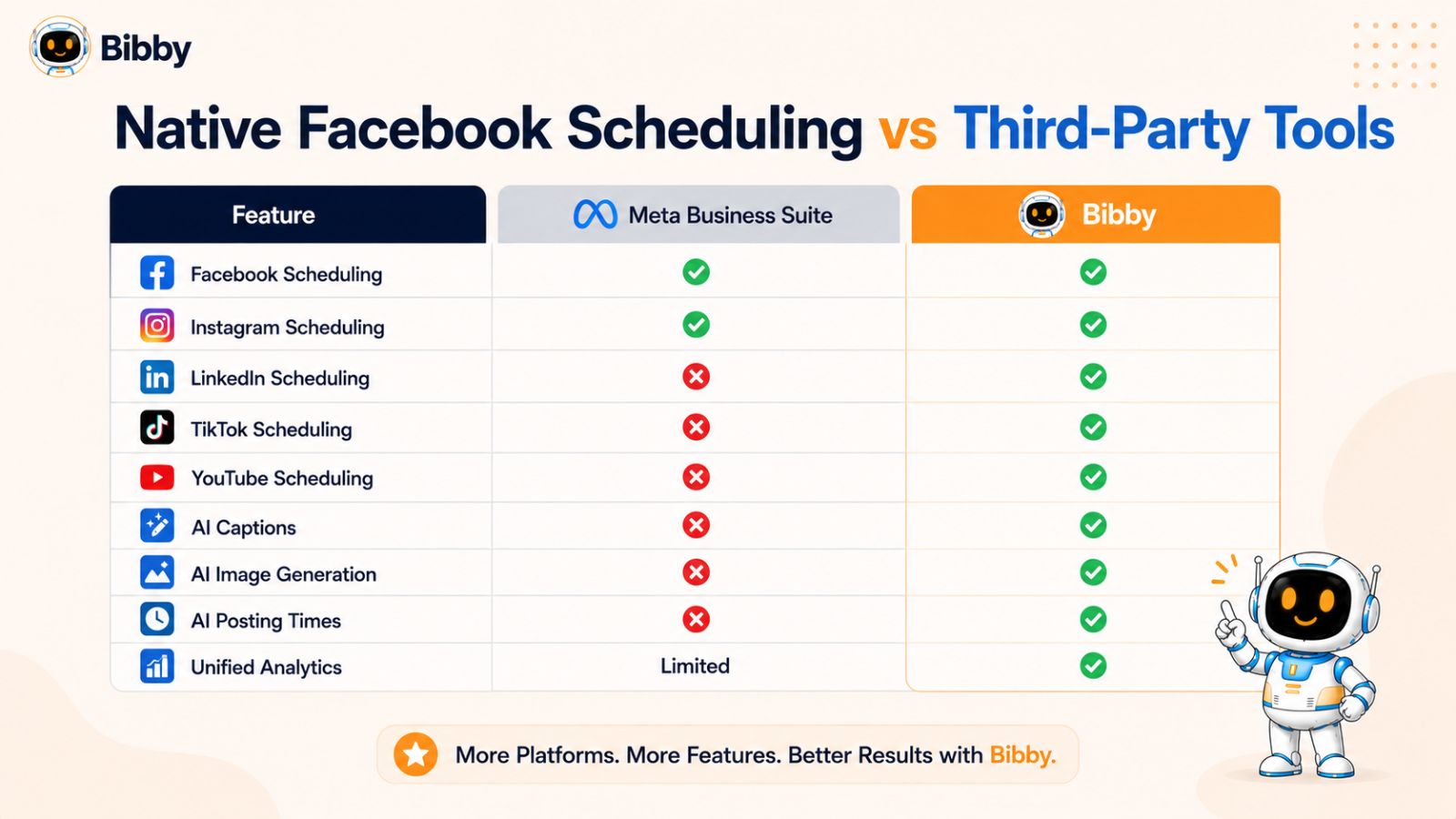
While Facebook's native scheduler works well for basic needs, many businesses and creators eventually outgrow its capabilities and look for more advanced solutions that streamline content creation, scheduling, and analytics across multiple platforms.
Let's compare both approaches.
Facebook's Built-In Scheduling Features
Facebook allows users to schedule posts directly through Meta Business Suite.
The process is relatively straightforward:
- Create a post.
- Upload your image or video.
- Write a caption.
- Select a future publishing date and time.
- Schedule the post.
For businesses that only manage a Facebook Page and publish occasionally, this can be a useful free solution.
Advantages of Native Facebook Scheduling
- Free to use
- Direct integration with Facebook
- Easy setup
- Suitable for basic scheduling needs
- No third-party software required
For small businesses with limited posting requirements, these features may be enough to maintain a simple content calendar.
Also read complete guide on: How to automate facebook posts?
Limitations of Facebook's Native Scheduler
As content marketing becomes more sophisticated, Facebook's built-in tools begin to show several limitations.
Limited Platform Support
Meta Business Suite primarily focuses on Facebook and Instagram.
If your marketing strategy includes LinkedIn, TikTok, YouTube, or other platforms, you'll need additional tools to manage those channels.
This often results in:
- Multiple logins
- Separate content calendars
- Duplicate work
- Increased complexity
No AI-Powered Content Creation
Facebook allows you to schedule content, but it does not automatically create content for you.
You are still responsible for:
- Writing captions
- Developing content ideas
- Creating visuals
- Optimizing posts
For busy teams and creators, content creation often consumes more time than scheduling itself.
Limited Automation Features
Facebook scheduling is primarily a publishing tool rather than a complete automation solution.
It does not automatically:
- Generate captions
- Suggest posting styles
- Optimize content workflows
- Schedule content across multiple networks
- Create AI-generated images
As a result, much of the workload remains manual.
Basic Analytics
While Meta provides useful reporting, businesses that manage multiple platforms often need a more centralized view of performance.
Tracking results across several social networks can become difficult when analytics are spread across different dashboards.
Why Businesses Choose Third-Party Scheduling Tools
Third-party platforms are designed to solve these challenges by providing a centralized system for content creation, publishing, and analysis.
Rather than managing each social network separately, users can control everything from a single dashboard.
Benefits often include:
- Multi-platform publishing
- Content calendars
- Team collaboration
- AI content generation
- Advanced analytics
- Automated workflows
- Content libraries
These capabilities help businesses scale their social media efforts without significantly increasing workload.
Please look at detailed list of benefits of scheduling social media posts.
How Bibby Simplifies the Entire Process
Unlike traditional scheduling tools that focus only on publishing, Bibby combines content creation, scheduling, automation, and analytics into a single workflow.
Instead of juggling multiple tools, users can manage their entire social media strategy from one platform.
A typical Bibby workflow looks like this:
Step 1: Upload or Generate Content
Users can either:
- Upload their own images and videos
- Generate images using AI
This eliminates the need to switch between separate design and scheduling tools.
Step 2: Choose a Posting Style
Rather than writing every caption from scratch, users select a posting style that aligns with their goals, such as:
- Educational
- Promotional
- Professional
- Inspirational
- Entertaining
Step 3: Generate Captions Automatically
Bibby's AI creates captions based on the selected style, dramatically reducing content creation time while maintaining consistency.
Step 4: Schedule Across Multiple Platforms
Users can schedule content simultaneously for:
- TikTok
- YouTube
This allows businesses to execute a unified social media strategy without duplicating work across platforms.
Step 5: Publish at AI-Optimized Times
Instead of manually researching the best posting times, Bibby automatically schedules content when audiences are most likely to engage.
Step 6: Monitor Performance
Users can track analytics and measure content performance from a centralized dashboard, making it easier to optimize future campaigns.
Which Option Is Best?
The right choice depends on your goals.
Facebook's native scheduler works well if:
- You only use Facebook occasionally
- You have a limited content calendar
- You don't need advanced automation
A dedicated platform like Bibby is often the better choice if:
- You manage multiple social networks
- You publish content frequently
- You want AI-assisted content creation
- You need advanced scheduling capabilities
- You want centralized analytics
- You are looking to save as much time as possible
As your social media strategy grows, having a complete automation system becomes increasingly valuable. Instead of spending hours creating and publishing content manually, you can focus on building relationships, generating leads, and growing your brand while your content runs automatically in the background.
How to Schedule Facebook Posts Automatically: Step-by-Step
Scheduling Facebook posts automatically is much easier than many people think. With the right workflow and tools, you can create weeks or even months of content in a single session and let automation handle the publishing process.
Whether you're managing a business page, personal brand, agency account, or online store, the following process will help you build a reliable and scalable social media system.
Step 1: Plan Your Content Strategy
Before scheduling anything, determine what type of content you want to publish.
Many successful Facebook pages use a mix of content formats to keep their audience engaged.
Examples include:
- Educational posts
- Industry tips
- Product promotions
- Customer testimonials
- Behind-the-scenes content
- Videos
- Stories
- Company updates
- User-generated content
A simple content plan ensures that your Facebook feed remains balanced and valuable to followers.
For example, you might structure your weekly content like this:
| Day | Content Type |
|---|---|
| Monday | Educational Tip |
| Tuesday | Product Showcase |
| Wednesday | Customer Story |
| Thursday | Industry Insight |
| Friday | Promotional Offer |
| Saturday | Video Content |
| Sunday | Community Engagement |
Planning ahead prevents last-minute scrambling and helps maintain consistency.
Step 2: Create or Gather Your Media
Once your content plan is ready, start preparing your media assets.
This may include:
- Images
- Videos
- Graphics
- Stories
- Promotional creatives
Many businesses create content using design tools and then upload it to a scheduling platform.
However, modern AI-powered tools can simplify this process significantly.
For example, Bibby allows users to either upload their own media or generate images using AI directly within the platform. This reduces the need for multiple tools and speeds up content production.
Step 3: Create Captions with AI That Encourage Engagement
Captions play a critical role in the success of Facebook posts.
A strong caption should:
- Grab attention quickly
- Deliver value
- Encourage interaction
- Include a clear call to action
Examples of calls to action include:
- Comment below
- Share your thoughts
- Visit our website
- Send us a message
- Learn more
Writing captions manually for dozens of posts can be time-consuming.
This is where AI automation can provide significant value.
With Bibby, users simply select a posting style and the platform automatically generates captions tailored to that style. This helps maintain consistency while dramatically reducing content creation time.
Step 4: Upload Your Media
After your media and captions are ready, upload them to your scheduling platform.
Organizing content into a centralized library offers several advantages:
- Easier scheduling
- Faster content management
- Better collaboration
- Improved content planning
A centralized workflow also makes it easier to repurpose successful content in future campaigns.
Step 5: Select the Platforms You Want to Publish On
Many businesses no longer rely solely on Facebook.
They also publish content on:
- TikTok
- YouTube
Managing each platform separately creates unnecessary work and increases the chances of missed posting opportunities.
Using a multi-platform scheduling tool allows you to publish content across several networks from a single dashboard.
With Bibby, users can select multiple platforms simultaneously and schedule content for all of them in one workflow.
Step 6: Choose Your Publishing Schedule
Now it's time to determine when your content should be published.
There are several common approaches:
Daily Scheduling
Ideal for active brands that publish content every day.
Weekly Scheduling
A popular option for small businesses and creators.
Monthly Scheduling
Perfect for businesses that prefer batching large amounts of content at once.
Campaign-Based Scheduling
Useful for product launches, promotions, seasonal events, and special announcements.
The goal is to create a predictable publishing schedule that aligns with your audience's expectations.
Step 7: Let AI Optimize Posting Times
One of the most challenging aspects of social media management is identifying the best time to post.
Audience behavior can vary based on:
- Industry
- Location
- Platform
- Content type
- Audience demographics
Rather than relying on guesswork, many modern scheduling platforms use artificial intelligence to identify optimal posting windows.
Bibby automatically schedules content at AI-optimized times, helping maximize visibility and engagement without requiring users to manually analyze audience activity patterns.
Step 8: Schedule and Automate
Once everything has been reviewed, simply confirm your schedule.
At this point, the platform takes over.
Your content will be:
- Published automatically
- Delivered at the scheduled times
- Distributed across selected platforms
- Managed without manual intervention
Instead of logging in every day to publish content, you can focus on other areas of your business while your content calendar runs in the background.
Step 9: Monitor Analytics and Improve Performance
Scheduling is only part of a successful social media strategy.
The most effective marketers continually review performance data and make improvements over time.
Track metrics such as:
- Reach
- Engagement
- Comments
- Shares
- Click-through rates
- Follower growth
- Video views
Analyzing this data helps identify what content resonates most with your audience.
Bibby's analytics dashboard makes this process easier by providing performance insights across multiple social platforms in a centralized location.
Also read: How to automate social media for small business?
A Simple Facebook Scheduling Workflow
To summarize, the easiest way to schedule Facebook posts automatically looks like this:
- Plan your content.
- Upload or generate images and videos.
- Select your preferred posting style.
- Generate captions with AI.
- Choose Facebook and other social platforms.
- Let AI determine the best posting times.
- Schedule content in advance.
- Monitor analytics and optimize results.
By following this workflow, businesses can dramatically reduce the time spent managing social media while maintaining a consistent and professional online presence.
The Easiest Way to Schedule Facebook Posts Automatically with Bibby
While there are many social media scheduling tools available today, most still require users to jump between multiple platforms for content creation, caption writing, scheduling, and analytics.
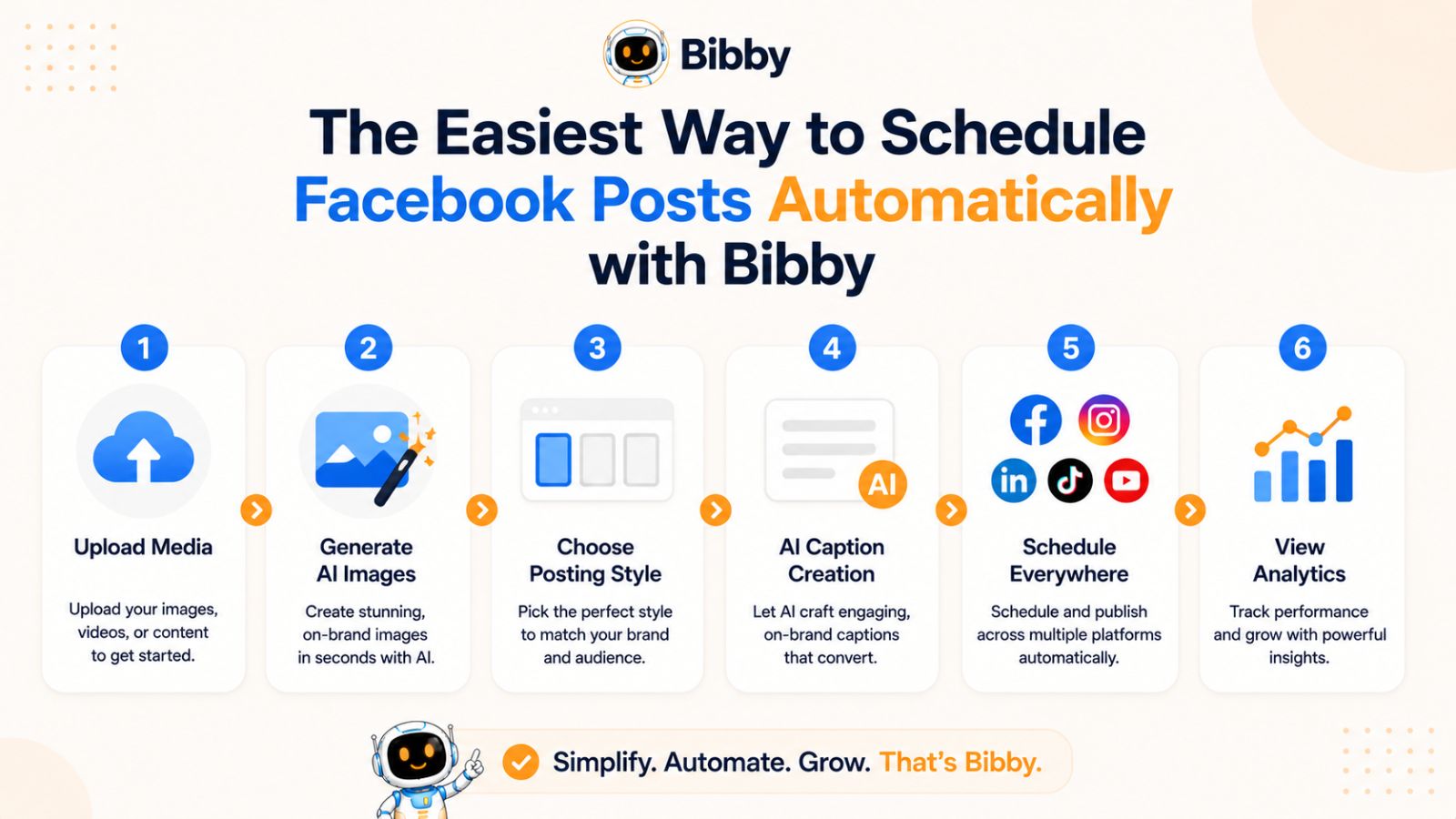
This fragmented workflow can quickly become time-consuming, especially for businesses and creators who publish content across several social media platforms.
Bibby was built to solve this problem by combining content creation, AI automation, scheduling, publishing, and analytics into one simple workflow.
Instead of spending hours every week managing social media, users can create, schedule, and optimize content in minutes.
What Is Bibby?
Bibby is an AI-powered social media scheduling and automation platform designed to help businesses, creators, agencies, and marketers manage their content more efficiently.
The platform simplifies the entire publishing process by allowing users to:
- Create content faster
- Generate AI-powered captions
- Schedule posts automatically
- Publish across multiple social networks
- Track performance through analytics
- Manage images, videos, and stories from one dashboard
The goal is simple: spend less time managing social media and more time growing your business.
How Bibby's Simple Workflow Works
One of Bibby's biggest advantages is its straightforward workflow.
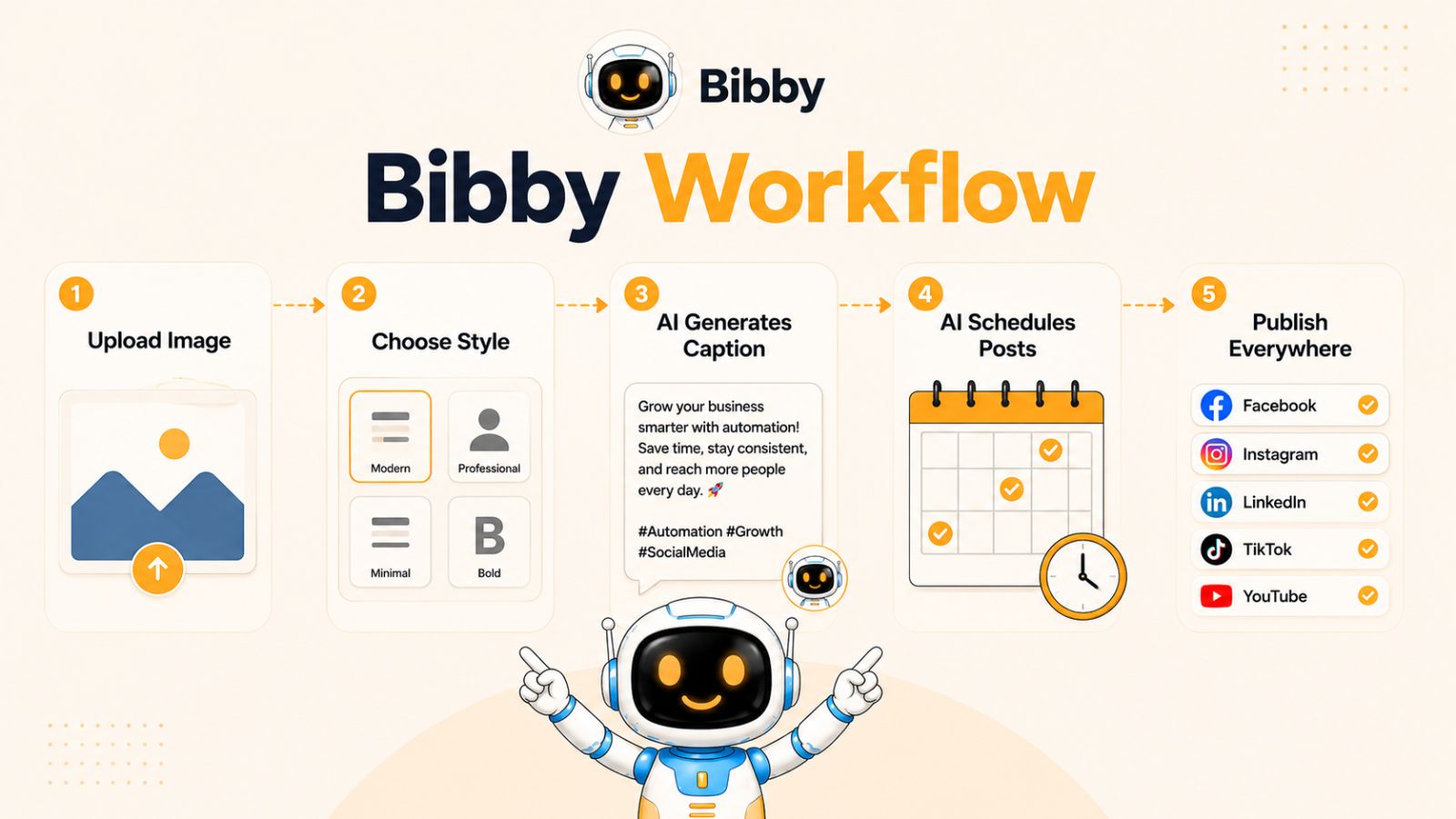
Rather than requiring multiple tools and complicated setups, the platform guides users through a streamlined content creation and scheduling process.
Step 1: Upload Your Media or Generate Images with AI
Every social media campaign starts with content.
With Bibby, you can either:
- Upload your own images
- Upload videos
- Create content assets in advance
- Generate images using AI
This flexibility allows businesses to use existing content or create new visuals directly within the platform.
Instead of switching between graphic design software and scheduling tools, everything can be managed from one place.
Step 2: Choose Your Posting Style
Creating captions for every post can be one of the most time-consuming parts of social media management.
Bibby simplifies this by allowing users to select a preferred posting style before generating content.
Examples include:
- Educational
- Professional
- Promotional
- Inspirational
- Entertaining
- Thought leadership
- Brand awareness
- Community-focused
Choosing a style helps ensure that all content aligns with your brand voice and marketing objectives.
Step 3: Generate Captions Automatically with AI
Once a posting style is selected, Bibby's AI creates captions automatically.
This eliminates one of the biggest bottlenecks in content creation.
Instead of staring at a blank screen trying to think of what to write, users receive ready-to-publish captions that can be used immediately or customized as needed.
Benefits include:
- Faster content creation
- Consistent brand messaging
- Reduced writer's block
- Improved productivity
- More efficient content planning
For businesses publishing dozens of posts every month, this feature alone can save hours of work.
Step 4: Schedule Content Across Multiple Platforms
Modern marketing requires a presence on more than just Facebook.
Many brands actively publish on:
- TikTok
- YouTube
Managing each platform individually often leads to duplicate work and inconsistent publishing schedules.
Bibby solves this by allowing users to select multiple platforms at once and schedule content from a single dashboard.
Instead of publishing the same content five different times, users can manage everything in one place.
Step 5: Publish at AI-Optimized Times
Knowing when to post can be just as important as knowing what to post.
Many businesses struggle to determine:
- The best time of day
- The best days of the week
- Audience activity patterns
- Platform-specific engagement windows
Bibby's AI analyzes these factors and automatically schedules content at optimized times designed to maximize visibility and engagement.
This removes the guesswork from scheduling and helps users get more value from every piece of content they publish.
Manage More Than Just Standard Posts
Today's audiences consume content in many different formats.
Bibby supports scheduling and managing:
- Facebook posts
- Instagram posts
- LinkedIn posts
- TikTok content
- YouTube content
- Videos
- Stories
- Promotional campaigns
This allows businesses to maintain a consistent presence across multiple channels without managing separate workflows for each content type.
Centralized Analytics and Performance Tracking
Publishing content is only half the battle.
The most successful marketers continuously analyze performance and refine their strategy.
Bibby's analytics dashboard provides visibility into key performance metrics, including:
- Reach
- Engagement
- Audience growth
- Content performance
- Campaign effectiveness
By tracking results from a centralized dashboard, users can quickly identify what is working and make smarter marketing decisions.
Why Businesses Choose Bibby
Businesses often adopt Bibby because it combines multiple tools into a single platform.
Instead of paying for separate solutions for:
- Content creation
- AI writing
- Scheduling
- Publishing
- Analytics
Users can manage everything from one streamlined system.
Key advantages include:
- Simple workflow
- AI image generation
- AI caption creation
- Multi-platform scheduling
- AI-optimized publishing times
- Video scheduling
- Story scheduling
- Centralized analytics
- Time-saving automation
Who Can Benefit Most from Bibby?
Bibby is particularly valuable for:
Small Business Owners
Maintain a professional social media presence without hiring a dedicated marketing team.
Content Creators
Create and schedule content faster while focusing more time on audience growth.
Marketing Agencies
Manage multiple client accounts efficiently from one platform.
Freelancers and Consultants
Build personal brands without spending hours each week on social media management.
E-commerce Businesses
Promote products consistently across multiple channels and track campaign performance more effectively.
The Bottom Line
If your goal is simply to schedule an occasional Facebook post, Facebook's native scheduling tools may be sufficient.
However, if you want a complete social media automation system that helps create content, generate captions, optimize publishing times, schedule across multiple platforms, and track results from a single dashboard, Bibby offers a much more comprehensive solution.
By combining AI-powered content creation with automated scheduling and analytics, Bibby allows businesses and creators to spend less time managing social media and more time focusing on growth.
Advanced Facebook Scheduling Strategies
Once you've mastered the basics of scheduling Facebook posts automatically, the next step is optimizing your strategy for maximum reach, engagement, and efficiency.
Many businesses use scheduling tools simply to publish content in advance. However, the most successful brands use automation strategically to build stronger audience relationships, increase engagement, and generate better business results.
The following advanced strategies can help you get more value from every post you schedule.
Build a Monthly Content Calendar
One of the biggest mistakes businesses make is scheduling content one post at a time.
A better approach is to create a monthly content calendar that aligns with your marketing goals and business objectives.
A content calendar helps you:
- Maintain consistency
- Balance content types
- Plan promotions in advance
- Reduce last-minute content creation
- Identify content gaps
For example, your monthly content mix might include:
| Content Type | Percentage |
|---|---|
| Educational Content | 40% |
| Community Engagement | 20% |
| Brand Awareness | 15% |
| Promotional Content | 15% |
| Customer Success Stories | 10% |
This approach creates a more engaging and balanced content strategy.
Batch Create Content
Content batching is one of the most effective productivity techniques used by marketers and creators.
Instead of creating content daily, dedicate a specific block of time to produce multiple posts at once.
For example:
- Create one month's content in a single day
- Write captions for several weeks at once
- Design multiple graphics together
- Record several videos in one session
Batching reduces context switching and dramatically increases efficiency.
When combined with scheduling tools like Bibby, an entire month's content can often be planned and scheduled in just a few hours.
Diversify Your Content Formats
Many Facebook pages rely too heavily on a single content format.
To maximize engagement, mix different types of content throughout your schedule.
Examples include:
Image Posts
Perfect for announcements, quotes, tips, and promotions.
Video Content
Often generates higher engagement and retention than static content.
Stories
Useful for behind-the-scenes updates, limited-time promotions, and audience interaction.
Educational Content
Builds authority and trust within your industry.
User-Generated Content
Showcases customer experiences and strengthens social proof.
A diverse content strategy helps keep your audience engaged and interested over time.
Use Evergreen Content to Maximize Efficiency
Evergreen content remains valuable long after it is published.
Examples include:
- Tutorials
- How-to guides
- Frequently asked questions
- Industry tips
- Best practices
- Case studies
Unlike time-sensitive content, evergreen posts can often be repurposed and scheduled multiple times throughout the year.
Benefits include:
- Reduced content creation workload
- Consistent audience value
- Better long-term content performance
- Increased return on content investments
A strong evergreen content library can become one of your most valuable marketing assets.
Schedule Content Across Multiple Platforms
Your audience likely doesn't exist exclusively on Facebook.
Many users consume content across several platforms throughout the day.
Cross-platform scheduling helps you expand your reach without creating significantly more work.
Common platform combinations include:
- Facebook + Instagram
- Facebook + LinkedIn
- Facebook + TikTok
- Facebook + YouTube
Using a centralized platform like Bibby allows you to publish content across multiple channels from one dashboard, ensuring consistent messaging and branding.
Customize Content for Each Platform
Although cross-posting is efficient, every social network has unique audience expectations.
For example:
Longer captions and community discussions often perform well.
Visual storytelling is the primary focus.
Professional and educational content tends to generate stronger engagement.
TikTok
Short-form entertainment and educational videos dominate.
YouTube
Long-form and highly informative video content often perform best.
Advanced marketers adapt content slightly for each platform while maintaining a consistent brand voice.
Use AI to Scale Content Creation
One of the biggest challenges in social media marketing is creating enough quality content consistently.
Artificial intelligence can dramatically increase content production without sacrificing quality.
AI can assist with:
- Caption creation
- Content ideas
- Content repurposing
- Campaign planning
- Hashtag suggestions
- Audience targeting insights
Bibby's AI-powered workflow helps streamline content creation by generating captions automatically based on your selected posting style, allowing you to scale content production more efficiently.
Leverage AI-Optimized Posting Times
Many marketers still rely on generic "best time to post" studies.
The problem is that every audience behaves differently.
The ideal posting time depends on factors such as:
- Industry
- Location
- Audience demographics
- Platform
- Content format
AI-powered scheduling tools can analyze these variables and automatically select more effective publishing windows.
This often results in:
- Increased visibility
- Higher engagement rates
- Better reach
- Improved campaign performance
Monitor Analytics and Continuously Improve
Advanced social media strategies are driven by data rather than assumptions.
After scheduling and publishing content, regularly review performance metrics such as:
- Reach
- Engagement
- Shares
- Comments
- Video watch time
- Click-through rates
- Follower growth
Look for patterns in your highest-performing posts.
Ask questions such as:
- Which topics generate the most engagement?
- Which content formats perform best?
- What posting times produce the strongest results?
- Which calls to action drive the most clicks?
The answers can help refine future scheduling decisions and improve overall performance.
Create Automated Campaign Workflows
As your content strategy grows, consider building automated workflows around recurring campaigns.
Examples include:
- Weekly educational series
- Monthly promotions
- Product launches
- Seasonal campaigns
- Customer spotlight features
By creating repeatable systems, you can reduce manual effort while maintaining a steady flow of high-quality content.
The Most Effective Scheduling Strategy
The most successful Facebook marketers don't simply automate publishing—they automate entire content systems.
A high-performing workflow typically looks like this:
- Plan content monthly.
- Batch-create content.
- Generate captions with AI.
- Schedule across multiple platforms.
- Publish at AI-optimized times.
- Track analytics.
- Improve based on performance data.
This combination of planning, automation, and optimization allows businesses to scale their social media presence without dramatically increasing workload.
The result is a more efficient marketing strategy that generates consistent engagement, stronger brand visibility, and better long-term growth.
Common Facebook Scheduling Mistakes to Avoid
Scheduling Facebook posts automatically can save significant time and improve consistency, but automation alone does not guarantee success.
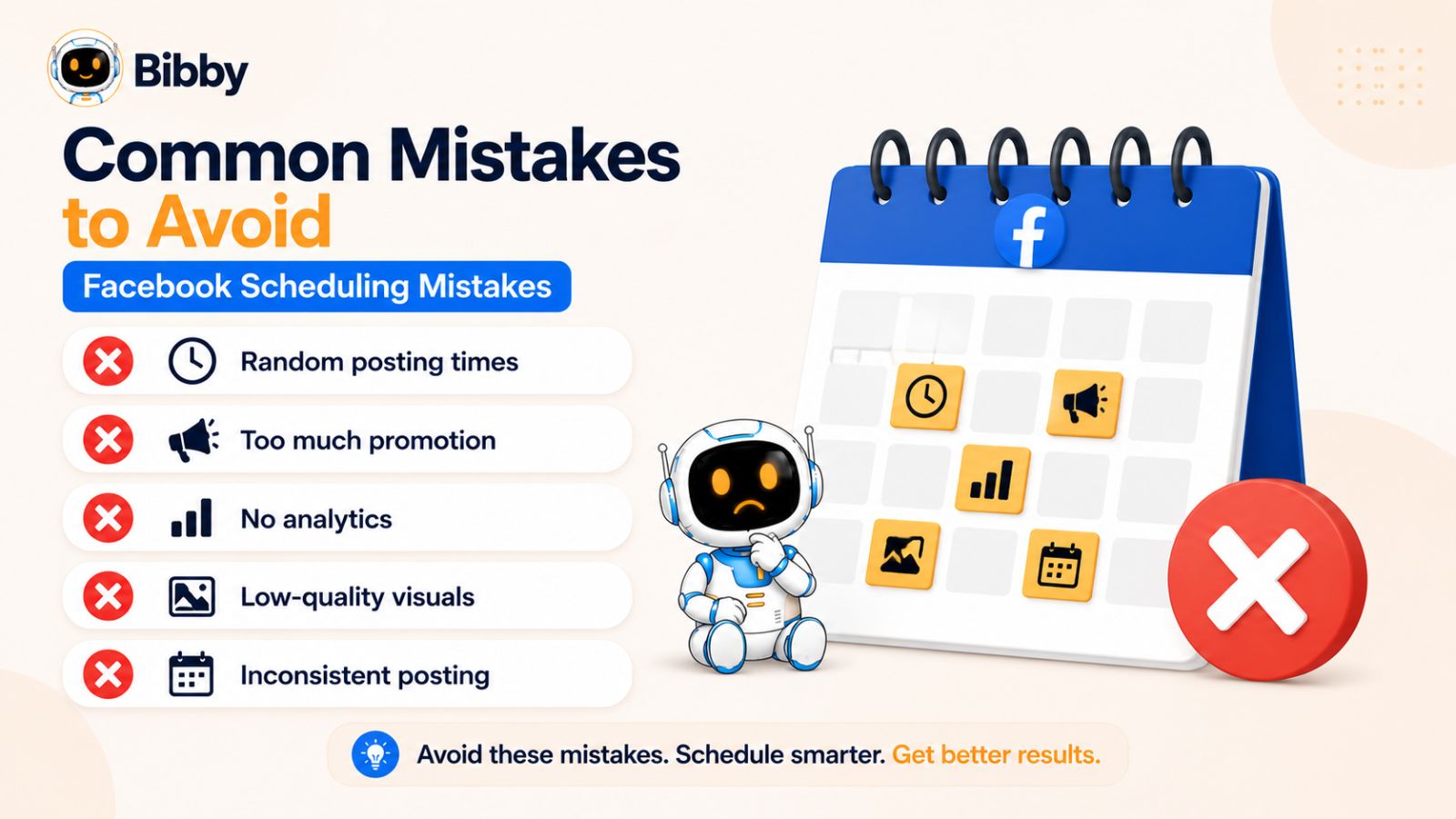
Many businesses invest in scheduling tools only to see disappointing results because they make avoidable mistakes that limit engagement and reach.
Understanding these common pitfalls can help you build a more effective Facebook marketing strategy and get better results from your scheduling efforts.
Posting Without a Content Strategy
One of the biggest mistakes businesses make is scheduling content without a clear plan.
Simply filling a calendar with random posts rarely leads to meaningful engagement or business growth.
Before scheduling content, establish:
- Content goals
- Target audience
- Content themes
- Posting frequency
- Key performance indicators (KPIs)
Every post should serve a purpose, whether it's educating your audience, generating leads, building brand awareness, or driving sales.
A well-structured content strategy makes scheduling significantly more effective.
Posting at Random Times
Timing can have a major impact on post performance.
Many businesses schedule content based on convenience rather than audience behavior.
For example, posting at 2:00 AM simply because that's when content was created may result in lower visibility and engagement.
Instead, focus on publishing when your audience is most active.
AI-powered platforms like Bibby help solve this problem by automatically scheduling content at optimized times based on engagement opportunities, reducing the guesswork involved in timing decisions.
Over-Promoting Your Business
Many brands use Facebook primarily as a sales channel.
As a result, every scheduled post becomes a promotion.
Unfortunately, audiences rarely engage with accounts that constantly try to sell something.
A healthier content mix typically includes:
- Educational content
- Helpful tips
- Industry insights
- Community engagement posts
- Customer stories
- Entertaining content
- Promotional content
The goal is to provide value consistently while integrating promotions naturally.
Ignoring Comments and Messages
Automation should never replace human interaction.
A common mistake is scheduling content and then forgetting about it after it goes live.
Social media remains a two-way communication channel.
If followers leave comments, ask questions, or send messages, they expect responses.
Ignoring engagement opportunities can:
- Reduce audience trust
- Lower engagement rates
- Hurt customer relationships
- Limit community growth
Automation should handle publishing, while humans focus on conversations and relationship building.
Using the Same Content Everywhere
Cross-platform publishing is efficient, but blindly copying identical content across every social network is rarely the best approach.
Each platform has different user expectations.
For example:
- Facebook encourages discussion.
- Instagram prioritizes visual storytelling.
- LinkedIn favors professional insights.
- TikTok rewards short-form creativity.
- YouTube focuses on video-first content.
A smarter approach is to adapt content for each platform while maintaining a consistent overall message.
Neglecting Visual Quality
Even the best caption cannot compensate for poor visuals.
Low-quality images, poorly edited videos, and inconsistent branding can significantly reduce engagement.
Before scheduling content, ensure that your visuals are:
- High resolution
- Mobile-friendly
- Brand consistent
- Professionally designed
- Relevant to the message
If creating visuals is a challenge, AI-generated image tools can help streamline the process while maintaining quality standards.
Scheduling Too Far Ahead Without Flexibility
Planning content in advance is beneficial, but scheduling months of content without reviewing it can create problems.
Markets change.
Trends emerge.
News events happen.
Business priorities evolve.
If your content calendar is completely locked in, you may miss opportunities to respond to current events and industry conversations.
Maintain flexibility by regularly reviewing upcoming scheduled content and making adjustments when necessary.
Ignoring Analytics
Many businesses focus heavily on scheduling but rarely analyze performance afterward.
This is a major missed opportunity.
Without analytics, it's impossible to know:
- Which content performs best
- What topics resonate with audiences
- Which posting times are most effective
- Which platforms generate the strongest results
Data should guide future content decisions.
Platforms like Bibby provide centralized analytics that make it easier to identify trends and optimize future campaigns.
Inconsistent Posting Frequency
Some businesses schedule dozens of posts one month and then disappear the next.
Inconsistency can weaken audience engagement and reduce brand visibility.
It's generally better to maintain a sustainable publishing schedule than to post aggressively for short periods and then stop.
Consistency builds trust and helps audiences know what to expect from your brand.
Relying Entirely on Automation
Automation is a powerful tool, but it should support your marketing strategy rather than replace it.
The best results come from combining automation with human creativity and expertise.
Use automation for:
- Scheduling
- Content organization
- Caption generation
- Posting time optimization
- Performance tracking
Continue using human judgment for:
- Brand strategy
- Customer interactions
- Community management
- Creative direction
- Campaign planning
The balance between automation and human involvement often produces the strongest long-term results.
Quick Checklist Before Scheduling Facebook Posts
Before publishing content automatically, ask yourself:
✅ Does this post provide value to my audience?
✅ Is the visual high quality?
✅ Is the caption engaging?
✅ Does it include a clear call to action?
✅ Is the posting time optimized?
✅ Does it fit my overall content strategy?
✅ Have I reviewed the content for errors?
✅ Am I tracking performance afterward?
Following this checklist can help prevent many of the mistakes that limit social media growth.
The Bottom Line
Facebook scheduling tools can dramatically improve efficiency, but success depends on how they are used.
Avoiding common mistakes such as random posting times, excessive promotion, poor visuals, and neglected analytics will help ensure your automated content strategy produces meaningful results.
When combined with a thoughtful content plan and a platform like Bibby that supports AI-generated captions, multi-platform scheduling, AI-optimized posting times, and analytics, automation becomes a powerful growth tool rather than simply a convenience feature.
Measuring the Success of Scheduled Facebook Posts
Scheduling Facebook posts automatically can save time and improve consistency, but how do you know if your strategy is actually working?
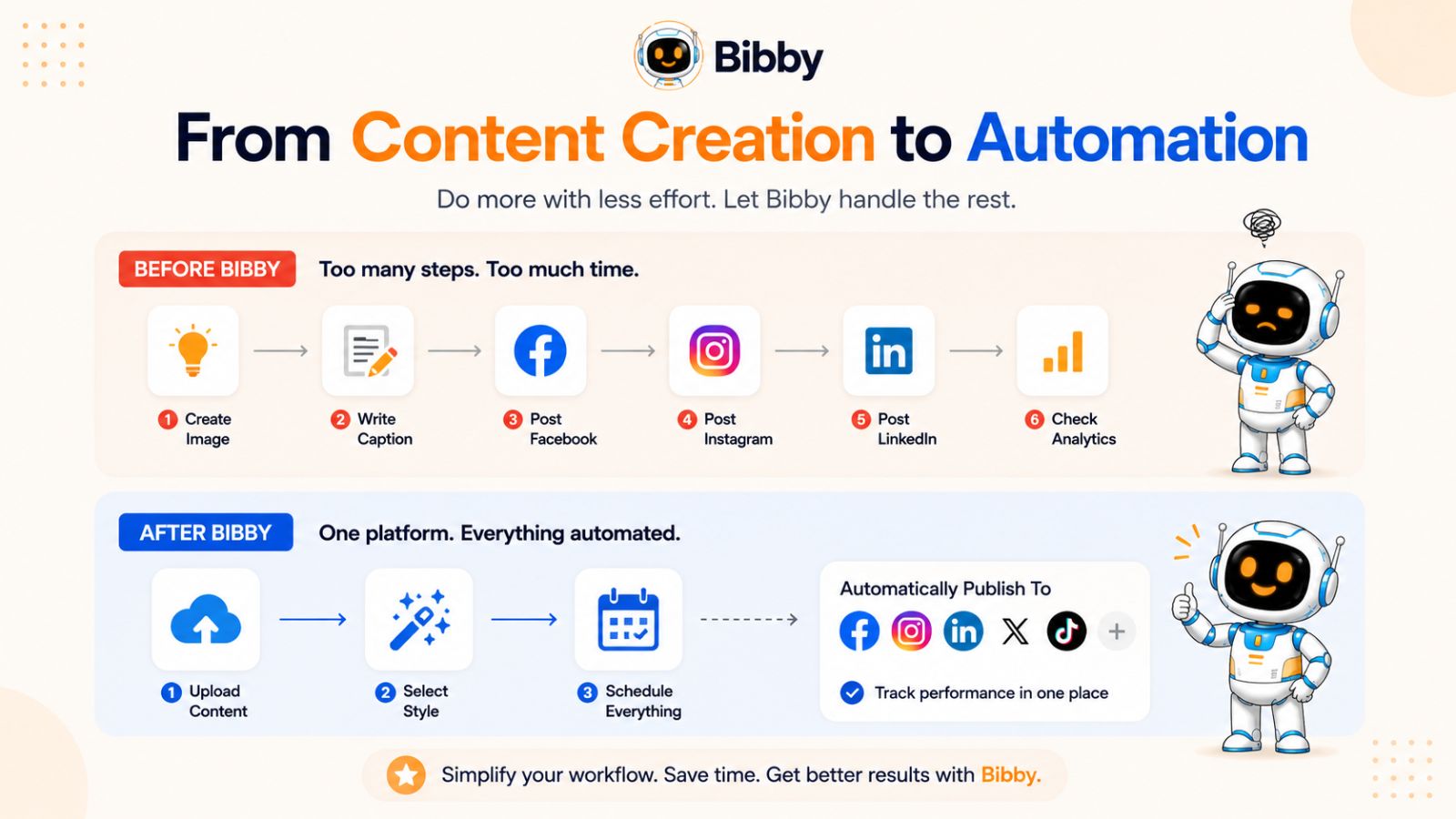
The answer lies in tracking the right metrics and using performance data to continuously improve your content.
Many businesses focus heavily on publishing content but spend very little time analyzing results. The most successful brands take the opposite approach. They treat every post as an opportunity to learn more about their audience and refine their strategy.
By measuring performance consistently, you can identify what drives engagement, generates leads, and contributes to business growth.
Why Analytics Matter
Without analytics, social media marketing becomes guesswork.
You may be posting regularly, but you won't know:
- Which content resonates most with your audience
- What posting times generate the highest engagement
- Which platforms perform best
- What types of content drive conversions
- How your audience responds over time
Analytics provide the insights needed to make smarter decisions and maximize the value of every post you schedule.
Key Metrics to Track
While every business has unique goals, several Facebook metrics are important for almost everyone.
Reach
Reach measures the number of unique users who see your content.
A growing reach often indicates that your content is being shown to more people and gaining visibility.
Monitor:
- Total reach
- Organic reach
- Reach trends over time
Increasing reach is often a sign that your content strategy is moving in the right direction.
Engagement
Engagement measures how people interact with your content.
Examples include:
- Likes
- Reactions
- Comments
- Shares
- Saves
High engagement typically signals that your content is relevant and valuable to your audience.
When evaluating engagement, focus on trends rather than individual posts.
Click-Through Rate (CTR)
If your content includes links, click-through rate is one of the most important metrics to monitor.
CTR shows how many people clicked after seeing your post.
A strong CTR often indicates:
- Effective headlines
- Compelling visuals
- Clear calls to action
- Relevant content
Improving CTR can have a direct impact on website traffic, lead generation, and sales.
Follower Growth
Follower growth helps measure whether your content is attracting new audience members.
Although follower count should never be the only success metric, steady growth often suggests that your content is reaching and appealing to the right people.
Track:
- New followers
- Growth rate
- Audience retention
Video Performance
If you publish videos, monitor additional metrics such as:
- Video views
- Watch time
- Average view duration
- Completion rate
These insights can help determine what types of video content perform best.
Shares and Saves
Shares and saves often indicate particularly valuable content.
When people share your content, they are essentially recommending it to others.
High share rates often lead to:
- Increased reach
- Greater visibility
- More engagement
- Stronger brand awareness
Similarly, saved posts often signal content that audiences want to revisit later.
Comparing Content Performance
Not all posts perform equally.
One of the most valuable analytics exercises is comparing your highest-performing content against your lowest-performing content.
Ask questions such as:
- Which topics receive the most engagement?
- Which content formats perform best?
- Which captions generate the most interaction?
- Which calls to action drive clicks?
- Which posting times produce the strongest results?
Patterns often emerge that can guide future content decisions.
Finding Your Best Posting Times
Many marketers spend significant time researching the best time to post on Facebook.
The reality is that the ideal posting time varies from audience to audience.
Your best posting times depend on:
- Industry
- Location
- Audience demographics
- Content type
- User behavior
Rather than relying solely on generic industry benchmarks, use your own analytics data whenever possible.
AI-powered scheduling tools like Bibby can further simplify this process by automatically selecting optimized publishing times designed to maximize engagement opportunities.
Measuring Cross-Platform Performance
If you're publishing content across multiple social networks, it is important to evaluate performance beyond Facebook.
Compare results across platforms such as:
- TikTok
- YouTube
You may discover that:
- Educational content performs best on LinkedIn.
- Videos generate stronger engagement on TikTok.
- Product demonstrations receive more views on YouTube.
- Community discussions thrive on Facebook.
Understanding platform-specific performance helps you allocate resources more effectively.
How Bibby Analytics Simplifies Performance Tracking
One challenge businesses often face is managing analytics across multiple platforms.
Instead of logging into separate dashboards, Bibby provides centralized analytics that allow users to monitor content performance from one location.
This makes it easier to:
- Identify top-performing content
- Track audience growth
- Monitor engagement trends
- Evaluate campaign effectiveness
- Optimize future publishing decisions
Having all performance data in one place saves time and creates a clearer picture of overall social media performance.
Turning Data Into Better Results
Analytics are only valuable when they lead to action.
Use your performance data to:
- Publish more of what works
- Improve underperforming content
- Test new ideas
- Refine posting schedules
- Optimize calls to action
- Improve audience targeting
The goal is continuous improvement rather than perfection.
Even small optimizations can produce significant long-term gains when applied consistently.
Success Is More Than Likes
Many businesses focus exclusively on likes and reactions, but meaningful success often extends beyond engagement metrics.
Depending on your goals, success may include:
- Website traffic
- Lead generation
- Product sales
- Email subscribers
- Appointment bookings
- Brand awareness
- Customer retention
Always align your social media metrics with broader business objectives.
The Bottom Line
The true value of Facebook scheduling isn't simply publishing content automatically—it's creating a repeatable system that allows you to learn, improve, and grow over time.
By tracking reach, engagement, clicks, follower growth, and cross-platform performance, you can make smarter decisions and maximize the return on your social media efforts.
When combined with AI-powered scheduling, automated caption generation, multi-platform publishing, and centralized analytics from tools like Bibby, measuring and improving social media performance becomes significantly easier and more scalable.
Frequently Asked Questions
Can I Schedule Facebook Posts Automatically for Free?
Yes. Facebook allows users to schedule posts through Meta Business Suite at no cost. This option works well for basic Facebook and Instagram scheduling.
However, if you want advanced features such as AI-generated captions, multi-platform scheduling, AI-optimized posting times, content automation, and centralized analytics, a dedicated social media management platform may be a better choice.
How Far in Advance Can I Schedule Facebook Posts?
You can schedule Facebook posts days, weeks, or even months in advance depending on your content strategy.
Many businesses plan content on a monthly basis, while larger organizations and agencies often build content calendars several months ahead. The key is to maintain flexibility so you can adjust content when trends, events, or business priorities change.
Can I Schedule Facebook Stories Automatically?
Yes. Many modern social media scheduling platforms support Facebook Story scheduling.
This allows businesses to plan story content in advance and maintain consistent engagement without needing to publish manually every day.
Platforms such as Bibby also support scheduling multiple content formats, including stories, videos, and standard social media posts.
What Is the Best Time to Schedule Facebook Posts?
There is no single best posting time for every business.
The ideal time depends on factors such as:
- Audience demographics
- Industry
- Geographic location
- Content type
- User behavior
The most effective approach is to analyze your audience data and engagement patterns over time. AI-powered scheduling tools can further improve results by automatically selecting optimized publishing times based on audience activity.
Can AI Write Facebook Captions for Me?
Yes. Many social media automation tools now use artificial intelligence to generate captions automatically.
AI can help:
- Create engaging captions
- Maintain a consistent brand voice
- Overcome writer's block
- Speed up content creation
- Generate ideas for future posts
For example, Bibby allows users to choose a posting style and automatically generates captions tailored to that style, reducing the time required to create social media content.
Can I Schedule Facebook, Instagram, LinkedIn, TikTok, and YouTube Posts Together?
Yes. Multi-platform scheduling tools allow users to publish content across multiple social networks from a single dashboard.
This approach offers several benefits:
- Less manual work
- More consistent branding
- Simplified content management
- Faster campaign execution
- Centralized analytics
Rather than managing each platform separately, businesses can streamline their entire social media workflow.
Can I Schedule Videos on Facebook?
Yes. Facebook supports video scheduling, allowing businesses and creators to publish video content automatically at a future date and time.
Video scheduling is especially useful for:
- Product demonstrations
- Educational content
- Brand storytelling
- Event promotions
- Customer testimonials
Many third-party scheduling tools also support video publishing across multiple social media platforms simultaneously.
Is Facebook Scheduling Worth It for Small Businesses?
Absolutely.
Small business owners often have limited time and resources. Scheduling content in advance helps maintain a consistent social media presence without requiring daily effort.
Benefits include:
- Time savings
- Improved consistency
- Better engagement opportunities
- More efficient marketing workflows
- Reduced stress
Even scheduling just one or two weeks of content in advance can significantly improve productivity.
What Is the Difference Between Social Media Scheduling and Social Media Automation?
Social media scheduling focuses on publishing content at predetermined times.
Social media automation goes beyond scheduling and may include:
- AI-generated captions
- AI-generated images
- Automated workflows
- Posting time optimization
- Content recommendations
- Performance analytics
Automation reduces manual work throughout the entire content creation and publishing process rather than simply scheduling posts.
What Is the Best Tool for Scheduling Facebook Posts Automatically?
The best tool depends on your goals and workflow requirements.
If you only need basic Facebook scheduling, Meta Business Suite may be sufficient.
However, businesses and creators looking for a complete social media automation solution often prefer platforms that combine content creation, AI assistance, scheduling, publishing, and analytics in one place.
Bibby is designed specifically for this purpose. Users can upload or generate images with AI, choose a posting style, automatically generate captions, schedule content across Facebook, Instagram, LinkedIn, TikTok, and YouTube, publish at AI-optimized times, and track performance through a centralized analytics dashboard.
Final Thoughts
Scheduling Facebook posts automatically is one of the most effective ways to save time, maintain consistency, and improve your social media marketing results.
Throughout this guide, you've learned that successful Facebook scheduling goes beyond simply choosing a future publishing date. The most effective strategies involve creating a content plan, scheduling posts consistently, publishing at optimal times, and using analytics to continuously improve performance. You've also seen how automation can reduce repetitive tasks and help businesses manage multiple social media platforms more efficiently.
The three most important takeaways are:
- Consistent scheduling helps increase visibility and audience engagement.
- AI-powered automation can dramatically reduce content creation and publishing time.
- Analytics and optimization are essential for long-term social media growth.
As social media becomes more competitive, businesses and creators need tools that do more than just schedule posts. Platforms like Bibby streamline the entire workflow by allowing users to upload or generate images with AI, choose a posting style, automatically generate captions, schedule content across Facebook, Instagram, LinkedIn, TikTok, and YouTube, publish at AI-optimized times, and monitor performance through centralized analytics.
The natural next step is learning how to build a complete AI-powered social media content strategy that not only automates publishing but also helps you consistently create engaging content, grow your audience, and generate measurable business results across every major social platform.