
Managing social media can quickly become overwhelming when you're posting across multiple platforms every day.
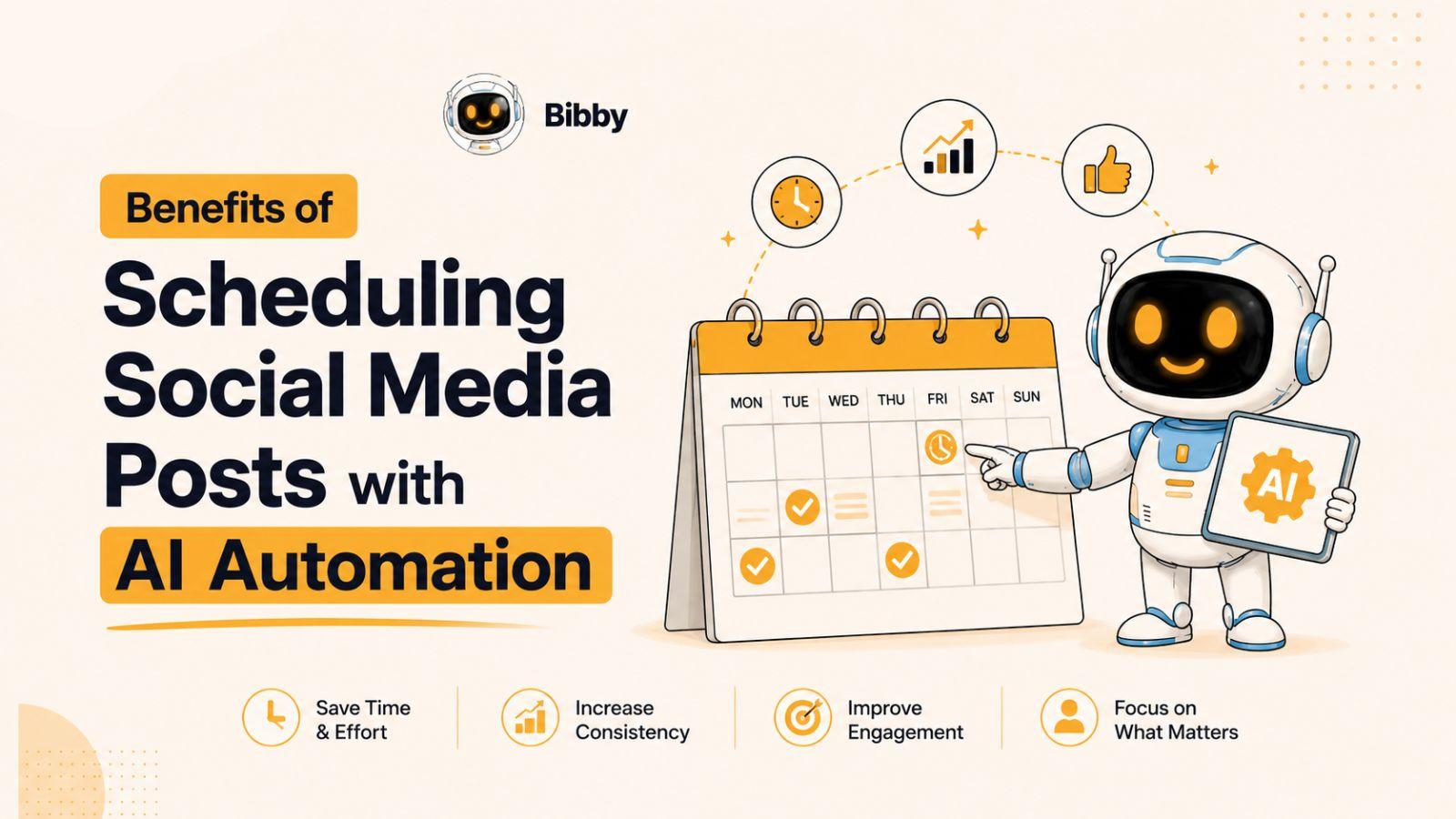
Whether you're a business owner, marketer, agency, or content creator, maintaining a consistent social media presence requires significant time and effort. The good news is that scheduling your social media posts can eliminate much of the manual work while helping you publish more consistently, reach your audience at the right time, and improve overall marketing results.
In this blog, you will look into:
- How scheduling saves hours of social media management every week
- Why consistent posting leads to better engagement and growth
- How AI-powered tools like Bibby automate your entire workflow
As social media platforms continue to evolve, businesses that automate content creation and scheduling gain a major advantage over those still posting manually. Let's explore the biggest benefits of scheduling social media posts and how modern AI tools are making the process easier than ever.
Also read: How to Use AI for Smarter Content Scheduling
What Is Social Media Post Scheduling?
Social media post scheduling is the process of creating content in advance and setting it to be automatically published on specific social media platforms at predetermined times and dates. Instead of manually posting every piece of content throughout the day, marketers can plan their content calendar ahead of time and let scheduling software handle the publishing process.
At its core, social media scheduling helps businesses maintain a consistent online presence without requiring someone to be actively posting around the clock. This is especially important as brands expand across multiple channels, each with its own audience, content formats, and engagement patterns.
How Social Media Scheduling Works
The scheduling process is typically straightforward:
- Create or upload your content.
- Write a caption or post description.
- Select the platforms where the content should appear.
- Choose a publishing date and time.
- Allow the scheduling tool to publish automatically.
Once scheduled, posts are automatically published according to the chosen schedule, ensuring your content reaches audiences even when you're busy running your business, meeting with clients, or focusing on other priorities.
Manual Posting vs. Scheduled Posting
Manual posting requires users to log in to each social media platform individually and publish content in real time. While this approach may work for occasional posts, it becomes increasingly inefficient as content volume grows.
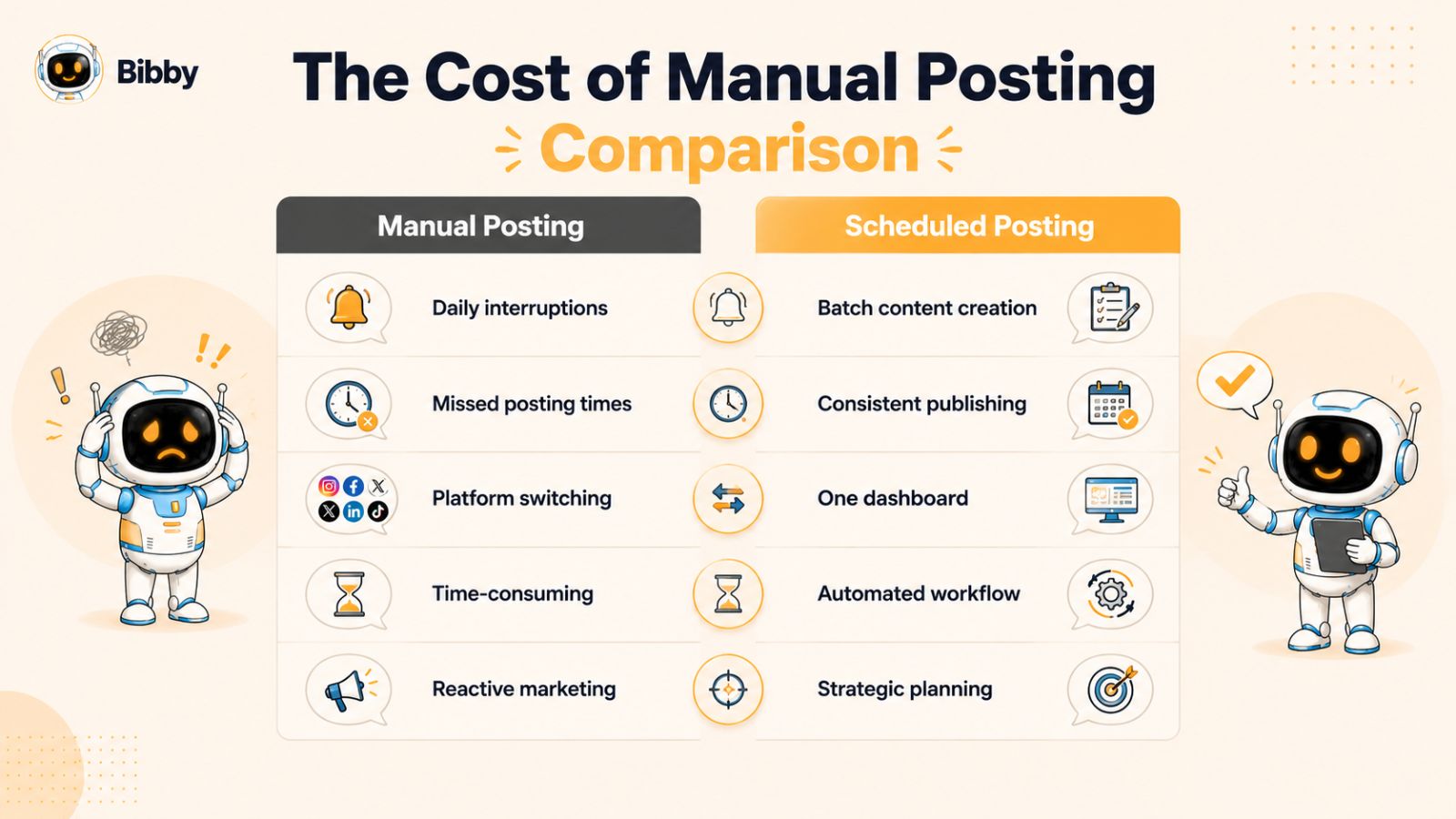
Scheduled posting offers several advantages:
- Eliminates repetitive daily publishing tasks
- Reduces the risk of missed posting opportunities
- Enables long-term content planning
- Improves consistency across platforms
- Frees up time for strategy and audience engagement
For businesses managing multiple social accounts, scheduling quickly becomes a necessity rather than a convenience.
Platforms That Support Scheduled Content
Today's social media scheduling tools allow users to manage content across multiple networks from a single dashboard, including:
- TikTok
- YouTube
- X (formerly Twitter)
Instead of jumping between platforms, marketers can manage their entire content strategy in one place.
The Evolution of Social Media Scheduling
Traditional scheduling tools focused solely on publishing content at specific times. Modern platforms have evolved far beyond basic scheduling.
Today's AI-powered solutions can help generate captions, recommend optimal posting times, analyze performance, and automate much of the content management process. This shift allows businesses to spend less time on repetitive tasks and more time creating meaningful content and building relationships with their audience.
As we'll explore throughout this guide, social media scheduling is no longer just about convenience—it's become one of the most effective ways to improve efficiency, consistency, and marketing performance.
Also have a look: How to Automatically Post to Multiple Social Media Platforms
The Top Benefits of Scheduling Social Media Posts
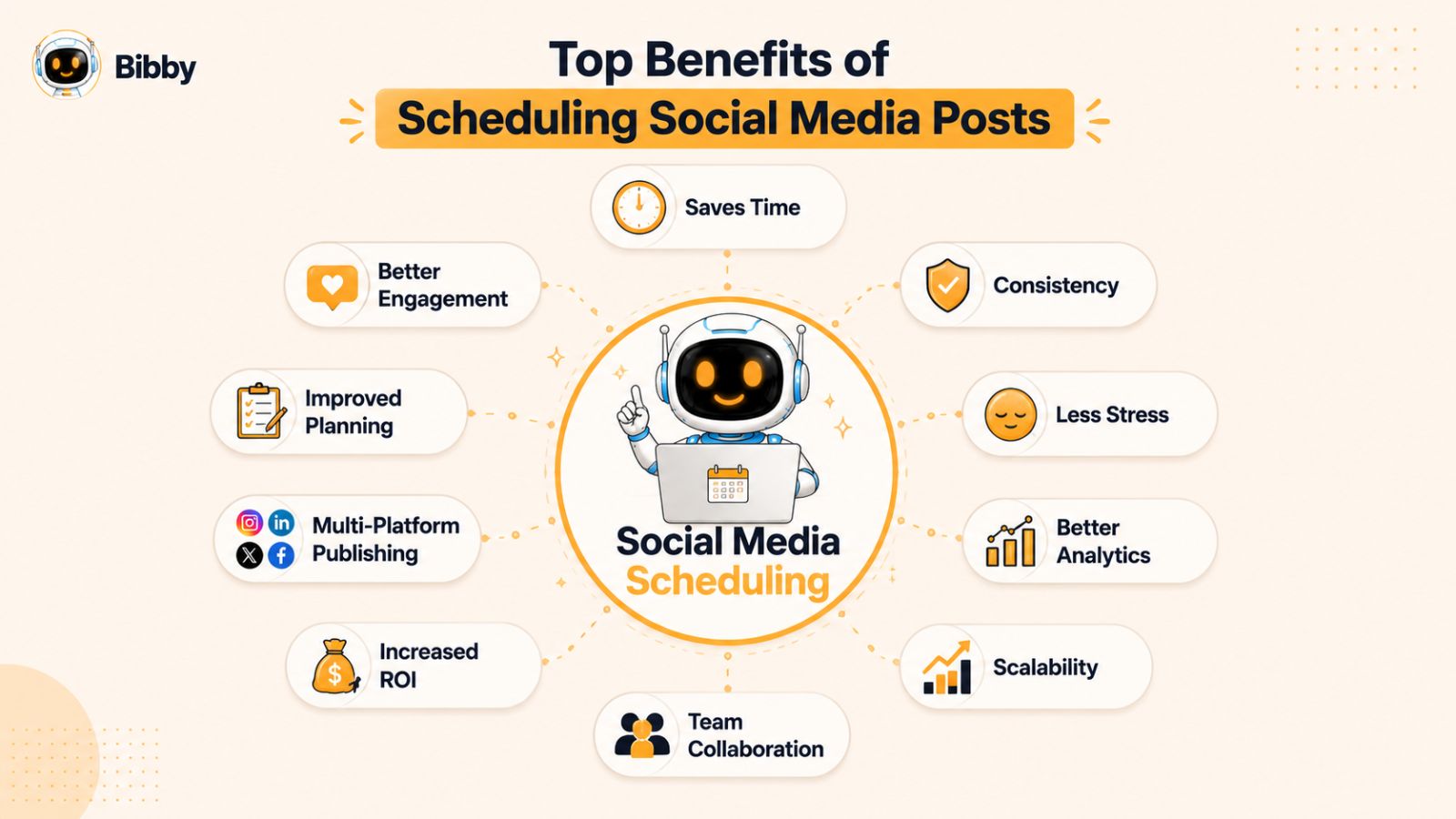
For businesses, marketers, and content creators, time is one of the most valuable resources. Social media scheduling helps you maximize that resource while improving consistency, engagement, and overall marketing performance. Here are the biggest benefits of scheduling social media posts.
1. Saves Hours of Time Every Week
One of the most obvious benefits of scheduling social media posts is the time savings.
Instead of stopping multiple times throughout the day to publish content manually, you can create and schedule an entire week—or even a month—of content in a single session. This allows you to focus on higher-value activities such as strategy, customer engagement, product development, or business growth.
Many businesses discover that batching content creation and scheduling significantly reduces the amount of time spent managing social media.
2. Maintains Consistent Posting
Consistency is one of the most important factors in social media success.
When you post regularly, your audience knows what to expect from your brand. Consistent publishing also increases the likelihood that your content will be seen by followers and recommended by platform algorithms.
Without scheduling, it's easy to miss posting days during busy periods. Scheduling ensures your content calendar remains active even when your team is focused elsewhere.
3. Improves Audience Engagement
Timing plays a major role in how well social media content performs.
Publishing content when your audience is most active increases the chances of receiving likes, comments, shares, and other forms of engagement. Scheduling allows you to plan posts for peak activity periods rather than posting whenever you happen to be available.
Over time, this can lead to stronger audience relationships and improved content performance.
4. Enables Better Content Planning
Scheduling encourages a more strategic approach to social media marketing.
Instead of deciding what to post at the last minute, businesses can plan content weeks in advance. This creates opportunities to align social media efforts with product launches, seasonal campaigns, promotions, industry events, and company objectives.
A planned content calendar typically produces better results than reactive posting.
5. Reduces Stress and Last-Minute Work
Creating content under pressure often leads to rushed decisions and lower-quality posts.
Scheduling removes much of this pressure by allowing marketers to prepare content ahead of time. Knowing that your upcoming posts are already scheduled provides peace of mind and reduces the daily burden of social media management.
This is particularly valuable for small business owners and entrepreneurs who already have numerous responsibilities competing for their attention.
6. Supports Multi-Platform Marketing
Most brands no longer rely on a single social media platform.
They publish content across Facebook, Instagram, LinkedIn, TikTok, YouTube, and other channels to reach different audiences. Managing all of these platforms manually can become extremely time-consuming.
Scheduling tools simplify this process by enabling users to manage multiple platforms from one centralized dashboard.
7. Improves Team Collaboration
For marketing teams and agencies, scheduling tools create a more organized workflow.
Team members can collaborate on content creation, review upcoming posts, approve campaigns, and maintain visibility into the publishing calendar. This reduces confusion and helps ensure that everyone remains aligned with marketing goals.
A collaborative workflow also helps maintain brand consistency across all channels.
8. Provides Better Performance Insights
Most modern scheduling platforms include analytics features that help marketers understand what's working and what isn't.
By reviewing engagement, reach, impressions, and audience growth, businesses can make informed decisions about future content strategies. Instead of relying on assumptions, teams can use data to continuously improve performance.
Analytics transform social media marketing from guesswork into a measurable growth channel.
9. Increases Marketing Efficiency
Scheduling helps teams accomplish more without increasing workload.
When content creation, publishing, and performance tracking are streamlined, marketers can manage larger content calendars without sacrificing quality. This increased efficiency often translates into better results with fewer resources.
For growing businesses, this can be a significant competitive advantage.
10. Creates a Foundation for Scalable Growth
As a business grows, social media demands often increase as well.
More products, more campaigns, and more platforms require a system that can scale efficiently. Scheduling provides that foundation by automating repetitive publishing tasks and allowing teams to manage larger content operations without becoming overwhelmed.
The result is a marketing process that can support long-term growth while maintaining consistency and quality across every platform.
Also read: 10 Best AI Social Media Content Scheduling Tools
Why AI Is Transforming Social Media Scheduling
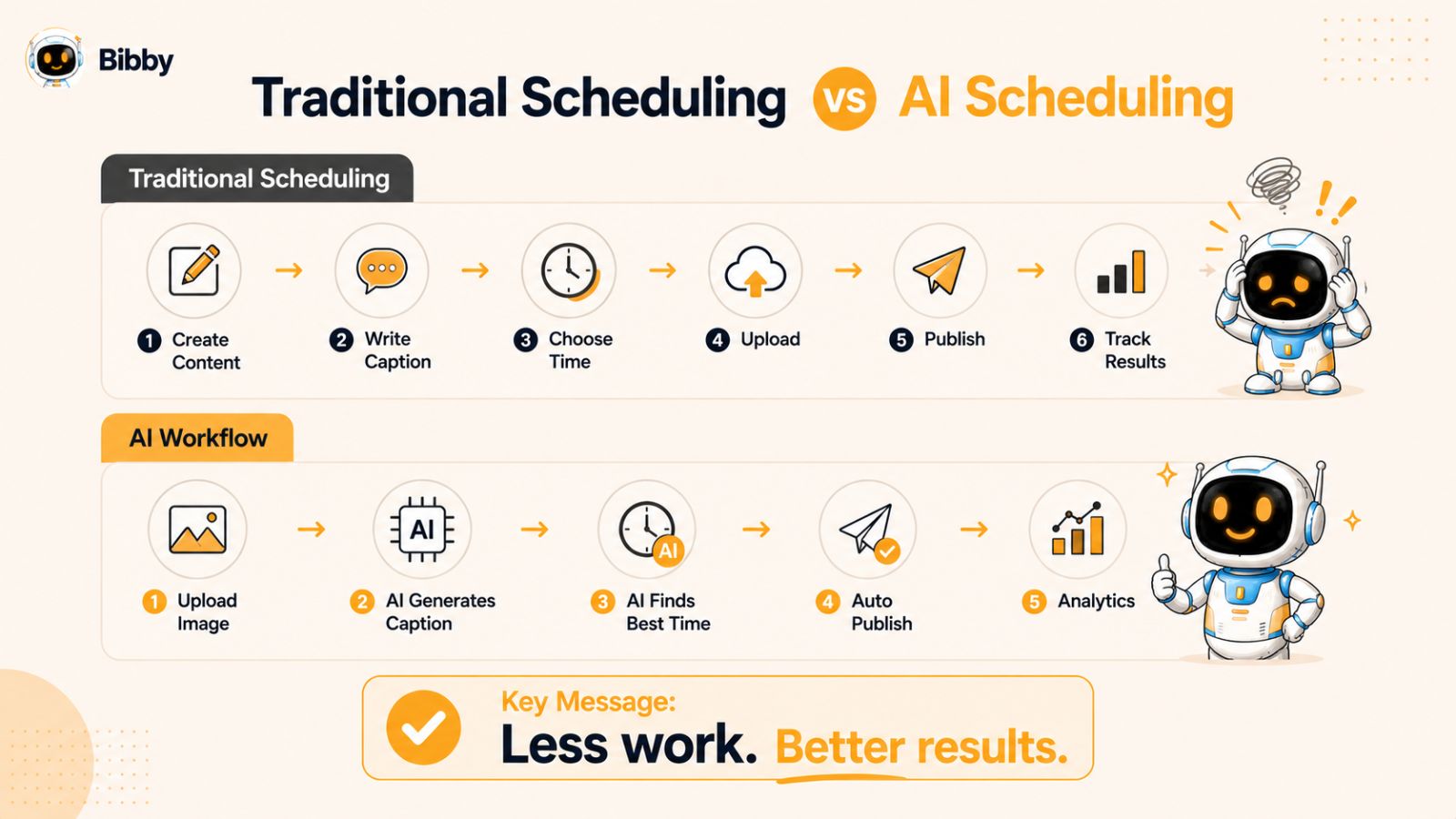
While traditional scheduling tools have helped businesses save time for years, they still require a significant amount of manual work. Marketers often need to create content, write captions, decide when to publish, upload media, and manage multiple platforms individually.
Artificial intelligence is changing that.
Modern AI-powered social media tools are automating many of the tasks that previously consumed hours each week, allowing businesses to create, schedule, publish, and optimize content with far less effort.
The Limitations of Traditional Scheduling Tools
Most traditional scheduling platforms focus primarily on publishing content at a specific time. While useful, they still leave much of the work in the hands of the user.
Common challenges include:
- Manually writing captions for every post
- Deciding the best times to publish
- Managing content across multiple platforms
- Creating enough content to maintain consistency
- Monitoring performance and adjusting strategies
As content demands increase, these tasks can quickly become overwhelming, especially for small businesses, agencies, and creators managing multiple accounts.
How AI Improves the Scheduling Process
Artificial intelligence helps eliminate many of these bottlenecks by automating repetitive tasks and optimizing publishing decisions.
Instead of spending hours preparing posts, users can leverage AI to accelerate nearly every stage of the workflow.
AI can help:
- Generate engaging captions automatically
- Adapt content for different social platforms
- Recommend or select optimal posting times
- Analyze engagement patterns
- Streamline content creation workflows
- Reduce manual scheduling work
This allows marketers to focus more on strategy, creativity, and audience relationships rather than repetitive administrative tasks.
AI-Optimized Posting Times Drive Better Results
One of the biggest advantages of AI scheduling is timing optimization.
Audience activity varies significantly based on platform, industry, location, and behavior patterns. Determining the best publishing times manually often involves trial and error.
AI systems can analyze engagement data and identify when audiences are most likely to interact with content. Posts can then be scheduled automatically during those high-opportunity windows, helping businesses maximize reach and engagement.
Rather than guessing when to publish, marketers can rely on data-driven recommendations.
AI Reduces Content Creation Bottlenecks
For many businesses, creating enough content is often more difficult than scheduling it.
Writing captions, brainstorming ideas, and maintaining a consistent posting schedule can consume substantial time and creative energy. AI-powered tools help solve this challenge by generating captions and content suggestions that accelerate the creation process.
Instead of staring at a blank screen, marketers can start with AI-generated content and refine it to match their brand voice.
The Future of Social Media Management
The future of social media marketing is not simply scheduling posts—it's automating entire workflows.
Businesses increasingly want solutions that can help them create content, generate captions, optimize publishing schedules, distribute posts across multiple platforms, and provide actionable performance insights from a single interface.
This shift toward end-to-end automation is why AI-powered platforms are becoming the preferred choice for businesses looking to save time while improving results.
One platform leading this evolution is Bibby, which combines AI content creation, smart scheduling, multi-platform publishing, and analytics into a simple workflow designed to make social media management virtually effortless.
You might like reading: How to Choose the Right AI Social Media Post Scheduling Tool?
How Bibby Simplifies Social Media Scheduling and Automation
Many social media tools help you schedule posts. Very few help you create content, generate captions, optimize posting times, publish across multiple platforms, and track performance—all from a single dashboard.
That's where Bibby stands apart.
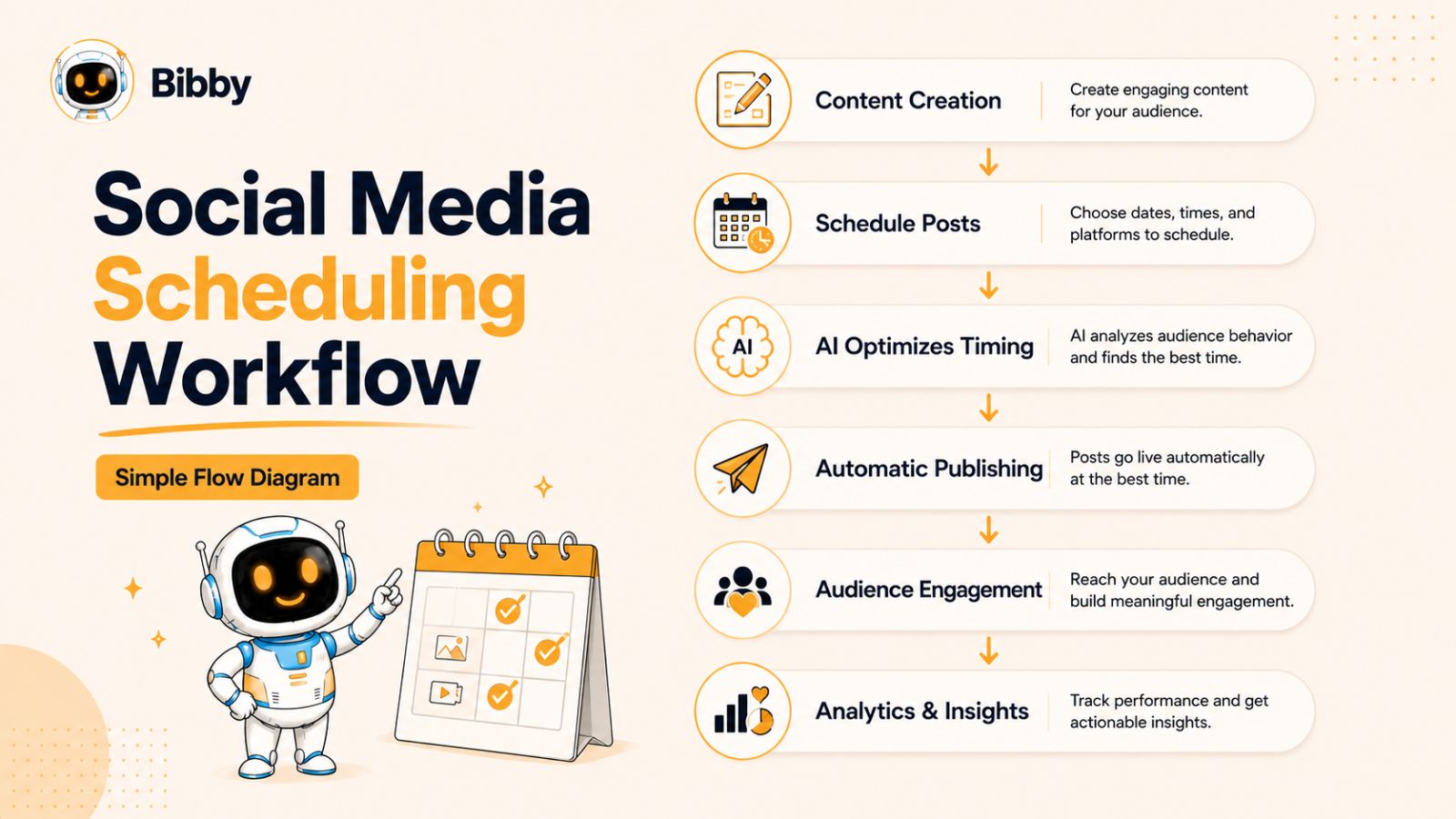
Bibby is an AI-powered social media scheduling and automation platform designed to eliminate the repetitive work involved in managing social media. Instead of juggling multiple tools and workflows, users can handle their entire content creation and publishing process in one place.
Whether you're a small business owner, content creator, marketer, or agency, Bibby helps you spend less time managing social media and more time growing your brand.
What Is Bibby?
Bibby is a social media automation platform that simplifies the entire content publishing workflow.
Rather than requiring users to manually create content, write captions, schedule posts, and monitor multiple social platforms, Bibby uses artificial intelligence to automate much of the process.
With support for major platforms including Facebook, Instagram, LinkedIn, TikTok, and YouTube, Bibby enables users to manage their social media presence from a single, streamlined workspace.
Bibby's Simple Three-Step Workflow
One of Bibby's biggest advantages is its simplicity.
Instead of navigating complicated publishing systems, users can move from content creation to scheduled publishing in just a few steps.
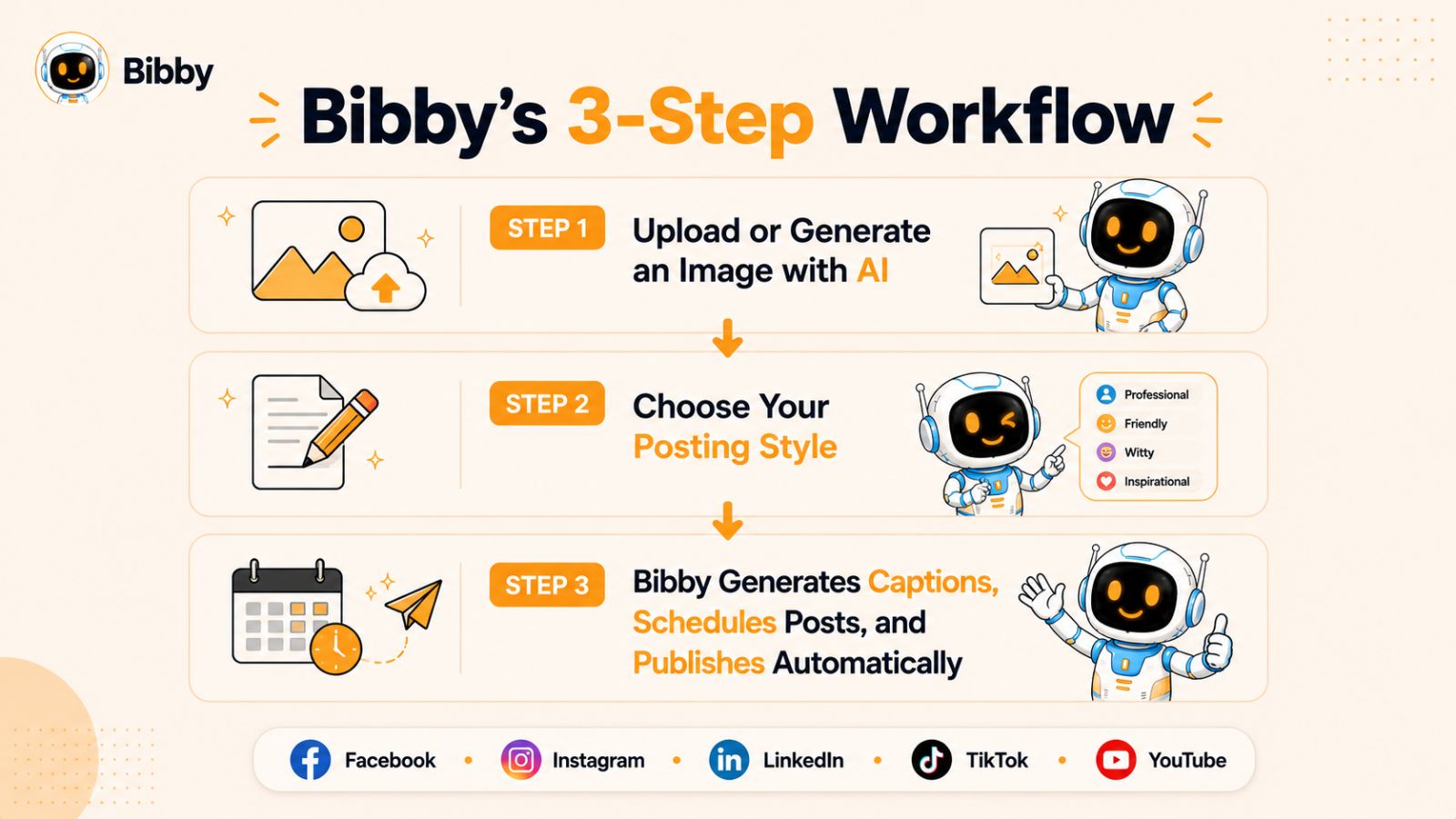
Step 1: Upload or Generate Your Content
Every social media post starts with content.
With Bibby, users can either upload their own images and media or generate new visuals using AI. This flexibility makes it easy to create content regardless of whether you already have assets prepared.
Instead of switching between design tools and scheduling platforms, everything starts inside a single workflow.
Step 2: Choose Your Posting Style
Every brand has its own voice and personality.
Bibby allows users to choose a preferred posting style so content aligns with their brand identity and marketing goals. Whether you're aiming for a professional, educational, conversational, or promotional tone, the platform helps ensure consistency across every post.
This removes much of the guesswork involved in creating engaging social media content.
Step 3: Let Bibby Handle the Rest
Once your content and posting style are selected, Bibby's AI takes over.
The platform automatically generates captions designed to fit your content and selected tone. It then schedules your posts across your chosen social media platforms at AI-optimized times intended to maximize visibility and engagement.
Instead of manually publishing content every day, your social media calendar can be managed automatically.
Publish Everywhere From One Dashboard
Managing multiple social media platforms individually can quickly become exhausting.
Bibby simplifies multi-platform publishing by allowing users to schedule content across:
- TikTok
- YouTube
This centralized approach saves time, reduces complexity, and helps maintain a consistent brand presence across all channels.
Stay Focused While Bibby Works in the Background
One of the biggest benefits of automation is freedom.
Rather than constantly thinking about what to post next or when to publish, users can prepare content in advance and allow Bibby to manage the scheduling process automatically.
This frees marketers, creators, and business owners to focus on higher-value activities such as customer engagement, product development, sales, and business growth.
Instead of spending hours every week managing social media, you can let Bibby handle the routine work while maintaining a consistent and active online presence.
Also read: 7 Reasons Your Small Business Should Switch to AI Social Media Scheduling
Beyond Posts: Additional Features That Make Bibby Stand Out
While scheduling social media posts is essential, modern marketers need much more than a simple publishing tool. Today's audiences consume a variety of content formats, and businesses need visibility into what's working and what's not.
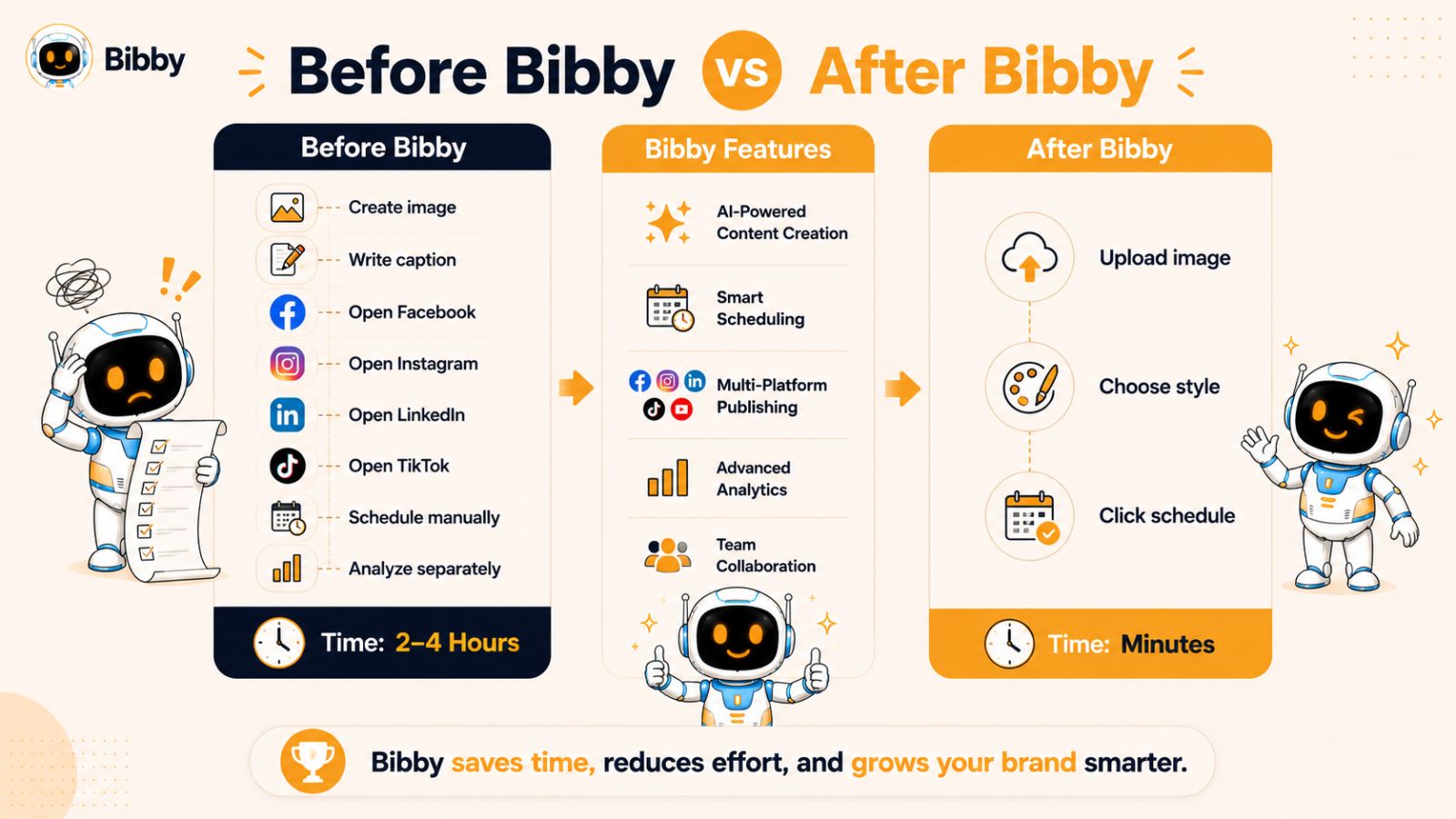
Bibby goes beyond basic scheduling by providing a complete social media management solution that helps users create, publish, analyze, and optimize their content strategy from a single platform.
Schedule and Publish Videos Effortlessly
Video continues to dominate social media engagement across nearly every platform.
However, managing video content often requires additional tools, workflows, and scheduling processes. Bibby simplifies video publishing by allowing users to manage video content alongside their regular social media posts.
Whether you're publishing educational content, product demonstrations, behind-the-scenes footage, or promotional videos, Bibby helps streamline the process and keep your content calendar organized.
This allows businesses to incorporate more video into their marketing strategy without creating additional complexity.
Manage Stories Alongside Your Regular Content
Stories have become one of the most effective ways to engage audiences on social media.
Instead of treating stories as a separate workflow, Bibby enables users to manage stories alongside their standard content strategy. This creates a more unified approach to social media management and helps brands maintain consistent communication across all content formats.
By managing posts and stories from one platform, marketers can save time while ensuring a cohesive brand experience.
Track Analytics That Matter
Publishing content is only half the battle. Understanding performance is what drives long-term growth.
Bibby provides analytics that help users measure the effectiveness of their social media efforts. By monitoring key performance indicators, marketers can gain valuable insights into how audiences interact with their content.
Analytics can help answer important questions such as:
- Which posts generate the most engagement?
- What content formats perform best?
- Which platforms deliver the strongest results?
- How is audience growth trending over time?
- What publishing strategies are driving the highest reach?
These insights help businesses make smarter decisions and continuously improve their social media strategy.
Eliminate Tool Overload
Many businesses rely on multiple tools for content creation, scheduling, analytics, and publishing.
This fragmented workflow often leads to inefficiencies, higher costs, and unnecessary complexity. Teams spend valuable time switching between platforms instead of focusing on creating great content.
Bibby helps solve this problem by bringing critical social media management functions together in one place.
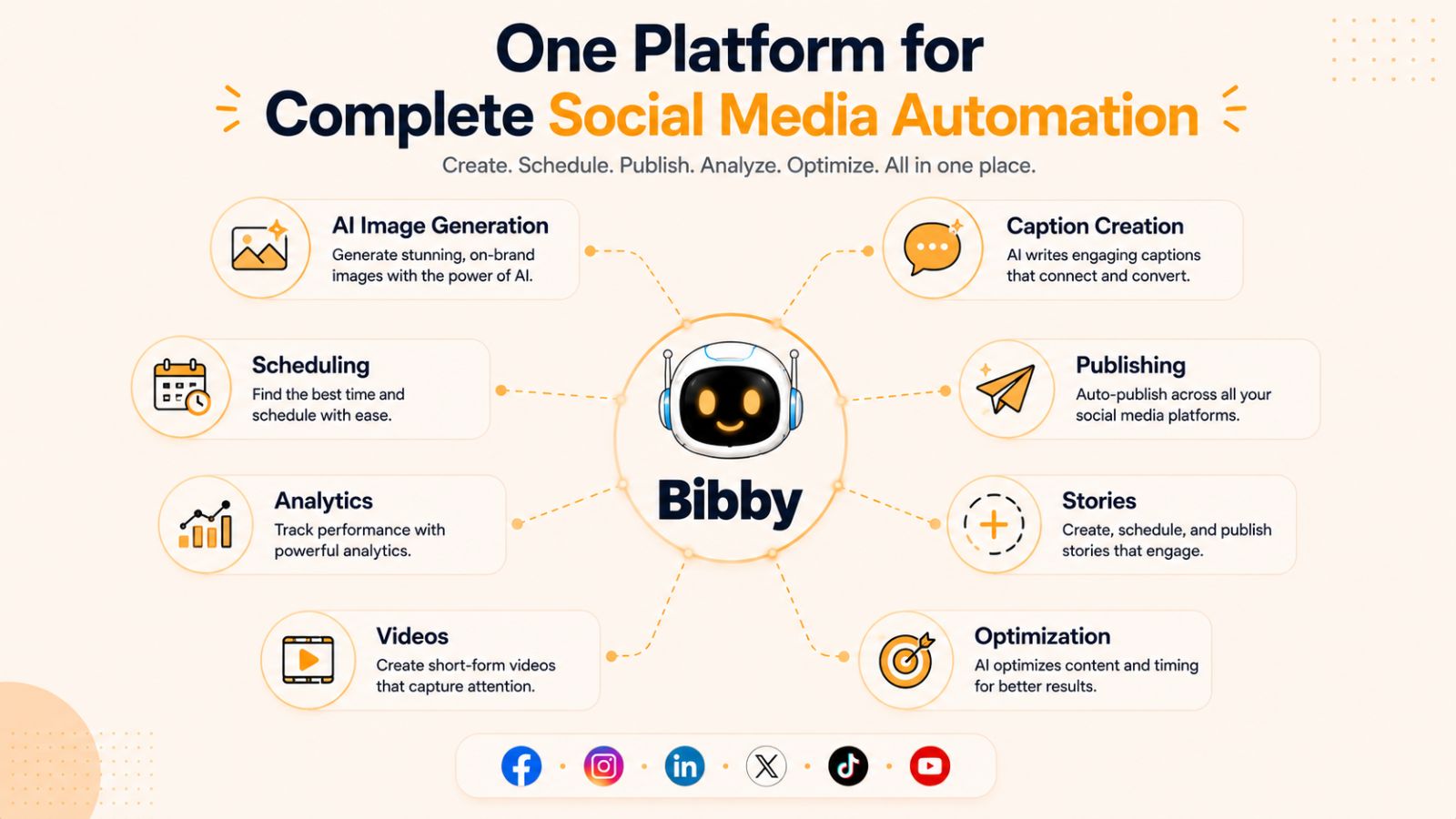
Instead of managing several disconnected tools, users can handle:
- Content creation
- AI-powered caption generation
- Post scheduling
- Multi-platform publishing
- Video management
- Story publishing
- Performance analytics
All from a single dashboard.
Complete Social Media Automation
The ultimate goal of social media automation is not simply scheduling content—it's creating a system that allows businesses to maintain an active, effective social media presence with minimal manual effort.
Bibby's combination of AI content generation, automated scheduling, optimized publishing times, multi-platform distribution, and integrated analytics creates a workflow that dramatically reduces the amount of time required to manage social media.
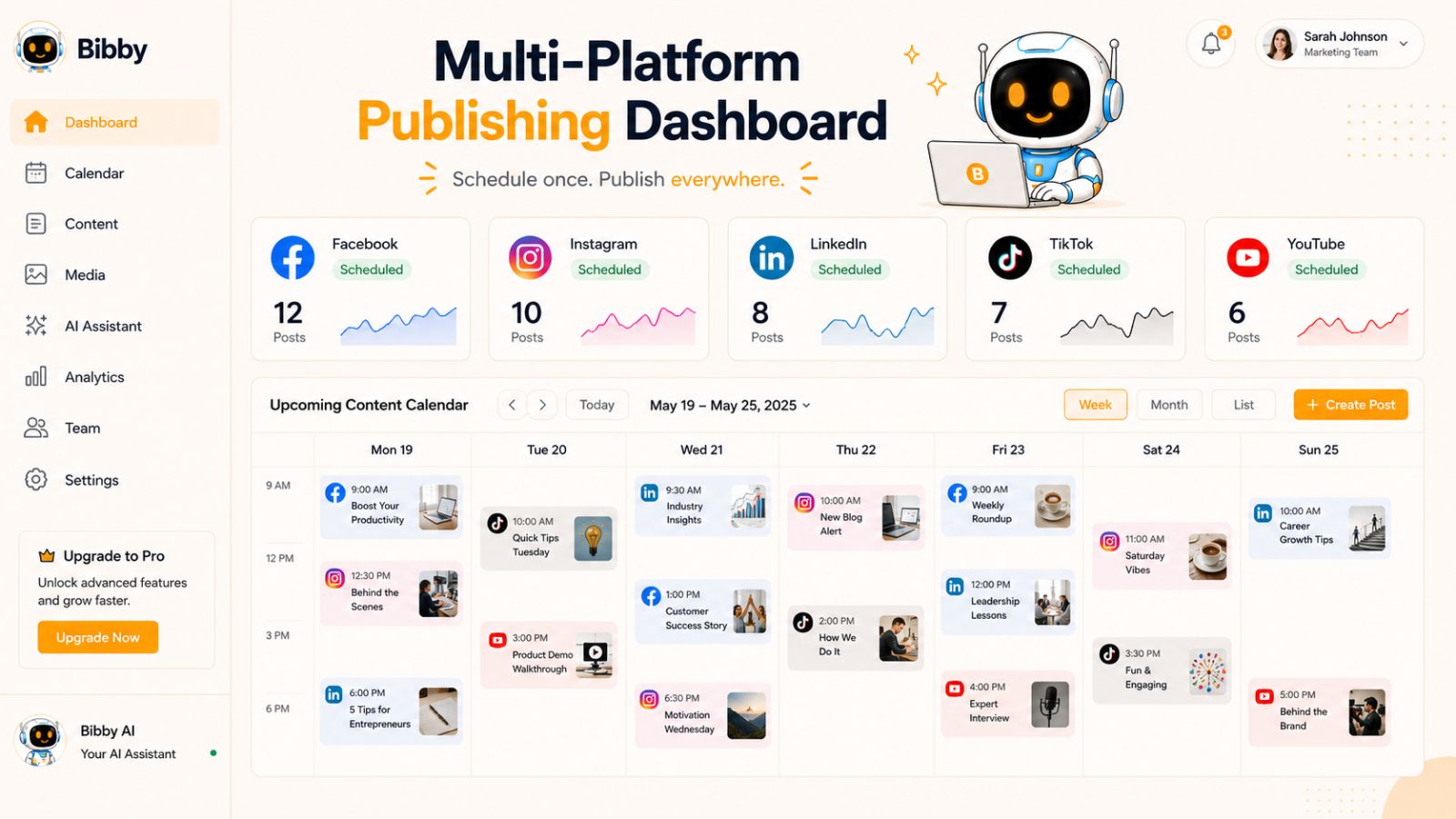
For business owners, marketers, agencies, and creators, this means less time spent on repetitive tasks and more time available for strategy, creativity, audience engagement, and growth.
In a world where content demands continue to increase, having a platform that automates the majority of the workflow can provide a significant competitive advantage.
Must read: AI Scheduling vs Manual Posting: The Growth Experiment
Who Benefits Most from Social Media Scheduling?
Social media scheduling is valuable for virtually anyone who publishes content online. However, the benefits become even more significant for individuals and organizations managing multiple platforms, large content calendars, or limited resources.
Whether you're running a business, building a personal brand, or managing client accounts, scheduling can help you save time, maintain consistency, and achieve better results.
Small Business Owners
Small business owners often wear multiple hats.
Between managing operations, serving customers, handling sales, and overseeing marketing, finding time to post on social media every day can be difficult. As a result, social media often becomes inconsistent or neglected altogether.
Scheduling allows small businesses to plan content in advance and maintain an active online presence without needing to be online constantly.
Key benefits include:
- More consistent posting
- Reduced workload
- Better brand visibility
- Increased efficiency
Marketing Teams
Marketing teams are responsible for coordinating campaigns, creating content, tracking performance, and achieving growth objectives.
Without a structured scheduling system, social media management can become disorganized and time-consuming.
Scheduling tools help marketing teams:
- Plan campaigns ahead of time
- Coordinate content across channels
- Maintain publishing consistency
- Improve collaboration
- Measure performance more effectively
This creates a more scalable and efficient marketing operation.
Social Media Agencies
Agencies often manage multiple clients simultaneously, each with unique goals, audiences, and content requirements.
Manually publishing content for every client can quickly become overwhelming.
Scheduling platforms allow agencies to streamline operations by managing multiple accounts from a centralized system. This improves efficiency, reduces errors, and enables agencies to serve more clients without significantly increasing workload.
Content Creators and Influencers
For creators, consistency is often one of the biggest drivers of audience growth.
Followers expect regular content, but maintaining a consistent publishing schedule can be challenging when balancing content production, community engagement, sponsorships, and other responsibilities.
Scheduling helps creators:
- Stay consistent
- Plan content in advance
- Maintain audience engagement
- Reduce daily publishing tasks
This allows creators to spend more time creating content and less time managing logistics.
Entrepreneurs and Solopreneurs
Many entrepreneurs handle marketing entirely on their own.
Instead of interrupting their day to publish content manually, scheduling enables them to create content in batches and automate distribution across multiple platforms.
The result is a more efficient workflow that supports business growth without requiring additional team members.
Large Businesses and Enterprise Teams
Large organizations often manage multiple brands, departments, products, and campaigns simultaneously.
Social media scheduling provides the structure necessary to coordinate large-scale publishing efforts while maintaining brand consistency and governance standards.
Benefits include:
- Improved workflow management
- Better content oversight
- Enhanced team collaboration
- Greater scalability
- Stronger reporting capabilities
Why AI-Powered Scheduling Is Beneficial for Everyone
Regardless of business size or industry, AI-powered scheduling tools offer additional advantages beyond traditional scheduling.
Platforms like Bibby simplify content creation, automate caption generation, identify optimal posting times, and publish across multiple social networks automatically. This allows users to achieve more with less effort while maintaining a professional and consistent online presence.
Whether you're managing a single brand account or dozens of client profiles, AI automation helps eliminate repetitive tasks and frees up time for the work that truly drives growth.
🚀 Automate Your Social Media in Minutes
Upload an image, choose your posting style, and let Bibby generate captions and schedule your posts.
Start for FreeBest Practices for Scheduling Social Media Posts
Scheduling social media posts can save time and improve consistency, but simply filling a content calendar isn't enough. To achieve the best results, businesses should follow proven scheduling strategies that maximize engagement, maintain authenticity, and support long-term growth.
The following best practices will help you get the most value from your social media scheduling efforts.
Create Content in Batches
One of the biggest advantages of scheduling is the ability to batch content creation.
Instead of creating and publishing posts individually throughout the week, dedicate specific time blocks to producing multiple pieces of content at once. This approach improves efficiency, reduces interruptions, and helps maintain a more consistent publishing schedule.
Many successful marketers create and schedule an entire week's or month's worth of content in a single session.
Maintain a Consistent Posting Schedule
Consistency is often more important than frequency.
Posting irregularly can make it difficult to build audience trust and maintain visibility within platform algorithms. Establish a realistic posting schedule that your team can sustain over the long term.
Whether you publish daily, several times per week, or on a custom schedule, consistency should remain the priority.
Optimize Posting Times
Publishing great content at the wrong time can limit its reach.
Audience behavior varies depending on platform, industry, location, and demographics. Identifying when your audience is most active can significantly improve engagement rates.
Modern AI-powered tools like Bibby simplify this process by automatically scheduling content at AI-optimized times, helping businesses reach audiences when they are most likely to engage.
Customize Content for Each Platform
Not all social media platforms operate the same way.
Content that performs well on LinkedIn may not achieve the same results on TikTok or Instagram. While scheduling tools make multi-platform publishing easier, it's important to adapt content to each platform's audience and format.
Consider customizing:
- Captions
- Hashtags
- Media formats
- Calls-to-action
- Content length
Platform-specific optimization often leads to better performance.
Leave Room for Real-Time Content
Scheduling should not completely replace spontaneous content.
Industry news, trending topics, company announcements, and audience interactions often require real-time responses. A balanced strategy combines scheduled content with timely posts that keep your brand relevant and responsive.
Think of scheduling as the foundation of your content strategy, not the entire strategy itself.
Monitor Analytics Regularly
Scheduling makes publishing easier, but ongoing optimization remains essential.
Review performance data regularly to understand which content types, formats, and publishing times generate the best results. Analytics provide valuable insights that can help improve future campaigns and maximize return on investment.
Pay attention to metrics such as:
- Engagement rates
- Reach
- Impressions
- Click-through rates
- Follower growth
- Video performance
Data-driven decisions typically outperform assumptions.
Review AI-Generated Content Before Publishing
AI can dramatically accelerate content creation, but human oversight remains important.
Always review AI-generated captions and content to ensure they align with your brand voice, messaging, and objectives. A quick review helps maintain authenticity while still benefiting from automation.
The most effective workflows combine AI efficiency with human creativity and judgment.
Use Automation to Support Strategy, Not Replace It
Automation is most powerful when it supports a thoughtful marketing strategy.
Tools can help create content, schedule posts, and optimize workflows, but successful social media marketing still requires understanding your audience, providing value, and building genuine relationships.
When used strategically, scheduling and automation allow businesses to spend less time on repetitive tasks and more time on activities that drive meaningful growth.
By following these best practices, organizations can maximize the benefits of social media scheduling while creating a stronger, more sustainable presence across every platform.
You might like: How to Build a High-Performing Content Calendar Using AI Automation
Common Mistakes to Avoid When Scheduling Social Media Posts
While scheduling can dramatically improve efficiency and consistency, it's important to avoid common mistakes that can reduce engagement or weaken your social media strategy.
By understanding these pitfalls, businesses can get the full benefit of social media scheduling while maintaining authentic connections with their audience.
Scheduling Too Far Ahead Without Reviewing Content
Planning content weeks or months in advance can be beneficial, but social media moves quickly.
Industry trends, current events, audience interests, and business priorities can change unexpectedly. Content that seemed relevant when scheduled may become outdated or inappropriate by the time it is published.
Regularly review your scheduled content calendar to ensure posts remain timely, accurate, and aligned with current events.
Ignoring Analytics and Performance Data
Many businesses schedule content and then forget to analyze the results.
Without reviewing performance metrics, it's difficult to understand what's working and where improvements can be made. Social media success depends on continuous optimization.
Make it a habit to review analytics regularly and adjust your content strategy based on actual audience behavior rather than assumptions.
Posting the Exact Same Content Everywhere
Cross-platform publishing saves time, but every social network has unique audiences and content preferences.
A caption that performs well on LinkedIn may not resonate with TikTok users, while content optimized for Instagram may require adjustments before being shared on Facebook or YouTube.
Whenever possible, customize content for each platform to improve engagement and relevance.
Over-Automating Your Social Media Presence
Automation should make social media management easier—not make your brand feel robotic.
Some businesses rely so heavily on automation that they stop interacting with followers, responding to comments, or participating in conversations.
Social media is ultimately about building relationships. Scheduling should handle the repetitive tasks while freeing up more time for genuine engagement.
Neglecting Community Management
Scheduling content does not eliminate the need for active participation.
Followers still expect responses to questions, comments, and messages. Failing to engage with your audience can reduce trust and limit the effectiveness of your content.
The most successful brands combine automated publishing with active community management.
Prioritizing Quantity Over Quality
Publishing more content isn't always the answer.
A calendar filled with low-quality posts will rarely outperform a smaller number of high-value posts that educate, entertain, or inspire the audience.
Focus on creating content that provides real value rather than simply increasing posting frequency.
Using Generic Captions That Lack Personality
Captions play a major role in engagement.
Even when using AI-powered tools, content should still reflect your brand's unique voice and personality. Generic or repetitive captions can make content feel impersonal and less engaging.
Platforms like Bibby help generate captions quickly, but businesses should still ensure their messaging aligns with their brand identity and audience expectations.
Failing to Adapt as Platforms Evolve
Social media platforms constantly introduce new features, content formats, and algorithm changes.
A scheduling strategy that worked a year ago may not be as effective today. Businesses should remain flexible and continuously adapt their content approach to stay competitive.
The most successful marketers treat scheduling as an evolving process rather than a set-it-and-forget-it solution.
The Goal Is Smarter Social Media Management
The purpose of scheduling is not simply to automate posting—it is to create a more efficient, scalable, and effective social media strategy.
By avoiding these common mistakes, businesses can maintain authenticity, improve engagement, and maximize the value of both scheduling and automation tools.
When combined with AI-powered platforms like Bibby, scheduling becomes more than a productivity tool—it becomes a competitive advantage that helps brands consistently create, publish, and optimize content at scale.
🚀 Automate Your Social Media in Minutes
Upload an image, choose your posting style, and let Bibby generate captions and schedule your posts.
Start for FreeConclusion
Social media scheduling has evolved from a simple convenience into an essential part of modern marketing. By scheduling posts in advance, businesses can save valuable time, maintain a consistent presence across platforms, and improve engagement by reaching audiences at the right moments.
The biggest benefits are clear: scheduling helps eliminate repetitive manual work, supports a more strategic content approach, and creates a scalable system for long-term growth. When combined with AI-powered automation, these advantages become even more powerful.
Platforms like Bibby take social media management a step further by simplifying the entire workflow. From uploading or generating images with AI to automatically creating captions, scheduling content at AI-optimized times, publishing across Facebook, Instagram, LinkedIn, TikTok, and YouTube, and tracking analytics from a single dashboard, Bibby helps businesses spend less time managing social media and more time growing their brand.
As social media continues to become more competitive, businesses that embrace automation will be better positioned to stay consistent, increase engagement, and scale their marketing efforts efficiently.
If you're ready to take your strategy to the next level, the natural next step is learning how to build a complete AI-powered social media marketing system that automates content creation, publishing, optimization, and performance tracking from end to end.