

Social media marketing is moving beyond manually creating, captioning, and scheduling posts toward AI systems that can manage much of the publishing workflow autonomously.
AI social media automation is changing how brands create content, distribute it across platforms, and maintain a consistent presence without requiring marketers to manage every post by hand. The real shift is not simply using AI to write captions—it is turning social media into an always-on marketing channel where strategy can be translated into content, campaigns, and scheduled publishing with far less manual work.
The result is a fundamentally different way to think about social media: less as a daily task and more as an intelligent marketing system.
What Is an Autonomous Social Media Marketing Channel?
For years, social media automation meant little more than scheduling a post in advance. A marketer would create the image, write the caption, choose a publishing time, and add the post to a queue. The software handled the final step, but almost all of the marketing work still depended on a human.
An autonomous social media marketing channel goes much further.
Instead of treating AI as a tool for completing individual tasks, an autonomous system can connect those tasks into a continuous workflow: creating or adapting content, generating captions, selecting platforms, determining when content should be published, organizing campaigns, and keeping the publishing calendar active.
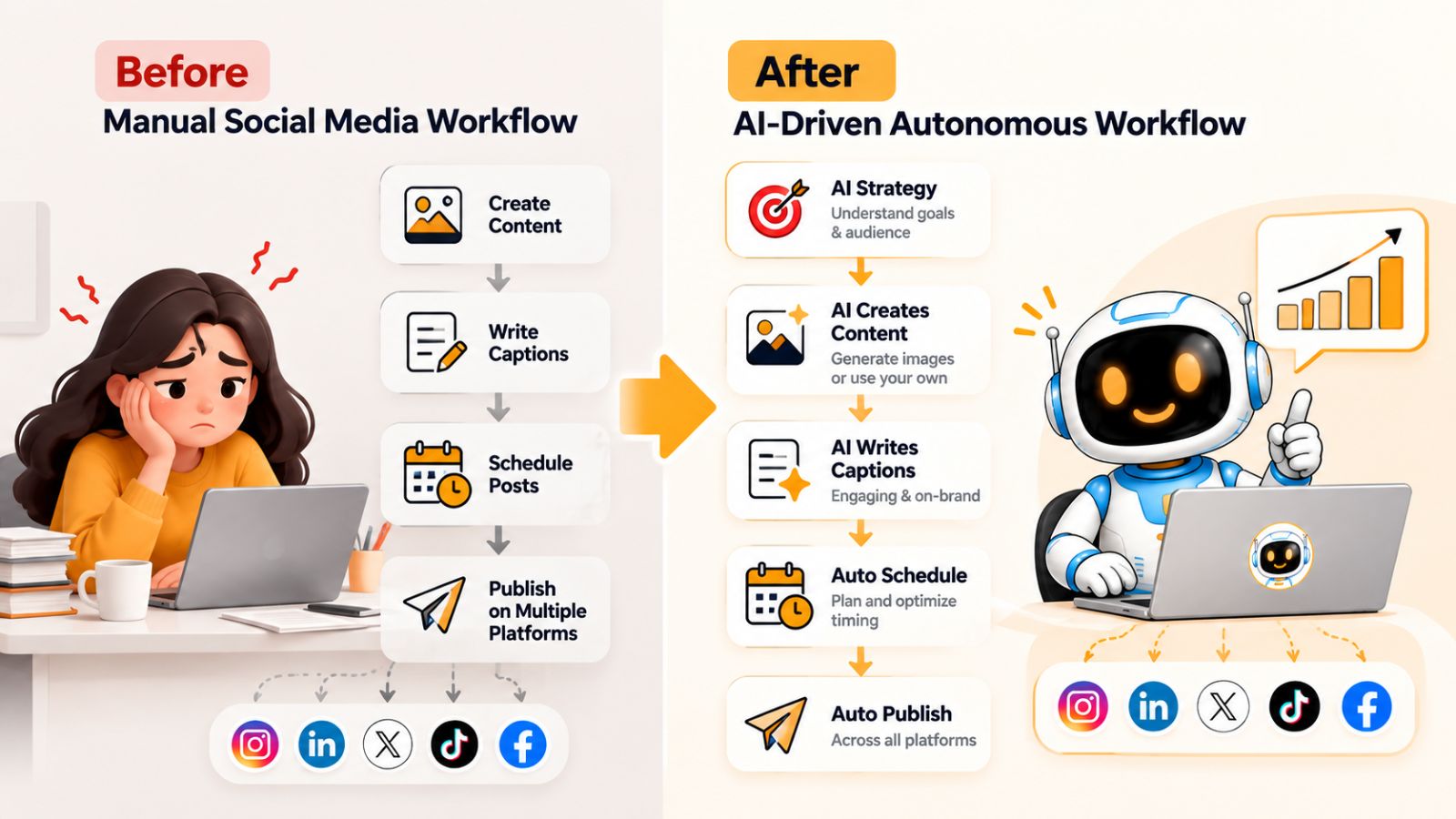
AI-assisted vs. automated vs. autonomous social media
These three approaches may sound similar, but there is an important difference.
AI-assisted social media means a human remains responsible for most decisions while AI helps with individual tasks. For example, a marketer might ask AI to write five Instagram captions and then manually choose, edit, schedule, and publish them.
Automated social media removes some repetitive manual work. A marketer can prepare content in advance and use automation to publish it according to predefined rules.
Autonomous social media connects more of the workflow. Instead of simply following a fixed schedule, the system can take a broader marketing objective and help turn it into executable content and publishing decisions.
That distinction matters because the bottleneck in social media marketing has never been publishing a single post. The difficult part is maintaining the entire system consistently.
A brand may need to publish several times a week across Instagram, Facebook, LinkedIn, YouTube, and TikTok. Each platform has different audiences, formats, content expectations, and publishing patterns. At the same time, the brand needs consistent messaging, fresh creative, relevant captions, and campaigns that work together rather than appearing as disconnected posts.
An autonomous approach attempts to bring those moving parts into one workflow.
The human still sets the direction
Autonomous does not mean that humans disappear from marketing.
The most valuable human decisions remain strategic: What does the brand stand for? Who is the audience? What products should be promoted? What campaigns matter? What tone should the company use? What should never be published automatically?
AI can then handle more of the operational execution.
This creates a useful division of labor. Humans provide strategy, context, creativity, and judgment; AI handles repetitive execution, adaptation, organization, and distribution.
Tools such as Bibby illustrate where this model is heading. Instead of forcing marketers to jump between separate tools for creative generation, captions, scheduling, and platform management, Bibby brings those activities into a single social media workflow. A marketer can upload an image or generate one with AI, select a posting style, and have captions generated automatically before scheduling content across selected platforms.
The bigger idea is not that AI can publish a post without human intervention. It is that the entire social media operation can increasingly function as a connected system.
And that changes the question marketers should be asking.
Instead of asking, “What should I post today?”, they can start asking, “How can I build a social media system that continuously turns my marketing strategy into content and distribution?”
That is the foundation of the autonomous social media channel.
Why Traditional Social Media Management Is Breaking Down
The traditional social media workflow was designed for a world where publishing a few posts each week was enough to maintain a brand presence. Today, that model is becoming increasingly difficult to sustain.
A modern brand may need to create content for multiple platforms, adapt its messaging to different audiences, respond to trends, maintain a consistent visual identity, and publish frequently enough to remain visible. Every additional platform creates another layer of work.
The problem is not simply the number of posts. It is the number of decisions behind every post.

Every post creates a chain of manual tasks
Consider what happens when a marketer wants to publish a single piece of content.
First, they need an idea. Then they need a visual or video. Next comes the caption, hashtags, platform selection, formatting, publishing date, publishing time, and potentially different versions for different networks.
Multiply that process across dozens of posts and several social platforms, and social media quickly becomes an operational workload rather than a marketing channel.
A team might spend hours each week doing work that does not necessarily require human creativity or strategic judgment.
That includes:
- Writing variations of captions
- Resizing or adapting creative assets
- Copying content between platforms
- Building publishing calendars
- Finding available publishing slots
- Scheduling repetitive posts
- Repurposing existing content
- Maintaining consistent posting frequency
These tasks are important, but they are also highly repeatable. That makes them particularly suitable for AI and automation.
More platforms mean more complexity
Social media is no longer one channel.
A company might use Instagram for visual storytelling, Facebook for community and broader reach, LinkedIn for professional audiences, YouTube for long-form or video content, and TikTok for short-form discovery.
The same underlying marketing idea can potentially work across all of them—but simply copying and pasting the same post everywhere is rarely the best approach.
Each platform has its own format and audience expectations.
That creates a difficult balancing act: marketers need to produce more platform-specific content without proportionally increasing the amount of manual work.
AI can help solve this by turning one marketing input into multiple pieces of executable content.
Content consistency becomes a second problem
Publishing more frequently creates another challenge: consistency.
A brand can have a strong strategy and still struggle to execute it consistently. A busy marketing team may publish heavily for two weeks and then go quiet because other priorities take over.
This inconsistency can happen even when the team has plenty of ideas.
The issue is execution.
An AI-powered social media workflow can reduce that gap by separating content creation from the moment of publication. Instead of creating and publishing everything manually in real time, marketers can prepare content and allow an automated system to distribute it according to a planned schedule.
Bibby follows this broader model by allowing marketers to manage different media formats—including images, carousels, videos, and stories—and schedule them across multiple social platforms. Rather than treating every post as an isolated publishing task, the workflow can become part of an ongoing content system.
The real bottleneck is coordination
The biggest problem with traditional social media management may therefore be coordination.
One person might create the creative. Another might write copy. Someone else might manage the calendar. A social media manager then has to coordinate publishing across platforms.
For larger teams, this can create unnecessary handoffs. For smaller teams, it can mean that one person is responsible for everything.
AI changes the economics of this workflow by allowing many operational steps to happen inside the same system.
The goal is not simply to publish faster.
The goal is to make consistent, multi-platform marketing execution possible without requiring humans to manually coordinate every step.
That is where AI social media automation starts becoming more than a convenient scheduling feature—and starts looking like a new marketing infrastructure.
How AI Social Media Automation Actually Works
AI social media automation works by connecting several marketing tasks that were traditionally handled separately.
Instead of creating a post, writing its caption, scheduling it, and publishing it as four independent activities, an AI-powered system can treat them as parts of one workflow. The marketer provides the direction and source material, while AI helps turn that input into platform-ready content and a publishing plan.
The workflow can be broken into several stages.
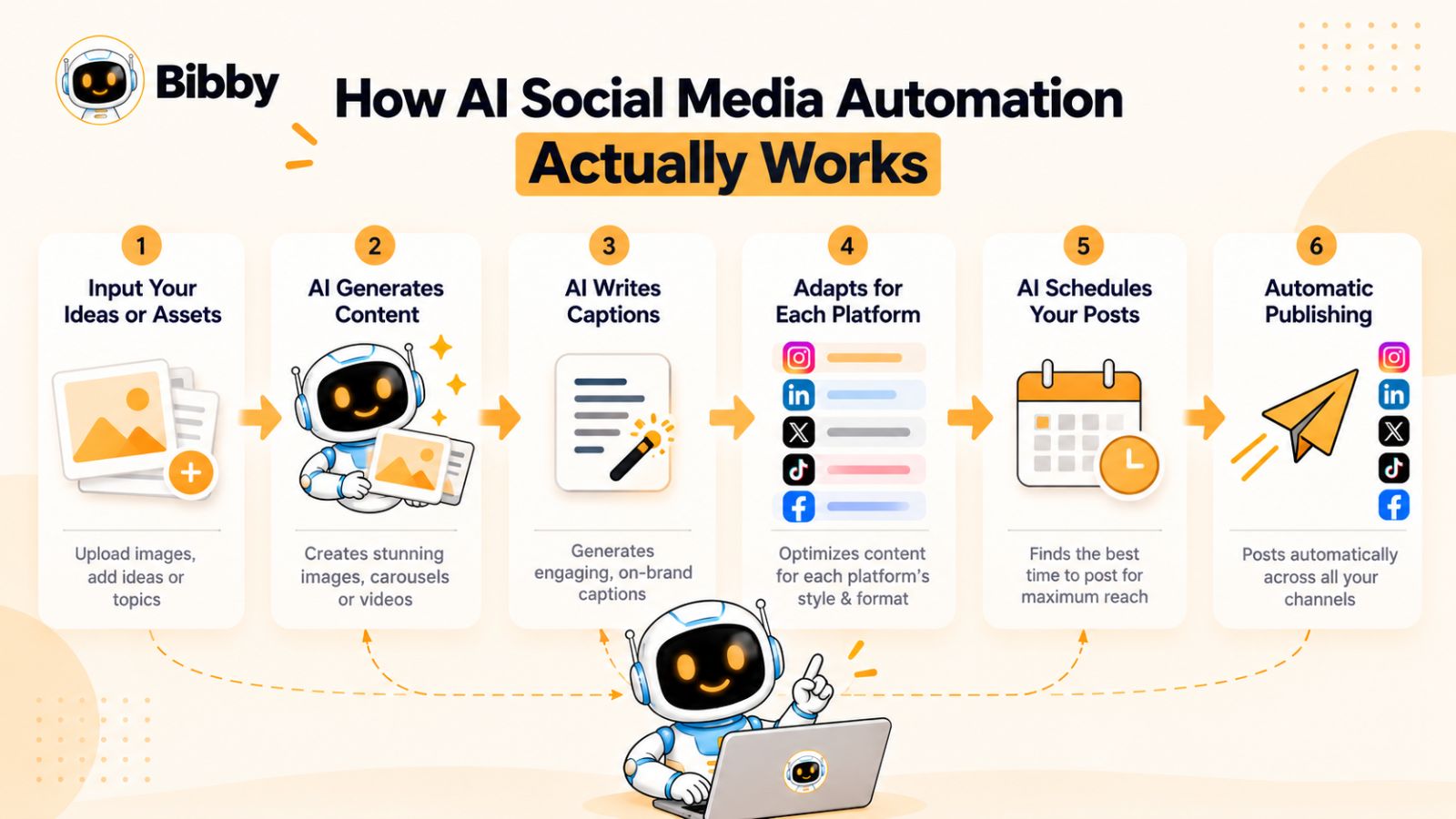
1. Start with an idea or creative asset
Every social media workflow needs an input.
That might be a product image, a promotional video, a blog post, a campaign idea, a product announcement, or an image generated with AI.
The important change is that marketers do not necessarily need to start with a finished social media post.
An AI system can work from a broader input and help transform it into something suitable for social distribution.
For example, a company launching a new product could provide its product image and basic campaign information. From there, AI can help develop the social content surrounding that launch rather than requiring the marketer to manually create every individual post.
2. Generate the social media copy
Once the creative is available, the next challenge is communicating the idea.
AI can generate captions based on the creative, brand voice, campaign objective, and selected posting style. This removes one of the most repetitive parts of social media management: starting from a blank text box every time a post needs to be published.
The marketer can still review or modify the result, but the initial writing process no longer has to begin from scratch.
This becomes particularly valuable when the same campaign needs multiple posts.
3. Adapt content for different platforms
A social media campaign rarely belongs to only one platform.
The same marketing idea may need to appear on Facebook, Instagram, LinkedIn, YouTube, and TikTok, but the presentation can vary depending on where it is published.
An AI-powered workflow can help manage this distribution rather than forcing marketers to manually duplicate each piece of content.
This is an important distinction between content automation and content distribution automation.
The first helps create the content.
The second helps ensure that content actually reaches the appropriate channels.
An increasingly capable system can bring both together.
4. Choose when content should be published
Scheduling is another area where AI can reduce repetitive decision-making.
Traditional scheduling often requires a marketer to manually choose a date and time for every post. That works when the publishing volume is low, but becomes increasingly difficult as the number of platforms and posts increases.
AI-powered scheduling can instead use available information and predefined objectives to identify appropriate publishing windows.
For example, Bibby can schedule selected media across different dates at AI-optimized times. Rather than asking the marketer to manually construct an entire publishing calendar, the system can take responsibility for more of the operational scheduling process.
The purpose is not to find a mythical “perfect” posting time.
It is to reduce unnecessary manual decisions while maintaining a consistent publishing rhythm.
5. Distribute multiple content formats
Modern social media is no longer dominated by static images.
Brands now work with carousels, short-form videos, stories, product content, educational posts, announcements, and other formats.
An autonomous workflow therefore needs to handle more than one type of media.
This is where an integrated system can become significantly more useful than a collection of disconnected tools. Instead of using one application to create an image, another to write copy, another to schedule posts, and another to manage campaigns, the marketer can increasingly manage the workflow from one place.
Bibby supports this broader approach by allowing marketers to work with images, carousels, videos, and stories while managing distribution across major social platforms.
6. Keep humans in control
Automation does not have to mean surrendering control.
A useful AI social media system should make routine execution easier while allowing humans to intervene when judgment matters.
A marketer can still decide what the brand should communicate, which campaigns to run, which content deserves approval, and what tone the company should maintain.
AI simply takes on more of the repetitive execution.
That distinction is important because the future of social media marketing is unlikely to be humans versus AI.
It is more likely to be humans directing AI-powered marketing systems.
And once these individual capabilities are connected, the workflow starts looking less like a social media scheduler and more like an AI-powered social media manager.
The New AI Social Media Workflow
The biggest change AI brings to social media marketing is not a single feature. It is the ability to connect the entire publishing process into a workflow that requires fewer manual steps.
A traditional workflow might look like this:
Idea → create content → write caption → adapt content → choose platforms → choose dates → schedule → publish
An AI-powered workflow can compress much of that process:
Idea or creative → AI-assisted content → brand-aware captions → platform selection → optimized scheduling → automated publishing
That difference becomes significant when a business is publishing consistently across multiple channels.
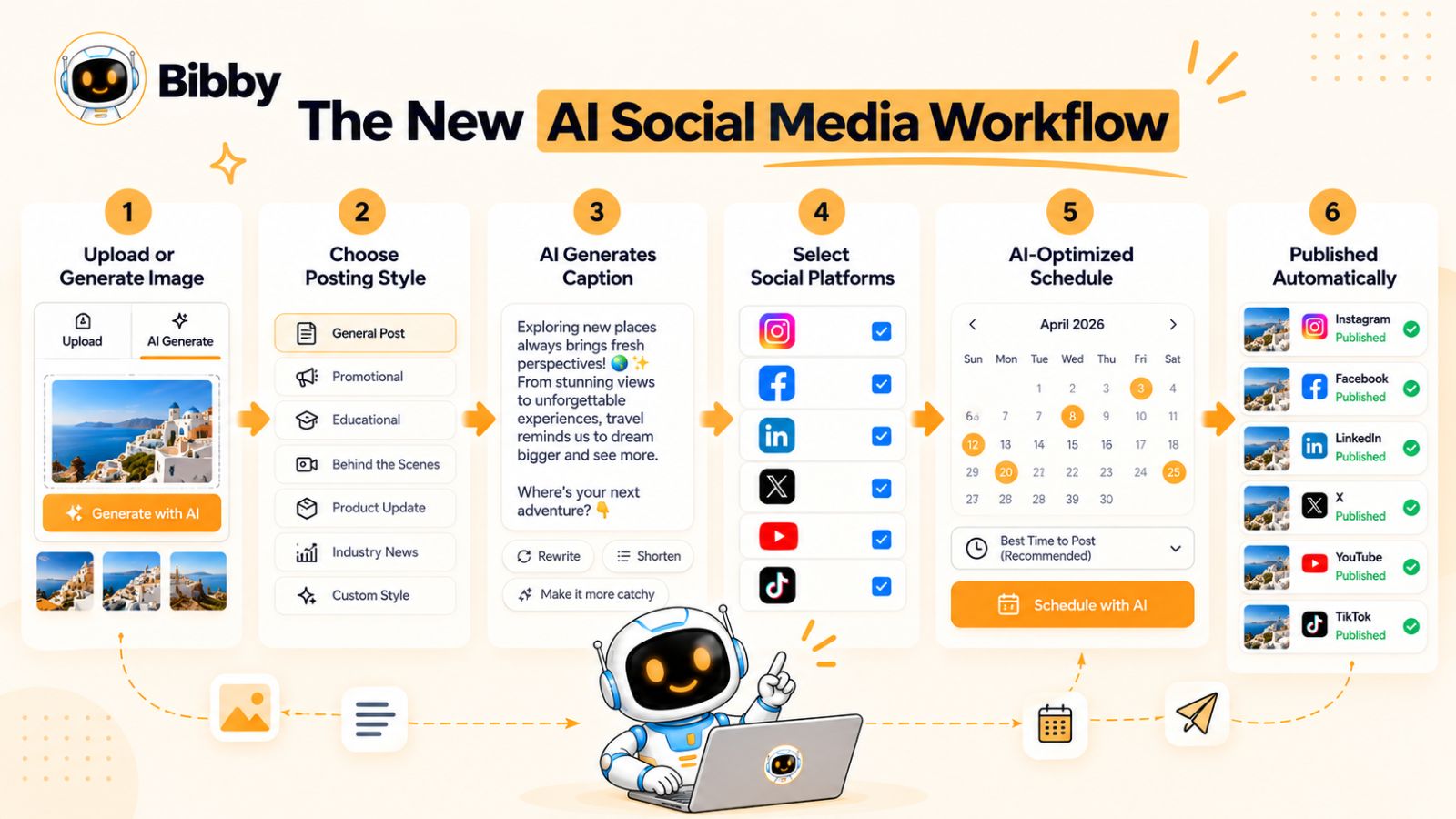
Step 1: Upload or generate the creative
The workflow can begin with something as simple as an image.
A marketer might upload an existing product photo, promotional graphic, or campaign visual. Alternatively, an AI image generator can be used to create the visual from an idea.
This matters because the marketer does not necessarily need to have the complete post figured out before opening the social media tool.
The creative becomes the starting point.
Step 2: Choose the posting style
The next step is giving the AI context about how the content should communicate.
A promotional post might need a different style from an educational post. A product launch might require urgency, while a thought-leadership post might benefit from a more conversational approach.
Instead of writing every instruction from scratch, a structured posting style can help the system understand what kind of message should accompany the creative.
This gives AI a framework while keeping the marketer in control of the desired communication style.
Step 3: Let AI generate the caption
Once the creative and style are defined, AI can generate the caption.
This removes one of the most repetitive parts of social media management: staring at a blank caption field.
The marketer can review the result, make adjustments, or regenerate it when the first version does not fit.
Bibby is designed around this kind of workflow. After the marketer uploads or generates the visual and selects a posting style, Bibby can automatically generate the caption rather than requiring the user to create the copy separately.
The same workflow can then be applied repeatedly across a content calendar.
Step 4: Select the platforms
The next decision is distribution.
Instead of manually creating separate publishing tasks for every social network, marketers can select the platforms where the content should appear.
For a campaign, that could include Facebook, Instagram, LinkedIn, YouTube, and TikTok.
The advantage is operational simplicity. The marketer can think about the campaign as one marketing activity while the system handles the complexity of distributing the resulting content across the selected channels.
Step 5: Let AI handle the publishing schedule
Once the content and platforms are selected, scheduling becomes the next piece of the workflow.
Bibby can schedule media across different dates at AI-optimized times, reducing the need to manually construct a publishing calendar post by post.
This is particularly useful when a marketer has a large batch of content.
Instead of deciding:
“This post goes Tuesday at 10:00, this one goes Thursday at 2:00, and this video goes Saturday at 7:00.”
the marketer can provide the content and publishing requirements while the system handles more of the scheduling logic.
That turns scheduling from a repetitive administrative task into an automated part of the marketing workflow.
Step 6: Publish different types of content
An effective social media system also needs to accommodate different formats.
A brand might publish an educational carousel on LinkedIn, a product image on Instagram, a short video on TikTok, a video on YouTube, and a story as part of the same broader campaign.
The content does not have to be limited to static posts.
Bibby supports images, carousels, videos, and stories, allowing marketers to manage multiple content formats from the same social media workflow.
Step 7: Manage the system conversationally
The workflow becomes even more interesting when the interface itself becomes conversational.
Instead of navigating through multiple menus, a marketer can communicate with an AI system in natural language.
Bibby's chat interface is designed around this concept. A user can interact with the tool conversationally to manage social media activities such as creating a brand kit, creating campaigns, creating posts, or regenerating captions.
That changes the relationship between the marketer and the software.
The marketer no longer has to learn every button and setting before getting work done. They can increasingly describe what they want the system to accomplish.
From scheduling tool to marketing operator
This is the broader evolution taking place.
A traditional scheduler answers the question:
“When should this post be published?”
An AI-powered social media system can increasingly help answer:
“What should we publish, how should we communicate it, where should it go, and when should it be distributed?”
That does not make the human marketer irrelevant.
It gives the marketer leverage.
Instead of spending most of the day moving content between tools and manually maintaining a publishing calendar, the marketer can spend more time on strategy, creative direction, audience understanding, and campaign ideas.
That is the foundation for social media becoming an increasingly autonomous marketing channel.
AI Social Media Managers: From Tools to Interfaces
The next evolution of social media software may not be another dashboard with more buttons. It may be a conversation.
Traditional social media management platforms are built around interfaces. Users navigate calendars, upload files, select platforms, create posts, adjust settings, and move between different sections to complete their work.
That model works, but it assumes the user already knows which feature they need and where to find it.
AI introduces a different possibility: tell the system what you want to accomplish, and let the system determine the steps required to make it happen.
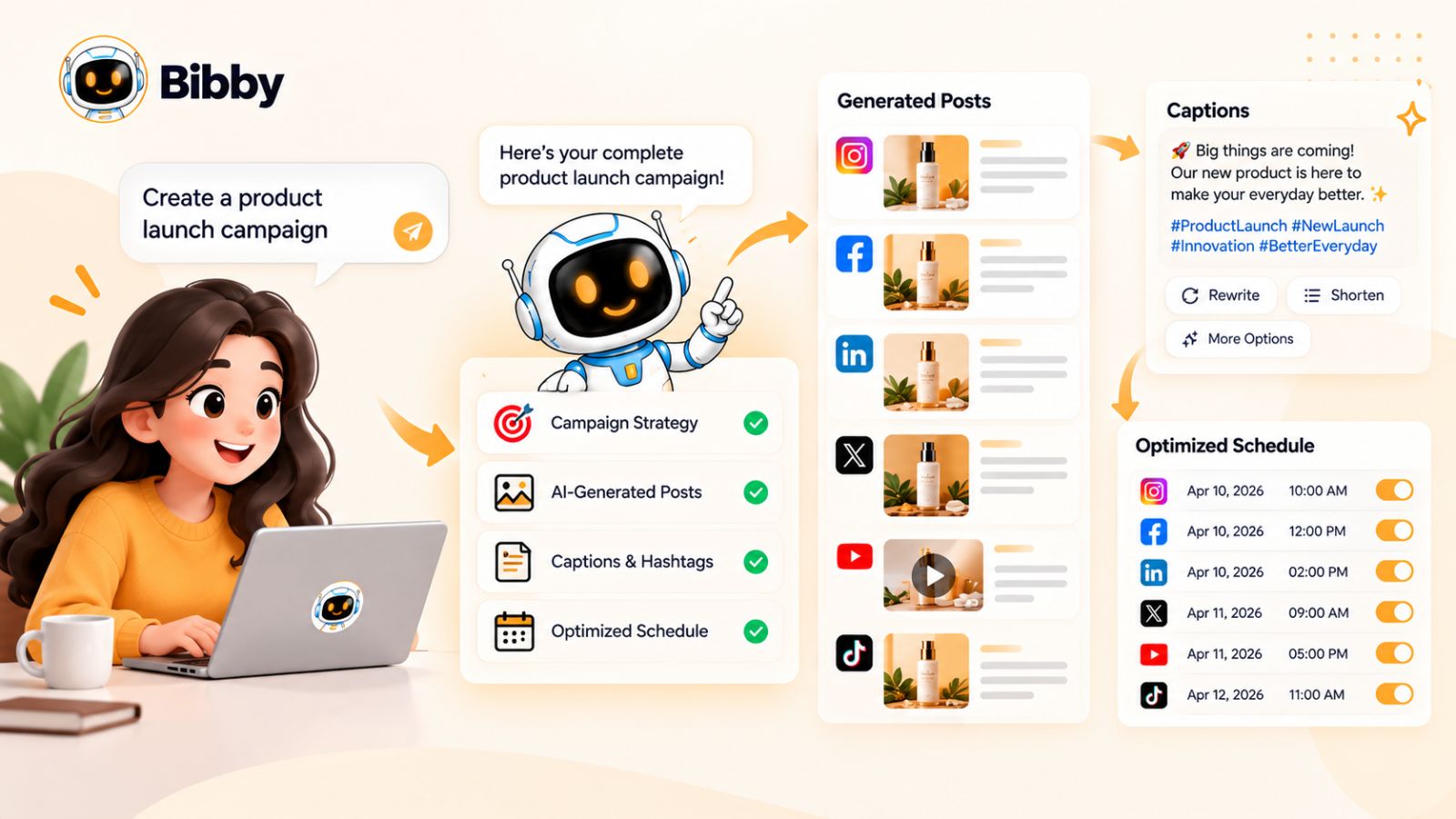
From clicking through workflows to describing outcomes
Imagine a marketer wants to launch a campaign for a new product.
With traditional software, they might need to:
- Create a campaign.
- Upload the creative.
- Write several captions.
- Create individual posts.
- Select social platforms.
- Add publishing dates.
- Configure the schedule.
- Review everything.
- Make changes.
- Publish or queue the campaign.
With a conversational AI interface, the starting point can be much simpler.
The marketer can describe the campaign, provide the relevant assets and instructions, and let the system help translate that request into the required social media actions.
The difference is subtle but important.
The interface begins to adapt to the marketer instead of requiring the marketer to adapt to the interface.
What an AI social media manager can handle
A conversational social media manager can potentially become the central control layer for a brand's social presence.
Instead of opening separate tools for separate jobs, a marketer can use a single conversation to initiate multiple activities.
For example, Bibby's chat interface allows users to manage social media through conversation, including tasks such as:
- Creating a brand kit
- Creating campaigns
- Creating posts
- Regenerating captions
- Managing social content
This kind of interaction makes AI feel less like a feature inside social media software and more like an operational assistant.
The user provides the objective. The AI helps execute the workflow.
Brand context becomes increasingly important
There is another reason conversational AI can be valuable: social media content needs context.
A caption should not sound like it was written for a completely different company. A campaign should reflect the brand's visual identity and communication style. Promotional content should use the right terminology and positioning.
That is why brand information becomes an important part of an autonomous social media system.
A brand kit can provide the AI with information about the business's visual and communication identity. Once that context is available, content generation becomes less about producing generic text and more about producing content that fits the specific brand.
This is one of the key differences between simply asking a general-purpose AI to “write an Instagram caption” and using an AI social media manager that understands the broader publishing environment.
Conversation can become the new command center
The long-term significance of conversational social media management is bigger than convenience.
It changes the unit of work.
Instead of thinking in terms of individual posts, marketers can begin thinking in terms of intent.
“Create a campaign for our new product.”
“Turn this idea into a week of social content.”
“Regenerate these captions in our brand voice.”
“Create posts from this campaign and schedule them across our selected platforms.”
These are marketing objectives rather than individual software operations.
The AI system can then translate the objective into smaller actions.
That is exactly what makes conversational interfaces interesting for autonomous marketing: they provide a bridge between what the marketer wants and what the software needs to do.
Human approval still matters
Conversational automation should not mean blindly allowing AI to publish anything it generates.
Brands still need control over sensitive announcements, major campaigns, controversial topics, customer communications, and anything that could materially affect reputation.
The strongest model is therefore not unrestricted automation.
It is controlled autonomy.
AI handles the repetitive work. Humans retain strategic authority and the ability to review, change, approve, or stop the workflow.
As these systems improve, the social media manager's role can gradually shift from manually operating publishing software to directing an intelligent marketing system.
That is a much larger change than simply adding an AI caption generator to an existing scheduler.
How Autonomous Social Media Changes Content Strategy
AI automation does more than reduce the time required to publish social media content. It changes the way marketers can approach Content Strategy in the first place.
For years, social media planning often revolved around a simple question: What should we post today?
That question creates a reactive workflow. Every day brings another blank space on the content calendar, another caption to write, another creative to produce, and another publishing decision to make.
An autonomous approach shifts the question from individual posts to systems.
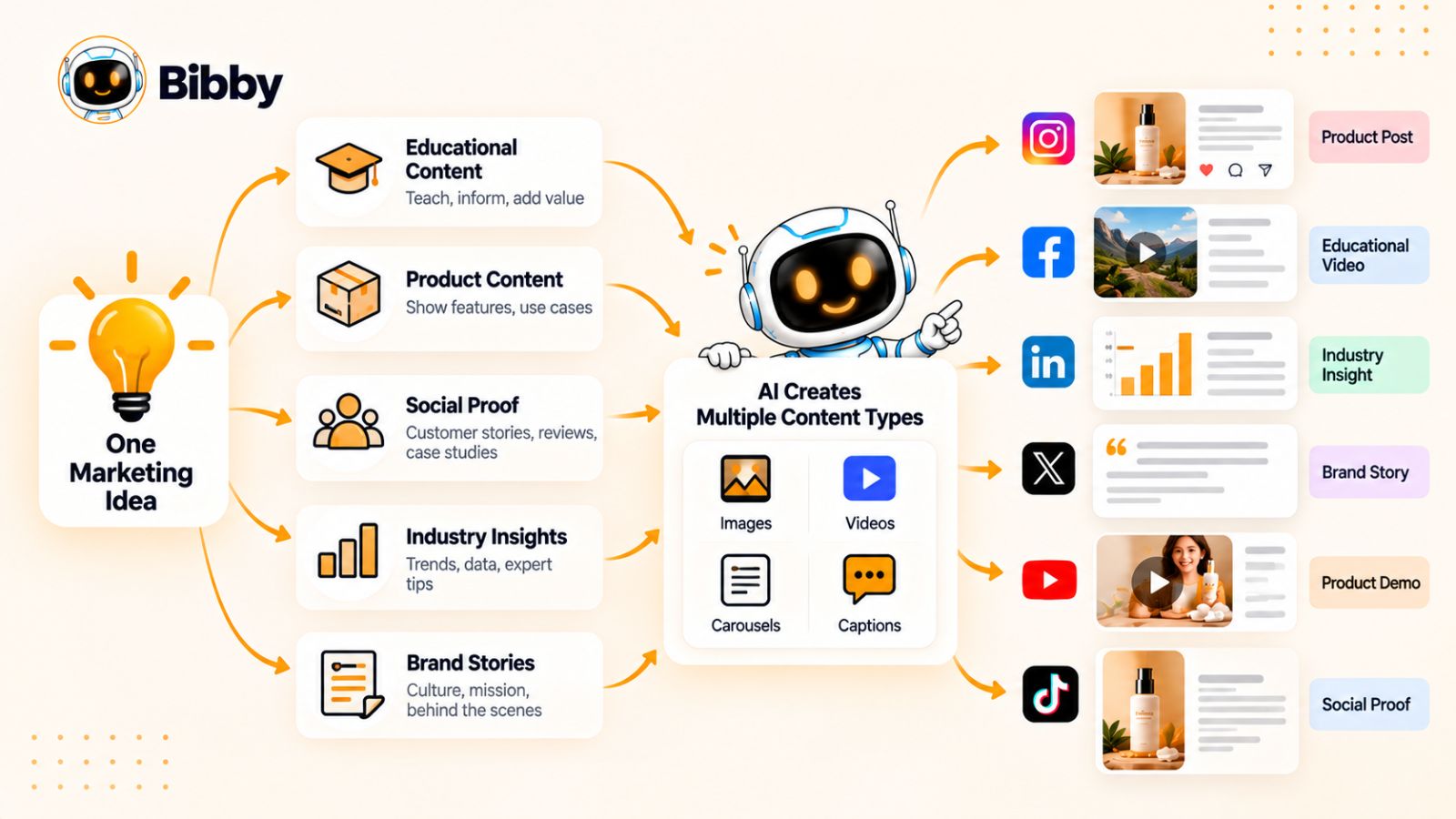
Instead of planning one post at a time, marketers can build content engines that continuously turn ideas, products, campaigns, and expertise into social media content.
From individual posts to content systems
A strong social media strategy usually contains several recurring themes.
A SaaS company might have content pillars around product education, customer stories, industry insights, company culture, and product updates.
An e-commerce brand might focus on products, demonstrations, customer-generated content, educational information, promotions, and seasonal campaigns.
Once these pillars are defined, AI can help transform them into a continuous stream of content.
This is where automation becomes strategically useful.
The marketer defines the themes and objectives. AI can assist with the repetitive execution required to keep those themes active across the publishing calendar.
The result is less dependence on inspiration.
Consistency becomes easier to maintain
Consistency is one of the biggest challenges in social media marketing.
A brand may know exactly what it wants to communicate but still struggle to publish regularly because content production competes with everything else happening inside the business.
AI can reduce this operational friction.
Instead of requiring a marketer to sit down every day and create something new, content can be prepared in batches and distributed over time.
A tool such as Bibby can take uploaded or AI-generated creative, generate captions based on a selected posting style, and schedule the resulting media across different dates and platforms.
That allows a team to think in terms of a content pipeline rather than a daily publishing chore.
One idea can become multiple pieces of content
Autonomous social media also makes repurposing more practical.
A single marketing idea can potentially become:
- An educational carousel
- A short-form video
- A LinkedIn post
- An Instagram post
- A Facebook post
- A YouTube video
- A story
- Several follow-up posts
The goal is not to copy the exact same message everywhere.
The goal is to extract more value from the underlying idea.
AI can help marketers adapt the presentation, wording, and format while keeping the central message consistent.
This can dramatically increase the amount of content a small marketing team can produce without requiring a proportional increase in manual work.
Campaigns become easier to coordinate
The same principle applies to campaigns.
A campaign should not feel like ten unrelated social posts. The posts should work together around a common objective.
For example, a product launch might include:
Awareness → education → product demonstration → social proof → launch announcement → reminder → follow-up
An AI-powered workflow can help turn that campaign structure into an organized publishing sequence.
Instead of manually remembering which post belongs to which stage, marketers can manage the campaign as a connected unit.
This is one reason campaign management becomes an important component of autonomous social media.
Automation should not eliminate originality
There is a potential misunderstanding here.
If AI makes publishing easier, brands might be tempted to publish more content simply because they can.
That is not necessarily a better strategy.
More posts do not automatically create more attention.
The value of autonomous marketing comes from making good strategy easier to execute consistently, not from flooding every platform with low-value content.
Human creativity remains important for positioning, storytelling, original ideas, opinions, research, and distinctive brand perspectives.
AI is most useful when it removes the operational friction surrounding those ideas.
The marketer becomes the architect
This leads to a broader change in the marketer's role.
Instead of being primarily a content operator, the marketer can become the architect of the content system.
They define:
- Who the brand is targeting
- What the brand wants to be known for
- Which content pillars matter
- Which campaigns deserve attention
- What the brand voice sounds like
- Which platforms matter
- What success looks like
AI can then help execute the system at a scale that would be difficult to manage manually.
That is the real promise of autonomous social media marketing.
It is not about replacing strategy with automation.
It is about making strategy executable at scale.
One Piece of Content Can Become a Multi-Platform Campaign
One of the strongest advantages of AI-powered social media automation is the ability to separate a marketing idea from the manual work required to distribute it.
In a traditional workflow, creating content for five social networks can feel like creating five separate marketing projects. The marketer has to prepare assets, write copy, format posts, choose publishing dates, and manage each platform individually.
AI makes it possible to think differently.
Instead of starting with five platforms, marketers can start with one core idea and build a distribution system around it.
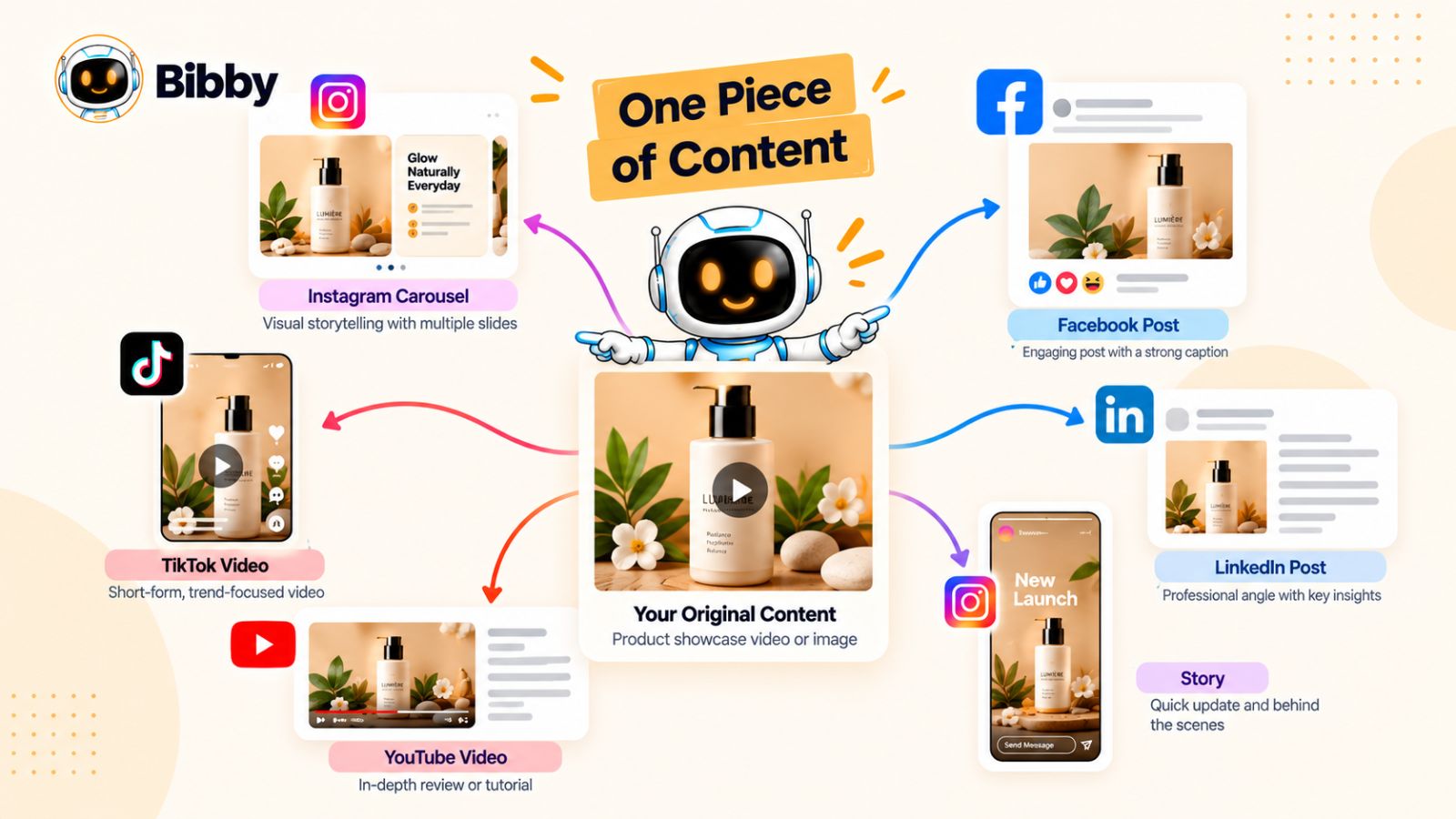
The idea becomes the source material
Imagine a company has just launched a new feature.
The underlying marketing idea is simple:
“Our new feature helps customers accomplish X faster.”
That idea can support an entire content campaign.
On LinkedIn, it might become an educational post explaining the problem the feature solves.
On Instagram, it could become a carousel showing the feature in action.
On Facebook, the same launch could be presented as a product-focused update.
On TikTok, it could become a short demonstration.
On YouTube, it could become a more detailed product walkthrough.
The message remains connected, but the execution changes according to the platform.
This is where AI-powered content workflows become valuable.
Multi-platform does not mean copy-and-paste
There is an important distinction between cross-platform distribution and simply publishing identical content everywhere.
Each social network has its own content environment.
Instagram is heavily visual. LinkedIn often rewards professional insight and expertise. TikTok is built around short-form video discovery. YouTube can support both short-form and longer video content. Facebook can accommodate a broad mixture of formats and community-oriented communication.
A strong automated system therefore needs to preserve the central campaign message while allowing the content to fit the destination.
AI can help marketers handle this adaptation at scale.
The goal is not to make every platform identical.
The goal is to make the campaign coherent without making it repetitive.
More formats create more opportunities
Modern social media campaigns can include far more than a single image and caption.
A single campaign may involve:
- Static images
- Multi-image carousels
- Short-form videos
- Stories
- Educational posts
- Product demonstrations
- Promotional announcements
- Customer-focused content
Managing these formats manually can quickly become complicated.
Bibby is built around this broader publishing model, supporting images, carousels, videos, and stories while allowing users to select multiple social platforms for distribution.
That means a marketer can think about the campaign as a complete content system instead of maintaining separate workflows for every format.
Distribution can happen over time
Another advantage is that a campaign does not have to be published all at once.
In fact, spacing content across multiple days can create a more sustained campaign presence.
For example:
Day 1: Introduce the problem
Day 3: Educate the audience
Day 5: Demonstrate the solution
Day 7: Share a customer-focused message
Day 10: Make the product announcement
Day 13: Publish a reminder or follow-up
AI-powered scheduling can help organize this sequence without requiring the marketer to manually enter every publishing slot.
Bibby can distribute selected media across different dates and use AI-optimized times for scheduling, allowing marketers to build a publishing calendar without manually determining every individual time slot.
Small teams can operate like larger teams
This is where the impact becomes particularly significant for small businesses and lean marketing teams.
A company does not necessarily need a large social media department to maintain a presence across multiple platforms.
With the right workflow, a small team can create a batch of content, organize it into campaigns, adapt it for different channels, and schedule it in advance.
AI does not eliminate the need for marketing expertise.
It reduces the amount of operational labor required to execute that expertise.
That distinction matters.
A small team with a clear strategy can potentially produce and distribute significantly more content without spending every day manually operating social media software.
The future is coordinated distribution
Social media platforms are increasingly becoming distribution channels rather than isolated destinations.
The marketing idea exists at the center.
AI helps transform that idea into different formats.
Automation distributes those formats.
Humans provide the strategic direction and creative judgment.
That creates a new model:
One strategy → multiple content assets → multiple platforms → coordinated distribution.
As AI systems become better at understanding context, brand identity, formats, and audience behavior, this model can become increasingly autonomous.
The result is not simply more social media content.
It is a social media operation capable of turning a single marketing idea into a coordinated, multi-platform campaign with far less manual execution.
AI-Optimized Scheduling: Why Timing Matters
Creating strong social media content is only half of the distribution problem. The other half is deciding when that content should reach an audience.
For a small number of posts, manually choosing publishing times is manageable. But as a brand publishes across multiple platforms, formats, campaigns, and time zones, scheduling can become another full-time administrative task.
This is where AI-optimized social media scheduling becomes useful.
The problem with manual scheduling
Traditional social media scheduling usually works from a fixed calendar.
A marketer creates a post, chooses a date, selects a time, and adds it to the queue. The process is repeated for every piece of content.
That approach provides control, but it also creates friction.
Imagine managing 50 pieces of content across five platforms. Even if the content is already finished, someone still needs to decide where every post goes and when each one should appear.
The more content a brand produces, the less attractive manual scheduling becomes.
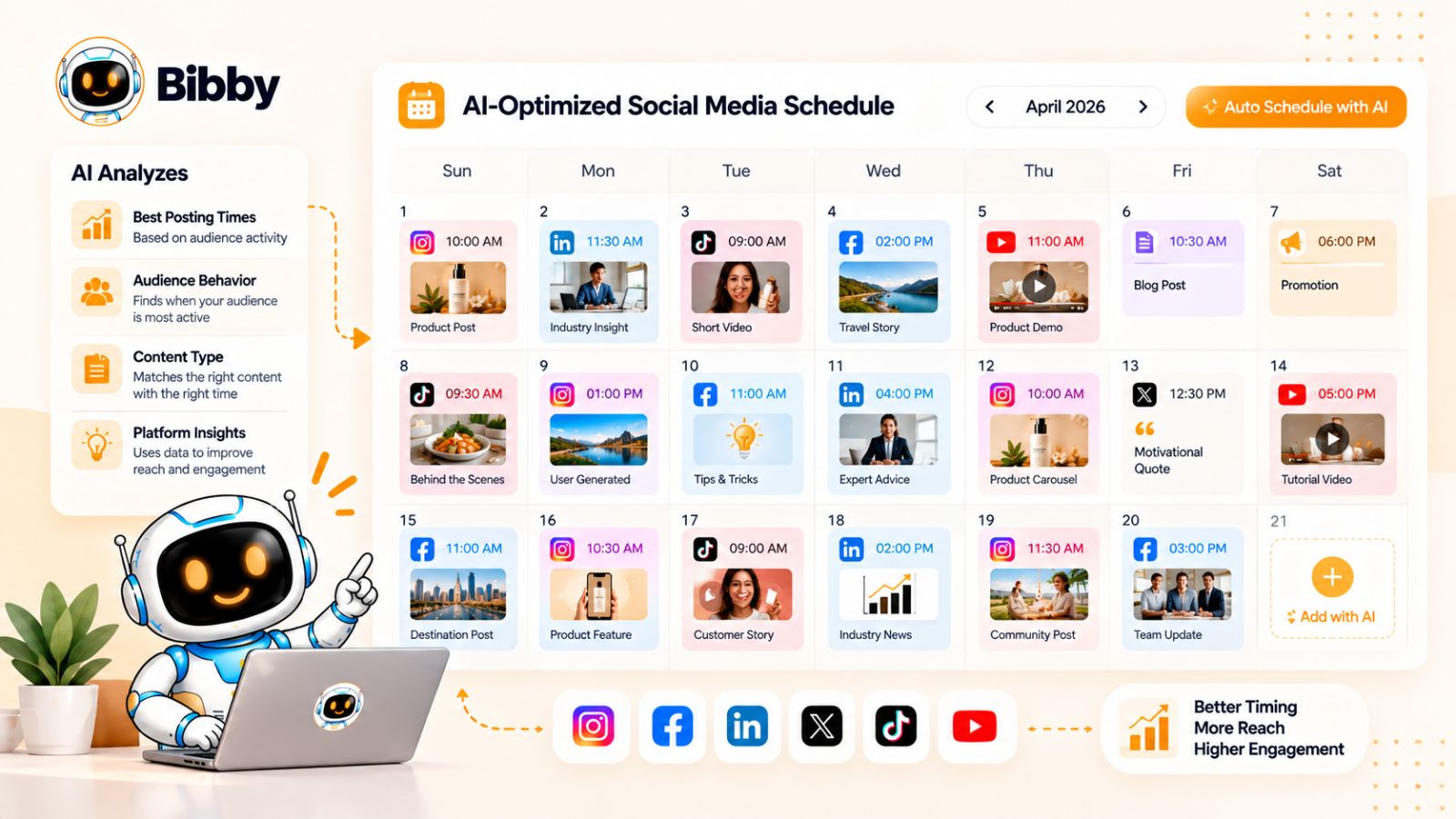
AI can turn scheduling into a decision system
An AI-powered scheduler can approach the problem differently.
Rather than treating every publishing time as a decision the marketer must manually make, the system can use available signals and scheduling rules to identify suitable publishing windows.
These signals can potentially include factors such as:
- Historical audience activity
- Platform-specific behavior
- Previous publishing patterns
- Time zones
- Content schedules
- Campaign requirements
- The desired publishing frequency
The objective is not to predict the exact minute when a post will become successful.
There is no universal “best time to post” that works for every audience, platform, industry, and piece of content.
The more useful objective is to reduce manual guesswork while maintaining a consistent distribution schedule.
AI-optimized timing in practice
Suppose a marketer has created 20 posts for the next month.
With a traditional workflow, they might spend significant time assigning individual dates and times to those posts.
With an AI-powered workflow, the marketer can provide the content and scheduling requirements while the system handles more of the calendar construction.
Bibby, for example, can schedule media across different dates at AI-optimized times.
That means the marketer can focus less on manually filling calendar slots and more on deciding what the campaign should communicate.
This becomes especially useful when content needs to be distributed across multiple platforms simultaneously.
Different platforms require different schedules
Timing becomes more complicated when a campaign spans several social networks.
An audience on LinkedIn may behave differently from an audience on TikTok.
A YouTube audience may consume content differently from an Instagram audience.
A global business may also have followers across several time zones.
A single publishing schedule therefore cannot necessarily be applied everywhere.
AI can help manage this complexity by treating distribution as a platform-specific problem rather than assuming every channel follows the same pattern.
This is another reason integrated social media automation is becoming more valuable.
The system can manage the complexity in the background while the marketer sees the larger campaign.
Scheduling is about consistency, not just timing
There is another important benefit that is sometimes overlooked.
A good social media schedule creates consistency.
If a brand publishes whenever someone happens to have time, its social presence can become unpredictable. One week may contain ten posts while the next contains none.
Automation makes consistency easier because content can be prepared in advance and distributed according to a defined publishing rhythm.
That creates an important separation:
Content can be created when the marketing team has time, while content can be published when the audience is most appropriate to reach.
This is one of the fundamental advantages of social media scheduling.
Don't let optimization replace judgment
AI scheduling should still be treated as an optimization layer rather than an unquestionable authority.
There are situations where the marketer knows something the algorithm does not.
A product launch may need to happen at a specific time. A live event may require real-time publishing. A major announcement may need to coordinate with a press release or another marketing channel.
In these situations, business context matters more than automated timing.
The best autonomous systems therefore combine automation with human control.
AI handles routine scheduling decisions.
Humans override the system when timing is strategically important.
Scheduling is becoming infrastructure
As social media moves toward greater automation, scheduling becomes less of a standalone feature and more of the infrastructure connecting content to distribution.
The marketer creates the strategy.
AI helps create and organize the content.
The scheduling system determines how that content should move through the publishing calendar.
Automation then handles distribution.
That turns social media scheduling from a repetitive administrative activity into part of an intelligent marketing pipeline.
And as the number of platforms and content formats continues to grow, that distinction will become increasingly important.
What Businesses Can Automate—and What They Shouldn't
The rise of autonomous social media does not mean that every part of marketing should be handed over to AI.
In fact, knowing what to automate and what to keep under human control may become one of the most important skills for modern marketers.
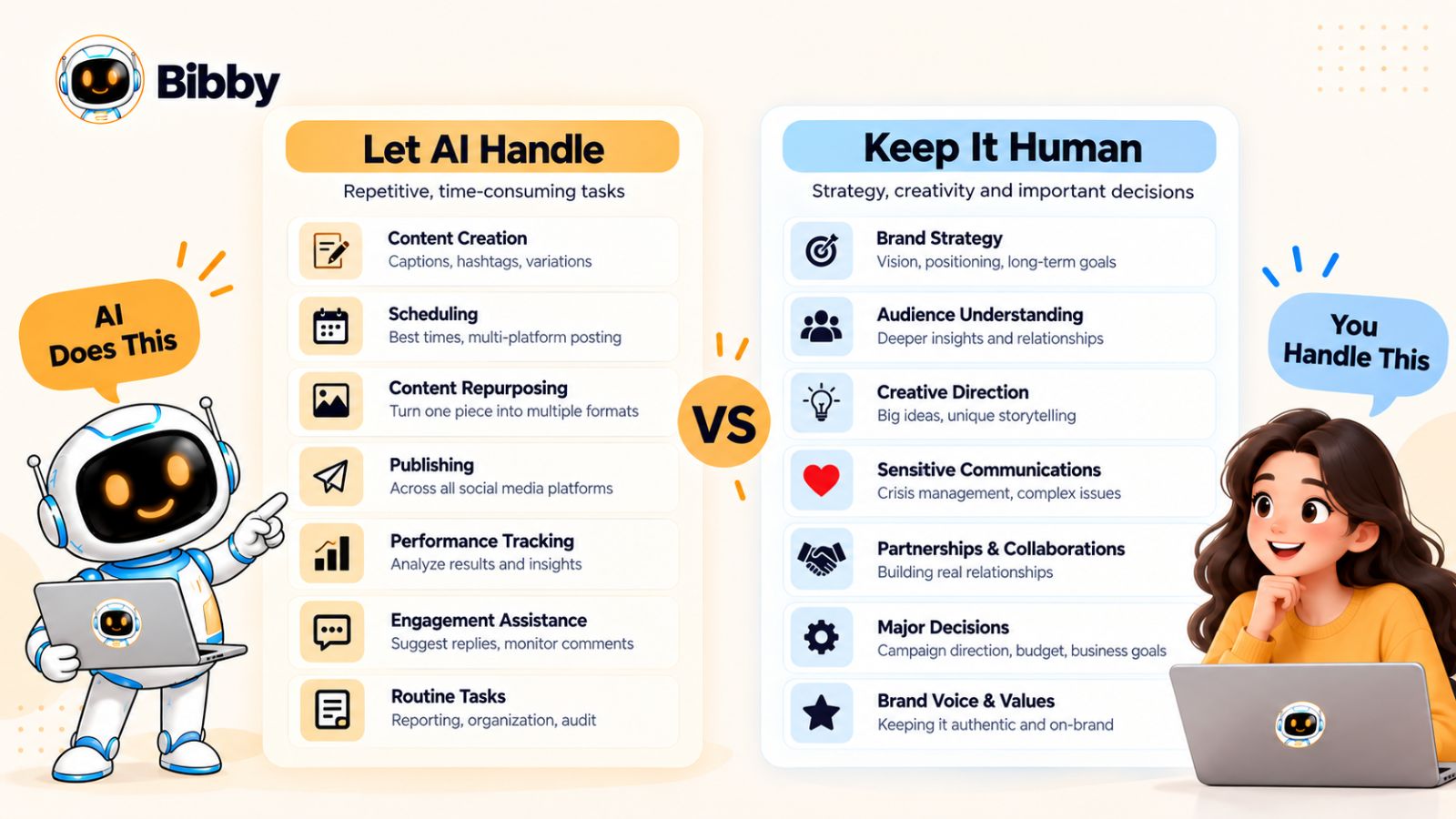
The strongest AI social media workflows automate repetitive execution while keeping strategy, judgment, and accountability with people.
What AI can automate
A growing number of social media tasks are structured enough for AI to handle with limited human involvement.
These include:
Caption generation.
AI can turn a creative asset or campaign brief into a starting caption, reducing the amount of time marketers spend writing repetitive social copy.
Content scheduling.
Instead of manually assigning dates and times to every post, AI-powered scheduling can organize content across a publishing calendar.
Content distribution.
Once the appropriate platforms have been selected, automation can distribute content across multiple channels.
Content repurposing.
A central idea can be adapted into different formats and platform-specific posts.
Routine publishing.
Images, carousels, videos, and stories can be prepared and scheduled in advance.
Campaign organization.
AI can help turn a campaign concept into a series of coordinated social media activities.
Content regeneration.
When a caption or post does not work, conversational AI can make it easier to request another version instead of starting from scratch.
Tools such as Bibby bring many of these activities into one workflow. A marketer can provide creative assets, choose a posting style, generate captions, select platforms, and schedule content rather than coordinating each task through separate applications.
What should remain human
Automation becomes less appropriate when a decision depends heavily on context, judgment, or brand reputation.
Consider brand positioning.
AI can help communicate a company's positioning, but the decision about what the company should stand for belongs to the people running the business.
The same applies to major strategic decisions.
Humans should remain responsible for decisions such as:
- Defining the brand's identity
- Understanding the target audience
- Setting marketing objectives
- Developing positioning
- Choosing major campaign themes
- Approving sensitive communications
- Handling serious customer issues
- Responding to unexpected events
- Making reputation-sensitive decisions
These activities require context that cannot always be reduced to a repeatable workflow.
Automation should have boundaries
Imagine a company suddenly receives widespread criticism about a product.
An autonomous system might be capable of generating a response and publishing it quickly.
That does not mean it should.
The appropriate response may require input from leadership, customer support, legal teams, communications professionals, or other stakeholders.
The same principle applies to breaking news, controversial subjects, sensitive customer complaints, and unexpected public events.
The more consequential the communication, the more important human review becomes.
The right model is controlled autonomy
This creates a useful framework for thinking about AI-powered marketing:
Automate the repetitive.
Assist with the complex.
Keep consequential decisions human.
That model gives businesses the efficiency benefits of automation without pretending that marketing can be reduced entirely to software instructions.
For everyday social media operations, AI can take on a substantial amount of repetitive work.
For strategic decisions, humans remain responsible.
This is also why a conversational system such as Bibby's can be useful without needing to replace the marketer. A user can interact with the system to create campaigns, build a brand kit, create posts, regenerate captions, and manage other routine activities while retaining control over the overall marketing direction.
More automation should mean more strategy—not less
The ultimate purpose of automation is not to eliminate marketing thinking.
It is to create more time for it.
If a marketer spends fewer hours manually writing captions, copying content between platforms, and maintaining a publishing calendar, those hours can instead be used to research customers, develop campaigns, study performance, create original ideas, and improve the brand.
That is the real opportunity.
AI should not make marketing less thoughtful.
It should make thoughtful marketing easier to execute consistently.
The Rise of the Always-On Social Media Brand
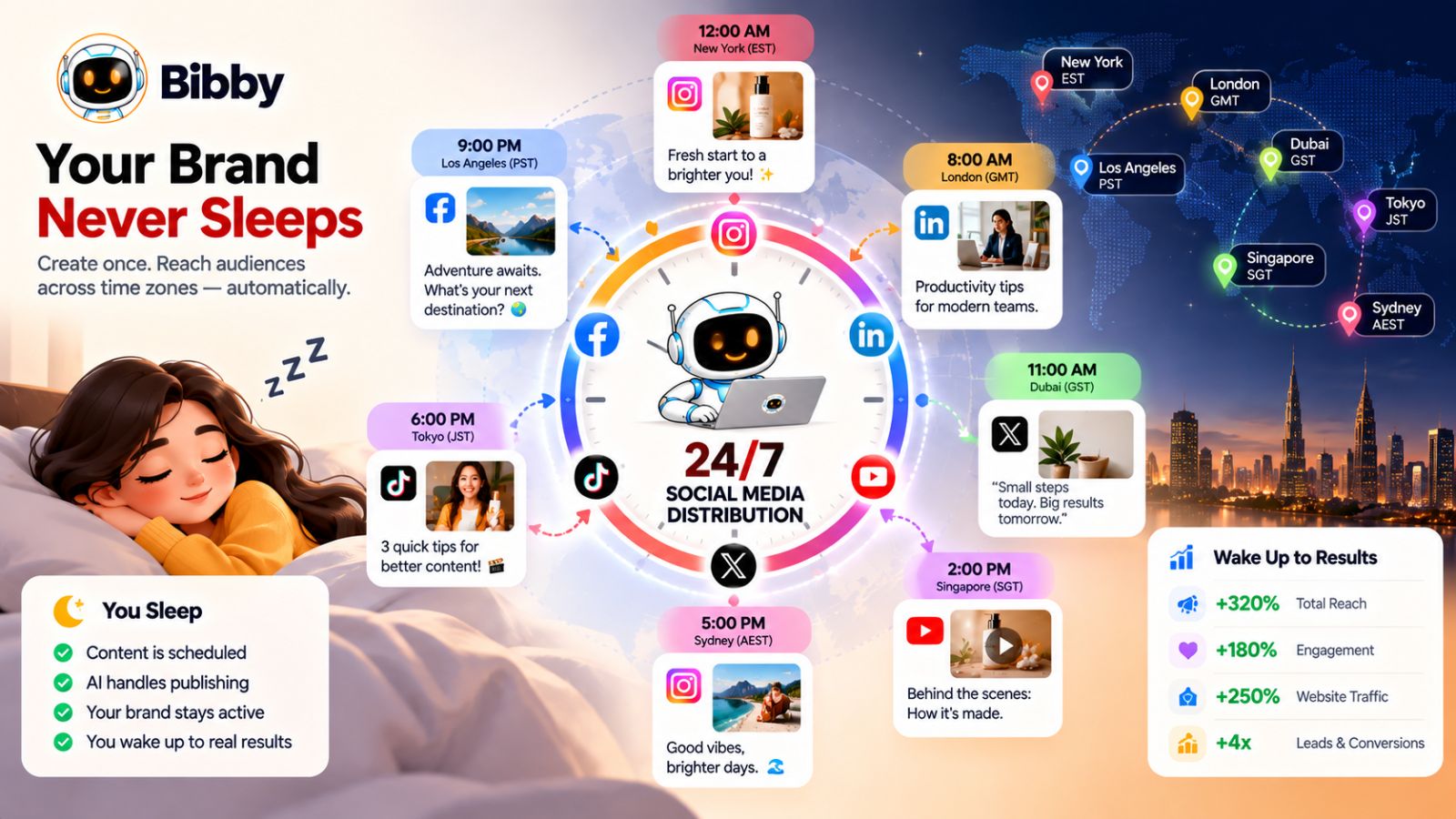
One of the most important consequences of AI social media automation is the emergence of the always-on brand.
An always-on brand does not necessarily mean publishing constantly. It means having a social media system capable of maintaining a consistent presence without requiring someone to manually operate it every day.
That distinction matters.
The goal is not to flood audiences with content. The goal is to ensure that valuable content continues moving through the publishing system even when the marketing team is focused on other priorities.
From daily tasks to continuous systems
Traditional social media management often creates a daily dependency.
Someone needs to remember that a post is due. Someone needs to write the caption. Someone needs to find the creative. Someone needs to publish it.
If that person becomes busy, the social media schedule can stop.
Automation changes the dependency.
Content can be created in batches and scheduled ahead of time. AI can assist with captions and organization. Publishing can continue according to the campaign calendar.
This means social media becomes less dependent on what the team happens to be doing at 10 a.m. on a Tuesday.
Small teams can maintain a larger presence
This is particularly significant for startups, creators, local businesses, and lean marketing teams.
A small team may not have enough people to dedicate someone to social media publishing every day.
That does not necessarily mean the brand needs to disappear between campaigns.
An automated workflow can allow the team to prepare content when resources are available and let the system distribute it over time.
Bibby fits naturally into this model by combining content creation and social media scheduling into a single workflow. A marketer can upload or generate creative, choose a posting style, have captions generated, select platforms, and schedule media across different dates.
The result is less manual calendar management.
Global audiences make “always-on” more complicated
An always-on strategy becomes even more useful when a company serves audiences in different regions.
A team operating from one time zone cannot realistically be available around the clock to publish content manually.
Automated scheduling allows content to be distributed according to the intended publishing calendar even when the marketing team is offline.
AI-optimized timing can further reduce the need to manually determine every publishing slot.
The system effectively becomes the bridge between the team's working hours and the audience's online behavior.
Always-on does not mean always promotional
There is also a strategic mistake brands should avoid.
If “always-on” becomes an excuse to continuously promote products, audiences may quickly lose interest.
An effective always-on social presence should contain different types of value:
- Educational content
- Industry insights
- Entertainment
- Brand stories
- Customer experiences
- Product education
- Community content
- Promotional campaigns
The purpose of automation is to make this mix easier to maintain—not to turn every available publishing slot into an advertisement.
Evergreen content becomes more valuable
Automation also makes evergreen content easier to use strategically.
Some content remains useful long after it is published.
A software company might have a tutorial that remains relevant for months. A fitness brand might have educational content that continues to answer common questions. A business consultant might have foundational advice that is useful to new audiences throughout the year.
Such content can become part of a larger content library.
Instead of creating everything from scratch every week, marketers can combine new campaigns with evergreen assets and schedule them throughout the calendar.
AI can help organize and distribute this content while the marketing team focuses on creating genuinely valuable material.
Always-on marketing requires a strong content foundation
Automation cannot compensate for a weak content strategy.
If a brand has nothing useful to say, publishing more efficiently will not solve the problem.
The foundation still needs to be strong:
Clear audience → strong positioning → useful ideas → good creative → consistent distribution
AI strengthens the distribution layer.
It can also accelerate parts of the creation process.
But the quality of the underlying marketing strategy remains important.
The brand becomes a system, not a schedule
This is ultimately the deeper shift.
Traditional social media management thinks in terms of calendars.
Autonomous social media marketing thinks in terms of systems.
The calendar is simply one output of that system.
The system knows what the brand wants to communicate, what types of content it needs, where that content should be distributed, and how frequently the audience should hear from the brand.
AI and automation make it possible to operate that system with fewer manual interventions.
And that is why the future of social media may not be about finding more people to manage increasingly complicated calendars.
It may be about building better systems that allow a small number of people to operate sophisticated, always-on marketing channels.
AI Social Media Automation for Different Types of Businesses
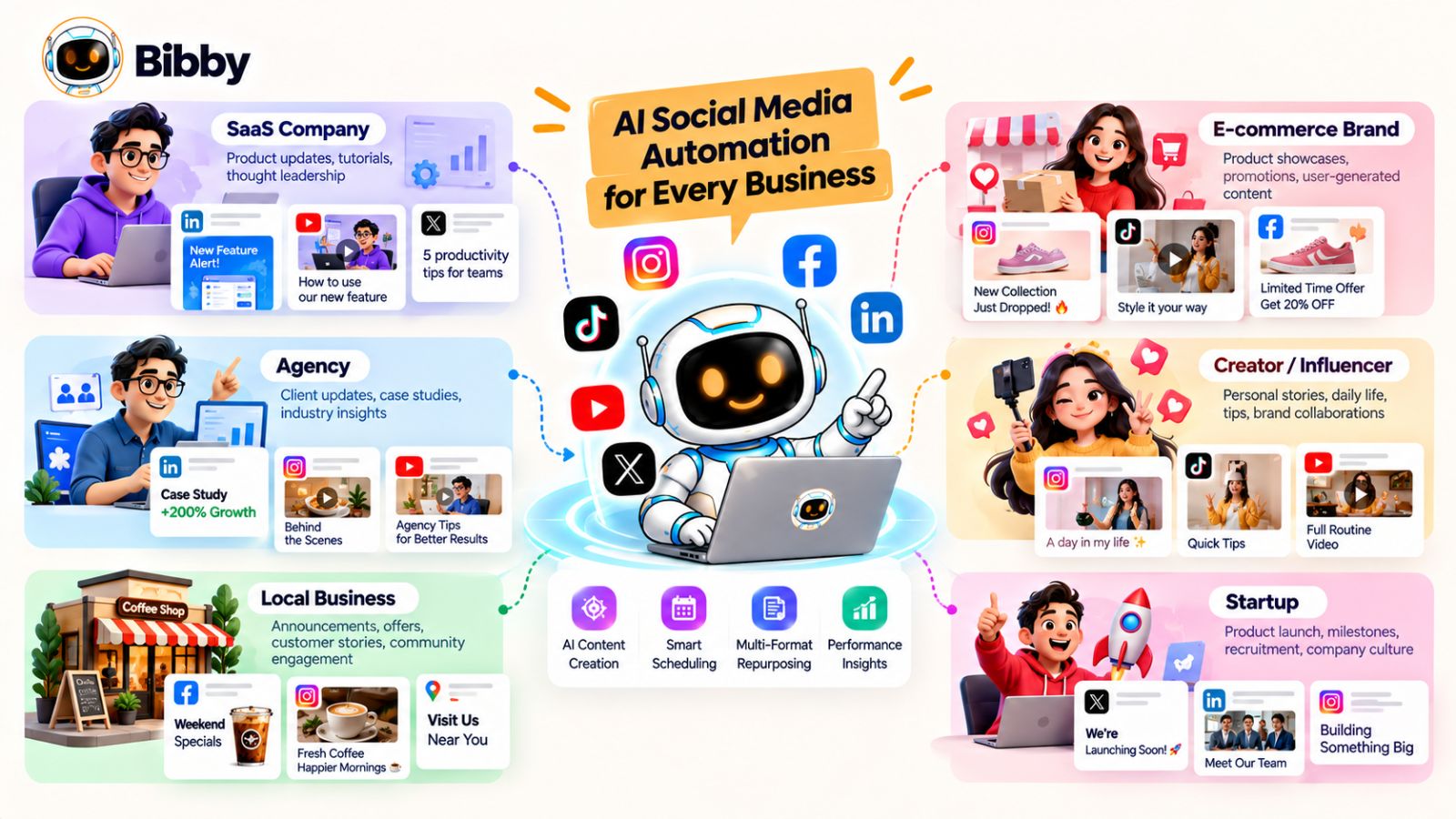
AI social media automation is not limited to large companies with dedicated marketing departments. In many cases, smaller teams may benefit even more because automation can remove repetitive work that would otherwise consume a significant portion of their limited time.
The exact workflow will differ by business, but the underlying principle remains the same: use AI to reduce the operational work required to consistently turn marketing ideas into published content.
SaaS and technology companies
Software companies often have a large amount of knowledge they can turn into social content.
Product updates, tutorials, customer stories, industry insights, feature explanations, use cases, and educational content can all become part of a social media strategy.
The challenge is turning that knowledge into consistent content.
AI can help transform product information and existing marketing material into social posts, while automation can distribute those posts across relevant channels.
For a SaaS company, this can create a continuous educational layer around the product rather than relying exclusively on promotional announcements.
E-commerce brands
E-commerce businesses often have a natural supply of visual content.
Products can be photographed, demonstrated, compared, reviewed, and incorporated into different campaigns.
AI social media automation can help turn that product library into an ongoing publishing system.
A single product could support multiple content formats:
- Product imagery
- Feature-focused posts
- Educational carousels
- Short-form videos
- Customer-focused content
- Promotional campaigns
- Seasonal posts
- Stories
Tools such as Bibby can help e-commerce teams manage these different formats and schedule them across multiple social platforms.
The result is a more systematic approach to turning the product catalog into social content.
Marketing agencies
Agencies have a different challenge: scale.
An agency may manage social media for several clients, each with a different brand voice, visual identity, audience, content calendar, and publishing strategy.
Manual workflows become increasingly difficult as the client list grows.
AI can help agencies reduce repetitive tasks such as caption generation, content organization, scheduling, and post creation.
The biggest opportunity is not necessarily replacing agency expertise.
It is allowing strategists and account managers to spend less time performing repetitive publishing operations and more time on client strategy and creative direction.
Creators and personal brands
Creators often have an endless supply of ideas but limited time to distribute them.
A creator might produce a video, write an article, record a podcast, or develop an educational concept and then struggle to turn that source material into enough social content.
AI can help with that transformation.
One idea can become multiple posts, formats, and publishing moments.
Automation then allows the creator to maintain a consistent presence without manually scheduling every piece of content.
This can be particularly useful for personal brands where the creator remains responsible for the original ideas and perspective while AI handles more of the operational work.
Local businesses
Local businesses may not have a dedicated social media team at all.
A restaurant, gym, salon, real estate business, clinic, or local service provider may have plenty of things worth sharing but very little time to manage a publishing calendar.
Automation can make social media more practical for these businesses.
A business owner could prepare several pieces of content in one session and allow an AI-powered workflow to generate captions and schedule them across selected platforms.
The business remains active online without requiring the owner to become a full-time social media manager.
Startups
Startups face a particularly difficult resource constraint.
They need visibility, but marketing teams are often small.
AI can provide leverage by helping a small team execute more of the social media workload without adding the same amount of manual labor.
A startup can establish its brand kit, define content themes, create campaign assets, generate captions, and build a publishing schedule within a more centralized workflow.
The objective is not to create an enormous amount of content.
It is to make limited marketing resources go further.
The common denominator
Despite their differences, these businesses share the same fundamental problem.
They have things worth communicating, but limited time to consistently distribute those ideas.
AI social media automation addresses the gap between having content worth publishing and actually publishing it consistently.
That is why the technology has relevance across so many business models.
Whether the company sells software, physical products, professional services, or the creator's expertise itself, the underlying challenge remains similar:
Create valuable ideas → turn them into content → distribute them consistently → keep improving the system.
AI is increasingly capable of helping with every step except the part that matters most: deciding what is genuinely worth saying.
How to Choose an AI Social Media Automation Tool
As AI becomes part of social media management, the number of tools promising automated content creation and publishing will continue to grow.
But not every AI social media tool solves the same problem.
Some are primarily caption generators. Others focus on scheduling. Some specialize in image generation or video creation. Others provide analytics or social inbox features.
For businesses looking to build a genuinely automated social media workflow, the more useful question is not “Does this tool have AI?”
It is:
“How much of my social media workflow can this tool actually simplify?”
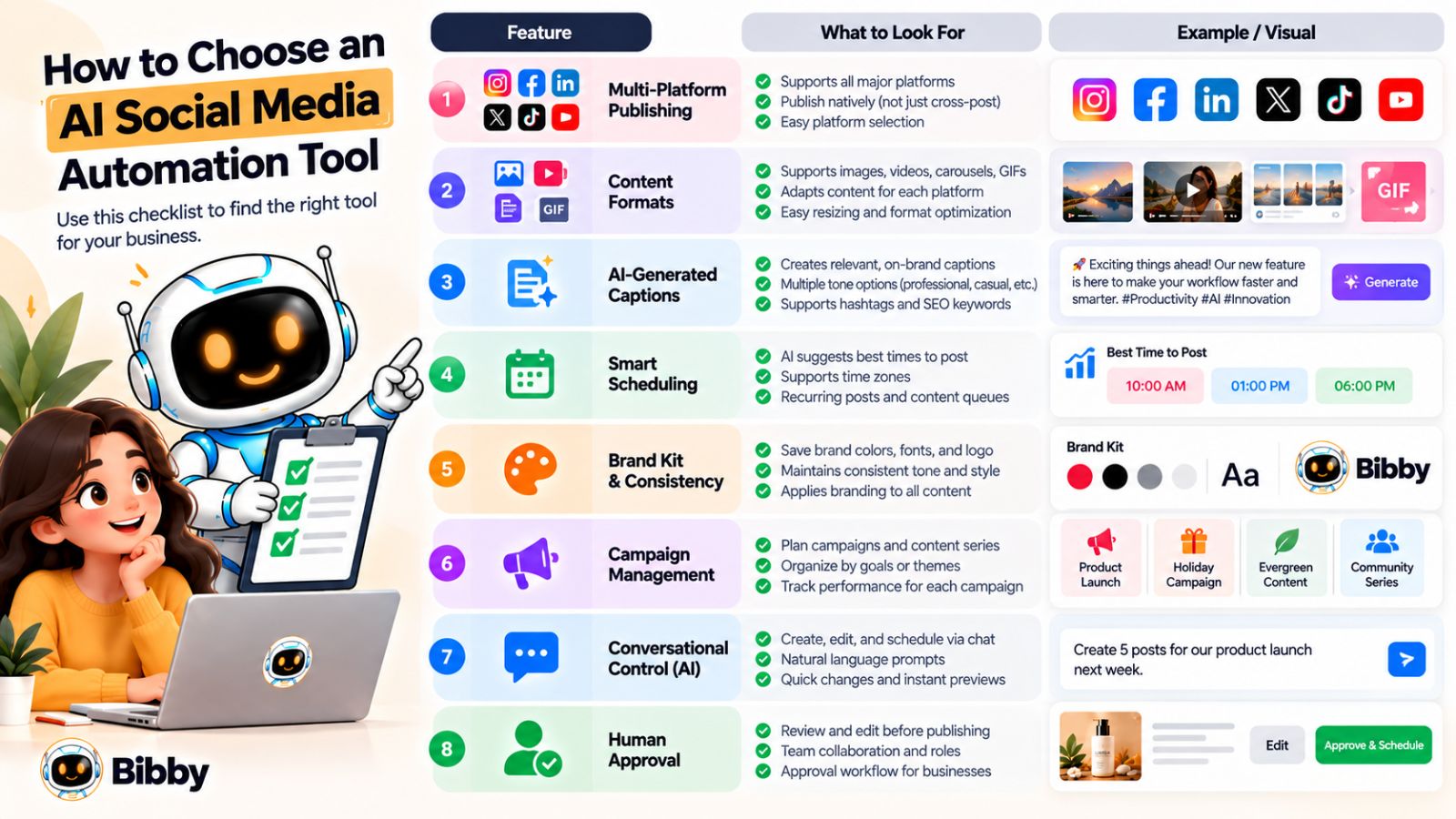
1. multi-platform publishing
The first consideration is platform coverage.
If a business manages several social channels, switching between different publishing systems defeats much of the purpose of automation.
Look for a workflow that can manage the platforms relevant to your audience from one place.
For many brands, that could include Facebook, Instagram, LinkedIn, YouTube, and TikTok.
The exact platforms matter less than whether the tool allows the business to manage its actual distribution strategy without unnecessary duplication.
2. Multiple content formats
Social media is no longer just static images.
A useful automation platform should accommodate the formats a modern brand actually publishes, such as:
- Images
- Carousels
- Videos
- Stories
Bibby supports these different media formats, allowing them to become part of the same publishing workflow.
This matters because automation becomes less useful when marketers still need separate tools for every type of content.
3. AI caption generation
Writing captions manually for every post can become a significant bottleneck.
AI-generated captions can remove much of that repetitive work, particularly when the system can take the creative and desired posting style into account.
However, caption generation should be treated as a starting point rather than a guarantee of quality.
The best workflows allow marketers to review, modify, or regenerate content when necessary.
Bibby includes automatic caption generation as part of its publishing workflow, with the ability to regenerate captions when a different version is needed.
4. AI-powered scheduling
Scheduling is one of the clearest areas where automation can save time.
A tool should ideally do more than provide a calendar where users manually enter every date and time.
AI-powered scheduling can help determine publishing windows and distribute content across different dates.
Bibby's scheduling workflow can place media across different dates using AI-optimized publishing times, reducing the amount of manual calendar management required.
5. Brand consistency
AI-generated content is only useful if it still sounds and looks like the brand.
A social media automation platform should therefore provide ways to establish brand context.
That might include:
- Brand voice
- Visual identity
- Messaging guidelines
- Brand assets
- Content preferences
A brand kit can give AI a foundation for generating content that is more consistent with the business.
6. Campaign management
Individual posts are only one part of social media marketing.
Businesses also need to coordinate launches, promotions, seasonal campaigns, educational series, and other multi-post initiatives.
A useful platform should make it possible to think beyond individual posts.
Bibby's workflow includes campaign creation through its conversational interface, allowing users to work with campaigns rather than treating every social post as an isolated task.
7. Conversational control
This may become one of the most important differences between traditional social media software and the next generation of AI marketing tools.
A conventional interface requires users to navigate the software.
A conversational interface lets users describe what they want.
Bibby's chat interface allows marketers to manage social media through conversation, including creating brand kits, creating campaigns, creating posts, and regenerating captions.
That can make the software feel more like an AI social media manager than a conventional scheduling dashboard.
8. Human control
Automation should never mean losing control of the brand.
Before choosing a tool, businesses should consider how easily humans can review, edit, regenerate, reschedule, or override AI-generated content.
The ideal system should reduce repetitive work without making important decisions opaque.
9. One connected workflow
Perhaps the most important consideration is whether the features actually work together.
An AI caption generator is useful.
A scheduling tool is useful.
An image generator is useful.
A campaign manager is useful.
But combining these capabilities into one workflow can be substantially more powerful than using them independently.
That is the direction the category is moving toward.
Instead of:
Create → copy → paste → caption → schedule → repeat
the workflow becomes:
Create or upload → define the style → generate → select platforms → schedule → publish
That is a much closer approximation of an autonomous social media channel.
The real question to ask
When evaluating an AI social media automation platform, businesses should look beyond the number of AI features listed on the pricing page.
The better question is:
How many manual decisions and repetitive steps does this tool remove from my actual social media workflow?
The answer reveals whether the platform is simply adding AI features to traditional social media management—or genuinely helping turn social media into an automated marketing system.
The Future: Social Media Becomes an Autonomous Distribution Layer
The most important development in AI-powered social media may not be better captions, faster image generation, or easier scheduling.
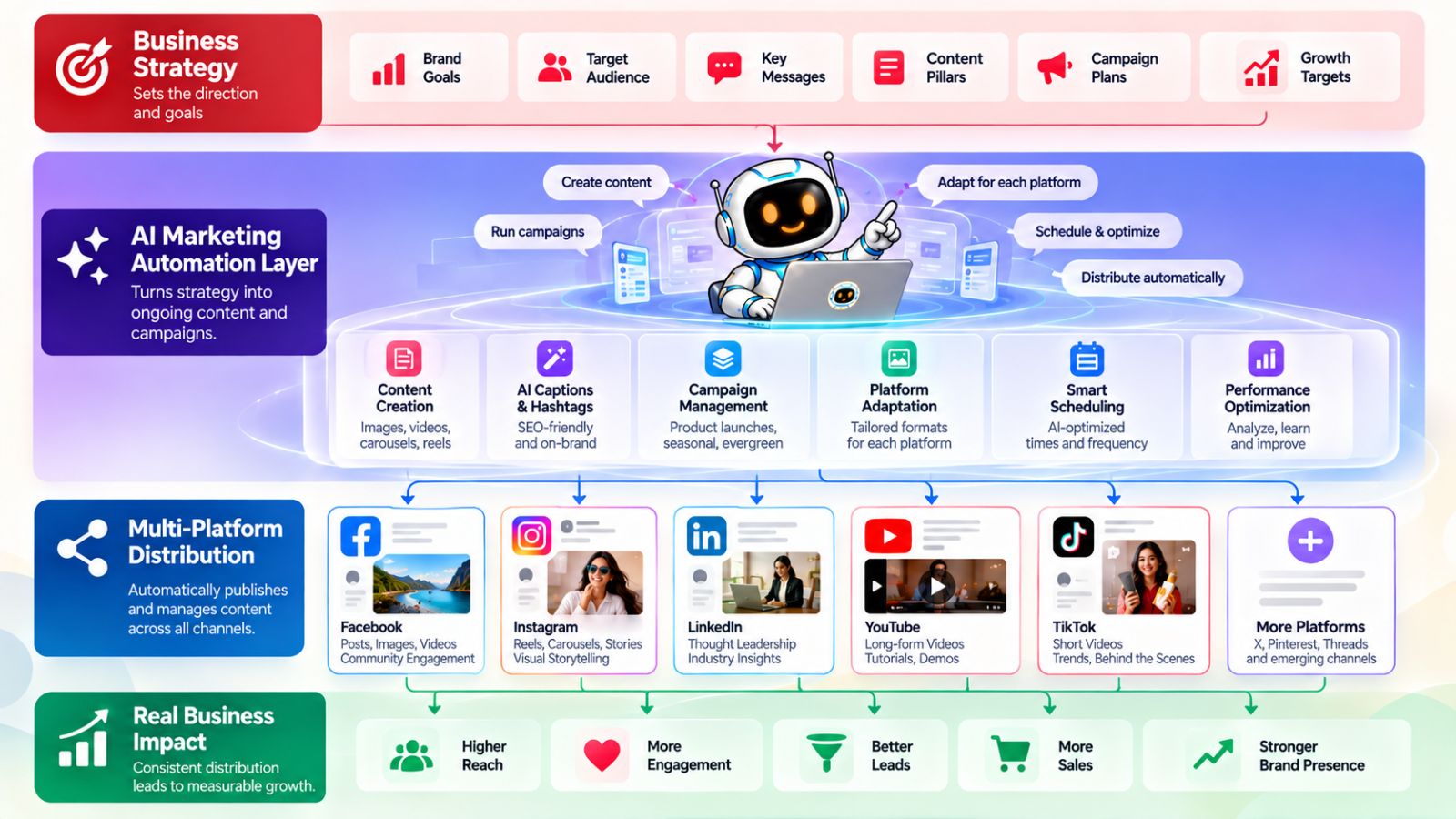
It may be the gradual transformation of social media from a collection of publishing platforms into an autonomous distribution layer for marketing.
Today, marketers still think about Facebook, Instagram, LinkedIn, YouTube, and TikTok as separate channels that need to be managed individually.
AI is beginning to make that distinction less important.
The marketer can increasingly start with a strategy, campaign, idea, or piece of creative and let software handle more of the work required to turn that input into distributed social content.
From content creation to content orchestration
The first generation of AI marketing tools focused heavily on creation.
Write a caption.
Generate an image.
Create a video.
Rewrite this post.
Those capabilities are useful, but they solve individual problems.
The next stage is orchestration.
An AI system can potentially connect the entire chain:
Strategy → campaign → content → captions → platform adaptation → scheduling → publishing
That is a fundamentally different proposition.
The value is no longer determined by how good an individual AI-generated caption is.
It is determined by how effectively the system can help a marketer operate the entire content pipeline.
The interface may become less important
As AI becomes better at understanding natural language, marketers may spend less time learning software interfaces.
Instead of navigating through dozens of settings, they can increasingly describe their objective.
“Create a campaign around our new product.”
“Turn this creative into several social posts.”
“Regenerate these captions in our brand voice.”
“Schedule this campaign across our selected platforms.”
The software then translates those instructions into actions.
Bibby's conversational interface represents this direction by allowing users to manage activities such as brand-kit creation, campaigns, posts, and caption regeneration through chat.
The broader implication is significant: the social media manager may increasingly interact with software the same way they interact with another member of their marketing team.
Autonomous does not mean unsupervised
There will still be a role for human oversight.
Brands need people who understand their customers, positioning, culture, reputation, and business objectives.
AI can execute.
Humans decide what deserves execution.
This creates a model where autonomy exists within boundaries.
A company can define its brand identity, content pillars, campaigns, preferred platforms, and publishing rules. AI can then handle much of the repetitive work inside those boundaries.
That is more realistic—and potentially more useful—than imagining a completely independent marketing machine.
The social media team may become smaller but more strategic
This shift could also change how marketing teams allocate their time.
A social media manager who previously spent hours each week preparing captions and maintaining publishing calendars may increasingly spend that time on:
- Audience research
- Creative strategy
- Campaign planning
- Community building
- Brand positioning
- Performance analysis
- Original content
- Experimentation
The software takes on more execution.
The human role moves upward.
This is a recurring pattern in automation: when routine execution becomes cheaper, the value of judgment and strategy becomes more important.
The real competitive advantage may be the system
As AI social media tools become more accessible, simply having access to AI will no longer be a meaningful differentiator.
Most businesses will eventually have access to AI caption generation, image creation, scheduling, and content assistance.
The competitive advantage will increasingly come from how well a business builds its marketing system around those capabilities.
A company with a clear brand voice, strong content pillars, useful ideas, high-quality creative, and an efficient distribution system can get more value from automation than a company that simply generates large amounts of generic content.
AI is the infrastructure.
Strategy remains the differentiator.
Social media becomes a marketing operating system
This is where the idea of an autonomous social media channel ultimately leads.
Social media stops being something a marketer has to remember to do every day.
Instead, it becomes an operating system that continuously connects:
Ideas → content → campaigns → platforms → schedules → audiences
The human marketer remains responsible for direction and judgment.
AI increasingly handles execution.
And tools that combine creation, content management, conversational control, scheduling, and multi-platform publishing are helping move social media toward that model.
the future of social media marketing may therefore belong less to brands that simply publish more and more to brands that build intelligent systems capable of consistently turning good marketing ideas into distribution.
Final thoughts
AI is changing social media from a collection of manual publishing tasks into an increasingly connected marketing system. The biggest shift is not simply that AI can write captions or generate images—it is that creation, content adaptation, scheduling, campaigns, and distribution can increasingly work together.
Three ideas matter most:
- AI can automate much of the repetitive social media workflow, from captions and content creation to scheduling and publishing.
- Autonomous social media still needs human strategy, with people defining the brand, campaigns, audience, and important decisions.
- The biggest opportunity is building a connected content system, rather than using AI for isolated tasks.
Platforms such as Bibby demonstrate where this workflow is heading by bringing creative generation, caption creation, campaign management, multi-format publishing, scheduling, and conversational social media management into a more unified experience.
The next step is not simply adopting another AI tool. It is designing a workflow around your actual marketing goals—what you want to publish, who you want to reach, which platforms matter, and what should remain under human control.
Once those foundations are clear, the next logical step is to build an AI-powered social media workflow from strategy to automated publishing and turn your social presence into a system that can keep working even when your marketing team is focused elsewhere.