
IGTV (Instagram TV) was Instagram's dedicated platform for long-form video content, created to give creators and businesses more space to publish videos beyond the shorter formats available in the Instagram feed. Launched in 2018, IGTV was designed around mobile-first, vertical video and became a popular way to share tutorials, interviews, educational content, vlogs, product demonstrations, and other longer videos directly with an Instagram audience.
Unlike a standard Instagram post, IGTV was built specifically for longer-form viewing and gave creators their own video channels within Instagram. Over time, however, Instagram changed how it handled video content and moved toward a more unified video experience. The standalone IGTV brand was eventually discontinued, making IGTV primarily a historical term rather than a current Instagram feature.
If you are searching for IGTV today, the important distinction is that you can no longer use IGTV as a separate Instagram platform. Instagram has since consolidated its video experience across formats such as Reels, feed videos, Stories, and Live. Understanding what IGTV was, why Instagram introduced it, why it was discontinued, and what replaced it helps explain how Instagram's approach to video has evolved.
In this article, you will learn:
- What IGTV stood for and how the platform worked
- Why Instagram discontinued IGTV as a standalone product
- What Reels, Stories, Live, and feed video replaced it with
What Is IGTV (Instagram TV)?
IGTV, short for Instagram TV, was Instagram's long-form video platform designed for creators and businesses to publish videos longer than traditional Instagram feed content. Unlike Instagram's standard feed, which was originally focused on shorter posts and videos, IGTV provided a dedicated space for longer, vertical, mobile-first video content.
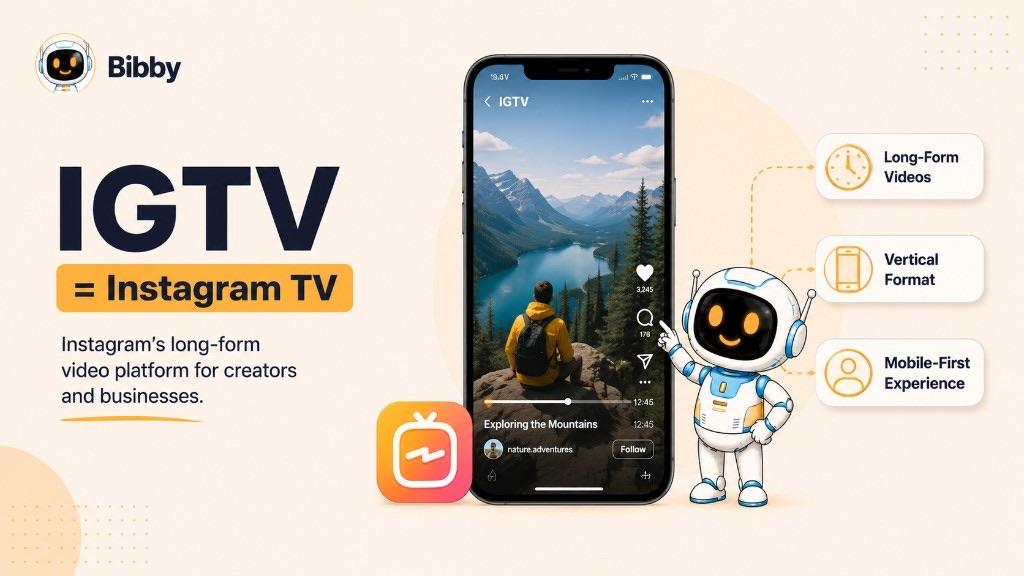
Instagram launched IGTV in 2018 as part of its broader push into online video. The platform allowed creators to build dedicated video channels and publish content such as tutorials, interviews, educational videos, product demonstrations, reviews, vlogs, and episodic series. Videos could be discovered through Instagram and, for a period, through the standalone IGTV experience.
One of IGTV's defining characteristics was its vertical video format. Instead of asking users to rotate their phones or watch traditional landscape videos, Instagram designed IGTV around the way people naturally held their smartphones. This approach helped make longer video content feel native to the Instagram experience.
IGTV also became an important tool for businesses and influencers that wanted to go beyond short social posts. A brand could use it to explain a product in detail, while a creator could publish a multi-part educational series or longer personal video without being restricted to the shorter formats available elsewhere on Instagram.
However, IGTV is no longer a standalone Instagram product. Instagram eventually moved away from the separate IGTV experience and toward a unified approach to video. Today, Instagram distributes video through its broader ecosystem rather than maintaining a dedicated IGTV platform.
So, when you encounter the term IGTV today, it generally refers to Instagram's former long-form video service and the videos that were originally published through it. Understanding IGTV is also useful for understanding the evolution of Instagram from a photo-sharing platform into a broader video and creator-focused social network.
What Does IGTV Stand For?
IGTV stands for Instagram TV. The name combined “IG,” a common abbreviation for Instagram, with “TV” to communicate the platform's focus on longer-form video content.
Instagram introduced the name to distinguish IGTV from the shorter videos and other posts traditionally published in the Instagram feed. The idea was to create a dedicated video destination where creators could publish longer content and build audiences around recurring video series, much like traditional television channels but designed specifically for mobile users.
The name also reflected Instagram's ambition to expand beyond photo sharing. With IGTV, creators could produce tutorials, interviews, educational programs, product reviews, vlogs, and other extended video content while keeping their audience within the Instagram ecosystem.
Although IGTV is no longer an active standalone Instagram product, the term still appears in older articles, social media guides, videos, and discussions about Instagram marketing. When you see “IGTV” today, it generally refers to Instagram's former long-form video platform rather than a feature that can be accessed separately on Instagram.
When Was IGTV Introduced?
Instagram introduced IGTV on June 20, 2018, as a dedicated platform for long-form mobile video. Instagram positioned it as a new destination where creators could publish longer videos and connect with audiences beyond the limits of traditional Instagram feed content.
At launch, IGTV was designed around vertical, full-screen video, reflecting Instagram's mobile-first approach. Users could access IGTV through the Instagram app, while Instagram also offered a separate IGTV app. Creators could establish their own channels and publish longer videos directly to their followers and other viewers.
The launch was significant because Instagram was expanding from its original photo-sharing roots into a much broader video platform. Rather than treating longer videos as an extension of the feed, IGTV initially presented them as a dedicated content experience.
IGTV's Evolution
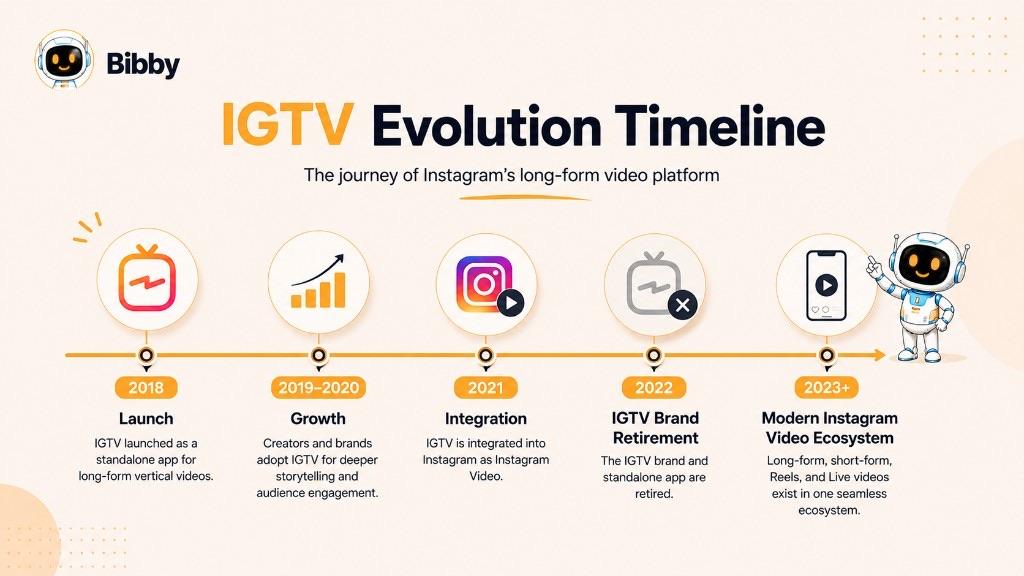
IGTV did not remain unchanged throughout its lifespan. Instagram gradually integrated the experience more closely with its main platform and adjusted how creators and users interacted with video content.
Over time, Instagram increasingly focused on making video a central part of the overall Instagram experience rather than maintaining completely separate destinations for different video types. This eventually led to the retirement of the standalone IGTV brand and a broader consolidation of Instagram's video formats.
As a result, IGTV is now best understood as an important stage in Instagram's evolution toward its current video-first ecosystem, rather than as a currently available standalone platform.
How Did IGTV Work?
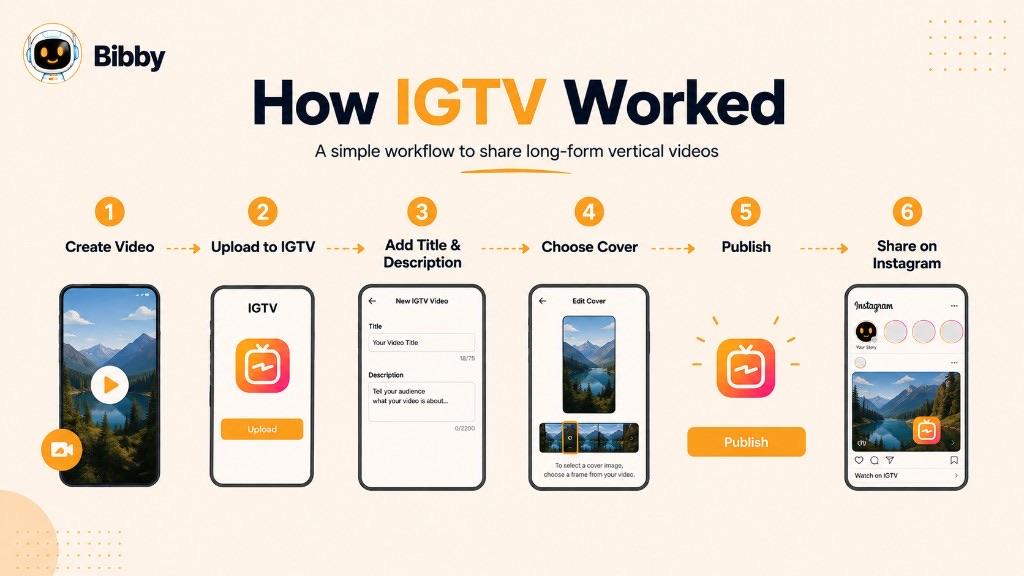
IGTV was designed to make long-form video feel native to Instagram. Instead of publishing a longer video as a regular feed post, creators could upload it to their IGTV channel, add supporting information, and share it with their Instagram audience.
The basic IGTV workflow looked like this:
Create a video → Upload it to IGTV → Add a title and description → Choose a cover image → Publish → Share it on Instagram
1. Creators Uploaded Long-Form Videos
Creators could upload videos specifically for the IGTV format. The platform was particularly associated with vertical, mobile-first videos, making content easy to watch on a smartphone without turning the device sideways.
2. Creators Added Titles and Descriptions
Each IGTV video could include a title and description. These helped explain the video topic and give viewers additional context.
For businesses and creators, this information also provided an opportunity to communicate the purpose of the video and encourage viewers to take an action, such as visiting a website or exploring another piece of content.
3. Creators Used Custom Cover Images
Creators could select a cover image for their IGTV videos. The cover acted as the visual introduction to the content and could influence whether someone decided to watch.
This made thoughtful thumbnails and consistent visual branding useful for creators building a recognizable video presence.
4. Videos Could Be Shared Through Instagram
IGTV was closely connected to Instagram. Creators could promote their longer videos through Instagram posts and other parts of the platform, allowing followers to discover content without relying entirely on a separate IGTV destination.
This connection was particularly useful for businesses that already had an established Instagram audience.
5. Creators Could Build Video Channels
IGTV gave creators a dedicated place to organize their longer videos. This made it possible to publish recurring content, educational series, interviews, tutorials, reviews, and other formats that benefited from more viewing time.
For example, a creator could publish a weekly tutorial series rather than trying to fit the entire topic into a short Instagram video.
6. IGTV Focused on Long-Form, Vertical Video
The biggest difference between IGTV and Instagram's original feed video experience was its emphasis on longer-form content. Instagram was attempting to give creators more room to tell stories, teach concepts, explain products, and develop episodic content.
However, Instagram's video strategy eventually changed. Rather than keeping separate experiences for different types of video, Instagram moved toward a more unified video ecosystem. The standalone IGTV experience was eventually discontinued.
In short, IGTV worked as Instagram's dedicated long-form video destination, combining longer videos, creator channels, vertical viewing, and Instagram's existing social network. Today, the same concept should be understood in the context of Instagram's broader video formats rather than as a separate IGTV platform.
What Was IGTV Used For?
IGTV was primarily used to publish long-form video content on Instagram. It gave creators, influencers, publishers, and businesses more room to explain ideas, tell stories, educate audiences, and showcase products than the shorter video formats available on Instagram at the time.
Because IGTV was built around vertical, mobile-first viewing, it worked particularly well for content people could consume directly from their smartphones.
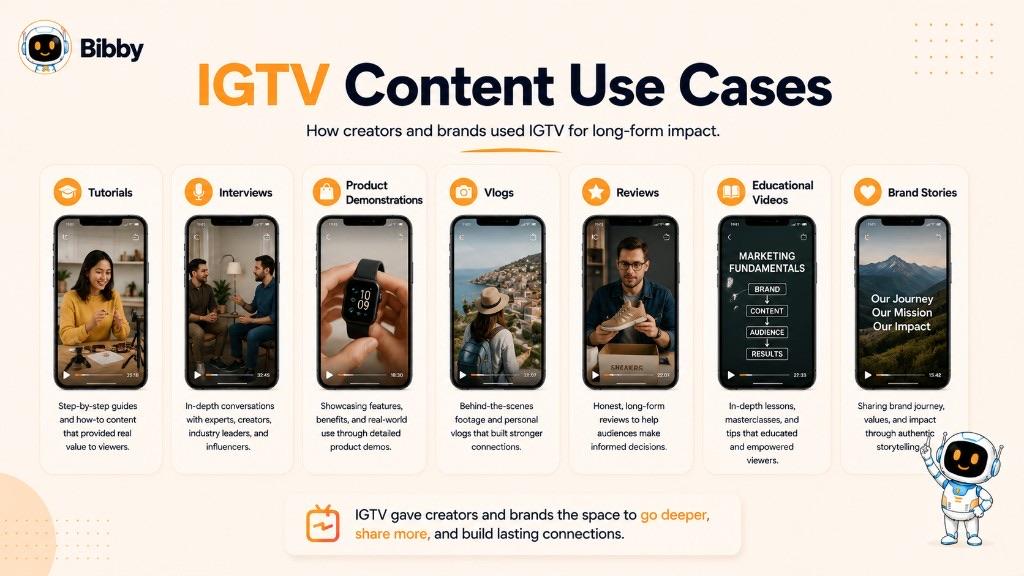
Common IGTV Use Cases
Educational videos: Creators could publish tutorials, lessons, how-to guides, and detailed explanations that required more time than a short social media clip.
Product demonstrations: Businesses could show how products worked, explain features, demonstrate use cases, and answer common customer questions.
Interviews: Brands, influencers, and publishers could conduct longer interviews with experts, founders, customers, or other creators.
Vlogs and personal content: Creators used IGTV for personal stories, behind-the-scenes videos, travel content, daily-life videos, and longer updates for their communities.
Reviews and comparisons: Longer videos gave creators enough space to examine products, services, apps, or other subjects in greater detail.
Video series: IGTV could support recurring content, allowing creators to develop episodic shows around a particular topic or audience interest.
Brand storytelling: Businesses could use longer videos to communicate their brand story, introduce their team, explain their mission, or showcase their work.
Webinar and event content: Longer educational or event-based recordings could also be adapted for Instagram audiences.
Why Was IGTV Useful for Businesses?
For businesses, IGTV created an opportunity to move beyond highly visual promotional posts and provide deeper educational and informational content.
For example, a software company could create a detailed product walkthrough, a fitness brand could publish a complete training session, and a fashion business could produce an extended styling guide.
This made IGTV particularly useful for businesses that needed more than a few seconds to communicate their message.
Why Did Creators Choose IGTV?
The main attraction was simple: more room for storytelling.
Creators could take a topic that would be difficult to explain in a short Instagram post and turn it into a structured video. This made IGTV suitable for audiences that wanted tutorials, explanations, interviews, reviews, and other forms of deeper content.
Although IGTV itself has been discontinued, many of the content strategies associated with it remain relevant. Creators and businesses still use Instagram's current video formats to educate audiences, demonstrate products, tell stories, and repurpose longer-form content into multiple social media posts.
IGTV Video Length: How Long Could an IGTV Video Be?
One of the main reasons Instagram introduced IGTV was to give creators more flexibility for long-form video. Unlike the shorter videos traditionally associated with Instagram's feed, IGTV allowed creators to publish substantially longer content.
Historically, IGTV videos could be up to 60 minutes long, although the exact limits depended on factors such as how and where the video was uploaded.
| Upload type | Historical IGTV video length |
|---|---|
| Mobile uploads | Up to 15 minutes |
| Web uploads | Up to 60 minutes |
IGTV's longer duration made it possible to create tutorials, interviews, educational programs, product demonstrations, vlogs, reviews, and episodic video series without compressing the entire topic into a very short clip.
Did IGTV Always Have a 60-Minute Limit?
No. Instagram expanded IGTV's video-length capabilities over time. When the platform launched, video-length restrictions were more limited, and Instagram later increased the maximum duration for eligible uploads.
This evolution reflected Instagram's broader effort to compete for longer-form video consumption and give creators more flexibility.
Is the IGTV Video Length Limit Still Relevant?
Not as a current IGTV publishing specification. IGTV is no longer a standalone Instagram product, so historical IGTV limits should not be treated as today's Instagram video requirements.
If you are looking for current Instagram video-length limits, check the requirements for the specific Instagram format you plan to use, because Instagram's video rules and formats have changed since the IGTV era.
The important takeaway is that IGTV was created to provide Instagram creators with significantly more space for long-form video than the platform's original feed formats allowed.
What Video Format Did IGTV Use?
IGTV was built around a mobile-first, vertical video experience. This was one of its defining characteristics and helped distinguish IGTV from traditional long-form video platforms that were primarily designed around landscape content.
Instagram wanted IGTV videos to feel natural when viewed on a smartphone. Instead of requiring users to rotate their phones, vertical video filled the mobile screen and created an immersive viewing experience.
IGTV Aspect Ratio
IGTV was primarily associated with a 9:16 vertical aspect ratio, which matched the full-screen orientation of most smartphones.
Creators could also work with other video orientations in certain circumstances, but vertical video was central to the original IGTV experience.
Why Did IGTV Focus on Vertical Video?
The decision was closely connected to how people used Instagram. Instagram was already a mobile-first social network, and users typically interacted with the platform while holding their phones vertically.
By designing IGTV around vertical video, Instagram removed friction from watching longer content on mobile devices.
This approach also helped normalize vertical video for longer-form storytelling at a time when much of the established online video ecosystem still favored landscape formats.
What Kind of Content Worked Well on IGTV?
The format was suitable for content such as:
- Tutorials and how-to videos
- Interviews
- Product demonstrations
- Educational videos
- Vlogs
- Reviews
- Behind-the-scenes content
- Creator series
- Brand stories
Creators could structure these videos for vertical viewing while still providing considerably more depth than short social media clips.
Is the IGTV Format Still Used Today?
The term “IGTV format” is now historical because IGTV no longer exists as a standalone Instagram product. However, the broader idea of creating mobile-first vertical video remains highly relevant to Instagram.
Today's Instagram video ecosystem includes formats such as Reels, Stories, and other video posts, each with its own publishing requirements and recommended dimensions.
Therefore, if you encounter advice about “IGTV size,” “IGTV resolution,” or “IGTV aspect ratio,” check when that information was published. Many IGTV specifications found online refer to the platform as it existed before Instagram consolidated its video products.
Why Did Instagram Create IGTV?
Instagram created IGTV to make long-form video a larger part of the Instagram experience. When IGTV launched in 2018, Instagram was already one of the world's largest mobile social platforms, but much of its video experience was centered around shorter content.
IGTV gave Instagram a way to compete for longer viewing sessions while giving creators more space to produce detailed video content.
1. To Give Creators More Room for Long-Form Content
Traditional Instagram posts were not designed around lengthy videos. IGTV gave creators a dedicated environment where they could publish longer videos without trying to compress an entire story, tutorial, interview, or explanation into a short clip.
This opened the door to formats such as:
- Tutorials
- Interviews
- Educational series
- Product demonstrations
- Reviews
- Vlogs
- Behind-the-scenes videos
2. To Make Instagram More Video-Centric
Instagram had evolved considerably from its original photo-sharing focus. Video was becoming an increasingly important part of social media, and IGTV was one of Instagram's major steps toward becoming a broader video platform.
Rather than treating long-form video as an occasional feature, Instagram created a dedicated destination for it.
3. To Encourage Creator-Led Programming
IGTV was designed around the idea that creators could develop their own recurring video content. A creator could build a channel around a specific topic and publish a series of episodes for an existing Instagram audience.
This made IGTV more than just a place to upload individual videos. It was intended to become a destination for creator programming.
4. To Build a Mobile Alternative to Traditional Video Platforms
IGTV's vertical-first approach reflected Instagram's mobile audience. Instead of copying traditional television or desktop video experiences exactly, Instagram designed the product around smartphone viewing.
The result was a long-form video experience that was particularly suited to users watching content on their phones.
5. To Keep More Video Consumption Inside Instagram
IGTV also supported Instagram's broader goal of keeping creators and audiences within its ecosystem. Creators already had followers, communities, and engagement on Instagram, so providing a long-form video destination gave them another reason to publish and consume video without leaving the platform.
The Bigger Picture
IGTV ultimately became one stage in Instagram's transition from a primarily photo-focused social network into a platform centered on multiple forms of visual and video content.
Although the standalone IGTV product was eventually discontinued, its development demonstrated Instagram's long-term investment in video. The platform later moved toward a more unified video strategy rather than maintaining separate destinations for different types of video.
Why Was IGTV Discontinued?
Instagram discontinued IGTV as a standalone product because its video strategy was moving toward a more unified experience rather than separate destinations for different types of video. Instagram announced in 2021 that it was removing the IGTV brand and bringing long-form and short-form video closer together under Instagram Video.
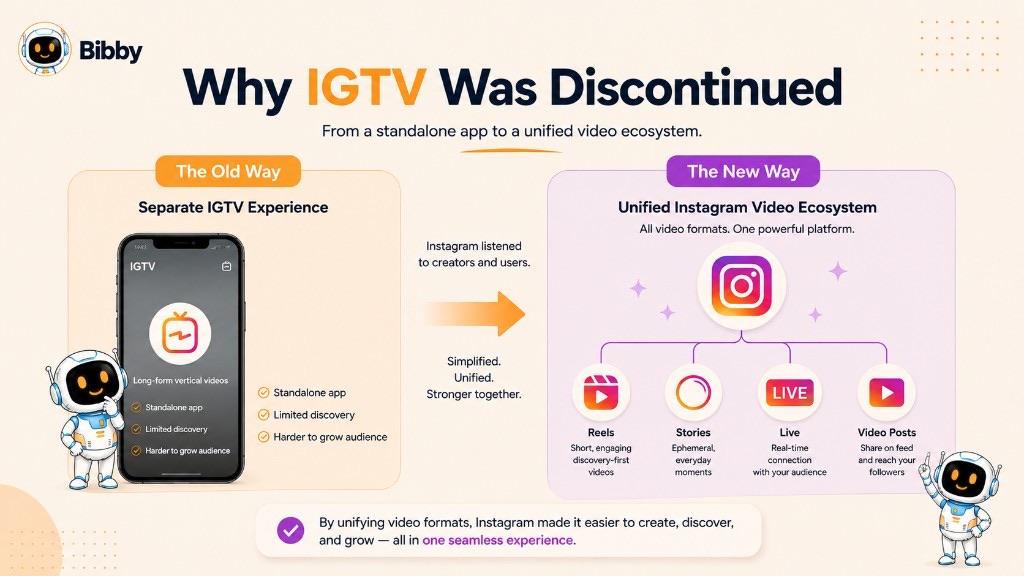
The change reflected how the platform and its users were consuming video. Instagram increasingly treated video as a central part of the overall Instagram experience rather than something that needed its own separate product.
Instagram Was Consolidating Video
One of the biggest changes was the move toward a unified video experience. Instead of requiring users to understand different Instagram video products, Instagram increasingly brought video content together within the main platform.
This made the distinction between traditional feed videos and IGTV less important.
Short-Form Video Became More Important
The rise of short-form vertical video, particularly Instagram Reels, also changed Instagram's video strategy.
Rather than building its future around a dedicated long-form destination, Instagram increasingly focused on a broader video ecosystem where different types of content could coexist and be discovered through the same platform.
This did not mean long-form video disappeared from Instagram. Instead, the separate IGTV identity disappeared.
The IGTV Brand Became Less Necessary
As Instagram's video formats evolved, maintaining a separate name and product for IGTV created additional complexity.
Instagram could provide video publishing and discovery directly within its primary app while continuing to support different types of video content.
This made the standalone IGTV experience less central to Instagram's product strategy.
What Happened to IGTV?
In 2021, Instagram announced that it would remove the IGTV brand and move toward a more unified video format. The separate IGTV app was also eventually discontinued.
The important distinction is that Instagram did not stop being a video platform. Instead, it changed how video was organized and presented.
Was IGTV Replaced by Reels?
Not exactly.
It is tempting to say that Reels simply replaced IGTV, but that oversimplifies Instagram's product evolution. Reels became a major part of Instagram's short-form video strategy, while other video content continued to exist within Instagram's broader video ecosystem.
So, rather than thinking:
IGTV → Reels
it is more accurate to think:
IGTV → Instagram's unified video ecosystem
This distinction matters because IGTV and Reels were designed around different content experiences.
The Key Takeaway
IGTV was discontinued as a standalone product, not because Instagram abandoned video, but because Instagram changed its approach to video. The platform moved away from separate video destinations and toward an integrated ecosystem covering short-form, long-form, Stories, Live, and other video experiences.
Is IGTV Still Available?
No. IGTV is no longer available as a standalone Instagram product. Instagram retired the IGTV brand as part of its move toward a more unified video experience.
This does not mean Instagram stopped supporting video. Instead, Instagram changed how video content is organized and published. Video became integrated more directly into the main Instagram experience rather than being separated into a dedicated IGTV destination.
What Happened to the IGTV App?
Instagram also discontinued the separate IGTV app. Users can no longer use IGTV as an independent destination for discovering or publishing videos.
The removal of the standalone app was part of the broader shift away from treating IGTV as a separate product.
Can You Still Upload an IGTV Video?
You cannot upload a video to IGTV as a separate publishing destination because the IGTV product no longer exists.
However, creators can still publish video content on Instagram through the platform's current video formats. The appropriate format depends on the type of content, its intended audience, and Instagram's current publishing requirements.
Can You Still Watch Old IGTV Videos?
The answer depends on what happened to the individual video and where it was published or stored after Instagram changed its video system. The important point is that there is no longer a separate IGTV section functioning as the dedicated platform it once was.
Older articles and tutorials may still refer to an “IGTV channel” or “IGTV tab,” but those references describe Instagram as it existed before the product was consolidated.
What Should You Use Instead of IGTV?
If your goal is to publish video on Instagram today, you should use Instagram's current video formats rather than looking for an IGTV upload option.
Depending on your content, that may include:
- Reels
- Instagram video posts
- Stories
- Live video
Instagram's available features and video specifications can change, so current publishing requirements should always be checked before preparing content.
In short, IGTV is no longer an active standalone feature. The concept of publishing longer video on Instagram evolved into the platform's broader video ecosystem.
What Happened to IGTV Videos?
When Instagram discontinued the standalone IGTV experience, it did not mean that Instagram stopped supporting video content. Instead, Instagram changed how video was organized, published, and discovered by moving away from a separate IGTV destination.
This distinction is important because IGTV was a product and brand, while IGTV videos were pieces of content published through that system.
IGTV Became Part of Instagram's Broader Video Strategy
Instagram gradually moved toward a unified video experience. Rather than keeping long-form videos inside a separate IGTV environment, the platform began treating video more broadly across Instagram.
As a result, older references to an “IGTV channel,” “IGTV tab,” or “IGTV upload” describe Instagram's previous video system and should not be interpreted as current Instagram features.
Were IGTV Videos Deleted?
There was no universal rule that every video previously associated with IGTV was simply deleted when the IGTV brand was retired.
The availability of individual older videos could depend on factors such as how the content was published, whether it remained on the account, and subsequent changes made by Instagram or the creator.
Therefore, it is more accurate to say that IGTV as a standalone destination was discontinued, rather than saying that all IGTV videos were automatically erased.
Where Did IGTV Content Go?
Instagram's transition moved video content toward its broader video ecosystem. Content that had previously been associated with IGTV could therefore become part of an account's regular Instagram video presence rather than remaining inside a separate IGTV destination.
The exact experience changed as Instagram continued updating its video products.
Can Creators Still Use Their Old IGTV Content?
Creators who still have access to older video content can potentially repurpose it for today's Instagram formats, depending on the content's quality, dimensions, relevance, and current platform requirements.
For example, an old tutorial could be:
- Edited into shorter clips
- Republished as a Reel
- Turned into a carousel summarizing the key points
- Converted into several educational posts
- Used as source material for a new video series
This approach can be more valuable than simply trying to recreate the old IGTV publishing workflow.
Why Does IGTV Content Still Matter?
IGTV may be discontinued, but the content strategy behind it has not disappeared.
Creators and businesses still need ways to communicate complex ideas through video. Tutorials, interviews, demonstrations, educational content, product explanations, and long-form storytelling remain useful across modern social platforms.
The difference is that Instagram no longer requires a separate IGTV product to deliver that content.
In short, IGTV videos did not represent a completely separate kind of content. They were long-form Instagram videos published through a platform that Instagram later retired and folded into its broader approach to video.
What Replaced IGTV?
IGTV was not replaced by one single Instagram feature. Instead, Instagram moved toward a unified video ecosystem that brought different types of video content into the main Instagram experience.
This is an important distinction because it is common to see Instagram Reels described as the replacement for IGTV, but the two products served different purposes.
Instagram Video Became the Broader Direction
Instagram increasingly moved away from maintaining separate products for different video formats. Video became a more integrated part of the main Instagram experience, allowing users to discover and interact with different types of video without needing a dedicated IGTV destination.
This broader approach effectively replaced the role that IGTV once played.
What About Instagram Reels?
Reels became one of Instagram's most important video formats, particularly for short-form, discovery-focused content.
Reels are designed around short, engaging vertical videos that can reach audiences beyond an account's existing followers through Instagram's recommendation systems.
However, Reels should not be considered a perfect one-to-one replacement for IGTV.
| IGTV | Instagram Reels |
|---|---|
| Designed for longer-form video | Designed primarily for short-form video |
| Had a dedicated video experience | Integrated into Instagram |
| Focused on longer storytelling | Focused heavily on discovery and engagement |
| Built around creator video channels | Built around individual short-form videos |
| Discontinued | Current Instagram format |
What About Instagram Stories?
Stories also became part of Instagram's broader video ecosystem, but they serve a different purpose from what IGTV was designed to accomplish.
Stories are temporary, highly interactive pieces of content that are useful for:
- Quick updates
- Behind-the-scenes content
- Polls and questions
- Announcements
- Daily engagement
They are not a direct replacement for long-form IGTV content.
What About Instagram Live?
Instagram Live provides another way to publish longer video, particularly for real-time interactions such as:
- Interviews
- Q&A sessions
- Product launches
- Events
- Discussions
- Community conversations
Again, Live is a different experience from the prerecorded long-form videos that IGTV was designed to support.
So, What Is the Modern Equivalent of IGTV?
There is no single modern “IGTV replacement.”
Instead, Instagram distributes video across different formats based on the content's purpose:
Reels → Short-form and discovery
Stories → Temporary and interactive content
Live → Real-time video
Instagram video posts → Broader video publishing
This reflects Instagram's larger shift from separate video products toward a more integrated video platform.
What Should Creators Use Today?
The right format depends on the content rather than its length alone.
A detailed tutorial might be adapted into a longer Instagram video and several shorter Reels. A quick tip may work better as a Reel, while an announcement or behind-the-scenes update may fit naturally into Stories.
For creators and businesses, the more useful question today is not “What replaced IGTV?” but:
“Which Instagram video format best fits the content I want to publish?”
That shift captures the biggest change from the IGTV era to Instagram's current video strategy.
IGTV vs Instagram Feed Videos
IGTV and Instagram feed videos were both used to publish video content, but they originally served different purposes. IGTV was created specifically for longer-form video, while Instagram feed videos were designed to fit into the broader feed experience.
The distinction became less important as Instagram gradually unified its video products, but understanding the historical difference helps explain why IGTV was created in the first place.
IGTV vs Instagram Feed Videos: Key Differences
| Feature | IGTV | Instagram feed videos |
|---|---|---|
| Primary purpose | Long-form video | Video within the main Instagram feed |
| Viewing experience | Dedicated IGTV experience | Instagram feed |
| Content approach | Detailed, longer storytelling | Shorter, feed-friendly content |
| Format | Strong focus on vertical video | Supported multiple video orientations |
| Creator experience | Dedicated IGTV channels | Published directly to Instagram profiles and feeds |
| Discovery | Instagram and IGTV surfaces | Instagram feed and other discovery surfaces |
| Status today | Discontinued | Evolved into Instagram's broader video experience |
IGTV Was Designed for Long-Form Content
The biggest difference was the intended content length and viewing experience.
IGTV gave creators more space to produce content that needed additional time, including tutorials, interviews, product demonstrations, educational programs, and episodic series.
A creator could use IGTV to develop a 20-minute educational video, for example, rather than reducing the entire subject to a short clip.
Feed Videos Were Part of the Main Instagram Experience
Instagram feed videos were designed to appear naturally alongside photos and other posts.
Users could scroll through their feeds and encounter video content without entering a separate video destination. This made feed videos particularly useful for short updates, announcements, promotional content, and content designed for quick consumption.
Why Did the Difference Eventually Disappear?
As Instagram's video strategy evolved, the platform began bringing its different video experiences closer together.
Rather than requiring creators and users to understand separate products for different types of video, Instagram moved toward a more unified video system.
This eventually made the distinction between “IGTV video” and “Instagram feed video” less meaningful.
Which Was Better?
Neither format was universally better. They were designed around different content goals.
IGTV was better suited to:
- Tutorials
- Interviews
- Educational content
- Detailed product demonstrations
- Vlogs
- Episodic video series
Feed videos were better suited to:
- Quick announcements
- Short demonstrations
- Promotional posts
- Community updates
- Content designed for feed browsing
Today, creators do not need to choose between IGTV and feed video because IGTV is no longer a standalone publishing option. Instead, the content should be adapted to whichever Instagram video format best matches the audience, topic, and publishing objective.
IGTV vs Instagram Reels
IGTV and Instagram Reels were created for different types of video content. IGTV was Instagram's former long-form video platform, while Reels was designed primarily for short-form, vertical video and content discovery.
Although Reels became increasingly important as Instagram's video strategy evolved, it is not technically accurate to describe Reels as a direct one-to-one replacement for IGTV.
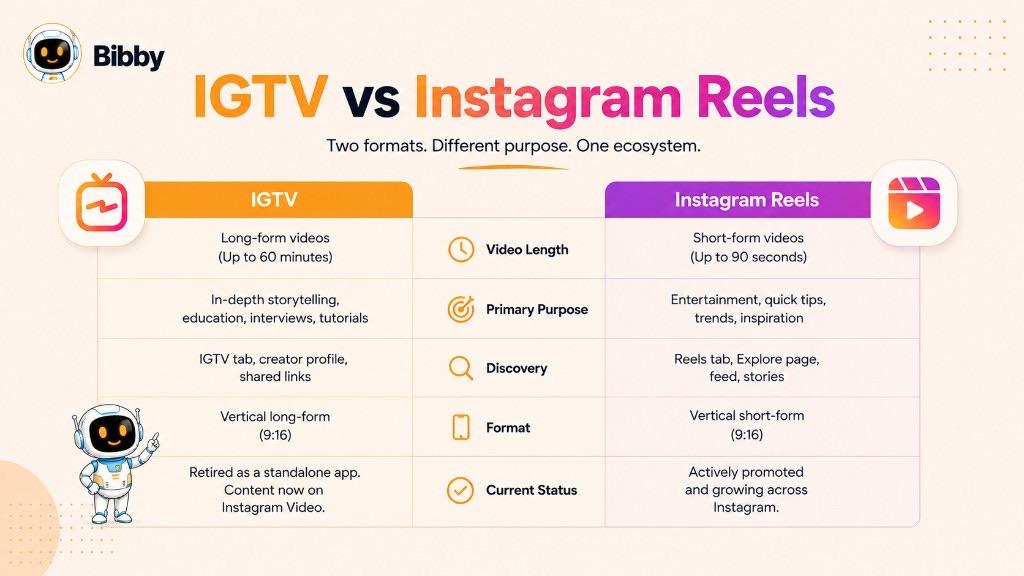
IGTV vs Reels: Key Differences
| Feature | IGTV | Instagram Reels |
|---|---|---|
| Primary purpose | Long-form video | Short-form vertical video |
| Original experience | Dedicated IGTV destination | Integrated Instagram format |
| Content style | Tutorials, interviews, series, detailed videos | Short, engaging, entertaining, educational videos |
| Discovery | Instagram and IGTV | Reels and Instagram recommendation surfaces |
| Creator focus | Longer storytelling | Reach, discovery, and engagement |
| Status | Discontinued | Active Instagram format |
IGTV Was Built for Longer Stories
IGTV gave creators more room to explain a topic or develop a story. It was particularly useful for content that needed several minutes or more to provide meaningful value.
Creators used IGTV for:
- Tutorials
- Interviews
- Product demonstrations
- Reviews
- Educational videos
- Vlogs
- Episodic series
The goal was often to keep viewers engaged with a deeper piece of content.
Reels Are Built for Short-Form Discovery
Instagram Reels developed around a different content behavior.
A Reel can communicate an idea in a short, highly engaging format and potentially reach people who do not already follow the creator. Reels became an important part of Instagram's recommendation-driven discovery experience.
Common Reel content includes:
- Quick tips
- Trends
- Short tutorials
- Product highlights
- Entertainment
- Educational snippets
- Behind-the-scenes clips
Is Reels the Replacement for IGTV?
Not exactly.
Reels became a major part of Instagram's video strategy after the IGTV era, but it does not serve precisely the same purpose.
The better way to understand the transition is:
IGTV = dedicated long-form video experience
Reels = short-form, discovery-oriented video format
Modern Instagram video = multiple video formats working together
Instagram's broader shift was toward making video a central part of the platform rather than maintaining separate destinations for different video lengths.
Can Long-Form IGTV Content Become Reels?
Yes, and this is one of the most useful ways to repurpose older IGTV-style content today.
A long-form tutorial, interview, or product demonstration can provide the source material for multiple short videos.
For example:
20-minute tutorial → 5 short clips → 5 Reels → supporting Stories → carousel summary
This allows creators to preserve the depth of long-form content while adapting individual ideas for modern short-form discovery.
Which Should Creators Use Today?
Creators should not try to recreate the old IGTV workflow. Instead, they should choose Instagram's current video formats based on the purpose of each piece of content.
Use short-form video when the goal is discovery and quick engagement, and use longer video when the topic requires more explanation.
The most effective strategy can combine both: create valuable long-form source material, then turn its strongest ideas into shorter videos, carousels, Stories, and other social content.
The key difference is simple: IGTV was a standalone long-form video product, while Reels is a current short-form video format within Instagram's broader content ecosystem.
IGTV vs YouTube
IGTV was often compared with YouTube because both platforms allowed creators to publish longer-form video content. However, they were built around different ecosystems, audiences, and content-discovery models.
IGTV was an extension of Instagram's social network, while YouTube was built primarily as a dedicated video platform. This difference shaped how creators used each service.
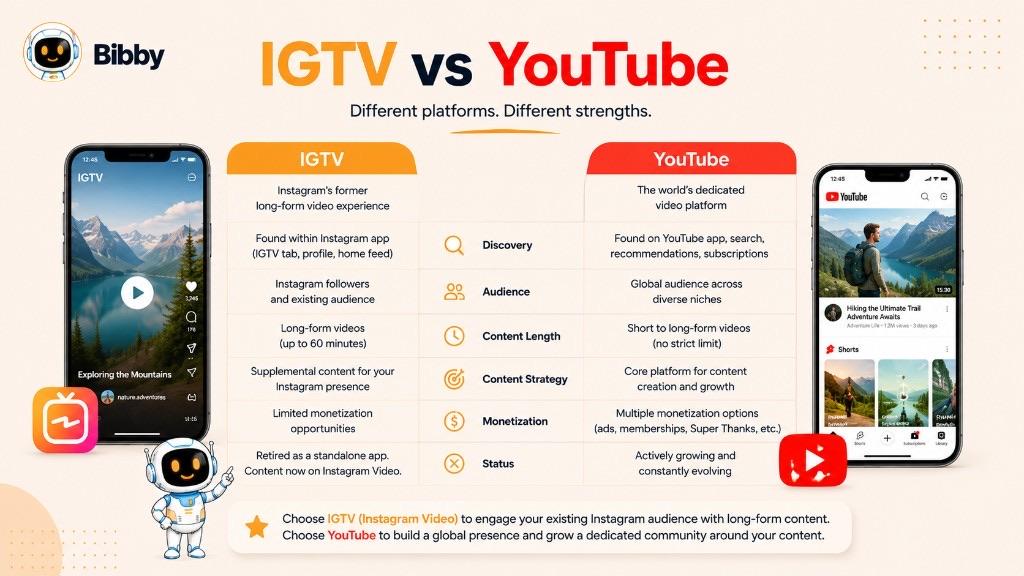
IGTV vs YouTube: Key Differences
| Feature | IGTV | YouTube |
|---|---|---|
| Platform | Dedicated video platform | |
| Primary focus | Social networking + video | Video discovery and publishing |
| Audience | Primarily Instagram users | Global video-search audience |
| Content | Long-form social video | Short-form and long-form video |
| Discovery | Instagram ecosystem | Search, recommendations, subscriptions, external sharing |
| Creator channels | IGTV channels | YouTube channels |
| Search behavior | Primarily social discovery | Strong search-driven discovery |
| Current status | Discontinued | Active |
IGTV Was Built Around Instagram's Existing Audience
One of IGTV's biggest advantages was that creators did not need to build an audience from scratch on a completely separate social network.
Creators already using Instagram could use IGTV to publish longer videos for people who followed them or discovered their content through Instagram.
For businesses, this made IGTV particularly interesting because it connected long-form video with an existing Instagram presence.
YouTube Was Built Around Video Discovery
YouTube operates primarily as a video platform. People can discover videos through:
- Search
- Recommendations
- Subscriptions
- Playlists
- Suggested videos
- External websites and social networks
This gives YouTube a particularly strong role in searchable, evergreen video content.
For example, a user searching for a software tutorial years after publication may still discover that video through YouTube search.
IGTV Was More Socially Connected
IGTV was closely tied to Instagram's social graph. Creators could use their existing Instagram identity and audience to promote longer videos.
This made IGTV useful for:
- Influencers
- Instagram-first creators
- Lifestyle brands
- Fashion businesses
- Product-focused businesses
- Creators with established Instagram communities
YouTube Offered a More Established Long-Form Video Ecosystem
YouTube remained more deeply associated with long-form video, creator channels, video search, and evergreen content.
Creators could build extensive libraries of videos around a specific subject and organize them using playlists, channel sections, and other tools.
IGTV was never simply “Instagram's version of YouTube.” Its main advantage was the connection between Instagram's existing social audience and longer-form video.
Which Was Better for Businesses?
The answer depended on the business objective.
IGTV was useful for:
- Reaching an existing Instagram audience
- Brand storytelling
- Product demonstrations
- Educational Instagram content
- Interviews
- Social-first video campaigns
YouTube was useful for:
- Search-driven video
- Evergreen tutorials
- Long-form educational content
- Product reviews
- Extensive video libraries
- Building a dedicated video audience
Today, businesses can still use both Instagram and YouTube, but there is no need to structure an Instagram strategy around IGTV because the product has been discontinued.
What Can We Learn From the IGTV vs YouTube Era?
The comparison highlights an important shift in social media marketing: long-form video and short-form video do not have to compete.
A business can create one substantial piece of video content and repurpose it across platforms. A detailed YouTube video, for example, can become shorter Instagram videos, Reels, Stories, carousels, and other supporting content.
That approach makes the underlying content more valuable while adapting it to how people consume video on each platform.
Is IGTV the Same as Instagram Video?
No. IGTV and Instagram Video were not exactly the same thing. IGTV was a specific Instagram product created for long-form video, while Instagram Video became the broader video experience as Instagram gradually consolidated its video formats.
The terminology can be confusing because Instagram changed how it organized video several times.
IGTV Was a Dedicated Product
When IGTV launched, Instagram presented it as a separate destination for longer-form video. Creators could publish videos to dedicated IGTV channels, and users could discover that content through the IGTV experience.
The product was designed around longer, mobile-first video and gave creators more space for content such as:
- Tutorials
- Interviews
- Educational videos
- Product demonstrations
- Vlogs
- Video series
Instagram Video Became a Broader Experience
As Instagram's video strategy evolved, the platform began bringing different types of video closer together.
Instagram eventually removed the IGTV brand and moved toward a more unified approach to video. Rather than maintaining separate identities for different video products, Instagram increasingly treated video as a core part of the main platform.
This is why older articles may use terms such as “IGTV video” while newer Instagram resources simply refer to video.
Why Did Instagram Change the Terminology?
The change reflected how users were actually consuming content.
Instagram had multiple video experiences, including:
- Feed videos
- IGTV
- Reels
- Stories
- Live
Maintaining separate products and terminology for each experience could make the platform more complicated for creators and viewers.
Instagram therefore moved toward a system where video could be created, discovered, and consumed across the broader Instagram experience.
Is “Instagram Video” the New Name for IGTV?
Not exactly.
It is better to think of Instagram Video as part of the broader evolution of Instagram's video strategy, rather than as a simple rename of IGTV.
IGTV was specifically associated with a dedicated long-form video product. Instagram Video represented a more integrated approach in which video content could exist across different parts of the platform.
What Does This Mean for Creators?
If you encounter an older guide telling you to:
“Upload your video to IGTV”
that instruction is outdated.
Creators today should follow Instagram's current video publishing options rather than looking for an IGTV upload button or dedicated IGTV channel.
The appropriate format depends on the content, audience, and objective.
For example:
- Reels can work well for short-form discovery.
- Stories are useful for temporary updates and interaction.
- Live is suited to real-time conversations.
- Video posts can support broader video content.
The Simple Answer
IGTV was Instagram's former dedicated long-form video platform. Instagram Video refers to the broader video experience that emerged as Instagram consolidated its video products.
So, while IGTV played an important role in the development of Instagram video, IGTV and Instagram Video should not be treated as identical terms.
How Did Creators Use IGTV?
Creators used IGTV to publish longer, more detailed video content for their Instagram audiences. It gave them an opportunity to move beyond short posts and create tutorials, interviews, reviews, educational series, and other content that needed more time to develop.
The typical IGTV content workflow was:
Choose a topic → Record the video → Edit for vertical viewing → Create a cover → Add a title and description → Publish → Promote through Instagram
Tutorials and Educational Content
One of the strongest use cases for IGTV was educational content. Creators could explain a topic in greater depth without reducing the subject to a short clip.
For example, a marketing creator could publish a detailed SEO tutorial, while a fitness creator could demonstrate an entire workout routine.
Interviews and Conversations
IGTV also worked well for interviews, discussions, and expert conversations.
Creators could interview:
- Industry experts
- Business owners
- Other creators
- Customers
- Influencers
- Subject-matter specialists
Longer videos gave these conversations room to develop naturally instead of forcing them into a short social post.
Product Reviews and Demonstrations
Businesses and influencers could use IGTV to demonstrate how products worked or provide detailed reviews.
A technology creator, for example, could publish a complete product review covering features, performance, advantages, disadvantages, and practical use cases.
For businesses, this format could also support product tutorials and customer education.
Vlogs and Behind-the-Scenes Content
Creators used IGTV for personal and behind-the-scenes storytelling, including travel videos, daily-life content, event coverage, creative processes, and longer updates.
This type of content helped creators build a stronger connection with audiences by providing more context than a single image or short video could offer.
Episodic Video Series
IGTV was also suitable for recurring content.
A creator could develop a weekly or monthly series around a specific subject, creating a recognizable content format that audiences could return to.
For example:
Episode 1 → Introduction
Episode 2 → Beginner's Guide
Episode 3 → Common Mistakes
Episode 4 → Advanced Strategies
This approach helped turn individual videos into a larger content library.
Brand Storytelling
Businesses could use IGTV to communicate stories that were difficult to express through conventional promotional posts.
Examples included:
- Company stories
- Founder interviews
- Customer stories
- Product journeys
- Behind-the-scenes production
- Educational brand content
- Expert commentary
Instead of making every post directly promotional, businesses could use longer videos to build familiarity and authority.
How Creators Promoted IGTV Content
Publishing a long video was only part of the strategy. Creators could also use their broader Instagram presence to drive attention toward their videos.
A longer IGTV video could be supported by:
- Instagram feed posts
- Stories
- Short video clips
- Captions
- Profile promotion
- Other social channels
This created an early version of a strategy that remains highly relevant today: create one substantial piece of content, then distribute smaller pieces of it across multiple formats.
What Can Creators Learn From IGTV Today?
Although IGTV has been discontinued, its core content strategy remains useful.
Creators do not need a separate IGTV channel to produce detailed video. Instead, they can create valuable long-form source material and repurpose it into shorter videos, carousels, Stories, and other social content.
For example:
One detailed tutorial → multiple short videos → carousel summary → Stories → social posts
This approach allows creators to get more value from every piece of content while adapting the same idea to different audience behaviors.
IGTV's biggest legacy may therefore be less about the platform itself and more about the idea that Instagram could support deeper, creator-led video storytelling alongside its shorter social content.
How Did IGTV Change Social Media Video?
IGTV played a role in pushing long-form, vertical video further into mainstream social media. Instagram did not invent vertical video, but its decision to build a dedicated long-form video experience around mobile viewing helped demonstrate that longer content did not have to follow the traditional landscape-video model.
Its influence can be seen in several parts of today's social video landscape.
1. It Helped Normalize Vertical Long-Form Video
Before IGTV, long-form online video was strongly associated with landscape formats, particularly on desktop-oriented platforms.
IGTV challenged that convention by making vertical video central to its mobile viewing experience. Creators could tell longer stories while keeping their phones in the orientation they normally used for social media.
That helped reinforce an important shift:
Long-form video could be designed for mobile first.
2. It Expanded What Creators Could Publish on Instagram
Instagram had historically been associated with photos and shorter social content. IGTV gave creators more room to publish detailed material.
Tutorials, interviews, reviews, educational videos, and episodic series became easier to fit into an Instagram-focused content strategy.
This helped Instagram move further toward becoming a platform where creators could publish different levels of content depth.
3. It Encouraged Creator-Led Video Series
IGTV was designed around the idea of creators having channels and producing recurring video content.
That encouraged creators to think beyond individual posts and consider:
series → episodes → recurring audiences
This approach remains common across social media today, even though the platforms and formats have changed.
4. It Connected Long-Form Video With Social Distribution
Traditional video platforms are heavily centered on video discovery, while social networks are built around relationships and ongoing audience interaction.
IGTV combined these ideas by allowing creators to use their existing Instagram presence to promote longer videos.
A creator could build interest through a post or Story and then direct viewers toward a longer piece of content.
5. It Helped Instagram Become More Video-Centric
IGTV was part of Instagram's broader transition from a primarily photo-sharing application into a platform where video became increasingly central.
Instagram subsequently expanded its investment in other video formats, particularly short-form video.
The eventual decline of IGTV therefore does not mean the experiment failed to influence Instagram's direction. Instead, it became one stage in a much larger evolution toward an increasingly video-focused platform.
6. It Helped Shape the Modern Repurposing Model
One of the most useful lessons from the IGTV era was that a longer video could serve as a source asset for multiple pieces of social content.
A creator could take one long-form video and extract:
- Short video clips
- Quotes
- Educational tips
- Images
- Carousels
- Stories
- Promotional posts
This content-repurposing approach has become even more important as creators and businesses publish across multiple social networks.
Was IGTV a Major Turning Point?
IGTV should not be credited with single-handedly transforming social media video. The shift toward video was driven by many platforms, creators, technologies, and changes in audience behavior.
However, IGTV was an important part of Instagram's experimentation with longer, mobile-first video.
Its most lasting contribution was not the IGTV brand itself. It was the broader idea that Instagram could support deeper video storytelling and that creators could build video content specifically for mobile audiences.
Today, the Instagram video landscape looks very different, but many of the principles behind IGTV remain relevant: mobile-first storytelling, recurring video content, content repurposing, and matching video format to audience behavior.
IGTV for Businesses: What Was It Used For?
IGTV gave businesses a way to use Instagram for longer-form educational, promotional, and brand-building video content. Instead of relying only on images, captions, and short videos, businesses could use IGTV to explain products, demonstrate services, answer questions, and tell stories in greater depth.
Although IGTV is no longer available as a standalone product, many of the business use cases it supported remain relevant across Instagram's current video formats.
Product Demonstrations
Businesses could use IGTV to show customers how a product worked.
A detailed demonstration could cover:
- Product features
- How to use the product
- Setup instructions
- Common use cases
- Tips and best practices
- Frequently asked questions
This was particularly useful for products that were difficult to explain through a single image or short post.
Tutorials and Educational Content
IGTV was well suited to businesses that needed to educate their audience before making a purchase.
For example:
- A software company could demonstrate a new feature.
- A beauty brand could publish a detailed tutorial.
- A fitness business could explain an exercise routine.
- A professional services company could answer common industry questions.
Educational content could build trust without requiring every video to be a direct sales pitch.
Founder and Expert Interviews
Businesses could use IGTV for longer conversations with founders, executives, employees, customers, and industry experts.
These interviews could help businesses demonstrate expertise and put real people behind the brand.
Brand Storytelling
Longer video gave businesses more room to explain who they were and why they existed.
Content could include:
- Founder stories
- Company milestones
- Behind-the-scenes footage
- Manufacturing processes
- Team introductions
- Customer stories
- Brand values
This type of content could make a business feel more recognizable and human.
Product Reviews and Customer Questions
Businesses could also create videos addressing common customer concerns.
For example, a company could produce a video answering:
- How does the product work?
- Who is it designed for?
- What problem does it solve?
- How is it different from alternatives?
- How should customers get started?
This transformed frequently asked questions into reusable marketing content.
Repurposing Other Marketing Content
IGTV also fit into a broader content marketing workflow.
A business could take a webinar, interview, presentation, or educational session and adapt it into a longer Instagram video. Smaller sections could then be repurposed into shorter social posts.
For example:
One webinar → long-form video → short clips → carousel → Stories → promotional posts
This approach reduced the pressure to create completely new content for every social media post.
Why IGTV Was Valuable for Businesses
The main advantage was depth.
A short social media post can attract attention, but some products and services require more explanation. IGTV gave businesses a way to provide that additional context while reaching an audience already using Instagram.
Today, businesses can achieve a similar objective through Instagram's current video formats rather than IGTV itself.
The underlying strategy remains valuable: create useful video content, break it into smaller pieces, distribute it across relevant formats, and use consistent publishing to keep the audience engaged.
Can You Upload Long Videos to Instagram Today?
Yes, Instagram still supports video content, but you can no longer upload videos through a separate IGTV destination. IGTV was discontinued as a standalone product, and Instagram has since moved toward a more unified video experience.
This means that if you are looking for an “IGTV upload” option, you will not find one in the current Instagram interface.
What Should You Use Instead of IGTV?
The right Instagram video format depends on the type of content you want to publish.
Reels are designed primarily for short-form, vertical video and are an important part of Instagram's discovery and recommendation experience.
Stories are useful for temporary video updates, behind-the-scenes content, announcements, polls, questions, and other interactive content.
Instagram video posts can be used for broader video publishing within the main Instagram experience.
Live video is designed for real-time conversations, interviews, events, Q&A sessions, and community interaction.
The exact features, video durations, and publishing requirements can change as Instagram updates its platform.
What About Very Long Videos?
If you have a video that was originally created for IGTV, you should not automatically assume that it can be uploaded unchanged using a current Instagram format.
Instead, consider the video's:
- Length
- Aspect ratio
- Resolution
- Content structure
- Audience
- Publishing objective
A long tutorial, for example, may work better when divided into several shorter pieces, while a detailed video may be better suited to a current long-form video publishing option supported by Instagram.
How Can You Repurpose Old IGTV Content?
Old IGTV content can still provide useful source material.
For example, a 20-minute educational video could be transformed into:
Long-form source video → 5 short clips → Reels → Carousel summary → Stories → Additional social posts
This allows businesses and creators to preserve the useful information in older content while adapting it to current audience behavior.
Should You Still Search for “IGTV Upload” Tutorials?
Be careful with older tutorials.
Many articles, videos, and social media guides published during the IGTV era contain instructions that no longer match Instagram's current interface. A guide telling you to open an IGTV tab or create an IGTV channel may describe an older version of Instagram.
For current publishing, always rely on Instagram's latest available video options and specifications.
The Bottom Line
You can still publish video on Instagram, but you cannot publish to IGTV because IGTV no longer exists as a standalone platform.
The better approach today is to choose the Instagram video format based on your content goal rather than trying to recreate the old IGTV workflow.
How to Build an Instagram Video Strategy Today
The end of IGTV does not mean the end of long-form video on Instagram. It simply means creators and businesses need to think about video as part of a broader content system rather than relying on a single destination for longer videos.
A strong Instagram video strategy can combine longer educational content, short-form videos, Stories, carousels, and other formats to reach people at different stages of the content journey.
1. Start With a Strong Content Idea
Before choosing a video format, decide what you want the content to accomplish.
Your goal could be to:
- Educate your audience
- Generate awareness
- Explain a product
- Answer customer questions
- Build authority
- Increase engagement
- Generate leads
- Promote a campaign
The objective should determine the content format, not the other way around.
2. Create One Valuable Source Video
Instead of creating every social media post from scratch, start with a substantial piece of useful content.
For example, a business could create a detailed video explaining:
“How to Choose the Right Social Media Scheduling Tool.”
That one topic can provide enough material for several smaller pieces of content.
3. Repurpose the Video Into Multiple Formats
Break the main video into smaller ideas.
A single source video could become:
- Short-form videos
- Reels
- Instagram Stories
- Carousels
- Quote graphics
- Educational posts
- Question-based posts
This is particularly useful for businesses that struggle to maintain a consistent publishing schedule.
4. Adapt Content to Each Platform
If you publish across multiple social networks, avoid simply copying the exact same post everywhere.
The same idea can be adapted for:
The topic can remain consistent while the video length, caption, presentation, and call to action change based on the platform.
5. Use AI to Speed Up Content Creation
AI can help reduce some of the repetitive work involved in social media management.
For example, AI tools can assist with:
- Generating content ideas
- Creating images
- Writing captions
- Repurposing content
- Creating variations
- Building campaigns
- Organizing publishing schedules
The goal is not to remove human creativity. It is to reduce the manual work surrounding content production and distribution.
6. Schedule Content Consistently
A strong content strategy can lose momentum when posts are created and published manually at random times.
Scheduling allows businesses and creators to prepare content in advance and maintain a consistent publishing rhythm.
Tools such as Bibby can bring content creation, caption generation, and scheduling into a single workflow.
With Bibby, you can upload an image or generate media with AI, choose a posting style, let AI create the caption, and schedule content across selected platforms at AI-optimized times.
7. Learn From What Performs
Publishing is only half of the process.
Review which topics attract attention, which videos generate engagement, and which formats your audience prefers. Use those patterns to improve the next batch of content.
8. Build a Repeatable Content System
The biggest lesson from the IGTV era is that social video should not depend on one specific feature.
Platforms change. Formats change. Product names disappear.
A more durable strategy is to build a repeatable system:
Create → Repurpose → Adapt → Schedule → Publish → Improve
This approach allows your content strategy to survive platform changes while making every piece of content work harder.
How Bibby Fits Into the Workflow
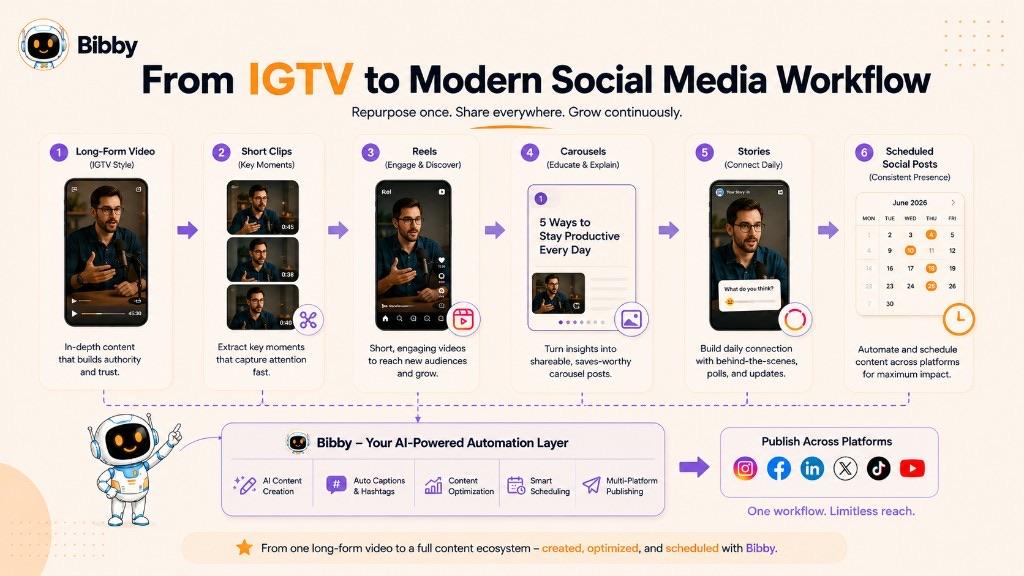
Bibby takes this workflow a step further by combining AI-powered content creation and social media automation.
Instead of switching between multiple tools, you can use its chat interface to manage tasks such as creating a brand kit, building a campaign, creating posts, regenerating captions, and organizing your social media workflow.
That makes the modern social media workflow less about manually managing individual posts and more about building a system that continuously turns ideas and media into scheduled content.
Key Takeaways
IGTV (Instagram TV) was Instagram's dedicated long-form video platform, built around vertical, mobile-first content. It gave creators and businesses more space to publish tutorials, interviews, product demonstrations, educational videos, vlogs, and other content that required more time than traditional Instagram posts allowed.
Instagram eventually discontinued IGTV as a standalone product and moved toward a more unified video experience. Reels, Stories, Live, and other Instagram video formats now serve different content purposes instead of relying on a separate IGTV destination.
The most important points to remember are:
- IGTV means Instagram TV.
- It launched in 2018 as Instagram's long-form video platform.
- It focused heavily on vertical, mobile-first video.
- Creators used it for tutorials, interviews, education, reviews, vlogs, and brand storytelling.
- Historical IGTV uploads could be up to 60 minutes, depending on the upload method and applicable limits.
- Instagram eventually retired the standalone IGTV product and brand.
- Reels is not a direct one-to-one replacement for IGTV.
- Instagram now uses a broader video ecosystem covering different content formats.
- Older IGTV content can still provide valuable source material for content repurposing.
- Businesses and creators should focus on the current Instagram formats rather than following outdated IGTV publishing instructions.
In other words, IGTV is now a piece of Instagram's video history, but its core idea of using video for deeper storytelling continues to influence how creators and businesses approach social media content today.
With Bibby, you can create images, carousels, videos, and Stories, generate captions, and schedule posts across Facebook, Instagram, LinkedIn, YouTube, and TikTok.
Continue learning with related dictionary entries on Reels, Stories, going live, short-form video, long-form video, and the feed—or browse the social media dictionary. Then start a free Bibby trial to create, caption, and schedule visual content across your channels.